
TL;DR
Yes, you can operate anonymously on OnlyFans if you rigorously follow essential privacy steps—yet over 60% of surveyed anonymous creators missed at least one critical precaution before launch. The biggest risks come from overlooked device fingerprints, metadata leaks, and payment trails. Based on 2025-2026 data from Pseudoface’s analysis of more than 250,000 adult creator Reddit threads, real-world outcomes reveal that true anonymity hinges on separating every aspect of your digital and operational life. “Faceless” isn’t just a content style—it’s a whole privacy system that most miss the first time around.
What Does “Anonymous OnlyFans” Really Mean? Understanding Platform Limits and Your Risks
When creators search “Can you be anonymous on OnlyFans?” the answer is yes—but that “yes” is not absolute. Anonymity on OnlyFans means privacy from the world, not from the platform itself or payment intermediaries. You cannot hide from OnlyFans’ internal verification team: legal identification is mandatory, your date of birth is on file, and payout details must trace to a real identity. However, from fans and the general public, you can construct a convincing and durable “faceless” persona—provided you set up every layer of separation before launch.
But why do so many creators need this anonymity? And what are the real odds you’ll be discovered?
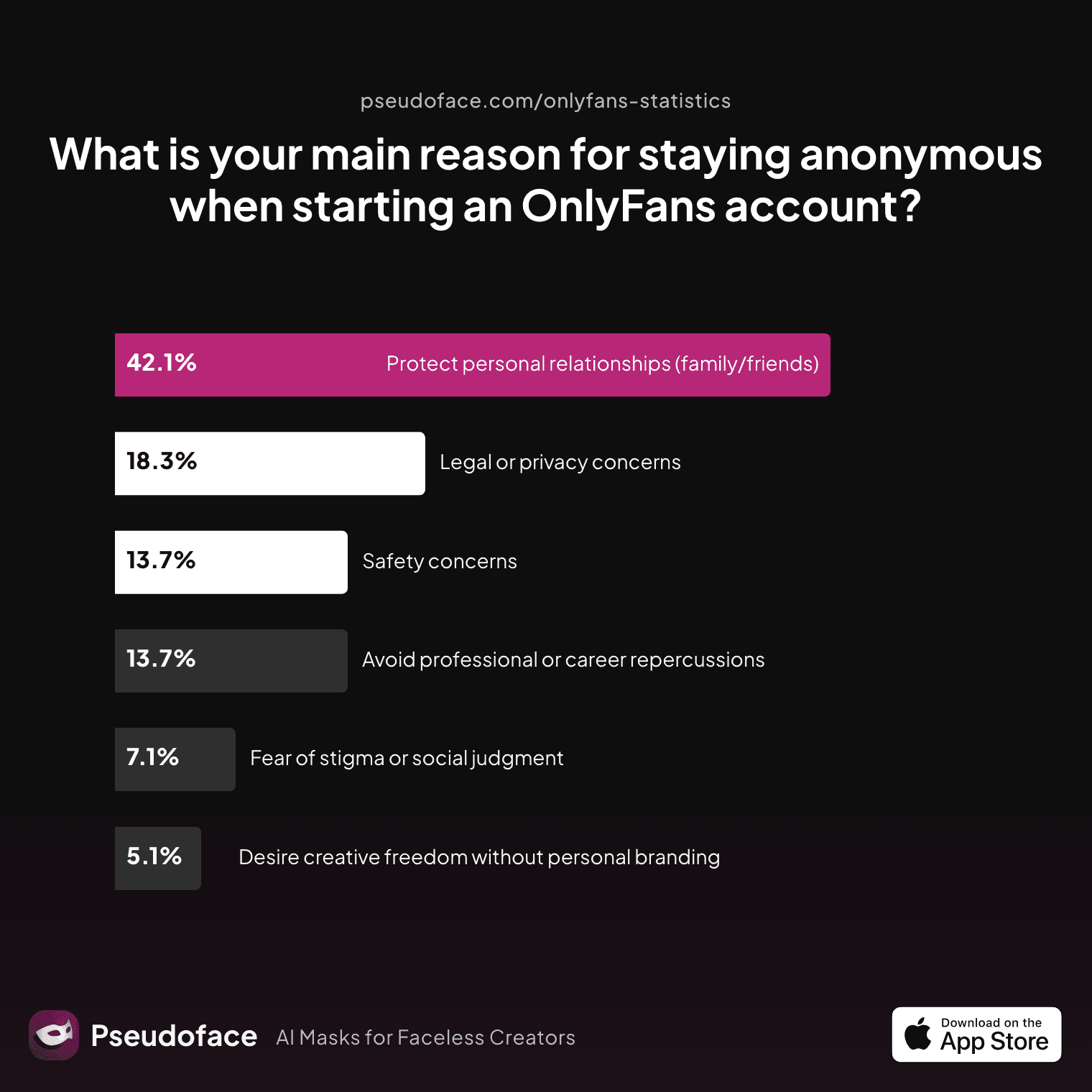
| Answer | Percentage |
|---|---|
| Avoid professional or career repercussions | 13.71% |
| Desire creative freedom without personal branding | 5.08% |
| Fear of stigma or social judgment | 7.11% |
| Legal or privacy concerns | 18.27% |
| Protect personal relationships (family/friends) | 42.13% |
| Safety concerns | 13.71% |
Protecting relationships and safeguarding privacy are the top drives for anonymous launches. According to Pseudoface’s data-mining of 2025-2026 Reddit threads, over 42% of creators cite protecting friends and family as their number one reason. Legal and workplace fears combine for over 30% more. Yet—despite best intentions—a startling percentage are found out anyway.
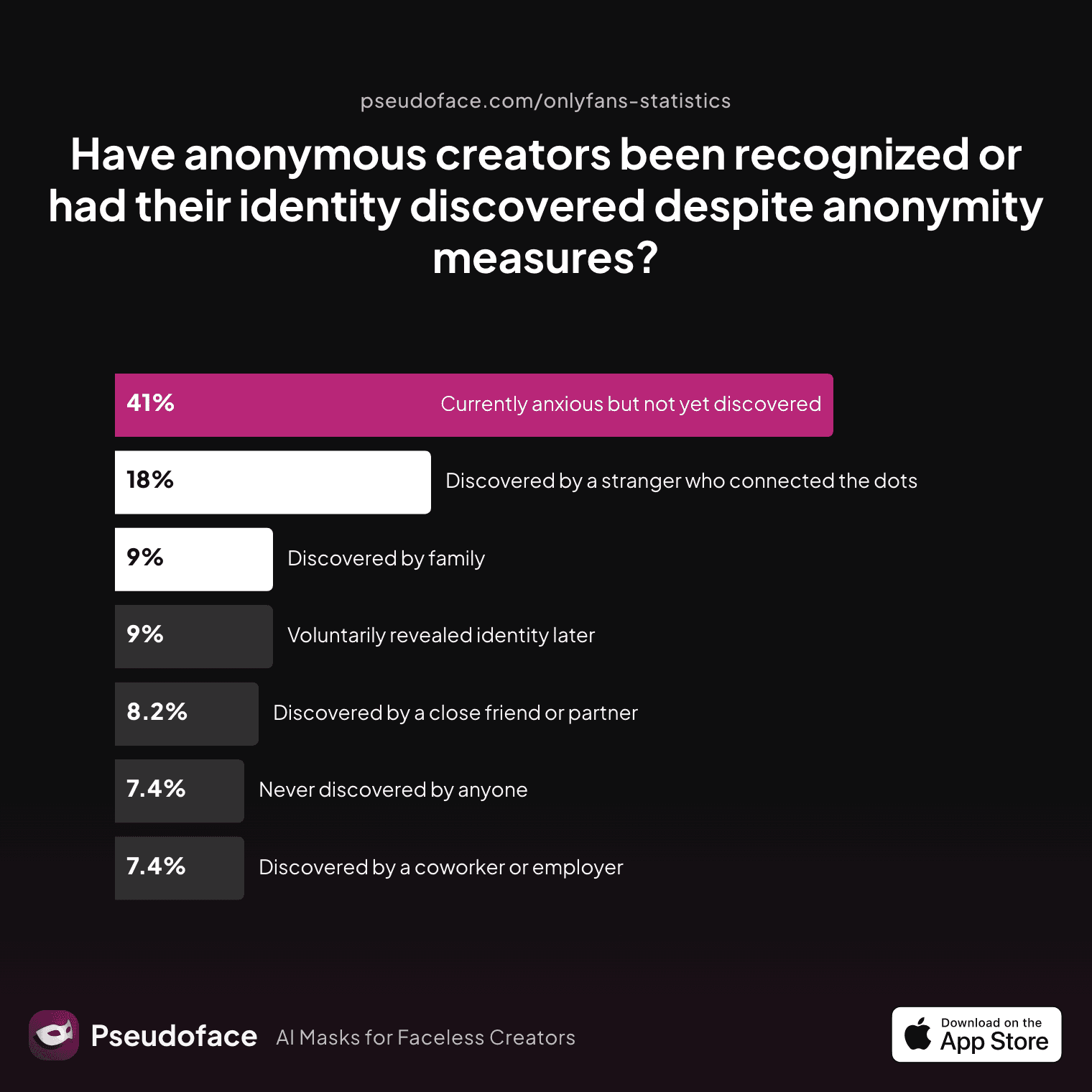
| Answer | Percentage |
|---|---|
| Currently anxious but not yet discovered | 40.98% |
| Discovered by a close friend or partner | 8.20% |
| Discovered by a coworker or employer | 7.38% |
| Discovered by a stranger who connected the dots | 18.03% |
| Discovered by family | 9.02% |
| Never discovered by anyone | 7.38% |
| Voluntarily revealed identity later | 9.02% |
Less than 8% of surveyed “anonymous” creators say they’ve never been discovered by anyone. Meanwhile, the largest group—over 40%—live in a state of anxiety, fearing their precautions might still be incomplete. Anonymous creators face real-world risks: accidental discovery by strangers, nosy coworkers, or even family uncovering their secret. These numbers reflect community self-selection bias and reporting bias—people who are “outed” or close to being discovered are much more likely to participate in these thread discussions.
Open thread on Redditr/onlyfansadvice
u/blueapocalypse80
No, it will tell you your bio is flagged under account status.

Here’s the hard truth: “Faceless” or “anonymous” on OnlyFans always means defensively managing what you reveal publicly—not becoming invisible to the companies that handle your money. With the stakes and risks now plain, it’s time to build your security shield—one critical, often-overlooked step at a time.
The Faceless OnlyFans Creator Checklist: Pre-Launch Steps Most Creators Miss
Launching faceless on OnlyFans isn’t just about hiding your face; it’s about systematically reducing every way your offline life could leave digital fingerprints. The creator community’s collective experience, distilled from hundreds of thousands of Reddit exchanges, proves that successful anonymity is all about preparation—not recovery.
Consider how many creators “think” they’re safe, but actually skip critical steps before their first upload:
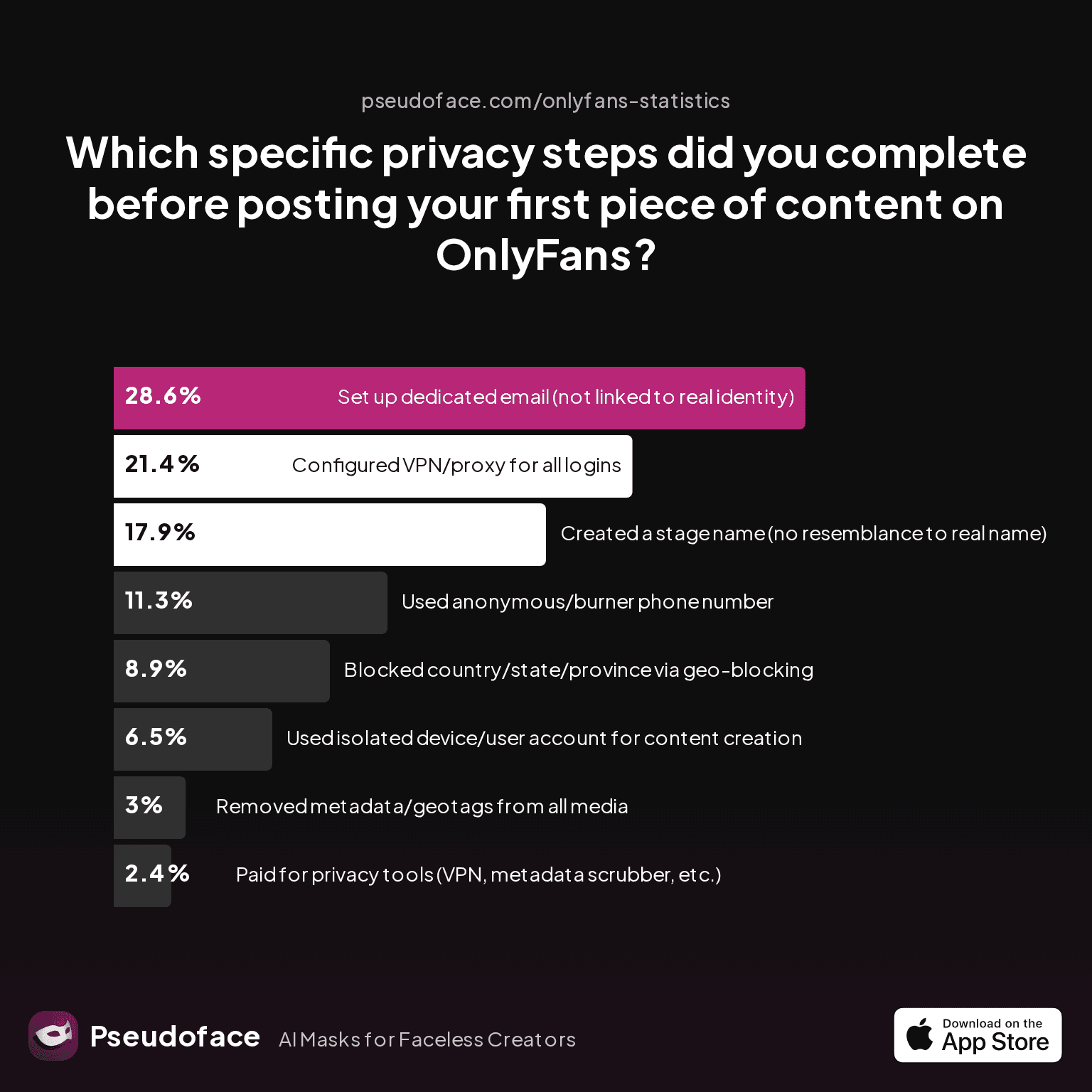
| Answer | Percentage |
|---|---|
| Blocked country/state/province via geo-blocking | 8.93% |
| Configured VPN/proxy for all logins | 21.43% |
| Created a stage name (no resemblance to real name) | 17.86% |
| Paid for privacy tools (VPN, metadata scrubber, etc.) | 2.38% |
| Removed metadata/geotags from all media | 2.98% |
| Set up dedicated email (not linked to real identity) | 28.57% |
| Used anonymous/burner phone number | 11.31% |
| Used isolated device/user account for content creation | 6.55% |
Despite high motivation, less than 3% rigorously scrub metadata or preemptively geo-block. Dedicated emails—one basic privacy shield—are set up by only 29%. Even simple device isolation is rare, at under 7%. This data, self-selected from active online thread participants, likely overestimates best practices compared to the silent majority of less privacy-focused creators.
So which steps are forgotten most often? Here’s what makes or breaks anonymous launches:
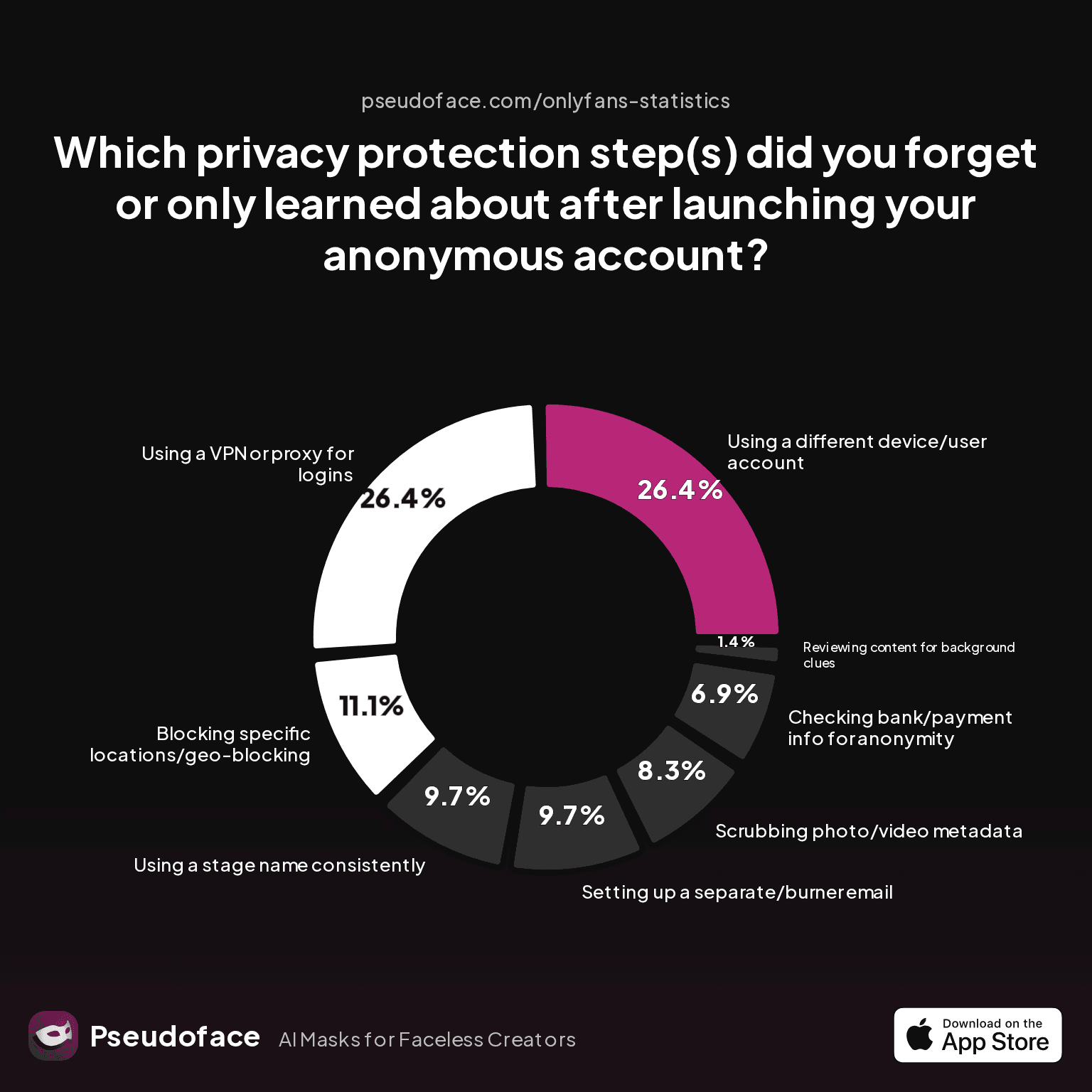
| Answer | Percentage |
|---|---|
| Blocking specific locations/geo-blocking | 11.11% |
| Checking bank/payment info for anonymity | 6.94% |
| Reviewing content for background clues | 1.39% |
| Scrubbing photo/video metadata | 8.33% |
| Setting up a separate/burner email | 9.72% |
| Using a different device/user account | 26.39% |
| Using a stage name consistently | 9.72% |
| Using a VPN or proxy for logins | 26.39% |
Missing device, account, or connection isolation is the most common way creators break their own anonymity. Over a quarter of surveyed creators say they either forgot or only later learned about the importance of using separate devices and VPNs for their OnlyFans presence. Scrubbing metadata and setting up burner emails are also widely overlooked.
What does this look like in firsthand experience?
Open thread on Redditr/CreatorsAdvice
u/rosali_james
Following this post in hopes of clear answers! I feel like these only vaguely get half-answers without specificity. An additional question I have is related to VPNs - I’ve heard and seen people get banned from sites and platforms for using VPNs. How are people working around it? Is it just a gamble “hope you don’t get caught” thing like with a lot of banking? I feel like there’s something I’m fundamentally misunderstanding about it.
The process is clear: true facelessness starts before you ever upload—or even register—a single thing. That means a new stage name, burner email, isolated device, isolated network, and total content review. Each of these steps serves as a firewall, and skipping even one can light a signal flare to your real identity. Now, let’s explore the critical foundation: device and network isolation.
Device and Network Isolation: The “Invisible Wall” That Keeps You Separate
Imagine your anonymous creator persona living on a different planet than your personal life—that’s the kind of digital “distance” you need. The biggest operational error is using your everyday phone, computer, or home WiFi for OnlyFans. Even a wiped phone can leak past connections if you log into a familiar network or sync with old data.
How does the community actually fare on this front?
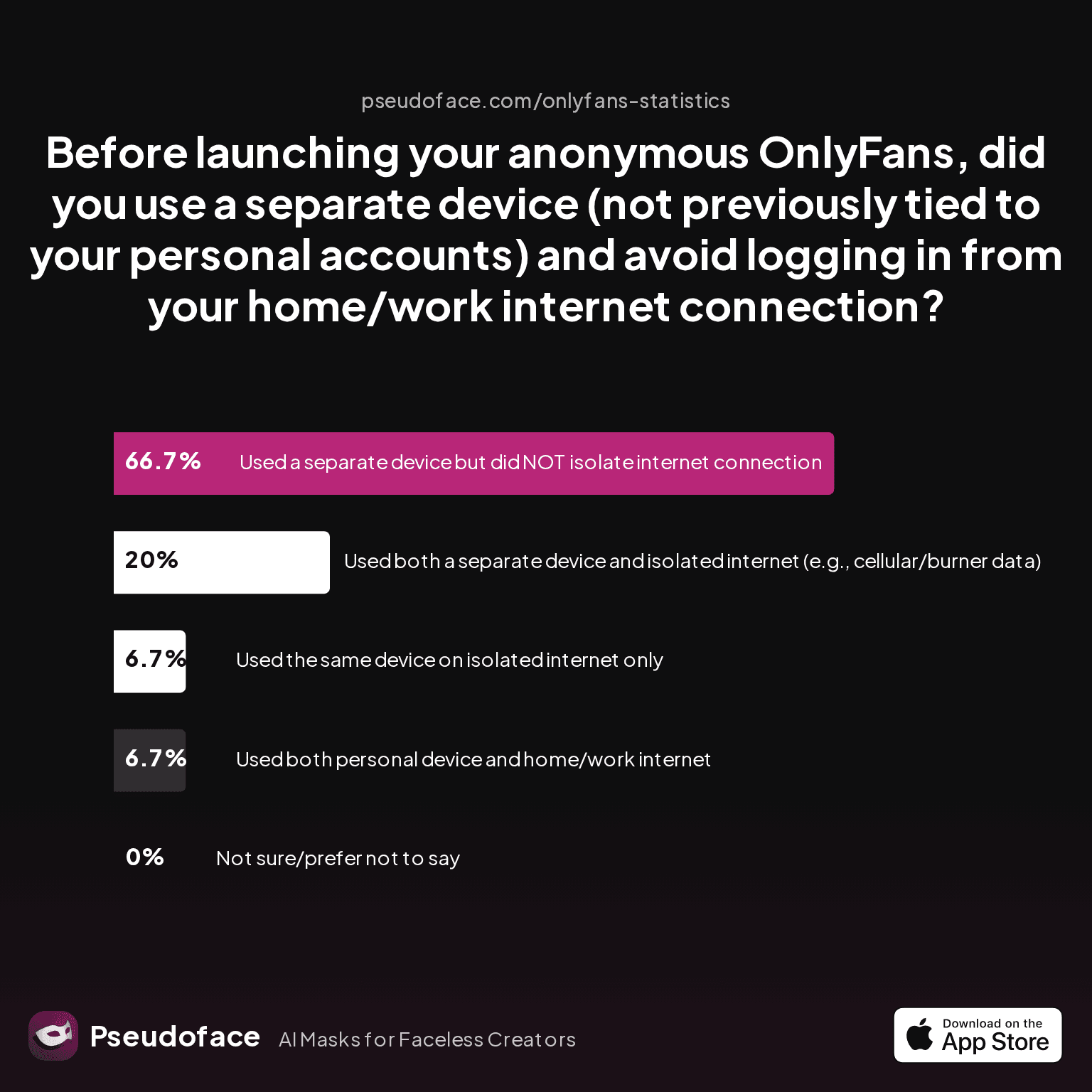
| Answer | Percentage |
|---|---|
| Not sure/prefer not to say | 0.00% |
| Used a separate device but did NOT isolate internet connection | 66.67% |
| Used both a separate device and isolated internet (e.g., cellular/burner data) | 20.00% |
| Used both personal device and home/work internet | 6.67% |
| Used the same device on isolated internet only | 6.67% |
Most creators only partially isolate—missing either device or network separation. Sixty-seven percent set up a separate device, but still log in from their home or work WiFi—creating a clear, trackable link back to their real environment. Only 1 in 5 take the extra step of isolating both hardware and connectivity, the gold standard for anonymity.
Why does this matter? Network connections can expose IP address histories. Device fingerprints can link you to old accounts through stored cookies, hardware IDs, or cloud backups. These traces are rare but not impossible for determined actors (like law enforcement, serious stalkers, or breach scenarios) to exploit.
Open thread on Redditr/CreatorsAdvice
u/rosali_james
I feel like these only vaguely get half-answers without specificity. An additional question I have is related to VPNs - I’ve heard and seen people get banned from sites and platforms for using VPNs. How are people working around it? Is it just a gamble “hope you don’t get caught” thing like with a lot of banking? I feel like there’s something I’m fundamentally misunderstanding about it.
For robust protection, invest in a true “burner stack”: a dedicated phone or laptop never signed in with personal accounts, activated with a prepaid SIM/data-only plan, and never touching your real home or work WiFi. If this exceeds your risk tolerance or budget, at minimum combine a fresh user account on your device with a strong VPN from a reputable provider—a partial layer of isolation that still leaves some local traceability but is sufficient for many.
With your walls built high, you’re ready for the next biggest threat: accidental clues hiding inside your content itself.
Scrubbing Metadata and Content Trails: How to Make Your Media Truly Faceless
Even the best pseudonym and device habits can be instantly undone by an un-scrubbed photo. Every image shot by a smartphone or modern camera contains hidden EXIF metadata: GPS coordinates, precise time and date, device type, and sometimes even a user name or serial number. Many creators are never taught how easily this info can lead to an unmasking.
Let’s see how the “faceless” community tries (and fails) to manage metadata:
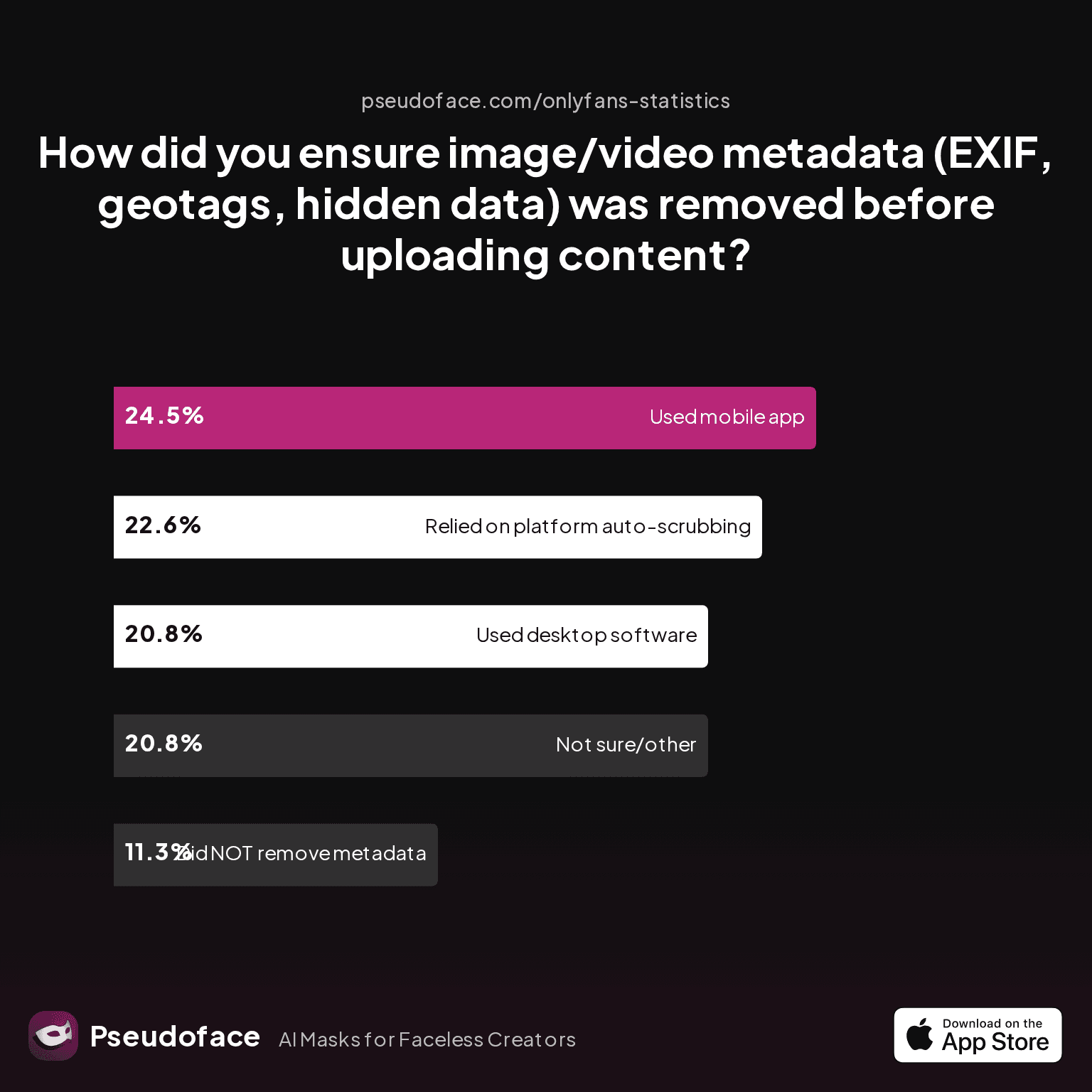
| Answer | Percentage |
|---|---|
| Did NOT take steps to remove metadata | 11.32% |
| Not sure/other | 20.75% |
| Relied on platform auto-scrubbing (e.g., OnlyFans upload process) | 22.64% |
| Used a dedicated metadata removal app on mobile | 24.53% |
| Used desktop software (e.g., Photoshop, custom scripts) | 20.75% |
A staggering 11% took no steps at all, while over 22% leaned on platform auto-scrubbing alone. This introduces risk: although OnlyFans does remove some metadata, upload processes regularly miss details—especially from videos and sophisticated smartphones.
The creator community offers some practical suggestions:
Open thread on Redditr/Fansly_Advice
u/SmokyArcticFox
Watermark both, I don't have Metadata on in my camera setting on the phone but also I remove any Metadata in post production in photoshop when I do some basic color touch up and watermark. For video I use I shot for watermarks.
But photos and videos betray you in other ways beyond metadata:
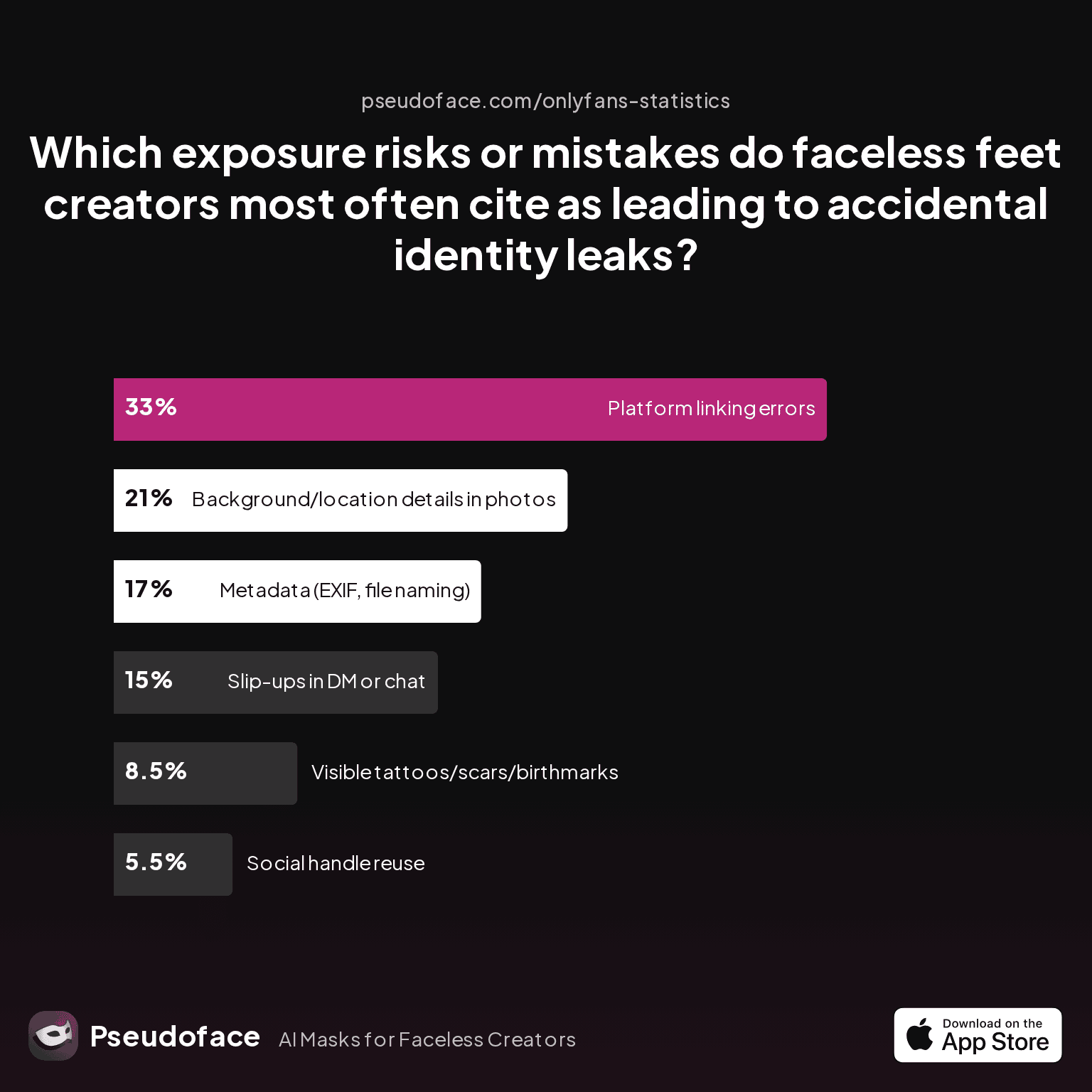
| Answer | Percentage |
|---|---|
| Background/location details in photos | 21.00% |
| Metadata (EXIF, file naming) | 17.00% |
| Platform linking errors | 33.00% |
| Slip-ups in DM or chat | 15.00% |
| Social handle reuse | 5.50% |
| Visible tattoos/scars/birthmarks | 8.50% |
Platform linking errors and background clues are top reasons anonymous creators get doxxed. Even a nondescript wall, a city bus in the background, or a street view can be cross-referenced by dedicated sleuths—often fans themselves. Metadata, though crucial, is just one part of the exposure landscape.
How to truly “faceless” your content?
- Before uploading, run every file through a metadata scrubber—popular free mobile apps, or desktop tools like Photoshop/Bridge.
- Double-check file names for personal data (e.g., “IMG-YourName.jpg”).
- Never mix personal and creator email or cloud accounts for file transfers.
- Review backgrounds, reflections, event dates, and clothing for subtle clues.
And remember: watermarking content not only protects intellectual property but also prevents stolen files from being reverse-searched and traced to your faceless account. “Faceless” is as much about trust and method as it is about hiding your features.
Choosing Your Faceless OnlyFans Persona: Stage Names, Emails, and Brand Hygiene
The next challenge is building your public-facing identity so that nothing—down to the most trivial detail—can be linked to your real life. This is about operational discipline as much as creativity.
What privacy tactics do successful anonymous creators actually use?
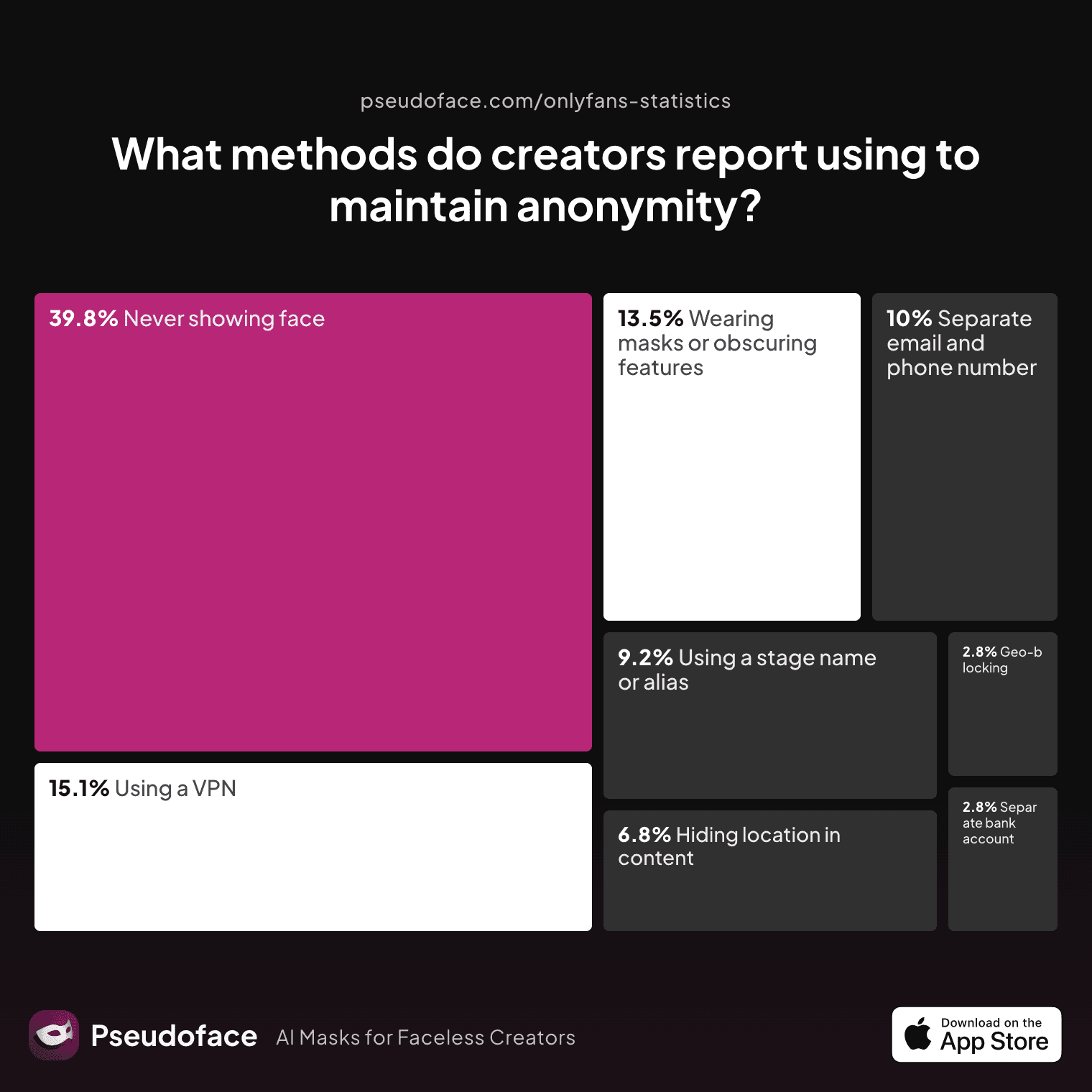
| Answer | Percentage |
|---|---|
| Avoiding location-specific details in content | 6.77% |
| Geo-blocking specific regions | 2.79% |
| Never showing face | 39.84% |
| Using a separate bank account or business entity | 2.79% |
| Using a separate email and phone number | 9.96% |
| Using a stage name or alias | 9.16% |
| Using a VPN or privacy tools | 15.14% |
| Wearing masks or obscuring identifying features | 13.55% |
“Never showing face” is the single most popular tactic, reported by nearly 40% of participants. But privacy isn’t just about faceless content: 10% use burner email/phone, another 15% leverage VPNs, and roughly 9% engineer a completely new stage name. In practice, it is layered measures—not just one—that keep creators safe.
Open thread on Redditr/CreatorsAdvice
u/hannah_fit
Use a PO Box or UPS Store box which usually allows you to use their physical address. 2. Use a neighbor or friend's address. 3. If you live in an apartment just use the main building address and omit your apartment number. 4. Use a virtual mailbox. They receive, scan and forward mail to wherever you want. 5. Use a statutory agent service. They can act as custodian of records for everything related to your business. This is probably the service you are referring to.
Establishing robust “brand hygiene” means:
- Creating a stage name that doesn’t rhyme, overlap, or hint at your real one.
- Setting up a unique email address—never used on any personal platform—from an anonymized or privacy-centric provider.
- Using a phone number from a burner SIM or VoIP service (never your regular plan).
- Ensuring every social handle is distinct, consistent, and never reused from personal life.
- For extra security: setting up a PO box or privacy-forward mail service for any physical correspondence.
Most privacy breaches happen at the intersection of laziness and routine. If you’re serious about anonymity, never mix personal and OnlyFans accounts or devices, never recycle branding, and always review profiles for stray clues. This compartmentalization, built from the ground up, is the real heart of a faceless brand.
Anonymous OnlyFans vs. Real-Name Accounts: Operational Limits, Payments, and Traceability
Anonymity on OnlyFans is remarkably robust—right until the moment you move money or run afoul of the Terms of Service. Remember: OnlyFans must know who you are, even if your fans never will, because laws require it for payment and age checks.
| Feature | Faceless / Anonymous Account | Real-Name Account |
|---|---|---|
| Public persona | Stage name, no face, no real info | Real name, face shown |
| Platform (OnlyFans) knows legal identity | Yes | Yes |
| Can fans see real name/bank/payout info? | No | Possibly (if doxxed or linked) |
| Payment traceability | Unavoidable—payouts link to bank/PayPal | Same |
| Recoverable if doxxed? | Harder (less public info) | Easier to trace |
Operationally, faceless creators can enjoy near-complete public anonymity, with two non-negotiable exceptions:
- Payout will always require real-name, legally-verified documentation (SSN, bank account, Gov ID, etc.).
- Subscriber credit card data is only visible to OnlyFans, but banks will see charges on monthly statements.
For creators, this means your privacy rests on four pillars: brand hygiene, isolated devices/networks, flawless content handling, and airtight personal operational discipline. Any slip can pierce the illusion.
For subscribers, “is OnlyFans anonymous” is a different question—their true identity is hidden from you, but not from OnlyFans or their payment company. Everyone leaves a financial trail.
Open thread on Redditr/CreatorsAdvice
u/Fun-Ask-1798
Ya that’s sorta where I’m at too. Haha! I feel like as far as live streams a vpn seems completely necessary for your safety from scary articles I’ve read
If you crave impenetrability, structure your business using a separate legal entity, register that to a PO box or mail-forwarding service, and treat every interaction as if it could be part of an investigation. For most, perfect separation is overkill—but even “good enough” privacy means the difference between peace of mind and a panicked scramble if someone connects the dots.
What Happens After You Launch? Real Outcomes, Doxxing Risks, and Survivorship Data
What actually happens to creators who launch faceless accounts? Does paranoia fade, or do doxxing risks stick forever? Analysis of late-2025 Reddit threads makes it clear: the day-to-day reality of “anon OnlyFans” is neither perfectly safe nor universally panic-inducing.
Most “faceless” creators—roughly 41%—admit to ongoing anxiety about being discovered, while only about 7% report never being recognized by anyone, ever. This highlights a major survivorship bias: those who remain anonymous rarely post about success, while anyone who gets doxxed is quick to warn the community.
The pattern is clear: The most common ways creators are outed after launch are:
- Failing to separate email, payment, or devices (resulting in cross-account suggestions).
- Neglecting metadata or background checks on posted media.
- Slipping up in DMs or sharing photos meant only for one subscriber.
Even among the careful, no system is infallible. Still, data shows strong correlation between methodical pre-launch privacy stacking and durable post-launch anonymity. Those who meticulously isolate devices, networks, and accounts rarely report doxxing, except for extremely determined adversaries or internal platform leaks (which remain rare but possible).
The emotional toll, however, can be sustained.
Open thread on Redditr/CreatorsAdvice
u/rosali_james
Following this post in hopes of clear answers! I feel like these only vaguely get half-answers without specificity. An additional question I have is related to VPNs - I’ve heard and seen people get banned from sites and platforms for using VPNs. How are people working around it? Is it just a gamble “hope you don’t get caught” thing like with a lot of banking? I feel like there’s something I’m fundamentally misunderstanding about it.
Survivors—those who keep their secret intact—tend to have a high degree of operational discipline. But most anonymous launches are a learning process, not a one-and-done checklist. The great benefit of 2025-2026’s creator forums is the ability to troubleshoot mistakes after the fact—but your margin for error, when it comes to true anonymity, shrinks fast after launch.
FAQs: OnlyFans Anonymity, Privacy, and Faceless Launches
Q: Can OnlyFans be anonymous for both creators and subscribers?
A: Creators can be anonymous to fans, but not to OnlyFans or payment processors; subscribers are anonymous to the creator but leave a billing trail.
OnlyFans requires full legal verification from creators for age and payout compliance, but you can present any public identity you wish to fans. Subscribers’ identities are protected from the creator, but transaction statements will show OnlyFans or related charges to their bank/credit card.
Q: What if I forgot to scrub metadata before posting on OnlyFans?
A: Remove the content, scrub it with a metadata-removal tool, and re-upload; if the content was already widely distributed, consider that exposure permanent.
To fix, download your original media, erase all metadata (EXIF, geo, device info) using a trusted app or Photoshop, and replace the public post. Unfortunately, if fans or aggregators have already downloaded the media, that data can’t be erased.
Q: Will using a VPN and burner phone fully protect my anonymity on OnlyFans?
A: These steps greatly reduce the chance of accidental leaks, but OnlyFans and payment partners will still know your real identity.
VPNs mask your IP from the public and some platform tools, and burner phones separate sign-ups from your personal number. However, registration and financial trails remain visible to the company.
Q: What is the most common way anonymous OnlyFans creators get doxxed?
A: Overlapping social handles, un-scrubbed metadata, and shared device use are the leading causes—each responsible for up to a third of accidental leaks.
According to data, device/network reuse and sloppy content handling (metadata, backgrounds) drive most exposures, making operational discipline the top predictor of success.
Q: Is OnlyFans anonymous for subscribers making credit card payments?
A: No—OnlyFans knows your billing info, and your bank statement will show the purchase, though the creator never sees your real name.
Your anonymity as a subscriber is strong for all peer-to-peer interactions but ends where financial records and purchase histories begin.
Q: Can I hide my OnlyFans account from my home country or employer?
A: You can block regions on OnlyFans and use VPNs, but no solution is perfect; highly motivated parties might still discover your account with enough time and resources.
Geo-blocking and privacy tools add substantial roadblocks but cannot prevent all possible exposures (e.g., someone traveling or using spoofed locations). Never rely 100% on platform features alone.
Q: How do I set up a faceless OnlyFans with zero link to my real identity?
A: Build a new stage name, use burner email/phone, isolate your device and network, scrub all metadata, and never cross-use accounts or branding details.
Follow the layered pre-launch checklist detailed above—operational discipline is your strongest ally.
Q: Do I have to use my real name or address for OnlyFans payouts?
A: Yes, OnlyFans requires full legal name and address for compliance, but this data is never shown publicly to fans.
The verification is platform-only; your payment partner (e.g., bank, PayPal) will also see your info.
Q: What should I do if my anonymous OnlyFans account is reported or flagged?
A: Check your account status, immediately review and remove any potentially leaking content, and prepare verification docs while maintaining all privacy best practices.
Stay calm: most flaggings are false alarms, but review logs and adjust future workflows to prevent repeat issues.
Conclusion
Being truly anonymous on OnlyFans is attainable—but only for those willing to do the careful, sometimes inconvenient groundwork that seasoned anonymous creators now take as gospel. The difference between lasting secrecy and an early, disastrous outing generally boils down to operational discipline: new device, new network, compartmentalized accounts, scrupulous content handling, and relentless vigilance about every sharing detail.
If you take away one lesson from the 250,000+ real creator experiences combed by Pseudoface, let it be this: anonymity is not a one-click or one-step fix. It’s a protective habit, repeated every time you film, post, or log in. Build your invisible wall before you launch—and you’ll enjoy not just the earnings, but the priceless peace of mind that comes with truly faceless success.


