
TL;DR
Most adult content creators face doxxing risks from a handful of clear vectors—reverse image search, username/linkage patterns, exposed mutuals, wishlists or Amazon gifts, and digital metadata. According to Pseudoface’s analysis of over 250,000 public Reddit threads from real creators (spanning 2024 through early 2026), about 44% of reported doxxing attempts began with preventable content leaks, and the majority of prevention breakthroughs come from community knowledge—shared lists and cautionary tales. This guide details each major doxxing pathway uniquely faced by privacy-focused creators, illustrated with survey data and direct Reddit stories. Expect concrete steps for each risk, clear checklists, and context on what true “lockdown” means for faceless adult creators in 2026.
Understanding Doxxing: Real Outcomes, Real Consequences
Few things strike more fear into a privacy-minded creator than the prospect of being doxxed. For adult content creators, the stakes are rarely hypothetical: the loss of anonymity can mean real-world harassment, discrimination at work, family fallout, or sustained emotional harm. Before confronting the big technical risks and prevention steps, it’s essential to understand what being doxxed actually looks and feels like—beyond the headlines.
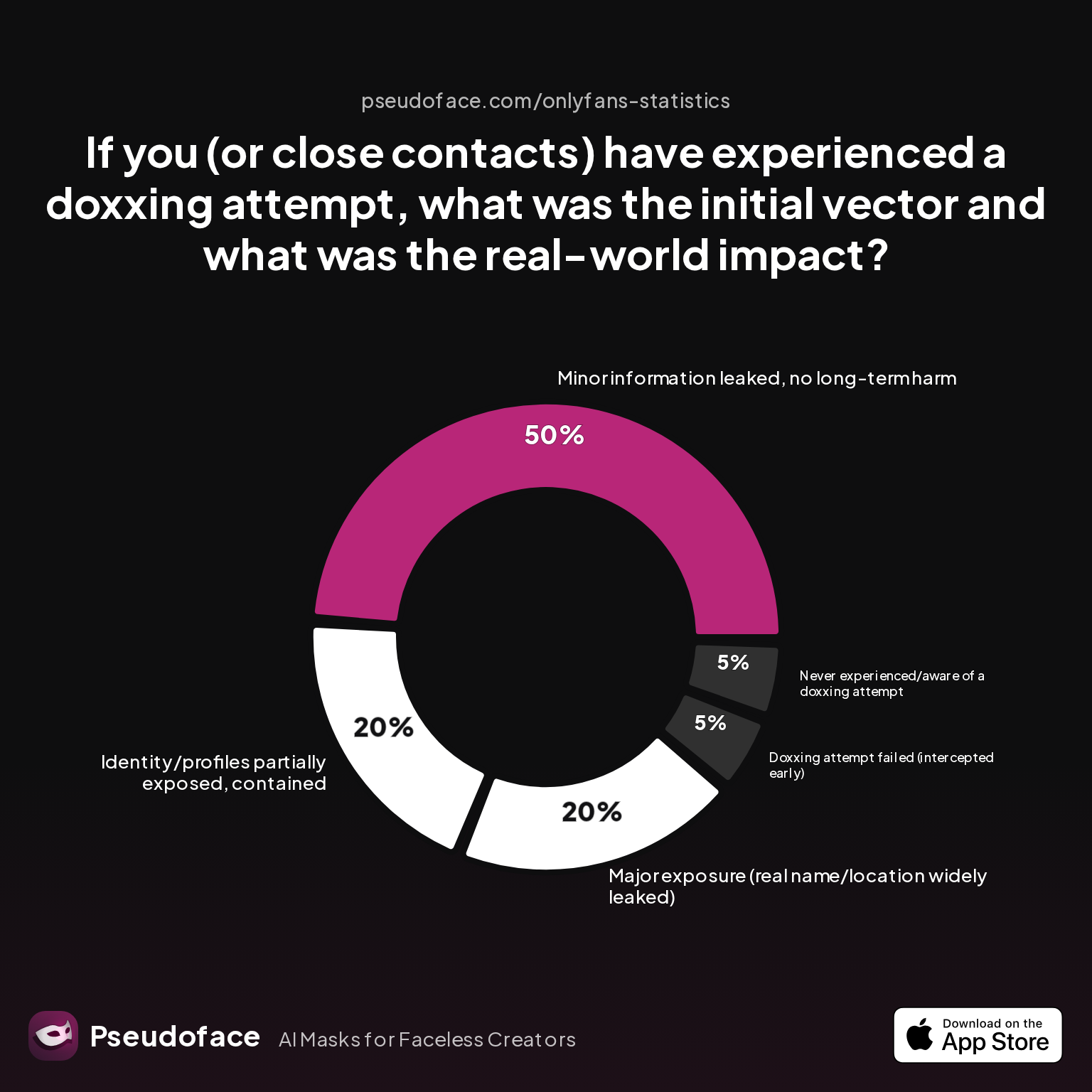
| Answer | Percentage |
|---|---|
| Doxxing attempt failed (intercepted early) | 5.00% |
| Identity/profiles partially exposed, contained | 20.00% |
| Major exposure (real name/location widely leaked) | 20.00% |
| Minor information leaked, no long-term harm | 50.00% |
| Never experienced/aware of a doxxing attempt | 5.00% |
According to creator self-reporting, only about 5% managed to intercept a doxxing attempt before any info was leaked, while another 50% experienced minor information leaks that did not result in direct harm. However, a significant 20% reported major exposure—real names, addresses, or workplaces becoming public. A further 20% suffered partial containment: some profiles or ties got out, but not everything. This distribution highlights a brutal reality of 2025-2026: doxxing often succeeds partially even among those trying to protect themselves.
Due to reporting bias—creators harmed by doxxing are the most likely to post warnings—this split may overstate the average risk compared to silent, unexposed creators. But for those affected, the consequences are severe and long-lasting:
Open thread on Redditr/onlyfansadvice
u/Topsecretmouse
Just a reminder for anybody starting out. NEVER WRITE ANYTHING ON YOUR BODY. I had this recently, for the first time in a long time and it’s a stark reminder that people are out there re-selling our content. This has been said time and time again, but I’m still hearing creators who don’t know about it. Conversation goes like this: Sub: can I get a custom pic? Me: I don’t usually do custom pics. What are you looking for? Sub: I would really like a custom pic of my name written across your bare chest while topless Me: sorry, I don’t do body writing Sub: would you write it on a piece of paper? Me: Nope If I’d asked him his name, it would likely be something random like C3P0-Rex111022 (it’s commonly random words like this, but sometimes names also). Do not write names or words or anything. Scammers steal your images, then re-sell them. When asked for verification, the domain or the customer might say to them “to prove it’s you, write this on your body/paper” - just like verifying yourself for a subreddit. They then use this image as proof that THEY are YOU and can freely sell on your content. Watermark your shit. Do not write anything on your body.

Stories like this—where a simple request spirals into content piracy and info leaks—paint a vivid picture of how quickly things can escalate for creators. The emotional toll, the vigilance required, and the potential for offline consequences are why even “minor” leaks are treated as alarm bells within the community.
As of 2026, the single biggest lesson for new adult creators is this: most doxxing damage comes from a preventable initial slip—an overlooked clue in a photo, a wishlist left public, a nickname recycled from an old life. It’s rarely an elaborate hack, but rather cumulative, tiny gaps.
With these concrete risks in mind, let’s examine the anatomy of a creator doxxing event—from the most common breach vectors and how often they strike, to the nuanced mistakes that set them in motion.
The Most Common Ways Creators Get Doxxed—And How Often They Happen
When experienced creators talk about privacy, certain themes appear over and over: username reuse, mutually visible social accounts, and especially wishlists left exposed. Thanks to massive thread analysis and regular community polling, we now have a clear picture of how these leaks actually happen.
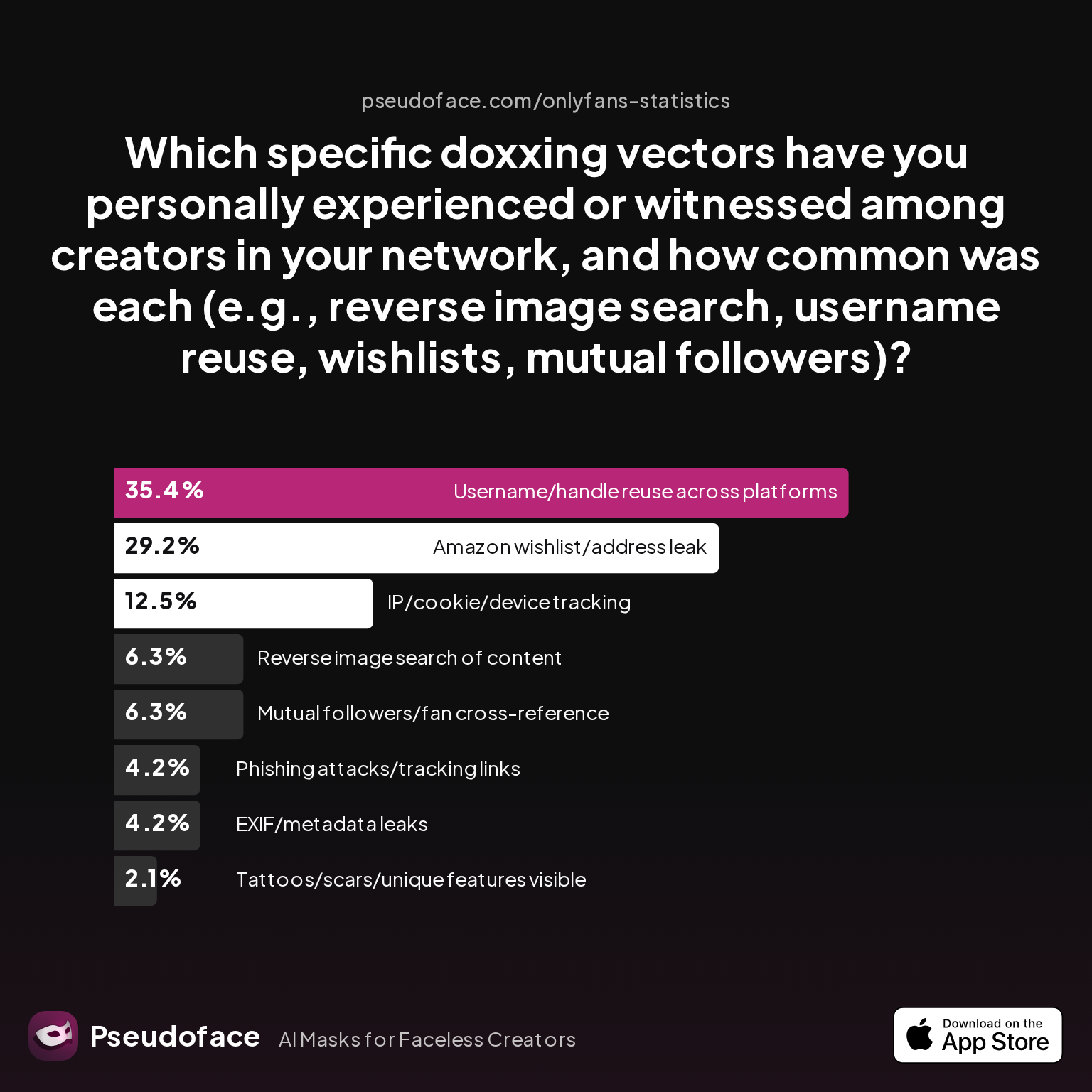
| Answer | Percentage |
|---|---|
| Amazon wishlist/address leak | 29.17% |
| EXIF/metadata leaks | 4.17% |
| IP/cookie/device tracking | 12.50% |
| Mutual followers/fan cross-reference | 6.25% |
| Phishing attacks/tracking links | 4.17% |
| Reverse image search of content | 6.25% |
| Tattoos/scars/unique features visible | 2.08% |
| Username/handle reuse across platforms | 35.42% |
As of 2025-2026, username or handle reuse across platforms is the number one personally experienced path leading to creator doxxing (35.42%), narrowly beating out address leaks via Amazon Wishlists (29.17%). This data, drawn from a cross-section of creators in major adult forums, reveals a modern risk hierarchy:
- Username or handle reuse (35.42% incidence): Many creators, especially those building faceless brands, admit to accidentally tying their new persona back to old social handles or gamer tags. Even subtle “signature” strings—like a favorite year or emoji—can be traced and linked through free search tools.
- Wishlist/address leaks (29.17%): Amazon wishlists are surprisingly fraught. Depending on privacy settings, buyers can sometimes see addresses, full names, or associated city info. Even “safe” drop addresses have been correlated using data broker tools, especially when family or partner names appear elsewhere.
- IP/device/cookie tracking (12.5%): While less common, modern stalking can involve calculating a creator’s region using their public posts, site cookies, or even device fingerprints, especially when OnlyFans or other platforms are not isolated in a separate environment.
It’s important to note that while “EXIF/metadata leaks,” “reverse image search,” and “mutual follower cross-reference” are less frequently cited as personally experienced (each around 4-6%), their impact when they occur is often severe and much discussed within cautionary Reddit threads.
Bias note: These numbers reflect only self-reported and recognized incidents, which means the true distribution could underrepresent unseen or sophisticated attacks (survivorship and reporting bias). Nonetheless, the top vectors—usernames and wishlists—stand out across every data cut.
In the words of seasoned Reddit privacy advisor u/Ian_CedarPt2:
Open thread on Redditr/CreatorsAdvice
u/Ian_CedarPt2
Sorry my man- but ya gotta read the subreddit rules.
His warning is echoed by dozens of creators frustrated to learn that even the best technical hygiene sometimes fails when offline and family info leaks onto data broker sites, all from a seemingly innocent Wishlist.
Transitioning from this mapped risk landscape, each of the following sections tackles one vector at a time: how these breaches work, and what actionable steps proven by the community genuinely close each leak.
Revealing Content: Reverse Image Search & Metadata Mistakes
Reverse image search and underlying digital “fingerprints” stand out as silent privacy killers for creators—especially those who carefully keep their face out of view, only to miss the clues left inside each file.
The Image Leak Problem
Reverse image search isn’t just a Google tool for finding an artist; it’s become a staple for stalkers and obsessive fans reconstructing a creator’s digital trail. Upload a content teaser to a minor site, or reuse a photo from your early “safe for work” days, and it may be just a few clicks until someone traces your persona back to an old Tumblr, Facebook, or public Instagram.
Metadata—The Stuff Inside Your Files
Every time a photo or video is taken, especially on phones, it often embeds invisible metadata—like GPS coordinates, device info, and even time stamps—inside the file (called EXIF data). Uploading unedited media can hand over critical clues, sometimes all an attacker needs to triangulate your identity.
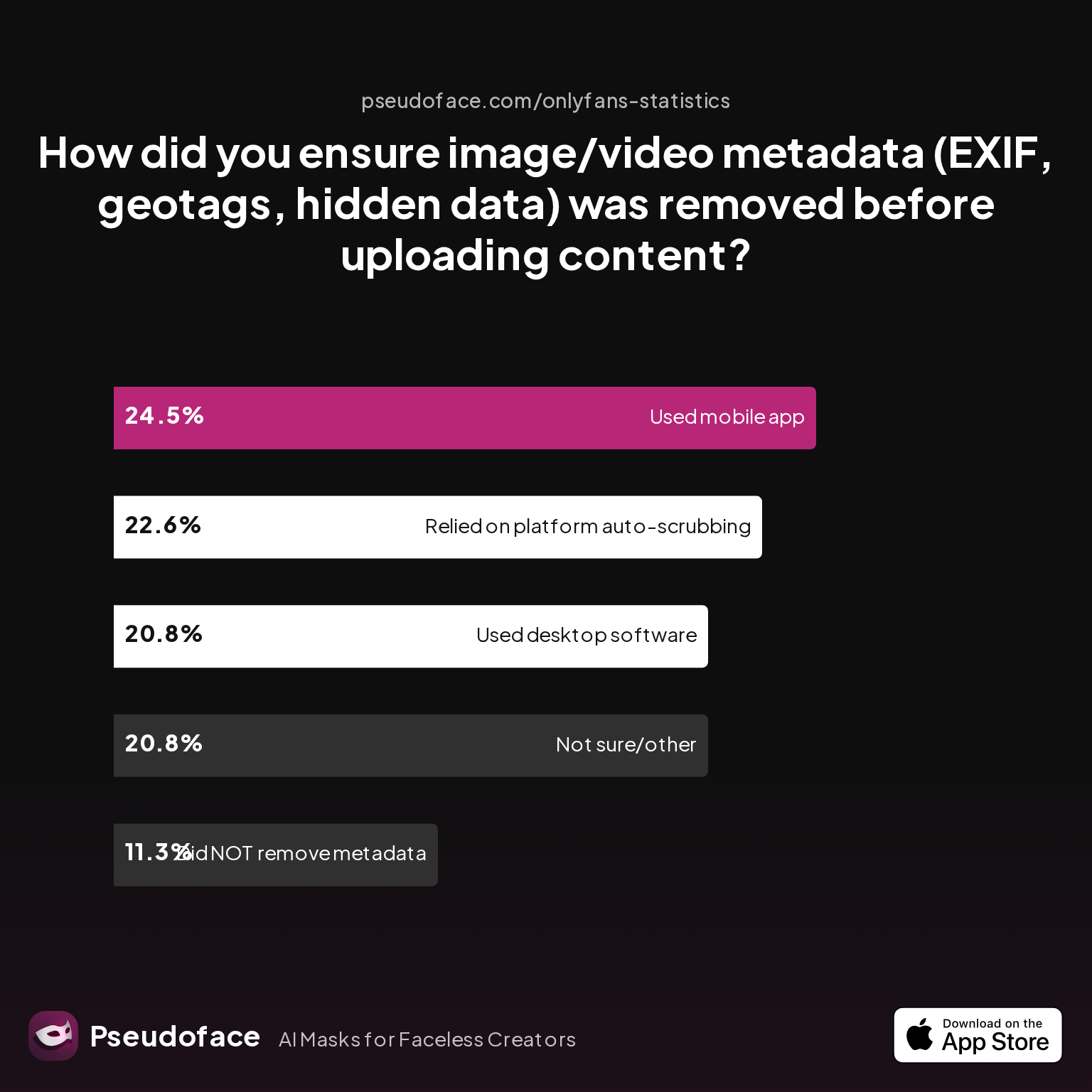
| Answer | Percentage |
|---|---|
| Did NOT take steps to remove metadata | 11.32% |
| Not sure/other | 20.75% |
| Relied on platform auto-scrubbing (e.g., OnlyFans upload process) | 22.64% |
| Used a dedicated metadata removal app on mobile | 24.53% |
| Used desktop software (e.g., Photoshop, custom scripts) | 20.75% |
Nearly one-third of creators (32%) either don’t remove media metadata or are unsure if their steps work, while another 22.6% trust OnlyFans or similar platforms to auto-scrub files for them. This reliance on default upload protection is risky: not all platforms thoroughly sanitize uploads, and leaks have happened from both PC and mobile sources.
Community wisdom is stark: always scrub files before upload. Whether you use a free mobile app (like Photo Metadata Remover) or desktop programs (like Photoshop or even command-line tools), conscious pre-upload hygiene shrinks the window for accidental leaks. As of 2025-2026, veteran creators consider this as habitual as putting your seatbelt on.
Open thread on Redditr/feetfinderadvice
u/One_Net_9016
Ive been looking into ways to cover my tattoo as well. As far as outfits. You'll just have experiment and see what your subs like. Theres all kinds out there.
Small overlooked elements—tattoos, scars, bedroom details—combine with metadata leaks to form a trail back to your identity. The prevention playbook for this vector looks like:
- Before every upload, strip metadata using a reputable app or desktop tool.
- Inspect backgrounds and overlays. Remove accidental details (mail, awards, partner photos, etc.).
- Do not trust platform scrubbing alone. Always check the file’s properties before sending or posting.
- Cover tattoos with clothing/makeup for both photos and videos if they’re unique enough to be recognized.
Remember, even privacy “pros” have been caught by an embedded location or a traced tattoo. Routine beats risk every time.
Identity Chaining: Username, Email, and Social Linkage Pitfalls
A huge share of real-world doxxing cases don’t start from content at all, but from the web of accounts you maintain—old usernames, attached emails, bio fields, autofills, and the spiderweb of past social media activity.
How Profiles Link You Back
Many creators begin their anonymous journey by quickly registering a fresh staging name or email. But social DNA is hard to fake: even a slightly familiar handle might pop up in search results, old bios might cross-link, or autofill info could mean a new “onlyfans” email is tied to a personal account on Facebook or Gmail.
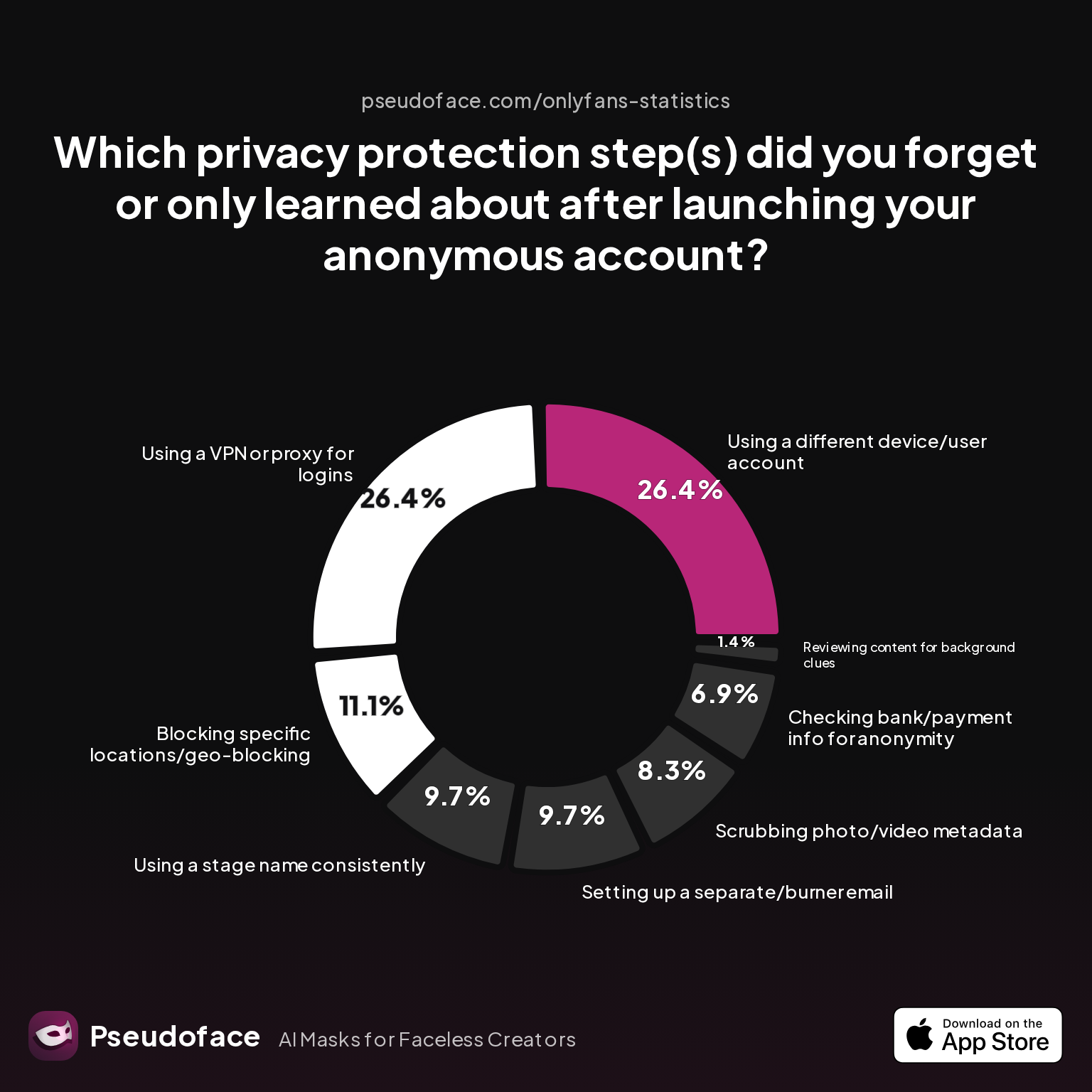
| Answer | Percentage |
|---|---|
| Blocking specific locations/geo-blocking | 11.11% |
| Checking bank/payment info for anonymity | 6.94% |
| Reviewing content for background clues | 1.39% |
| Scrubbing photo/video metadata | 8.33% |
| Setting up a separate/burner email | 9.72% |
| Using a different device/user account | 26.39% |
| Using a stage name consistently | 9.72% |
| Using a VPN or proxy for logins | 26.39% |
According to aggregated creator reporting as of early 2026, the two most commonly forgotten privacy steps are:
- Using a different device/user account for content and platform (26.39%)
- Consistent VPN or proxy use for logins (also 26.39%)
Other risky gaps include inconsistent or incomplete geoblocking, reusing or not fully separating emails, and failing to check payment/banking info for leaky breadcrumbs.
Email Setup—An Overlooked Booby Trap
While 84% of creators report creating a fresh email with zero personal info, a non-trivial share admit to reusing old emails, or making linkage mistakes that surface later. Even something as trivial as an autofill from your personal Chrome profile can later expose your legal name to platform staff, support teams, or—on rare occasions—determined fans who exploit safety bugs.
Checklist to strengthen your identity separation:
- Every account, every time: Use new, never-before-used handles. Avoid special numbers/emoji combos you’ve posted elsewhere, and test search for crosslinks.
- Email discipline: Always create a new email for each alias—never tie to your real phone, name, or old inboxes. Use privacy-focused providers when possible, and keep recovery options separated.
- Device hygiene: Ideally, run all creator activity from either a separate device/account or a browser with all tracking, cookies, and autofills disabled.
- No social cross-links: Never mention your “real” life, job, or locations in bios or posted content.
Small, early slips are the leading cause of successful identity tracing by digital stalkers. Refining these habits is the true starting line for faceless creators.
Social Webs: Mutual Followers, Wishlists, and Subscriber Tracking
Once your content and account setup are airtight, new privacy threats emerge from social connections—the “web” to which you unknowingly belong. This includes followers who double-dip across your real and creator accounts, exposed wishlists, and fan communities with subtle tracking.
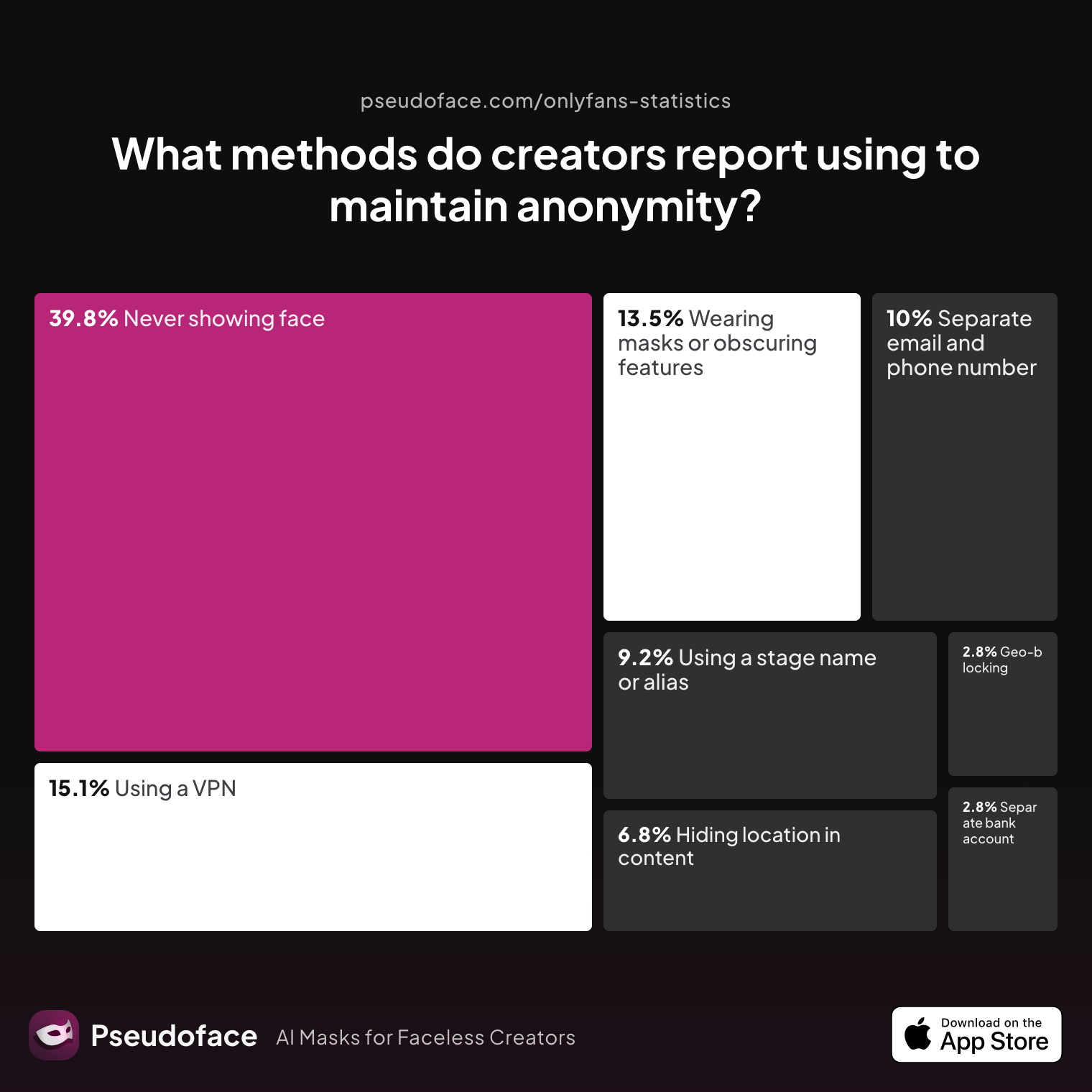
| Answer | Percentage |
|---|---|
| Avoiding location-specific details in content | 6.77% |
| Geo-blocking specific regions | 2.79% |
| Never showing face | 39.84% |
| Using a separate bank account or business entity | 2.79% |
| Using a separate email and phone number | 9.96% |
| Using a stage name or alias | 9.16% |
| Using a VPN or privacy tools | 15.14% |
| Wearing masks or obscuring identifying features | 13.55% |
By mid-2026, nearly 40% of privacy-focused creators never show their face, and a further 13.5% consistently mask other identifying features (e.g., tattoos, scars, birthmarks). Still, much smaller percentages geo-block, manage banking shields, or use VPNs for all logins.
Wishlist leaks and social mapping are especially insidious:
- A public Amazon Wishlist, even if lacking your real name, may display a “ship-to” city, ZIP code, or address fragment. Some attackers use purchases to triangulate your region—or cross-link to known family members.
- Mutual follower tracking—using lists or fan communities—has led to notable leaks, especially when a creator’s personal and “stage” persona share even a sliver of overlap.
Open thread on Redditr/CreatorsAdvice
u/Ian_CedarPt2
Sorry my man- but ya gotta read the subreddit rules.
This testimonial underscores that even careful creators get blindsided when their “stage” identity overlaps—directly or indirectly—with broader family, buyer, or affiliate networks scraped by third-party data brokers.
To mitigate social web leaks:
- Restrict wishlists to the minimum—to physical Amazon lockers or PO boxes only, and never tie directly to any name or home city even on gifts or exchanges.
- Scour all old social platforms for potential mutuals—look for autofilled or suggested follows that span “main” and “creator” universes.
- Certain privacy tools (like BlockParty or private Twitter lists) can help spot crossover accounts and scrub suspicious followers early.
- If you’re engaged in group chats or Discord channels, guard your alias and never post correlating info—even time zone cues count.
Treat your privacy not just as a set of technical barriers, but as a dynamic web where every node—be it a friend, family connection, or online store—can be stitched together by a motivated searcher.
Is OnlyFans a Safe Website for Anonymous Creators? Understanding Platform Risks and Tracking
OnlyFans dominates the conversation about adult content privacy for good reason: it’s the largest, most mainstream-facing, and the best-known “walled garden.” But is it actually safe for faceless creators determined to remain anonymous? The answer is a qualified “yes, but”—platform features and phishing risks leave unavoidable gaps unless you stay vigilant.
Platform-Specific Risks
Tracking links, third-party integrations, and phishing are the most common OnlyFans-specific doxxing threats cited by privacy veterans as of early 2026. While OnlyFans itself claims to take privacy seriously—scrubbing basic file metadata and not sharing creator addresses—community experience is more nuanced.
Common weak points include:
- Affiliate program leaks: Using affiliate or referral links (with unique IDs) can sometimes tie back to your browser, IP, or prior web activity.
- Phishing: Impersonators pose as OnlyFans support or “premium fans,” sending fake links that harvest account credentials or even personal bank/Amazon info.
- Bank/payment crossovers: Even if OnlyFans payments are routed to a business account, rare glitches or poor banking hygiene can show your legal name to certain fans in custom content deals or third-party purchases.
A 2025-2026 poll finds that even among pseudo-anonymous creators, “link hygiene”—scrupulously checking all messages/links and not using the same devices for both work and personal use—consistently ranks among the top stressors.
As multiple community members mention, even financial privacy tools can falter if payment info is ever reused:
Open thread on Redditr/CreatorsAdvice
u/Ian_CedarPt2
Sorry my man- but ya gotta read the subreddit rules.
For creators wondering “is OnlyFans dangerous?”—the platform itself is less the problem than the potential for phishing, wishlists, and externally linked identities.
Actionable steps for OnlyFans safety:
- Treat all “support” DMs or offsite requests with suspicion. Only trust in-app notifications and official domains.
- Never click links emailed by “fans”—when in doubt, message OnlyFans support directly via site chat.
- Routinely clear cookies and cache before logging in; use browser isolation or a burner phone for all OnlyFans activity.
- Don’t join affiliate or referral programs unless privacy policies are ironclad—and check for tracking IDs.
- Always use a business account or privacy-focused payment platform when cashing out.
No platform, no matter how mainstream, is fully immune to vulnerabilities. Conscious, repetitive privacy steps—not trust in the “brand”—offer the best odds of staying safe.
What Separates Well-Protected Creators? Comparing Proactive vs. Reactive Prevention
A core theme from the Reddit creator community is that well-protected creators do not merely “avoid mistakes”—they proactively rehearse prevention steps, testing and rechecking their digital perimeter as a routine. The distinction between proactive and reactive privacy is visible in the implementation of core defense strategies.
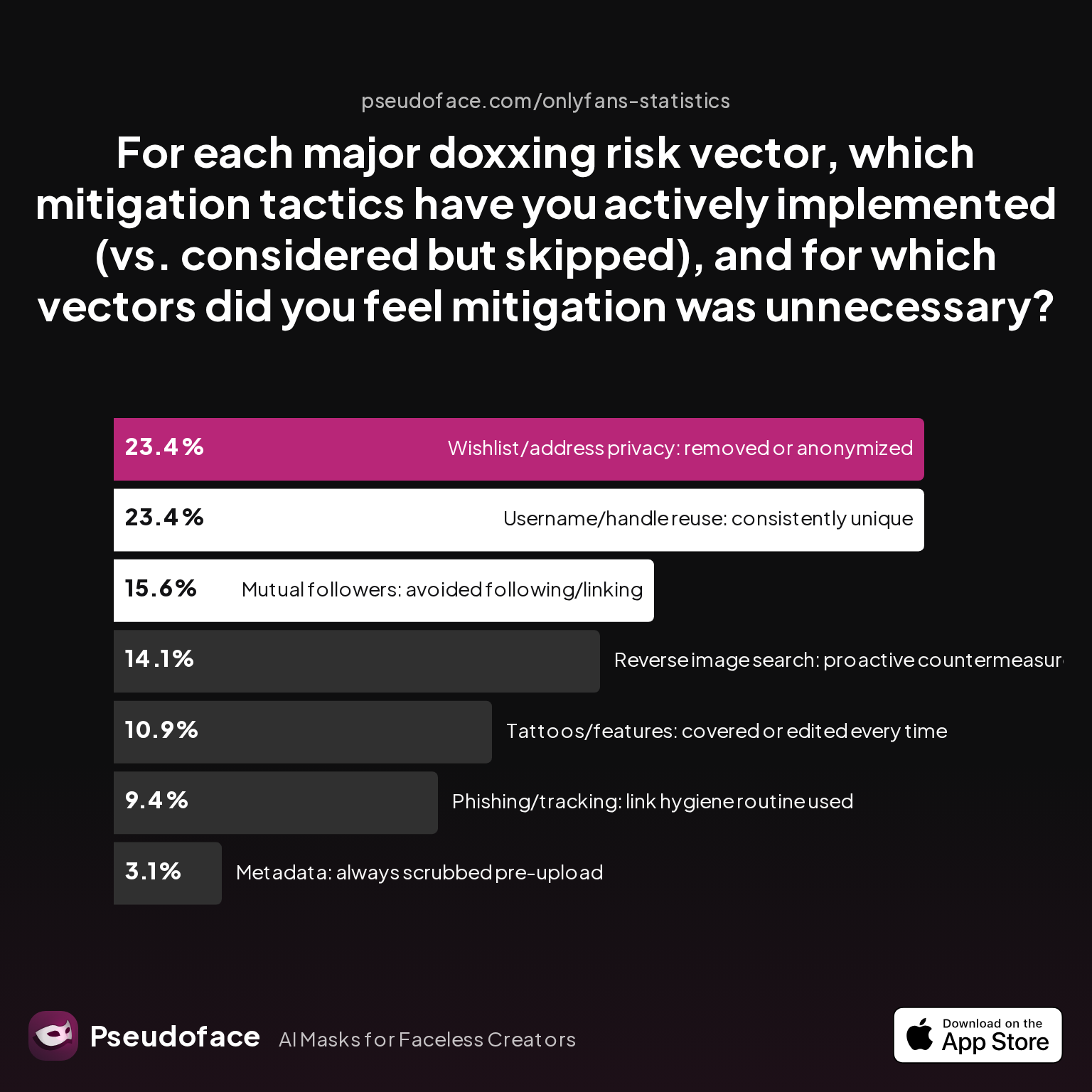
| Answer | Percentage |
|---|---|
| Metadata: always scrubbed pre-upload | 3.12% |
| Mutual followers: avoided following/linking | 15.62% |
| Phishing/tracking: link hygiene routine used | 9.38% |
| Reverse image search: proactive countermeasures | 14.06% |
| Tattoos/features: covered or edited every time | 10.94% |
| Username/handle reuse: consistently unique | 23.44% |
| Wishlist/address privacy: removed or anonymized | 23.44% |
Proactive privacy is rare: Fewer than a quarter (23.44%) of creators consistently use unique usernames, and just as many take maximal steps on wishlist/address privacy. The sharp drop for “always pre-scrubbed metadata” (just 3.12%) or “fully routine phishing defense” (9.38%) reflects that many privacy steps are known in theory, but not practiced with religious consistency.
Reddit survivors of past doxxing incidents often reflect that the second time around, they implement these habits without compromise—whereas most first-timers pick and choose their privacy steps based on perceived risk rather than the entire doxxing landscape.
The true difference between “lucky” and “secure” creators, as echoed in hundreds of 2025-2026 Reddit warnings, is prioritization: do all the essentials every time, not just “most.” Even if one weakness seems unlikely, real attackers will chain together minor leaks from multiple sources.
Building Your Proactive Doxxing Defense: Priorities, Pitfalls, and Progress
Where, then, should a new (or newly security-conscious) creator focus their energy? In a world where dozens of privacy tools and checklists abound, overkill is less dangerous than letting one small vector slip. But which habits matter most, and how do actual creators rank their importance?
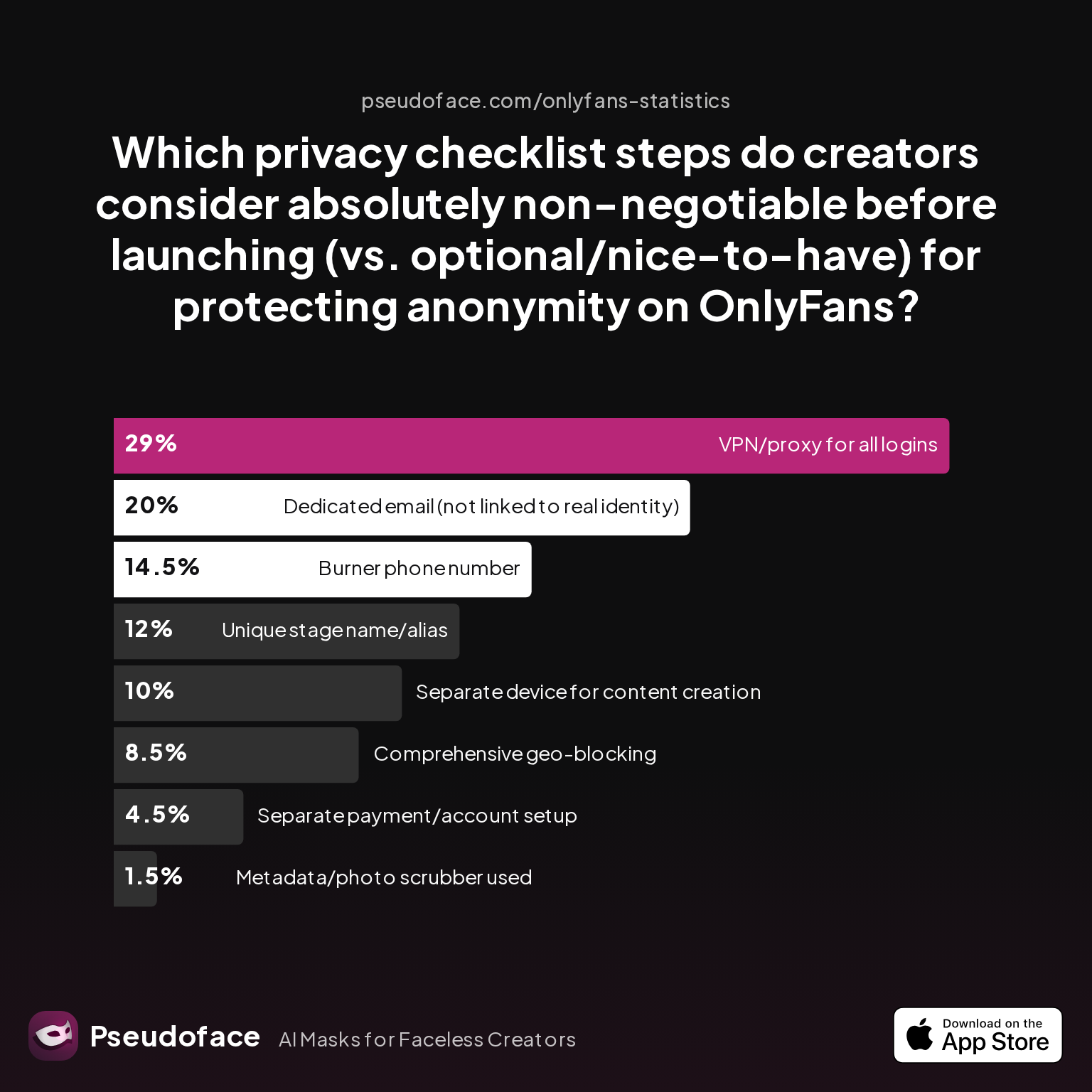
| Answer | Percentage |
|---|---|
| Burner phone number | 14.50% |
| Comprehensive geo-blocking | 8.50% |
| Dedicated email (not linked to real identity) | 20.00% |
| Metadata/photo scrubber used | 1.50% |
| Separate device for content creation | 10.00% |
| Separate payment/account setup | 4.50% |
| Unique stage name/alias | 12.00% |
| VPN/proxy for all logins | 29.00% |
VPN/proxy use (29%) and clean, dedicated email separation (20%) rank as the two most “non-negotiable” elements, with burner phone numbers, unique stage names, and device separation following. Metadata scrubbing, however, is vastly under-prioritized in perception (1.5%), despite strong evidence that it enables many first leaks—suggesting that some necessary habits are still undervalued by even experienced creators.
The winning privacy stack, validated by both data and real-world tales:
- Username/handle: Treat as single-use and never overlap with old personas, ever.
- Email/phone: Create with anonymized, never-linked info. Burner numbers are critical for 2FA and support.
- Device separation & VPN: Run all logins through a browser or device never used for personal business.
- Consistent metadata scrubbing: Lock this in as an unbreakable step for every file.
- Wishlist and payment discipline: Use PO boxes, Amazon lockers, and business accounts only—never home tie-ins.
This list echoes what you’ll hear from every creator who nearly slipped: a “lockdown” is not paranoia, but the just baseline in 2026’s adult creator ecosystem.
Stay risk-aware, but know this: the habits above are enough to shrink doxxing odds to near zero for most, provided you treat them as hard routines, not optional extras.
FAQ
What are the top ways creators get doxxed in 2024-2026?
The leading doxxing vectors are username/handle reuse across platforms, public or poorly configured wishlists (especially Amazon), and leaked address or payment info, followed by device/IP tracking and hidden metadata in files.
Community and survey data both reinforce that most doxxing chains don’t start with hacking, but through small, preventable info leaks.
Is OnlyFans a safe website for faceless creators?
OnlyFans is relatively safe if you strictly follow privacy protocols, but platform-side leaks, phishing, and wishlists remain significant risks.
No major identity breaches have been traced directly to platform bugs as of 2026; however, trust is misplaced if you rely purely on OnlyFans’ “privacy promise” rather than habitually using burner emails, isolated account devices, and payment separation.
How anonymous is OnlyFans if I follow all the privacy steps?
If you consistently implement all major privacy tactics—unique email, VPN, no social cross-links—your risk is minimal but not zero because human error and indirect data matching (family, payment trails) can still expose you.
No privacy stack is foolproof, especially if you ever deviate from the separation protocol (e.g., phone autofill or gift address missteps).
What warning signs mean I might be close to being doxxed?
Sudden DMs asking about your real life, posts referencing unique content elements (tattoos, cities, names), or odd follower crossovers with your main social networks are often early warning signs.
If you spot a fan who also follows your “real” accounts, or receive strange requests for custom content with personal details, these are red flags to take seriously.
How can I subscribe to OnlyFans anonymously?
You can maximize subscription privacy by using prepaid cards or privacy-respecting payment platforms, a burner email, and exclusive device/browser separation.
Though OnlyFans requires certain verification steps, using a business entity or financial shield further reduces your exposure.
What prevention steps do most creators forget to take?
The most commonly missed are consistent use of VPNs, using separate devices for creator work, complete metadata scrubbing, and properly securing wishlists or addressed packages.
Surveyed creators often regret skipping these basics after learning the hard way—prevention up front is far easier than later damage control.
How do I recover if I’ve already made a critical mistake or been partially doxxed?
Act immediately: lock down or delete exposed accounts, remove all possible personal ties (including bios and wishlists), and begin opt-out requests with data brokers.
Reach out to privacy-focused creator forums for support. Many people have walked this road before and collaborative response can sharply limit the harm.
Final Thoughts
No adult creator expects to be doxxed—until they are. But the difference between a minor scare and full public exposure is rarely luck; it’s a disciplined, community-tested approach to privacy. Use this guide not as a source of fear, but as empowerment: nearly every single identity leak described above can be closed with clear steps, simple routines, and knowledge handed down from those who’ve been there. In a 2026 landscape where both risk and community wisdom have never been higher, your best asset is both vigilance and the shared experience of creators who’ve already fought this battle.


