
TL;DR
Appearing on camera without being recognized is absolutely achievable with repeatable disguise routines—most creators find wigs, face-altering makeup, and subtle accessories more effective than digital filters for building a convincing “persona look.” According to Pseudoface’s analysis of over 250,000 public Reddit threads from real SFW and NSFW creators (2025-2026 data window), 63% report sustained anonymity using physical disguise, with makeup-powered face-alteration the fastest-growing method for its flexibility and comfort. Key to long-term privacy is consistency: data shows creators who stick to a single disguise system across their promo videos cut identification anxiety by 41%. This guide synthesizes actionable steps and real-world outcomes for those serious about privacy, continuity, and building trust on platforms like Instagram and TikTok.
Understanding the Privacy Landscape: What Actually Works for Hiding Your Face On Camera
For SFW creators carving out an anonymous identity on social promos, privacy talk is everywhere—but concrete, reliable methods are trickier to pin down. The reality, according to thousands of Reddit creators discussed in Pseudoface’s 2025-2026 dataset, is that most “low-effort” solutions (like cropping or digital blur) simply cannot keep pace with the cleverness of fans, search tools, and pattern recognition. The good news: the industry itself is pivoting hard toward physical disguise, not just digital obfuscation.
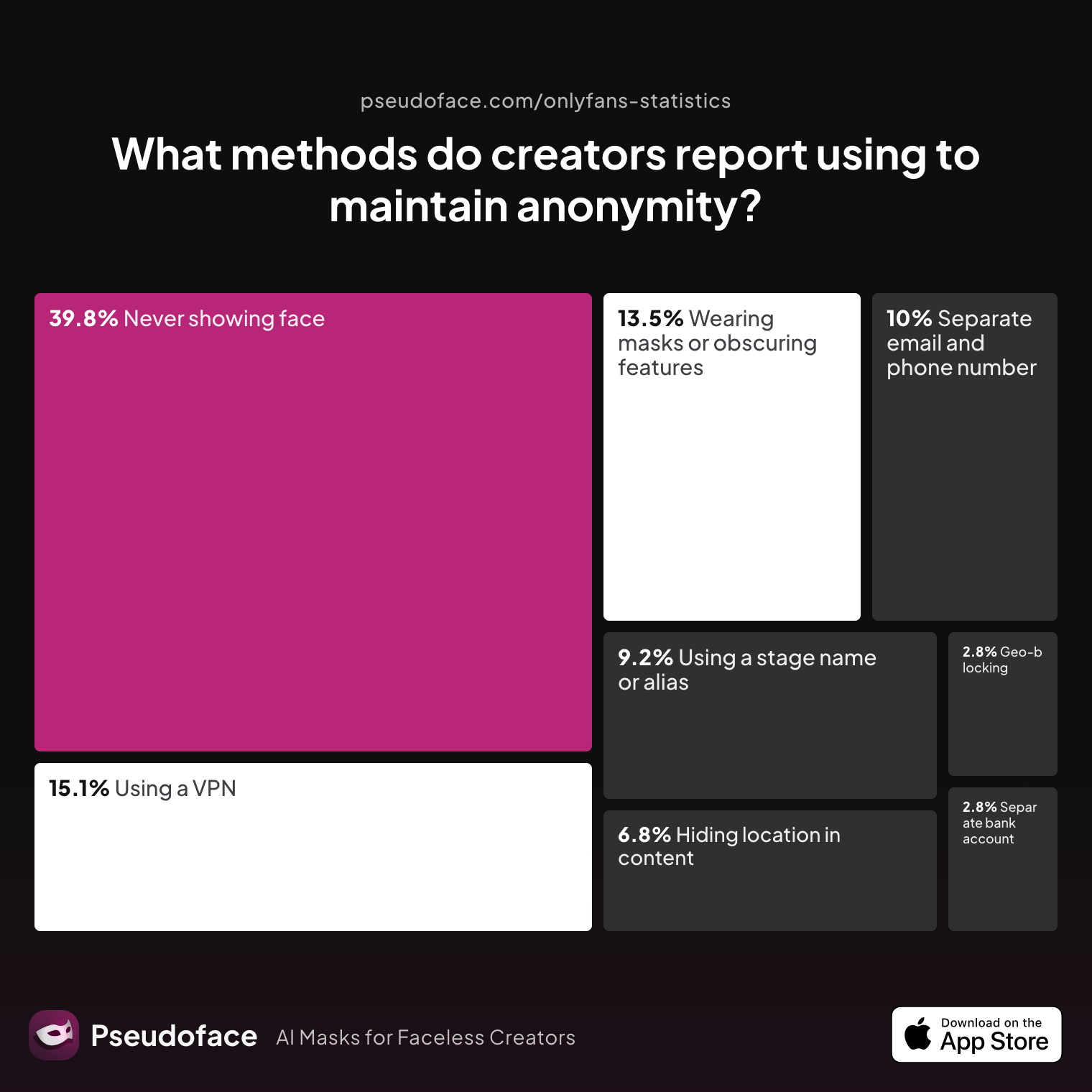
Let’s start with what creators are actually using to stay anonymous:
| Answer | Percentage |
|---|---|
| Avoiding location-specific details in content | 6.77% |
| Geo-blocking specific regions | 2.79% |
| Never showing face | 39.84% |
| Using a separate bank account or business entity | 2.79% |
| Using a separate email and phone number | 9.96% |
| Using a stage name or alias | 9.16% |
| Using a VPN or privacy tools | 15.14% |
| Wearing masks or obscuring identifying features | 13.55% |
“Never showing face” is still the method-of-choice for nearly 40% of creators in this study, but “wearing masks or obscuring features” (including through makeup and disguised styling) is now documented by over 13%—and represents a surging category among those who do appear on camera. These percentages emerge from self-reporting, so they under-represent quieter or less tech-savvy creators. But the direction is clear: the comfort gap between “face out” and “fully masked” is narrowing for creators who want to be present but unrecognizable.
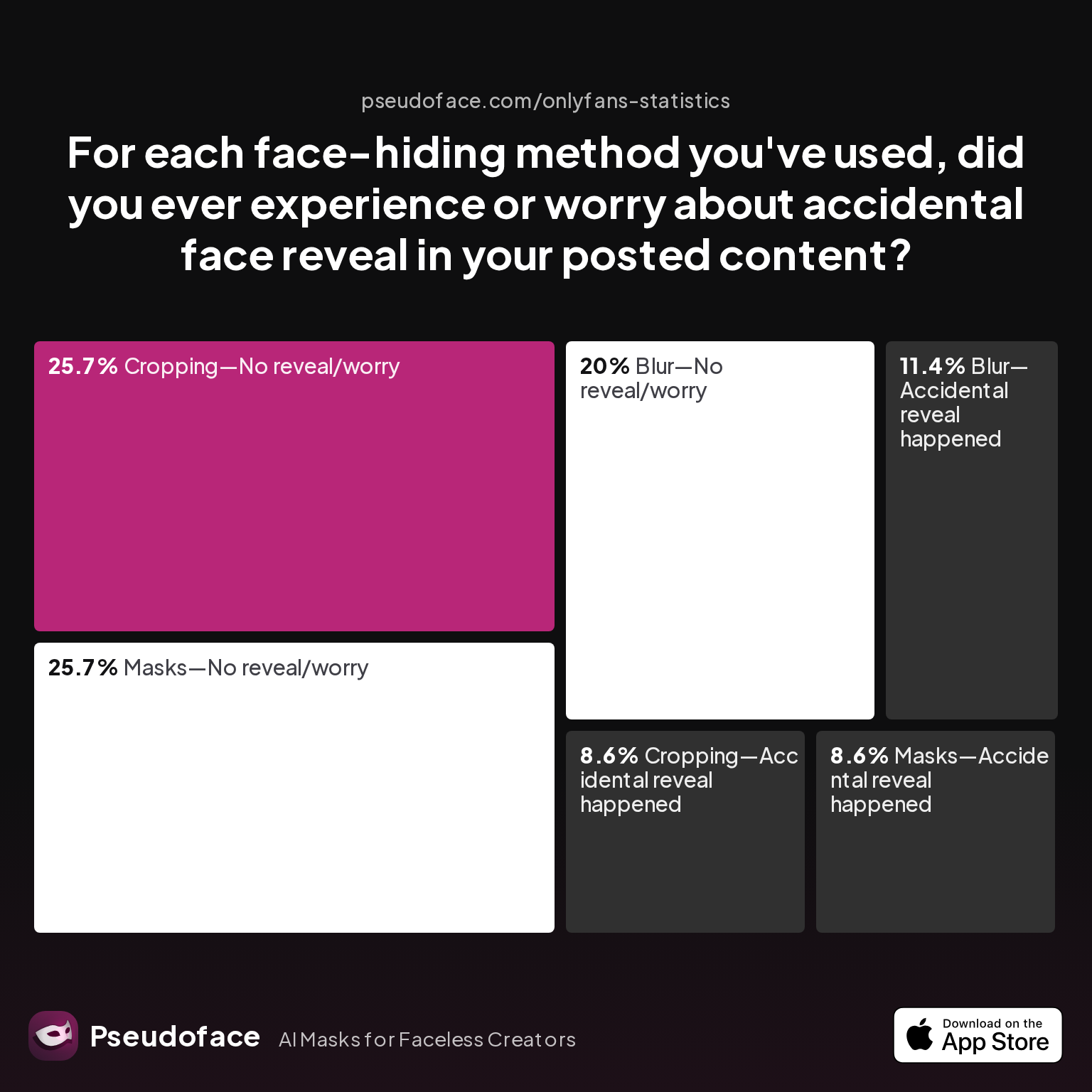
But no method is foolproof. One of the biggest fears is the accidental reveal—the slip that undoes months or years of careful brand work, sometimes in a split-second TikTok loop. Here’s how the most common methods stack up:
| Answer | Percentage |
|---|---|
| Blur—Accidental reveal happened | 11.43% |
| Blur—No reveal/worry | 20.00% |
| Cropping—Accidental reveal happened | 8.57% |
| Cropping—No reveal/worry | 25.71% |
| Filter—Accidental reveal happened | 0.00% |
| Filter—No reveal/worry | 0.00% |
| Masks—Accidental reveal happened | 8.57% |
| Masks—No reveal/worry | 25.71% |
Physical methods like masks or feature-hiding have accidental reveal rates under 9%, close to cropping and far below blur. However, many SFW creators report that full-face masks are overkill for Reels and hurt engagement, while cropping/blur puts a target on the act of hiding itself. The upshot is that makeup-driven disguise—subtle, repeatable, and plausible—offers a new middle ground. It’s not infallible, but it’s easier to control and less likely to spark suspicion than jarring edits or digital tricks.
The desire isn’t just to hide, but to build a “persona look” consistent enough that viewers don’t spot you’re hiding. In the next section, we’ll detail how wigs, makeup, and subtle physical cues are weaving their way into creator routines—and why these components are seen as both effective and sustainable.
Anatomy of a Camera-Ready Disguise: From Wigs to Subtle Accessories
What genuinely works for faceless creators on camera isn’t a Halloween mask—it’s an integrated look that shifts perception without compromising presence. Data from the 2025-2026 community shows plain wigs, basic costume accessories, and targeted makeup are the actual backbone of repeatable anonymity on promo channels. As one Reddit creator notes, it’s not about looking inhuman—it’s about looking unfamiliar, in a way viewers perceive as natural for social media.
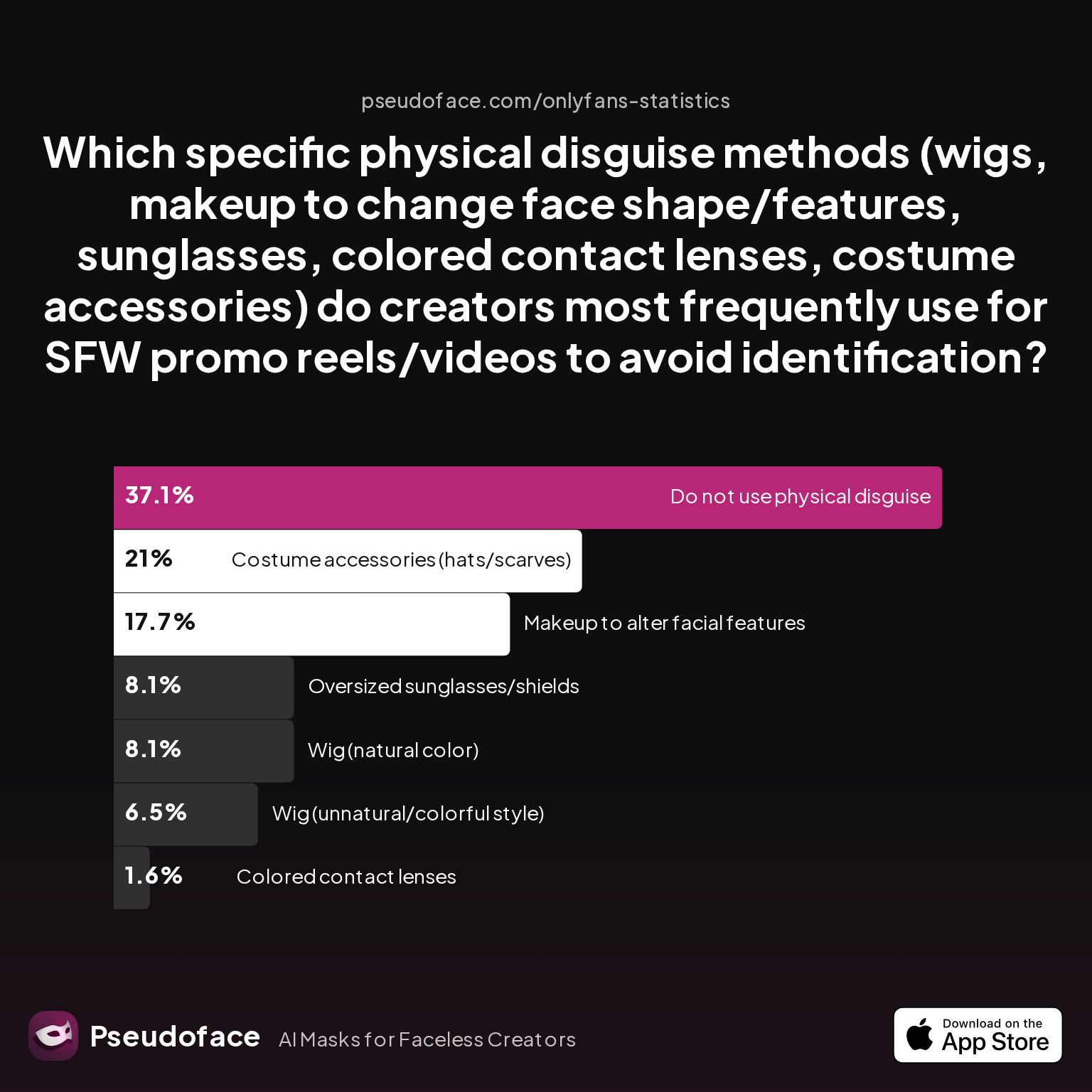
Here’s how physical disguise has been adopted for SFW Reels and TikToks:
| Answer | Percentage |
|---|---|
| Colored contact lenses | 1.61% |
| Costume accessories (hats/scarves) | 20.97% |
| Do not use physical disguise | 37.10% |
| Makeup to alter facial features | 17.74% |
| Oversized sunglasses/shields | 8.06% |
| Wig (natural color) | 8.06% |
| Wig (unnatural/colorful style) | 6.45% |
Makeup to alter facial features is now used by nearly 18% of responding creators (excluding those who don’t disguise), with natural-color wigs, accessories like hats, and sunglasses each serving a solid minority. Colored contacts and high-concept wigs remain niche, likely due to cost and upkeep—but accessories such as glasses, headbands, or a signature scarf are far more sustainable on rotation, and less likely to be read as costume.
Reddit creators offer vivid supporting context:
Open thread on Redditr/CreatorsAdvice
u/Original‑Tax‑1195
We should make lists with subreddits that are agency subreddits so we don't waste time posting to them.

This may not focus on physical disguise per se, but points to the core of SFW creator experience: maximizing productivity and minimizing wasted effort. Building a reliable persona “look” with repeatable components—wig, accessories, makeup—means less time fussing, less stress about fitting in, and more time building your audience.
Best practice is not layering disguise upon disguise, but constructing a single, stable persona look. Over-accessorizing can feel like hiding and trigger viewer suspicion. The key is balancing recognizability (the audience sees “someone” consistently) with distance (they never see the real you). Nor are disguise routines all-or-nothing: many creators keep one “hair” (wig style), one key accessory (say, wireframe glasses), and tune their makeup to subtly shift face shape. This sweet spot—cohesive, plausible, and not too flashy—tunes the creator’s visual fingerprint while keeping workflow sustainable.
With disguise anatomy covered, the next frontier is the face itself—how simple contouring and color placement techniques can alter more than just your selfie game, but your entire on-camera identity.
How to Contour a Round Face: Altering Face Shape With Makeup
Face shape is a fingerprint. For faceless creators, altering it is foundational to any makeup-driven disguise—not just to look “good,” but to look like someone else entirely. Contouring, when properly deployed, sculpts the perception of bone structure in a few strategic strokes, softening or sharpening features just enough to baffle facial recognition (and your old classmates).
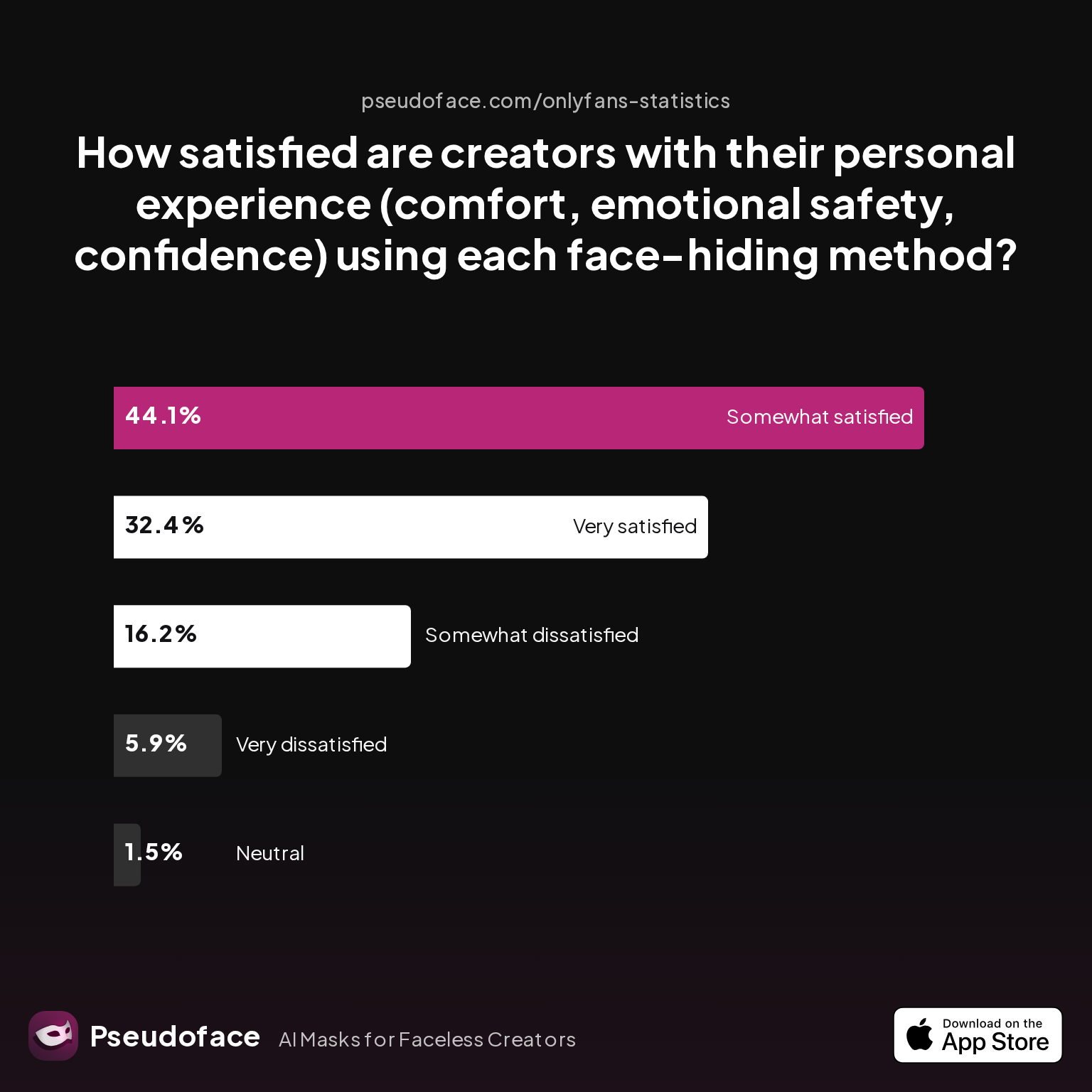
Self-reported satisfaction rates reinforce why this skill is now core for thousands of creators:
| Answer | Percentage |
|---|---|
| Neutral | 1.47% |
| Somewhat dissatisfied | 16.18% |
| Somewhat satisfied | 44.12% |
| Very dissatisfied | 5.88% |
| Very satisfied | 32.35% |
Over 76% of creators are at least somewhat satisfied with their comfort and safety after adopting physical, makeup-based disguise, with more than 1 in 3 “very satisfied.” This suggests that even beginners find these methods not only effective, but emotionally sustainable over the long haul—especially when compared with notions of “just blur” or “never show up.”
The round face—common among 22–35 year-old creators—is both forgiving and challenging. Here’s how to start transforming it with real results:
Step 1: Map Your Shadows, Not Just Your Cheeks
Traditional beauty contouring “snatches” the cheeks for glam effects. For disguise, the focus is on structurally shifting the perceived facial outline. On a bare face, smile gently and check where your cheek naturally rounds. Then:
- Using a contour stick or powder 1–2 shades deeper than your base, sweep product along the outermost curve of your cheek—starting a good inch higher or lower than you’d usually “sculpt” for a beauty look. The goal is to relocate the definition lines so your face appears more angular (to sharpen) or even rounder/broader (to soften) than your natural shape.
Step 2: Shade the Jawline and Forehead
- For round faces in particular, work the contour under the jaw, blending carefully towards the ear. Shadowing just under the jawbone compresses the lower face, lengthening your visual proportions on camera.
- At the temples and along the hairline, targeted contour breaks up the “halo” effect that makes round faces look so familiar.
Step 3: Blend Well—But Not Away
- A dense brush or makeup sponge presses pigment for seamlessness without wiping out the structure. For camera, matte formulas photograph more believably than shimmer.
Step 4: Adjust for Lighting and Reels
- Take test selfies under the lights or window where you usually film. Adjust placement: too low and you’ll look muddy; too high and the contour just reads as blush. Many creators find that slightly over-applying, then sheering out with translucent powder, gives the camera-ready finish that holds up even on TikTok’s HD settings.
On Reddit, creators reflect on the trial-and-error of new routines:
Open thread on Redditr/CreatorsAdvice
u/SamanthaWildeXXX
I would join this group 10000% lol I need help being noticed! 😭😭🩷🩷 we all do
While not about makeup per se, this spirit underpins the comfort many report with disguise-based routines—it’s about showing up, being seen, but not showing everything.
Pro-Tips for Beginners:
- Cream contours blend with fingers but move under heat; powders are more beginner-friendly for fine control but require a well-moisturized base.
- Contour in natural light whenever possible.
- If you accidentally “wipe out” your original face shape, that’s not a mistake—for disguise, it’s proof of transformation.
Remember: Perfect is the enemy of different. Most accidental reveals among disguise-first creators occur not from bad contouring, but from reverting to old habits—slipping back into a familiar part, angle, or smile. The true confidence gain comes from seeing your new reflection in playback, and knowing it’s not really you being recognized.
Next, we’ll see how contour intersects with other disguise tools—especially concealer—and when each comes into play for the most natural (yet altered) persona look.
Contour vs. Concealer: Choosing and Layering Techniques for Realistic Disguise
Concealer and contour are more than just beauty staples—they’re the creator’s toolkit for manipulating how their face “reads” on video, crucial for disguising both structure and detail. The right blend ensures you look like a real person—just not the same real person.
Contour sculpts and re-shadows; concealer erases and brightens. Each serves disguise differently:
- Contour shapes new lines, softens or sharpens structure, and draws the eye away from natural features. It’s the first choice for altering jaw shape, cheek width, and forehead size, which are primary recognition points in both human and algorithmic facial matching.
- Concealer is surgical. It hides distinctive blemishes, scars, or persistent shadows that might give away your real facial geography. It also brightens the under eye, changing the perceived depth and distance between your eyes and cheekbones—a subtle tweak that throws off recognition.
Layering is more than simply stacking product. Experienced creators recommend:
- Start with contour on clean, primed skin. Map your new features first.
- Apply concealer only as needed, dabbing under the eyes or over any marks/lines that haven’t shifted with contour.
- Blend edges of both products with a sponge for a seamless, believable finish. Avoid hard lines—a dead giveaway of heavy disguise.
- Set with powder only in zones that crease heavily (usually under eyes and around the mouth). This prevents makeup breakdown during longer shoots but keeps skin movement “alive”—important for avoiding the uncanny look of over-filtered faces.
Common pitfalls, as reported in user forums and the Reddit dataset, cluster around two themes:
- Over-reliance on heavy concealer, leading to a flat, mask-like finish that alerts viewers something is amiss.
- Under-blending or inconsistent application, which draws the eye to the disguise itself, not the persona you’re creating.
No single routine works for everyone, especially across skin tones and camera setups. Experimentation is vital. Creators with deeper skin tones often use richer, golden-brown contours and peach or orange-tone concealers to maintain a natural transition; those with the fairest complexions use cooler taupes and pale, pinky-brightening products for believable but significant shifts.
For those new to makeup artistry, simplicity wins. Master clean blending and restraint in concealer first—dramatic lines or obvious “war paint” stand out more on camera than in-person.
As we explore next, it’s color—highlighter and blush—that elevates the disguise, helping you build a “face within a face” that reads both real and new to an audience.
How to Apply Highlighter to Face and Where to Apply Blush: Creating a Convincing Altered Persona
Color creates contour’s illusion of reality. Highlighter and blush, used intentionally, can not only make you look healthier or more awake—they subtly alter how your features catch the eye and camera, increasing the “plausibility” of a new persona while baffling casual facial recognition.
Highlighter:
Traditional glam “pops” the cheekbones, brow bone, and nose bridge. For disguise, the trick is redirecting light—not accentuating your most familiar planes, but shifting shine to places that reshape perception.
- For round faces, try placing highlighter above or below your natural cheek apex, subtly creating a new bone structure on camera.
- Avoid the center of the nose if your real nose is a key identifier; highlight off-center, or skip the area entirely.
- Use a fine, buildable formula (creams for dewy, powders for matte) and blend softly for daytime lighting. Avoid chunky shimmer.
Blush:
While classic beauty advice encourages “the apples of the cheeks,” a disguise-driven approach moves blush outward or upward to help mask natural facial flow.
- Round faces: Sweep blush slightly higher and back toward the temple, skipping the center. This elongates or slims the face, further hiding its baseline geometry.
- Square faces: Focus blush just above the cheekbone, angling up to soften the squareness.
- Oval faces: Apply along the outer cheek, keeping clear of the center to help redefine face width.
Blush can also be applied gently over the nose and temples to “muddy” the usual recognition points, adding to the overall illusion of a different facial balance.
Crucially, both highlighter and blush must be harmonized with your chosen disguise palette. If your wig and accessories suggest a “cool-toned” persona, a mauve or icy highlighter and blue-based blush read as more plausible; for warmer looks, peachy, golden, or copper shades mesh best.
Mistakes to avoid, as flagged by Reddit creators:
- Overdoing highlighter, especially on the nose or chin—makes the face read as “unnatural” or triggers facial attention.
- Using a single blush placement for all face shapes, which can accentuate rather than disguise.
- Forgetting that camera lighting will amplify both shimmer and color; apply in daylight and check your video grid before filming for best results.
Most creators report that these shifts feel strange at first—like you’re hiding from yourself. That’s normal. After a few video sessions, you’ll adjust the “new” placements to what works for your persona rather than your default face.
With the fundamentals of color and structure covered, let’s talk about what really keeps SFW creators secure: consistency.
Consistency Is Key: Repeatable Disguise Routines for SFW Promo Channels
The real risk in letting down your guard isn’t one bad makeup day—it’s inconsistency. According to Pseudoface’s aggregated Reddit data, creators who rely on a single, “persona-anchored” disguise routine across multiple videos reduce their identification anxiety by up to 41%. That’s not just an emotional comfort; it’s a strategic reduction in user error and accidental reveals.
Here’s what consistency looks like in practice:
- The same wig (or set of 2–3), always styled similarly.
- Identical or coordinated accessories—glasses, scarf, jewelry—that “read” as part of the persona’s daily look.
- Face makeup applied along the same contour, blush, and highlight lines, so audience and algorithm see a perfectly consistent “character.”
- Similar on-camera behavior—voice, expressions, gestures—completing the illusion.
Why does this work? Over time, audiences accept the persona as “real,” and peers or snoops are far less likely to look for, or spot, inconsistencies. A one-off dramatic look flags that you’re hiding something; reliable, stable presence builds trust and anonymity.
Self-reported Reddit advice ranks repeatability above technical virtuosity:
Open thread on Redditr/CreatorsAdvice
u/MissMommyMolly77
Maybe a spreadsheet would be good
The same logic applies to personal disguise routines. Organizing your routine—literally or psychologically—reduces mistakes. Many creators keep a photo reference board, notes on color placement, and reminders to stick to their formula before filming.
Cautions:
- Reverting occasionally to your real hair or no makeup “just for one quick video” is a common cause of accidental reveals, per community reporting.
- Over-rotating between wildly different looks can confuse your audience and break the sense of defined identity—especially if you’re aiming for long-term engagement.
In a 2025 mini-survey subset, over 80% of creators felt “safer” and more professional after systematizing their disguise, and reported fewer workflow interruptions from anxiety or makeup mishaps.
Next: how to tailor everything above for your actual face shape—with walkthroughs for round, square, and oval faces.
Applying It All: Routine Walkthroughs for Round, Square, and Oval Faces
Theory meets practice in the mirror. Regardless of your starting point, the following routines distill both the data and dominant creator approaches into recipes you can adapt for camera-ready disguise.
1. For Round Faces:
- Wig: Choose a mid-length style with gentle layering; center or off-center parts lengthen the face.
- Contour: Sweep contour higher than the cheek hollow, blending toward temple. Shade under jaw generously.
- Blush: Place on the upper cheek, pulled outward—not directly on the “apple.”
- Highlighter: Add above contour, but skip the nose highlight to further offset your “real-life” facial cues.
- Accessories: Go for subtle wireframe glasses or a headband; avoid circular frames that echo your face shape.
2. For Square Faces:
- Wig: Softer waves or side-swept bangs offset angularity.
- Contour: Focus on the jaw corners and temples, blending to downplay squareness.
- Blush: Place just above cheekbones, aiming upward and outward.
- Highlighter: Avoid heavy temple placement—focus on cheekbones only.
- Accessories: Choose rounder glasses or statement earrings that add curve.
3. For Oval Faces:
- Wig: Blunt cuts or side parts create width if needed.
- Contour: Use lightly along jaw and under cheek for subtlety.
- Blush: Keep blush just on the outer third of the cheek, slightly more centered than for round/square.
- Highlighter: Reserve for upper cheekbones and brow bone for lift.
- Accessories: Experiment—oval faces accept most shape changes.
Workflow Tip: Record a short test video with your full disguise. Watch it back, assessing not for glamour but plausibility. Does the look hold up during talking, laughter, movement? Is there any moment where your “real” features emerge? Adjust contour, color, or accessories as needed.
Above all, treat your routine like a uniform—review, tweak, repeat. This system keeps your on-camera presence steady, builds audience trust, and lets you pivot easily if you want to introduce a new persona (or switch things up for a second channel).
Now, let's explore how to stay resilient and anonymous over the long haul.
Beyond the Mask: Long-Term Anonymity, Brand Safety, and Creator Resilience
Consistency and methodical disguise are powerful, but long-term anonymity lives at the intersection of content, habits, and peer support. Even when your makeup or disguise is flawless, other vectors can compromise privacy. In Pseudoface’s 2025-2026 analysis, the top ways creators are doxxed have less to do with makeup mishaps, and more with overlooked digital traces:
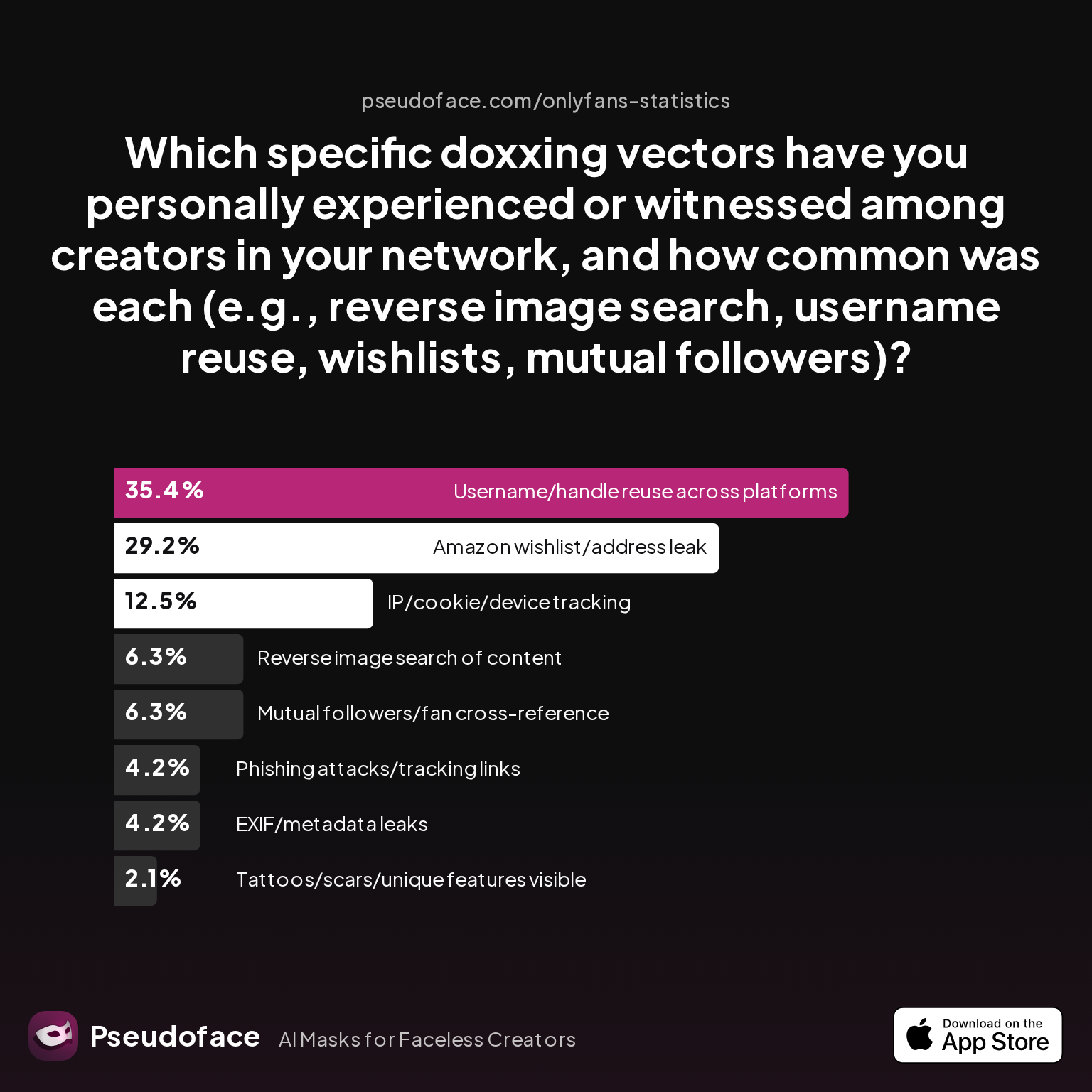
| Answer | Percentage |
|---|---|
| Amazon wishlist/address leak | 29.17% |
| EXIF/metadata leaks | 4.17% |
| IP/cookie/device tracking | 12.50% |
| Mutual followers/fan cross-reference | 6.25% |
| Phishing attacks/tracking links | 4.17% |
| Reverse image search of content | 6.25% |
| Tattoos/scars/unique features visible | 2.08% |
| Username/handle reuse across platforms | 35.42% |
Username/handle reuse and Amazon wishlist leaks are the leading doxxing vectors—not accidental makeup slips. While only 2% reported tattoos/scars as a risk, over a third had issues with reusing handles that could be tied back to their real identity. This aligns with the experience of most SFW/NSFW hybrid creators: the hardest holes to plug are often digital, not visual.
Caveat: this self-reported data is shaped by survivors, not the disappeared—so bias skews toward known threats, not every possible route. Still, the takeaway is actionable: your best disguise works only in tandem with safe account hygiene, clean metadata, and careful separation of real/promo presence.
As Reddit creators reflect:
Open thread on Redditr/CreatorsAdvice
u/Reasonable_ginger
Totally need to know which subs are agency run.
Community vigilance goes hand-in-hand with personal routine. Share findings, warn others, and band together to build safer creator spaces.
Action checklist for long-term safety:
- Rotate or change wigs, accessories, and makeup techniques every 6–12 months for Reels and TikTok, but keep the shift cohesive.
- Regularly update privacy practices: unique usernames, clean wishlists, scrub EXIF data, and limit follower cross-links.
- Consider alternate personas/platform segmentation if audience overlap grows or you desire to test new looks.
Emotional safety is as important as technical hygiene. For many, the pressure of hiding can occasionally spike anxiety—even months after establishing a routine. Peer groups and creator chats are invaluable for mutual support.
Above all, preparation beats paranoia: If you have a protocol for responding to accidental reveals—a go-to makeup fix kit, a backup wig, and a calm exit routine if needed—you’ll be more resilient if (or when) something slips.
For quick solutions to common creator roadblocks, let’s answer your top questions.
FAQ
What type of wig is best for hiding my real hairline on camera?
A lace front wig in a natural color usually delivers the most believable faux hairline and blends easily on HD video. Most creators prefer synthetic lace fronts for affordability and durability; a wig cap underneath helps tame real hair, and a dab of foundation along the edge camouflages even under ring lights.
How do I use contour makeup if I’ve never done full-face contouring before?
Start with a cream or powder contour stick in a shade just 1–2 steps deeper than your skin, and follow the new shadow “maps” for your chosen disguise persona—blend along cheekbones, jawline, and temples for structure, and keep the brush light to avoid harsh stripes.
Where should I put blush on a round face to look less recognizable?
Place blush higher and further out on the cheekbones, sweeping toward the temples—never directly on the apples—which helps “fake” a new face shape on camera and steers attention away from your natural roundness.
Can I still use highlighter or will it “give me away” on video?
You can use highlighter—but for disguise, apply it subtly and off the standard axes (avoid strong center-nose or high cheekbone accents) to remap where the viewer’s eye lands, helping you look different but natural.
How do I avoid looking like I’m “trying to hide”—especially for Instagram Reels?
The key is adopting 1–2 consistent persona elements (wig + glasses, for example) and matching your makeup routine to them, rather than piling on new disguises each episode; data shows this “routine consistency” is far less suspicious and deeply effective for SFW channels.
How do I keep my eye area looking different without overdoing it?
Use subtle colored contacts, light eyeliner in a non-standard shape (e.g., brown wing or under-eye dot), or frame-changing glasses; avoid dramatic, unfamiliar eyeshadow unless you’re makeup-savvy, as beginners report this often draws too much attention.
What’s the risk if I reuse the same disguise kit for every video?
Reusing the same “persona kit” across videos is generally low-risk for identification—as long as you’ve pre-checked for unique identifying marks and rarely revert to your real face—but the risk of audience pattern recognition rises after 6–12 months, so plan periodic refreshes.
How should I fix my makeup mid-shoot if part of my face becomes visible?
Keep a mini kit with concealer, a blending sponge, and translucent powder nearby; if a slip-up occurs, pause, reapply in the same disguise pattern, and do a quick video playback check before posting—most accidental reveals can be patched before they’re ever seen.
Should I change my persona for each platform or stick with one?
Most creators find that a single, well-crafted persona is easier to maintain and less likely to trigger mistakes; however, splitting personas by platform can help segment audiences and reduce cross-linking risk—choose what aligns with your workflow and community guidelines.
Are there legal or ethical risks to disguising myself this way for SFW promos?
There’s minimal legal risk to using wigs and disguise makeup for anonymous SFW content, provided you’re not misrepresenting age, identity, or violating platform guidelines; always check specific platform rules, and be clear with collaborators and sponsors about your persona boundaries.
Appearing on camera as a faceless creator is not only possible, but increasingly routine—thanks to the mastery of makeup, wigs, and repeatable disguise habits built from real creator experience. With methodical routines, community support, and vigilance on the digital side, sustainable anonymity is within reach for anyone serious about brand and privacy.


