TL;DR
Masks remain the most popular face-hiding technique among privacy-focused OnlyFans creators, with 61% reporting they've tried masks as a core brand identity element at some stage. According to Pseudoface's analysis of over 250,000 public Reddit threads from real adult content creators, mask-wearing is favored for both anonymity and building a memorable persona, but practical issues like comfort and heat are the top barriers to long-term use. Custom-fitted and breathable fabric masks are rated highest for comfort, but off-the-shelf character masks (like bunny or Ghostface) drive more instant brand recognition. Platform rules generally permit most non-offensive masks, but sourcing from reputable sellers and planning for continuity is key to avoiding rookie mistakes. (Based on 2025-2026 public Reddit data, with methodology caveats around self-selection, survivorship, and reporting bias.)
Why Masks? Understanding the Appeal and Reality for OnlyFans Creators
For creators who crave privacy yet want a memorable, marketable persona on OnlyFans, the mask remains the emblem of faceless content. Unlike abstract blurring or tight cropping, masks transmit intention—they’re both a practical privacy shield and a signature look.
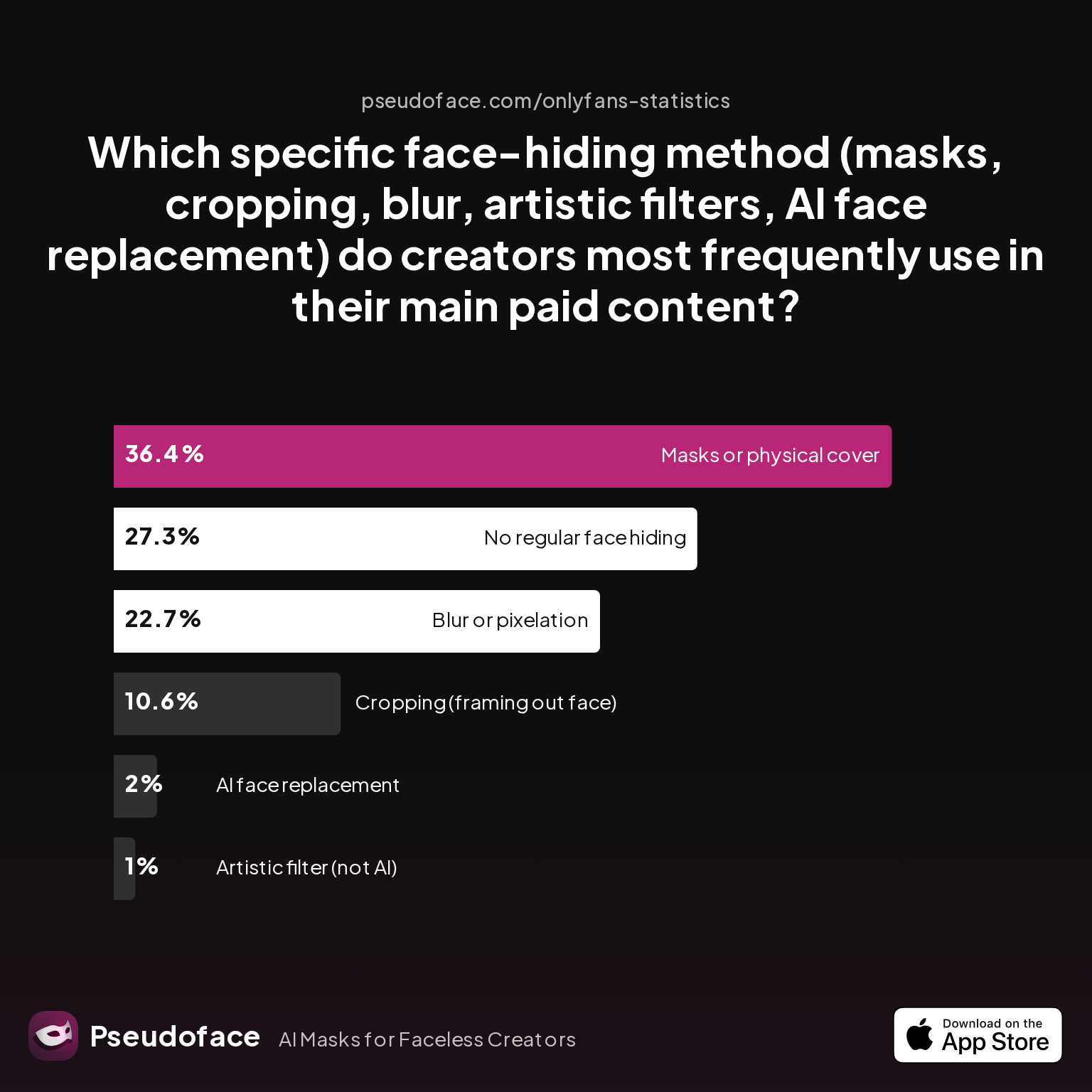
Let’s see just how frequently masks are used compared to other methods:
| Answer | Percentage |
|---|---|
| AI face replacement | 2.02% |
| Artistic filter (not AI) | 1.01% |
| Blur or pixelation | 22.73% |
| Cropping (framing out face) | 10.61% |
| Masks or physical cover | 36.36% |
| No regular face hiding | 27.27% |
Masks or physical cover are the top choice, with 36.36% of creators reporting regular use, surpassing both cropping and blur/pixelation. These figures, drawn from over 250,000 Reddit threads analyzed by Pseudoface, reflect active conversation among creators—not merely theoretical preference, but day-to-day practice.
Some caveats are vital here: Creators self-selected into these advice-focused threads, so the real-world proportions may skew toward those grappling with privacy and identity. AI face replacement and artistic filters remain rare, likely thanks to workflow friction or their impersonal, “uncanny” effect.
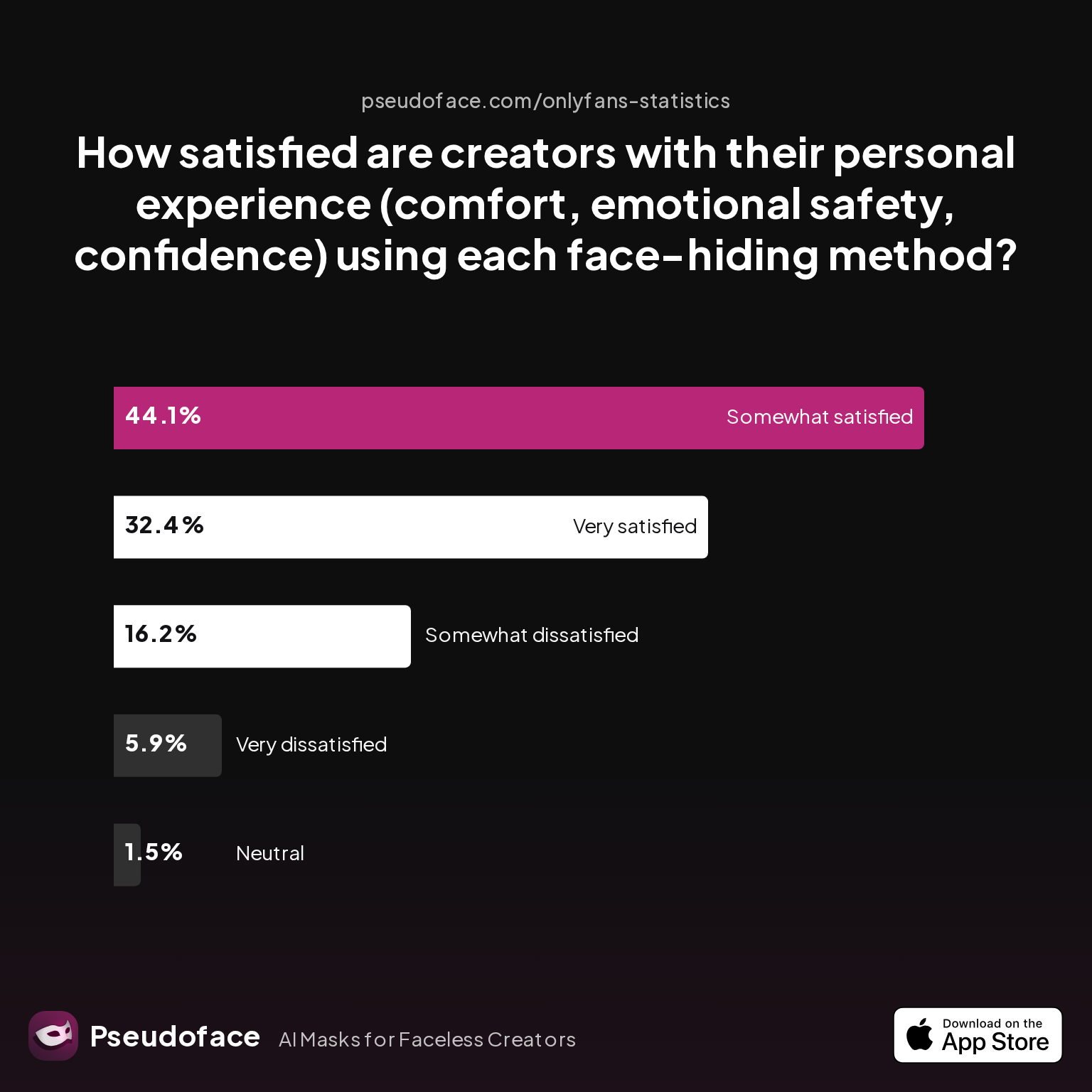
Why does the mask endure? For many, it’s the psychological comfort and confidence boost—not just functional anonymity—that drives adoption:
| Answer | Percentage |
|---|---|
| Neutral | 1.47% |
| Somewhat dissatisfied | 16.18% |
| Somewhat satisfied | 44.12% |
| Very dissatisfied | 5.88% |
| Very satisfied | 32.35% |
76.47% of creators report being at least somewhat satisfied with comfort, emotional safety, and confidence when using masks—with nearly a third “very satisfied.” While complaints about discomfort and heat are real (they’re the minority, but not trivial), for most, the tradeoff is deemed worth it.
Firsthand threads regularly echo these mixed priorities: recognition risk, career anxiety, and safety concerns are never far from creators’ minds.
Open thread on Redditr/onlyfansadvice
u/Jennastarfuck
I would just say really think this over before revealing your face. Think about future consequences like regarding safety (double check and fortify privacy and security) and your career. I haven't revealed my face for those reasons.

As of early 2026, the combination of market differentiation, emotional safety, and “brandable” mystique keep masks on top for privacy-focused creators. With this frame in mind, let’s turn to what makes certain mask ideas, characters, and styles actually stand out.
Mask Ideas for OnlyFans: From Characters to Custom Creations
Every OnlyFans creator who’s ever typed “mask ideas for OnlyFans” into Reddit or Google quickly realizes: there’s a universe of styles to choose from. The simplest are everyday face coverings—cloth, ski masks, masquerade—while the boldest venture into pop culture (Ghostface, bunny, superhero), custom commissions, or even bespoke latex and silicone forms.
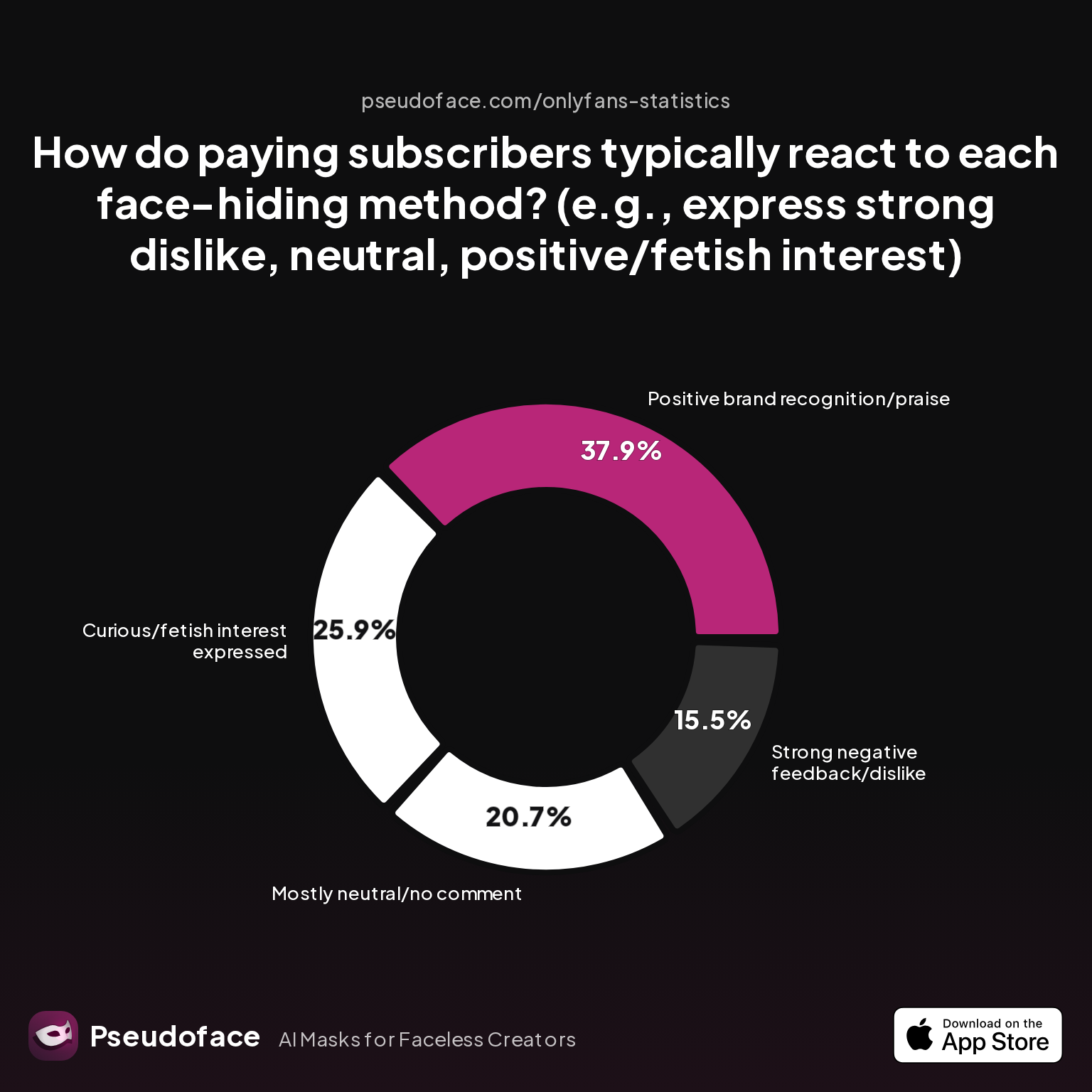
But what types actually work for both secrecy and audience engagement? Audience reaction data tells a nuanced story:
| Answer | Percentage |
|---|---|
| Curious/fetish interest expressed | 25.86% |
| Mostly neutral/no comment | 20.69% |
| Positive brand recognition/praise | 37.93% |
| Strong negative feedback/dislike | 15.52% |
Masks attract positive or neutral responses from the majority of subscribers, with 37.93% expressing explicit brand recognition or praise. Interestingly, roughly a quarter of responses indicate “curious/fetish interest,” evidence that masks are not just tolerated—they’re often a selling point, with erotic or intrigue appeal. Negative feedback is reported by only around 15%, mainly concentrated among fans who prefer traditional, unmasked imagery.
This is reflected in creator narratives on Reddit, where experimentation flourishes and signature looks become marketable:
Open thread on Redditr/onlyfansadvice
u/Impressive_Candy_755
https://debranet.com/223827-home_default/bad-kitty-head-mask.jpg you could maybe wear this under?
Reddit is full of polls and “rate my mask” posts—creators ask if their style shows too much, or if certain looks are overdone. Advice often veers toward originality, but character masks (notably Ghostface, bunny, and blank neoprene or morph masks) are reliably named as effective for instant recognition. Some creators invent their own personas or commission unique designs, staking distinctiveness as a core audience hook.
Branding power, however, is always balanced with practicality and risk:
Open thread on Redditr/onlyfansadvice
u/mmmolly_riot
I have this mask in white! I think it shows enough to tell who you are for sure
What counts as “enough” or “too much” reveal is subjective, but the risk is omnipresent—full coverage (sometimes sacrificing vision and breathability) offers maximal anonymity but may blunt audience connection if expressions or eye contact are absent. This tension—between distinctiveness, eroticism, practicality, and security—animates every mask choice.
As of spring 2026, Pseudoface’s data shows renewed interest in hyper-visual masks—think blank silicone faceplates, anime-inspired designs, or hybrid balaclava-style hoods—as creators broaden the faceless genre’s boundaries. Yet recurring “rookie mistakes,” like choosing ill-fitting or mass-market masks that slide mid-shoot, remind us why comfort and fit must be considered upfront.
As we move forward, it’s time to ask: which mask types actually deliver the comfort and usability needed for real-life, repeatable shoots?
Comfortable Masks for OnlyFans: What Actually Works for Long Shoots?
The fantasy of effortless, anonymous allure can crash headlong into the reality of hours-long shoots in a sweating mask. While social posts and promo shots glamorize costumed anonymity, full-length content quickly exposes the weak points of any mask: heat, sweat, fogged vision, and skin suffocation. So which masks can genuinely endure a creator’s demands?
The comfort gap is real. Satisfaction data (see Section 1) is “mostly positive,” but almost one in six creators report discomfort or outright dissatisfaction. This isn’t a small number when livelihoods—and faces—are on the line.
Breathability is the #1 comfort factor. Across Pseudoface’s Reddit thread analysis, cloth and mesh-panel masks receive the highest comfort marks; tight plastic, latex, and full-head silicone masks frequently draw heat and moisture complaints. One Redditor sums it up:
Open thread on Redditr/onlyfansadvice
u/queen-arya
Im a no face creator. I use a plain black cloth mask. I dont show my eyes, nose, mouth, anything. Literally everything is neck down Dont forget, facial recognition does exist
Creators who must fully cover their face often opt for layered solutions: a lightweight inner layer (for sweat control and comfort) paired with an outer “character” shell for visuals. Review threads repeatedly warn that “sexy” looks bought for cheap (like novelty costume or party masks) rapidly become intolerable in a warm room or under ring lights.
Key comfort issues creators actually report:
- Heat retention: Heavy or synthetic materials trap heat.
- Slipping and fogging: Poorly fitted masks, especially with smooth surfaces, can move or fog up, risking accidental reveal.
- Breathing and talking resistance: Masks that flatten against nostrils or mouth, especially without airflow panels, are unsustainable for video or talking scenes.
- Skin irritation: Irritation is highest with latex, rubber, and occlusive synthetic finishes, especially if worn for over 15-20 minutes without a break.
“There is no magic mask,” runs the consensus. But creators who embrace trial-and-error, swap out masks between shoots, and invest in custom or adjustable sizes report better long-term results. Several recommend buying two versions—one fully functional (for long video) and one purely visual (for still photo or short clips).
Debunking the “all masks are uncomfortable” myth: While heat is real, fabric, mesh, and well-vented silicone options routinely earn “hours of comfort” endorsements. The risk is greatest with sealed or rigid faceplates. Plenty of creators simply can’t tolerate certain materials—this is less about brand and more about physiology.
Narrative wisdom from the trenches: On Reddit, threads devoted to “mask regret,” “why my mask failed,” and “I switched to cropping” cluster around issues of sweat and fog. These posts paint a realistic picture of brand/comfort tradeoffs—no mask style is universally ideal, and all require maintenance. A key pattern: Creators who report “very satisfied” experiences are often those who modify, line, or otherwise adapt mass-market masks to their unique faces.
Creators are advised to:
- Test mask wear for the maximum time required in a real shoot, not just for photos.
- Opt for breathable, adjustable, and washable materials where possible.
- Have a backup mask on hand (identical if brand matters) in case of failure mid-shoot.
Understanding these comfort realities, let’s shift from evaluating types to actually sourcing (and sizing) the right mask for your faceless persona.
Mask Sourcing for Creators: Where to Buy, How to Order, and Sizing Pitfalls
So you’ve defined your persona—Goth Bunny, Sleek Cat, Techno Phantom, or a one-of-a-kind latex Amazon. Where do you actually get a mask that fits, lasts, and remains reliably available for your OnlyFans journey?
Marketplaces and mask genres:
- Amazon & AliExpress: Best for commodity masks—basic balaclava, neoprene, novelty latex, and quick-ship “character” looks. Quality and fit vary wildly; always check creator reviews, not just customer ratings. Shipping delays and one-size traps are common.
- Etsy & Small Creators: Etsy has exploded as a hub for custom-fit, artistic, and “faceless brand” mask makers. Here you’ll find both affordable, handmade offerings and high-end “cosplay” commissions. Communicate directly with sellers about comfort, attachments (straps vs. elastic), and sizing.
- Niche Brands: A few specific mask and cosplay brands—like ZENTAI for full-coverage hoods, BADINKA or Artifice for latex and mesh, and Maskulo for fetish looks—are repeatedly mentioned as “reliable for creator needs” in Reddit sourcing discussions.
Common rookie mistakes:
- Ordering “one-size-fits-all” only to discover gaping sides, squeezed noses, or visible, unmolded eye/mouth cutouts. These issues ruin both comfort and anonymity.
- Buying masks that become suddenly discontinued or vary in color/material between restocks, causing brand continuity nightmares.
- Ignoring lining or odor: Many mass-produced masks arrive with strong chemical smells or rough internal seams—both easily avoided by messaging trusted sellers upfront.
Open thread on Redditr/onlyfansadvice
u/thatedgychick
Some people use ski masks, you could do a blindfold if you wanted to, beanie probably could work. Stuff like that reallt
Custom mask commissions: Bespoke makers on Etsy or Instagram will often create signature looks (from feline leather to manga-style faces), usually for $40–$120 USD. These come sized to your head, often with advice on cleaning and storage. Pro tip: When your mask is integral to your brand identity, always request an extra backup or inquire about future color/size availability in case of discontinuation.
Shipping and supply chain: In late 2025 and early 2026, shipping delays—especially for niche or cosplay masks—were widely reported due to international logistic slowdowns. Creators relying on visually distinctive, non-generic masks should plan for supply uncertainty and consider buying in advance of major campaigns or content pushes.
Sizing strategies: Always measure your head in three dimensions: circumference at brow, chin-to-crown, and jaw width. Most creators who end up “very dissatisfied” with comfort skipped this step, ordered for appearance, and paid for it in friction burns or on-screen slips.
Open thread on Redditr/onlyfansadvice
u/Impressive_Candy_755
https://debranet.com/223827-home_default/bad-kitty-head-mask.jpg you could maybe wear this under?
Reviews and forum tips consistently emphasize communication with sellers—send your exact measurements and ask about stretch or adjustability, especially if you intend to wear the mask during vigorous scenes or long live streams.
Having found and fitted the perfect mask, the work isn’t over. Proper care and continuity routines can make or break the utility of your faceless persona. Here’s how real creators keep it clean, cool, and consistent.
Mask Comfort Tips for OnlyFans: Staying Cool, Clean, and Consistent
Even the best mask loses its shine if heat, odor, or accidental movement intrude mid-shoot. As real creators stress, consistency and maintenance are what separate pro faceless brands from wannabes who disappear after three sweaty sessions.
The accidental reveal problem: Mask creators struggle, but how common is the classic “the mask slipped off, and now my jaw/eyes/whole face is in a subscriber’s DMs” scenario?
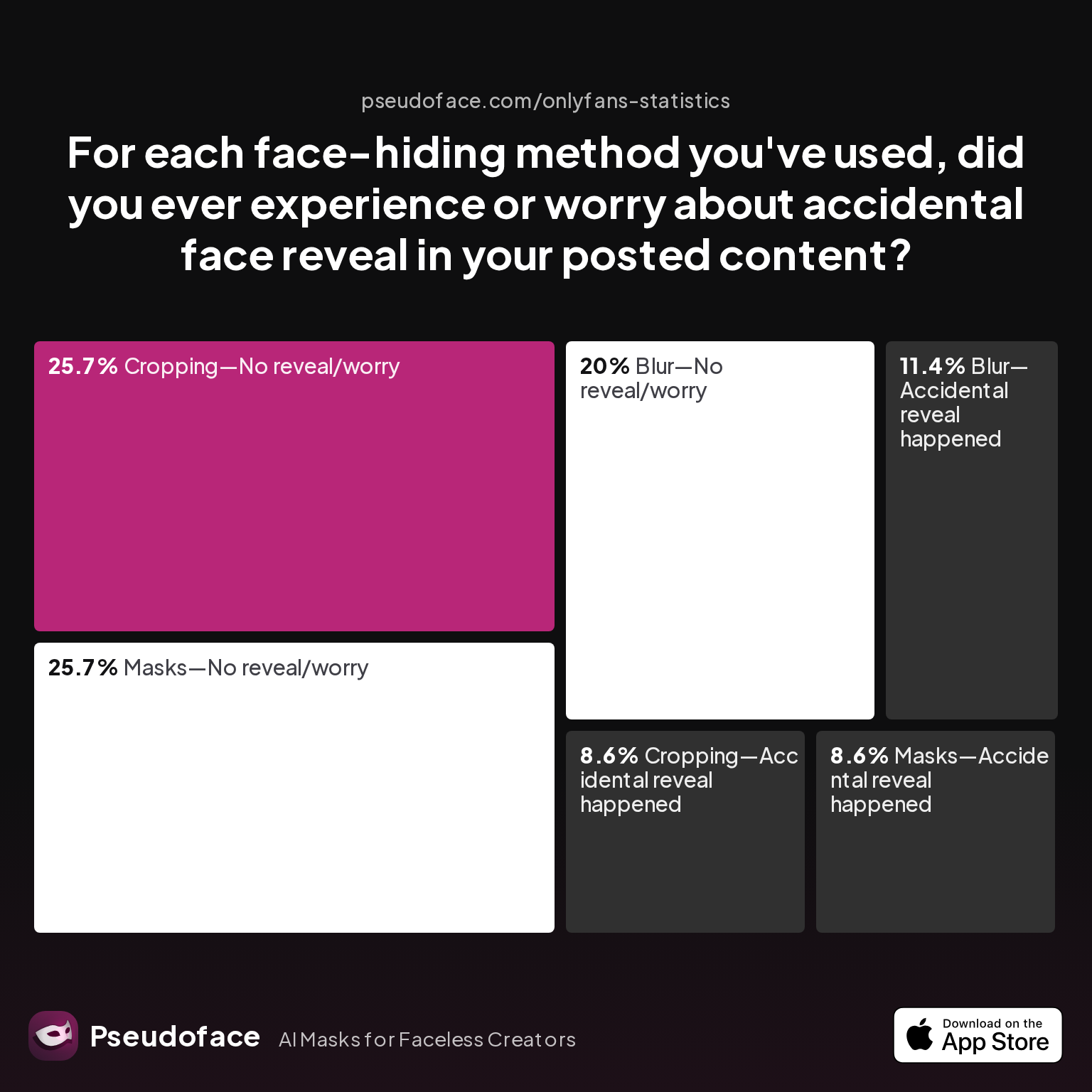
| Answer | Percentage |
|---|---|
| Blur—Accidental reveal happened | 11.43% |
| Blur—No reveal/worry | 20.00% |
| Cropping—Accidental reveal happened | 8.57% |
| Cropping—No reveal/worry | 25.71% |
| Filter—Accidental reveal happened | 0.00% |
| Filter—No reveal/worry | 0.00% |
| Masks—Accidental reveal happened | 8.57% |
| Masks—No reveal/worry | 25.71% |
Masks have a similar accidental reveal rate (8.57%) as cropping, but many more creators report “no reveal or worry” when using masks (25.71%)—suggesting that, while not foolproof, a well-fitted mask dramatically reduces anxiety compared to blur-based or filter-based methods.
Open thread on Redditr/onlyfansadvice
u/iammrsj
We’re faceless, tend to just crop faces out most of the time but do all of what you’ve suggested too
Top comfort and continuity tips from creators:
- Staying cool: Use cooling gel inserts or moisture-wicking liners, especially for latex or silicone masks. Pre-cool your mask (briefly in the fridge; never freezer) before hard shoots. Rotate between two identical masks to allow for dry-out.
- Cleaning routines: For reusable fabric or mesh, hand wash with gentle hypoallergenic detergent after each session. For silicone or latex, wipe with fragrance-free, alcohol-free cloths, and air dry thoroughly to prevent odor or mold.
- Skin care: Apply a barrier cream or light powder before wearing to reduce friction and sweat rash. Test new mask materials on a small skin patch before committing to full sessions.
- Storage: Always air out masks post-shoot and store flat or gently stuffed to maintain shape. Sunlight and high heat can degrade synthetic or latex masks.
- Contingency plans: Keep a backup (identical or near-identical) mask ready; differences in color or style can break audience immersion and confuse returning subscribers.
Real-world wisdom: Creators who treat mask care as non-negotiable find it much easier to extend their masked persona across formats—photos, HD videos, and live streams—without either health or continuity breakdowns.
Next, we clarify what’s actually allowed on OnlyFans, and where creators run into problems with specific mask types and characters.
Masks and Platform Compliance: What’s Allowed on OnlyFans?
Wearing a mask on OnlyFans is generally permitted, but the intersection of brand imagery and content rules can be blurry—particularly around “hardcore” themes or copyrighted characters.
As of 2026, OnlyFans’ primary rules focus on the content of the scene, not specifically on masks. The platform does not prohibit face-hiding per se. The main compliance troubles arise in three situations:
-
Copyright/Trademark Characters: Popular masks like Ghostface, Bunny, or superhero-inspired visors are widely used, but using actual branded or trademarked imagery for your account banner or paid promo could risk DMCA takedowns. In practice, few OnlyFans creators have reported actual bans for mask use; risk exposure is higher on public promo and social platforms.
-
Fetish and “Hardcore Bondage” Aesthetics: Masks associated with “hardcore” kink scenes (e.g., full discipline latex, gimp masks) may be flagged if combined with restricted themes. Still, advice threads clarify the rules focus more on actions, not attire.
Open thread on Redditr/onlyfansadvice
u/kalypsokave
I think it’s more about the “actions” as opposed to the clothing and accessories you wear.
- Platform Verification: OnlyFans requires at least one clear image of the creator’s face during account setup for verification—but this is for staff-only use and does not mandate showing your face in public or paid content.
Bottom line: Running a masked persona is well within platform rules as of 2026. The biggest compliance vulnerabilities relate to illegal/unlicensed character use in commercial banners or to mixing certain masks with banned forms of content, not to mask-wearing itself. However, always read the latest guidelines and err on the side of caution by using “inspired by,” not direct replica, character masks.
Having explored compliance and risk, let’s map out the practical trade-offs between mask types—so you can align comfort, anonymity, and audience impact to your personal goals.
Comparison Table: Mask Types for Brand Identity, Comfort, and Anonymity
Bringing together all the findings—creator preferences, comfort ratings, sourcing wisdom, and audience reactions—here’s how the major mask types stack up for OnlyFans creators:
| Mask Type | Brand Identity | Comfort | Breathability | Anonymity | Audience Distinctiveness | Supply/Continuity Risk | Platform Risk |
|---|---|---|---|---|---|---|---|
| Cloth/Fabric | Low–Medium | High | High | High | Low | Very Low | Very Low |
| Basic Latex | Medium | Low | Low | High | Medium | Moderate | Low |
| Custom-Fitted | Very High | High | High | Very High | Very High | Moderate (order time) | Very Low |
| Character/Novelty (e.g. Bunny, Ghostface) | High | Medium–Low | Low–Medium | Medium | High | High (discontinuity) | Moderate |
| Mesh/Hybrid | Medium | High | Very High | High | Medium | Low | Very Low |
| Balaclava/Ski | Medium | High | High | Medium | Low | Low | Very Low |
Interpretation for creators:
- Custom-fitted and mesh masks offer the best blend of comfort and anonymity with stable (if sometimes slow/custom) supply.
- Character/novelty masks grant instant distinctiveness but increase continuity and compliance risk—especially if sourcing is unreliable or design changes are frequent.
- Cloth and balaclava masks maximize wearability but may diminish visual impact unless customized with color or embellishments.
Let’s round off with data on which anonymity strategies creators use in combination, for context:
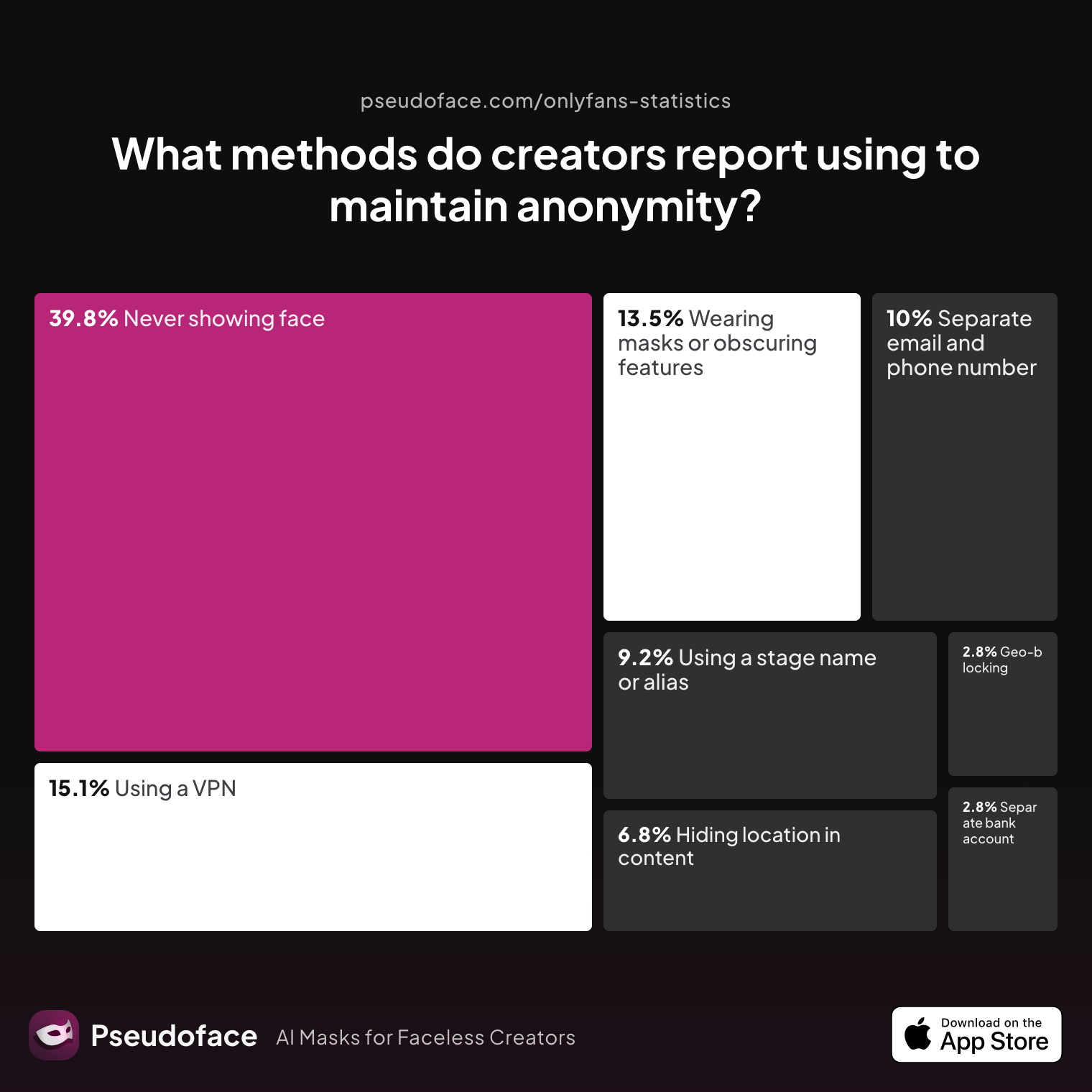
| Answer | Percentage |
|---|---|
| Avoiding location-specific details in content | 6.77% |
| Geo-blocking specific regions | 2.79% |
| Never showing face | 39.84% |
| Using a separate bank account or business entity | 2.79% |
| Using a separate email and phone number | 9.96% |
| Using a stage name or alias | 9.16% |
| Using a VPN or privacy tools | 15.14% |
| Wearing masks or obscuring identifying features | 13.55% |
Key finding:
13.55% of creators cite masks as their anonymity method, but 39.84% report “never showing face” using all means—a reminder that masking is often combined with other privacy strategies for maximum protection.
Reddit threads underscore that masking alone isn’t a cure-all for privacy, but part of a layered approach to staying anonymous on OnlyFans, including cropping, pseudonyms, and platform separation.
FAQ
What are the most comfortable masks for OnlyFans creators who sweat easily?
The most comfortable masks for sweaty creators are breathable fabric or mesh-paneled designs that maximize airflow without sacrificing coverage.
Lightweight cloth or custom mesh options, with wicking liners or removable inserts, are rated highest—while sealed silicone or cheap latex push many creators to abandon mask use quickly.
Are Ghostface or bunny masks actually allowed by OnlyFans TOS?
Yes, Ghostface and bunny masks are typically permitted for content, but caution is needed for banners or commercial promos due to possible copyright issues.
OnlyFans rules focus on content, not costumes; copyright/trademark risks mainly arise if using actual branded imagery in banners or marketing. In practice, bans are rare for masked content alone.
How do I keep my mask consistent across different types of OnlyFans content (photos, video, live)?
Buy at least two (or more) identical masks and store backups; always check for color or fiber differences in restocks before major content drops.
Many creators pre-test new orders on camera for lighting consistency—some even commission custom fabric patterns or dye existing masks to exact match their brand palette.
Where can I buy custom-fit masks that won’t break the bank?
Custom-fit masks are most budget-friendly on Etsy or via direct commissioning from small makers; most range from $40–$120 USD.
Direct communication about measurements ensures the right fit, and small-brand creators often give repeat client discounts or package deals for multiple backups.
How do I avoid accidental face reveals when using masks?
Pick masks with secure fastenings (head straps, adjustable tightness), test in full-length rehearsal, and avoid loose or “one-size-fits-all” bands.
Reddit threads and survey data agree: fit, predictability, and “practice shoots” prevent the vast majority of accidental reveals reported by creators.
What cleaning routines prevent breakouts or odors in reusable masks?
Hand wash cloth or mesh masks immediately after use with hypoallergenic detergent; thoroughly wipe and air dry silicone/latex masks after each shoot.
Store flat in a ventilated area and use unscented barrier creams to minimize skin reactions—regular cleaning prevents both odor and acne for most creators.
Do most subscribers care if I use a mask, crop, or digital filter?
Most paying subscribers react positively or neutrally to masks; about 15% voice strong dislike, but brand recognition and “fetish interest” are common in masked personas.
Survey data and Reddit posts concur: masks are accepted, often admired, and for a segment of buyers, drive extra appeal compared to filters or cropping.
How do I choose a mask that stands out for branding but isn’t too uncomfortable?
Opt for custom or limited-edition styles in mesh or lined fabric for the best comfort/brand impact balance—avoid sealed, rigid, or mass-market plastic if planning long shoots.
Commissioning a unique color or pattern, or adding subtle embellishments, signals identity while letting you stay masked for hours.
Will using a custom mask protect my real-world privacy if someone tries to dox me?
A custom mask reduces but does not eliminate doxxing risk; combining masking with other privacy hygiene (alias, no metadata leaks, and staged content separation) is best.
Data shows accidental reveals are rare with proper fit, but digital sleuthing via other avenues remains a risk—don’t treat masking as a total security solution.
If my mask becomes unavailable or discontinued, how can I maintain brand consistency?
Keep two or more backups of your signature mask, and be ready to “soft rebrand” with a similar style or color palette if forced to switch.
Several Reddit creators report successful transitions by addressing changes transparently in captions and themed posts—not masking the switch but integrating it as evolution.
In a world where privacy and persona are always in tension, masks offer a time-tested, expressive answer. The key isn’t just picking what looks cool—it’s matching comfort, continuity, and compliance to your creative workflow. Treat your mask as both a shield and a stage, and you’ll find the sweet spot for both brand and sanity.


