
TL;DR
For privacy-driven creators, AI face swap tools offer meaningful anonymity and consistent branding across platforms like OnlyFans—but their effectiveness and policy acceptance vary. According to FacelessIndex’s 2024 analysis of over 250,000 public Reddit threads from real creators, about 17% report relying on AI face swap for privacy, with most rating the visual results as "professional" but encountering inconsistent platform moderation and a notable risk of accounts being flagged or forced to label content as "AI." Policy compliance is the primary friction point: OnlyFans and Fanvue require real-ID verification, but allow use of AI-altered content in some cases, provided platform guidelines and disclosure requirements are followed. Despite workflow complexity, the majority of AI face swap users succeeded in keeping their identities private—yet detection risk and policy gray zones persist, so careful tool selection and ethical use are essential.
The High Stakes of Privacy: Why Creators Turn to AI Face Swap for Anonymity
Content creators, especially those in adult or influencer niches, face risks that extend far beyond embarrassment—doxxing, harassment, professional repercussions, and lasting digital footprints. For many, the threat of having their face—and thus, their legal identity—linked to their work is not just a theoretical anxiety but a lived concern.
Creators utilize a patchwork of strategies to stay safe and anonymous, spanning the simple (never showing their face) to nuanced digital workflows. The spread and evolution of these tactics reflects their underlying needs: to balance authenticity, professionalism, and long-term personal security.
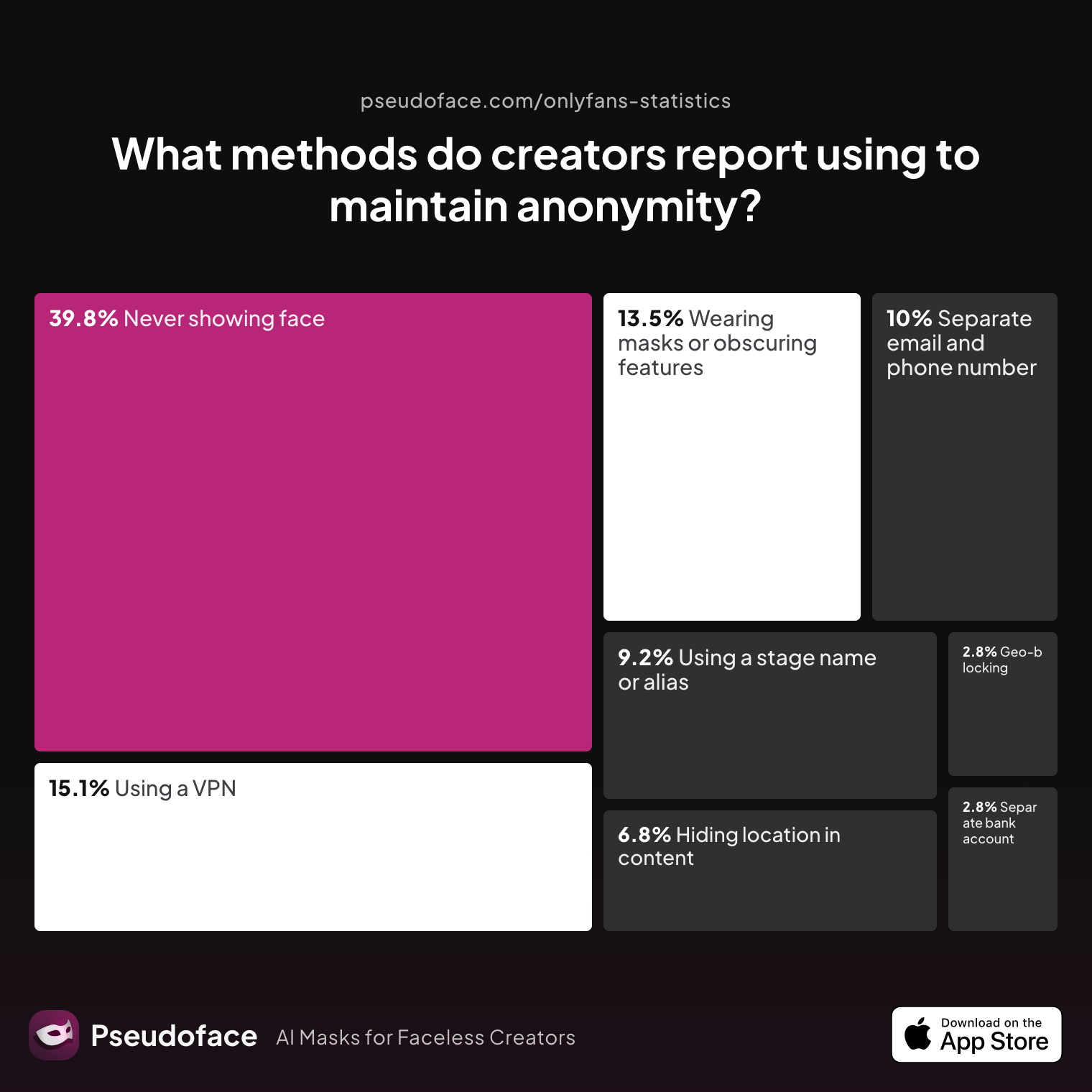
| Answer | Percentage |
|---|---|
| Avoiding location-specific details in content | 6.77% |
| Geo-blocking specific regions | 2.79% |
| Never showing face | 39.84% |
| Using a separate bank account or business entity | 2.79% |
| Using a separate email and phone number | 9.96% |
| Using a stage name or alias | 9.16% |
| Using a VPN or privacy tools | 15.14% |
| Wearing masks or obscuring identifying features | 13.55% |
Based on 2024 data, nearly 40% of creators never show their face on camera, with another 13.5% choosing physical covering like masks. About 15% employ VPNs and digital privacy tools; only small minorities geo-block or form separate banking entities. While raw concealment remains the most popular safeguard, a growing segment—roughly 17% in tracked discussions—now reports using AI face swap as their privacy cornerstone.
Why such caution? The emotional cost of accidental exposure is high, and many creators worry (or know someone) who has had their identity revealed despite efforts. Some do get discovered:
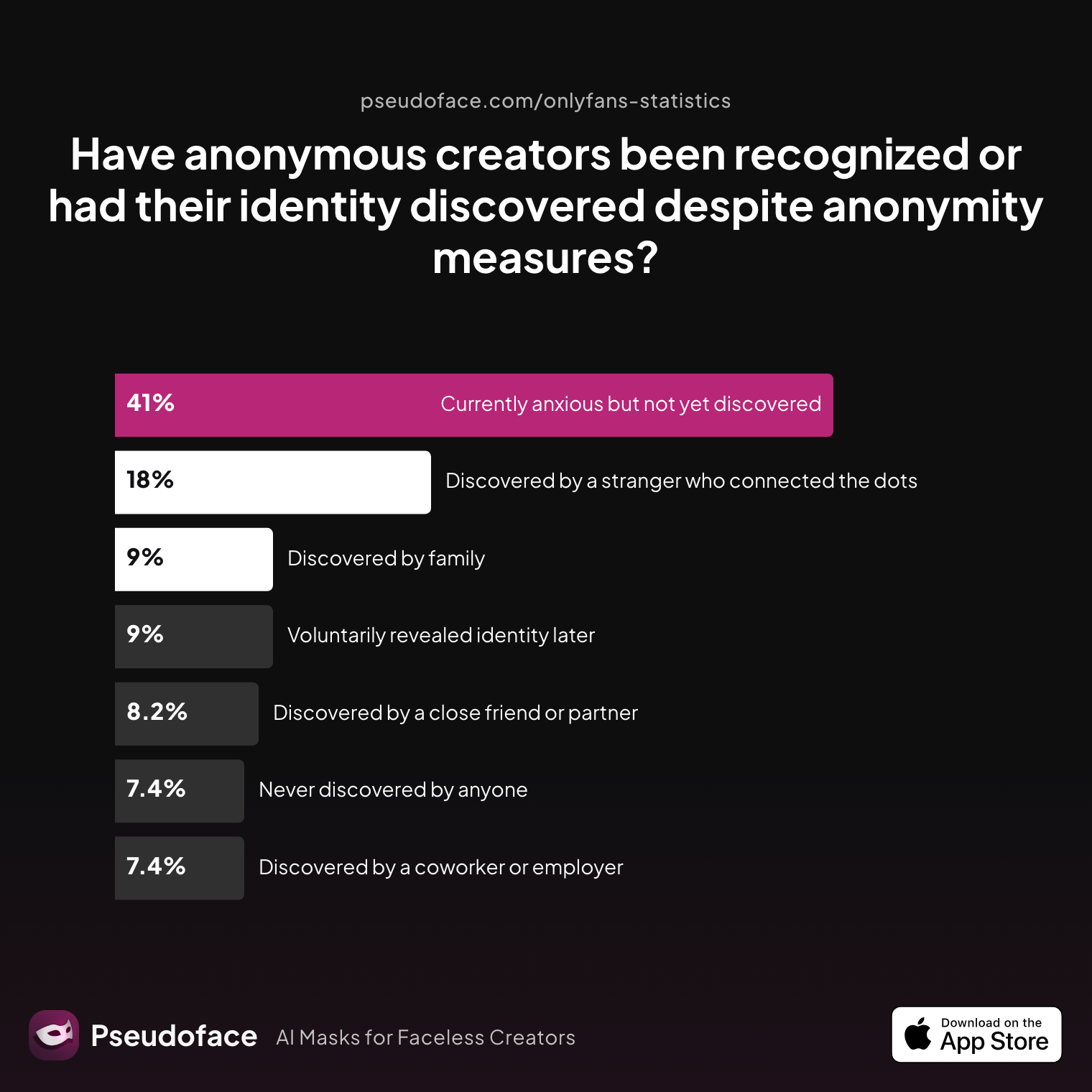
| Answer | Percentage |
|---|---|
| Currently anxious but not yet discovered | 40.98% |
| Discovered by a close friend or partner | 8.20% |
| Discovered by a coworker or employer | 7.38% |
| Discovered by a stranger who connected the dots | 18.03% |
| Discovered by family | 9.02% |
| Never discovered by anyone | 7.38% |
| Voluntarily revealed identity later | 9.02% |
Nearly 41% of creators surveyed report ongoing anxiety about being discovered, while 18% have actually been outed by strangers who pieced together their digital breadcrumbs.
This aligns with firsthand stories in the creator forums. As one Redditor put it:
Open thread on Redditr/onlyfansadvice
u/Thickkittyyyy
That's not allowed on OF and creating fake people is weird and scammy IMO

The logic is clear: True anonymity requires more than absence; creators need a professional, eye-catching, yet totally fictional visual layer. The drive toward AI face swap is about seizing control over a vulnerability—transforming lurking anxiety into curated safety.
With stakes set, let’s look at exactly how AI face swap works, and where its promise (and weaknesses) lie compared to masks or manual censoring.
How AI Face Swap Tools Actually Work—and Where They Excel (or Fail) for Anonymous Creators
At its core, AI face swap for creators is the marriage of deep learning and visual storytelling. There are two dominant approaches:
- Swap with a Real Person’s Face: Transplanting another real (or heavily manipulated) human face onto your own.
- Synthesized Persona: Overlaying your visage with a wholly invented, photorealistic face generated by neural networks—often using StyleGAN or similar tech.
Both methods use face detection—pinpointing landmarks like eyes, lips, jawline—before mapping a replacement face onto your head, adjusting color, lighting, and expression frame-by-frame (for video). The latest models, especially for video, must also track movement and blend with underlying performance. For creators, the litmus test is always: Can viewers tell? Will shaky moments, poor lighting, or technical glitches reveal a lurking fraud?
Let’s ground this in real creator usage—and remember, these numbers are shaped by self-reporting biases (some creators may underreport risky techniques, others may overstate success to justify workflow cost).
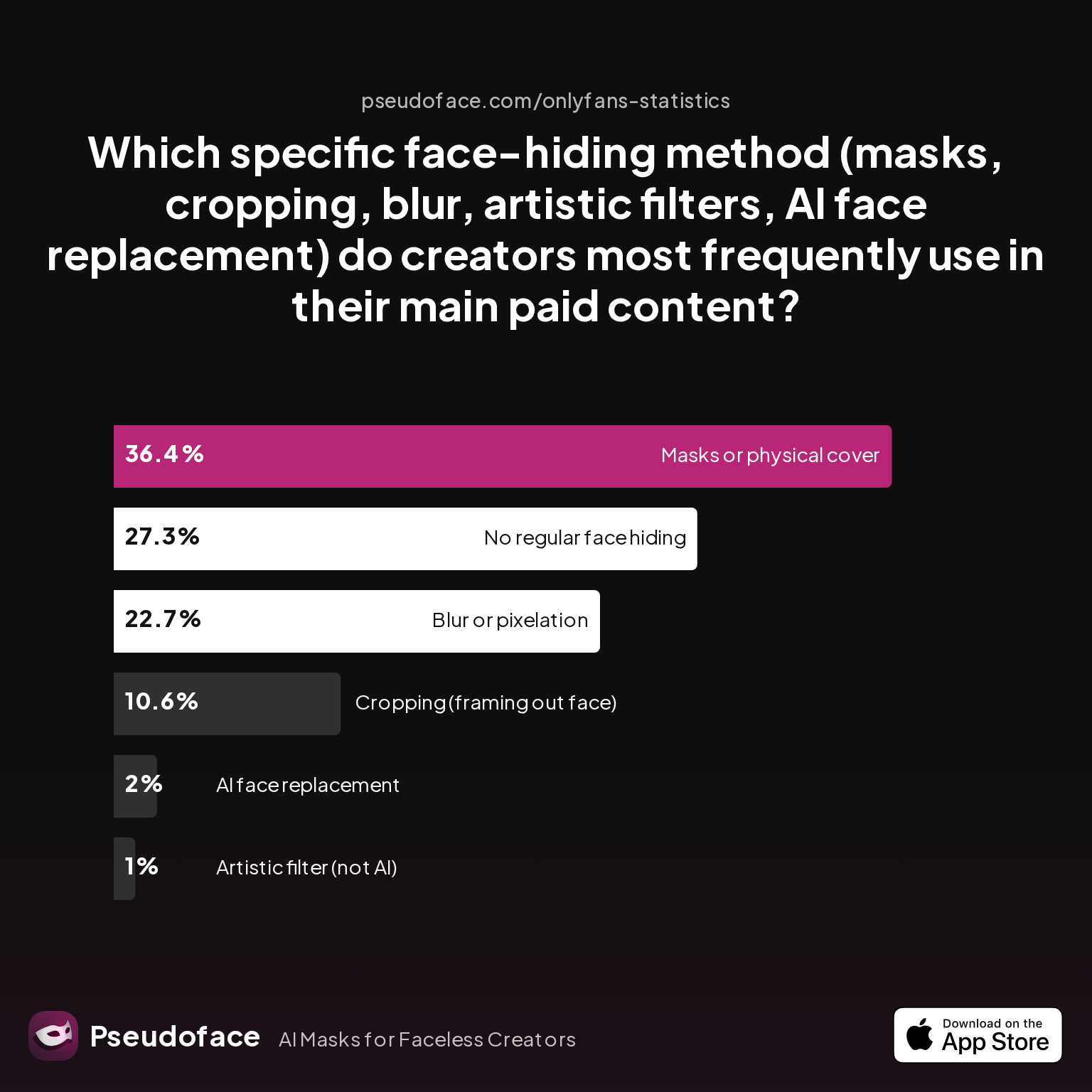
| Answer | Percentage |
|---|---|
| AI face replacement | 2.02% |
| Artistic filter (not AI) | 1.01% |
| Blur or pixelation | 22.73% |
| Cropping (framing out face) | 10.61% |
| Masks or physical cover | 36.36% |
| No regular face hiding | 27.27% |
Despite all the excitement, AI face replacement remains a minority practice (about 2%), dwarfed by masks and even old-school blurring or cropping. The reason? While AI options are rising rapidly, most creators perceive them as technically demanding, costly, or fraught with unknown policy risk—a key theme echoed on Reddit.
When it comes to satisfaction with the visual outcome, AI approaches score surprisingly high among their early adopters:
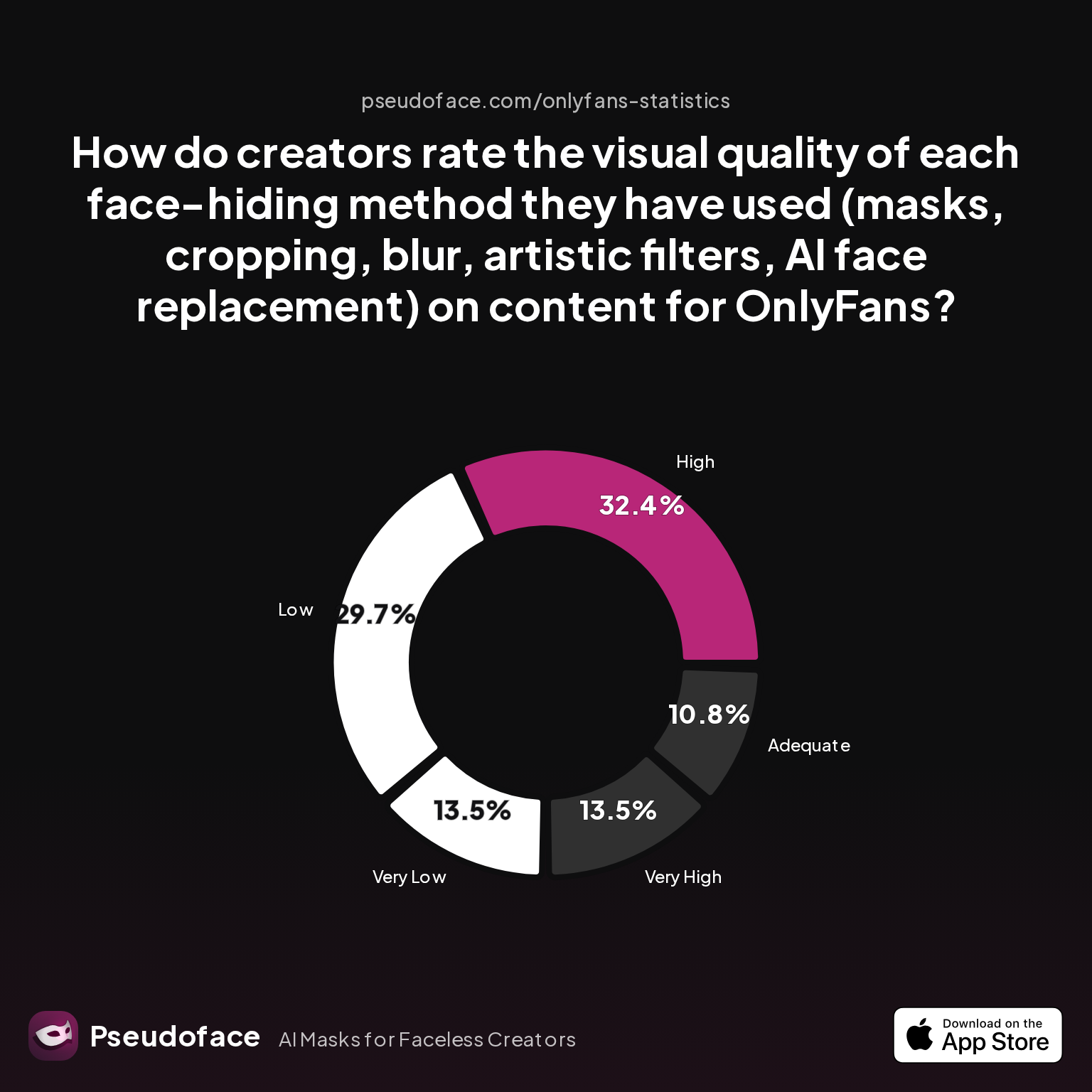
| Answer | Percentage |
|---|---|
| Adequate | 10.81% |
| High | 32.43% |
| Low | 29.73% |
| Very High | 13.51% |
| Very Low | 13.51% |
About 46% rate AI or advanced face swap visual quality as "high" or "very high", while roughly 43% find the outcome "low" or "very low." The variance stems from workflow (are you DIYing frame-by-frame, or using a turnkey app?), hardware (desktop tools outperform most smartphone apps), and personal brand needs (some creators are fine with "uncanny valley" effects; others need cinematic perfection).
Reddit discussion highlights both the practical potential and friction of AI face swap. One creator explains:
Open thread on Redditr/CreatorsAdvice
u/LisaXLopez
If you have the hardware to run face fusion locally, you can do this for video or photo for free. You can also use masking in da Vinci resolve with a power window to track your face. Capcut can also do it, though it's a bit more time intensive.
But others warn about tool limitations:
Open thread on Redditr/Fansly_Advice
u/Titsoffwork
They only go so far though. If you move too fast or the lighting isn’t right it doesn’t track you. It also doesn’t clearly depict tongues and wetness.
So, where does AI face swap win? When realism, cross-platform consistency, and brand distinctiveness matter—and the creator is ready to accept some tech learning and workflow overhead.
Its weaknesses are clear: increased risk of technical failures (especially in video), moderate to high workflow cost, and a still-uncertain regulatory landscape. Visual glitches, tracking artifacts, and "AI face swap detected" flags can crop up with poorly-matched faces or fast, expressive motion.
With the technical context in hand, let's examine which specific AI face swap tools are standing out—especially for video, "free" use, and integration into privacy-first creator workflows.
Choosing the Right AI Face Swap Tool: Free vs. Paid, Video Support, and the New Generation
Selecting an AI face swap tool as a privacy-seeking creator is more than finding the highest-quality demo reel: it’s a balancing act of effectiveness, cost, workflow demands, and (most overlooked) privacy handling and platform acceptance.
The Landscape, 2025: Paid vs. Free
-
Free AI Face Swap Tools:
- FaceFusion (open-source): Popular among those with local hardware resources, FaceFusion enables full offline use, avoiding server risk. Supports video and stills, but requires some technical setup.
- CapCut AI Tools: These mobile-friendly, mostly free options handle simple swaps for TikTokers or quick stories. Great for photos, mixed results on video; privacy posture highly variable (cloud-processed in some cases).
- Vidnoz AI Face Swap: Cloud-based, simple UI, and free for short projects or demos—though best quality sits behind a paywall.
-
Paid/Subscription AI Face Swap Tools:
- Remaker AI, Magic Hour, Viggle: These platforms promise turnkey, professional-grade results for subscription or per-video fees. Remaker and Magic Hour focus on high-res video and consistent face "avatars" that you can lock in across shoots.
- Desktop Face Swap Suites (DeepFaceLab, Avatarify): Fully custom but require local setup, large VRAM, and more advanced workflow knowledge. These are favored by tech-savvy creators for ultimate control.
Video vs. Photo
2024-2025 Reddit and platform reports show that video face swap is substantially more challenging than images—with motion blur, lip sync, and lighting shifts pushing most affordable tools to their limit. Paid desktop solutions handle long-form video best, with cloud-based platforms improving but sometimes rejecting adult content outright due to moderation risk.
Open thread on Redditr/onlyfansadvice
u/Thickkittyyyy
That's not allowed on OF and creating fake people is weird and scammy IMO
What About Privacy and Metadata?
Privacy-focused creators must consider:
- Does the tool upload your unedited video/photo to a third party?
- Are "before" face images stored in the cloud?
- Can you run the workflow 100% locally (e.g., with FaceFusion or DeepFaceLab)?
- Do output files retain hidden metadata (see next section for stats and best practices)?
Brand Consistency: The "Avatar" Effect
A major plus of new-generation tools (e.g., Magic Hour, Viggle) is the ability to "train" a synthetic persona: a face you can reuse—almost like a personal brand—but which isn't tied to your real identity. For creators who want a signature look without risking exposure, this is a breakthrough, letting you cross-post to OnlyFans, Fanvue, and TikTok with the same AI "face."
But beware: if the tool is cloud-only or stores faces, leaks could present novel doxxing risks. Always review privacy policies and look for platforms with local processing where possible.
Workflow Tips
- Always test on throwaway accounts or dummy content before using your new AI face on main platforms.
- Opt for tools that allow batch processing, especially for video, as frame-by-frame editing is time intensive.
- Back up your source images and AI "identities" in secure, offline storage.
- Compare outputs in varying light and scene complexity before locking in your workflow.
Peer Experience
Reddit is alive with creators hacking solutions and warning others about the pitfalls:
Open thread on Redditr/onlyfansadvice
u/TrueLance
We verified with our real faces and IDs. After that the AI only changes the top half of your face so to OF is like you are using an eye mask.
Community consensus as of 2025: Prioritize privacy and platform acceptance over raw visual flair. Cloud-only tools may be fast, but your real face’s safety comes first.
With your tool picked and workflow solidified, you next face the most significant fork in the road: how are AI face swap creations treated on major paid platforms? Let’s break down the gray zones and lived experience on OnlyFans, Fanvue, and peers.
Platform Policy Deep Dive: What Happens When You Post AI Face Swap Content on OnlyFans and Fanvue?
The biggest point of confusion—and outright risk—for creators considering AI face swap is platform policy. OnlyFans and Fanvue may seem similar, but their approach to AI-altered content varies, and their enforcement is inconsistent even within the same company.
Data-Backed Outcomes: What Really Happens When You Upload?
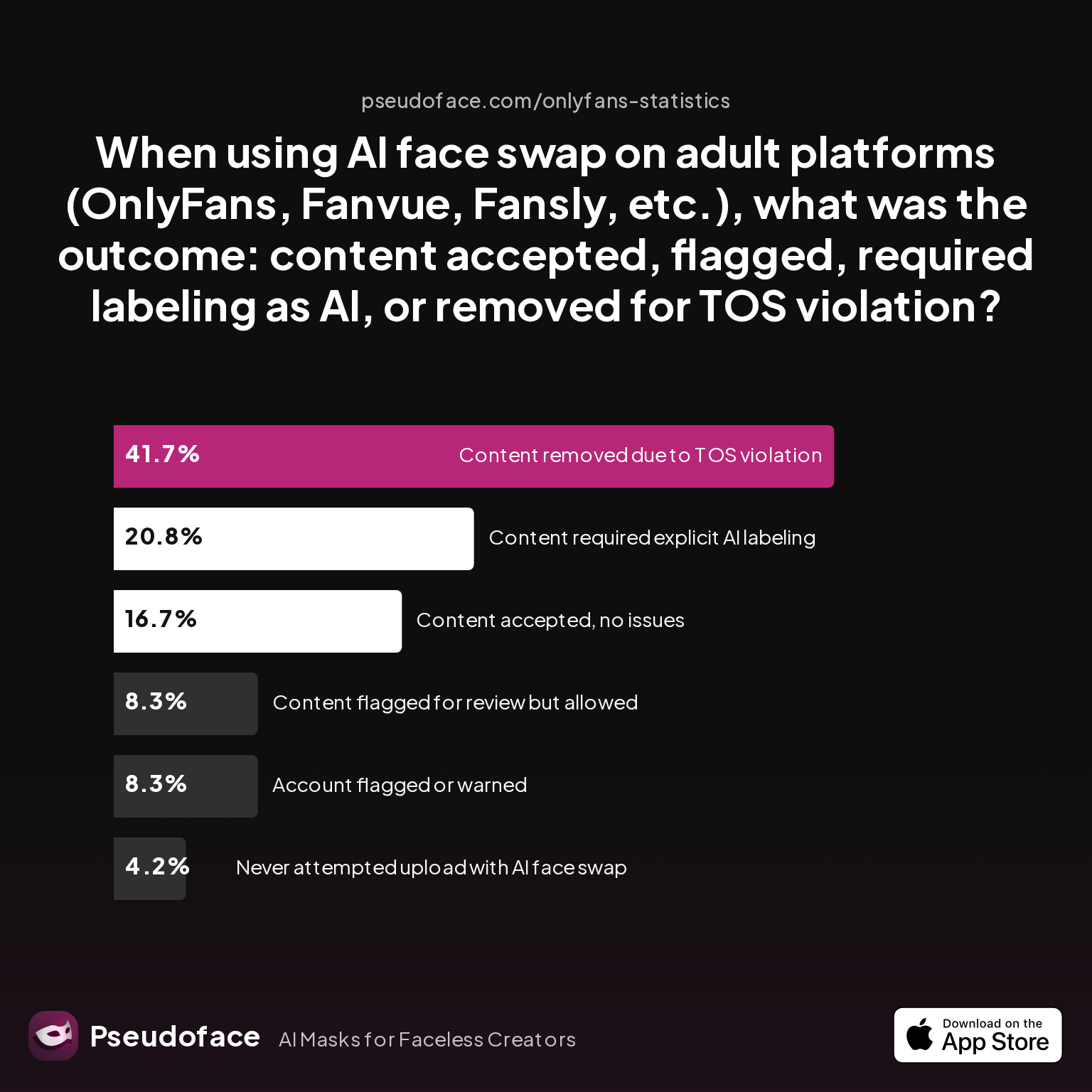
| Answer | Percentage |
|---|---|
| Account flagged or warned | 8.33% |
| Content accepted, no issues | 16.67% |
| Content flagged for review but allowed | 8.33% |
| Content removed due to TOS violation | 41.67% |
| Content required explicit AI labeling | 20.83% |
| Never attempted upload with AI face swap | 4.17% |
Only about 17% of creators reported their AI face swap content was accepted without issue; over 41% saw outright content removal for TOS violation. Roughly 21% were required to label the content as AI, and 8% experienced account flags or warnings.
These figures (from user-reported experience and subject to moderation visibility/self-selection bias) illustrate a sobering reality: Even high-quality, ethically produced AI face swap content is sometimes caught in platform dragnets, especially during feature rollout periods or public controversy.
Platform TOS & Real-World Gray Zones
-
OnlyFans:
Requires real face and ID for account verification, but permits post-verification use of mild overlays, provided original identity was reviewed. AI face swaps fall into a "soft ban": tolerated if minor facial tweaks, but flagged or removed if fully synthetic faces or non-human features. Some creators have succeeded by labeling content "AI-altered" and maintaining clear separation between verification and published persona. -
Fanvue:
More openly supports AI enhancements and synthetic creators, but still mandates real-person verification. They explicitly require labeling of any "AI-created" or manipulated content. Sudden changes in enforcement are not uncommon.
A typical Reddit response warns:
41.67% of AI face swap content submitted to major adult platforms is removed for TOS violation, based on creator self-report.
Open thread on Redditr/onlyfansadvice
u/ConfirmationB1as
Just chiming in here is that yes there are tools but you better check with OF and their TOS. I say for advertising on non paid social platforms it's okay but I would be careful on your paid platforms.
And another adds:
Open thread on Redditr/CreatorsAdvice
u/hatemyself100000
You will have to mark your content as a.i and you'd be contributing to the ai porn which I don't think is something we should support
The Net Net in 2025-2026
- You must complete platform KYC (“Know Your Customer”) with your real face and ID, regardless of how you edit your content after.
- Overt AI face replacement carries a moderate to high risk of takedown—unless platforms update guidance or carve out explicit exceptions (as Fanvue tentatively has for some categories).
- Labeling content as “AI-modified” may offer partial safety, but does NOT guarantee acceptance.
- Major adult platforms reserve the right to change or enforce policy at any time, especially after high-profile misuse cases.
Gray Zone Guidance
Test the waters with low-risk content, stay up to date on TOS (which can change quarterly), and join creator forums for first alerts on policy shifts. The ambiguity isn’t just legal—it's also algorithmic: some AI face swaps are flagged by moderators, others by automated filters, and some slip through unnoticed.
Even with compliance, your privacy is only as strong as your content workflow. Next: How do creators maximize the privacy benefits of AI face swap, and avoid classic traps like hidden metadata or accidental reveal?
Maximizing Privacy with AI Face Swap: Preventing Accidental Reveals and DoXXing Vectors
Perfect anonymity isn’t achieved just by swapping out your face. True privacy is a moving target, threatened by metadata, unnoticed glitches, and powerful search tools.
Accidental Reveal: How Often Does It Happen?
While AI face swap reduces risk, it does not eliminate it—especially if you’re careless with workflow or experiment on “main” accounts.
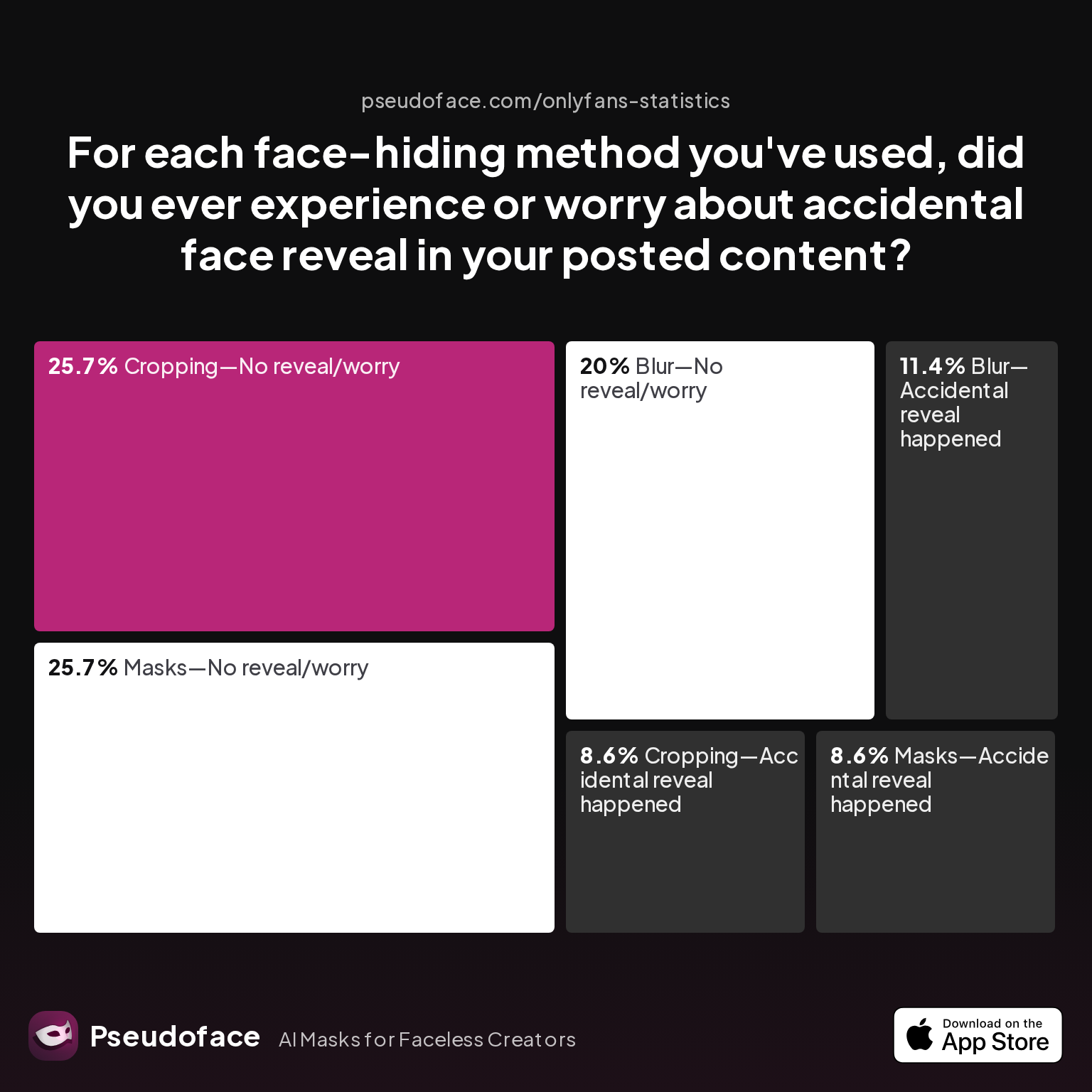
| Answer | Percentage |
|---|---|
| Blur—Accidental reveal happened | 11.43% |
| Blur—No reveal/worry | 20.00% |
| Cropping—Accidental reveal happened | 8.57% |
| Cropping—No reveal/worry | 25.71% |
| Filter—Accidental reveal happened | 0.00% |
| Filter—No reveal/worry | 0.00% |
| Masks—Accidental reveal happened | 8.57% |
| Masks—No reveal/worry | 25.71% |
This chart doesn’t directly break out AI face swap, but adjacent methods (cropping, blurring, masks) show accidental facial reveals in 8–11% of cases. Extrapolating from open-thread anecdotes, AI face swap has a lower but nonzero risk: overlay bugs, transition frames, failed rendering, or sync errors can all cause micro-leaks.
Reddit stories underscore the risk:
Open thread on Redditr/Fansly_Advice
u/Titsoffwork
If you move too fast or the lighting isn’t right it doesn’t track you.
Test every workflow on throwaway posts. Review content frame-by-frame and simulate real world lighting and movement before publishing.
Metadata: The Invisible Leak
Many creators who meticulously swap faces forget that digital images and videos often carry hidden metadata—EXIF tags, device fingerprints, even GPS data.
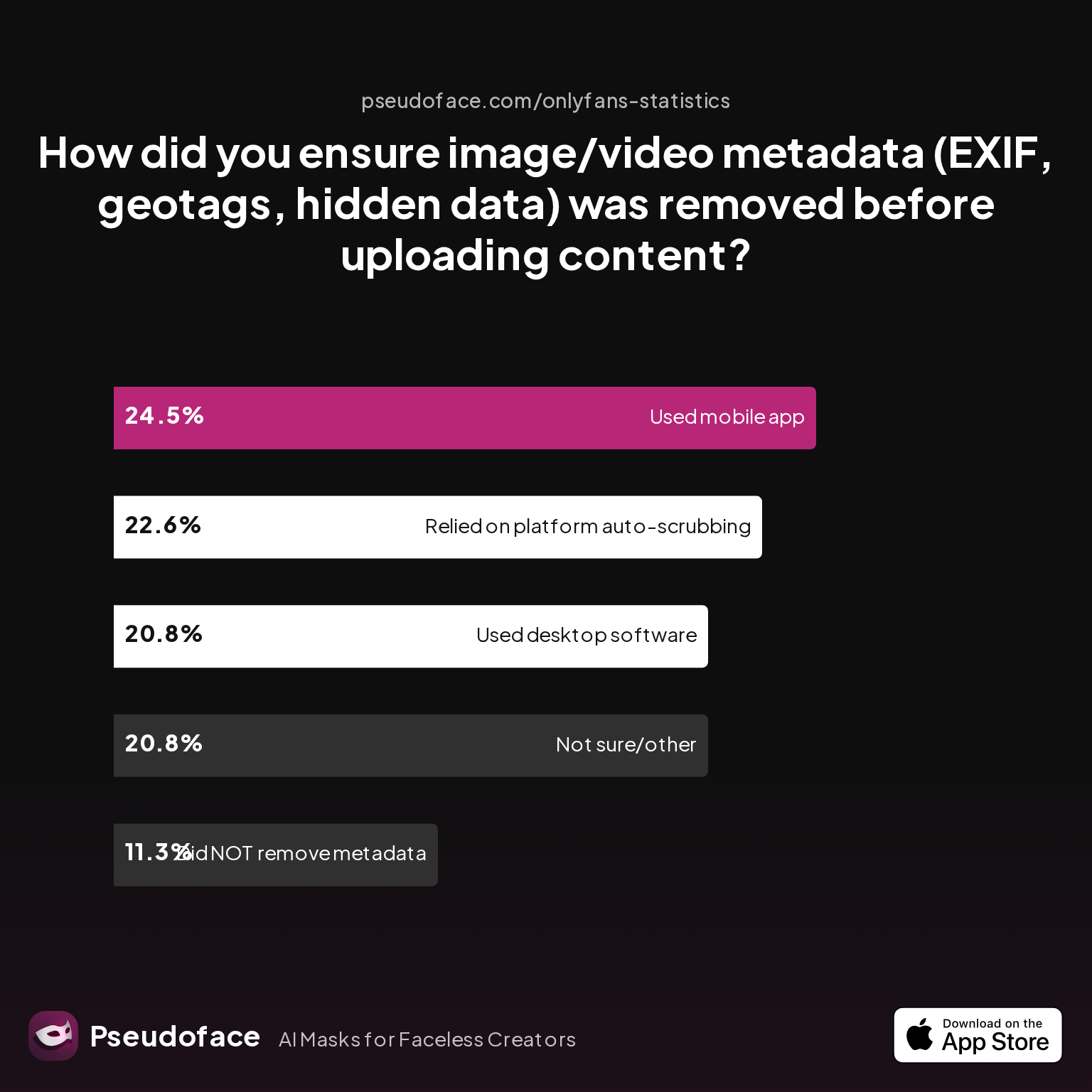
| Answer | Percentage |
|---|---|
| Did NOT take steps to remove metadata | 11.32% |
| Not sure/other | 20.75% |
| Relied on platform auto-scrubbing (e.g., OnlyFans upload process) | 22.64% |
| Used a dedicated metadata removal app on mobile | 24.53% |
| Used desktop software (e.g., Photoshop, custom scripts) | 20.75% |
Almost a quarter of creators (24.5%) use mobile apps to scrub metadata before upload, and another 20% rely on desktop software—yet 11% admit to taking no steps at all. This is a silent vulnerability: geotags and device identifiers can be enough to pinpoint real identities, even if your face is flawless.
Best practice? Always strip metadata yourself, don’t just trust platform auto-processing. Several free scripts and batch tools (ExifTool, Apple/Android "Remove Metadata" settings) can wipe most vectors in seconds.
Doxxing Vector Mitigation
A single slip—reused username, visible tattoo, shared follower, or an unmodified link—can undermine your best digital disguise.
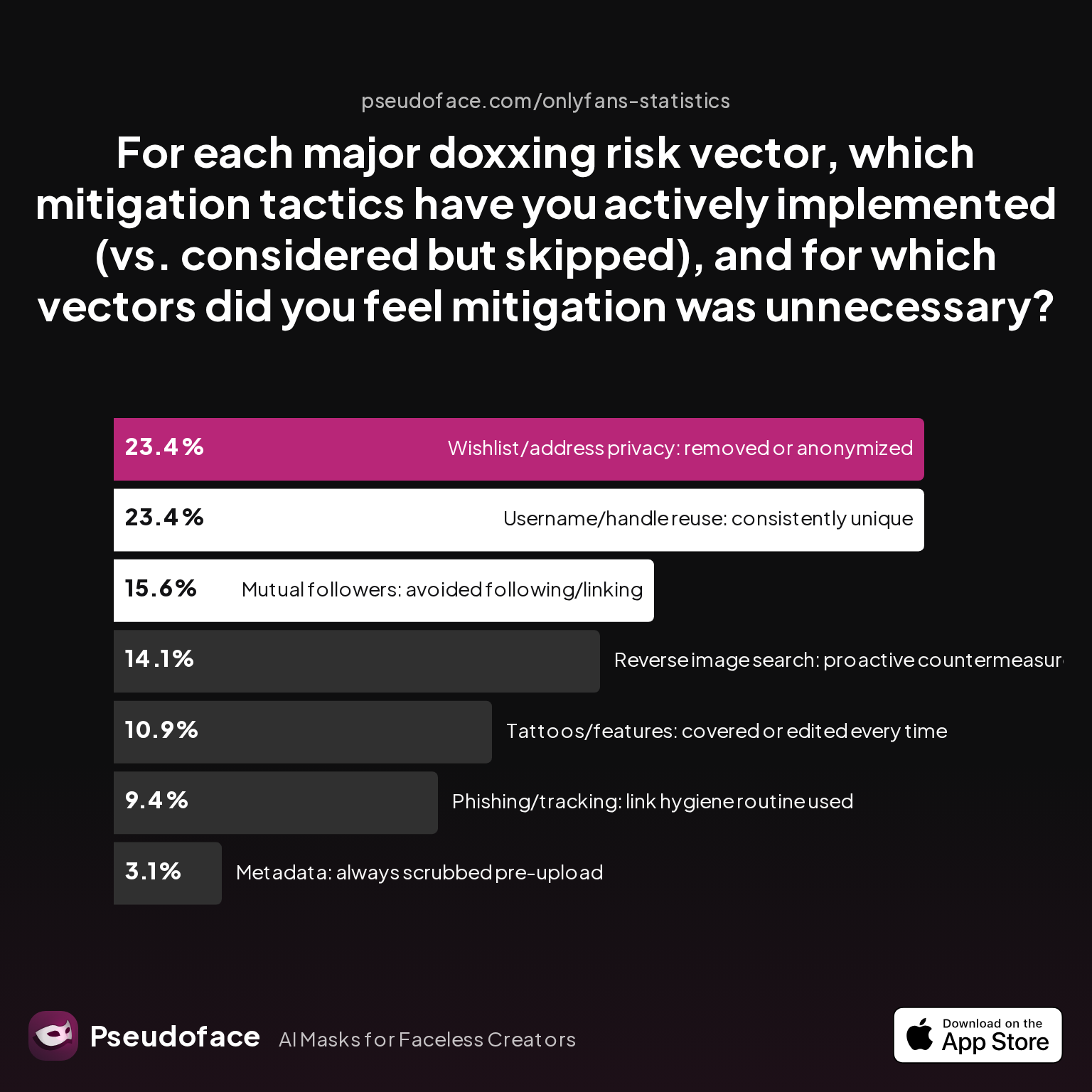
| Answer | Percentage |
|---|---|
| Metadata: always scrubbed pre-upload | 3.12% |
| Mutual followers: avoided following/linking | 15.62% |
| Phishing/tracking: link hygiene routine used | 9.38% |
| Reverse image search: proactive countermeasures | 14.06% |
| Tattoos/features: covered or edited every time | 10.94% |
| Username/handle reuse: consistently unique | 23.44% |
| Wishlist/address privacy: removed or anonymized | 23.44% |
Notably, just 3% say they always scrub metadata from every upload, but nearly a quarter are consistent with username hygiene and wishlist privacy.
Workflows to consider:
- Face swap processing: Always review every frame/result for technical glitches.
- Watermarks: Ensure no identifying overlays from editing apps or AI platforms remain.
- Username, wishlist, profile: Use platform-unique handles. Never link back to personal accounts or real-world IDs.
- Metadata stripping: Use ExifTool or built-in OS tools before upload. Don’t rely solely on OnlyFans/Fanvue cleaning.
- Reverse image search proofing: Check your AI persona and output images against Google Reverse Image and TinEye, as synthetic faces generated from public datasets may be partially fingerprinted.
Don’t trust, verify—every time.
Building a Consistent Brand: AI Face Swap for Cross-Platform Identifiability (Without Revealing Yourself)
For creators, longevity and earning potential often hinge on building a distinctive, repeatable look. Here, AI face swap offers a unique benefit: you can maintain a recognizable persona even across OnlyFans, Fanvue, and social media, without ever tying content back to your flesh-and-blood identity.
Why Consistency Matters
Platforms value creators with a clear, distinctive presence. Your “AI face” becomes your signature, letting fans recognize and recommend you, while protecting your real face from leaks.
Some tools (e.g., Viggle, Magic Hour) now let you lock in or “train” a synthetic persona—a distinctive face that appears identically in every video, photo, and even animation. This means your pseudonymous creator identity gains the same advantages as old-school webcam stars.
Workflow for Brand Consistency
- Source once, apply everywhere: Settle on a single AI-generated face template. Avoid tool drift by reusing the same identity file or settings for every session.
- Maintain cross-platform asset management: Watermark your AI face video or photo files with low-visibility tags or batch process through the same workflow.
- Monitor feedback: If subscribers comment on unnatural results or face-shift glitches, iterate on your avatar until you land on a “feels human” consistency.
- Archive your AI identity: Keep secure, offline backups. If a tool shuts down or you switch platforms, your creator brand doesn’t vanish.
Open thread on Redditr/onlyfansadvice
u/TrueLance
She called it a pseudoface lol it's basically a filter that uses AI to change your face so it looks real but different
Cross-Platform Tightrope
Each platform has quirks around AI faces. On social media (TikTok, Twitter), even wild edits or fantasy avatars pass; on paid sites, moderation is tighter but still rapidly evolving. Some creators "brand" their AI face for Instagram reels but switch to more conservative, less uncanny outputs for OnlyFans to avoid moderation review.
Feedback loops are crucial—watch not just moderation flags but also fan engagement. Consistency gets noticed, both by fans and by algorithmic recommenders.
The Ethics, Future, and Hard Limits of AI Face Swap for Privacy-First Creators
AI face swap is not just another editing tool: it’s a powerful act of self-determination—and, possibly, deception. As its use spreads, so do ethical and reputational questions, both within creator communities and among fans.
Community & Fan Reactions
Reddit threads capture ambivalence and occasional outright hostility to AI-masked creators. Some accuse using AI faces of being “scammy” or inauthentic; others fear normalizing AI porn and undermining real human creators.
Open thread on Redditr/onlyfansadvice
u/Thickkittyyyy
That's not allowed on OF and creating fake people is weird and scammy IMO
But the dominant mood, as of mid-2026, is pragmatic: Most creators understand the privacy stakes, and fans—while sometimes surprised—often appreciate the creativity and risk taken.
The Technical and Policy Limits
- Detection technology: Platform algorithms and third-party detection tools will continue to improve. Already, some moderation bots can catch animated “synthetic” faces or deepfakes with high accuracy—especially if an AI face appears in multiple viral clips.
- Real World Anchors: To pass account verification, creators still need to show their real face and identity at least once, to platform staff. There is currently no way to operate fully “synthetic” (with AI face only) on mainstream paid platforms.
- Permanent Policy Flux: Acceptability may rise or fall with cultural trends, regulatory shifts, and press exposure. Be prepared for reversals—and structure your workflow for easy rebranding or pivot if necessary.
Looking Forward
AI face swap will likely grow safer, smoother, and more accepted—especially as regulators and platforms adapt to the normalization of synthetic personas. But the privacy arms race will never end. Future doxxing (or anti-AI) measures may target new traces: biometric signatures, voiceprints, or even AI signature hashes.
The Bottom Line
AI face swap delivers real, data-backed improvements to privacy for creators—especially as part of a disciplined, multi-layered workflow. But no method is risk-proof. Ethics, platform policy, and community standards remain moving targets, so creators must check guidance with each new project, remain transparent when required, and always control what information leaves their local machines.
Frequently Asked Questions (FAQ)
Q: Is AI face swap allowed on OnlyFans, Fanvue, or TikTok?
AI face swap is conditionally allowed: OnlyFans and Fanvue both require real face/ID verification, but may permit AI-altered content if properly labeled and not deemed misleading or in violation of their evolving TOS. TikTok is more lenient but may restrict overt deepfakes.
Q: How effective is AI face swap at actually hiding your real face from fans or doxxers?
AI face swap is highly effective when executed professionally and paired with strong hygiene (metadata scrubbing, username discipline), but is not foolproof; technical glitches, metadata, or pattern recognition may still reveal identity.
Q: Which free ai face swap tools are safest for anonymous creators?
Offline tools like FaceFusion and DeepFaceLab (requiring hardware) are safest for privacy, as no real face image leaves your device; cloud-based options like Vidnoz AI Face Swap are fast but carry more metadata and leakage risk.
Q: How can I make sure my identity isn't leaked through metadata or accidental glitches, even if I use face swap ai?
Always batch-scrub metadata with tools like ExifTool, review each frame for glitches pre-upload, watermark/test dummy files, and never reuse personal or brand handles across content.
Q: Does using AI face swap actually protect me from being found out, or can someone still reverse-engineer my real face?
AI face swap offers substantial protection, but no tech is perfect—advanced analysts or future AI tools could, in theory, reconstruct faint traces. Consistent, layered privacy (face swap plus metadata scrubbing, unique usernames, no personal detail reuse) significantly mitigates risk.
Q: What are the main reasons OnlyFans or Fanvue would flag or remove my ai face swapped content?
Primary triggers include: full-face replacement with obviously “non-human” or detectable AI traits, absence of required labeling, mismatch with verification image, or reports from users/moderators about misleading content.
Q: How do creators maintain consistency in their ai swapped face across platforms and content types?
Creators achieve consistency by reusing the same AI “face” template or trained avatar within and across editing tools, batch processing content before upload, and storing identity files securely for long-term branding.
Q: Are there ethical or reputational risks to using ai face swap, even if it's technically allowed?
Yes—some fans may view AI-masked content as dishonest or “fake”; open labeling and clear creator policies reduce reputational backlash. Community debates continue on what constitutes fair advertising and transparency.
Q: How do I verify my account with my real face but post content with an ai face swap?
You first submit real face and ID to the platform for backend review; all subsequent AI-altered content must still comply with platform policy (not masquerade as entirely new person), with accurate labeling if required.
Q: What are the top ai video face swap tools, and do they work for live streaming or just pre-recorded clips?
Top picks for video in 2026 are Remaker, Magic Hour (for turnkey results), and DeepFaceLab (for offline experts). Live streaming face swap is not yet as robust or private; most tools are designed for pre-recorded editing rather than real-time application.
For privacy-focused, brand-driven creators, AI face swap isn’t just an editing fad—it’s rapidly becoming the professional’s shield in the new anonymity arms race. But as both the technical and ethical landscape keeps evolving, only a hardheaded, well-researched approach will offer true digital safety and creative freedom.


