
TL;DR
Anonymity-focused OnlyFans creators are increasingly using layered concealment strategies—64% rely on physical cover-ups like makeup or clothing, and 41% augment with digital editing, based on 2025-2026 data. According to Pseudoface’s analysis of over 250,000 real Reddit creator threads, birthmarks and surgical scars are most often concealed, while about half choose not to hide typical piercings. For most creators, deciding which features to cover comes down to perceived rarity and risk more than objective uniqueness. Straightforward, community-tested methods—such as strategic makeup, photoshoot posing, and metadata hygiene—can dramatically reduce identification risks without overwhelming tech or workflow changes.
Understanding Why Hiding Unique Physical Features Matters for OnlyFans Anonymity
Anonymity is the foundation for faceless or semi-anonymous creators on platforms like OnlyFans. Yet, as facial and voice hiding become common, many creators find themselves worrying about the next layer of risk—being recognized for a distinctive birthmark, scar, or piercing. These worries aren’t just hypothetical; social platforms and real-life stories show that determined acquaintances, digital sleuths, or even curious strangers can and do connect the dots.
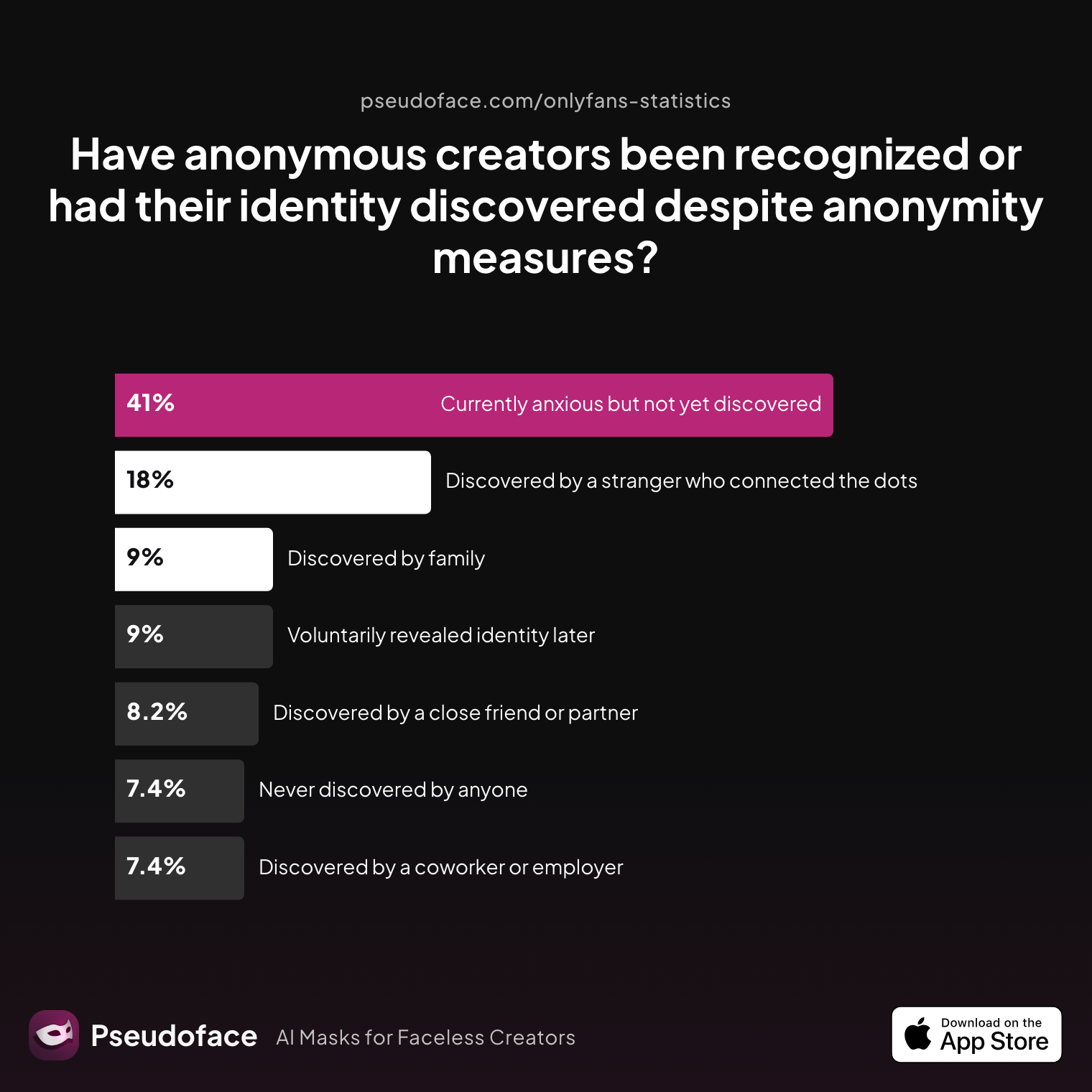
Let’s start with hard numbers: as of early 2026, creator anxiety isn’t misplaced.
| Answer | Percentage |
|---|---|
| Currently anxious but not yet discovered | 40.98% |
| Discovered by a close friend or partner | 8.20% |
| Discovered by a coworker or employer | 7.38% |
| Discovered by a stranger who connected the dots | 18.03% |
| Discovered by family | 9.02% |
| Never discovered by anyone | 7.38% |
| Voluntarily revealed identity later | 9.02% |
Nearly 1 in 5 faceless creators reported being discovered by a stranger who recognized non-obvious details—features that might include a birthmark, a surgical scar, or an unusual piercing. A further 16% were found out by friends, partners, or family despite strong anonymity efforts. The largest cohort (41%) are actively worried but haven’t (yet) had a disclosure event.
It’s easy to see why: the stakes range from awkward conversations to job loss or personal safety threats. Factors that drive this anxiety include:
- The possibility of someone local—coworker, friend, or family—subscribing or stumbling across your content.
- Reddit and Twitter stories circulating about “being outed by a single scar or mark.”
- Emerging facial recognition and AI image search tools that can amplify seemingly minor clues.
For many, this means that the question is less about whether to take steps to hide identifying physical features and more about which features are actually worth hiding—and how best to do it. That’s the core focus of this guide.
As one creator captured in a candid post:
Open thread on Redditr/onlyfansadvice
u/commonwenchofwood
Good vpn,use incogni,don't show face or voice if oyur not comfy with it and no one but ur fam is gonna recognise ur birthmarks gurl

This is the new frontline of anonymity: non-facial, non-tattoo, “unique enough” features that might be invisible to most buyers, but crystal-clear to those who know you off-platform. Before you can hide them, you have to decide—objectively and subjectively—what counts as "identifying" in the first place.
What Counts as “Identifying”? A Data-Driven Approach to Deciding Which Features to Conceal
One creator’s “unique” is another’s “barely noticeable.” This makes distinguishing genuinely risky features from background noise a deeply personal but essential process. Many creators default to the “better safe than sorry” principle—but is that always necessary?
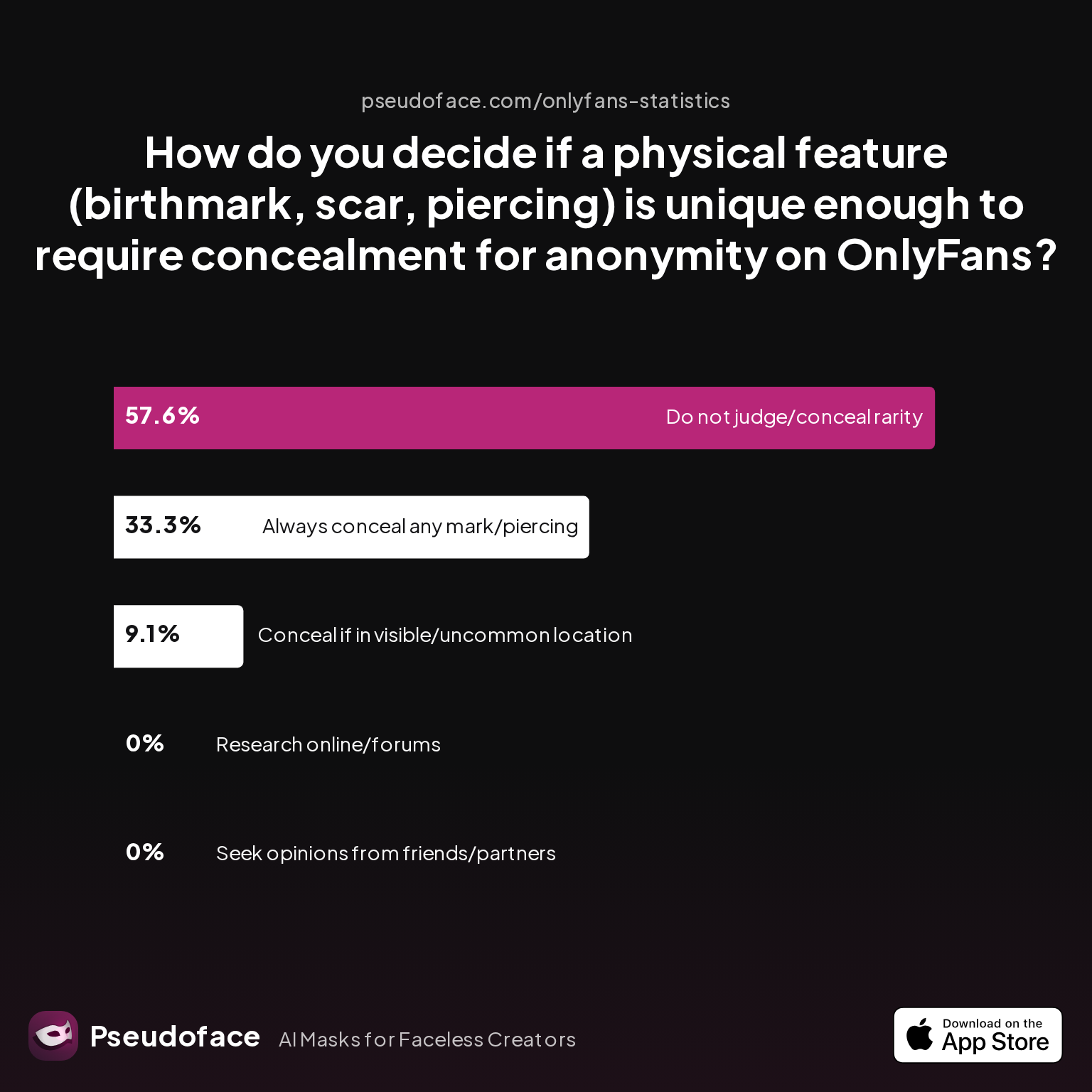
Pseudoface’s analysis of 2025-2026 Reddit threads reveals a clear majority either conceal everything or skip feature rarity assessment altogether.
| Answer | Percentage |
|---|---|
| I always conceal any non-standard mark/piercing, regardless of size or location | 33.33% |
| I do not take steps to judge or conceal feature rarity | 57.58% |
| I only conceal if the feature is in a visible/uncommon location | 9.09% |
| I research online or in creator forums to judge feature commonness | 0.00% |
| I seek opinions from trusted friends/partners | 0.00% |
Here’s what this means for creators:
- 1 in 3 creators take a maximalist approach—if it’s “non-standard,” it’s covered, no questions asked.
- Well over half make no proactive effort, either due to low risk, laziness, or being unsure what “counts.”
- Virtually no one systematically researches rarity or asks others for input, perhaps reflecting both the subjectivity and isolation of online creation.
This pattern exposes a key bias: only the most anxious, privacy-focused creators deliberate on feature rarity. Those who don't care, or who don’t believe it matters, simply don’t report experiences or advice—meaning these numbers might overstate the true risk for the average creator, but serve as a strong directional indicator for the privacy-conscious.
It’s also important to stress the demographic nuance. Creators who hide their faces, have high-stakes jobs, or come from tight-knit communities are far more likely to meticulously cover distinctive features. Others—especially those unconcerned about cross-platform exposure from family or day jobs—report little or no anxiety.
A recurring Reddit refrain highlights the spectrum:
Open thread on Redditr/onlyfansadvice
u/commonwenchofwood
Good vpn, use incogni, don't show face or voice if oyur not comfy with it and no one but ur fam is gonna recognise ur birthmarks gurl
Ultimately, deciding what’s “identifying” is about balancing two things:
- Subjective rarity: Is your mark/scar/piercing something people who know you well might instantly recognize?
- Context of exposure: Is the feature clearly visible in your photos/videos, in a spot that someone who knows you could plausibly see?
Most community advice comes down to a simple threshold: if a mark feels rare and is in a visible, regularly photographed spot, cover it or edit it. Otherwise, most generic piercings or routine marks aren’t worth the stress—unless your social circle is unusually attentive.
Having mapped your own risk profile, it’s time to understand which concealment methods creators actually trust—and why.
Comparing Methods: Physical vs. Digital Concealment Techniques for Different Features
With the decision made to hide a particular feature, the next challenge is execution. Community data shows that creators are pragmatic: they match concealment method to feature type, tech comfort, shoot logistics, and (often) their own patience for post-work.
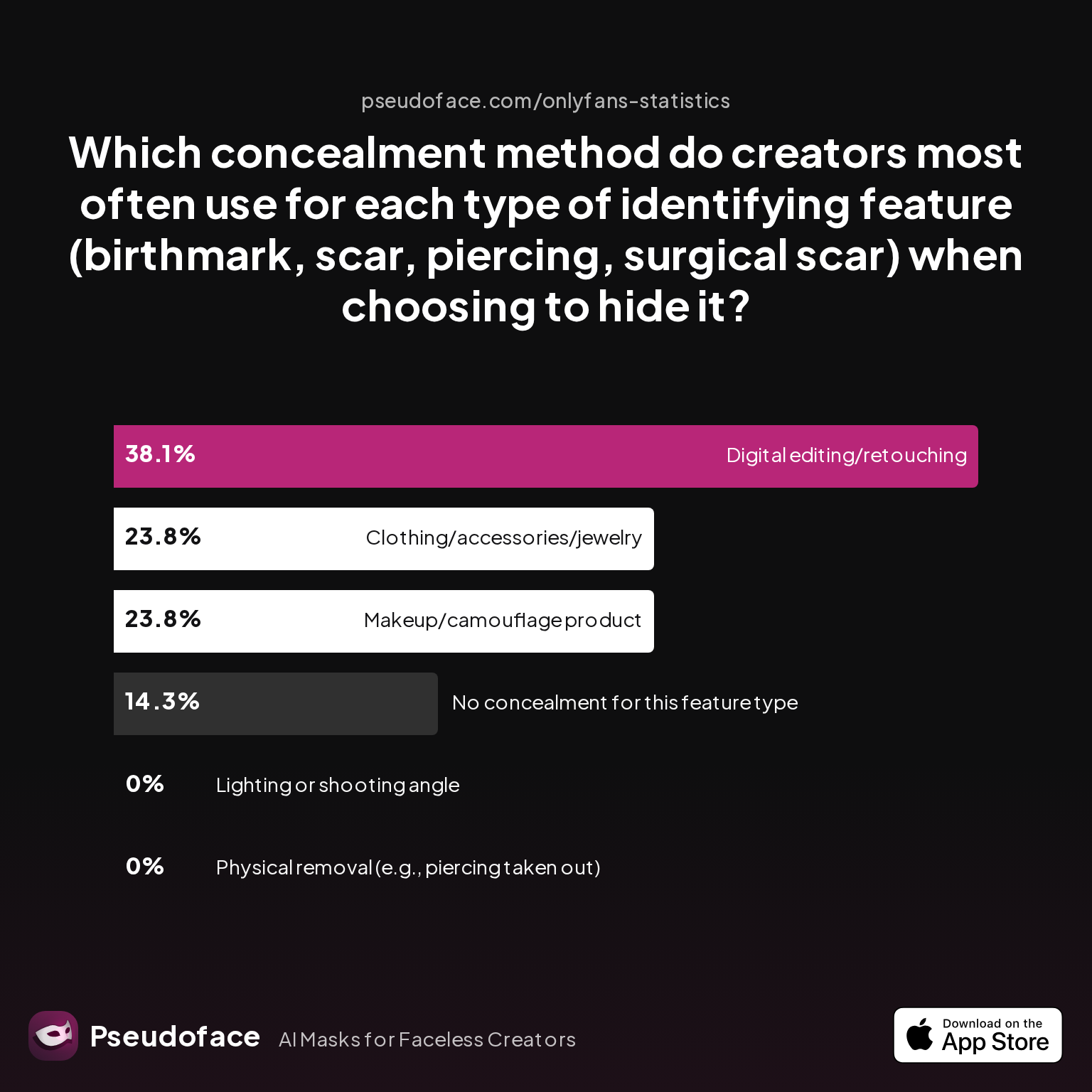
The most recent data (from late 2025 through early 2026) reveals nuance in these choices.
| Answer | Percentage |
|---|---|
| Clothing/accessories/jewelry | 23.81% |
| Digital editing/retouching | 38.10% |
| Lighting or shooting angle | 0.00% |
| Makeup/camouflage product | 23.81% |
| No concealment for this feature type | 14.29% |
| Physical removal (e.g., piercing taken out) | 0.00% |
A few patterns emerge:
- Digital editing/retouching (38.1%) is the top method, especially for features like birthmarks and scars that can be hard to cover consistently with clothing or makeup—especially in video.
- Clothing and accessories (23.8%) punch far above their weight, largely thanks to trends like jewelry layering, creative hosiery, or bandages that blend into natural or styled looks.
- Makeup/camouflage products (23.8%) remain a staple, outperforming digital for certain use cases, such as long shoots or when full skin realism is essential.
- Very few creators depend on lighting, camera angles, or simply removing piercings before shooting—a clear signal that routine, reliable coverage trumps subtlety for most.
Why do creators mix and match, rather than sticking to just one method? Reddit posts across hundreds of threads cite:
- Convenience: Clothing is instant but not possible in nude or lingerie shoots. Makeup is fast but can stain, sweat off, or look unnatural up close.
- Realism: Digital retouching is undetectable to buyers but can be time-consuming, especially if skills or tools are lacking.
- Workflow: For creators with limited tech skills or those shooting in batches, hybrid strategies (makeup for main images, digital for “specials”) are common.
This chart also illustrates an important caveat: reporting bias means digital methods may be overrepresented, as tech-savvy creators are more likely to share their process on platforms like Reddit, while creators who use low-tech or no methods often don’t participate in data collection.
All strategies have trade-offs. Layering methods (for example, using both makeup and editing) is the single most effective way to reduce exposure risk, but even the most careful creator must contend with practicalities—shoot sweat, retouch fatigue, or unforeseen wardrobe slips.
With this foundation, let’s drill down: what exactly works best for the two major “permanent” feature types—birthmarks and scars?
How to Hide Birthmarks on OnlyFans: Practical Concealment and Editing Steps
Birthmarks occupy a unique spot in creator anxieties. They’re generally permanent, visually distinctive, and—unlike tattoos—rarely stylized or easy to disguise as fashion. Their location and color variance mean that no single concealment method will fit everyone.
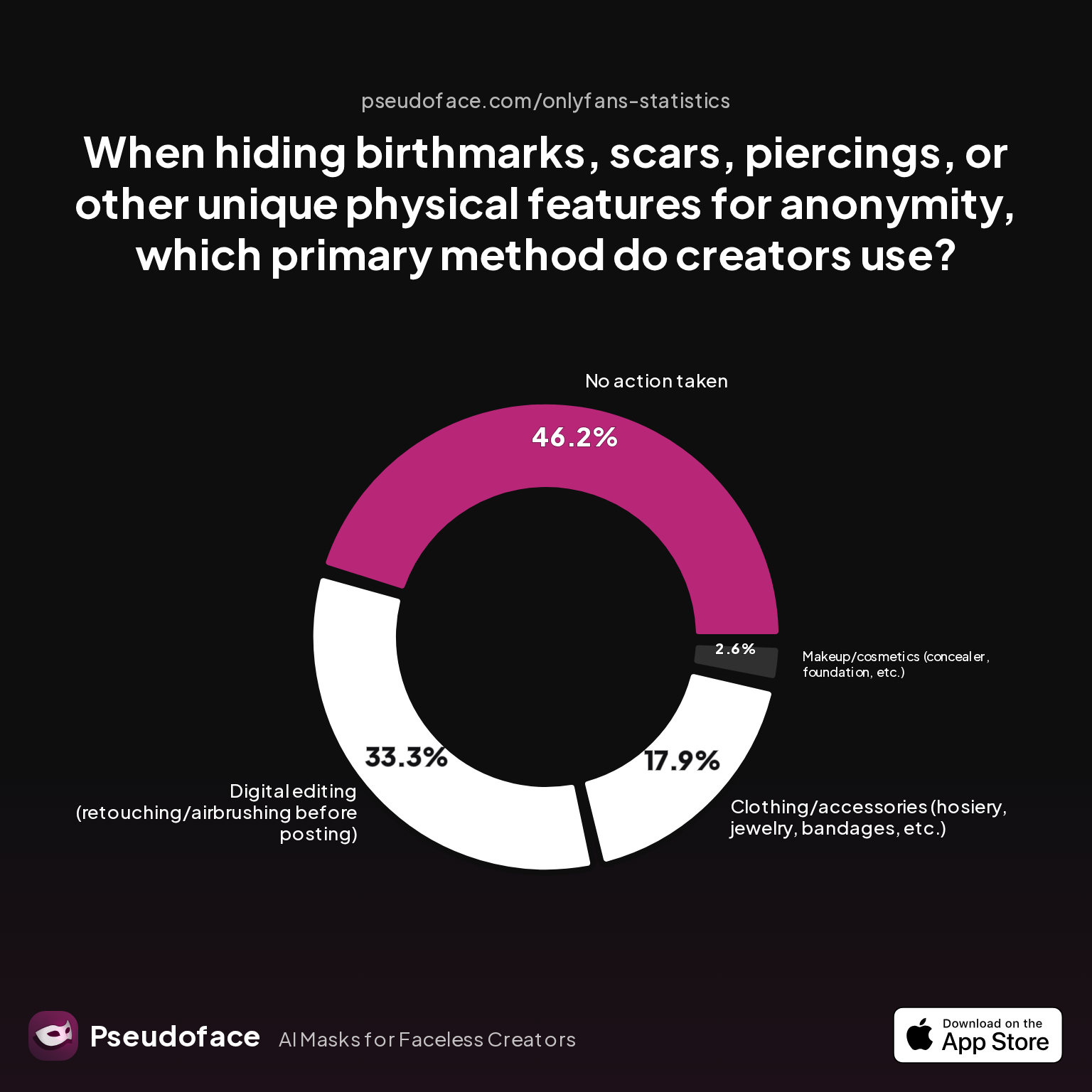
To anchor our approach, let’s look at 2026’s community-reported prevalence rates for birthmark hiding techniques:
| Answer | Percentage |
|---|---|
| Clothing/accessories (hosiery, jewelry, bandages, etc.) | 17.95% |
| Digital editing (retouching/airbrushing before posting) | 33.33% |
| Makeup/cosmetics (concealer, foundation, etc.) | 2.56% |
| No action taken | 46.15% |
| Physical removal (removing piercings before content) | 0.00% |
Digital editing (33.3%) and clothing/accessories (17.9%) are the most popular active strategies for birthmarks—with nearly half of creators simply taking no action, suggesting either low-risk features or high tolerance for potential identification. Notably, traditional makeup alone is rarely used for birthmarks, likely reflecting its limited performance on larger or textured marks.
For creators who do conceal, a workflow often looks like this:
-
Low-tech starters:
- Hosiery, patterned tights, and statement jewelry can make lower-body or arm birthmarks disappear in stylized content.
- Strategic lingerie or props, especially in boudoir, let you “cover” without seeming intentional.
-
Makeup in the toolkit:
- Specialized camouflaging foundations (like Dermacol or leg airbrush sprays) outperform casual concealers.
- These options are best for small, flat marks; raised or multi-color birthmarks are more challenging.
Open thread on Redditr/onlyfansadvice
u/gracefulhaley
Try Dermacol. It’s a foundation that can completely cover tattoos
- Digital editing for complete confidence:
- Phone apps with clone/heal tools (e.g., Snapseed, Lightroom, Photoshop mobile) are the go-to for stills.
- Pixel 8’s Magic Eraser and other AI tools work for simple backgrounds but can look “off” if overused.
Open thread on Redditr/onlyfansadvice
u/ChristalCake
My pixel 8 pro has a magic eraser, so my recent tubal surgery scars can be removed! But I know I'll have to invest in something better, cuz that edit can be a little wonky
- Hybrid approaches:
- Many creators layer makeup for tone-correction, use jewelry or props, and finish with a quick Healing Brush pass in software before upload.
- For video, advanced apps (e.g., CapCut or desktop DaVinci) let you “track” edits frame-by-frame, though these require more effort.
The big practical tips, including caveats from the community:
- Test for endurance: Some camo products (airbrush makeup, heavy cream foundations) can sweat or wipe off under lights.
- Expect to invest: Getting a natural look takes trial and error, and not all cheap makeup handles HD video.
- Walk the line with digital edits: View at “buyer zoom” distance to confirm consistency. AI can hallucinate skin irregularities if over-applied.
As of 2026, the single most effective method is simply blending several strategies—rather than over-committing to a single fix.
How to Hide Scars on OnlyFans: Low-Tech Fixes and Retouching Workflows
Scars run the gamut: faint stretch marks, surgical or accidental lines, pronounced raised tissue. Their diversity means workflow must be equally flexible.
Reddit communities are full of creators crowdsourcing product recommendations, bemoaning smear-prone makeup, and swapping app tips for cleanup work both in photo and video.
For in-the-moment coverage, leg or body airbrush makeup is repeatedly praised:
Open thread on Redditr/onlyfansadvice
u/NonworkAliceZ
Ohhh i can send you an imgur link if you want i live in japan and there's lots of places i have to cover up my tattoos to enter like bath houses and beaches ect japan has a lot of products to cover stuff up haha
But effectiveness tapers for larger, raised, or highly textured scars—and, per one user’s blunt assessment:
Open thread on Redditr/onlyfansadvice
u/NonworkAliceZ
Yes they definitely do it all seems to just wipe right off
Professional makeup brands (e.g., Dermablend, Dermacol) can help, but the best community advice leans toward digital editing for consistency.
Top photo editing methods, based on collective creator experience:
- Snapseed "Healing" tool: excellent for faint scars or quick spot-removal (free, mobile)
- Lightroom/Photoshop mobile: more nuanced controls and the ability to adjust blending and skin tone
- Pixel Magic Eraser and similar AI tools: great for speed, but risk “digital plastic surgery” if overused
- Desktop editors (Photoshop, Affinity Photo): best for batch work or high-res content
Open thread on Redditr/onlyfansadvice
u/amorboudoir
I love Lightroom - it is wonderful for editing pictures in general
For video, creator consensus is that easy, automated apps have yet to match photo-level realism. Manual post-production (using After Effects, DaVinci, or even CapCut) can “track” a cloned patch over the scar every frame. This is labor-intensive but provides professional results for important clips.
Bias caveat: reported “success” rates vary due to individual tech skills and scar complexity. Advice is heavily weighted toward mobile users, meaning some advanced desktop workflows may be underrepresented.
In summary:
- Small, flat scars = use Snapseed, Magic Eraser, or light makeup
- Large, raised, or recent/colored scars = digital retouching is your best bet
- Long shoots, lots of movement = hybrid (makeup for in-shoot, digital for final cleanup)
- For surgical or intentionally private scars (e.g. gender-affirming or medical): layering both coverage and editing is the only near-guaranteed way to avoid recognition
A final point: community data underscores that perfection isn’t required. Only features that stand out to people who already know you pose real risk, especially if your face and voice remain hidden.
Can Piercings Unmask You? How to Hide Piercings for Adult Creators (and When It’s Safe Not To)
Piercings straddle the line between “identifying” and “background detail.” Community data shows a surprisingly relaxed attitude here—many creators choose not to cover routine ear, navel, or nostril piercings unless the jewelry itself is extremely distinctive.
So, which piercings actually lead to being “outed”?
- Highly unusual placements (e.g., dermal anchors, rare cartilage piercings)
- Custom/local jewelry not widely available
- Visible “signature” pieces that friends or exes might remember
For the majority, especially those with common jewelry or healed holes, the risk is low. The key inflection point is personal history: do you have a piece your immediate circle would recognize instantly, even out of context?
Common approaches when covering up is needed:
- Jewelry swaps: switch to plain retainers or standard jewelry for shoots (if your everyday look uses something distinctive)
- Temporary removals: viable for short sessions, though some piercings close quickly, so caution is necessary for less established placements
- Digital edits: useful for navel or nipple jewelry, but less common due to the subtlety of appearance
A representative case from community conversation:
Open thread on Redditr/onlyfansadvice
u/topheavyanon
I have my home state blocked on OF. Could decrease subs, but good if you really want to hide identify from people who you know
For most creators, generic piercings fade into digital white noise. But when in doubt—especially with features that are the subject of frequent comments or are documented in your public life—choose a more “anonymous” jewelry option or digitally clean up the image.
Summary: Most “standard” ear/nose/navel piercings don’t require extra steps unless the jewelry or placement itself is rare or memorable. As a rule of thumb: if it’s the kind of detail that would show up in your Instagram selfies, and you haven’t faced comments about it being unusual, it’s low risk.
Hide Unique Features on OnlyFans: The Creator’s Ultimate Privacy Checklist
Covering identifying marks is just part of the broader privacy stack used by successful faceless or semi-anonymous creators. Data from 2025–2026 shows that while few check every box, the most robust anonymity comes from layering both physical and digital steps.
Let’s synthesize the most effective actions, supported by adoption and perceived-importance charts:
Geo-blocking
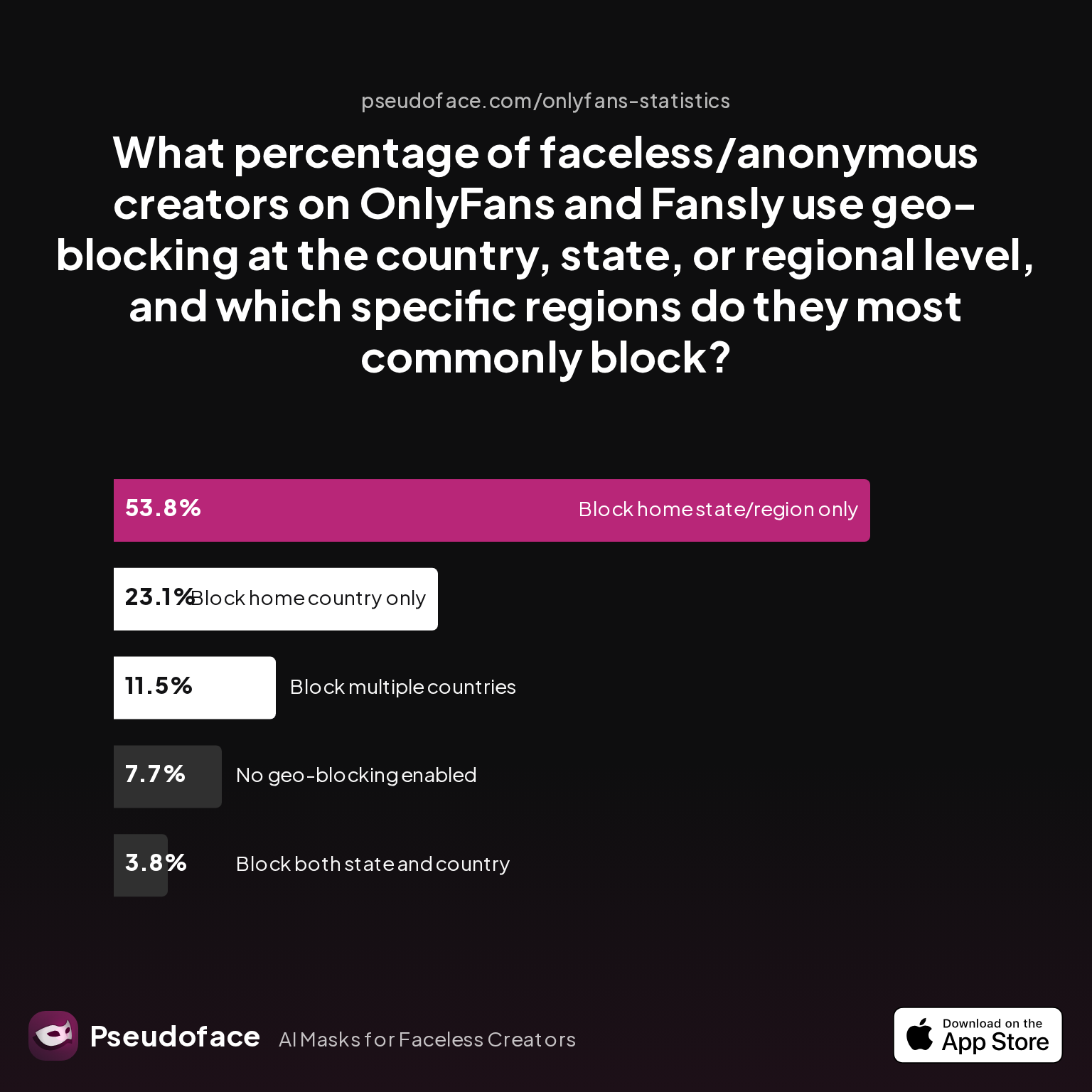
| Answer | Percentage |
|---|---|
| Block both state and country | 3.85% |
| Block home country only | 23.08% |
| Block home state/region only | 53.85% |
| Block multiple countries | 11.54% |
| No geo-blocking enabled | 7.69% |
More than half of privacy-focused creators block their home state or region, with only a minority (24%) relying on country-level blocks alone. The logic is simple: your local acquaintances are the biggest risk. However, geo-blocking can reduce your revenue if your home base is a large market—an important trade-off to consider.
Metadata scrubbing
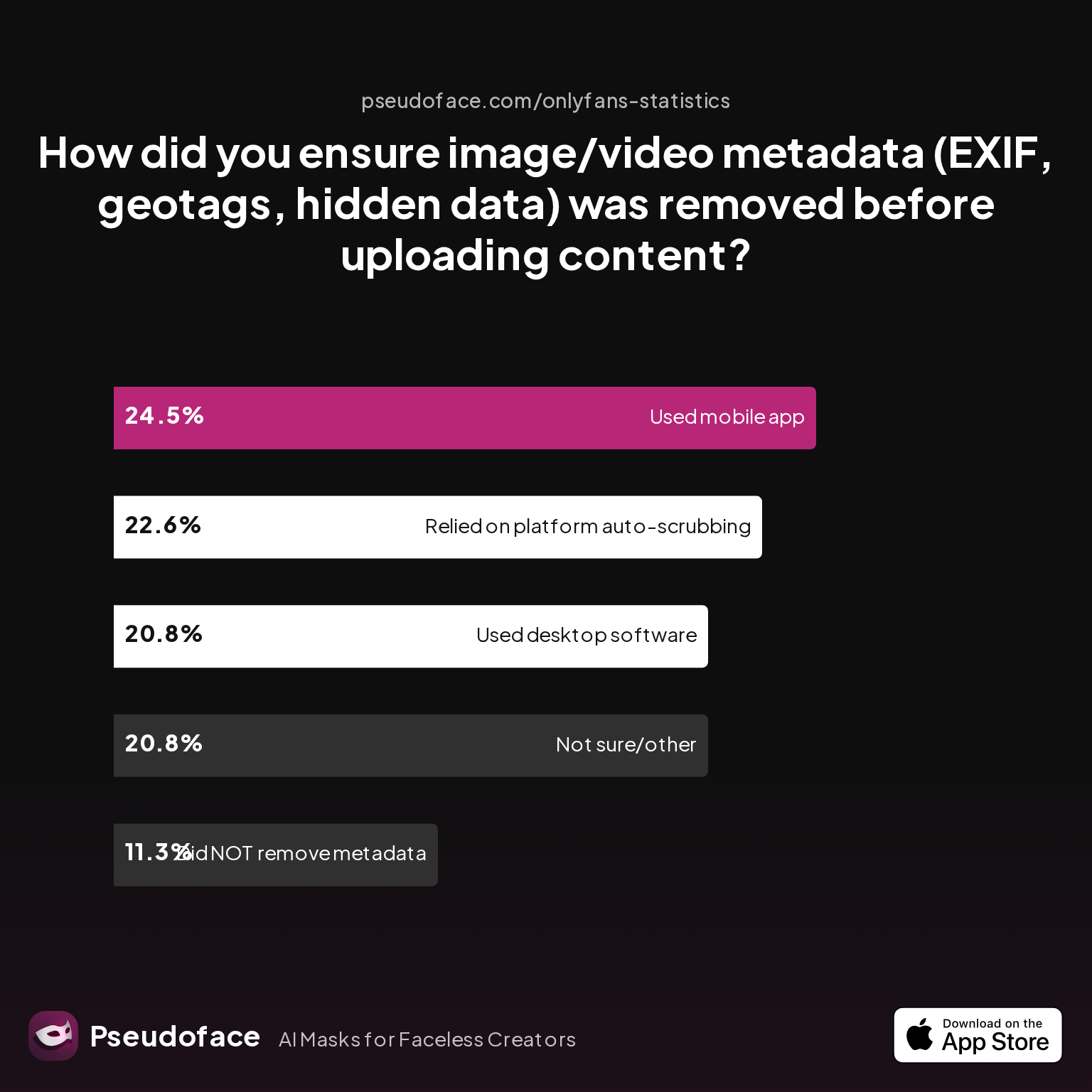
| Answer | Percentage |
|---|---|
| Did NOT take steps to remove metadata | 11.32% |
| Not sure/other | 20.75% |
| Relied on platform auto-scrubbing (e.g., OnlyFans upload process) | 22.64% |
| Used a dedicated metadata removal app on mobile | 24.53% |
| Used desktop software (e.g., Photoshop, custom scripts) | 20.75% |
Just under half of creators actively scrub metadata (25% mobile, 21% desktop); another quarter trust OnlyFans’ native removal. However, nearly a third are unsure or do nothing, opening up privacy risks in edge cases (especially if repurposing content for multiple platforms).
Pre-launch hygiene
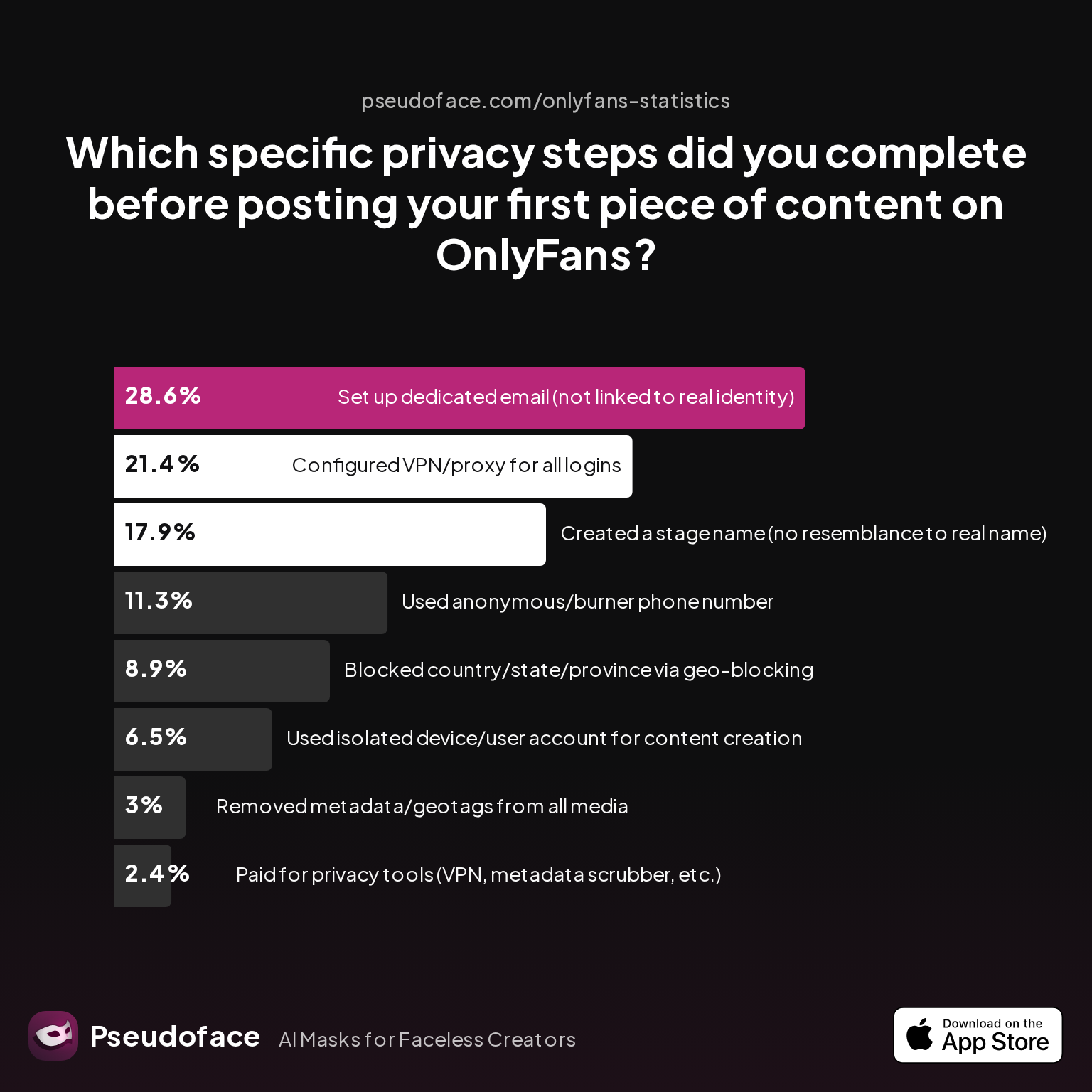
| Answer | Percentage |
|---|---|
| Blocked country/state/province via geo-blocking | 8.93% |
| Configured VPN/proxy for all logins | 21.43% |
| Created a stage name (no resemblance to real name) | 17.86% |
| Paid for privacy tools (VPN, metadata scrubber, etc.) | 2.38% |
| Removed metadata/geotags from all media | 2.98% |
| Set up dedicated email (not linked to real identity) | 28.57% |
| Used anonymous/burner phone number | 11.31% |
| Used isolated device/user account for content creation | 6.55% |
Less than a third even set up a dedicated email, and only a small minority paid for privacy tools or took advanced device isolation steps before posting.
Perceived non-negotiables
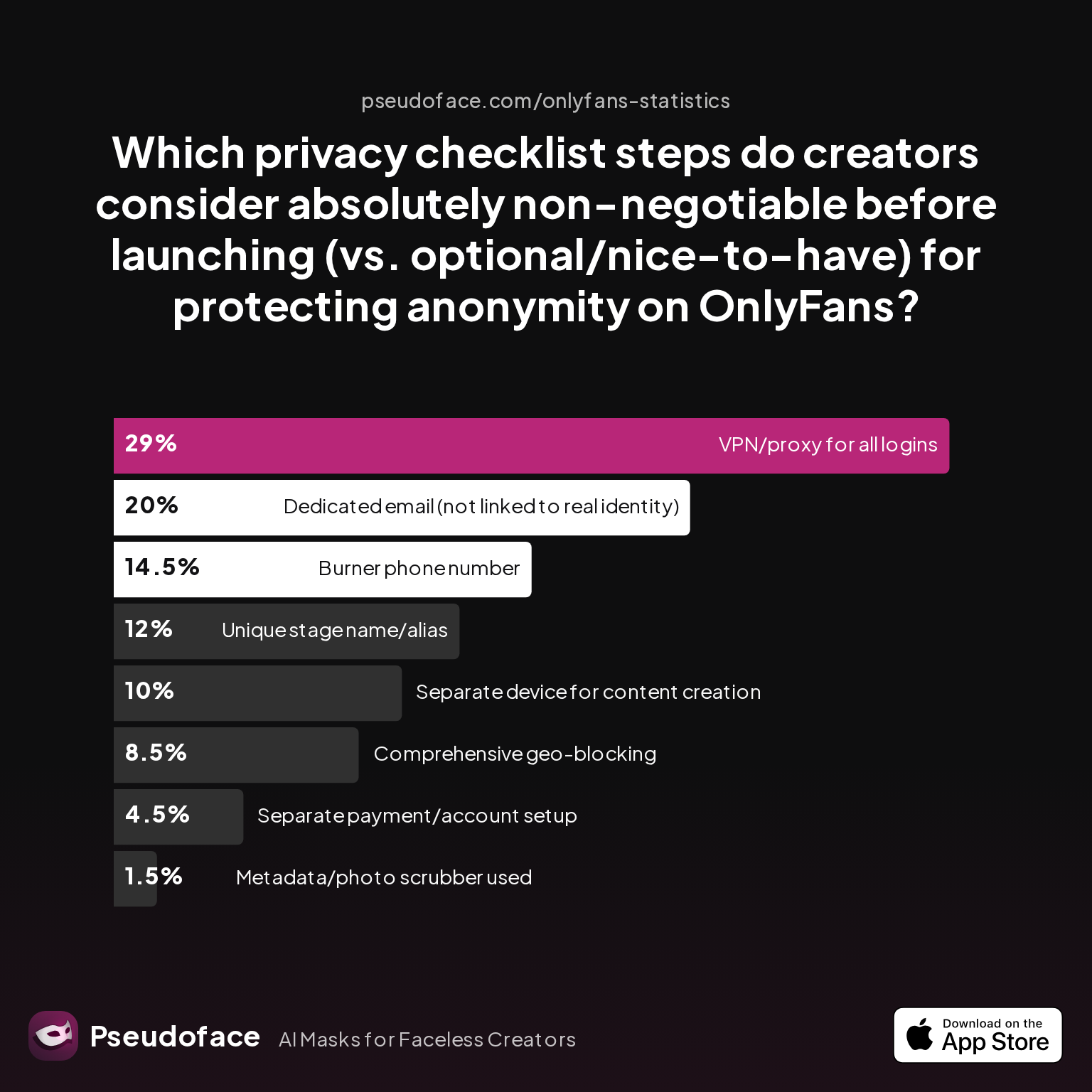
| Answer | Percentage |
|---|---|
| Burner phone number | 14.50% |
| Comprehensive geo-blocking | 8.50% |
| Dedicated email (not linked to real identity) | 20.00% |
| Metadata/photo scrubber used | 1.50% |
| Separate device for content creation | 10.00% |
| Separate payment/account setup | 4.50% |
| Unique stage name/alias | 12.00% |
| VPN/proxy for all logins | 29.00% |
Full-stack VPN use (29%) is the single most widely cited "must-have," followed by dedicated email and basic geo-blocking. Surprisingly, metadata scrubbing—despite clear technical risk—is rarely considered essential, perhaps indicating a disconnect between perceived and actual hazards.
Practical Privacy Checklist for Feature Coverage:
- Decide subjectively if your feature is rare and visible.
- For birthmarks: layer clothing, specialized makeup, and digital edits.
- For scars: try airbrush leg makeup for minor cases, master Snapseed/Lightroom for heavy retouching.
- For piercings: swap jewelry for retainers if worried, or skip edits unless the style is unique in your area.
- Always scrub metadata, especially for high-stakes posts or if cross-posting to Twitter/Reddit.
- Geo-block your home state at minimum if anonymity is essential.
- Use a separate, non-identifiable email and account name from day one.
Most creators who remain anonymous for years are those who prepare before launch—and stick to a workflow that fits their specific content and risk tolerance.
Staying Anonymous on OnlyFans: Advanced Tips and New Technology
For those seeking to future-proof their anonymity, emerging technologies offer new tools—along with fresh risks. Most community-reported “exposures” still result from human error, not tech, but as AI capabilities multiply, so do creator expectations (and fears).
Here are advanced strategies trending in 2026:
- AI-driven retouching: Apps like Lensa, FaceApp, and Pixel’s Magic Eraser democratize skin-and-mark removal, making it feasible for even amateur creators. For best results, limit AI edits to specific problem zones; avoid auto-filtering whole bodies to prevent “uncanny valley” artifacts.
- Obfuscation via posing/props: Creative composition hides features as “background action.” Strategic placement of props, cropped shots, or playful shadows make editing easier in post.
- Layered, redundant digital hygiene: Savvy creators use both platform-scrubbing and third-party metadata removers, often paying for pro tools to handle batch jobs. This is especially vital for multi-platform creators.
- Content segmentation: Shoot “safe” sets with visible features and keep “anonymous” sets for higher-risk content, sharing the latter only with vetted fans or paying for higher security.
Reddit forum advice remains pragmatic:
Open thread on Redditr/onlyfansadvice
u/commonwenchofwood
Good vpn,use incogni,don't show face or voice if oyur not comfy with it and no one but ur fam is gonna recognise ur birthmarks gurl
Bias warning: creators who post about tech tips are disproportionately advanced, so wider adoption is likely lower than it appears in trending forum threads.
Finally, always remember: no tool or workflow guarantees 100% anonymity. Cross-platform data scraping, accidental leaks, or a determined acquaintance’s memory are outside any creator’s full control. But by consistently practicing layered concealment, you raise the barrier for recognition to a practical minimum—especially when your goal is "unrecognizable to all but the closest" observers.
FAQ: Staying Anonymous by Hiding Birthmarks, Scars, and Piercings
What’s the easiest way to cover identifying features for OnlyFans on a budget?
The fastest and cheapest approach is to combine drugstore concealer (Dermacol, Maybelline), free editing apps like Snapseed, and everyday wardrobe/accessories. Most creators start with this blend and refine over time.
Is it really necessary to hide piercings if my face isn’t visible?
Most standard ear, nose, and navel piercings don’t increase anonymity risk if the jewelry isn’t unique—but switch to plain retainers or remove custom pieces if you think someone you know could recognize the detail.
Which app works best to edit out scars for creators on mobile?
Snapseed is the community favorite for spot-removal, while Lightroom and Pixel’s Magic Eraser are cited for more complex edits—though Magic Eraser sometimes produces “wonky” results for large scars.
Open thread on Redditr/onlyfansadvice
u/miss-cyra
I use Snapseed since it’s free and use the healing tool (however this works for smaller scars so not sure if it’d work for larger scars)
How do I know if my birthmark is unique enough I should bother hiding it?
If your birthmark is highly visible, significantly colored, or has drawn comments from friends/family before, err on the side of concealment; if it’s in a rarely shown spot and you’ve never heard it mentioned, it’s probably low risk.
What if makeup wipes off in a shoot—am I exposed?
Layering techniques (primer, setting spray, touch-up sponge) prevent most wipe-offs, but always double-check in a mirror between shots and rely on digital retouching as a fallback.
Open thread on Redditr/onlyfansadvice
u/NonworkAliceZ
Yes they definitely do it all seems to just wipe right off
Can I use jewelry or clothing to cover scars and birthmarks without looking awkward?
Yes—natural posing, playful fashion, or body jewelry placement can make covering feel like part of your style rather than a red flag, especially in boudoir or themed shoots.
What metadata or digital traces might give me away even if my body marks are hidden?
Common leaks come from EXIF data (location, device model), auto-backups, or accidental uploads; always use platform scrubbing plus a metadata app before posting.
How do creators who want to stay anonymous handle requests from followers for custom content showing more of their body?
Set clear boundaries in advance, and be ready to explain your anonymity rules—most fans respect limits if you confidently reaffirm your identity policy.
With practical workflows, honest data, and community wisdom, creators can minimize identification risks without letting anxiety block their creative or financial ambitions. As technology evolves, so does the privacy playbook—but the fundamentals of proactivity, self-knowledge, and layered coverage remain the bedrock of faceless success.


