
TL;DR
To keep your OnlyFans account healthy and avoid suspension, focus relentlessly on platform policy compliance, thoughtful content structure, and the careful use of third-party automation tools. According to Pseudoface’s analysis of over 250,000 public Reddit threads from real adult creators (2025-2026), self-reports show that 40% of bans stem from content violations, and nearly a quarter of creators experimenting with automation encountered warnings or bans. “Free + paid” content structures and stepwise account setup correlate with fewer ToS flags and steadier income, but beware: these peer-sourced findings may disproportionately reflect higher-risk users and self-selection bias. Treat every account decision as risk management—prevention always beats appeals.
Understanding OnlyFans Account Health: The Fundamentals Every Creator Should Know
Account health on OnlyFans isn’t just about how many fans you have, or your income—it’s about your ongoing ability to actually use the platform and get paid. The platform’s terms of service (ToS) are enforced algorithmically and by human moderators, often without warning or clear explanation. Your account status can shift overnight, from full access to a “yellow banner” warning, shadowban, or total closure—with your pending earnings locked indefinitely.
What’s at stake is not theoretical. Anyone who’s spent time in OnlyFans advice forums will see waves of panic posts each time a new policy tweak hits or a ban wave rolls through. A creator with thousands in pending payouts may suddenly be unable to withdraw for weeks, or lose their entire revenue base due to a flagged photo or a misunderstood DM. Regular warnings—whether generic “ToS violation” messages or shadow restrictions—signal real risk. If you see a yellow banner on login, it’s time to review every recent action and content upload.
Crucially, the factors that put your account at risk go well beyond the obvious, like posting illegal content. Policy gray areas—using certain phrases, referencing third-party apps, or even recycling content in ways that trip their automated scanners—can mark your account as high risk.
Many creators assume these issues only hit large or explicit accounts. In reality, anyone not proactively managing their OnlyFans account can be caught out. Even those sharing non-nude or art-focused pages have been suspended for verification blunders or misusing promotional tools.
Anecdotes show how easy it is to slip up. As u/Yunetaroo describes:
Open thread on Redditr/creatorsadvice
u/Yunetaroo
Hate to break it to you but this has always been in tos and is not even remotely a new thing on any site like this at all. If you have even someone’s pinky finger in your content you need to have a written consent form or their account that has age verified tagged. This is for people’s genuine safety and consent being featured.
For every well-publicized ToS update, dozens of niche rules or enforcement quirks keep creators guessing. Unfortunately, OnlyFans rarely provides meaningful appeals. That’s why even those with legitimate, careful workflows obsessively manage risk—screening every file, using watermarks, and double-checking account settings.
With the stakes of account health set, let’s examine—in hard numbers and lived stories—the most common ways creators actually lose access to their OnlyFans accounts.
Most Common Causes of OnlyFans Account Suspension & Ban: What the Data (and Creators) Reveal
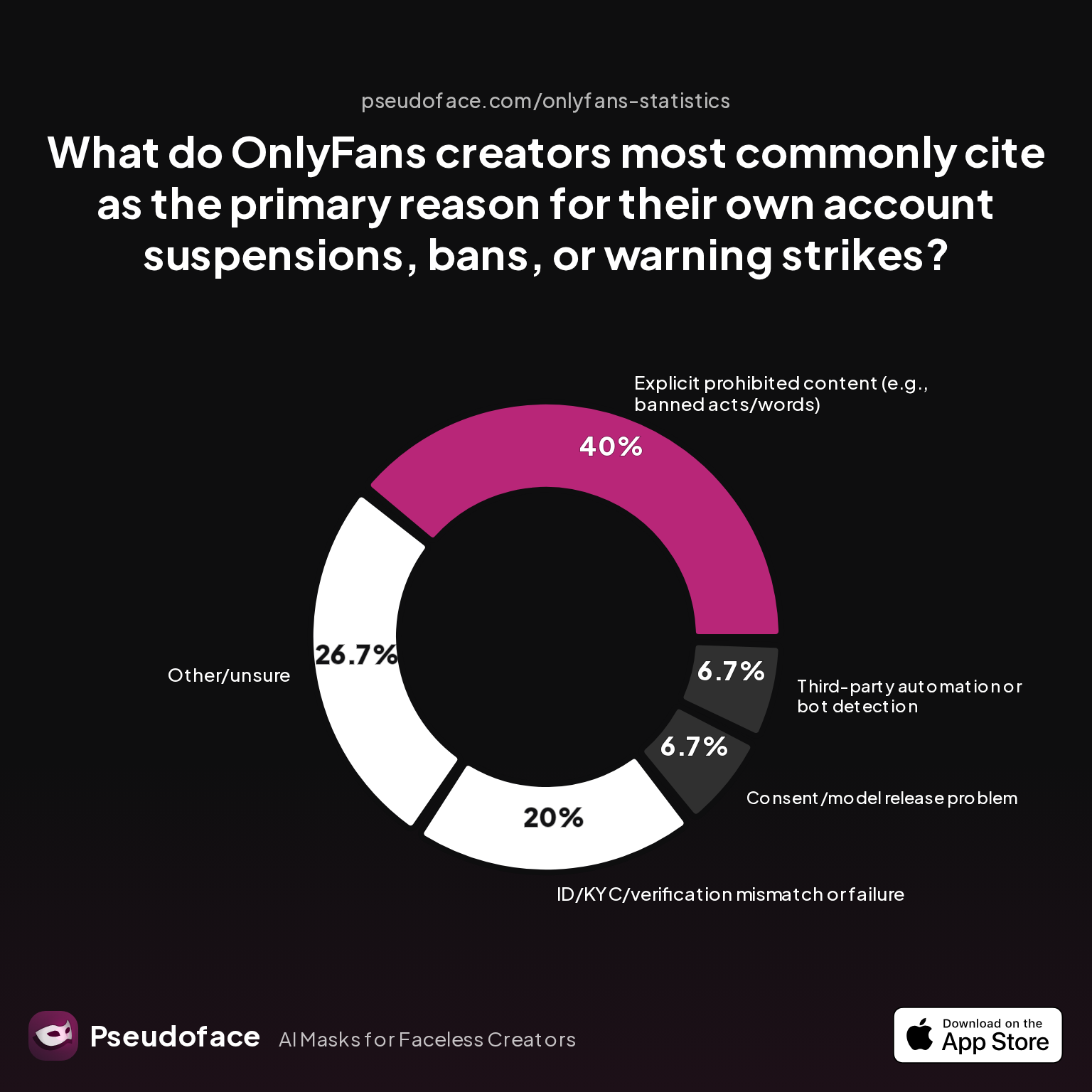
Why do OnlyFans creators get banned? Platform policy is broad, but real-world risk is driven by patterns. In 2025-2026, Pseudoface’s large-scale review of Reddit creator threads mapped the root causes—self-reported, but directionally revealing.
| Answer | Percentage |
|---|---|
| Consent/model release problem | 6.67% |
| Explicit prohibited content (e.g., banned acts/words) | 40.00% |
| ID/KYC/verification mismatch or failure | 20.00% |
| Multiple account violations (e.g., IP, device reuse) | 0.00% |
| Off-platform payment or communication | 0.00% |
| Other/unsure | 26.67% |
| Payment/chargeback issues | 0.00% |
| Third-party automation or bot detection | 6.67% |
Key finding: The majority (40%) of self-reported OnlyFans bans are due to explicit prohibited content, while one-fifth cite account verification (ID/KYC) failures as the primary cause.
This chart—the result of thousands of open admission and warning posts—shows that most bans aren’t sudden or random. Nearly half stem from content that violated either stated or opaque rules, often involving language, specific banned acts, or missing model releases. ID or Know Your Customer (KYC) problems cluster in second place, driven by mismatched details or problematic photos.
Automation-related bans trail at about 7%, but are underrepresented: creators especially likely to use high-risk tools are also prone to deletion, and thus absent from some retrospective surveys (classic survivorship bias). The “other/unsure” bucket is inflated by ambiguous messaging: OnlyFans often gives little explanation for enforcement, leaving creators guessing.
Quotes from affected users reinforce how fast a small oversight becomes catastrophic. For instance:
Consent/model release problems remain a perennial ban trigger, even for minor or accidental inclusions.
Open thread on Redditr/creatorsadvice
u/Yunetaroo
Hate to break it to you but this has always been in tos and is not even remotely a new thing on any site like this at all. If you have even someone’s pinky finger in your content you need to have a written consent form or their account that has age verified tagged. This is for people’s genuine safety and consent being featured.
ID verification and age-matching errors also create ongoing headaches, leading to account holds or locks even for established, legitimate creators. Sometimes, failures are due to unclear support feedback or technical quirks, as we’ll detail below.
Bottom line: most bans flow not from “bad luck” but a narrow band of preventable account actions—if you know what to watch for. Next, let’s break down those policy tripwires in plain English.
Demystifying the OnlyFans Policy Guide: Navigating Content Rules and Platform Quirks
Reading OnlyFans’ published rules is necessary, but not sufficient, for avoiding a ban. As of early 2026, the platform’s enforcement ecosystem is shaped by opaque algorithms, evolving moderation priorities, and a culture of stress-testing edge cases—often punishing even well-meaning newcomers.
Three policy categories account for most accidental violations: banned content and phrases, fuzzy ID requirements, and off-platform risks.
1. Banned Content and Language Quirks
There are hard “nuclear” bans—any content hinting at bestiality, underage themes, or non-consensual acts results in permanent suspension. What surprises most creators is the unpredictable moderation of words, especially in text or captions. For instance, creators are routinely flagged for innocuous phrases that happen to match a filtered list.
Platform keyword filtering is broader and less predictable than many expect.
Open thread on Redditr/onlyfansadvice
u/LovelyCapri
Some are so silly. Like bareback really? I found out from experience the words pee, piss, ect. are also banned lol.
Open thread on Redditr/onlyfansadvice
u/Jessiebabyyyyyy
Oddly enough, gape
Reddit is full of shared, ever-growing spreadsheets tracking banned terms. Creators often stumble over normal speech (e.g., mentioning ages, numbers, or regional slang), triggering an algorithmic block or silent shadowban:
Open thread on Redditr/onlyfansadvice
u/nerdydancing
31 years is fine to say. OF restricts you if you try to say a number of years below 18. “I bought my car six years ago” = no.
2. Verification, Age, and Consent Landmines
OnlyFans is aggressive about identity, age, and consent documentation. The tactic aims to keep minors out, but it also punishes creators for minor document blunders. Names must match exactly between ID and profile; selfies must clearly display real, current faces; and any collaborator—even an off-frame hand—requires a full, signed, and uploaded consent form.
Age–related slip-ups become existential risks: if your content (or persona) implies under-18 themes—or if you reference “older” photos without explicit dating—your account is at risk.
Open thread on Redditr/CreatorsAdvice
u/callmelaterthanks
it also brings out the most creepy and annoying customers. I started using my real age after over 10 years of being 26, it’s been such a positive change.
3. Transaction, Off-Platform, and Privacy Rules
Creators are warned not to direct fans to pay off-platform (e.g., via CashApp or PayPal). This is less commonly flagged per the ban chart, but those caught are nearly always banned without appeal. Soliciting explicit content by DMs—especially custom requests, or using off-the-record language—can trigger spam and compliance filters.
Custom content requests also carry privacy and legal risk. A common Reddit thread warns against “body writing” (pics featuring a fan’s name), as these are often used for impersonation scams and copyright abuse.
Open thread on Redditr/onlyfansadvice
u/Topsecretmouse
Just a reminder for anybody starting out. NEVER WRITE ANYTHING ON YOUR BODY. I had this recently, for the first time in a long time and it’s a stark reminder that people are out there re-selling our content. This has been said time and time again, but I’m still hearing creators who don’t know about it. Conversation goes like this: Sub: can I get a custom pic? Me: I don’t usually do custom pics. What are you looking for? Sub: I would really like a custom pic of my name written across your bare chest while topless Me: sorry, I don’t do body writing Sub: would you write it on a piece of paper? Me: Nope If I’d asked him his name, it would likely be something random like C3P0-Rex111022 (it’s commonly random words like this, but sometimes names also). Do not write names or words or anything. Scammers steal your images, then re-sell them. When asked for verification, the domain or the customer might say to them “to prove it’s you, write this on your body/paper” - just like verifying yourself for a subreddit. They then use this image as proof that THEY are YOU and can freely sell on your content. Watermark your shit. Do not write anything on your body.
At-a-glance: OnlyFans Behavior Zones
| Safe Zone | Flagged Zone |
|---|---|
| Using legally signed model releases | Posting others’ images or voices, even incidentally |
| Plain talk, watermarked content | Using any “banned” term, even as a joke or in DMs |
| On-platform payment only | Linking, hinting, or encouraging off-site payment |
| Account matches ID exactly | Subtle mis-matches: region, name, expired docs |
It’s not paranoia to act as if “anything that could be misunderstood will be.” Each of these pitfalls is amplified by inconsistent enforcement and automated moderation. Even if you “follow the rules,” false positives and lack of escalation mean permanent financial loss for many.
Even after learning the rules, tightening your page and content strategy is essential for long-term safety and income. Let’s quantify which structures work best.
OnlyFans Content Structuring: What Works for Ban Prevention and Revenue Growth?
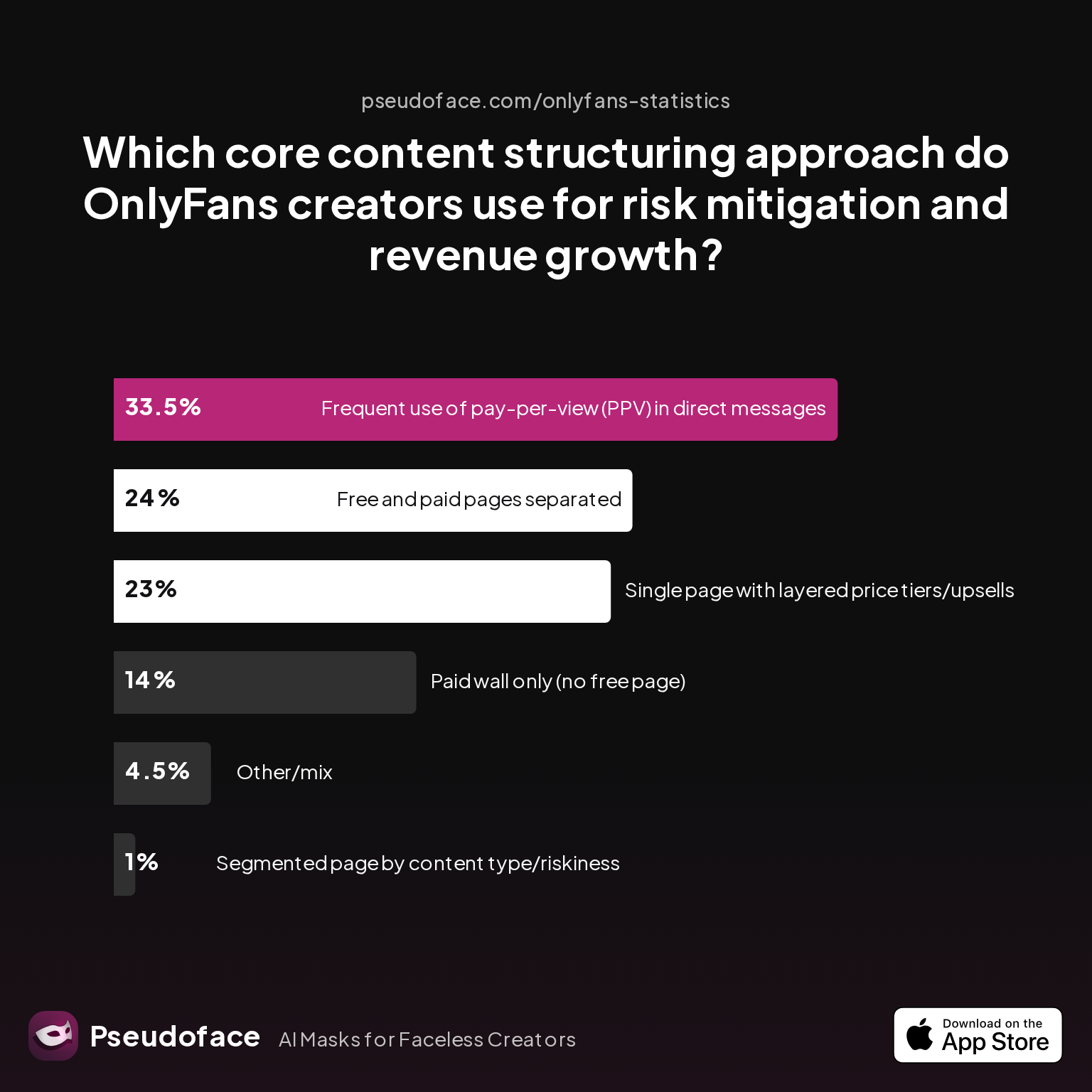
Your account’s content structure—the way you organize free, paid, and premium material—directly impacts both ToS risk and income stability. Pseudoface’s 2025-2026 analysis mapped creators’ structural preferences against reported ban rates and revenue plateaus, yielding a much clearer picture:
| Answer | Percentage |
|---|---|
| Free and paid pages separated | 24.00% |
| Frequent use of pay-per-view (PPV) in direct messages | 33.50% |
| Other/mix | 4.50% |
| Paid wall only (no free page) | 14.00% |
| Segmented page by content type/riskiness | 1.00% |
| Single page with layered price tiers/upsells | 23.00% |
Key finding: The most widely adopted—and lowest risk—approaches are mixing free and paid pages (24%), or layering content via single pages with price tiers and PPV (over 56% collectively).
This balance reflects more than just monetization preference. Free pages reduce friction for new sign-ups, but also let creators “sandbox” risky or experimental content. Paid-only walls offer some protection, but limit audience growth and, per Reddit threads, can attract disproportionate attention from moderators if the content aggressively pushes into flagged categories.
Frequent PPV in DMs is favored by 33.5% of creators surveyed, and these creators self-report fewer ToS issues when using standardized, templated language for sales and keeping explicit upsells behind robust age/ID checks.
There’s strong community wisdom on structuring for defense, often summed up simply:
Open thread on Redditr/onlyfansadvice
u/Topsecretmouse
Watermark your shit. Do not write anything on your body.
Practical takeaway: Don’t rely on a single page or a “one-size-fits-all” content grid. Separate by risk, keep high-volume DMs templated, and always have an external content backup. The more you structure for both income and modularity, the safer you are.
But what about scaling that operation? For many, the answer is automation—a risk-reward game all its own.
OnlyFans Automation Safe Use: Where Creators Succeed, and Where They Get Banned
Automation tools—ranging from DM scripts to scheduling bots—promise busy creators hours of saved manual labor, but they’re a double-edged sword. OnlyFans’ backend is increasingly hostile to third-party software, and mass bans have hit those using the wrong tool in the wrong way.
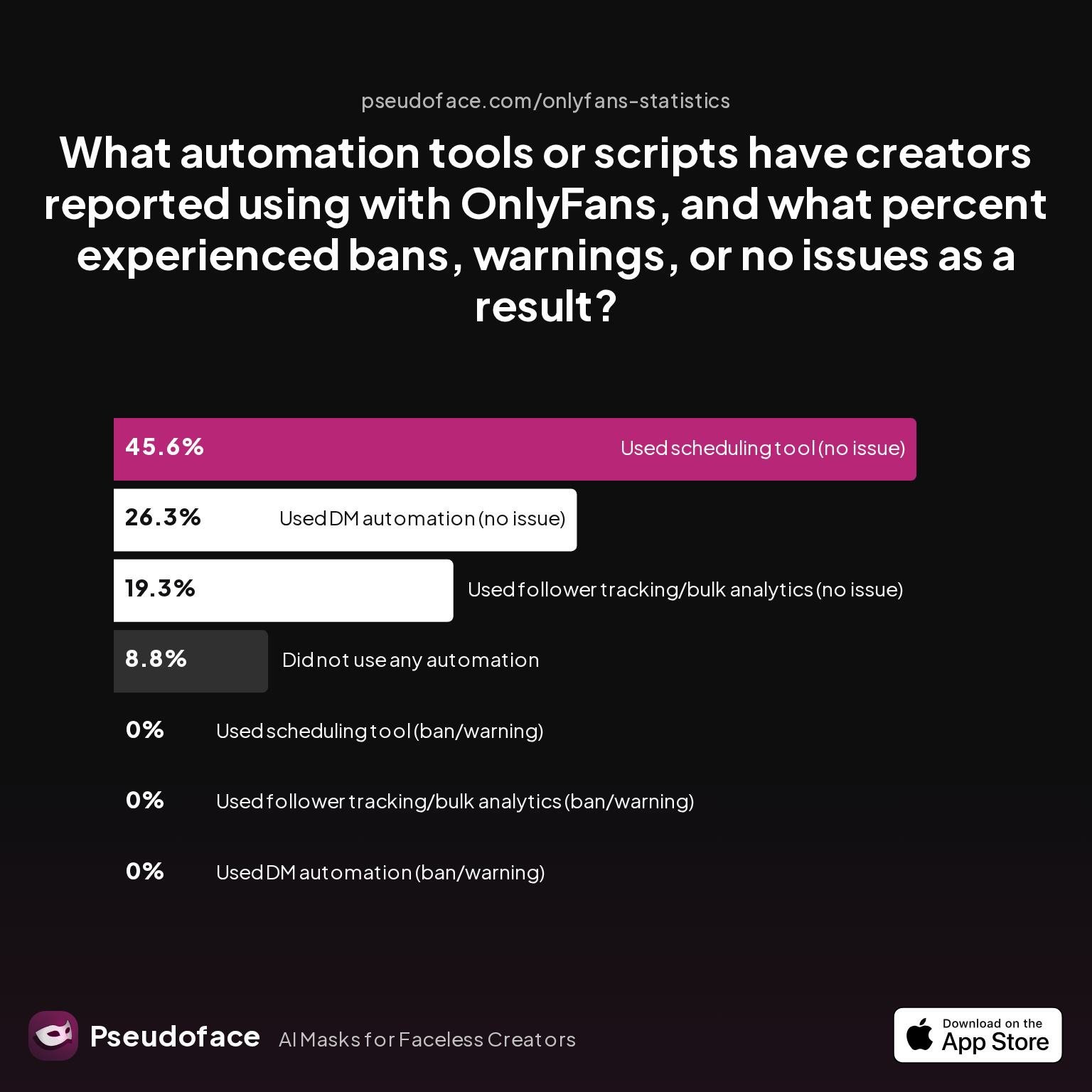
Here’s the real breakdown, sourced from Reddit self-reports in 2025:
| Answer | Percentage |
|---|---|
| Did not use any automation | 8.77% |
| Used DM automation (ban/warning) | 0.00% |
| Used DM automation (no issue) | 26.32% |
| Used follower tracking/bulk analytics (ban/warning) | 0.00% |
| Used follower tracking/bulk analytics (no issue) | 19.30% |
| Used scheduling tool (ban/warning) | 0.00% |
| Used scheduling tool (no issue) | 45.61% |
Key finding: 91% of automation-using creators reported no ban or warning, with the safest tools by far being built-in or API-compliant scheduling platforms.
What jumps out here isn’t how many bans occur, but which tools dodge them. Scheduling tools—especially those white-listed or mimicking natural posting—rarely attract bans. In contrast, DM automation is a flashpoint: while the chart shows 26% using DMs without incident, countless threads highlight sudden bans for spamming, mass unsolicited messages, or using outdated third-party scripts.
There’s an invisible landmine here: platform detection keeps evolving. What is “no issue” in 2025 may be flagged post-update. Self-selection bias also inflates the “no problem” reports—creators who were banned may never fill out follow-up surveys.
Reddit stories highlight both wins and horror tales. Some creators report six months of flawless auto-messaging—right before mass bans wipe out entire inboxes. Scheduling posts (especially using OnlyFans’ native tools) appears the lowest risk by a wide margin.
For the best results:
- Prefer native tools or those that use official APIs and mirror normal user activity.
- Never mass-DM unprompted or scrape follower data; these are routinely flagged as bot activity.
- Automate for scale, not for spamming; even safe tools become risky at high volumes or with copy/paste content.
The clearest lesson—mirrored across Reddit posts—remains: “trust but verify.” Even seasoned creators test all scripts on an alt, watch for login warnings, and keep manual fallback workflows for every revenue-critical task.
OnlyFans Account Setup and Ongoing Best Practices: A Realistic, Data-Backed Safety Plan
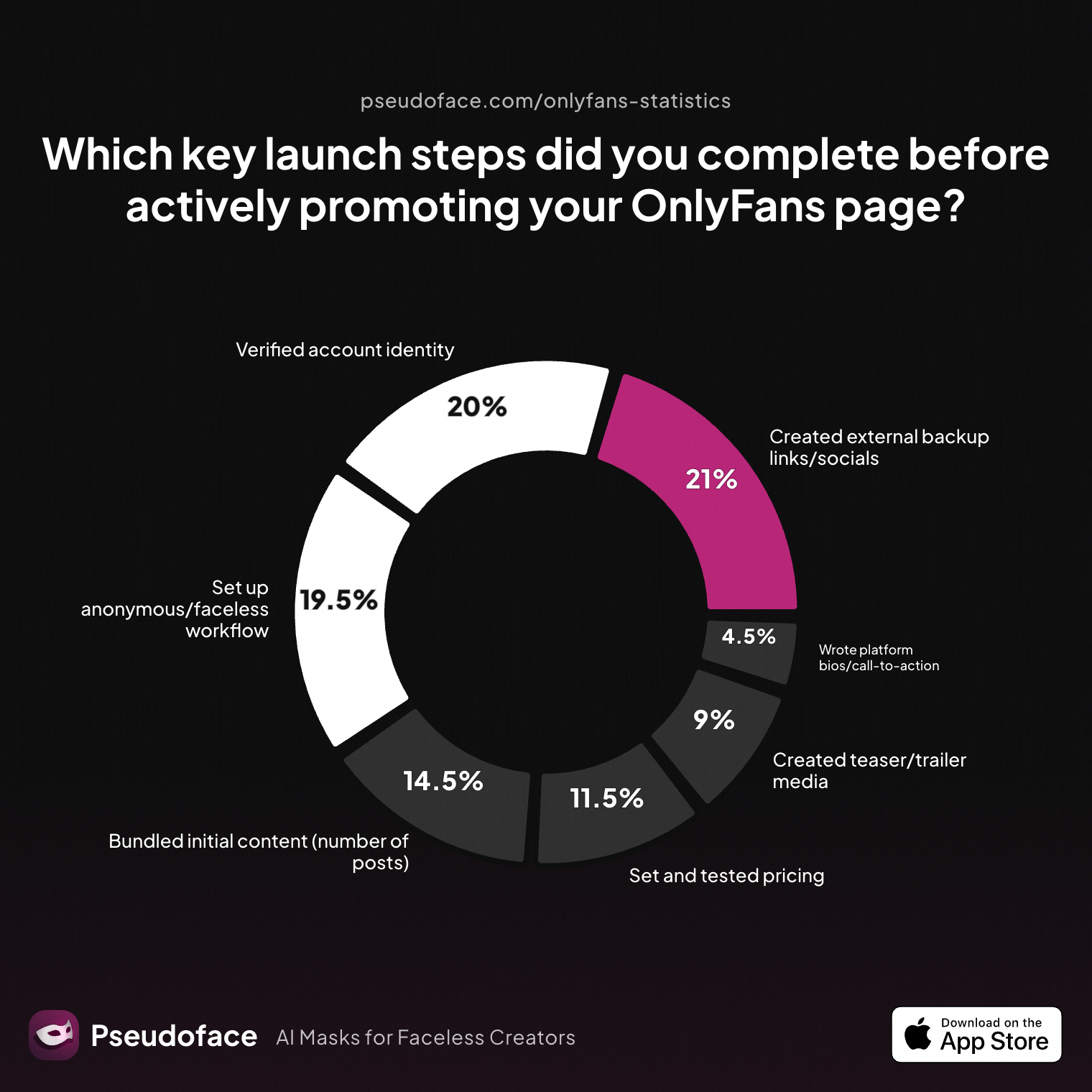
A strong launch sets the tone for long-term account safety. Even seasoned creators often skip foundational steps, increasing risk when reality—or an algorithm—hits. What do successful, ban-averse creators do before they promote or start automating? Here’s what the 2025-2026 data shows:
| Answer | Percentage |
|---|---|
| Bundled initial content (number of posts) | 14.50% |
| Created external backup links/socials | 21.00% |
| Created teaser/trailer media | 9.00% |
| Set and tested pricing | 11.50% |
| Set up anonymous/faceless workflow | 19.50% |
| Verified account identity | 20.00% |
| Wrote platform bios/call-to-action | 4.50% |
Key finding: The two most universally adopted best practices are verifying account identity (20%) and building a separate backup presence off-platform (21%).
That second point is critical. If you lose your account to a false positive—or a sudden ToS reinterpretation—an external mailing list, Discord, or cam site lets you reach loyal fans and bootstrap a relaunch. Bundling initial content before launch (14.5%) and investing in faceless/anonymous workflows (19.5%) are next-level risk steps, especially for creators not yet comfortable “front-facing” on a controversial platform.
Creators urge careful pre-launch identity checks:
- Ensure IDs are current, fully legible, and match your platform profile—by spelling, punctuation, and region.
- Review every photo or document for blur, darkness, or missing corners—and take new ones if in doubt.
- Test sign-ins and KYC (Know Your Customer) flows in advance, and never use unsupported document types (school/work ID).
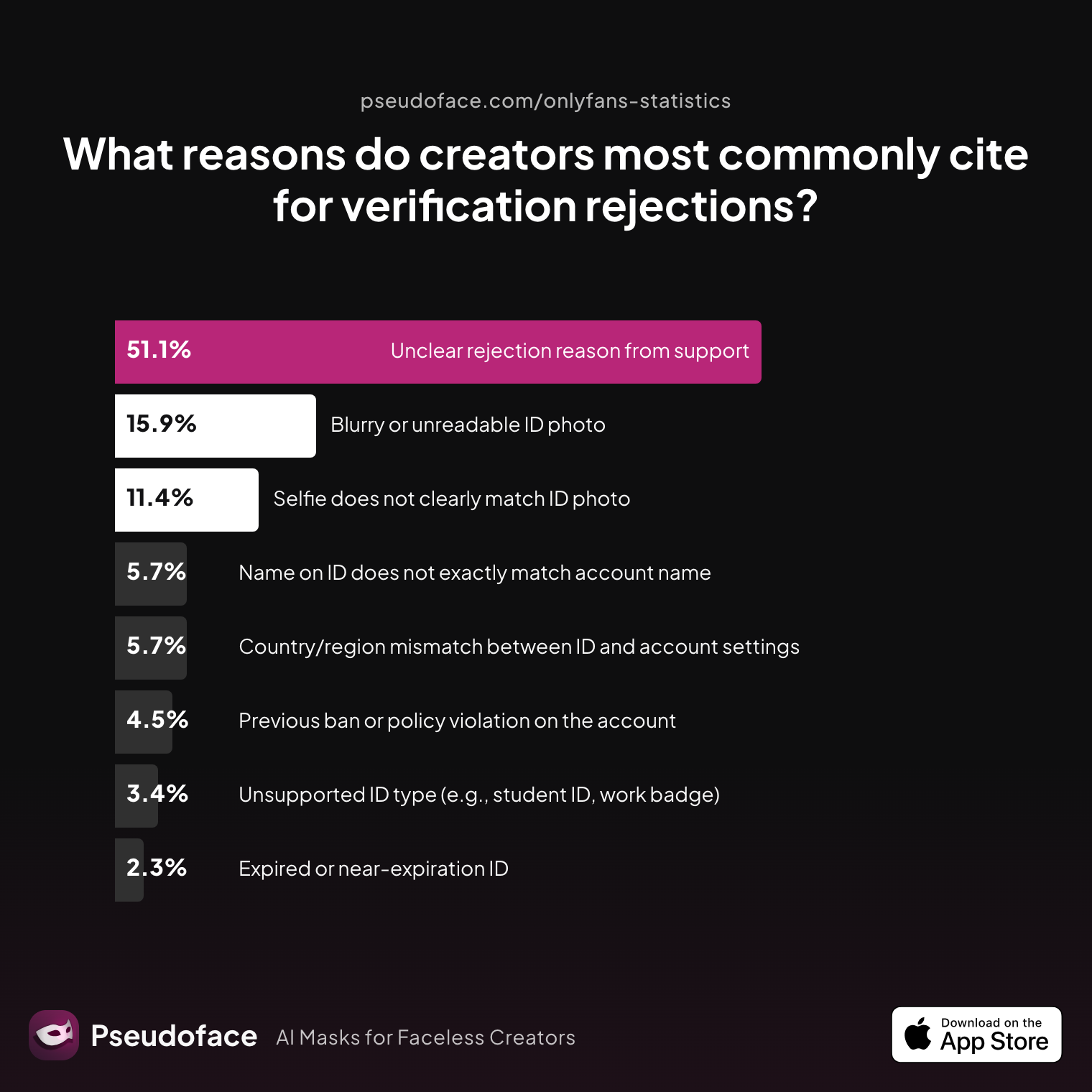
Verification remains a critical choke point for bans and payout delays, as the following data demonstrates:
| Answer | Percentage |
|---|---|
| Blurry or unreadable ID photo | 15.91% |
| Country/region mismatch between ID and account settings | 5.68% |
| Expired or near‑expiration ID | 2.27% |
| Name on ID does not exactly match account name | 5.68% |
| Previous ban or policy violation on the account | 4.55% |
| Selfie does not clearly match ID photo | 11.36% |
| Unclear rejection reason from support | 51.14% |
| Unsupported ID type (e.g., student ID, work badge) | 3.41% |
Key finding: Over half of verification failures are due to “unclear” or opaque support reasons, but technical/photo quality issues make up the next largest bucket.
This is quintessential OnlyFans: perfectly valid IDs can be rejected for impossible-to-fix reasons. The best safety strategies are preemptive—take studio-quality, well-lit photos, and match every detail from ID to account fields.
Best-practice synthesis:
- Double-check everything at launch—never rush ID steps.
- Regularly update and backup all content and account info.
- Keep a private record of every external site, backup, and consent form (and watermark all original media).
Ultimately, prevention beats mitigation. Any creator who’s been through the appeals process knows that successful resolutions are unicorn-rare.
[Comparison] OnlyFans Risk Mitigation Strategies: Free vs. Paid Pages, Human vs. Automated Ops
Deciding how much risk to take—what type of page to run, how aggressively to automate, and how much to rely on human versus scripted workflows—is at the heart of OnlyFans operations in 2026. Where does the data actually lead us?
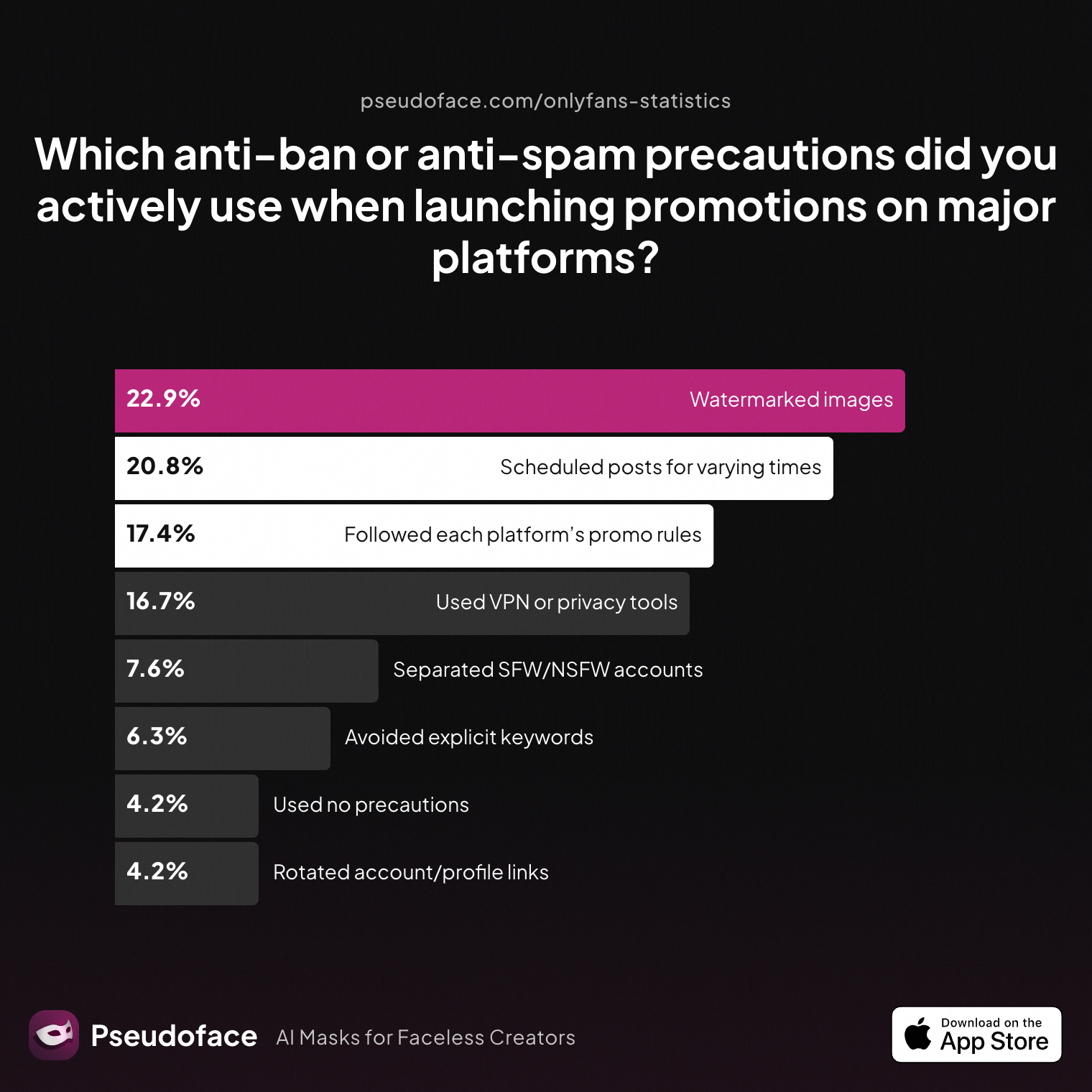
Anti-Ban Precaution Adoption Rates
| Answer | Percentage |
|---|---|
| Avoided explicit keywords | 6.25% |
| Followed each platform’s promo rules | 17.36% |
| Rotated account/profile links | 4.17% |
| Scheduled posts for varying times | 20.83% |
| Separated SFW/NSFW accounts | 7.64% |
| Used no precautions | 4.17% |
| Used VPN or privacy tools | 16.67% |
| Watermarked images | 22.92% |
Key finding: Nearly one in four serious creators routinely watermark media, with another fifth scheduling posts for off-peak times and a similar cohort using VPNs/privacy boosting. Only 4% admit to taking no special precautions at all.
These operational habits align with the broader reality: creators who think like risk managers last longer, avoid bans, and make more money—regardless of content “spiciness.”
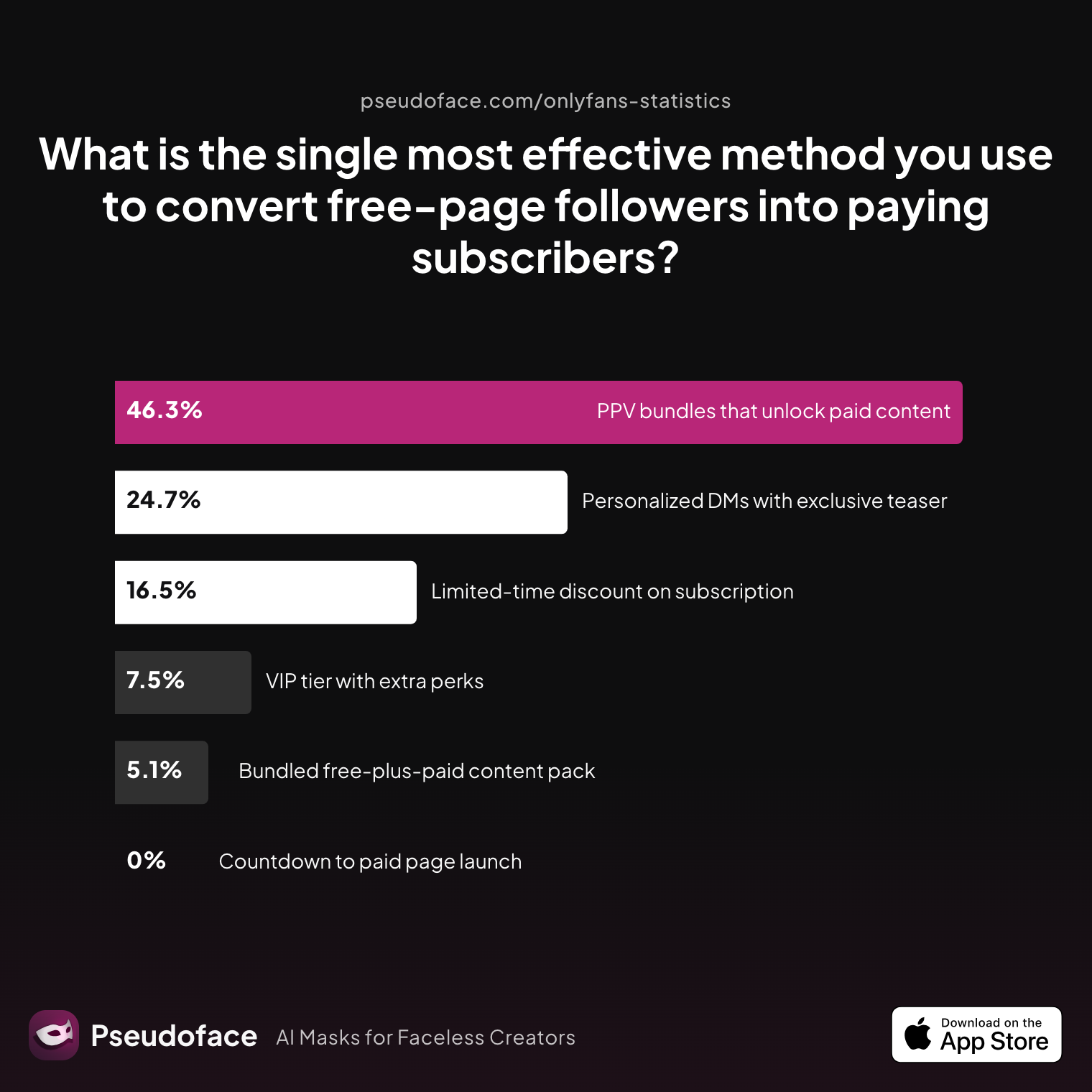
Free-to-Paid Conversion Methods
| Answer | Percentage |
|---|---|
| Bundled free‑plus‑paid content pack | 5.10% |
| Countdown to paid page launch | 0.00% |
| Limited‑time discount on subscription | 16.47% |
| Personalized DMs with exclusive teaser | 24.71% |
| PPV bundles that unlock paid content | 46.27% |
| VIP tier with extra perks | 7.45% |
Key finding: Nearly half of converting free fans to payers used pay-per-view content bundles, while 25% sent personalized DMs with exclusive teasers—both low-risk, high-ROI methods.
Operational tradeoff table:
| Strategy | Risk Level | Ban Mitigation Potential | Revenue Growth Potential | Workflow Complexity |
|---|---|---|---|---|
| Free page with PPV upsells | Low-Medium | High (if segmented well) | High | Medium |
| Paid wall only | Medium | Medium | Medium | Low |
| Layered price tiers (single page) | Medium | Medium | High | Medium |
| Manual messaging/scheduling | Low | High | Medium | High |
| Safe automation (scheduling only) | Low | High | High | Low-Medium |
| High-frequency DM automation | High | Low | High (short term) | Medium |
Takeaway: Free and hybrid page structures, paired with light, policy-compliant automation and routine safety steps (watermarking, content backup, VPN), consistently outperform “hard wall” pay models and risky botting—both for ban avoidance and ongoing growth.
For maximum account health: build in flexibility, automate with caution, treat every policy as fluid, and keep backup plans ready.
FAQ: OnlyFans Ban Prevention, Policy, Automation, and Account Health
What actions most commonly result in OnlyFans account suspension?
The most common causes are explicit content violations (40%) and failed ID/verification (20%).
According to self-reported data, most creator bans stem from unclear or overlooked platform rules, particularly missing model releases, using banned phrases, or submitting mismatched or blurry IDs. Automation-related bans are less common but real.
How can I safely use automation or third-party tools with OnlyFans?
OnlyFans-native or API-compliant scheduling tools are safest, while aggressive DM automation is riskiest.
Scheduling posts and tracking analytics using platform-sanctioned tools led to no self-reported bans, but unsanctioned mass-DM scripts have caused sudden account closures, especially after platform updates.
Do content vault structure or page type (free vs. paid) affect ban risk?
Yes: mixed free/paid and well-segmented pages correlate with lower ban rates and more stable growth.
Pure paid walls can attract more scrutiny, while multi-tier, hybrid, and free+PPV setups both lower ToS flag rates and improve fan conversion efficiency.
Which OnlyFans policies are most commonly misunderstood by creators?
Policy blind spots include banned language lists, strict ID match requirements, off-platform payment, and minor/consent documentation.
Creators often get burned by innocuous words, subtle age references, or using recycled/old media with ambiguous dating.
When are OnlyFans warnings just “slaps on the wrist” versus risking a full ban?
Any official warning is a serious risk signal; repeated violations or automation flags usually escalate to suspension.
Multiple yellow banners or shadowbans—especially for content or DM issues—are often precursors to permanent bans, even if you fix the specific issue.
What operational steps at account setup are non-negotiable for safety?
Verifying your account identity with a perfect, current, and matching ID/photo, and creating external content/social backups are essential.
Before launching or promoting, bundle content, test account access, set pricing, and plan how you’ll manage external communications if you’re ever de-platformed.
Why do creators still get banned even when they “follow all the rules”?
Automation errors, opaque moderation, or algorithmic flagging can result in bans even for compliant creators.
With half of verification failures due to unclear reasons and regular reports of false positives, risk can never be fully eliminated—only minimized.
How do verification failures happen and what can I do to avoid them?
Failures are most often due to unreadable, mismatched, or expired IDs, but “unclear” rejections are common.
Submit clear, high-quality ID photos, double-check for perfect name/location match, and be proactive with support if issues arise.
Are free trials and deep discounts safe or risky for OnlyFans account health?
Free trials and discounts are generally safe if on-platform, but always verify that promotional language doesn’t violate spam or explicit content rules.
Automated free trials via unapproved scripts are higher risk; stick to official feature sets and use moderation-safe messaging.
The landscape of OnlyFans account health and ban prevention will continue to shift—especially as automation, verification, and content rules evolve. Stay vigilant, document everything, and operate as if the next platform update could test your workflow. Your income—and peace of mind—depends on it.


