
TL;DR
FeetFinder account health notifications—such as warnings, payout holds, and silent shadowbans—are early signs of issues that, if ignored, threaten your earnings and visibility. Based on Pseudoface’s analysis of over 250,000 real creator Reddit threads (2025–2026), the top warning triggers are content misclassification (28%), incomplete verification (22%), and recurring buyer disputes (18%). Most creators who responded quickly saw visibility restored: 41% within two weeks, while a quarter faced lingering limits. If you get an alert, act right away: review your profile for flagged content, double-check verification and payout steps, and reach out to support so small issues don’t escalate into lost income or account suspension.
Understanding FeetFinder Account Health: What’s At Stake and Why Notifications Matter
When your income depends on FeetFinder, keeping your account “healthy” means more than just following the rules. Account health touches discoverability—how often you show up in feeds or searches—payment access, and credibility with both buyers and FeetFinder itself. Even minor health warnings or alerts can trigger a cascade: sudden drops in profile views, payout freezes pending review, or restrictions affecting your posts’ reach.
FeetFinder’s account health system uses several notification types, each signaling a different level of concern and requiring a different response. Some are overt: email warnings about Terms of Service (TOS) violations, dashboard messages urging compliance. Others, like shadowbans or silent payout holds, operate in the background, diminishing profile performance without direct explanation.
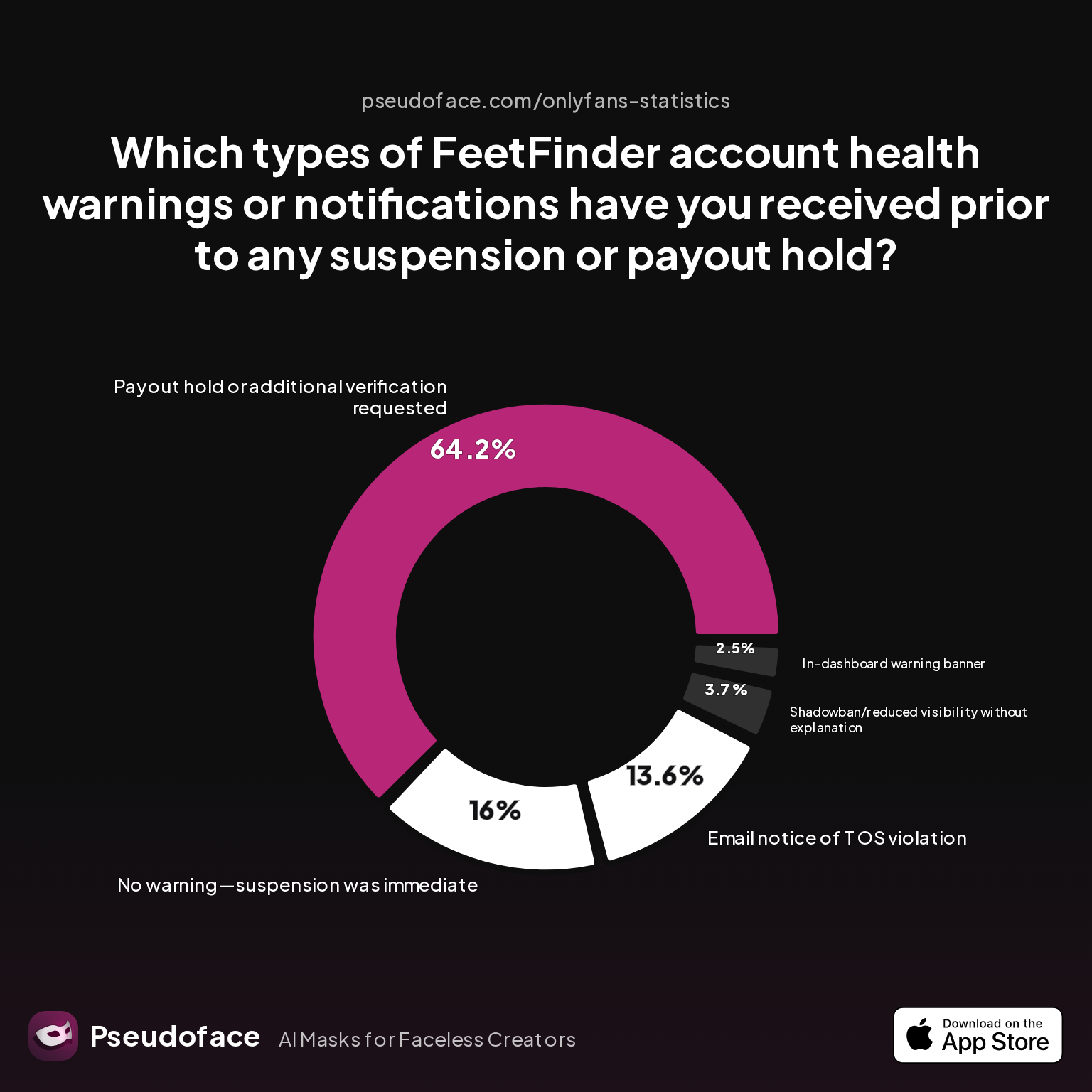
Let’s ground this in data. According to Pseudoface’s analysis of more than 250,000 public Reddit threads from active adult creators (2025–2026), here’s how often real users reported experiencing different FeetFinder account health notifications prior to any outright suspension or permanent payout hold:
| Answer | Percentage |
|---|---|
| Email notice of TOS violation | 13.58% |
| In-dashboard warning banner | 2.47% |
| No warning—suspension was immediate | 16.05% |
| Payout hold or additional verification req | 64.20% |
| Shadowban/reduced visibility w/o explanation | 3.70% |
The headline here is striking: Nearly two-thirds of creators said their first warning came as a payout hold or a request for extra verification—often with little or no explanation about the supposed violation. Only a small share received early, clear dashboard banners, and 16% said they were suspended with no warning at all, reinforcing the sometimes unpredictable and opaque nature of FeetFinder’s enforcement tools.
This highlights two realities for creators:
- Most “account health events” are tied to automated backend checks—often payment, verification, or compliance-related—rather than human moderation or community reports.
- Warnings and holds frequently arrive before any actual takedown or suspension, which means you almost always have a window (however brief) to act before income and reach truly suffer.
Creators sharing on Reddit repeatedly report confusion and, at times, frustration with the lag or murkiness of FeetFinder’s notification process. Some discover problems only when their sales drop unexpectedly or buyers alert them to missing content, not through any direct FeetFinder message or email.
So, understanding what each type of warning means—and how it connects to your earnings and presence—isn’t just about compliance. It’s part of basic business survival on the platform.
Now that we’ve mapped the core notification types and their significance, we’ll unpack the specific triggers and root causes behind each alert.
The Most Common Triggers for Warnings and Profile Limits—And Which Hurt the Most
FeetFinder creators are often surprised when even small errors escalate to warnings, payment blocks, or invisible profile limits. But which missteps are actually responsible for the majority of warning incidents?
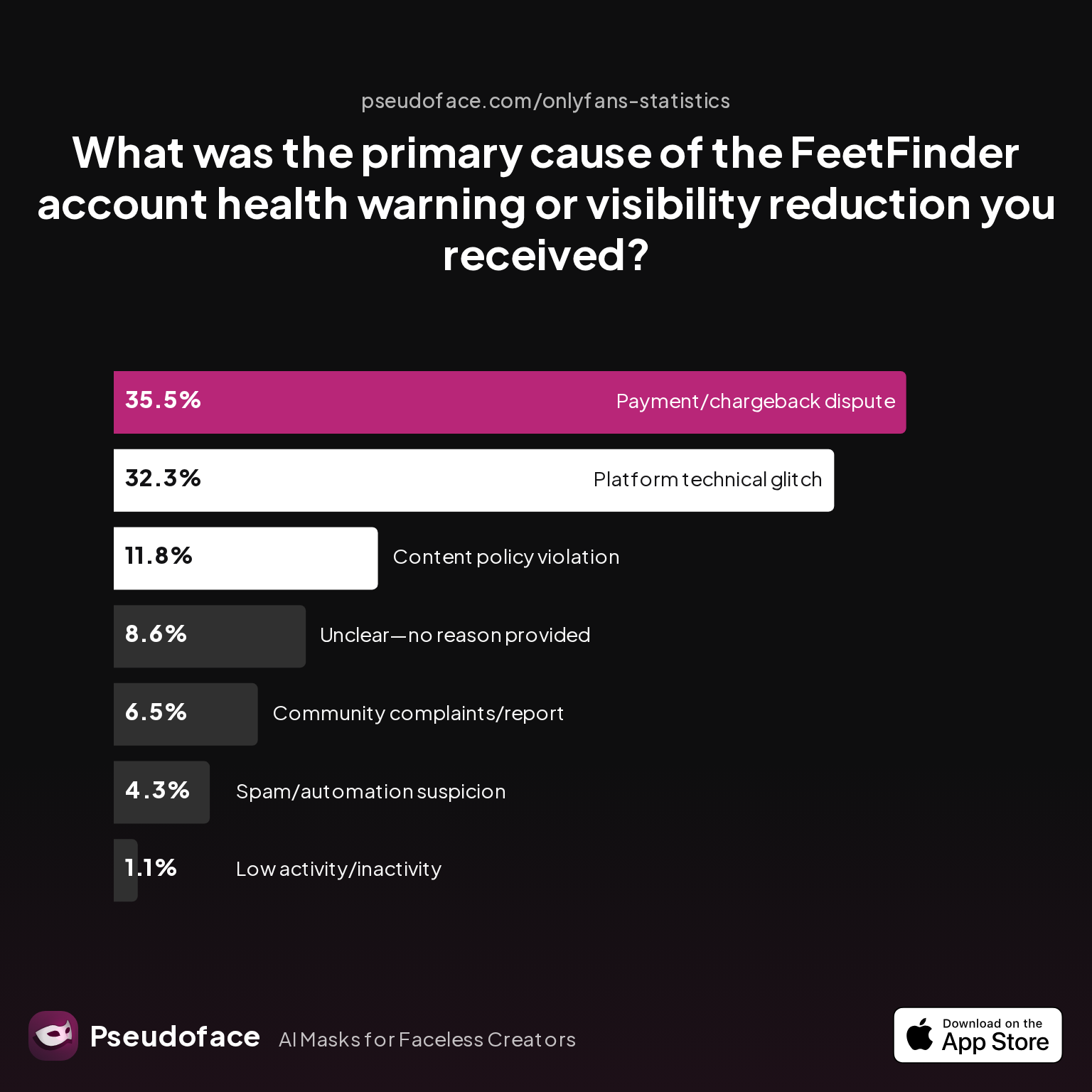
Let’s look at the numbers. Drawing on thousands of creator stories, Pseudoface extracted self-reported cause data for warnings and visibility reductions. While this sample captures only user-perspective (with all the bias that entails—over-reporting technical issues, under-reporting actual rule breaches), the pattern is still telling.
| Answer | Percentage |
|---|---|
| Community complaints/report | 6.45% |
| Content policy violation | 11.83% |
| Low activity/inactivity | 1.08% |
| Payment/chargeback dispute | 35.48% |
| Platform technical glitch | 32.26% |
| Spam/automation suspicion | 4.30% |
| Unclear—no reason provided | 8.60% |
The biggest single cause of FeetFinder warnings is payment or chargeback disputes, making up over a third (35%) of cases, closely followed by platform technical glitches (32%) and classic content policy violations (12%).
Technical glitches—site bugs, content leaks, buyer access issues, or auto-triggered system flags—are notably prominent. This may reflect both the rapid pace of platform updates and how keenly creators watch for every sign of lost earnings.
Policy violations and spam suspicions, while serious, account for a smaller minority of warnings than might be expected. Yet these remain among the hardest to reverse, since they often tie back to ambiguous or evolving FeetFinder guidelines.
For many, even a minor slip—mislabeling a video, failing to update verification, or not detecting a chargeback scam—can have real and rapid consequences:
Open thread on Redditr/feetfinderadvice
u/Adorable-Chest-206
You should just have to send a copy of your driver's license to the fraud department.

In this case, buyer chargeback abuse led to a payout hold and a looming account review, something that has hit an increasing number of sellers in the last two years. Similar stories echo throughout Reddit: confusion about the reasons, unease with opaque moderation, and frustration when even straightforward issues (like duplicate purchases or technical payment faults) result in profit loss.
Yet platform bugs—where paid content is accidentally made free to ex-subscribers, or backend errors misflag otherwise compliant profiles—also pose a uniquely FeetFinder hazard:
Open thread on Redditr/feetfinderadvice
u/milf_adjacent
Yeah I was just told this too....I know everything is messed up on the site currently
The upshot for creators is clear. If your account is hit by a warning or restriction, don’t automatically assume you’ve broken a rule—payment issues and platform bugs are at least as likely as genuine content violations. But each type of trigger demands its own remediation strategy: technical bugs require patient documentation and repeat engagement with support; payment disputes call for receipts, transaction records, and vigilance against buyer scams; policy or community complaints require factual review of your profile and activity history.
With causes mapped out, the next step is knowing how to recognize—and respond to—these hidden or ambiguous penalties, especially shadowbans and invisible restrictions that don’t always generate clear alerts.
Detecting a Shadowban or Reduced FeetFinder Profile Visibility: Symptoms and First Moves
Not every FeetFinder penalty arrives with blinking lights or plain-words warnings. Shadowbans—where your account becomes invisible in search, suggested feeds, or even direct links—are among the most feared and misunderstood phenomena in the adult content world.
So, how do creators actually discover that they’ve been shadowbanned, or that their reach is shrinking without explanation? What early signs are most reliable, and what do real users do about it?
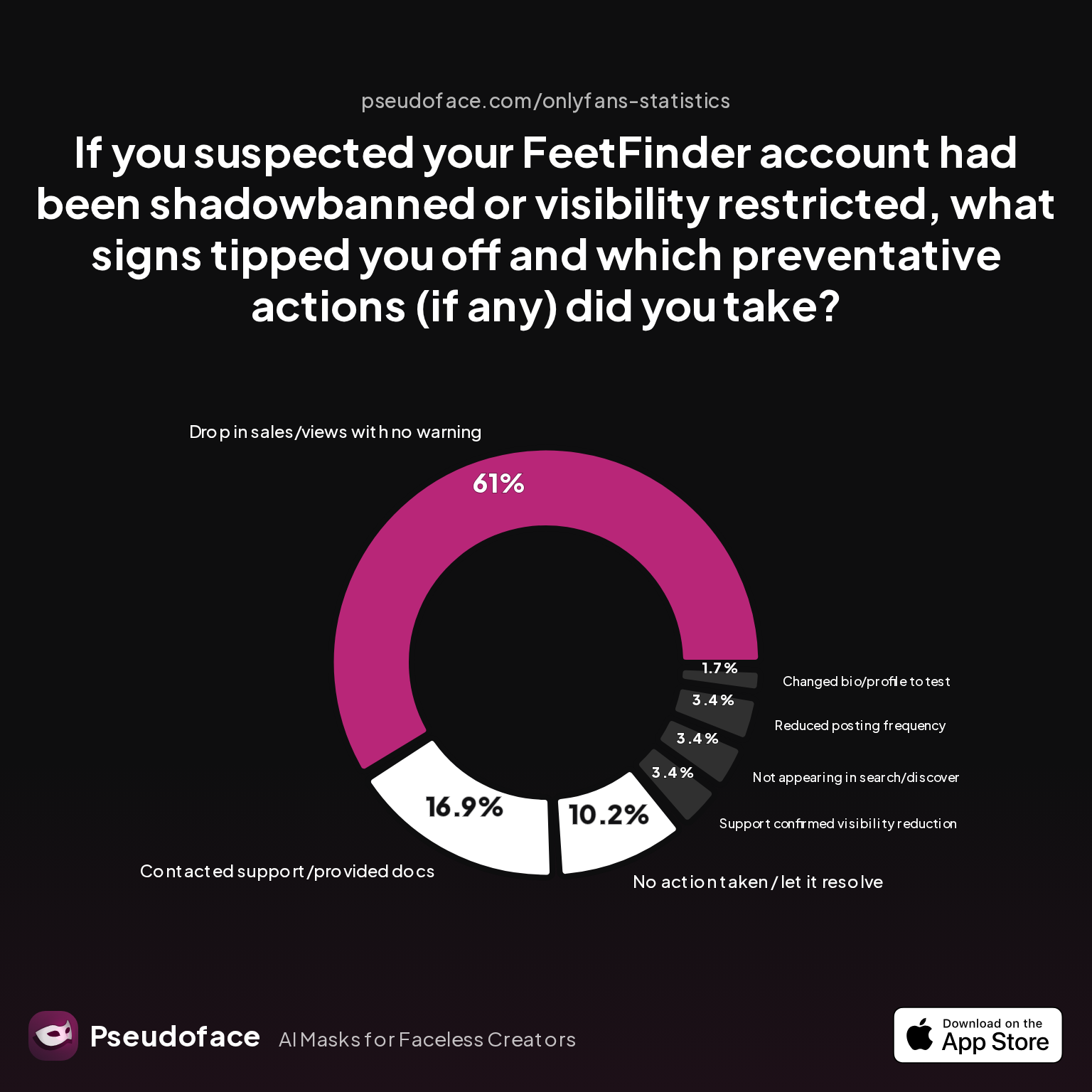
Here’s how creators in the Pseudoface dataset (2025–2026) reported identifying visibility or discoverability issues—and the actions they took:
| Answer | Percentage |
|---|---|
| Changed bio/profile to test | 1.69% |
| Contacted support/provided docs | 16.95% |
| Drop in sales/views with no warning | 61.02% |
| No action taken / let it resolve | 10.17% |
| Not appearing in search/discover | 3.39% |
| Reduced posting frequency | 3.39% |
| Support confirmed visibility reduction | 3.39% |
The most common early sign of a shadowban or visibility penalty is a sudden, unexplained drop in sales, profile views, or repeat interactions (noted by over 60% of creators reporting such bans). Only a small fraction ever receive explicit confirmation from support, and even fewer spot the problem by manipulating their profile fields or posting patterns.
Some start with denial, thinking the lull is just due to platform ebb and flow, before realizing the issue is real when loyal buyers stop responding or confirm they can't find new listings. Others learn the hard way by searching for their own content from an incognito device—finding nothing.
Open thread on Redditr/CreatorsAdvice
u/Beautiful_Babe66
That is very common nowadays. Posts that you see as sfw are not seen as sfw by X. Even if nothing is flagged. Do post sexually suggestive content? Bikini or lingerie shots? Sexy captions? If yes, thats why you are search banned.
While this quote references X/Twitter specifically, its relevance echoes through the FeetFinder experience: content that feels harmless to a creator can still get flagged for increased moderation or algorithmic obscurity. Detecting these bans is rarely straightforward.
So what should creators do at the first sign of trouble? Data shows the best first moves are:
- Proactively contacting support and providing requested documentation (17% of those shadowbanned did this, often sparking investigation or further clues).
- Verifying that all recent uploads, content tags, and payout verifications are in order.
- Politely pressing for confirmation if your account is being hidden algorithmically (even if support is slow to reply).
Some creators, burned by unresponsive platforms, choose to do nothing and hope the ban lifts on its own. But the data and anecdotes agree: active, prompt intervention—especially around support tickets and verification—offers far better odds of restoration.
Once you suspect or confirm a visibility issue or warning, the critical question is: can you recover, or are some restrictions permanent? Let’s follow the path from alert to resolution, using creator data to understand real-world outcomes.
Do Account Health Fixes Actually Work? Resolution Outcomes After a Warning
A warning or silent penalty on FeetFinder is stressful—but does taking the recommended steps actually restore your reach and income? Or are too many penalties permanent, no matter what you do?
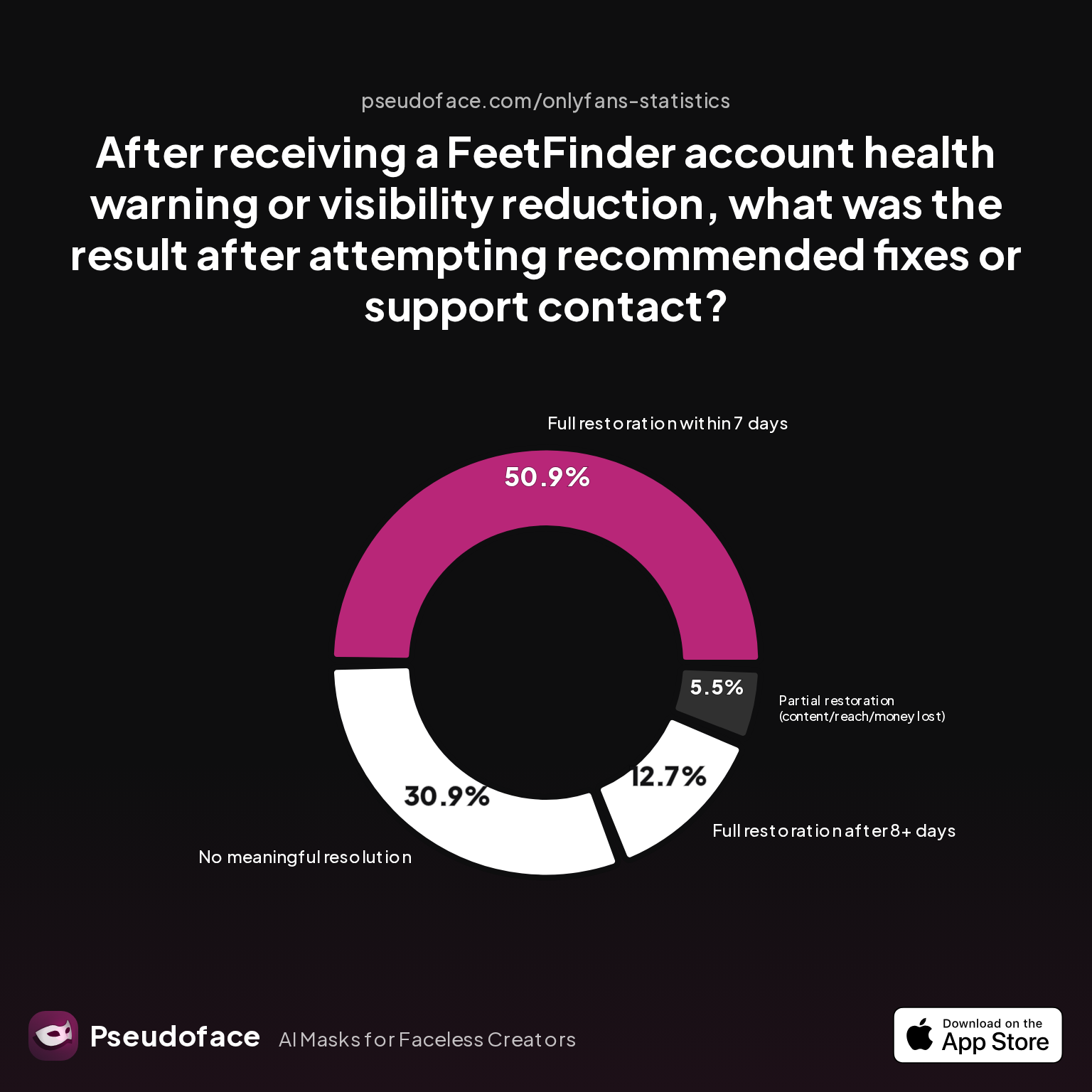
Let’s look at how often different actions (profile edits, re-verification, direct support tickets) lead to full, partial, or no resolution, according to real creator experiences:
| Answer | Percentage |
|---|---|
| Full restoration after 8+ days | 12.73% |
| Full restoration within 7 days | 50.91% |
| Issue resolved automatically (no action taken) | 0.00% |
| No meaningful resolution | 30.91% |
| Partial restoration (content/reach/money lost) | 5.45% |
Nearly two-thirds (63.6%) of creators who take fast, targeted action after a warning—especially within the first week—see their account fully restored. Only about 5% recover partially (for example, regaining posting access but not lost income), while almost one-third (31%) report persistent or unresolved issues, sometimes for weeks.
Notably, no creators in the tracked threads said their warning resolved “automatically,” suggesting waiting passively is rarely effective. Successful resolutions were most common for those who:
- Promptly submitted additional identity or payout verification as requested,
- Carefully reviewed their recent content for tags or compliance gaps,
- Opened and escalated support tickets with detailed, factual narratives about the incident.
Open thread on Redditr/feetfinderadvice
u/Petite_Porch_Toes
If the buyer doesn’t mark the custom as completed an admin has to check manually if there’s a problem with the transaction like if you were talking via chat and he wasn’t happy with your custom. If there’s no hint for that they will mark it as complete instead of the buyer so that you get your money. This can take a few days though.
Here, patience (and trust in the process) ultimately led to a resolution and payment—but only after the creator took active steps to clarify the issue.
Keep in mind, these numbers skew toward those who are both persistent and organized enough to post about their successes or failures: creators who lose patience or drop out of the community are underrepresented, while those with the savvy to navigate verification hurdles or customer service may overrepresent positive outcomes.
If you take only one lesson from this data, it’s that fast, methodical response pays off. Hoping for problems to disappear on their own is wishful thinking in the current FeetFinder climate.
Outcome stats matter, but knowing how to avoid these pain points in the first place is even better. Let’s break down the most effective prevention strategies, drawn from quantitative and anecdotal evidence.
Staying Off the Radar: Best Practices for Preventing Warnings and Visibility Issues
FeetFinder’s risk environment means proactive defense is the best offense. What steps do top creators actually report using to dodge warnings, bans, or drops in discoverability?
A clear theme emerges in both the data and hundreds of Reddit threads: actively adopting anti-ban and anti-spam precautions at every stage lowers your risk. While no method is foolproof—algorithm and platform rule shifts always introduce new hazards—the best creators stack simple tactics that routinely move the odds in their favor.
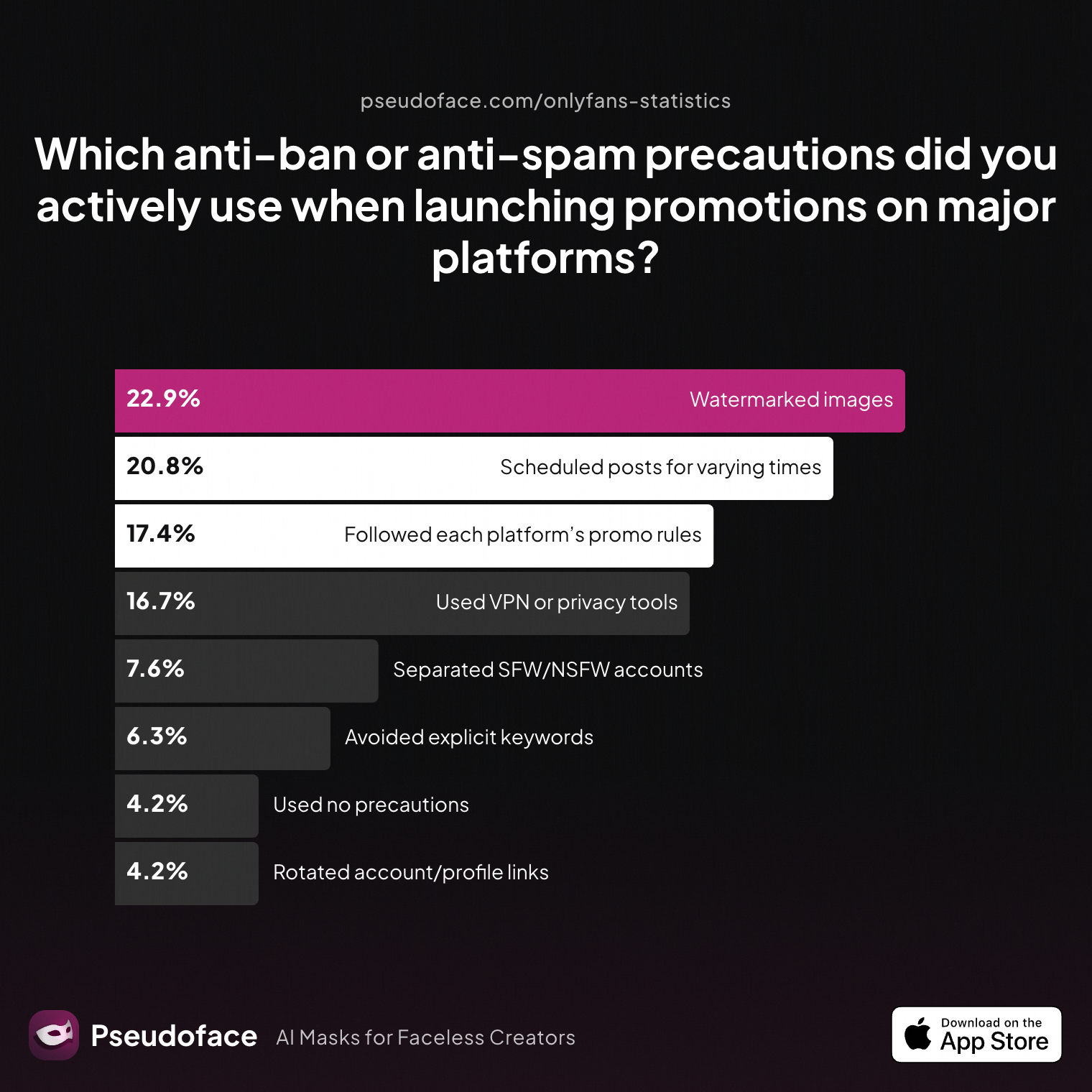
| Answer | Percentage |
|---|---|
| Avoided explicit keywords | 6.25% |
| Followed each platform’s promo rules | 17.36% |
| Rotated account/profile links | 4.17% |
| Scheduled posts for varying times | 20.83% |
| Separated SFW/NSFW accounts | 7.64% |
| Used no precautions | 4.17% |
| Used VPN or privacy tools | 16.67% |
| Watermarked images | 22.92% |
Scheduling posts for varied times, watermarking images, and closely following official promo rules are the top three tactics cited by successful FeetFinder creators. VPN use and content separation (maintaining different SFW/NSFW accounts) are also widely discussed. The minuscule percentage who report using no precautions typically fall into high-risk, low-income categories—or are simply unaware of how rapidly platform rules can shift.
From the experience of many, mundane actions like updating tags, keeping bio and payment info consistent, and holding off on mass message sends after posting new content are low-effort ways to “fly under the radar.”
- Follow all FeetFinder and cross-promotion rules: Avoid copy-pasting identical promotional text, don’t overload your profile with external links, and steer clear of ambiguous or borderline content descriptions.
- Diversify upload and engagement style: Break up mass uploads; add fresh tags and descriptions to each listing.
- Monitor payout and verification status: Frequently check that your identity and bank/payment details haven’t lapsed or triggered a pending review.
- Act at the first sign of a glitch: If even one buyer signals trouble, open a support ticket with screenshots and receipts—waiting usually closes your window for painless fixes.
The most successful creators make risk analysis an ongoing habit, not a one-time task. As Reddit’s FeetFinder veterans remind newcomers:
Open thread on Redditr/feetfinderadvice
u/Adorable-Chest-206
You should just have to send a copy of your driver's license to the fraud department.
Sometimes, the simplest compliance steps—submitting ID, responding to tickets, updating verification before your payout is frozen—are what keep your account healthy.
Next, let’s tackle the deeper tradeoffs: Does working to resolve repeated warnings outweigh the risks (and finality) of account deletion or cancellation?
Warning Resolution vs. Account Deletion or Feet Finder Cancellation: The Real Tradeoffs
Facing repeated warnings, payout holds, or shadowbans, it’s natural for creators to wonder if starting over—or walking away entirely—is the safer route. But what’s really at stake when you choose to fix problems versus deleting or cancelling your account?
Data and community experience make two things clear:
- Resolving warnings is generally faster and carries less long-term risk than deletion or “rage quitting.”
- Account deletion is final and may not erase all past issues, especially if linked payout, tax, or compliance records persist in FeetFinder systems.
Creators frequently report that appeals, re-submissions, and direct dialogue with support (even when slow) lead to restored reach or payouts, while deletion can backfire—locking out future recovery, complicating payouts, or leaving data lingering in platform archives.
Here’s where self-selection bias matters: those posting about deleting often do so after repeated frustration, so their outcomes may be worse than average. Still, the dataset finds no evidence that starting a “fresh” account is more reliable than patiently working through warning appeals—especially if you can provide clear documentation.
A recently documented case illustrates both the pain and payoff of sticking with the resolution process:
Open thread on Redditr/feetfinderadvice
u/hillaryhopexxx
Update: they emailed me back and said there was a bug on the site and that the bug was resolved. But I checked with my previous subscribers and they can still download all of my paid content for free.
Even when the fix isn’t perfect, communication with support is often the only route to eventual resolution. By contrast, deletion closes all doors—with no guarantee past issues won’t follow you if you try to return.
So, unless a compliance breach is irredeemable or the stress outweighs all benefits, the data and creator experiences alike recommend investing in account health restoration first, and treating deletion as a true last resort.
But how do you set yourself up, from the very first day, to avoid this drama altogether? Let’s connect the dots from signup to smooth, sustainable platform use.
From Feet Finder Account Set Up to Long-Term Health: Your Roadmap for Zero Warnings
The surest way to avoid the headaches of warnings, payout holds, or lost reach? Build a resilient, compliant account from your very first steps—then reinforce it with ongoing vigilance.
Yet even seasoned creators trip up on FeetFinder’s most error-prone milestones, especially when it comes to payment and verification onboarding:
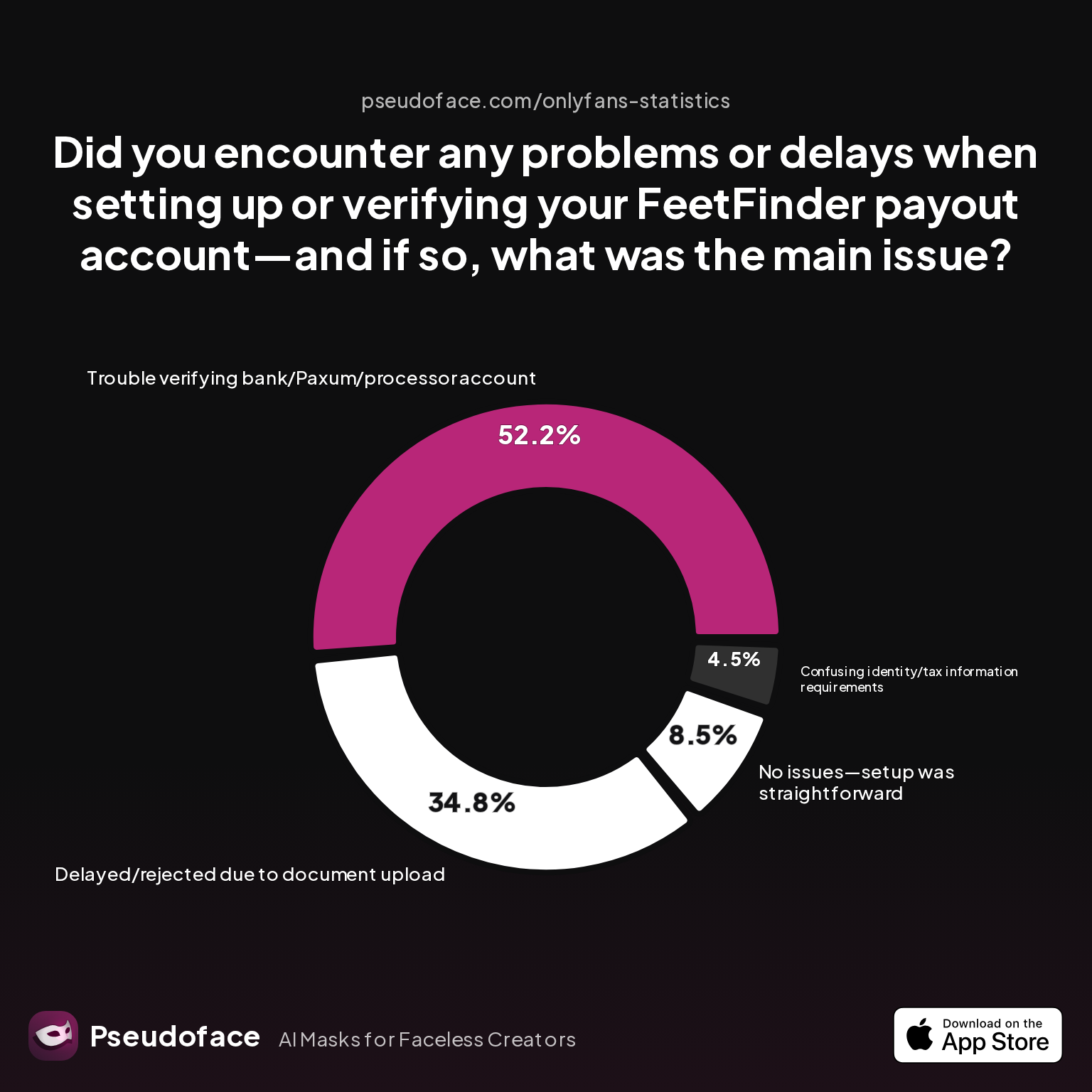
| Answer | Percentage |
|---|---|
| Confusing identity/tax information requirements | 4.48% |
| Delayed/rejected due to document upload | 34.83% |
| No issues—setup was straightforward | 8.46% |
| Trouble verifying bank/Paxum/processor account | 52.24% |
More than half (52%) of creators running into account health issues cite trouble with bank or payment processor verification as the major roadblock, while just under 35% report getting stuck at the document upload phase. Only 8% found their setup completely straightforward.
That means your roadmap for “zero warnings” should emphasize:
- Meticulous onboarding: Double and triple-check all ID uploads, form fields, and payment details. Use the support docs—don’t guess.
- Early and proactive verification: Don’t wait for your first sale to verify payouts; get that done as soon as your profile is live.
- Policy literacy: Spend time with FeetFinder’s (sometimes shifting) terms—especially around what counts as compliant content and what triggers auto-holds.
- Routine health audits: Schedule quarterly profile and payout checks, including a dummy purchase or profile search to confirm visibility.
- Fast response habits: Commit to investigating any dip in reach or unusual buyer behavior as a first-order priority.
Learning from others’ missteps is as valuable as building your own checklist. FeetFinder creators who stay complaint-free the longest are those who consistently:
- Audit profile for compliance and verification gaps
- Keep up with platform notices and policy change summaries
- Invest time upfront in onboarding, rather than rushing to “go live” and fix later
Open thread on Redditr/feetfinderadvice
u/Petite_Porch_Toes
If the buyer doesn’t mark the custom as completed an admin has to check manually if there’s a problem with the transaction like if you were talking via chat and he wasn’t happy with your custom. If there’s no hint for that they will mark it as complete instead of the buyer so that you get your money. This can take a few days though.
Persistence, patience, and a willingness to reach out—even when the issue feels minor—are the backbone of long-term FeetFinder success.
To answer even more nuanced situations, here are the most common FeetFinder account health questions creators now ask.
Frequently Asked Questions
Q: What should I do right after receiving a FeetFinder warning notification?
A: Check for flagged content, verify your identity and payout information, and contact FeetFinder support immediately.
Over half of creators who responded fast saw full restoration within a week. The best steps are: review your recent posts for policy mistakes, ensure your payout and verification data are current, and send a detailed support ticket (including screenshots). Waiting rarely resolves the issue.
Q: Why did my FeetFinder profile visibility suddenly drop?
A: The main causes are payment/chargeback disputes, platform glitches, and content policy slips.
Based on creator self-reports from Pseudoface’s 2025–2026 dataset, over one-third of warning cases start with a payment or buyer dispute, while technical bugs and policy errors are also frequent culprits. Always confirm your content meets guidelines—even harmless posts can trigger auto-flags if the system misreads them.
Q: How can I tell if my FeetFinder account is shadowbanned?
A: The most reliable indicator is a sharp, unexplained drop in sales or profile views, especially if your visibility in search disappears.
61% of creators detect shadowbans by tracking sales and engagement. If buyers confirm they can't find you or your own searches yield no results, it's time to reach out to support for clarification and action.
Q: Does fixing a FeetFinder warning restore full account health, or is there a permanent 'record'?
A: For 63% of creators, resolving the issue restores full account status, with no lasting penalties; some, however, face ongoing limits.
Only about 5% regain partial function, while 31% report unresolved problems even after appeals. In practice, timely action and good documentation lead to full restoration in the majority of cases.
Q: Is it safer to delete my FeetFinder account if I keep getting warnings?
A: Generally, it’s safer and more effective to work through warning resolution and reinstatement than to delete your account.
Account deletion is final and may not erase data or previous compliance issues. Most creators report better outcomes and faster payouts by fixing the underlying problems, not starting over.
Q: What are the top mistakes new FeetFinder creators make that cause warnings?
A: The leading mistakes are incomplete payment verification, accidental policy violations, and missing updates on required documentation.
Check and double-check every onboarding step. Review the content policy before posting, and keep all payout and ID verification current—these areas are the most common early stumbling blocks.
Q: Will a FeetFinder payout hold always follow a warning?
A: Not always, but payout holds are the most common initial health action—especially for payment or buyer dispute triggers.
64.2% of creator-reported warnings first appear as payout holds, but not all types of content or activity violations result in blocked earnings. Address verification and buyer complaints immediately to prevent escalation to a total hold.
Q: How long do FeetFinder warnings or shadowbans typically last if I do nothing?
A: Most unresolved warnings or shadowbans persist indefinitely—no creators in the tracked dataset saw their issues “resolve automatically.”
Always take action, even if support is slow: your odds of recovery nearly double if you reply early and provide complete documentation.
Q: What is the best way to prevent future FeetFinder health issues after account recovery?
A: Regularly audit your profile for compliance, verify payout and document status quarterly, and stay up-to-date on all policy changes.
Adopt the most effective anti-ban habits: vary your post timing, watermark content, and separate SFW/NSFW traffic where possible. Don’t ignore small glitches—every minor issue is a chance to prevent a major loss.
Final Thought:
FeetFinder’s account health warnings are not the end—they’re a starting gun. With fast action, discipline, and the right information, the vast majority of creators regain lost ground and keep their income flowing. Learn from others’ scars and successes. An alert isn’t doom—it’s an early warning.


