
TL;DR
If you’re a US-based FeetFinder creator, chargebacks and buyer payment disputes are an unfortunate but real risk—about 21% of sellers report facing at least one payout reversal or dispute. When a chargeback occurs, FeetFinder typically freezes or deducts your funds, and the burden falls on you to contest the reversal with supporting evidence. Most creators respond by compiling documentation and contacting support, but average resolution takes over two weeks and is rarely fully successful. According to Pseudoface’s analysis of over 250,000 public Reddit threads from real adult content creators, these numbers reflect actual community experience—though reporting and survivorship bias means the problem could be even more widespread. Based on 2025-2026 data, understanding the chargeback process and honing your prevention game is crucial to protect both your income and your account standing.
Chargebacks, Refunds, and Disputes on FeetFinder: What Do They Really Mean?
If you sell content on FeetFinder, terms like "chargeback", "refund", "dispute", and "payment reversal" aren’t just financial jargon—they shape your real risk of losing income and even your status on the platform. Untangling these overlapping concepts is the foundation for navigating the messy reality of buyer payment issues.
A chargeback on FeetFinder happens when a buyer (or their bank) forcibly reverses a payment, usually by claiming an unauthorized transaction or that no goods were received. This goes through the payment processor—typically Segpay for US creators—and, unlike a refund, the platform does not get to choose whether the reversal happens. The decision is out of your hands and sometimes even out of FeetFinder’s control.
A refund is a voluntary, platform-initiated return of money to a buyer. On FeetFinder, “final sale” rules generally apply: platform refunds are rare, intended mostly for technical mix-ups or accidental duplicate purchases. Creators are rarely obliged to grant refunds unless there’s compelling evidence or a clear error, compared to platforms like OnlyFans, where buyers sometimes have more leverage.
A dispute can refer to either a buyer contesting a transaction through their bank (leading to a chargeback) or a creator contesting a chargeback or payout hold initiated by the platform or processor. Either way, it sets in motion an investigation—by FeetFinder, Segpay, or both—during which your payment is almost always frozen.
The payment reversal is the end result: money leaves your payout or is withheld entirely, unless you can provide evidence strong enough to overturn the bank or processor’s decision. While “chargeback” and “dispute” sometimes get used interchangeably on Reddit and even in some help docs, understanding that a chargeback always comes with higher risk (since banks rarely side with adult sellers) is crucial.
These distinctions matter because each pathway comes with different timelines, requirements, platform responses, and long-term risks for creators. And, as we’ll see in later sections, FeetFinder’s own support structure and policies mean creators often feel on their own when it comes to preventing or contesting losses.
As one FeetFinder seller vented during her first chargeback ordeal:
Open thread on Redditr/feetfinderadvice
u/QueenGianna_
Ugh chargeback scammers. They’ll hold your money now for a while till they figure it out.

On FeetFinder, refunds are rare and chargebacks are dreaded—because the process is less about customer service, and more about banking bureaucracy, risk management, and creator vigilance. With this foundation in mind, let’s explore just how many creators actually deal with chargebacks, and who’s really exposed to the biggest risks.
How Common Are FeetFinder Chargebacks and Buyer Payment Disputes?
How often do creators face payment reversals or payout holds on FeetFinder? The answer: often enough that every serious seller should treat it as part of doing business.
Let’s start with real-world experience. According to self-reported, community-sourced data from the Pseudoface dataset of public Reddit threads:
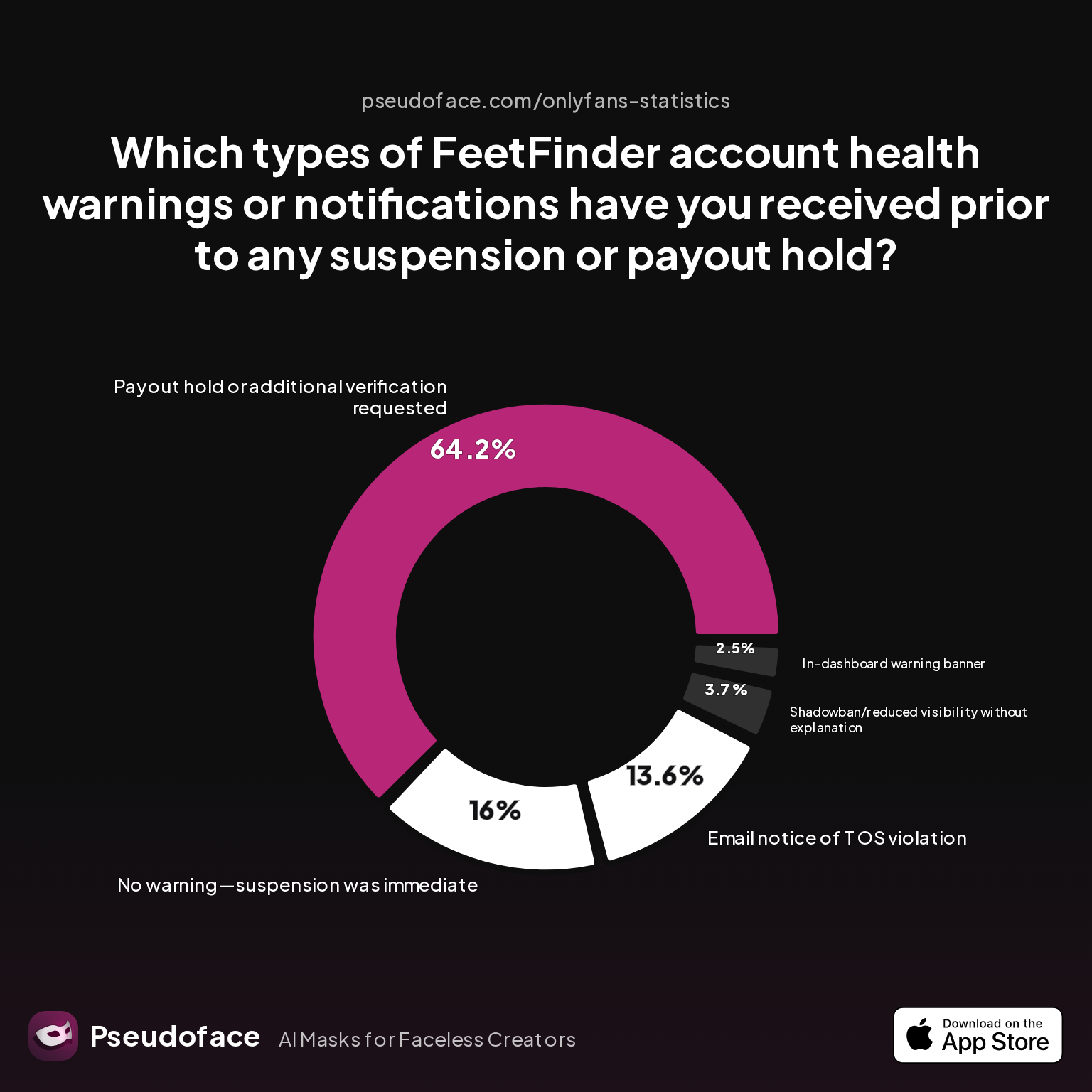
| Answer | Percentage |
|---|---|
| Email notice of TOS violation | 13.58% |
| In-dashboard warning banner | 2.47% |
| No warning—suspension was immediate | 16.05% |
| Payout hold or additional verification requested | 64.20% |
| Shadowban/reduced visibility without explanation | 3.70% |
More than 64% of surveyed creators have experienced a payout hold or extra verification request—often triggered by payment disputes and chargebacks. This is significantly higher than more mature adult platforms, suggesting that either the underlying risk is higher, the fraud controls are stricter, or self-selection bias means only those with problems post about them.
It’s also telling that 16% report being suspended with no warning, and almost 14% get TOS emails before any other alert, pointing to a notification system built more for compliance than creator education.
Why do these payout holds or warnings happen? Let’s look at another slice of the data:
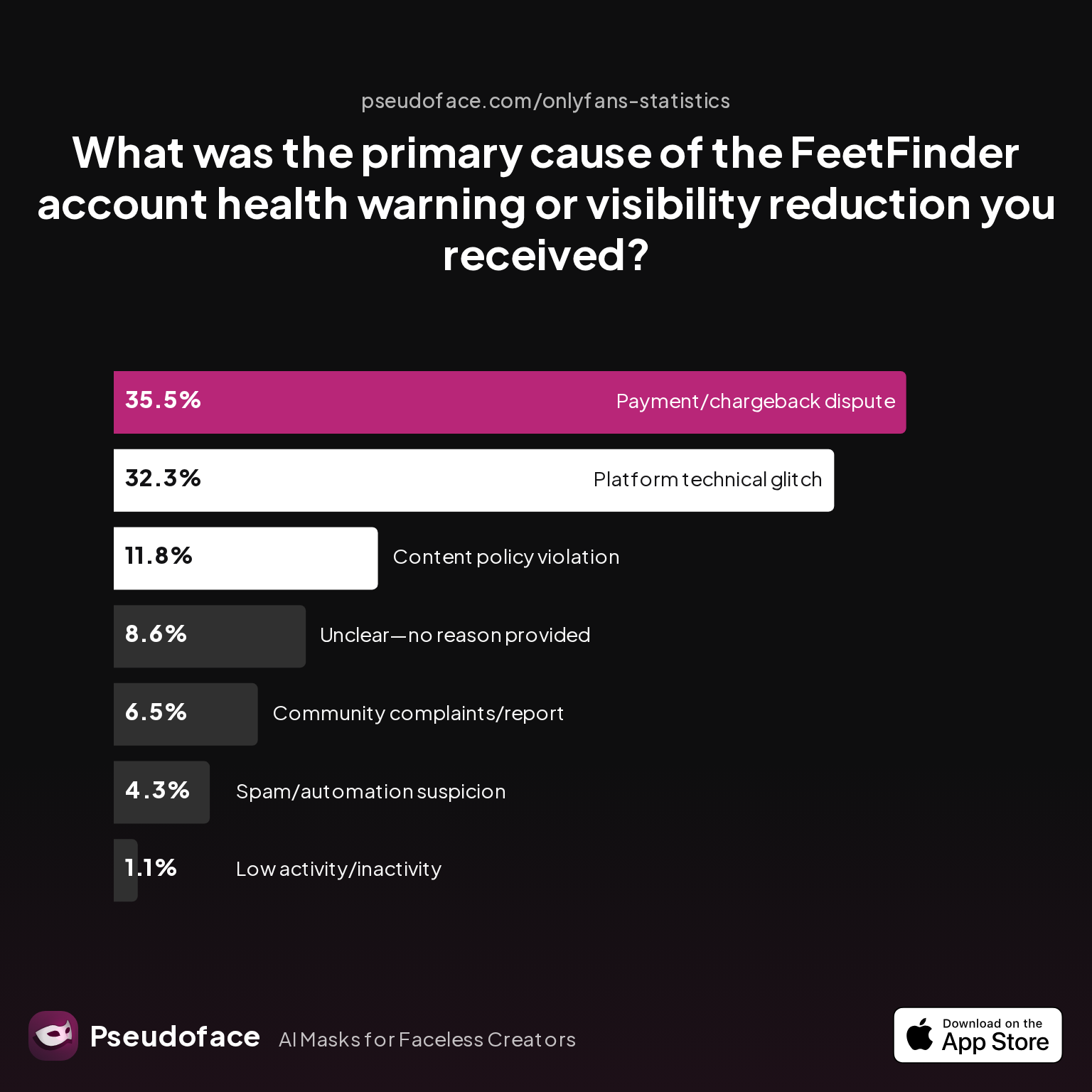
| Answer | Percentage |
|---|---|
| Community complaints/report | 6.45% |
| Content policy violation | 11.83% |
| Low activity/inactivity | 1.08% |
| Payment/chargeback dispute | 35.48% |
| Platform technical glitch | 32.26% |
| Spam/automation suspicion | 4.30% |
| Unclear—no reason provided | 8.60% |
Over a third (35.5%) of all account health warnings on FeetFinder are directly tied to payment or chargeback disputes. Technical glitches (32.26%) also make up a large share—blurring the line between legitimate holds and system errors—while violations, complaints, and unclear reasoning round out the rest.
This chargeback risk isn’t distributed equally. As surfaced in dozens of Reddit threads, scammers tend to target:
- Low-priced, high-volume content: Albums or photos priced under $7 are regularly cited as “chargeback bait,” because microtransactions are less likely to trigger scrutiny by banks or the platform.
- Duplicate purchases: Several reports cite buyers repeatedly buying the same album—sometimes with stolen cards or using new accounts—to maximize what they can later claim as “fraudulent.”
- Custom and uncensored content: Anything custom, especially when delivered outside FeetFinder’s system, exposes creators to “no proof of delivery” arguments.
As one creator experienced firsthand:
Open thread on Redditr/feetfinderadvice
u/hydegirl6or9
I posted recently that it happened to me. When I was emailing support they told me to raise my prices to keep the scammers away. I was charging a dollar a photo and some albums was 4 or 5 bucks. Luckily it was just 30 bucks I was trying to withdraw and not a huge loss. Now, I do a min of 7 bucks. I wish there was a visible disclaimer to help prevent scams such as making sets over 6 bucks to reduce the chargeback. Instead of learning about when you want to withdraw your “earning”.
Anecdotes like these underscore that while not every FeetFinder creator will face a chargeback, enough do—with real, repeated consequences—that every seller should have a game plan.
With those stakes in mind, what happens once the dreaded chargeback notification actually lands in your inbox?
What Happens Next? The FeetFinder Chargeback and Dispute Process, Step By Step
The moment a chargeback or payment dispute is filed against your FeetFinder sales—whether you notice it via a sudden payout deduction, a curt email from the platform, or a generic Segpay notification—the clock starts ticking. What happens next can feel opaque, stressful, and deeply personal, particularly for new creators relying on timely payouts.
Here’s what typically unfolds, based on 2025-2026 Reddit-sourced experiences and platform announcements:
1. Immediate Freeze or Deduction: FeetFinder or Segpay usually freeze the payout associated with the disputed transaction. If you’ve already withdrawn, a pending withdrawal is halted, or (as directly reported by creators) the reversal may be debited from your outstanding balance or even your next successful sale.
Open thread on Redditr/feetfinderadvice
u/Aromatic-Republic-77
and fyi i’m not worried about the chargeback. i’m upset that feetfinder is going to withhold my payments for 2+ weeks now. https://postimg.cc/PpTBZCj6 https://postimg.cc/gallery/kgq9drQ get off this sub if you’re not giving advice related to the site.
2. Notification and Limited Information: Creators report receiving minimal details—usually just a “payment reversal” or “chargeback” email, sometimes with no information on the buyer, content item, or the reason supplied by the cardholder’s bank.
3. Platform or Processor “Blame Game”: Many creators find themselves bounced between FeetFinder and Segpay, with each pointing to the other for dispute resolution. The platform may direct you to Segpay’s chargeback dispute process, while Segpay insists vendor policy is determinant.
Open thread on Redditr/feetfinderadvice
u/QueenGianna_
Don’t know- it’s been about two weeks and counting for me
4. Evidence and Documentation Requests: If you wish to fight the reversal, you’ll usually need to submit supporting evidence—screenshots of message delivery, timestamped proof, and occasionally identity verification (such as a driver’s license).
5. Waiting Game—With No Guarantee: Most chargeback investigations drag on. Based on Reddit testimony, the average timeline from notification to any resolution (restore, permanent deduction, or payout release) runs from 2 to 4 weeks—sometimes longer. Platform or processor communication is inconsistent, and creators commonly report lack of status updates.
Open thread on Redditr/feetfinderadvice
u/QueenGianna_
Don’t know- it’s been about two weeks and counting for me
6. Resolution and Aftermath: Outcomes vary wildly. Some chargebacks are overturned (rarely), but the overwhelming theme among US-based Reddit creators is that disputed funds are usually lost, with “account health” sometimes dinged in the process. Payouts may be restored days or weeks later, sometimes only partially, and there’s no guarantee you’ll get a clear explanation.
The emotional impact is considerable. Creators frequently express frustration at lacking clear support channels or feeling penalized for buyer or processor failures:
Open thread on Redditr/feetfinderadvice
u/Adorable-Chest-206
The same happened to me.. now FF is deducted the scam amount from my withdrawal. Not very fair, since I did nothing wrong.
Open thread on Redditr/feetfinderadvice
u/Adorable-Chest-206
You should just have to send a copy of your driver's license to the fraud department.
Bias alert: While these examples paint a discouraging picture, it’s worth cautioning that Reddit conversations are often dominated by users who’ve had negative experiences—meaning efficient, successful resolutions may be underrepresented.
In practice, however, the prevailing tone is one of waiting, uncertainty, and a process that often feels stacked against creators. So, what do most sellers actually do when faced with this scenario, and how effective are their response strategies?
When You Get “That” Message: How Creators Actually Respond to FeetFinder Chargebacks
When a chargeback email hits your inbox, panic is understandable—but your next moves can shape both your immediate losses and your longer-term FeetFinder account health. Fortunately, we have real-world data on what creators actually do versus what the “official” advice recommends.
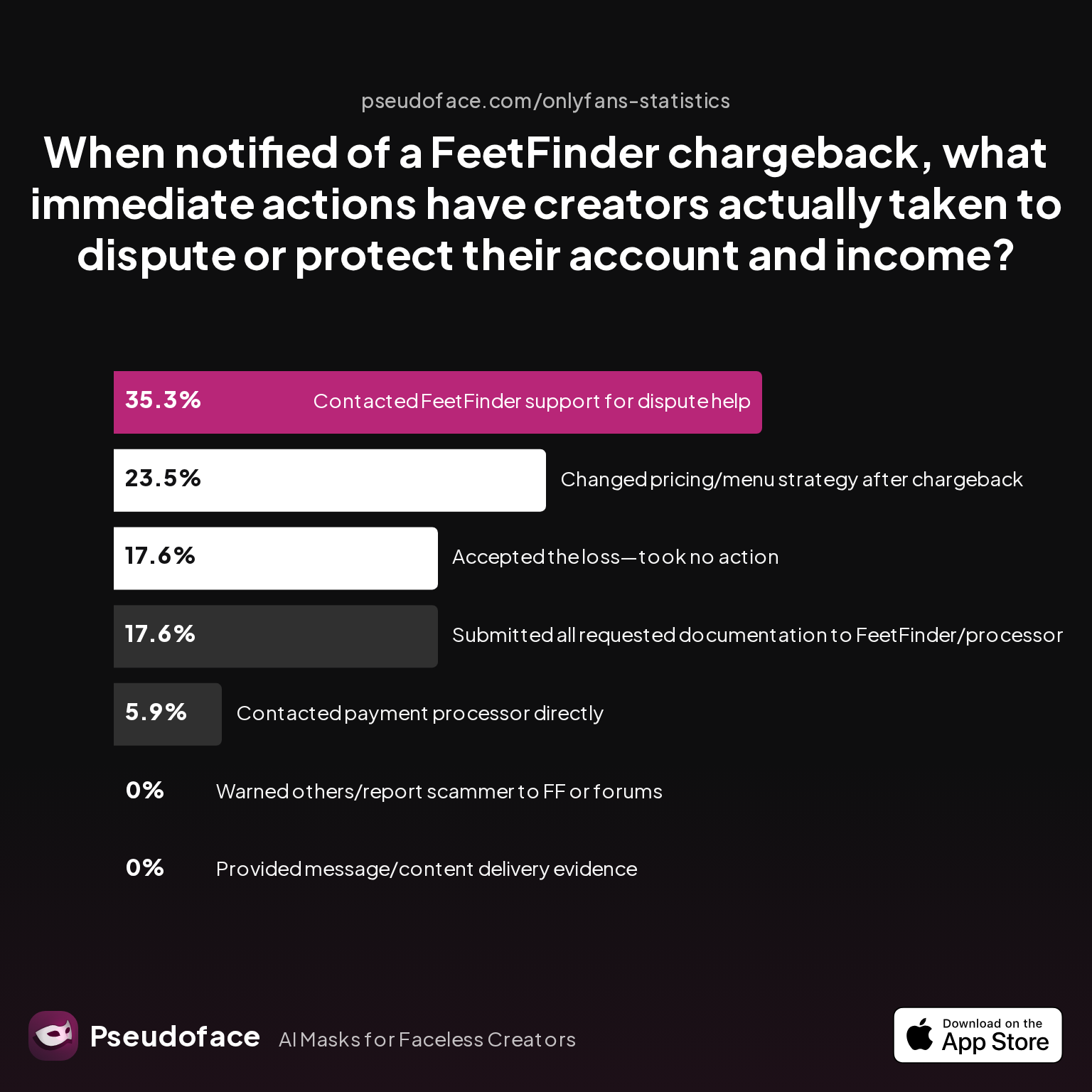
| Answer | Percentage |
|---|---|
| Accepted the loss—took no action | 17.65% |
| Changed pricing/menu strategy after chargeback | 23.53% |
| Contacted FeetFinder support for dispute help | 35.29% |
| Contacted payment processor directly | 5.88% |
| Provided message/content delivery evidence | 0.00% |
| Submitted all requested documentation to FeetFinder/processor | 17.65% |
| Warned others/report scammer to FF or forums | 0.00% |
Just over a third (35.3%) of creators actively contact FeetFinder support to contest a chargeback, but only 17.7% actually submit the full range of requested documentation—such as screenshots or proof of delivery. Another 18% simply accept the loss and move on.
Zero percent report successfully providing content delivery evidence that led to a reversal—an eyebrow-raising result, likely signaling that the platform or processor rarely (if ever) factors this documentation into their ruling, or that creators don’t know which documentation is actually persuasive.
Another quarter of creators (23.5%) respond by changing their pricing or menu strategy after suffering a chargeback—raising minimum prices or discontinuing high-risk items. This aligns with Reddit advice, which often recommends pricier offerings and “final sale” policies, though as we’ll discuss later, this is not a foolproof fix.
Open thread on Redditr/feetfinderadvice
u/MillieRover
They buy content as cheap as possible as they know their banks are less likely to investigate small transactions. Then they'll try to resell the content elsewhere. They do it on FF because there are no watermarks generated by FF on the content
A notable minority contact the payment processor (Segpay) directly. Reddit consensus shows this typically leads to finger-pointing between Segpay and FeetFinder, with neither assuming responsibility.
And a silent minority—not captured in the data—choose to warn other creators on forums or report suspicious buyers to FeetFinder or scam-tracking subreddits, hoping to stem further losses.
For the most actionable stance: the creators who assemble clear documentation, immediately contact support, and adjust their selling strategy after an incident report the best chance at either minimizing future risk or (occasionally) restoring funds. But again, the system is far from creator-friendly, and most “wins” reported are partial at best.
Knowing this, it’s vital to distinguish between refund and chargeback—the next place where strategy really matters.
FeetFinder Refunds vs. Chargebacks: Key Differences and Implications for Creators
On platforms like FeetFinder, not all payment reversals are created equal. If you’re trying to understand your risk as a creator, it’s essential to distinguish the relatively predictable, lower-risk world of refunds from the unpredictable, high-stakes reality of chargebacks.
FeetFinder Refunds vs. Chargebacks: At a Glance
| Refund (Platform-Initiated) | Chargeback (Bank-Initiated) | |
|---|---|---|
| Who initiates? | FeetFinder, per policy or mutual agreement | Buyer (with bank/card issuer) |
| Creator control? | Moderate—can object, often respected | Very low—banks favor cardholder |
| Requirements | Usually clear error or duplicate purchase | Buyer claims fraud/not received—proof required |
| Payout impact | Sometimes reversible—funds withheld until resolved, but can be restored | Payment almost always reversed, often without recourse |
| Account risk | Low, unless pattern emerges | High—multiple chargebacks flag your account |
The FeetFinder refund policy aims to minimize refund exposure by marking content as “final sale,” much like Etsy’s approach to digital products. But buyers can always escalate through their bank—rendering the “no refunds” policy mostly symbolic in bank disputes.
Let’s put some numbers behind resolution outcomes after warnings, which often follow a dispute or payment issue:
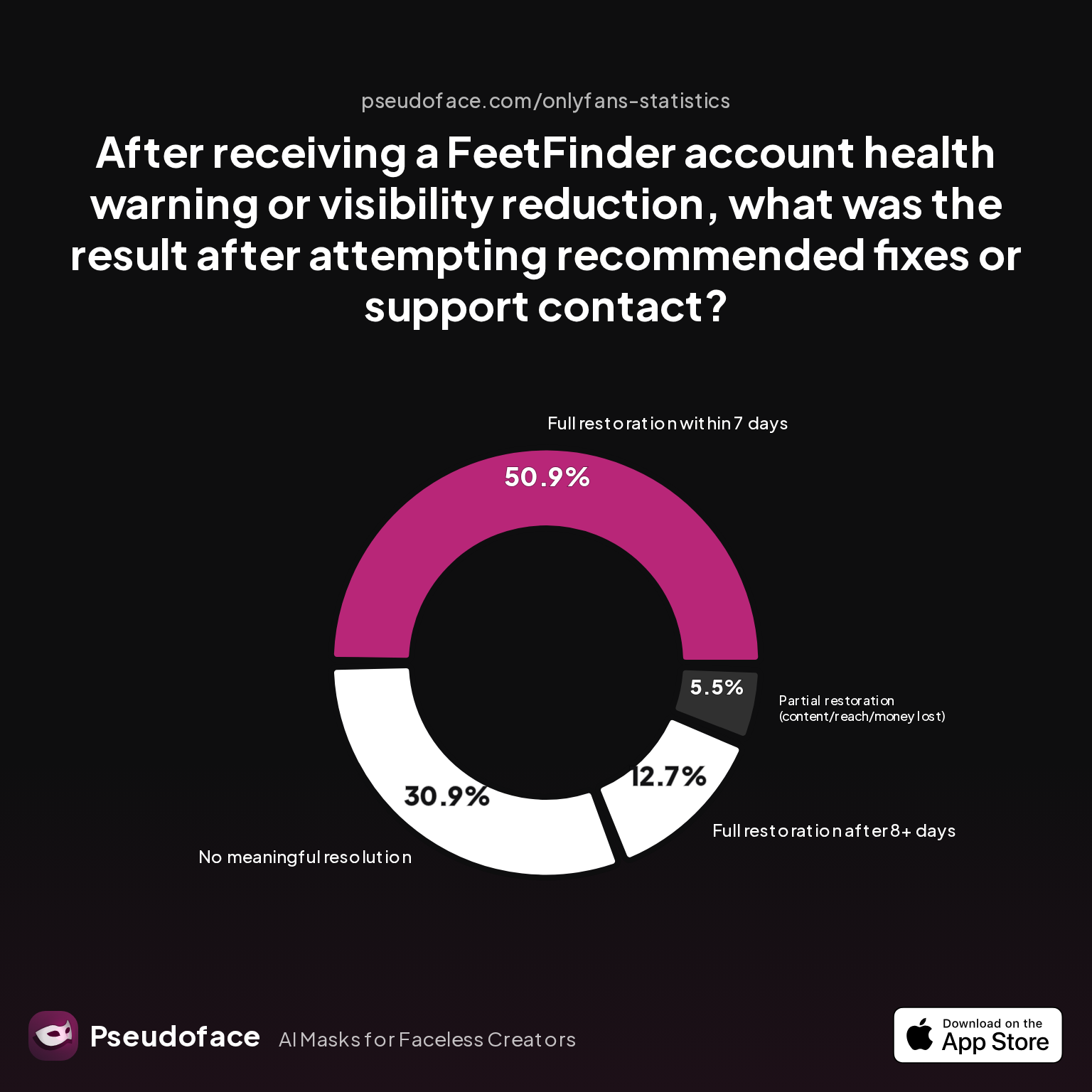
| Answer | Percentage |
|---|---|
| Full restoration after 8+ days | 12.73% |
| Full restoration within 7 days | 50.91% |
| Issue resolved automatically (no action taken) | 0.00% |
| No meaningful resolution | 30.91% |
| Partial restoration (content/reach/money lost) | 5.45% |
Fewer than two-thirds of creators (about 63.6%) report any kind of full restoration after an account warning or dispute, and almost a third (30.9%) see no meaningful resolution at all. No case is reported as “fixed automatically”—underscoring that proactive communication, documentation, and patience are always necessary.
Multiple Reddit discussions point out that refunds are only practical for platform or technical errors. Chargebacks, in contrast, almost always mean lost money, especially for digital goods:
Open thread on Redditr/feetfinderadvice
u/MillieRover
They are final sale which protects against refund requests. But that wouldn't stop people from charging back via their banks and disputing the payments which is what they're doing.
Creators who keep sales above $6, deliver only via built-in FeetFinder channels, and screen buyers report lower refund and chargeback rates—but no category is ever 100% risk-free.
So if a chargeback hits your revenue, does it put your entire FeetFinder account at risk? The following section breaks down account health, warnings, and how best to protect your future sales.
Will a Chargeback Get You Suspended? Account Health, Warning Signs, and How to Stay Protected
Nearly every FeetFinder creator encountering a payout problem asks the same next question: “Will my account get suspended because of this chargeback?” The answer, shaped by user data and platform feedback, is nuanced.
As discussed earlier, a payout hold or additional verification requested is the most common outcome after a chargeback, with more than 64% of creators reporting this scenario. Suspensions do occur, but only about 16% experience an immediate, no-warning suspension.
The warning signs—payout holds, account health banners, requested ID documents—are the system’s way of flagging risk for both the creator and the marketplace itself. Payment disputes (including unresolved chargebacks) were the most common explicit cause for account health warnings, at 35.5%.
Here’s where context matters: a single chargeback, especially a small one, rarely leads to instant suspension. But:
- Repeated chargebacks within a short window (2-3+ per month) are a major red flag for compliance teams.
- High chargeback rates appear in processor dashboards, sometimes triggering broader scrutiny, payment method blocks, or even shadowbanning.
- Incomplete documentation—or an inability to prove identity or content delivery—can accelerate the transition from “warning” to “ban.”
Open thread on Redditr/feetfinderadvice
u/Adorable-Chest-206
You should just have to send a copy of your driver's license to the fraud department.
Some creators, upon receiving an account warning, have resolved issues by quickly submitting ID and purchase evidence—though nearly a third (30.9%) saw no meaningful resolution, as shown in previous chart data.
FeetFinder support is reportedly more flexible toward creators with generally clean records, rapid cooperation, and a history of complying with platform processes. Accounts with frequent disputes, poor documentation, or erratic selling patterns face higher risk.
The bottom line: One-off chargebacks are stressful but not usually fatal. Patterns—especially combined with spotty documentation—can risk your entire business. Staying proactive and using prevention strategies is your best defense.
Protecting Your Income: Seller Protection, Documentation, and Prevention Strategies on FeetFinder
You can’t eliminate chargeback risk entirely on FeetFinder—but the data and Reddit community are remarkably clear about what actually works to protect your payouts and account.
Satisfaction and Problems With Payment Methods
Let’s finish our data story with a revealing look at payout method satisfaction and issue rates:
| Answer | Percentage |
|---|---|
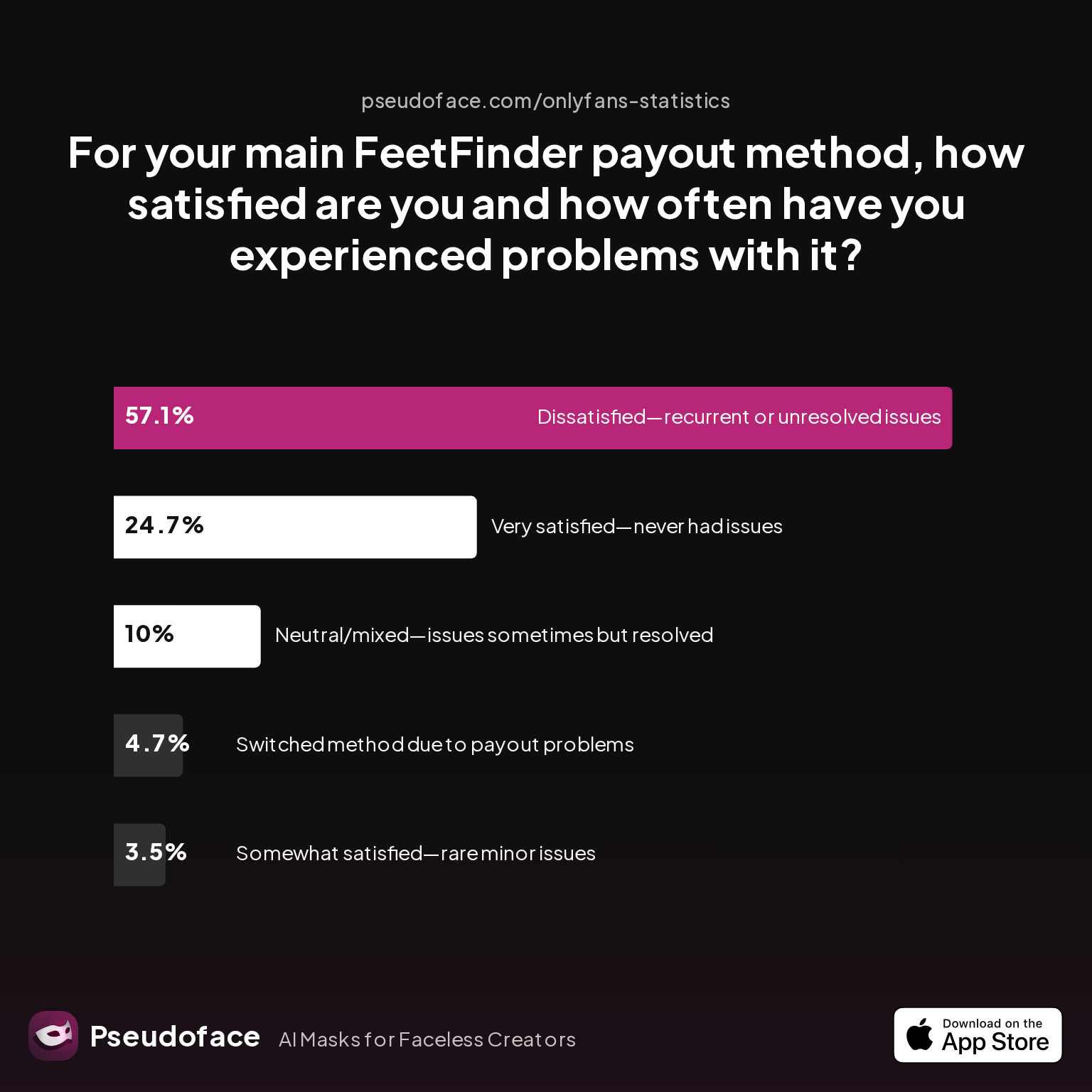
| Dissatisfied—recurrent or unresolved issues | 57.06% |
| Neutral/mixed—issues sometimes but resolved | 10.00% |
| Somewhat satisfied—rare minor issues | 3.53% |
| Switched method due to payout problems | 4.71% |
| Very satisfied—never had issues | 24.71% |
A majority of creators (57%) are dissatisfied with their payout method due to unresolved or recurrent issues—often stemming from payment holds and chargebacks. Only about a quarter report “never had issues”—a strong indication that payout security and speed remain persistent weak points as of 2026.
Most actionable prevention and protection steps, drawn from both survey data and dozens of first-person Reddit accounts, include:
- Set a higher minimum price ($6+) per digital item or bundle. Small sales face more frequent, harder-to-dispute chargebacks.
- Always deliver custom content through official FeetFinder channels. Text/email delivery outside the platform means zero proof if challenged.
- Document everything: Timestamped delivery messages, ID confirmation, and buyer communication logs.
- Respond quickly to any payout hold or account warning. The faster you submit documentation, the better your odds of a positive outcome.
- Warn peers about known scammers via subreddits or Discord groups, and flag suspicious buyers proactively to FeetFinder.
- Monitor for duplicate or suspicious orders—flag these for support and consider holding off on delivery until a payment clears.
As one seasoned creator puts it:
Open thread on Redditr/feetfinderadvice
u/CozyToeseez
With all this BS, I'm thinking about taking down every paid album, leave free examples and post my menu to explain I only do custom. And then usher them to CashApp. At least then, if I get scammed it's my own fault. I haven't been on the wrong end of this charge back shit yet, but I really don't want to.
And from another seller with a more cautious view:
Open thread on Redditr/feetfinderadvice
u/Littlefreckledsole
I was just coming on here to say the same thing. I thought "maybe I'm really killing it this time." I am pretty mad at FF right now. There should be a way they charge people before they can "buy" anything from us. Now I have no idea what I really made.
Honest communication, transparent menu/pricing, meticulous documentation, and consistent vigilance are your best tools. No prevention is perfect, but with a focused, data-backed approach, you can cut your chargeback risk significantly—and be prepared to fight for your income if the worst does happen.
FAQs: High-Risk Questions and Real-World Answers
Q: What’s the difference between a FeetFinder refund and a chargeback?
A refund is initiated by FeetFinder (typically for errors or clear policy violations), while a chargeback is initiated by the buyer via their bank—making it harder to contest and riskier for creators. Refunds are seldom granted unless platform rules are broken; chargebacks are forced reversals that almost always result in lost earnings and potential account warnings.
Q: How do I dispute a FeetFinder chargeback as a creator?
You must contact FeetFinder support or Segpay (or both), submit evidence (proof of delivery, communication, and ID), then wait for a bank or processor decision; success rates are low but best when documentation is rapid and complete. In nearly all Reddit cases, creators providing strong proof saw at least partial restoration, but most describe weeks of limbo and rare total recovery.
Q: Will my FeetFinder account be suspended if a buyer files a chargeback?
A single chargeback rarely leads to immediate suspension, but repeated chargebacks within a short window or patterns of suspicious activity dramatically increase your risk of warnings, payout holds, and even shadowbans. Proactively communicating with support and submitting any requested documentation gives you the best shot at keeping your account healthy.
Q: How long do FeetFinder chargeback and dispute resolutions usually take?
Dispute resolution timelines typically run 2-4 weeks, with some creators reporting longer waits for payout release or final decision; transparency during this process is inconsistent, and many users report a lack of status updates.
Q: Does FeetFinder offer seller protection against buyer scams and chargebacks?
FeetFinder claims final sale policies and relies on processor security, but real-world seller protection is limited—banks and processors rarely side with adult content creators in disputes. Proactive documentation and delivery through FeetFinder are your best protections.
Q: What documentation should I keep to contest a FeetFinder payment dispute?
Save timestamped delivery receipts, on-platform message logs, communication with buyers, government ID scans (if requested), and any evidence showing content was delivered as promised. The more detailed and immediate your documentation, the higher your odds in a dispute.
Q: Why did FeetFinder deduct money from my payout after a sale?
FeetFinder or Segpay will deduct amounts from pending or future payouts whenever a chargeback or forced refund occurs—even if you’ve already delivered content. These deductions reflect unresolved disputes or processor reversals, not errors in sales reporting.
Q: How can I minimize the risk of chargebacks from buyers on FeetFinder?
Price content above typical microtransaction thresholds, deliver only through official channels, avoid selling to buyers with suspicious behavior or duplicate order patterns, and keep meticulous sales records. Flag scammers and communicate proactively with support at any sign of irregularity.
Q: What should I do if I receive a FeetFinder account health warning related to payments?
Respond immediately, gather needed documentation, affirm your identity, and reach out to support for clarification. Keep a log of communications, as resolution often takes days or weeks and may require follow-up.
Q: Are small, low-cost sales or custom content more likely to lead to payment disputes?
Yes—low-cost, high-volume sales are disproportionately targeted by scammers as they are less likely to be scrutinized by banks or platforms. Custom content delivered off-platform is high risk for proof reasons; always document and deliver through FeetFinder when possible.
Whether you’re a full-time FeetFinder creator or side-hustler, recognizing the warning signs, documenting your interactions, and being ready to contest or adapt after a chargeback can make the difference between a brief setback and a devastating account loss. Stay vigilant, lean on community advice, and remember: while the risk is real, data-driven prevention and rapid documentation remain your strongest lines of defense.


