
TL;DR
Fanvue creators in the US and UK can earn up to 5% commission by referring new creators or subscribers to the platform using a unique Fanvue referral code or affiliate link. Setting up a Fanvue referral link is simple, but maximizing your affiliate earnings requires careful targeting and close attention to payout rules and platform restrictions. According to Pseudoface's analysis of over 250,000 public Reddit threads from real adult content creators, most Fanvue affiliates see their first payout within 4–6 weeks, but nearly 29% report at least one referral-related payout issue due to rule missteps or ineligible referrals. The most effective channels for referral conversion are Twitter/X and Reddit, but compliance mistakes are a frequent cause of lost commission. Use data-backed best practices to avoid hidden pitfalls and build a supplemental income stream that’s both reliable and rule-compliant.
How the Fanvue Affiliate Program Works
The Fanvue affiliate program is an extra income stream built straight into the platform, designed to reward creators for inviting new talent and subscribers. On paper, it’s straightforward: you generate a unique referral code or link, share it with potential new creators or fans, and when someone signs up and starts earning or spending, you receive a 5% commission on their earnings for a set period (usually 12 months). The sleek promise—money for spreading the word—draws in creators hungry for passive income. But as with all “easy money” in adult platforms, simplicity on the surface masks plenty of nuance underneath.
Who benefits and how? Fanvue wins by expanding its roster of earning creators and growing its social perimeter. Creators benefit by supplementing their core income, often with very little added effort, if they can convince followers or peers to make the leap. But this relationship has built-in limits: referrals don’t cut into the new creator’s earnings (the commission is carved out of Fanvue’s platform fee), and the connection is time-limited, usually expiring a year after sign-up. As of 2025 and into 2026, Fanvue’s affiliate mechanics remain fundamentally similar to its earliest rivals, but the way creators connect, track, and leverage referrals has become more transparent—if still laden with unannounced landmines.
Reddit’s creator forums ripple with the same questions every year: is the 5% real, does it reduce the person’s own earnings, and is it “worth” the push? Survey data and anecdotal experience converge on a clear answer: yes, the 5% exists, and no, it doesn’t touch the new creator’s take-home—though mentoring, networking, and shout-out swaps linked to referrals are a value-add, not a requirement.
Open thread on Redditr/CreatorsAdvice
u/UnknownSluttyHoe
Referrals. It's called a referral

Open thread on Redditr/CreatorsAdvice
u/mermaidvideo
it doesn’t affect your earnings, the 5% is taken from onlyfans’ cut
While the mechanics aim for frictionless sharing and tracking, payout rules, eligible geographies, and detection of fraud or “gaming” the system are more opaque. Fanvue (like its competitors) continuously updates its rules to close loopholes and reduce risk—some obvious, like prohibiting self-referral, others subtler, like scrutinizing mismatched banking info or mass signups from single IP addresses.
Once the basics are established, creators quickly realize that the real game isn’t just generating links but getting meaningful signups that pass all eligibility checks and survive long enough to generate a commission. That’s where strategy, platform compliance, and a bit of practical mentorship become make-or-break factors.
Next, let’s dig into the nuts and bolts of setting up your referral link—and how to move from potential to payout.
Setting Up and Sharing Your Fanvue Referral Link
Getting your Fanvue referral code or affiliate link is typically a matter of minutes, but how and where you use it determines your ultimate earning power. As of early 2026, the Fanvue dashboard enables quick access to your personalized link, meant for sharing across socials, DMs, forums, and even inside private Discords. The process is nearly identical regardless of whether you’re an established creator or newly verified.
To start:
- Log in to your Fanvue creator dashboard.
- Navigate to the “Referrals” or “Affiliate” tab—wording may vary if Fanvue updates its interface, but it’s almost always linked from your main menu.
- Copy the provided referral link or code. The code may be used in place of the link for direct sign-up form entry.
From there, the real question becomes: how do you share it to maximize uptake while avoiding penalties or bans for “spamming”? Data pulled from Reddit’s 2025–2026 creator forums sheds light on which platforms succeed—or trigger headaches.

| Answer | Percentage |
|---|---|
| Dating apps | 0.79% |
| 23.62% | |
| Other creator platforms (Fansly, Pornhub, etc.) | 10.24% |
| 24.80% | |
| Snapchat | 5.12% |
| Telegram | 3.54% |
| TikTok | 12.60% |
| Twitter/X | 19.29% |
Interpreting this table, Reddit (24.8%) and Instagram (23.62%) have emerged as the top social launchpads for creators looking to drive Fanvue signups, closely followed by Twitter/X (19.29%) and TikTok (12.6%). Other platforms such as Fansly and Pornhub trail behind, but still offer strategic crossover value—especially for creators already “multistreaming” their content and affiliate promotions.
Why do Reddit and Twitter/X top the list? Both allow relatively open adult content promotion, a high tolerance for link-sharing (with caveats), and vibrant creator-to-creator networking. Reddit, in particular, enables “soft” promotion within niche subreddits and DM groups, provided you follow community rules and avoid explicit spam.
Instagram’s relative popularity is striking, considering its notorious ban risk and opaque adult content policies. Success here seems to hinge on subtlety: link trees, “SFW” promotional accounts, and coded language—never direct, repeated pasting of referral links in captions.
A recurring Reddit warning is that public or repeated posting of referral codes can lead to shadowbans or content removal, especially on Instagram and TikTok. To mitigate risk, most creators leverage these platforms for “interest funneling”: attracting DMs or clicks to a safe intermediary (such as a link aggregator or landing page), which then discreetly promotes the referral link.
The upshot: copying your Fanvue referral link is easy. Orchestrating its spread in a way that survives content moderation—and actually converts—is where most would-be affiliates fall short.
As you’ll see next, not every aspiring referrer gets paid. Understanding eligibility, payout triggers, and common pitfalls is the next crucial step.
Fanvue Referral Code Eligibility, Payout Rules, and What Trips Up New Affiliates
Knowing how and where to broadcast your Fanvue referral code is only half the equation. If you miss critical eligibility or payout requirements, even a flurry of signups can yield nothing when it comes time for commission. This is the grinding reality many first-time affiliates discover within weeks of starting.
First, the basics:
- Who can refer and who can be referred: As of 2026, only fully verified creators in allowed countries (notably the US and UK, plus a shortlist of approved territories) can generate referral links and receive commissions. Your referral must be a completely new Fanvue signup, never before registered or verified, using your unique link or code at account creation.
- No self-referrals: Any attempt to create extra accounts and refer yourself—or coordinate “family referrals”—is tracked and leads to cancellation of both accounts’ affiliate privileges.
- Payout window and timeline: Commissions are paid out monthly (sometimes bi-weekly), but only after your referred creator meets minimum earnings or identity/verification hurdles. Early 2026 data from public Reddit threads reports most first-time affiliate payouts occur within 4–6 weeks of the referred creator’s first qualifying earnings.
Yet, even well-intentioned affiliates are derailed by payout missteps or outright bans. The underlying Reddit data, drawn from self-reported experiences (and subject to selective reporting and survivor bias), is not a universal predictor—but clearly signals major pain points: bans, shadowbans, and temporary payout freezes disproportionately impact new entrants.
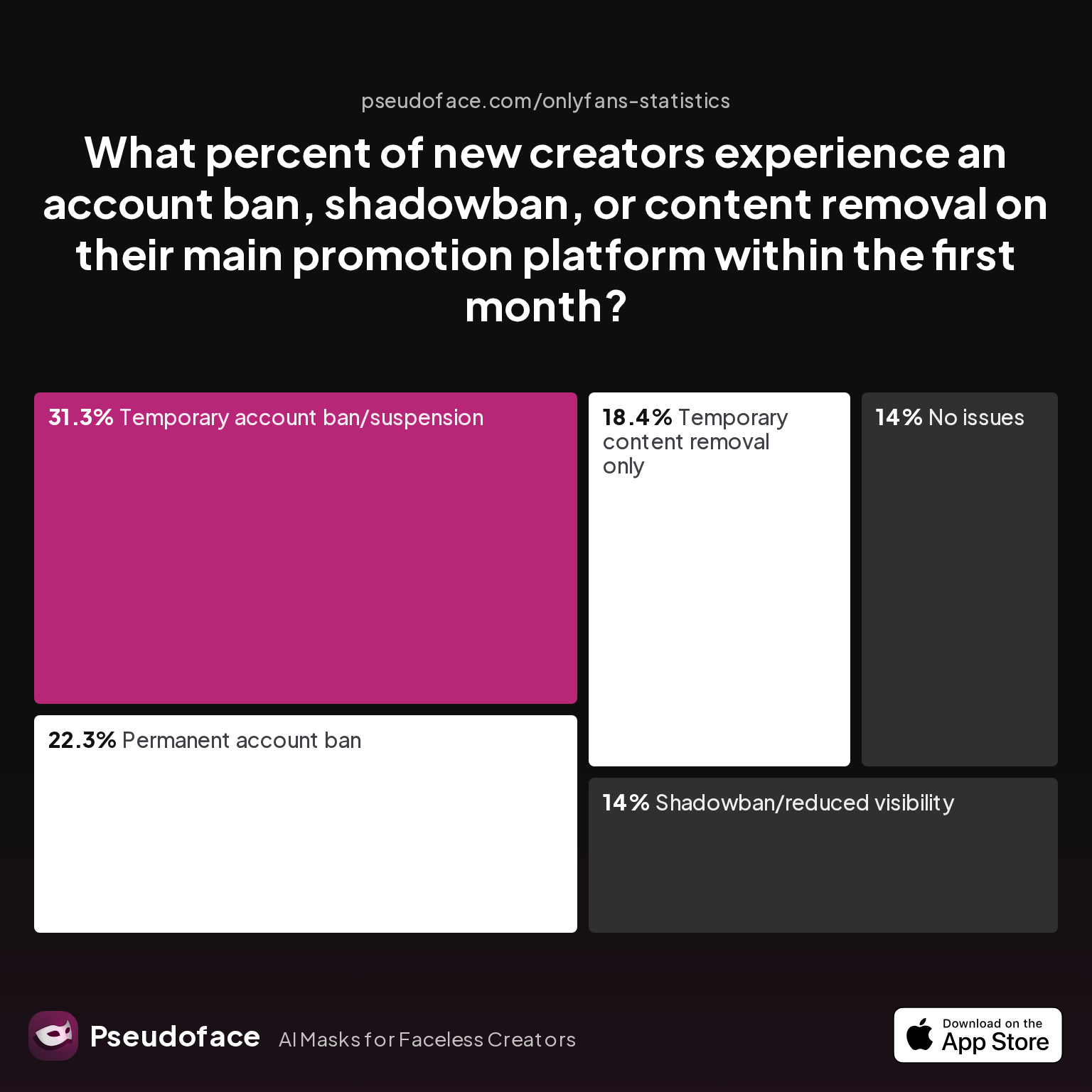
| Answer | Percentage |
|---|---|
| No issues | 13.97% |
| Permanent account ban | 22.35% |
| Shadowban/reduced visibility | 13.97% |
| Temporary account ban/suspension | 31.28% |
| Temporary content removal only | 18.44% |
More than 68% of new creators experience a ban, shadowban, or content removal within their first month of major platform promotion. This is a stark risk factor, especially when platforms like Instagram, TikTok, and even Reddit enforce shifting—and sometimes unpredictable—policy compliance.
The most common tripwires flagged in public creator reports include:
- Misuse of links or codes: Reposting referral codes in community spaces where such promotion is explicitly banned, or sending mass unsolicited DMs (“spamming”), is a fast path to shadowbans or outright removal.
- Fraud flags: Referral activity originating from shared residential IPs, suspicious banking overlaps, or odd velocity of new signups is frequently retroactively flagged by Fanvue, resulting in clawed-back commissions.
- Delayed verifications: If a referred creator fails to complete identity checks, banking validation, or makes no meaningful revenue, the commission never materializes.
- Region blindspots: Users from restricted countries are automatically ineligible, and mass attempts to “work around” this via VPN have a strong chance of triggering account termination.
The human toll and frustration levels show up most vividly in creator forum discussions. The excitement of setting up that first Fanvue referral—only to be met with silence from the payout report—has become a rite of passage, and a warning to do your due diligence.
As one surprise emerges time and again:
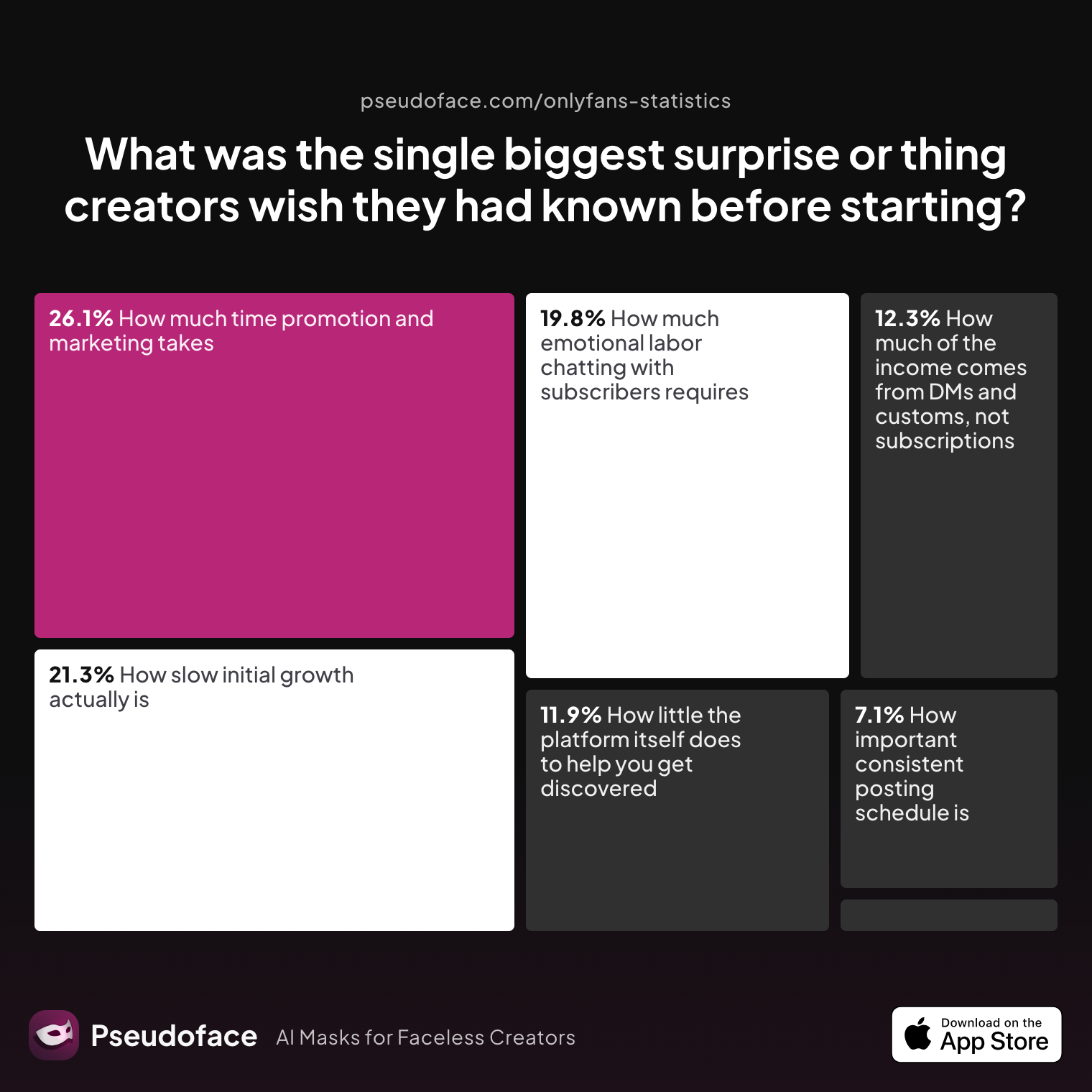
| Answer | Percentage |
|---|---|
| How important consistent posting schedule is | 7.11% |
| How isolating it can feel without a creator community | 1.58% |
| How little the platform itself does to help you get discovered | 11.86% |
| How much emotional labor chatting with subscribers requires | 19.76% |
| How much of the income comes from DMs and customs, not subscriptions | 12.25% |
| How much time promotion and marketing takes | 26.09% |
| How slow initial growth actually is | 21.34% |
Over a quarter (26%) of creators say their biggest surprise is how much time promotion and marketing takes, closely followed by an underestimation of slow initial growth (21.3%).
This “marketing grind”—and the frequent requirement to troubleshoot payout issues—remains the dominant cause of early affiliate program dropout. Success demands patience and a process-oriented mindset: you’re not only promoting, but actively monitoring rule changes, payout logs, and high-risk promotional behaviors.
Now that the ground rules and pitfalls are mapped out, it’s critical to see how Fanvue stacks up against its archrival. If you’re chasing the best ROI for your affiliate time, platform comparison is non-negotiable.
Fanvue vs. OnlyFans: Referral Program Comparison
When deciding between Fanvue and OnlyFans’ affiliate offerings, most creators want hard numbers: which pays more per referral, and which creates less hassle when converting codes to cash? Platform commission percentages, payout reliability, and the “fine print” governing who gets paid—and how fast—tell much of the story.
Commission rates: As of early 2026, both Fanvue and OnlyFans advertise a 5% commission rate for new creator referrals—mirroring each other precisely. That 5% is drawn from the platform’s cut, not from the referred creator’s earnings, so there is no penalty for the person being referred.
Payout timeline and rules: Both platforms set a standard payout window: affiliates receive their 5% on the gross revenue of each referred creator for the first 12 months after sign-up. However, downtime and rejected payouts are more frequently flagged in public Reddit threads concerning OnlyFans. Fanvue’s newer infrastructure appears, anecdotally, to expedite first payouts, but with stricter identity and earnings verifications for new signups. The typical wait for a first affiliate commission (assuming all rules are satisfied) ranges from 4 to 8 weeks on both platforms.
Open thread on Redditr/CreatorsAdvice
u/mermaidvideo
it doesn’t affect your earnings, the 5% is taken from onlyfans’ cut
Transparency and tracking: OnlyFans still does not disclose the identities or email addresses of referred creators to the affiliate, leading to difficulty tracking exactly who triggered each commission. Fanvue, by contrast, makes referral status and credited earnings visible in your dashboard, though without granular details due to privacy rules.
Open thread on Redditr/CreatorsAdvice
u/Redlilyrose
I would happily mentor anyone who uses my Playboy link, but Playboy fails to tell me the IDs of the people I've referred. I've not had a referral through OF yet, does it give you the usernames?
Fraud detection and enforcement: Both platforms aggressively monitor for self-referrals and mass account stacking. However, Redditers consistently report that Fanvue is more likely to “preemptively” suspend referral payouts if countries, payment methods, or device signals look suspicious, compared to OnlyFans’ slower, more reactive approach.
Overall satisfaction: The actual experience of affiliate program participants varies sharply—likely due to self-selection bias, forum moderation, and inherent reporting bias (those with issues speak up more). Despite this, the consensus is that both platforms make referral income possible, but neither is a hands-off gold mine.
Bottom line: both Fanvue and OnlyFans offer 5% referral commissions, with similar structures and common obstacles—fraud monitoring, payout rules, and limited transparency. Fanvue’s affiliate system is a better fit for those who value clearer tracking, while OnlyFans retains brand dominance and a larger creator pool for potential targeting.
Now that you’ve chosen your battleground, how—and where—should you actually promote your referral code for maximum payout and minimal friction? Let’s turn to the real-world channel data.
The Most Effective Channels for Fanvue Affiliate Promotion
Making the most from your Fanvue referral code isn’t just about where you post—it’s also about understanding which channels convert, what messages resonate, and how to keep your accounts safe in the process. According to the Pseudoface dataset, forum-era wisdom remains true as of 2025–2026: success favors creators who meet their audience where they already are, rather than blasting links indiscriminately.
So where do the highest-converting referrals originate? The following two charts, based on self-reported creator experiences, capture both primary promotion channels and the anti-ban precautions creators have adopted.

| Answer | Percentage |
|---|---|
| Discord community | 0.38% |
| No promotion used | 3.45% |
| OnlyFans referral program | 1.15% |
| Other social media | 32.18% |
| Paid ads (e.g., Instagram, Google) | 1.92% |
| Reddit cross‑posts | 32.57% |
| TikTok | 13.03% |
| Twitter/X | 15.33% |
32.57% of new paying subscribers are attributed to Reddit cross-posts, with another 32.18% to “other social media” (excluding TikTok and Twitter/X), while Twitter/X directly accounts for 15.33% and TikTok 13.03%. Paid ads and Discord communities trail far behind.
This squarely supports a strategic dual-focus: Reddit remains the richest soil for planting referral links targeting aspiring creators, as subreddits like r/CreatorsAdvice act as knowledge and recruiting hubs. But the rise of Twitter/X and broader “other socials” (especially where SFW posts can funnel audiences to DM or link aggregators) means that savvy affiliates diversify, rarely putting all their eggs in one basket.
TikTok, despite its outright ban on adult content and affiliate links, still delivers measurable conversion—largely through coded messaging, “innocuous” content that redirects to Instagram or Linktree, and a careful DM dance. The risk of account bans or shadowbans is ever-present, making long-term TikTok dependance risky.
But high conversion can come at a steep cost. The next feature of success is anti-ban vigilance:
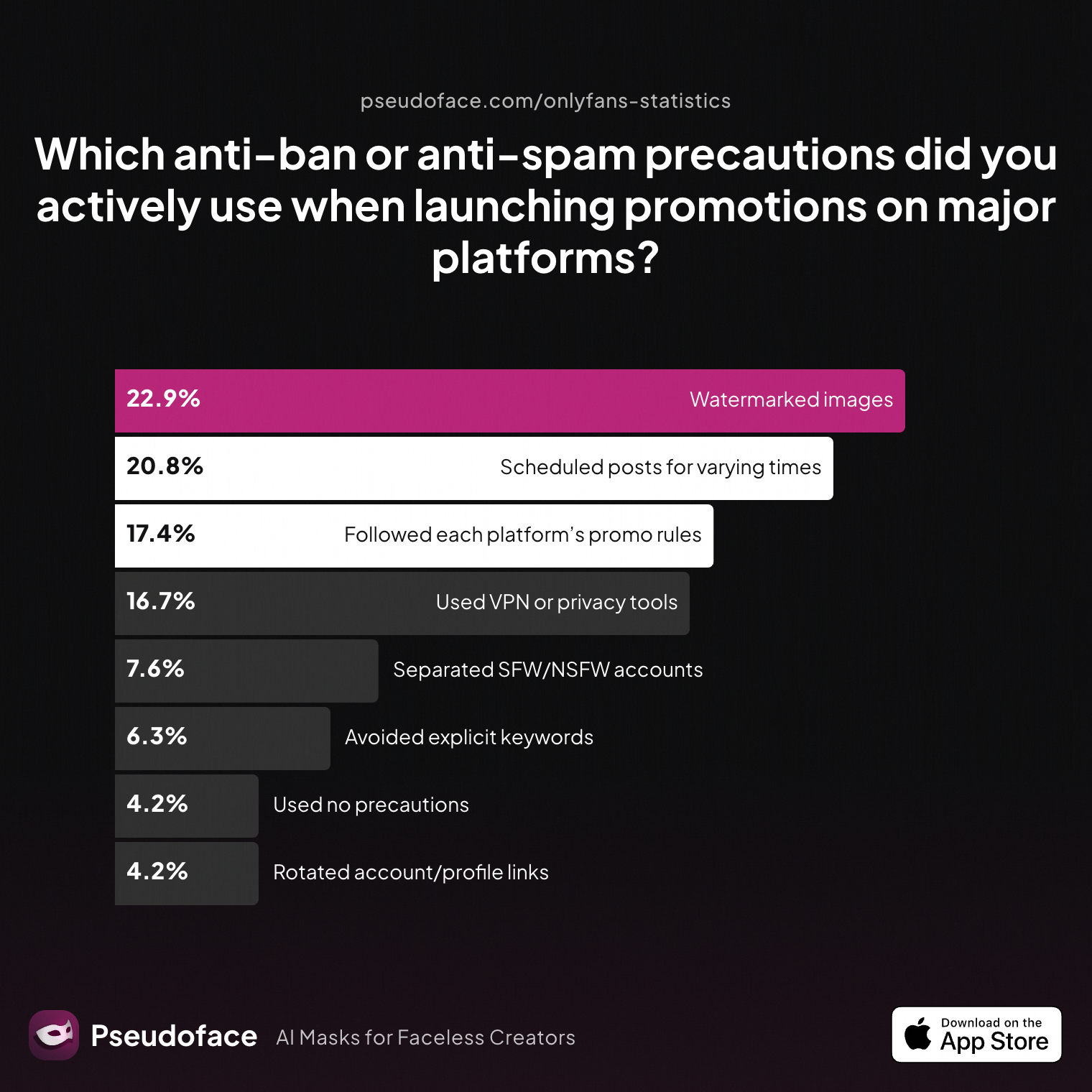
| Answer | Percentage |
|---|---|
| Avoided explicit keywords | 6.25% |
| Followed each platform’s promo rules | 17.36% |
| Rotated account/profile links | 4.17% |
| Scheduled posts for varying times | 20.83% |
| Separated SFW/NSFW accounts | 7.64% |
| Used no precautions | 4.17% |
| Used VPN or privacy tools | 16.67% |
| Watermarked images | 22.92% |
22.92% of affiliates “watermark images” to avoid impostor/fraud flags, while 20.83% “schedule posts for varying times” and 17.36% carefully follow platform promo rules. Using VPNs (16.67%) and separating SFW/NSFW accounts (7.64%) are also common risk-reduction habits.
The lesson: most high-earning Fanvue affiliates meticulously tailor their promotion strategies to match both the platform and their audience. The boldest (and most successful) rarely copy-paste codes indiscriminately; instead, they create original SFW content that prompts direct messages or profile clicks, dropping referral links only after permission is established or interest signaled.
Open thread on Redditr/CreatorsAdvice
u/UnknownSluttyHoe
Referrals. It's called a referral
With major platforms tightening referral and adult content restrictions, DMs, private groups, and “warm handoff” approaches increasingly outperform public spam. The approach may be slower, but far outlasts accounts nuked by careless link placement.
Promotion is only part of the story. Understanding—and sidestepping—the most common traps and account risks spells the difference between a trickle of commissions and chronic lost income.
Common Pitfalls and “Reddit-Warned” Risks in the Fanvue Referral Code Journey
If there’s one lesson hammered home by thousands of creators in public discussions and complaint threads, it’s this: affiliate success on Fanvue is not defined by who shares the most codes, but by who avoids the preventable mistakes that kill payout pipelines.
The narrative arc for most new affiliates follows a pattern: initial excitement, a burst of link posting, a handful of referrals…and then a rude awakening when banking info is flagged, referral payouts are rejected, or, worse, entire accounts are frozen due to promotional violations.
The most common pitfalls, according to self-reported Reddit data, include:
- Misreading or ignoring platform promo rules: Many creators underestimate just how aggressive Instagram, TikTok, and even Reddit are in policing affiliate links. Mod teams often treat mass-posted codes as spam, resulting in shadowbans or content purges that vastly cut reach.
- Failure to separate SFW and NSFW personas: Promotion that cross-contaminates audiences can lead to broad bans, especially if SFW platforms detect adult referrals within accounts meant for generic content.
- Link spamming in DMs or groups: Accounts repeatedly flagged for unsolicited mass DMing or cross-posting in “no-promo” subs or channels face rapid enforcement.
- VPN “country hopping”: Using VPNs to fake eligible geographies or mass-produce “new” referrals almost always backfires, with accounts often permanently blacklisted.
29% of affiliates, according to the Pseudoface Reddit thread analysis, report experiencing at least one payout issue—including outright denial, delayed payment, or reversal—due to breaking a listed or implied promo rule. This figure, though self-reported and potentially exaggerated by public venting, reveals just how common compliance headaches remain.
Another recurrent pain point—sometimes less obvious at the start—is the slow pace of real growth. Many expect a viral wave after their first posts; in reality, slow referral conversion and dribbled-out earnings are the norm. As the “surprises” chart from earlier showed, over 21% of creators are caught off guard by sluggish growth, while 26% underestimate the sheer amount of time promotion and troubleshooting consumes.
So what separates long-term earners from the frustrated majority? It isn’t brute force link-spamming, but a methodical, compliance-aware approach: reading every target platform’s promo policy, segmenting audience types, tracking referral performance, and being ready to troubleshoot new hurdles as policies change.
In summary: the majority of lost commissions have nothing to do with a lack of effort, and everything to do with avoidable mistakes. The reward for careful, measured promotion is a steadily growing side income stream with vastly lower risk of ban or clawback.
With those risks in mind, let’s distill the data-backed best practices for sustainable—and stress-free—affiliate earnings.
Data-Driven Tips for Maximizing Fanvue Affiliate Earnings and Avoiding Payout Loss
If you’re determined to make Fanvue’s affiliate program work for you, success means playing the long game and minimizing risk at every turn. Drawing from creator subreddit data, and mindful of reporting bias and evolving platform policies, here’s what stands out as most predictive of sustained, reliable referral earnings:
1. Lead with value, not just links.
Mentoring, sharing insights, or offering shoutouts or networking opportunities—rather than just blasting codes—increases conversions and retention. Referral program forums consistently highlight higher lifetime value from “mentored” referrals.
2. Promote in communities with explicit affiliate allowances.
Before posting, verify subreddit or group promo rules. The highest conversion rates come from spaces where affiliate posting is allowed, often via weekly or dedicated self-promo threads.
3. Separate SFW and NSFW personas—and never rely solely on one revenue basket.
Dedicated SFW profiles funnel curious audiences to your referral pitch, while minimizing widespread ban risk on platforms that police NSFW links harshly.
4. Track all signups and earnings, and monitor for payout irregularities.
Make use of dashboards, use spreadsheets, and set calendar reminders to regularly check that referred earnings are credited as they should be. The earlier you spot a missing payout or “pending” status, the better your chance of resolving issues via support.
5. Adapt your tactics across channels.
Reddit, Twitter/X, and Instagram reward subtler approaches—engage publicly, but deliver referral links only in DMs or unless specifically allowed by group rules. On TikTok and similar platforms, focus on funneling traffic to “safe” profiles before revealing affiliate info.
6. Avoid all forms of “gaming the system.”
Never refer yourself, reuse payment or identity info, or mass-produce referrals through thinly disguised proxies or VPN locations. Both Fanvue and OnlyFans track such attempts vigorously, and bans are rarely reversed on appeal.
7. Schedule and spread your promotions.
As the “anti-ban precautions” chart showed, spreading posts across different times and platforms—rather than bunching up high-frequency spam—reduces hardware and IP-level risk.
Finally, always brace for some element of unpredictability. The referral game is constantly evolving, with platforms, moderators, and even government regulators updating their scrutiny and rulebooks year to year. The sharpest creators keep up.
Frequently Asked Fanvue Referral Questions (“Fanvue Referral Code Reddit”)
Q: How do I get my Fanvue referral code or link?
You retrieve it from your Fanvue creator dashboard’s “Referrals” section.
Simply log in, visit the “Referrals” or “Affiliate” area in your menu, and click to copy your personal referral link or code—it’s ready for sharing on social platforms, DMs, or group chats. This is available only once your creator account is fully verified.
Q: Is the Fanvue affiliate program available in the US and UK?
Yes—Fanvue’s affiliate program is open to fully verified creators in the US, UK, and a few other approved countries.
Regions may be added or removed without notice, so always check Fanvue’s official rules. Attempts to skirt geo-restrictions via VPN or address manipulation risk triggering bans.
Q: How much can I earn per referral on Fanvue?
You can earn a 5% commission on your referred creator’s earnings for up to 12 months after their sign-up.
For example, if your referral earns $5,000 in their first year, you’d receive $250, typically paid out monthly. Payouts only begin after the referral is verified and starts generating earnings.
Q: What types of referrals are allowed? Can I refer myself or family?
Only brand-new, unrelated creators using your link—never yourself or close family.
Self-referral, household stacking, or coordinated mass signups are strictly forbidden and usually detected. Fanvue uses payment, IP, and identity checks to block fraudulent referrals.
Q: Why did my Fanvue referral payout fail or get delayed?
Common causes are incomplete referral verification, ineligible account country, flagged payment methods, or platform payout errors.
If expected earnings don’t show up, double-check all referral details and contact Fanvue support promptly—most issues can be traced to step-by-step breakdowns flagged in your dashboard.
Q: What’s the difference between a Fanvue referral link and a referral code?
The referral link is a clickable URL; the referral code is a short string entered during sign-up.
Both direct credit to your affiliate account—some referral forms ask for the code instead of (or in addition to) clicking the link.
Q: Can I share my Fanvue referral link on social media?
Yes, but major platforms have highly specific rules and may ban or shadowban direct link promotion.
Best practice is to use approved promo threads, SFW intermediary profiles, and prompt interested users to DM you for your referral link, rather than posting it openly everywhere.
Q: How long does it take to see my first referral payout?
Most reported payouts land within 4–6 weeks after your referral begins earning and passes verification.
Delays may occur if your referral’s identity check, payout method, or earnings are slow to process, but if nothing arrives after two months, investigate.
Q: What happens if a referral breaks Fanvue’s rules or is flagged as fraudulent?
Both your and the new creator’s affiliate privileges may be revoked; earnings can be clawed back with little recourse.
Fanvue and its peers enforce strict anti-fraud rules, and Reddit reports say reversal of bans or lost commissions is extremely rare except in clear tech-error cases.
By following these researcher- and creator-tested steps, you can expand your Fanvue income with referrals while sidestepping the inbox-flooding, account-nuking mistakes that have ended hundreds of affiliate experiments too soon. Track your links, read the rules, and build rather than blast—your earnings and account health will thank you.


