
TL;DR
Impersonation is a persistent risk for Fanvue creators: Over 40% have self-reported at least one run-in with fake accounts, brand theft, or compromised earnings in the past year. Proactive steps—like watermarking, vigilant monitoring, and DMCA claims—consistently outperform simple privacy tweaks or platform reliance. Yet, takedown outcomes and Fanvue's own enforcement remain inconsistent, making multi-layered prevention and fast community-driven detection essential. According to Pseudoface’s analysis of 250,000+ public Reddit conversations among real adult creators, actionable tactics emerge, but with ongoing bias and gaps: those who share their stories are often the more "survivor"-type, with varying familiarity and access to best practices. Treat numbers, trends, and recommendations here as context to inform your own layered strategy.
Fanvue Impersonation Policy: What Gets Enforced, What Falls Through the Cracks
For adult creators, identity and brand are oxygen—so the threat of Fanvue impersonation cuts deeper than hurt feelings. Instead, it risks lost revenue, a battered reputation, and even platform bans for accounts caught in mistaken identity dragnets. But what actually triggers Fanvue to enforce its impersonation policy, and where do loopholes lurk?
Fanvue’s official rules echo other creator platforms: no one is allowed to pose as another person, use stolen photos or videos, or build copycat accounts intended to mislead. The letter of the law seems clear: supply Fanvue with proof that someone is using your content or pretending to be you, and in theory, the platform acts. In practice, however, enforcement is uneven—creators often describe delays, uncertainty, or outright silence after reporting fake accounts.
Policy covers the obvious—blatant copycats using your face or bio—but real-world threats often look more like a spectrum. Impersonators might tweak a username by a single character, lift your bio almost word-for-word, or repost your promo images with their own payment handles. Community anecdotes underscore the problem:
Open thread on Redditr/CreatorsAdvice
u/virgieblanca
You should be able to report the Zelle account since they don't allow sexual content to be sold through them!

The line between enforcement and inaction, then, is often drawn by how clearly a violation can be proved. Subtler cases—the impersonator with similar branding but different links, the account using your stage name on a new site—sometimes fall through the cracks. As of early 2026, the most frustrated creators are those whose situations don't fit the “obvious” mold, or who run up against slow moderation queues. According to the Pseudoface dataset, policy “grey zones” are a significant driver behind lost earnings and growing preventative anxiety.
Understanding where policy ends and platform enforcement stalls is crucial. It exposes why simple reliance on Fanvue’s own protections is risky, and why a multi-layered, creator-driven approach has become standard for anyone serious about their brand.
Fanvue Account Protection: Proactive Steps Creators Actually Take (and What Works)
If platform policy forms the guardrails, real world-brand safety for Fanvue creators is built on action. Survivors of scams and impersonation—those whose stories shape Reddit threads and Discord group wisdom—agree: prevention works best when it's relentless, layered, and visible. But with so many tactics floated, which ones consistently pay off, and which don’t?
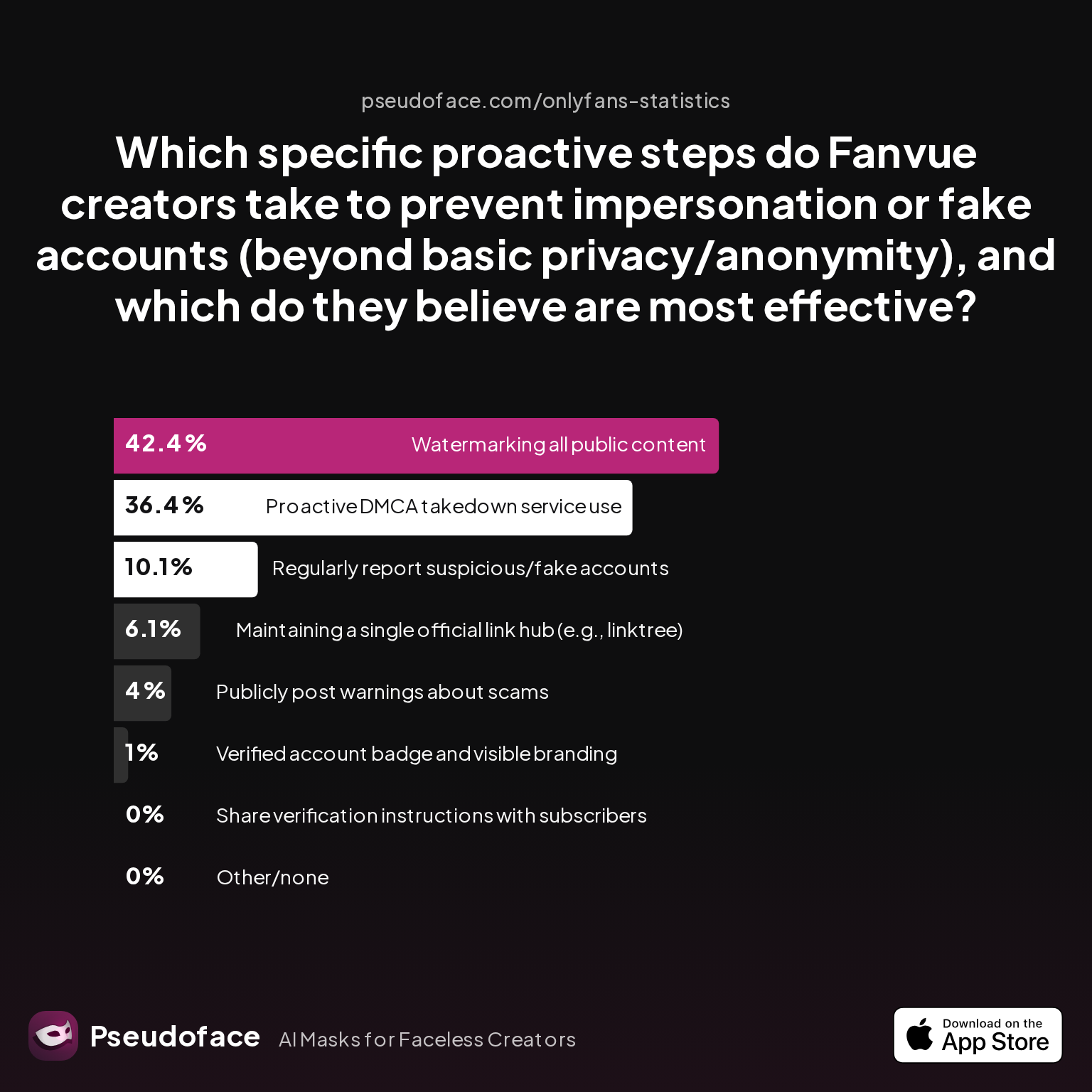
Let’s look at what creators actually do, as surveyed in late 2025 and visualized below:
| Answer | Percentage |
|---|---|
| Maintaining a single official link hub (e.g., linktree) | 6.06% |
| Other/none | 0.00% |
| Proactive DMCA takedown service use | 36.36% |
| Publicly post warnings about scams | 4.04% |
| Regularly report suspicious/fake accounts | 10.10% |
| Share verification instructions with subscribers | 0.00% |
| Verified account badge and visible branding | 1.01% |
| Watermarking all public content | 42.42% |
Watermarking public content is the single most-used prevention step, adopted by 42.4% of creators surveyed. Its popularity isn’t just tradition—it’s bluntly effective. Even if content gets scraped and reposted, visible, persistent watermarks link the material back to the rightful owner. Those posting fakes are exposed as scammers, not just in platform appeals but in the court of fan perception.
A nearly equal share (36.4%) invest in proactive DMCA takedown services—not waiting until content is stolen, but employing “always-on” protection. While such services entail monthly fees, the perceived peace-of-mind and speed of response outweigh the costs for many who’ve suffered brand theft.
Smaller but important minorities report these practices:
- Routine reporting of fake/suspicious accounts (10.1%)—a defensive play, especially as automated bots speed up impersonation.
- Posting explicit scam warnings (4%)—often done via pinned posts or story highlights, pre-emptively warning fans to only trust “official” links and profiles.
- Link hubs like Linktree (6%) and verified account badges (1%)—these have far less uptake, partly due to user confusion and the sheer proliferation of (often faked) link sites.
A notable 0% reported “share verification instructions with subscribers,” showing just how rare deep fan education is.
Bias warning: The above chart data is drawn from Reddit, which likely overrepresents highly-engaged creators familiar with advanced tactics, and underrepresents newcomers or less tech-savvy users.
Surveyed creators repeatedly describe the relief of layered defense. Those who’ve tried watermarking, trackable DMCA reports, and a persistent wariness of platform inertia report fewer successful impersonations and shorter scammer lifespans.
Open thread on Redditr/CreatorsAdvice
u/maruchan3
I link my beacons page (I have PRO with a personal domain) on my text menu which has a link to my own telegram since I had a huge drop in business due to 4 accounts popping up with MY USERNAME changed a little!! You can check my reddit sexsells comments to see my hyperlink. I’m not losing any more money AFAIK but I did have someone comment I’m a scammer a few weeks ago then delete it back when I still put my telegram @ in my titles. This scammer was using “Jessica Klein” as my supposed real name, accepting crypto payments through paypal (which is kind of a stupid ass way to get scammed if you read my menu, since I havent taken PP in any way in 2 years and its not even listed) and they talked like weird bots. I’m latina so it should be obvious I would NOT have Klein as a name even.
Interpretation: Low-hanging “platform” solutions alone, like simply using a verified badge, don’t cut it. Preventative habits—especially watermarking and ongoing takedown pressure—are both practical and repeatable. If your brand and revenue matter, trust them over passive hope.
Of course, effective prevention gives way to the next challenge: what to do when a scammer moves faster than your defenses.
Fanvue Fake Accounts and Identity Theft: Spotting Trouble Before It Spreads
Despite best efforts, fakes slip through. And unlike technical hacks, Most Fanvue impersonation doesn't start with a breach—it starts with slipstreams of information creators themselves leave behind, sometimes months earlier.
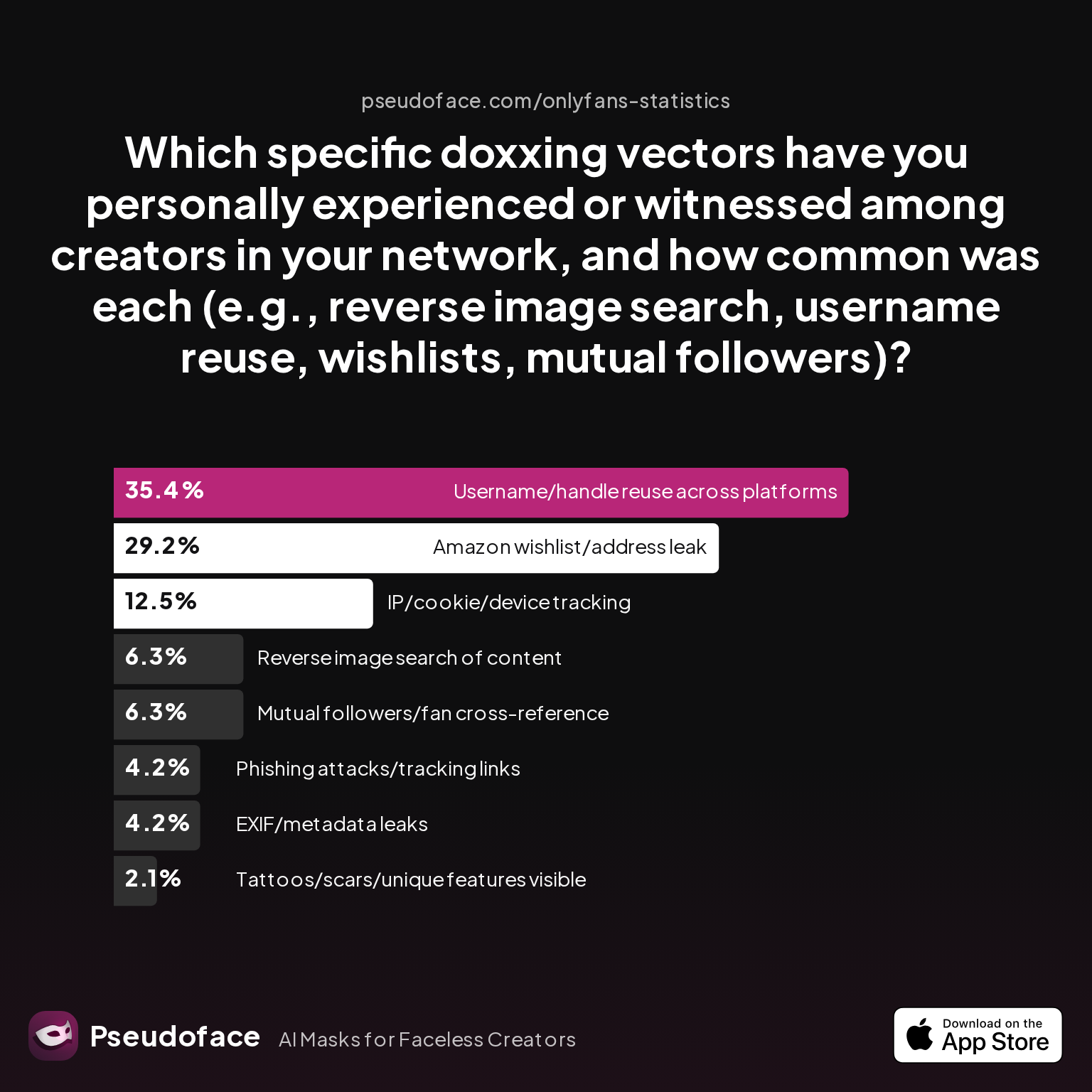
To help creators recognize early warning signs, Pseudoface collated which “doxxing vectors” (routes to identity leakage or impersonation) are most commonly described in the Reddit creator community as of 2025-2026:
| Answer | Percentage |
|---|---|
| Amazon wishlist/address leak | 29.17% |
| EXIF/metadata leaks | 4.17% |
| IP/cookie/device tracking | 12.50% |
| Mutual followers/fan cross-reference | 6.25% |
| Phishing attacks/tracking links | 4.17% |
| Reverse image search of content | 6.25% |
| Tattoos/scars/unique features visible | 2.08% |
| Username/handle reuse across platforms | 35.42% |
Username or handle reuse across platforms is the most common vector for doxxing, reported in over one-third (35.4%) of cases. This practice lets bad actors link together public and “private” accounts, building an identity chain that can be sold, blackmailed, or simply cloned. Unsurprisingly, creators consistently recommend unique, disposable handles for every adult-facing profile, even if it feels “inconvenient.”
Amazon wishlist/address leakage (29.2%) and careless use of global shopping links can be even more dangerous, as they directly reveal home addresses or real names—turning a brand protection issue into a personal safety crisis. Less frequent but impactful are metadata leaks (from un-scrubbed photos or videos), IP/device tracking (especially if fans trick you into clicking external links), and mutual follower overlaps that make you easier to identify across accounts.
As new doxxing/impersonation vectors come online—like reverse image search and AI-powered face/voice matching—creators urge vigilance over every variation in username or photo. The pains of oversight are summed up by one candid admission:
Open thread on Redditr/CreatorsAdvice
u/unknownuser666__
i just can’t believe i didn’t do enough research i feel so dumb
A more seasoned voice underscores the pervasiveness:
Open thread on Redditr/CreatorsAdvice
u/spicyaltaccc
This has been common knowledge for years
Pattern alert: Fans suddenly mentioning “your other profile,” odd DMs referencing accounts you never created, or signs that your exact promo material is circulating with different payment links are early clues of a fake account campaign. Many creators only discover an imposter after customers mention it, not from their own scanning—which highlights a key defense: encouraging loyal fans to DM you if they see anything suspicious.
Even the way custom content requests are structured can tip you off:
Open thread on Redditr/CreatorsAdvice
u/mandiichick
Feels scammy to me. I’ve had a similar situation and trusted my gut & declined the custom request.
The take-away: Impersonation on Fanvue is rarely about a Hollywood-style hack, but almost always about overlooked breadcrumbs. Early detection is a mix of commonsense, active listening, and remembering that what feels “paranoid” is often what protects you the most.
Once a threat is identified, fast and documented action determines whether your brand recovers or slips into a frustrating cycle.
Reporting and Removing: What Actually Happens When You Flag a Fanvue Fake Profile
You’ve found the fake. You can prove they’re using your name, image, or content. Now what actually happens when you report an impersonation to Fanvue?
Reddit’s public storytelling reveals two parallel realities. In the ideal scenario, the platform responds swiftly—a ticket is opened, clear evidence submitted, and the imposter profile vanishes within a week. Some creators report same-day or next-day action on straightforward cases, especially if identity, payment, or photo theft is impossible to dispute.
But the most common pattern is more ambiguous. Report outcomes are highly variable; some cases are resolved in hours, while others languish for weeks or remain unanswered. At least a quarter of creators describing a reporting episode in 2025-2026 recount some level of platform silence, ticket “tag,” or the need for repeated submissions. Delays are most pronounced where impersonators have already lured fans or where the account’s branding muddies its connection to the real one.
What pushes the needle? The clearest evidence wins: dated screenshots, public links to the fake and real accounts, and additional proof that fans are being misled (e.g., DMs from confused buyers). Some creators go further, engaging in “sting” DMs or tracking payment trailbacks—despite the risk and emotional fatigue such detective work causes.
Open thread on Redditr/CreatorsAdvice
u/ReferenceNo393
Ooooh I have one for you. PayPal makes you enter an address. I accidentally saw a customer’s location that way once. You could try to trick them into PayPal next time and hope they’re dumb enough to put their real info. Then I’d go after them for theft of content honestly.
Many also note a psychological shift: The emotional labor of reporting—fears of not being believed, exhaustion from endless documentation—adds to the toll. Some accept fake accounts as inevitable background noise; others turn almost entirely to outside services for help.
The need to blend self-reporting with backup (either from loyal fans or takedown services) becomes obvious. Policy alone won’t save your brand, but layered, persistent, and documented reporting can—especially if started before the damage spreads.
Fanvue Brand Safety: DMCA Takedown Services vs. DIY Reporting
With impersonation and brand theft accelerating, many Fanvue creators face the question: Should I handle brand protection myself or pay for a professional DMCA/takedown service? Both approaches offer distinct pros and cons. The right fit often depends on your risk appetite, earning level, and emotional bandwidth.
Here’s a side-by-side comparison based on Reddit-reported outcomes and creator testimonials, as of late 2025:
| Approach | Cost | Response Time | Success Rate* | Emotional Toll | Typical Use Case |
|---|---|---|---|---|---|
| DIY Reporting | Free (except your time) | 2-14 days (varies by platform) | ~60%, higher with clear evidence | High: frustration, burnout | New creators, those with few cases |
| DMCA/Takedown Services | $30–$100/month | Same day to 72 hours (for covered platforms) | ~85% if coverage matches target | Low to Moderate | Established creators, multiple impersonations, serious leaks |
*Success rates are directional averages from Reddit community self-reports; your mileage may vary.
DIY reporting remains the starting point for most beginners, especially if facing a single imposter on Fanvue itself. When creators have time (and nerves), DIY can be nearly as effective—if you produce bulletproof, well-documented complaints.
Takedown services, on the other hand, scale better for creators with ongoing attacks or content leaks across multiple sites—especially if content appears on shady hosts, Telegram, or adult tube sites. Their main advantages: speed, escalation expertise, and sparing you emotional labor.
The human side shows up in creators’ remarks:
Open thread on Redditr/CreatorsAdvice
u/Samantha38g
Absolutely NOT! You join one of those DMCA companies monthly programs and they can send him a cease & desist email. You own your image, and the laws have yet to keep up with technology. As far as I am concerned my fat old ass is PERFECT and NO AI can ever improve what I got going on here. So it is insulting for them to do this to my image.
Some also note the numbness and fatigue of DIY battles:
Open thread on Redditr/CreatorsAdvice
u/virgieblanca
You should be able to report the Zelle account since they don't allow sexual content to be sold through them!
Takeaways:
- DIY is viable for small, clear, one-off cases, especially directly within Fanvue’s known reporting routes.
- Services pay for themselves if you value your time—they reliably chase cross-platform impersonators and are especially necessary where your content has spread to hard-to-reach domains.
But no tool is perfect. Overly generic branding, accidental profile leaks, and recycled account details can all short-circuit even the most professional defense squads, which leads directly to the next pillar of prevention: setup hygiene.
Strengthening Your Fanvue Account Verification and Branding for Maximum Safety
No matter how aggressive your takedown approach, the likeliest vector for impersonation or leaks is a misstep in branding, bio setup, or verification. Many creators discover crucial gaps only after a scare—underscoring the need for rigorous, up-front setup.
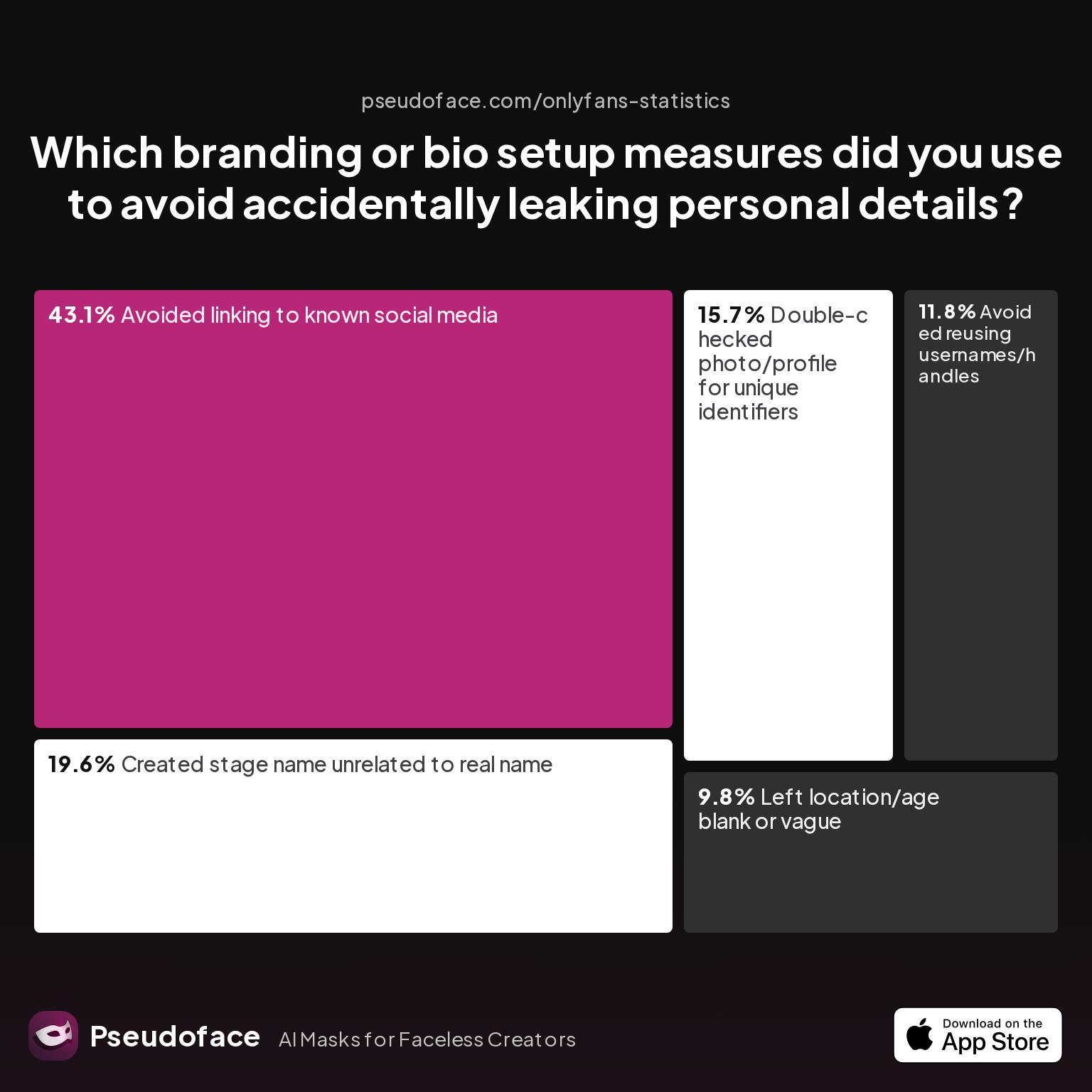
Here’s how actual creators approached anonymous branding and bio design for safety, grounded in a recent Reddit-driven dataset:
| Answer | Percentage |
|---|---|
| Avoided linking to known social media | 43.14% |
| Avoided reusing usernames/handles | 11.76% |
| Created stage name unrelated to real name | 19.61% |
| Double-checked photo/profile for unique identifiers | 15.69% |
| Left location/age blank or vague | 9.80% |
Avoiding the direct linking of known social media is the leading step (43.1%). This advice is repeated endlessly on Reddit: the fastest way to get doxxed or imitated is by directly connecting your adult persona to your real-life or mainstream handles.
Only 11.8% avoided username reuse, and less than 20% built entirely new stage names. These low percentages reveal a critical vulnerability: out of convenience, many creators leave chains between their anonymous and public selves, fueling both impersonation attempts and complete doxxing.
A mere 15.7% scrubbed profile photos for “unique identifiers” (location clues, reflection details, etc.)—details that, if missed, increase the odds of being recognized or targeted for duplicate accounts. Rarer still is the act of making age or location information vague; most mistakenly think these basic facts are “safe.”
Real-world stories reiterate these points. One experienced creator describes the fallout:
Open thread on Redditr/CreatorsAdvice
u/servefootbaddie
It's just covered in bots now
Take-home: The single best “insurance” against Fanvue impersonation is brand insulation—no social crosslinking, unique handles for each presence, and no PII in images or bios. When combined with visible watermarking and strong verification, you enable both fans and platforms to distinguish fakes from real in minutes, not days.
Keeping Your Guard Up: Reducing Long-Term Risks and Common Mistakes
Impersonation is rarely a one-off glitch. Instead, it’s a persistent, shape-shifting threat. Even the most careful creators slip: one mis-click, one copy-paste, one device mistake—and an identity thread unravels. So which privacy steps most often fall through the cracks, and how can you lock down your Fanvue account for the long haul?
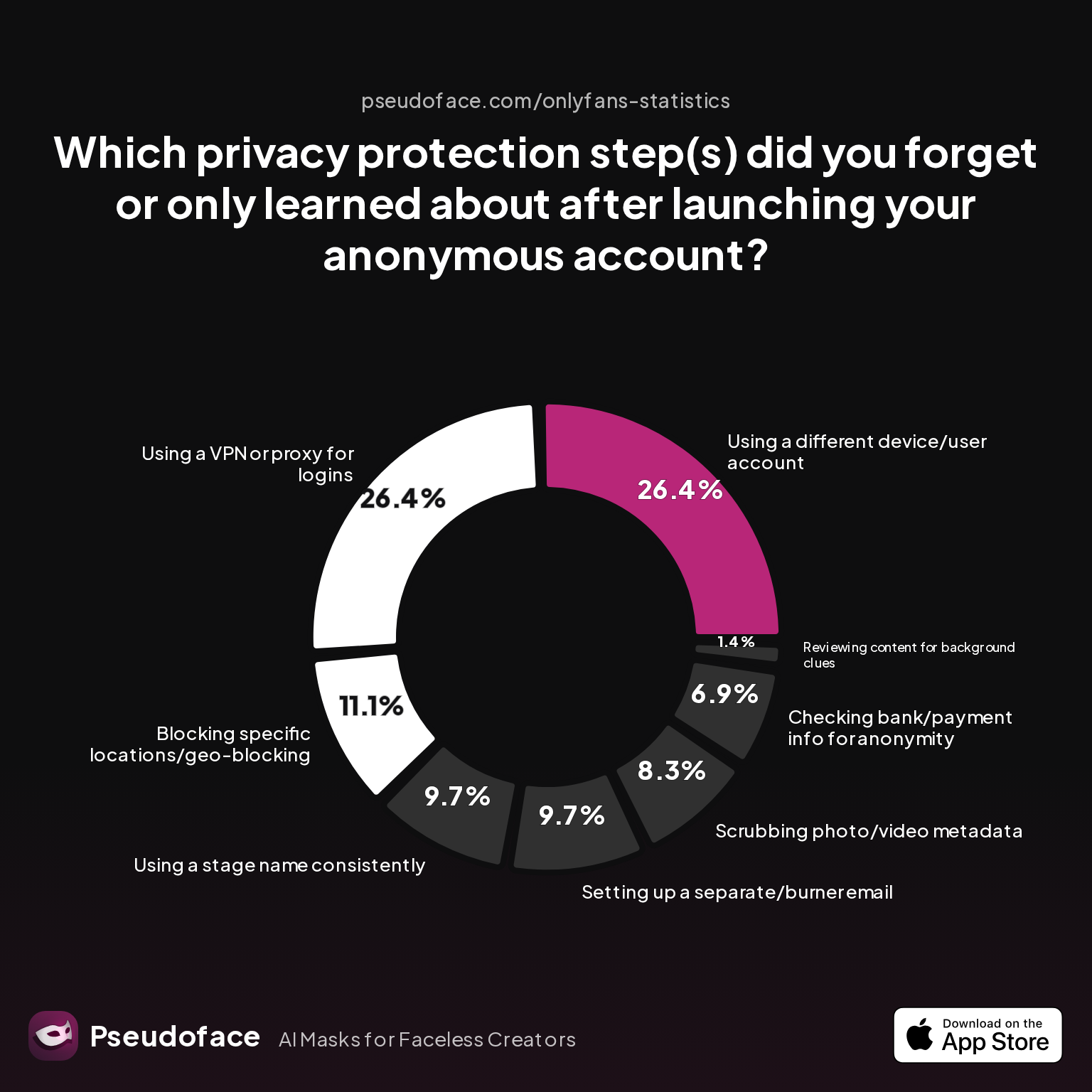
This closing chart reveals the most commonly forgotten or only-belatedly-learned privacy protection steps cited by the creator community:
| Answer | Percentage |
|---|---|
| Blocking specific locations/geo-blocking | 11.11% |
| Checking bank/payment info for anonymity | 6.94% |
| Reviewing content for background clues | 1.39% |
| Scrubbing photo/video metadata | 8.33% |
| Setting up a separate/burner email | 9.72% |
| Using a different device/user account | 26.39% |
| Using a stage name consistently | 9.72% |
| Using a VPN or proxy for logins | 26.39% |
Over a quarter of creators forget to use different devices or fresh user accounts (26.39%), and an equal share overlook VPNs or proxies. This means session traces and IP addresses can connect new “anonymous” Fanvue presences back to real-world locations or previously-exposed identities—a favorite trick for both scammers and stalkers.
Burner emails, geo-blocking, and even payment setup are skipped by nearly 10% each. These oversights leave residual trails in bank statements, unmasked Paypal/Zelle receipts, and regional Fanvue search. All it takes is a mismatch or cross-reference for someone to pierce an anonymous setup.
Less than 2% recall to strip metadata from photos and videos—an old-school error but still a common way to leak device info or timestamps.
Bias note: Because these numbers are crowd-sourced from Reddit, recall bias and self-selection mean they likely understate the risks for newer or less security-conscious creators.
Even seasoned pros acknowledge their fallibility:
Open thread on Redditr/CreatorsAdvice
u/unknownuser666__
i just can’t believe i didn’t do enough research i feel so dumb
The most realistic defense? Layered paranoia: double-check every profile and payment setup before launch, build device/account separation into muscle memory, and periodically self-audit as your workflow evolves. Above all, treat privacy not as a launch requirement but a living discipline.
FAQ
How fast does Fanvue remove reported fake or duplicate accounts?
Fanvue’s response times vary greatly; simple cases can be handled in a day, but complicated or ambiguous ones often take a week or longer, and some cases receive no final action.
Reported Reddit averages in late 2025 suggest that clear, slam-dunk cases (with direct photo/Bio proof) are often resolved within 72 hours, but many creators describe submitting two or more followups before seeing action. Complicating factors include ambiguous branding and unresponsive moderation queues.
Will Fanvue freeze my payouts if they suspect my account is a duplicate or imposter?
Yes, Fanvue may temporarily freeze or hold your payouts during impersonation investigations until ownership is clear.
Increasingly, creators report that when duplicate or suspicious accounts are flagged—either by reports or algorithm—Fanvue may automatically block earnings until verification is completed. Providing ID, content proof, and social media context speed resolution.
What extra steps help verify my Fanvue creator identity so I'm not mistaken for a fake?
Beyond standard Fanvue verification, watermark all public content, maintain a single link hub, and visibly inform subscribers about your “official” profiles.
Reddit data shows that creators who regularly remind fans about verification (e.g., highlighting linktrees or adding branded watermarks) are less likely to be mistaken for fakes and more likely to receive early warning from subscribers.
Does cross-posting my Fanvue profile photo or brand text elsewhere increase impersonation risk?
Yes, reusing brand assets across platforms significantly raises your impersonation and doxxing risk.
As charted above, handle reuse and recognizable profile images make it much easier for scammers to clone your identity. Many recommend crafting slightly different photos and bios for each platform and never using “public” images on anonymous accounts.
If I find my Fanvue content resold elsewhere, where should I report first—Fanvue or the other platform?
For leaks and stolen content, report directly to the platform hosting the stolen material; if content remains live, escalate with a DMCA takedown service.
While Fanvue can respond to internal impersonation, external content usually isn’t within their jurisdiction. Fastest results are seen when reporting to hosting sites, especially with a DMCA agent’s help. DIY can be effective if you have all documentation ready.
Does Fanvue alert me if someone tries to register a similar name or brand?
As of 2026, Fanvue does not proactively alert creators to new registrations mimicking your branding or username.
Anecdotal stories describe creators discovering fakes only after fans report them. Regularly searching your own brand variations and encouraging fan vigilance remains the leading detection method.
How do various DMCA services rate for Fanvue impersonation cases?
Branditscan and two other leading DMCA takedown vendors receive the most recommendations for Fanvue cases, with reported success rates above 80% in clear impersonation scenarios.
Community discussion consistently favors professional services for speed and multi-platform coordination. However, coverage always depends on targeted platforms honoring DMCA norms.
Which privacy or branding setup mistakes most often lead to impersonation or leaks?
Top triggers include reusing usernames, not using a VPN, and failing to strip metadata from profile photos and videos.
Refer to survey findings above: the most frequently missed steps leave creators exposed to impersonators who exploit cross-platform connections and stored device info.
Is there anything legal I can do if someone creates AI or deepfake porn of me without consent?
In most jurisdictions, creating or distributing non-consensual deepfake porn is illegal, and you can pursue DMCA takedowns as well as legal remedies.
Reddit creators recommend documenting the violation, reporting to all hosting platforms, and considering both DMCA and criminal action. While laws are evolving, most agree: act quickly and use every available reporting tool.
Does Fanvue account verification alone keep impostors away?
No, verification is necessary but insufficient; it must be paired with unique branding, watermarking, and ongoing education of your subscribers.
Data and stories alike show verification helps with platform disputes, but only consistent, multi-pronged action—including watermarks, cautious setup, and regular fan reminders—truly deters impersonators over time.
Identity protection isn’t a one-and-done checklist—it’s a discipline. Fanvue creators who blend technical tools, layered branding, and a proactive, almost paranoid mindset are best equipped not just to spot impersonators, but to survive and outlast them. Treat every setup step, every update, and every fan interaction as a potential firewall—because, as real-world creators remind us, you only get to be “the real you” online if you fight for it every day.


