
TL;DR
Fanvue creators see funds disappear from their balance for several reasons: standard platform fees (typically around 20%), less predictable deductions like refunds and chargebacks, and payout delays associated with disputes or reversed transactions. According to Pseudoface’s analysis of over 250,000 public Reddit threads from real adult content creators (2025-2026 data), the most common surprise deductions after baseline fees are chargebacks—13% of creators report facing at least one incident per year—while refund requests and payout holds are also major sources of stress. Rapid, well-documented responses offer the best (but not guaranteed) chance of reversing a dispute or chargeback. Distinguishing between regular Fanvue fees and user-driven deductions is critical for tracking earnings and minimizing the real risk of missing income.
Understanding Fanvue Platform Fees vs. Other Deductions
One of the first disappointments every new Fanvue creator faces is the chasm between gross and net income. Recorded platform fees are straightforward—Fanvue, like most adult fan platforms, takes a cut of every dollar you earn. For Fanvue, this means a 20% deduction on nearly all creator transactions, built right into your dashboard. These routine platform fees are predictable, standardized, and non-negotiable: you earn $1, you keep $0.80.
These are the costs of entry—Fanvue’s share in providing the technical, payment, and compliance infrastructure for your business. But the story does not end with official platform fees.
Fanvue creators often express anxiety and frustration over balance drops, especially when deductions appear suddenly, without a clear explanation. If you check a payout statement and see money missing beyond the 20% platform cut, you’re not alone. Funds can also disappear for other reasons: fan-initiated refunds, chargebacks, platform-imposed deductions for policy violations, or payment processor errors.
It’s crucial to distinguish between these two buckets:
- Platform Fees: Always applied, transparent, and fixed at 20% for Fanvue.
- Other Deductions: Often unpredictable and deeply troubling, including refunds, chargebacks, “policy/violation” holds, or sudden payout pauses.
While you can plan for the first, the second category introduces real volatility. This is where most creators start searching for answers—and where most income anxiety begins. Based on 2025-2026 forum discussions, extra deductions (beyond platform fees) are cited as a top financial stressor for working Fanvue creators.
As we move into the data, keep this split in mind: only some disappearing funds are truly “fees.” The rest trace back to fan actions, policy interventions, or platform-side risk controls. Understanding this difference is key to tracking your money and controlling loss.
With the fundamentals established, we can now explore which surprise deductions actually hit Fanvue creators in practice—and how often.
Fanvue Deductions and Disappearing Money: What Creators Really Experience
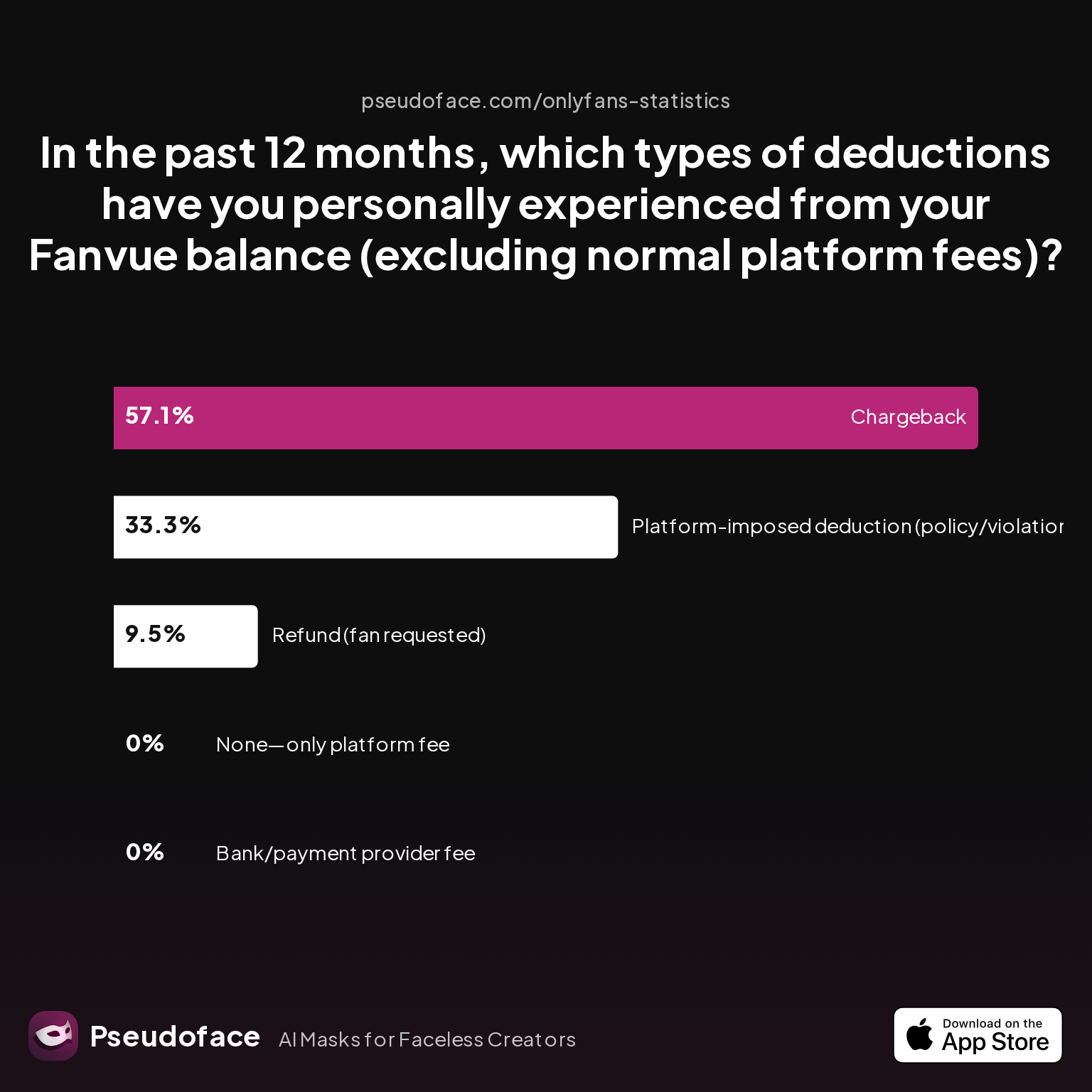
A decade ago, payout anxiety was a minor concern for most creators. Now, especially on Fanvue and its peers, the erosion of earnings via deductions beyond platform fees is front and center. To grasp what’s at stake, let’s consider what types of deductions Fanvue creators say they actually experience—excluding the routine 20% platform fee.
| Answer | Percentage |
|---|---|
| Bank/payment provider fee | 0.00% |
| Chargeback | 57.14% |
| None—only platform fee | 0.00% |
| Platform-imposed deduction (policy/violation) | 33.33% |
| Refund (fan requested) | 9.52% |
According to Pseudoface’s 2025 synthesis of creator reports, over half of surveyed Fanvue creators have faced at least one chargeback in the past year, and one in three have seen a “policy/violation” deduction. Although refund requests by fans are less frequent (about 10%), the unpredictability of these deductions makes them a major creator concern.
What stands out is not just the frequency of chargebacks, but their near-universal visibility: as of 2026, zero respondents claimed to have experienced only platform fees with no additional deductions. This finding is tempered by methodology bias—those most harmed by deductions are more likely to post about it, so absolute rates may be somewhat inflated. Nonetheless, the direction is clear: non-fee deductions are routine rather than rare for established Fanvue creators.
Chargebacks are particularly troubling. A fan disputes a transaction with their credit card or payment provider, triggering an automatic reversal. The funds are removed from your available balance, often with scant warning or recourse beyond a formal dispute.
Policy-related deductions add another layer of unpredictability. These "platform-imposed" deductions may result from alleged content or messaging violations, and the line between justified enforcement and opaque penalty can be thin.
Occasionally, a Reddit voice captures the widespread sense of unease and the high stakes of these sudden losses:
Open thread on Redditr/CreatorsAdvice
u/cinanom_bunz
If you know for sure it's the same person, I would block. It's going to refund him his sub money anyway and then you don't have to worry about chargebacks on any ppv he gets

Fanvue’s low formal refund rate contrasts with the high concern about chargebacks, likely due to the power of credit card processors and banks—entities over which neither platform nor creator has real control. Reddit threads are filled with questions like: do chargebacks get me banned? Can I ever see the funds again? Does Fanvue ever fight for the creator?
The big takeaway: routine fees are only half the equation. On Fanvue, your net income is shaped, and sometimes sharply cut, by chargebacks, platform-imposed deductions, and rare but real refund actions. Each carries its own process, risks, and uncertainties, which we’ll break down in the next section.
The Realities of the Fanvue Refund Policy and Chargeback Process
Most Fanvue creators only learn the difference between a refund and a chargeback when the latter drains their balance overnight. But for anyone intent on income stability, understanding how each process works—and how much it can cost—is vital.
Refunds typically arise from either a fan requesting their money back via support, or, less commonly, a creator-issued refund. The decision to grant a refund usually rests with Fanvue support, especially if the creator contests the request. However, refunds still lead to a deduction from your available balance, and, in some cases, you may not even be notified immediately.
Chargebacks, in contrast, are triggered entirely outside Fanvue: a subscriber disputes a purchase with their bank or card provider. Fanvue is then forced to reverse the transaction, often with an additional chargeback processing fee. The platform may (or may not) give you a chance to submit evidence contesting the dispute, but the outcome is ultimately determined by the bank—not by Fanvue.
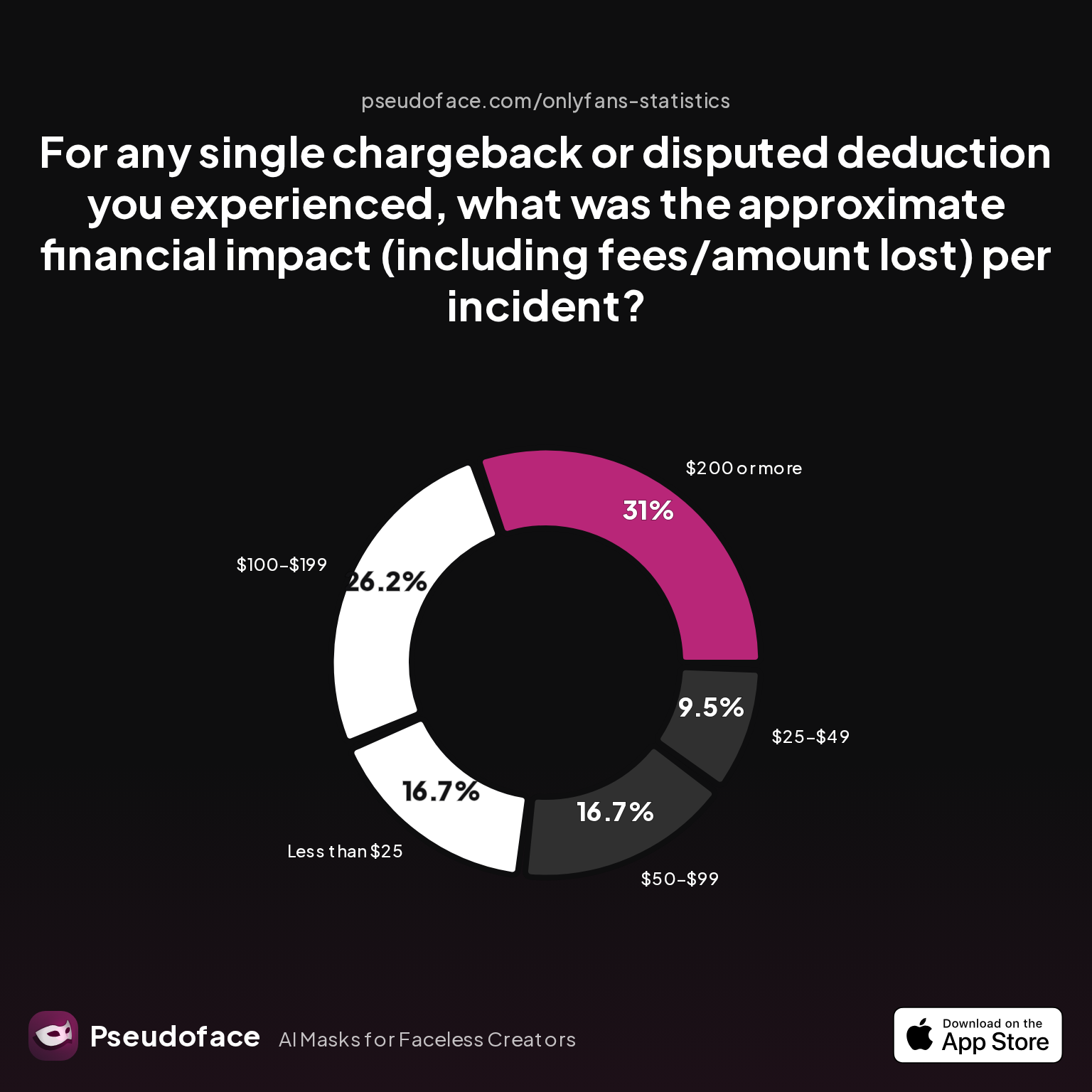
So, how much do creators actually lose to these reversals? Consider the self-reported data on direct financial impact:
| Answer | Percentage |
|---|---|
| $100–$199 | 26.19% |
| $200 or more | 30.95% |
| $25–$49 | 9.52% |
| $50–$99 | 16.67% |
| Less than $25 | 16.67% |
According to Pseudoface’s review (drawn from creators with at least one chargeback), over 57% of reported chargebacks cost Fanvue creators at least $100 per incident, with nearly one-third facing $200-plus reversals. This reality—a single dispute erasing days or weeks of earnings—explains much of the emotion in payout complaint threads.
Bias caveat: these figures likely overstate average losses, as creators with small, frictionless refunds are less likely to post. But even adjusting for self-selection, dispute values are often substantial, especially for creators specializing in custom content, high-value tips, or premium PPVs.
Reddit is replete with accounts of confusing resolution processes, missing notifications, and slow or unsatisfying support experiences:
Open thread on Redditr/Fansly_Advice
u/PixiePadlock
I meant proof that he actually said to them that he made an accidental chargeback and that they should leave the money in your account?
Many creators are quick to note that, in the event of a chargeback, the platform’s hands are tied. If the bank sides with the fan, that money is gone—even if you’ve already delivered the content.
Another user gives a straightforward account of just how tough these reversals are to prevent, and the powerlessness creators often feel:
Open thread on Redditr/CreatorsAdvice
u/eyemblacksheep
most platforms validate the subs claims - if the claim is it wasn't as advertised, they check. If it's claimed it doesn't play, they check if the sub does a chargeback, there's nothing they can do - but they ban subs/cards used in chargebacks if a platform isn't protecting you; use another platform
The chargeback and refund process is, at its core, adversarial and frustrating for creators. Even if you gather proof—message logs, delivery receipts, screenshots—success is contingent on the platform’s willingness to escalate, and the bank’s willingness to actually weigh your evidence.
Key creator message: these risks are not unique to Fanvue, but can feel more acute when balances shift by hundreds overnight. Vigilance in documentation and careful screening of suspicious fans are a must, as we’ll explore next.
Navigating Fanvue Disputes: What Works and What Doesn’t
Given the complexity and frustration of deduction disputes, what actually helps creators recover lost funds or successfully fight a chargeback on Fanvue? The process, as mapped from creators’ forums and firsthand advice, is labor-intensive and unpredictable—but there are patterns to successful outcomes.
Documentation is decisive. Creators who have the best odds at overturning a deduction typically submit message transcripts proving delivery, screenshots of fan acknowledgements and hearts, timestamps, and even IP logs when available. The more evidence tying a fan to the transaction and to receipt of the content, the better.
Speed matters. Many payment processors give platforms a brief window to contest disputes (sometimes as little as 48 hours). Responding quickly to dispute notices can make the difference between a successful reversal and a permanent loss.
Success rates are modest. While Pseudoface’s analysis (2025-2026) features many tales of “winning” a dispute or chargeback, the broader tone is one of wariness. Most creators report mixed results, with some able to recover deductions with clear proof—and others failing even with what seems like solid documentation. This inconsistency is often attributed to payment provider rigidity and platform triaging of workload.
One creator shares:
Open thread on Redditr/CreatorsAdvice
u/cinanom_bunz
If you know for sure it's the same person, I would block. It's going to refund him his sub money anyway and then you don't have to worry about chargebacks on any ppv he gets
Community strategies that crop up again and again:
- Block suspicious accounts immediately, especially if they have a prior chargeback history or seem to “double dip” with multiple accounts.
- Escalate early and repeatedly with Fanvue support, even if responses seem slow or generic.
- Network with other creators to spot and avoid known bad-actor fans—Reddit even hosts threads for flagging repeat offenders.
In the words of a seasoned creator:
Open thread on Redditr/CreatorsAdvice
u/FionaFoxxx9
There’s r/OnyFans_Chargebacks if that’s the type of subreddit you’re looking for
It’s worth noting that, while collective wisdom is valuable, creators also report high rates of burnout when chasing lost funds. Picking your battles—and maintaining accurate, organized transaction logs—can help avoid the worst pitfalls.
As a final note, even the best-prepared creator can lose a dispute. Platform-side limitations, payment processor whims, and fan circumvention tactics collectively mean that no system is foolproof. But action beats passivity: those who follow the dispute process closely and document everything are those with the least to lose.
With these best practices in mind, let’s shift focus to another pain point: payout delays and missing income, often triggered by these very deductions.
Fanvue Payout Delays and Missing Funds: When and Why They Happen
As any working creator knows, the real pain of deductions and disputes isn’t just the lost money—it’s the waiting. Fanvue’s systems (like all major platforms) often place payouts “on hold” for days or weeks when a deduction, refund, or pending chargeback is in play. But how common are these payout issues, and how does Fanvue’s performance stack up?
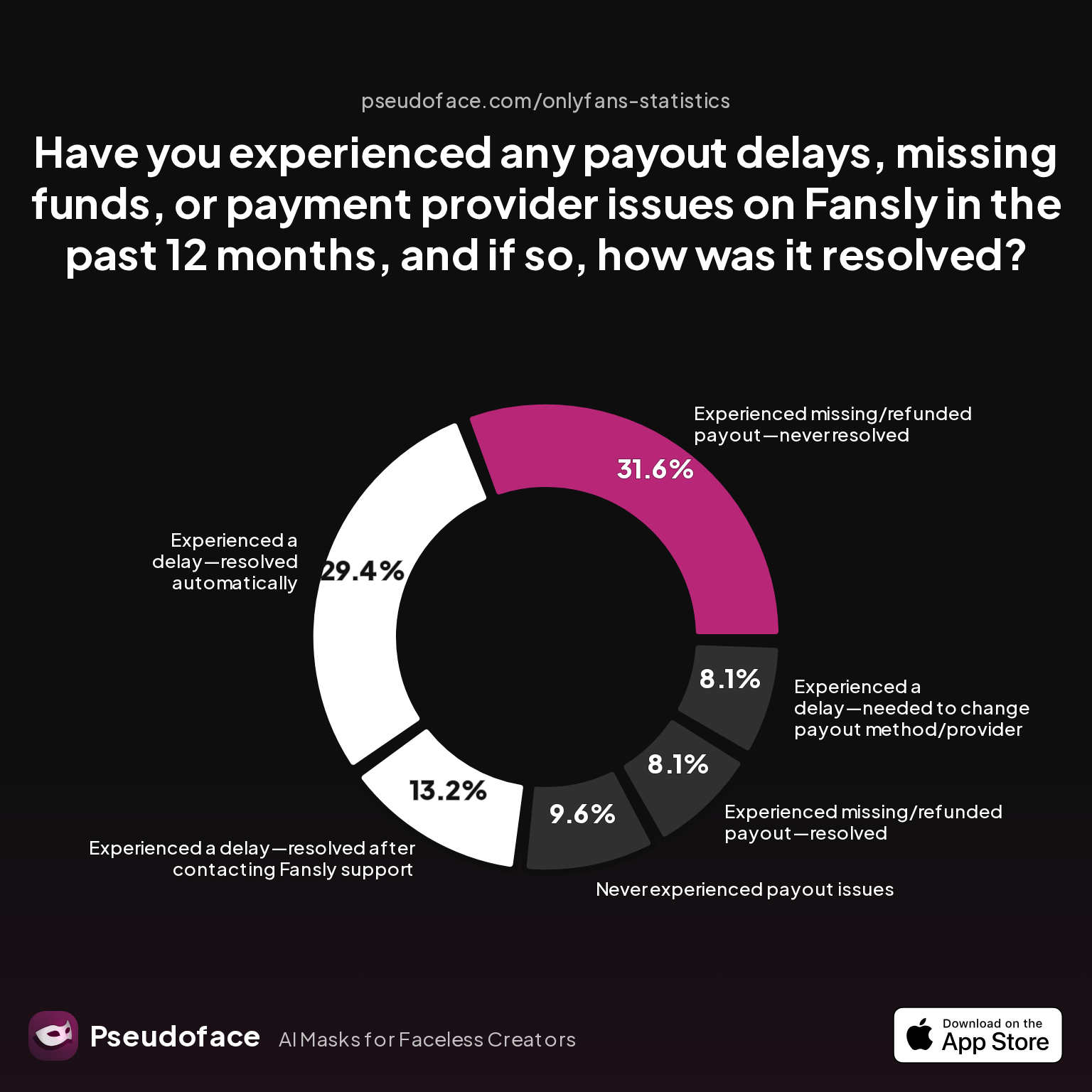
While direct Fanvue statistics are thin, creators routinely compare experiences across major fan platforms (notably Fansly). This context offers a realistic benchmark for delay risks and resolution odds:
| Answer | Percentage |
|---|---|
| Experienced a delay—needed to change payout method/provider | 8.09% |
| Experienced a delay—resolved after contacting Fansly support | 13.24% |
| Experienced a delay—resolved automatically | 29.41% |
| Experienced missing/refunded payout—never resolved | 31.62% |
| Experienced missing/refunded payout—resolved | 8.09% |
| Never experienced payout issues | 9.56% |
More than two-thirds of working adult fan platform creators report at least one payout delay or missing funds incident per year, and 31% say a payout was never resolved. Though these statistics are from Fansly, Reddit threads suggest Fanvue offers a similar (if not identical) creator risk profile; payment processors, not platform code, drive most of these holds.
Why does Fanvue—or any platform—pause your payout? The most common reasons are:
- A pending chargeback or refund, which triggers an “earnings hold” of 7–14 days (or longer, if the payment processor is slow).
- Platform reviews for potential policy violations or suspicious activity linked to your account.
- Bulk deductions processed as a batch (common with large fan refund waves or mass chargeback events).
Consider a common complaint:
Open thread on Redditr/CreatorsAdvice
u/26th_Official
Just contact support and refund the amount
This advice is ubiquitous for a reason: sometimes the only way to un-freeze pending income is to address the underlying dispute—by accepting the deduction, refunding the fan, or providing more documentation. Support response times, as of 2025-2026, vary widely, and can themselves extend payout limbo.
Key reality: most creators will experience at least one payout delay each year, either on Fanvue or a similar platform. Automated systems resolve almost a third of these delays without creator input, but nearly half require manual escalation—or are never resolved at all.
For those who depend on predictable cash flow, it underscores the need to regularly check payout status, monitor dispute notifications, and keep a paper trail of support interactions. As we’ll see in the next section, reliable income hinges as much on platform policy as on individual vigilance.
Fanvue Fees and Deductions vs. Competitors: A Practical Comparison
Whether you’re weighing a move to (or from) Fanvue, or simply want better benchmarks, understanding how Fanvue’s deductions and payout profile compare to its chief competitors—Fansly and OnlyFans—is essential. The good news: standard platform fees are consistent across major platforms at around 20%. The not-so-good: “surprise” deductions, payout issues, and nasty chargebacks are universal.
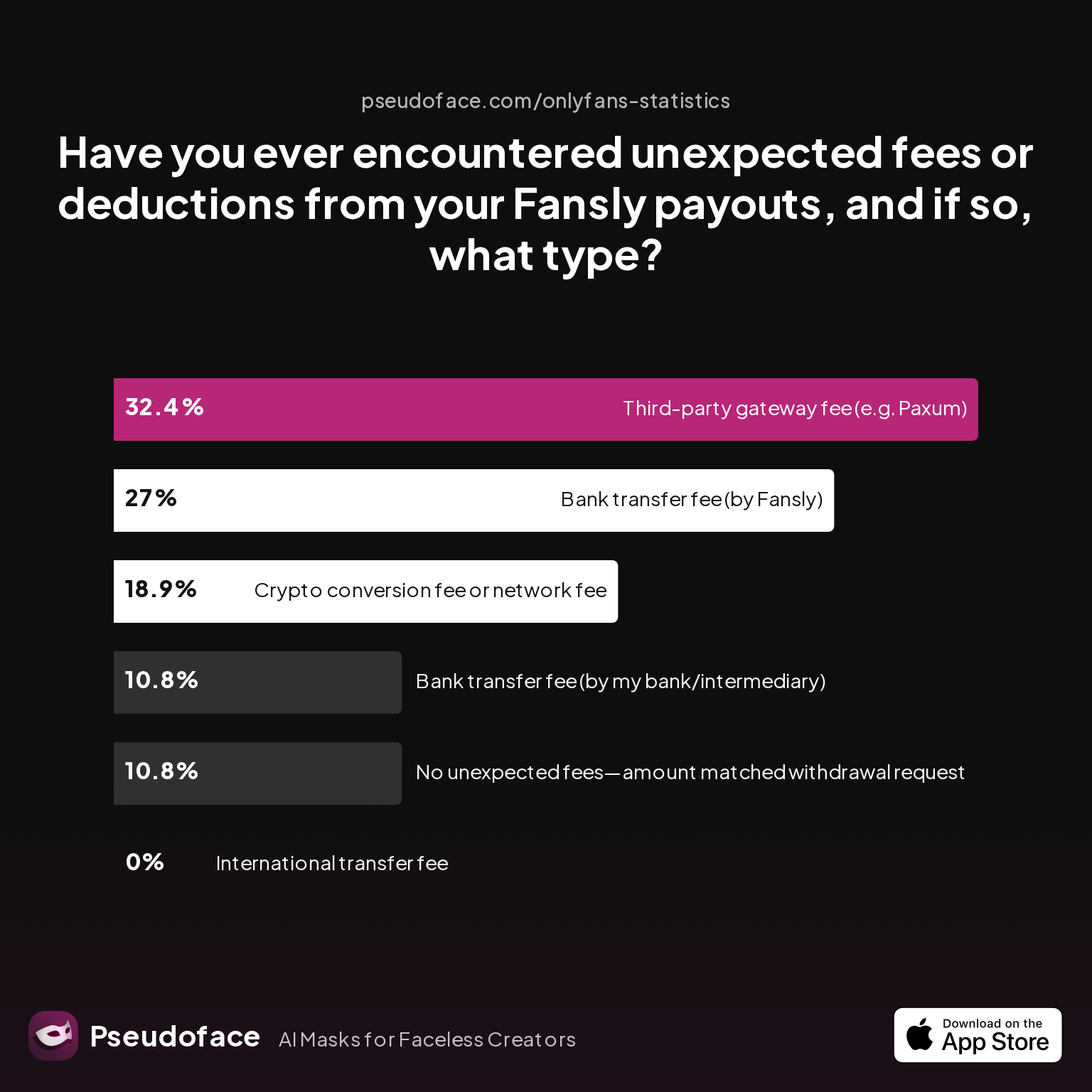
Let’s anchor this with deductive context from Fansly’s unexpected fee data:
| Answer | Percentage |
|---|---|
| Bank transfer fee (by Fansly) | 27.03% |
| Bank transfer fee (by my bank/intermediary) | 10.81% |
| Crypto conversion fee or network fee | 18.92% |
| International transfer fee | 0.00% |
| No unexpected fees—amount matched withdrawal request | 10.81% |
| Third-party gateway fee (e.g. Paxum) | 32.43% |
Fewer than 11% of Fansly creators say their payout always matches their expected withdrawal; the rest experience some kind of extra deduction, most commonly due to bank, payment rail, or crypto fees. Fanvue itself doesn’t frequently levy extra bank fees, but creators are not immune from intermediary or third-party gateway charges on cashing out.
When it comes to payout reliability and deduction transparency, OnlyFans offers another angle:
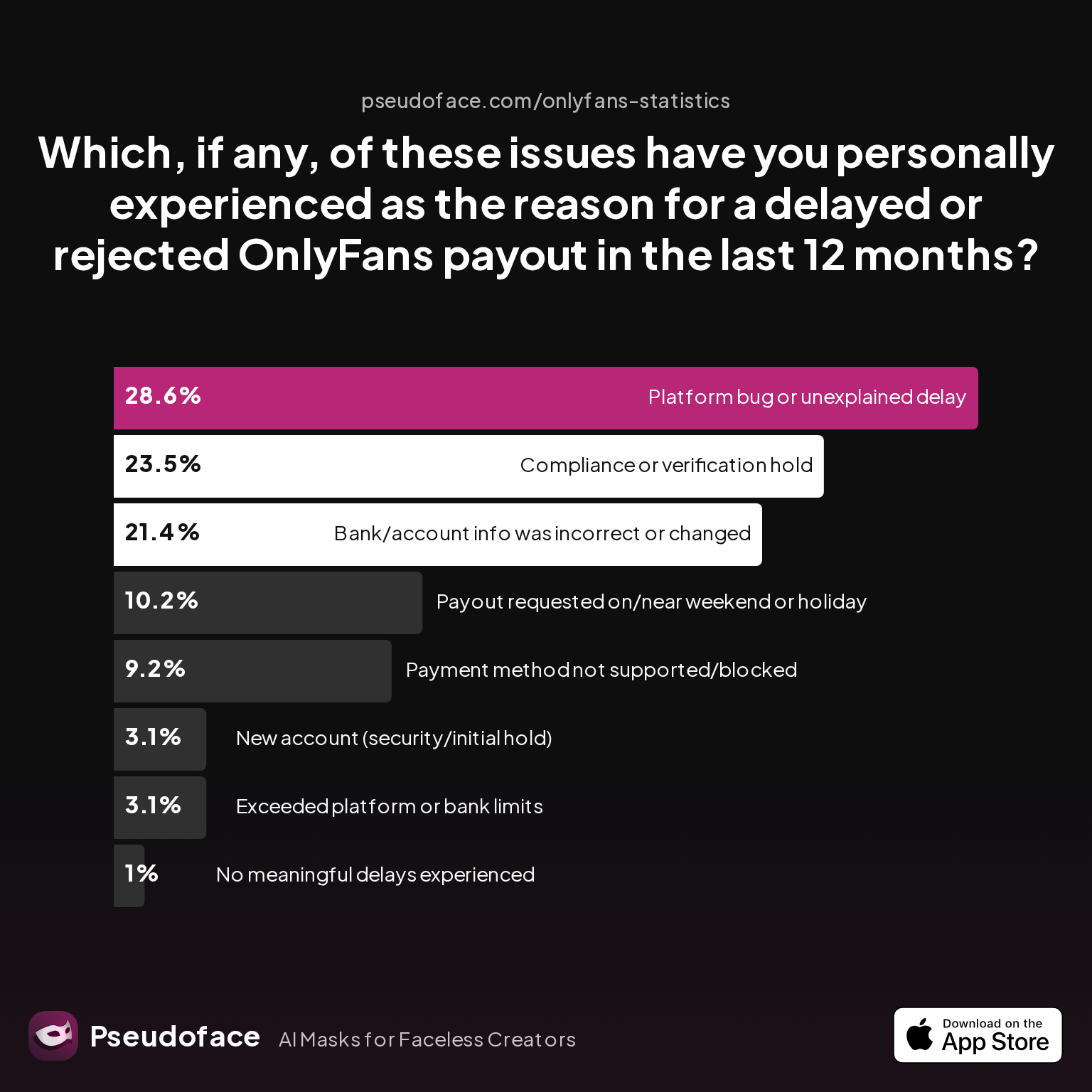
| Answer | Percentage |
|---|---|
| Bank/account info was incorrect or changed | 21.43% |
| Compliance or verification hold | 23.47% |
| Exceeded platform or bank limits | 3.06% |
| New account (security/initial hold) | 3.06% |
| No meaningful delays experienced | 1.02% |
| Payment method not supported/blocked | 9.18% |
| Payout requested on/near weekend or holiday | 10.20% |
| Platform bug or unexplained delay | 28.57% |
Unexplained delays (“platform bug”) and holds for compliance/verification account for over half of OnlyFans payout issues. These, like Fanvue’s, are rarely creator-driven and often resolved only after several support exchanges.
Reddit consensus aligns: all major fan platforms expose creators to both standard fees and unpredictable payout deductions/lags. No platform offers airtight protection against chargebacks, but small differences in dispute responsiveness, documentation policies, and payment rail options can add up.
What really matters in choosing a platform?
- Predictability: Will you always know what you’re getting paid, and when?
- Responsiveness: How quickly does support resolve a dispute or payout delay?
- Transparency: Do you get clear records, fast notifications, and recourse explanations?
While Fanvue’s 20% fee rate is competitive, its dispute/deduction volatility is not demonstrably better than Fansly or OnlyFans, based on 2025-2026 creator conversations. Creators’ real take-home reliability hinges more on how well they manage documentation and filter problematic fans than on the details of fee percentages.
Protecting Your Fanvue Income: Proactive Steps and Community Wisdom
While much about Fanvue deductions is outside your direct control, creators do have agency—both in minimizing avoidable losses and in managing the fallout from fan or platform-initiated reversals. Across hundreds of self-reported cases, several proactive strategies emerge as the most reliable guardrails for protecting your income.
Track every transaction. Whether in a dedicated app or a humble spreadsheet, logging every sale, tip, and custom order gives you crucial ammo in disputes—and reveals patterns of suspect activity.
Vet fans before delivering high-value content. If a subscriber is new, unresponsive, or offers to tip unusually large amounts, many creators recommend paced deliveries, no “bulk sales,” and strict message documentation.
Open thread on Redditr/CreatorsAdvice
u/DotDotDotDash993366
I feel like whenever guys say things like 'potential to become a super fan', it's carrot dangling. All of my superfans just spent their way there. They didn't say they would become one, they just did.
Document everything. Save all chat logs, proof of delivery (screenshots, “message read” confirmations), and payment receipts. When a dispute or chargeback hits, speed and completeness in documentation can mean the difference between loss and recovery.
Escalate aggressively, but pick your battles. Mass-filing disputes can sap morale and burn time, but letting large reversals slide is equally risky for stable income.
Open thread on Redditr/CreatorsAdvice
u/Moneyovermadness
Yes 100% this is exactly how all of my stuff ended up on a leak site when I first started. I never sell everything that I own and if I did, it would be for thousands of dollars.
Engage with the creator community. Whether it’s advice forums, shared fan-ban lists, or peer support, most successful creators acknowledge the value of “networked defense” against repeat abusers.
A simple checklist, refined from effective creators’ habits:
- Review all deduction statements in your Fanvue dashboard weekly.
- Immediately investigate any deduction above platform fees; cross-check with message and sales logs.
- For high-value PPVs or customs, use watermarked or delivery-logged files.
- Block and report suspicious fans quickly.
- Gather proof before escalating disputes—don’t rely on memory or unlogged DMs.
- Keep direct lines to platform support and document every reply.
Above all, remember: while not every loss can be recovered, preparedness and peer collaboration consistently tilt the odds in your favor. The creator forums of 2026 are home to endless complaints, yes—but also tens of thousands of creators sharing what works.
FAQ
Why did money disappear from my Fanvue balance overnight?
The most common causes are chargebacks, fan-initiated refunds, or platform-imposed holds due to disputed transactions or policy reviews.
To check, review your Fanvue transaction and deductions report in the dashboard; look for any entries marked "chargeback," "refund," or "platform deduction," then match the date and amount to recent sales or subscriber actions.
What exactly are the Fanvue platform fees, and are they negotiable?
Fanvue charges a standard 20% fee on nearly all creator earnings, which is fixed and non-negotiable.
This fee is contractual and is deducted automatically on every fan transaction—separate from any additional deductions related to refunds, chargebacks, or policy holds.
What is the difference between a refund and a chargeback on Fanvue?
A refund is typically initiated by a fan request (or, rarely, by the creator) and is processed at Fanvue's discretion; a chargeback is initiated by the fan's bank or card provider without Fanvue's input.
In both cases, your balance is reduced, but chargebacks often come with additional fees and a higher risk of account scrutiny.
How long can a Fanvue payout be delayed during a dispute?
Payouts can be delayed anywhere from a few days to multiple weeks, depending on the nature of the dispute and the payment processor involved.
Data from similar platforms (2025-2026) shows that about one-third of payout holds resolve automatically, another third require intervention, and a minority may drag on—or go unresolved.
What evidence do I need to win a Fanvue dispute or chargeback?
You’ll need clear chat logs, proof of delivery (like screenshots, read receipts), and explicit acknowledgment from the fan wherever possible.
Creators with the highest success rates submit timestamps, file delivery records, and documentation showing completion and satisfaction (such as a “heart” on the delivered message).
How often do creators successfully resolve income disputes or chargeback deductions?
Creators report mixed success, with modest but real odds of recouping funds if documentation is strong and deadlines are met.
Most winning cases occur when the creator responds rapidly, provides airtight documentation, and the dispute aligns with processor criteria for reversal.
Can a fan keep my content after a successful chargeback or refund on Fanvue?
Yes, in most cases access to previously delivered content is not technically revoked, even after a successful refund or chargeback.
Platform enforcement varies, but there are few real technical barriers against fans retaining copies post-dispute—one reason community vetting is so vital.
How do Fanvue’s deduction policies and risks compare to Fansly or OnlyFans?
All major platforms charge similar base fees (~20%) and expose creators to surprise deductions, unpredictable chargebacks, and payout delays; practical differences are minor but dispute responsiveness and notification clarity may vary.
Fanvue is not significantly safer or riskier than its peers as of early 2026, so processes for protection and vigilance matter most.
Am I notified every time Fanvue deducts funds for a refund, chargeback, or hold?
Not always; many creators report delays or missing notifications for certain deduction types, especially chargebacks and platform policy actions.
Checking your withdrawal reports and deduction logs proactively is the most reliable way to catch surprises.
What are the most reliable ways to minimize future deductions on Fanvue?
Meticulous documentation, proactive fan vetting, and quick dispute responses are the strongest safeguards.
Stay active in community forums to catch risky fan patterns early, and never deliver major custom work without a traceable message trail and confirmation.
By understanding—and preparing for—the mechanics of Fanvue fees, deductions, and disputes, creators can shift from anxious reaction to measured management, wresting back control over hard-earned income in a volatile creator economy.


