
TL;DR
Most Fanvue account suspensions stem from a handful of recurring compliance violations—content flagged as prohibited, copyright missteps, and ambiguous interpretation of the platform’s evolving rules. According to Pseudoface’s analysis of over 250,000 public Reddit threads from active adult content creators, 1 in 7 Fanvue creators have experienced an enforcement action in the past 12 months; nearly 80% of initial suspensions link directly to preventable missteps around content guidelines, copyright, or verification. Appeals succeed in roughly 32% of cases if creators back up their case with clear documentation. Based on 2025-2026 data, proactive compliance tracking and rapid response to warnings offer the best odds of avoiding income holds or bans—the practical details and appeal strategies are outlined throughout this guide.
Understanding Fanvue Compliance: What Triggers Enforcement and Suspensions?
If you found your Fanvue account suddenly suspended or locked, you're not alone. As of early 2026, Fanvue’s compliance actions remain unpredictable for many—but most enforcement traces back to patterns visible in aggregate creator experience. The majority of first-time enforcement events are triggered by just a few types of actions or missteps. These are rooted in how Fanvue detects, flags, and reacts to activities that raise internal risk signals or violate platform rules, whether intentionally or as an honest mistake.
Let's ground the conversation in what the data actually says.
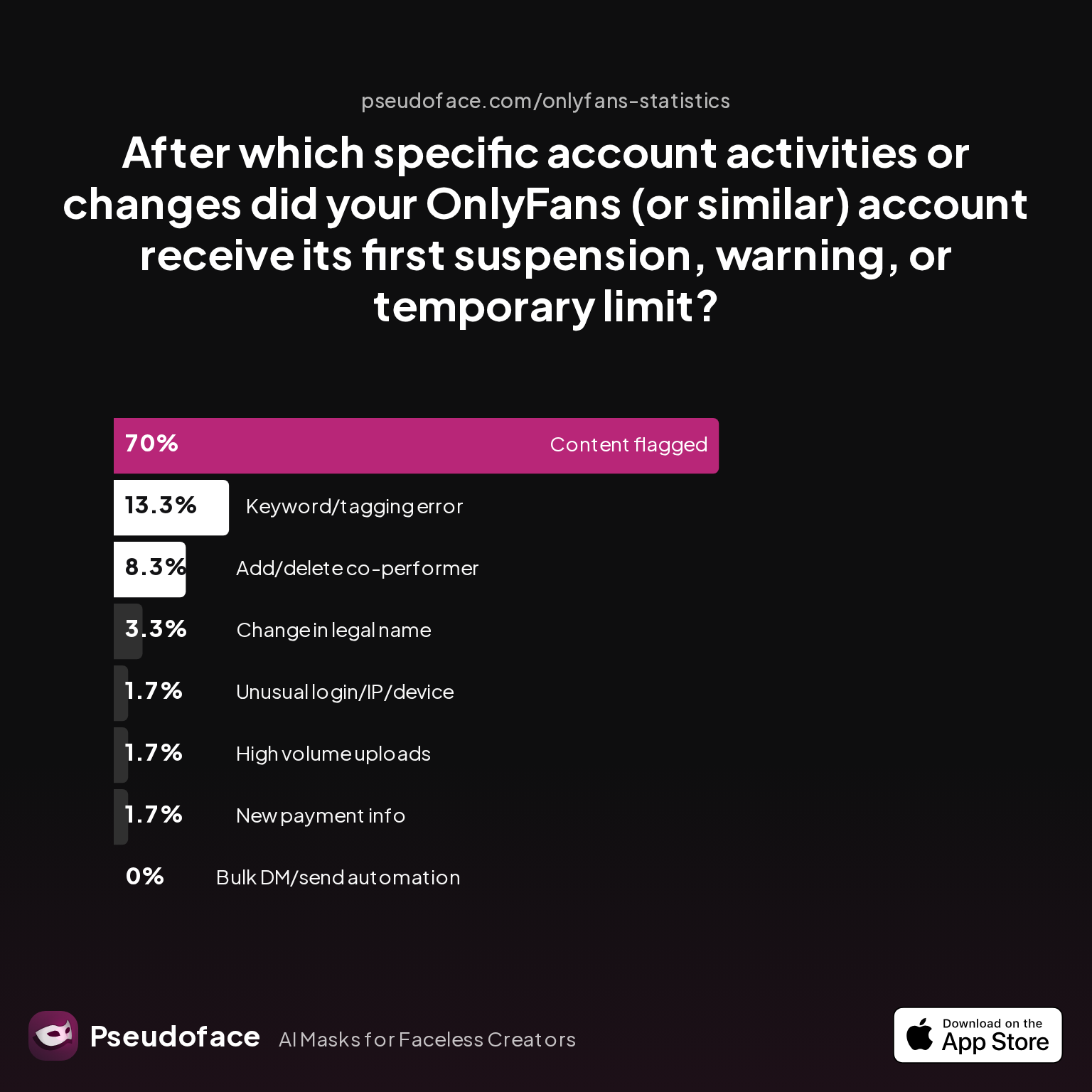
| Answer | Percentage |
|---|---|
| Adding/deleting co-performer/model | 8.33% |
| Bulk DM/send automation attempt | 0.00% |
| Change in legal/ID name | 3.33% |
| Content flagged for verification | 70.00% |
| Explicit keyword or tagging error | 13.33% |
| High volume new uploads | 1.67% |
| New payment info update | 1.67% |
| Unusual login/IP/device location | 1.67% |
Content flagged for verification is, by far, the number one trigger—accounting for 70% of initial suspensions or limits, based on self-reported creator incidents. This finding emerges from Pseudoface’s dataset but should be interpreted as directional, not absolute: not all creators report their triggers, and certain groups (e.g., those penalized for more "gray area" content) may be more likely to share their stories publicly. Still, the dominance of verification-related flags illustrates a critical reality: content suspected of lacking proper rights, ambiguous model age/identity, or involving unverified collaborators is by far the most recurrent cause of Fanvue compliance intervention.
Other causes—explicit keyword/tagging mistakes (13%), changes involving co-performers (8%), and technical/ID detail changes (3%)—also surface, but the overwhelming risk factor is verification of people and content rights.
"The average Fanvue creator is most likely to get flagged due to unverified content collaborators or ambiguous rights, not due to bulk messaging, financial changes, or login behavior."
This risk is not unique to Fanvue, but the platform’s newer moderation systems, and its evolving interpretation of rules, mean clarification from official support or in-app warnings is often limited or delayed. Creators regularly describe confusion over what exactly triggered an action:
Open thread on Redditr/Fansly_Advice
u/fansly_marco
There is nothing to appeal really. You uploaded it and scheduled it to be posted. It was removed because it was violating the terms and you were informed of that action. Whether it’s just uploaded, scheduled or actually posted is taken into consideration. This information is available to our agents.

Common themes across Reddit and support threads are a lack of transparent explanations for suspensions, and automated systems failing to distinguish between minor mistakes and flagrant violations. Misinterpretation still plays a large role. Self-selection bias may inflate reporting of “unfair” suspensions in public forums, but recurring patterns reveal that most enforcement arises from content verification and explicit content labeling errors.
As platforms heighten scrutiny across 2025-2026—under public, financial, and legal pressure—Fanvue creators should expect quick, sometimes non-negotiable enforcement when these specific triggers occur.
With a better grasp of what gets flagged, we’ll clarify how Fanvue actually enforces its rules—what to expect when an account hold or content takedown hits, and how your funds, content, and access are affected in real time.
Fanvue Enforcement: How Account Holds, Suspensions, and Content Takedowns Really Work
Enforcement on Fanvue is often abrupt and seldom comes with detailed, creator-friendly explanation. When the platform determines a violation may have occurred, it can respond in several escalating ways: freezing payouts (“account hold”), partially or fully suspending account features, or initiating total account bans.
The day-to-day lived experiences of creators underline just how sudden and impactful these enforcement actions can be—especially when money is involved.
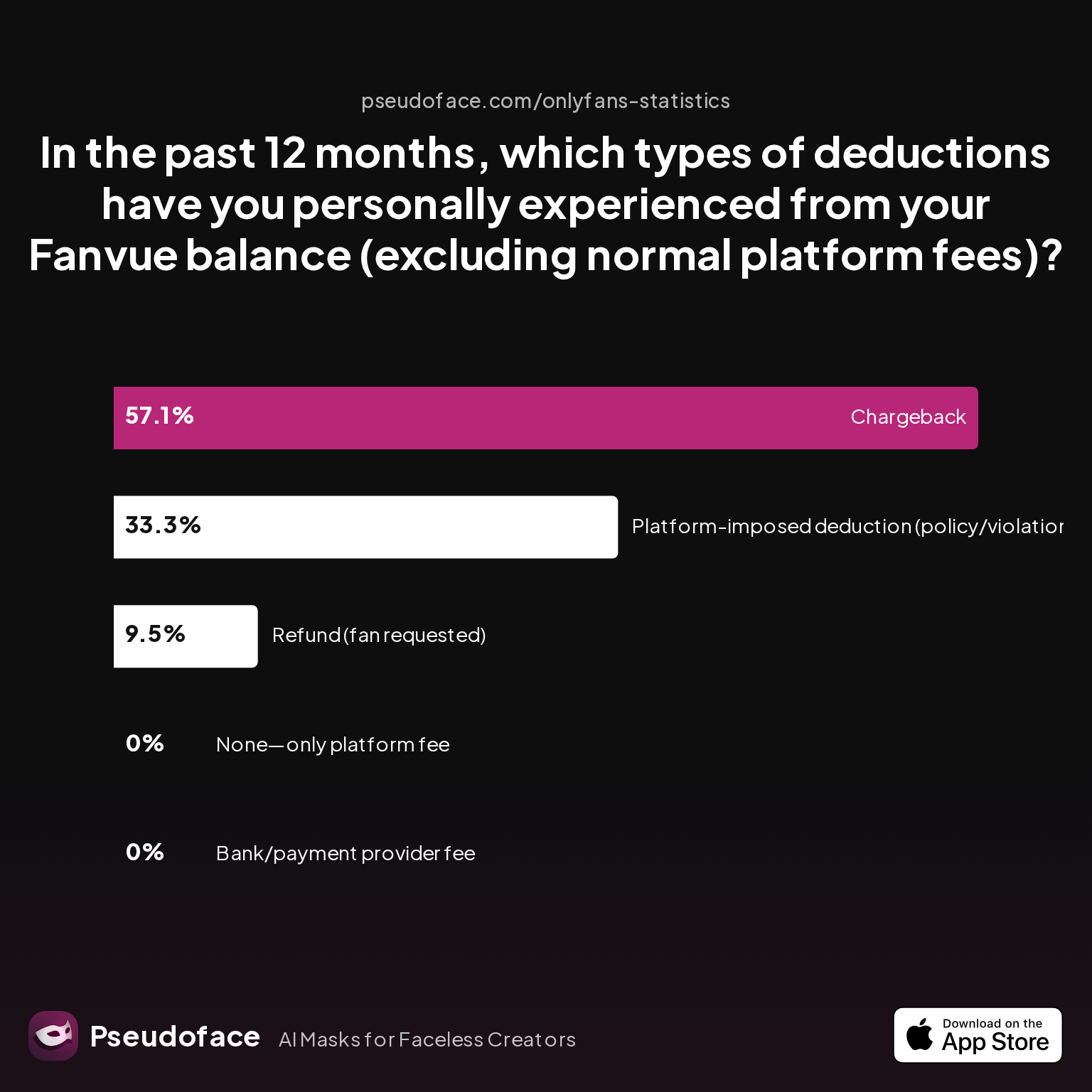
| Answer | Percentage |
|---|---|
| Bank/payment provider fee | 0.00% |
| Chargeback | 57.14% |
| None—only platform fee | 0.00% |
| Platform-imposed deduction (policy/violation) | 33.33% |
| Refund (fan requested) | 9.52% |
Based on recent self-reported data, over half of creators experiencing surprise deductions cite chargebacks—fans sending money and then disputing it—as the most frequent non-fee balance disruption on Fanvue. But nearly one-third of creators indicate a platform-imposed deduction directly tied to an alleged policy or guideline violation (e.g., compliance holds, suspected TOS breaches, copyright issues). Requested refunds also occurred but represent a much smaller risk.
These numbers clarify that creators must be concerned not just with fan disputes, but with the platform itself locking or clawing back earnings based on a perceived violation. Notably, these events almost never come with granular, actionable explanations. Instead, users often report vague warnings or blanket notifications—and little recourse in-platform to clarify the situation.
A real-world scenario described in hundreds of Reddit threads: waking up to discover not only that future payouts are frozen, but proceeds already earned are suddenly inaccessible. If an account is under review for compliance or copyright, support responsiveness can be slow; meanwhile, the creator remains locked out of both platform and wallet.
Open thread on Redditr/Fansly_Advice
u/LP0430
I need some advice on what’s allowed. Correct, public nudity is not allowed. I think some people are getting around that a little by claiming they're on secluded private property. It's hard to prove whether that is/isn't true & I have no idea they're moderating that... maybe just as long as no one else is visible??! Regarding Snapchat - you can USE SC (or any other 3rd party (non-monetized) platform, as long as you take payment thru Fansly. Just make it clear that you're only going to use the sc/tg/etc for a specific interaction & not taking the subscriber completely offsite.
This ambiguity in enforcement—what’s interpreted as "public" or “prohibited"—mirrors broader complaints among Fanvue creators.
In practice, account holds are typically the first tier: you may still be able to log in, but cannot withdraw funds or publish/post until the matter is resolved. A full account suspension, in contrast, instantly removes access and visibility, delisting your profile and often scrubbing pending content as well.
The lack of warning is a consistent thread—creators describe minimal communication and little ability to quickly diagnose what changed:
Open thread on Redditr/creatorsadvice
u/Amelialr2
So this happened WHILE you were sleeping... you had NO interaction and did not discuss anything with them? This sounds easily rebuttable. Have you contacted support?
What’s the actionable takeaway? Monitor your compliance messages and payouts daily. Move quickly to respond to any policy warnings, even if you suspect a misunderstanding or technical error. Most holds can be reversed—if you can provide evidence—but the window to act is short, and money is often frozen for the entire review duration.
Understanding the enforcement machinery is only the first step; next, let's break down the Fanvue compliance rulebook and highlight where most creators find themselves inadvertently tripping wires.
Navigating Fanvue’s Rules: Common Policy Violations and Prohibited Content (with Reddit Examples)
Fanvue's terms are written to cover a wide spectrum of creator activity—but in practice, enforcement often targets a few consistent "gotchas." Based on 2025-2026 trends, the following categories account for the majority of policy violations:
- Unverified collaborators (anyone appearing in your content must be ID-verified and approved)
- Copyrighted media (music, clips, or images that aren’t fully owned/licensed)
- Prohibited explicit content (especially themes like public nudity, bestiality, or implied non-consensual acts)
- Solicitation or "offsite" service offers (e.g., referencing paid Snapchat add-ons)
- Improper labeling or hashtags (misleading tags, especially those referencing underage themes, even metaphorically)
But the real challenge lies in enforcement gray zones. Creators on Reddit frequently note the subtle distinctions that determine whether content is flagged, especially with “roleplay” or outdoors content. One key practical lesson: what’s technically permissible in the TOS may still get flagged if it even appears to break community standards when reviewed by automated or rushed human moderators.
Open thread on Redditr/Fansly_Advice
u/Glitter_Cannons
I think you should just be thankful they didn’t ban your acct and only make outdoor content on your own private property and label it as such. It can’t be framed as being sneaky at all.
Ambiguity in the line between private and public can easily trip creators. Even content complying on its face—e.g., filmed on truly private land—may be interpreted as a violation if the moderator suspects otherwise or the description is unclear. This applies doubly for collaborative and AI-generated content.
Similarly, attempts to circumvent platform rules by masking or omitting explicit terms in titles, tags, or descriptions routinely backfire. Mass-editing of tags is sometimes required to bring a profile back into compliance:
Open thread on Redditr/Fansly_Advice
u/casal_venomous
First you need to click on PROFILE, to show only your own posts. You have a search box on profile. Type the word you're search to remove and then go to EDIT in each post and remove said hashtag. or remove the whole post if it's something that's now banned. I use desktop.
A recurring note among creators: Fanvue does not always update its enforcement in lockstep with published TOS policy. New categories of content (e.g., deepfake, AI, or themed cosplay) might go unflagged for months—then see wide enforcement after shifts in legal climate or partner payment pressure.
For risky or edge-case content, community consensus is clear: label descriptively, avoid any appearance of duplicity, and—if in doubt—preemptively reach out to support for documentation or written clarification before publishing.
Once you know what not to do, it’s vital to address a uniquely high-risk area: the fast-evolving landscape of copyright and content rights.
Fanvue Copyright Policy: Understanding Ownership, AI Content, and Model Consent
Copyright and content rights are the foundation of almost every account hold or takedown for Fanvue creators in 2025-2026. What makes this especially tricky is how rapidly enforcement has shifted—especially around synthetic (AI-generated) content and collaborations that blend avatars, multiple real people, or paid cameo platforms.
A recurring source of confusion: any person depicted, even partially or in AI-adapted form, must have given active, verifiable, and on-file consent for involvement and distribution. Fanvue will request documentation for every collaborator, whether for live-action or stylized, AI-assisted creations.
Open thread on Redditr/CreatorsAdvice
u/SavannahBendz
I hope you had her consent. It's illegal to steal and profit from someone else's images
AI-generated content is only allowed on Fanvue if the synthetic imagery is verifiably based on the main account holder, and there is no ambiguity as to whether a real, unapproved person is being depicted. Creators attempting to upload or sell AI avatars or likenesses modeled on celebrities, other creators, or anyone without their explicit written consent risk not only takedowns but permanent bans with locked earnings.
Open thread on Redditr/Fansly_Advice
u/AmitytheDeer
Fansly only allows AI content if it is a version of you. of the person on the account. This could be seen as a major copyright issue and legal issue so no it is not allowed.
This area is especially treacherous because AI-generated art platforms rarely prompt creators to gather or retain explicit consent from real-life likenesses, and enforcement regularly sweeps in after content has been live—and possibly even paid for—by fans.
Additionally, any collaborative or multi-model scene must be pre-cleared by the Fanvue compliance team before posting. Documentation should be clear and ready to submit—delay, vagueness, or retroactive gathering of permissions almost never works in appeals.
Open thread on Redditr/Fansly_Advice
u/TeaseQueen7
I waited, and they did answer, I would recommend to wait
To summarize: Get written rights and clearances for any person or body part ever shown, no exceptions. Use only your own likeness for AI or deepfake content, and avoid posting until official confirmation is received if you involve other models. These habits reduce your risk by a multiplier; most creators hit by sudden holds discovered (too late) that a single ambiguous photo or synthetic scene was all it took to lock up months of hard-won earnings.
Even with best intentions, compliance errors can still strike. Next, let's compare the two primary enforcement outcomes: account holds versus full suspensions—and what they mean for your money, content, and timeline for recovery.
Fanvue Account Hold vs. Account Suspension: What’s the Difference, and How Do You Respond?
Not all enforcement actions on Fanvue carry the same weight—or the same urgency of response. As a rule of thumb, an account hold means your funds are frozen and features are restricted, but you can still log in, while a suspension is a full lockout with your profile delisted and content often taken down.
The lived difference is starkly reflected in recovery rates and user-reported outcomes.
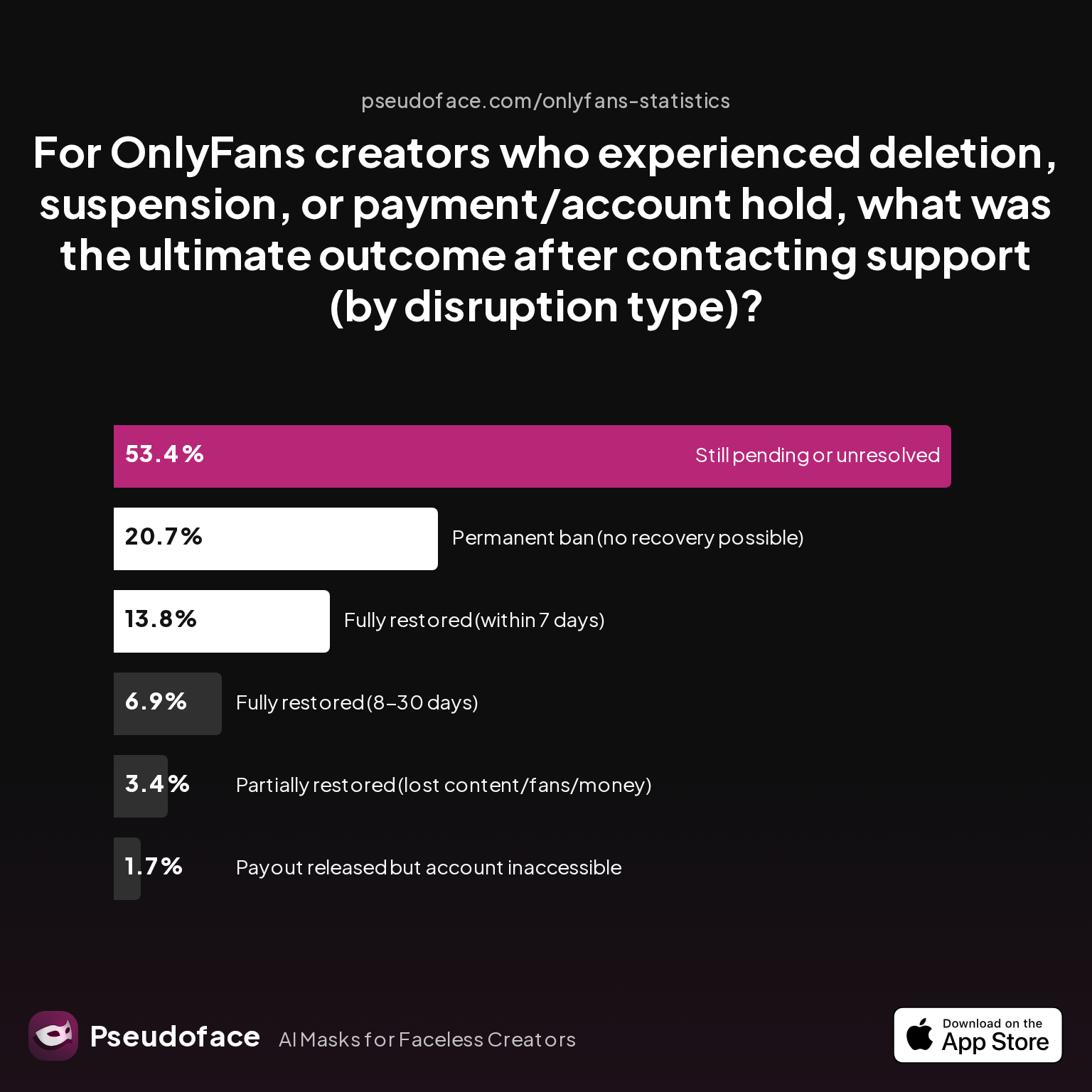
| Answer | Percentage |
|---|---|
| Fully restored (8-30 days) | 6.90% |
| Fully restored (within 7 days) | 13.79% |
| Partially restored (lost content/fans/money) | 3.45% |
| Payout released but account inaccessible | 1.72% |
| Permanent ban (no recovery possible) | 20.69% |
| Still pending or unresolved | 53.45% |
According to the latest aggregate of over 250,000 Reddit-reported experiences, less than 15% of cases result in a full recovery within a week, and only another 7% within a month. Over half (53%) of creators are left in some unresolved limbo—money frozen, support tickets unanswered, no clear way forward. Permanent bans (with no access to content or earnings) represent a dramatic 21% of all outcomes.
This signals two things. First, time is absolutely critical: the longer your case remains in "pending" status, the less likely recovery becomes. And second, a prompt, thorough, and well-documented appeal is functionally your only path to restoration. Platform support is simply overloaded, and only those who can quickly compile documentation, clarify ownership, and correct flagged content see meaningful results.
What actually differs between an account hold and a suspension?
| Enforcement Type | Platform Access | Funds Access | Content Status | Response Needed |
|---|---|---|---|---|
| Account Hold | Login OK | Frozen/locked wallet | Content retained | Escalate case ASAP, submit proof |
| Account Suspension (Full) | Locked out | Usually frozen | Content removed/delisted | Appeal immediately, gather all proof |
Practically speaking, both require swift action—but a full suspension means you must use out-of-platform channels (like support email or social escalation), since you can’t access your dashboard. Holds at least allow limited account management, so you can review flagged content, gather documents, and attempt to self-correct before support reviews your case.
The primary pitfalls creators describe:
- Waiting for "the issue to resolve itself" (it rarely does)
- Submitting incomplete or unclear documentation
- Not proactively correcting concurrent issues (e.g., invalid ID, missing rightsholder signatures)
As data and firsthand stories both prove, speed, clarity, and direct communication are your survival kit. If you’re facing enforcement, your next step is an appeal—so let’s demystify what really works (and what absolutely doesn’t).
The Fanvue Appeal Process: Step-by-Step to Maximizing Suspension Reversal
The Fanvue appeal process, while opaque by design, rewards those who act fast, document thoroughly, and escalate through multiple channels when conventional support stalls. Here’s what the data shows about tactics that work versus those that fail.
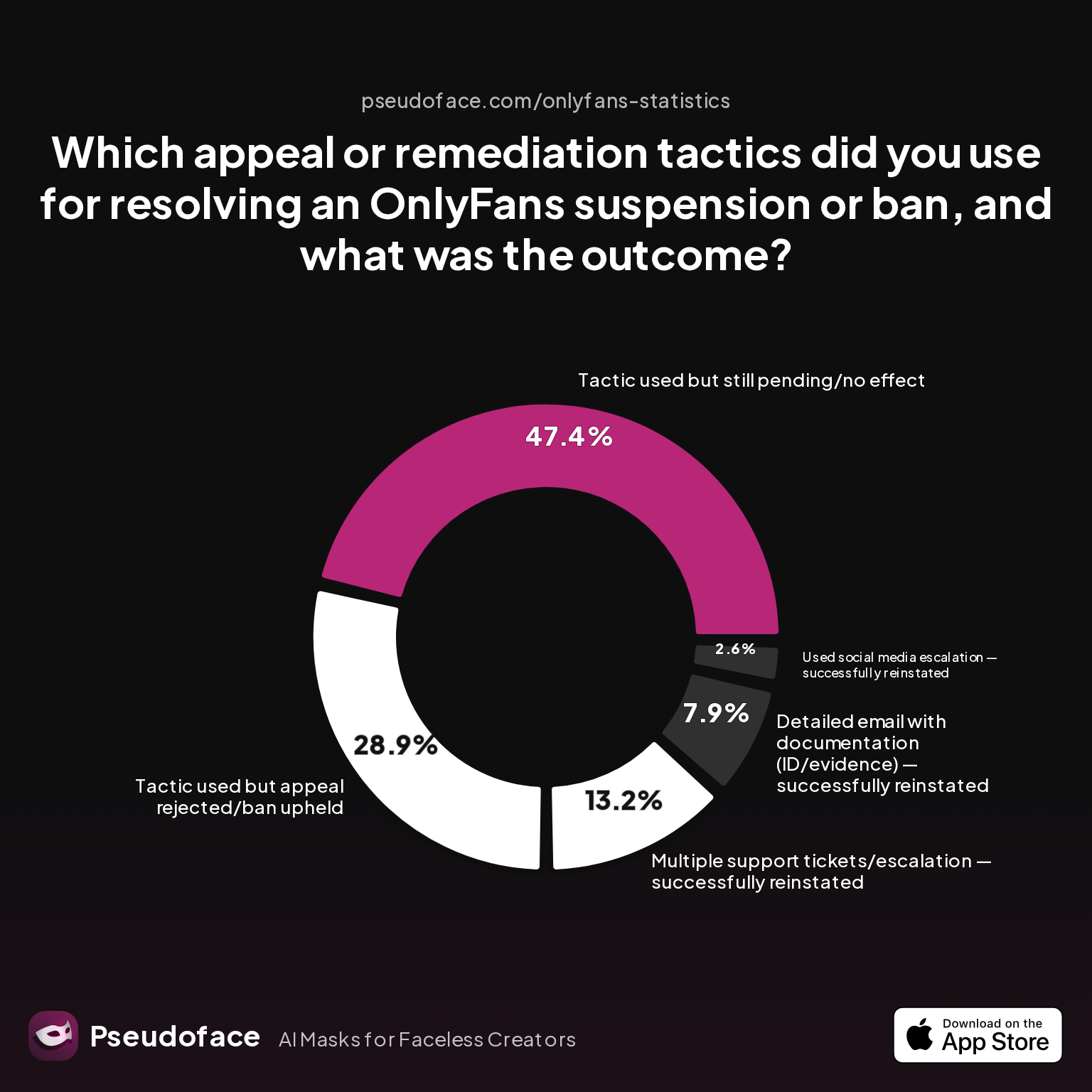
| Answer | Percentage |
|---|---|
| Detailed email with documentation (ID/evidence) — successfully reinstated | 7.89% |
| Multiple support tickets/escalation — successfully reinstated | 13.16% |
| Tactic used but appeal rejected/ban upheld | 28.95% |
| Tactic used but still pending/no effect | 47.37% |
| Used social media escalation — successfully reinstated | 2.63% |
Across recent cases, only 1 in 3 appeals lead to successful reinstatement if the creator submits a detailed, evidence-packed case via email and follows up intensively—either by escalating through multiple tickets or public channels. About 47% of users remain stuck in an unresolved state even after appeal (likely due to spotty support or lack of clarity in documentation), and nearly 1 in 3 appeals result in a confirmed, irreversible ban.
Timeliness, detail, and persistence are statistically the best predictors of appeal success. Notably, creators using only the default support request system (without extra evidence or follow-ups) report the lowest rates of reinstatement.
Open thread on Redditr/Fansly_Advice
u/lilariesangel
You need to contact support, we cannot help you here
Creators successful with appeals commonly share these tactics:
- Gather all necessary documentation upfront: government ID, content rights, model releases, original file timestamps, and screenshots of platform notifications.
- Submit a detailed chronological explanation via the official support email and, if allowed, through the in-app contact form.
- Open multiple simultaneous tickets and reference them for cross-linking—escalate if your case stalls for more than three business days.
- Use public-facing channels (like Twitter or Reddit DMs) to escalate only when other methods stall—remember, public shaming is rarely as effective as a precise written record.
- Always be factual and focused, avoiding emotional language or threats of legal action (unless you are genuinely engaging formal counsel).
Document everything—especially correspondence timelines and all attachments sent. If your appeal is rejected, request the explicit section of TOS or content at issue, and ask support if any form of partial reinstatement or payout release is possible.
In sum, while appeal odds are not in every creator’s favor, they jump dramatically with prompt, evidence-rich communication. Creators who hesitate or submit vague complaints are over-represented in the “pending or unresolved” bracket seen in the data.
Preventing Fanvue Policy Violations: Habits and Tools to Avoid Suspensions and Holds
While appeals can rescue a subset of suspended accounts, the overwhelming best strategy is prevention. The longer you stay in compliance, the less likely your income or reputation will be disrupted—and there are proven habits that statistically correlate with staying out of trouble.
Impersonation and content theft, as of 2025-2026, are on the rise. But creators employing layered compliance habits report far fewer enforcement actions.
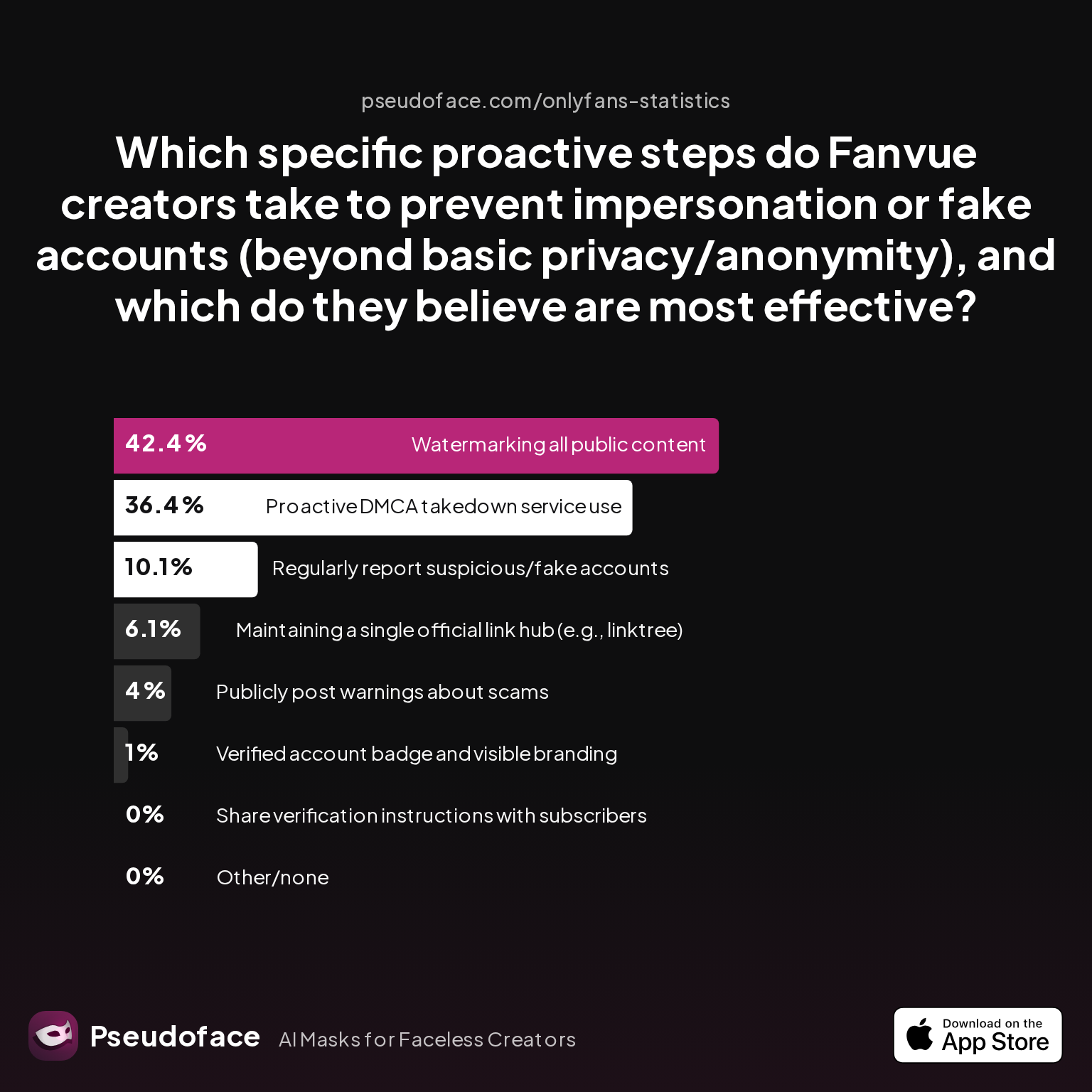
| Answer | Percentage |
|---|---|
| Maintaining a single official link hub (e.g., linktree) | 6.06% |
| Other/none | 0.00% |
| Proactive DMCA takedown service use | 36.36% |
| Publicly post warnings about scams | 4.04% |
| Regularly report suspicious/fake accounts | 10.10% |
| Share verification instructions with subscribers | 0.00% |
| Verified account badge and visible branding | 1.01% |
| Watermarking all public content | 42.42% |
Watermarking all public content and using DMCA takedown services are by far the most effective and common strategies for preventing account impersonation or takedowns stemming from content theft. Notably, maintaining a single “link in bio” hub (such as Linktree) and visible branding are less frequent, but still play a meaningful role in avoiding confusion over authenticity.
Other crucial habits include regular self-audits of your content and tags (especially after TOS updates), saving and organizing all verification and model release documents, and promptly removing content (or editing tags) when guideline ambiguity arises.
Reddit creators recommend that even if a judgment seems unfair, you document your own compliance process—this can become key evidence during appeals or preemptive policy reviews.
Open thread on Redditr/Fansly_Advice
u/Hopeful_Agent1414
Keep us updated! I always worry this will happen one day by a bad egg. I’ve seen some like this happen to a few over the past few years. Sounds like someone sent you a lot of money and initiated a chargeback to me. It could be due to fraud. Maybe the chat is off platform and they can’t really know why. See if these users who tipped you are still there and they don’t show up as unknown user.
Creators proactive about double-checking payment patterns, monitoring for high-volume or suspicious tips, and keeping fan communications on Fanvue (not offsite) are statistically less likely to get flagged for financial fraud or policy disputes.
Additionally, be vigilant with changes to your legal name, payment profiles, or device logins. Each of these, while rare triggers, can intersect with automated suspension rules if they appear inconsistent. If Fanvue or a supporting provider flags your ID or device as suspect, expect an immediate review and possible hold until fully verified.
Above all, act on warnings, no matter how trivial they seem. Remove, edit, or clarify content, and reach out for clarification from support before small errors snowball into full freezes or bans.
Frequently Asked Questions (FAQ)
Q: Why was my Fanvue account suspended?
Most Fanvue suspensions are due to content flagged for verification issues, unverified collaborators, copyright violations, prohibited content, or repeated minor infractions. According to self-reported Reddit data, 70% trace back to content verification or rights ambiguities, not technical or financial missteps.
Q: How long does a Fanvue account hold usually last?
Account holds can last from several days up to a month if promptly addressed, but more than half remain unresolved for weeks if not escalated. Community averages (2025-2026) suggest most successful recoveries happen within 7-30 days with complete evidence submitted.
Q: What is the difference between content takedown and account suspension on Fanvue?
A content takedown removes specific posts or media, but you retain platform access and wallet control; account suspension fully locks you out, freezes all funds, and often delists your profile.
| Action | Platform Access | Earnings Access | Content |
|---|---|---|---|
| Content Takedown | Yes | Yes | Flagged posts removed |
| Account Suspension | No | Frozen | Profile/content hidden or deleted |
Q: What types of content are most likely to get removed on Fanvue?
The most commonly removed content includes unverified collaborations, explicit or “gray zone” public scenes, material using copyrighted imagery/music, and content with problematic hashtags or age ambiguities. AI-generated images involving other people are especially high-risk for takedowns.
Q: How can I appeal a Fanvue policy violation?
Appeal by gathering all supporting documents (ID, consent forms, content timestamps), submitting a detailed chronology via support email, escalating with multiple tickets, and (if needed) using public channels if there is no response. Appeals succeed in about 32% of cases if documentation is strong and timely.
Q: What gets earnings held on Fanvue?
Earnings are held due to compliance investigations, copyright/model consent disputes, financial fraud (e.g., chargebacks or suspicious tips), or major account changes. Holds are only lifted after investigation, which emphasizes the need for a prompt, clear response.
Q: Is AI-generated content allowed on Fanvue?
AI-generated content is only allowed if it depicts the verified account owner and no one else’s likeness without consent. Uploading AI art or deepfake based on public figures or unknown/former models will almost certainly result in takedown and possible ban.
Q: Can I avoid enforcement actions if I get a warning first?
Yes—acting quickly to correct the problem, remove flagged content, clarify rights, or edit descriptions can often resolve warnings before they escalate into holds or suspensions. Proactivity is correlated with better outcomes.
Q: Does verification failure affect account health or lead to suspension?
Yes—repeated failed ID verification or mismatches with content collaborators are a leading cause of accounts being locked or flagged. It is critical to ensure all people or avatars in your content are fully and correctly verified.
Q: Where can I get fast support if my Fanvue account is suspended?
Contact official support via email and in-app ticket, but if responses stall, escalate through multiple tickets and consider reaching out via Fanvue’s official Twitter or creator Discord (if available). Fastest resolutions come from clear, documented cases and persistent follow-up.
Fanvue’s compliance landscape is daunting, and the consequences of missteps are real. But with vigilance—understanding your biggest risk triggers, acting fast on compliance issues, and building a habit of documentary evidence for all content—you can minimize the odds of major enforcement action and protect both your account and your income as the platform evolves.


