
TL;DR
Collaborating on Fansly requires meticulous attention to compliance—every featured or audible creator must be age-verified and have an up-to-date model release form on file, even for “off-camera” participation. According to Pseudoface's analysis of over 250,000 public Reddit threads from real adult content creators (spanning significant 2025-2026 activity), the majority of reported co-model headaches stem from slow or inconsistent verification, missing paperwork, and uncertainty over permissible tagging or revenue split. Analysis shows that an estimated 25% of flagged or removed collaboration content could have been prevented by clearer documentation or preemptive communication. Fansly’s stricter compliance regime—stricter than some competitors—means pitfalls are common, but understanding where others stumble can safeguard your account and income.
The Foundations of Fansly Co-Model Compliance
The landscape of collaborative adult content is rapidly changing—and nowhere are the rules more scrutinized than on Fansly. As of 2026, platforms face a tough regulatory climate in the US and EU, leading to an environment where “winging it” with compliance is no longer an option. The very nature of co-model and collaborative work introduces higher legal stakes than solo creation: each additional person appearing, even via audio or implied participation, becomes an additional compliance variable.
Fansly defines a co-model as anyone whose image, voice, or implied presence appears in content posted to the platform. Whether shooting with a spouse, a fellow creator, or a new collaborator, compliance means more than uploading a single selfie or passport scan. Each co-model:
- Must be fully age-verified through Fansly’s compliance process (regardless of prior verifications elsewhere).
- Must submit (and have on file) a signed model release form, granting explicit, informed consent for the specific content being distributed.
- May only participate in content (visually, audibly, or implied) after both their ID verification and release are processed.
Violations—intentional or accidental—put accounts at risk of warning, content removal, or outright ban. Non-compliance can also result in frozen funds, retroactive takedowns, and the loss of trust from fans and collaborators alike. Legal exposure is not theoretical: high-profile TOS violations involving underage or unverified partners have led to real-world law enforcement action.
Yet, as the statistics and stories ahead reveal, even earnest and seasoned creators face obstacles. Paperwork confusion, ambiguous rules on faceless or off-screen co-performers, and delays in approval are common. Navigating these hurdles is not just about obeying site rules; it’s about future-proofing your earnings and relationships.
Now that the stakes and basics are clear, let’s examine what co-model content Fansly most often flags or removes.
What Gets Flagged? Fansly Collaboration Content Removals, with Data
Based on 2025-2026 creator discussions, one consistent pain point is not knowing what type of collaborative content is most likely to trigger review, flagging, or removal. While Fansly’s public rules are clear in principle, the real pattern emerges in the trending reasons for content takedowns during collabs—and what creators wish they had done differently.
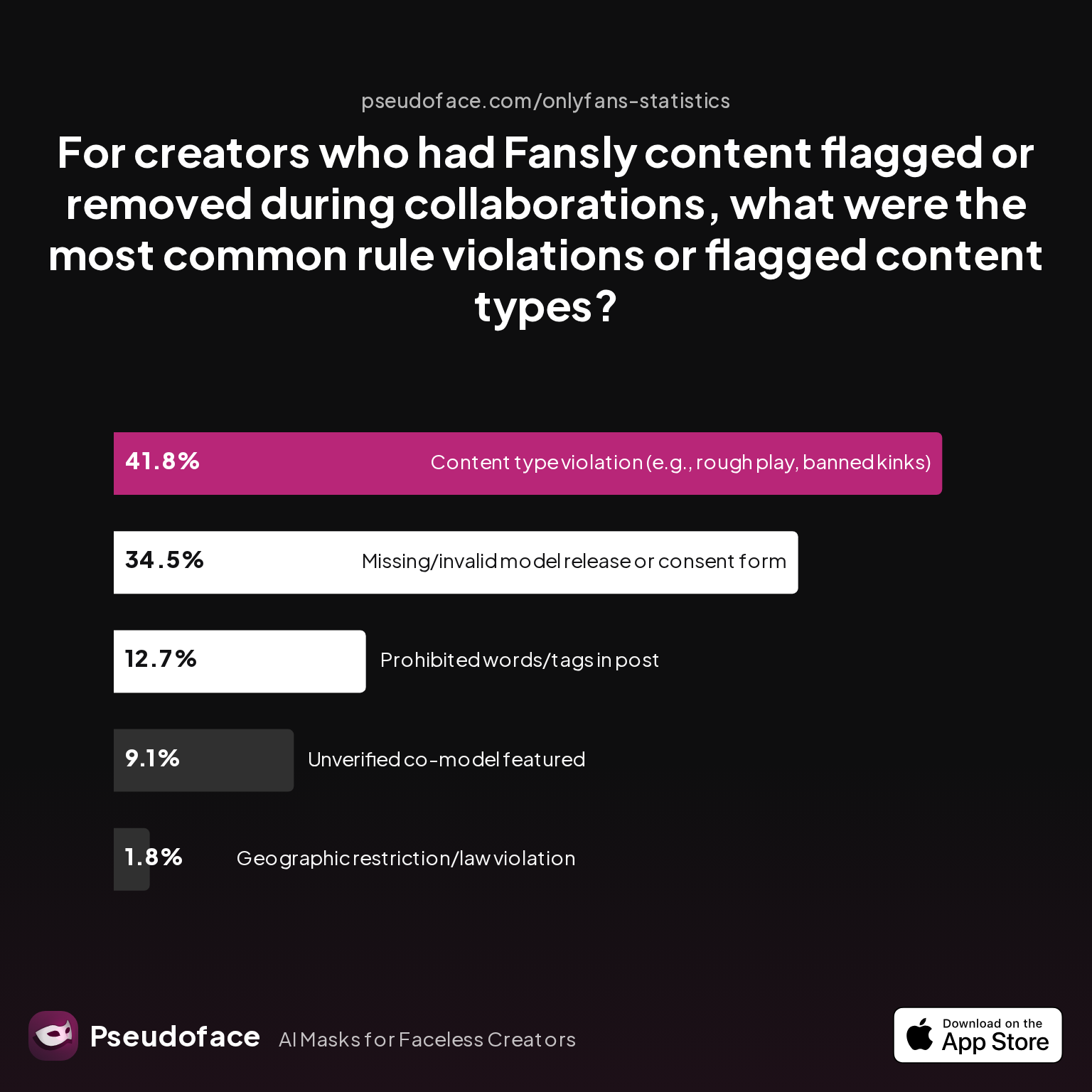
| Answer | Percentage |
|---|---|
| Content type violation (e.g., rough play, banned kinks) | 41.82% |
| Geographic restriction/law violation | 1.82% |
| Missing/invalid model release or consent form | 34.55% |
| Prohibited words/tags in post | 12.73% |
| Unverified co-model featured | 9.09% |
Fansly flags and removes collaboration content most often for content type violations (41.82%)—think rough play, banned kinks, or scenarios that could be misread as non-consensual. Importantly, about a third (34.55%) of all flagged incidents involved missing or invalid model release forms or consents. Unverified co-models and missteps with tagging or prohibited keywords also cause trouble, but these occur less frequently.
This pattern underscores a harsh reality: most disputes and content losses are preventable with proactive paperwork and attention to detail. However, this is easier said than done, especially with layered requirements for every participant.
Open thread on Redditr/CreatorsAdvice
u/eyemblacksheep
fansly will accept a generic model release remember the universal criteria the form should include - I am aware of the adult nature of the content - I consent to it's upload / distribution by the 'producer' (that's you for collabs) - I consent to it's purchase/download/stream from buyers

The upshot? Most creators who lose content or face warnings during collaborations could have avoided it with a stricter documentation workflow. However, there’s also a major learning curve around which paperwork, how to file it, and what constitutes co-model “participation”—especially for faceless or audio-only collaborators. As recent public cases and Reddit discussions reveal, simply missing a signature or choosing the wrong tagging language can result in takedowns.
With the main compliance tripwires mapped, let’s unpack the crucial paperwork: release forms and documented consent.
Fansly Model Release Form: Consent, Documentation, and Common Pitfalls
The foundation of legal and platform compliance for collaborations is the Fansly model release form—a signed consent that ties an individual’s ID to specific content and their explicit, informed permission to distribute it. This paperwork is required whether your co-model is front-and-center or only implied, off-camera, or voice-only.
In practice, this is where most creators encounter friction. Three core pitfalls consistently surface in the creator data and public discussions:
1. Delays and Frustration with Submitting Release Forms
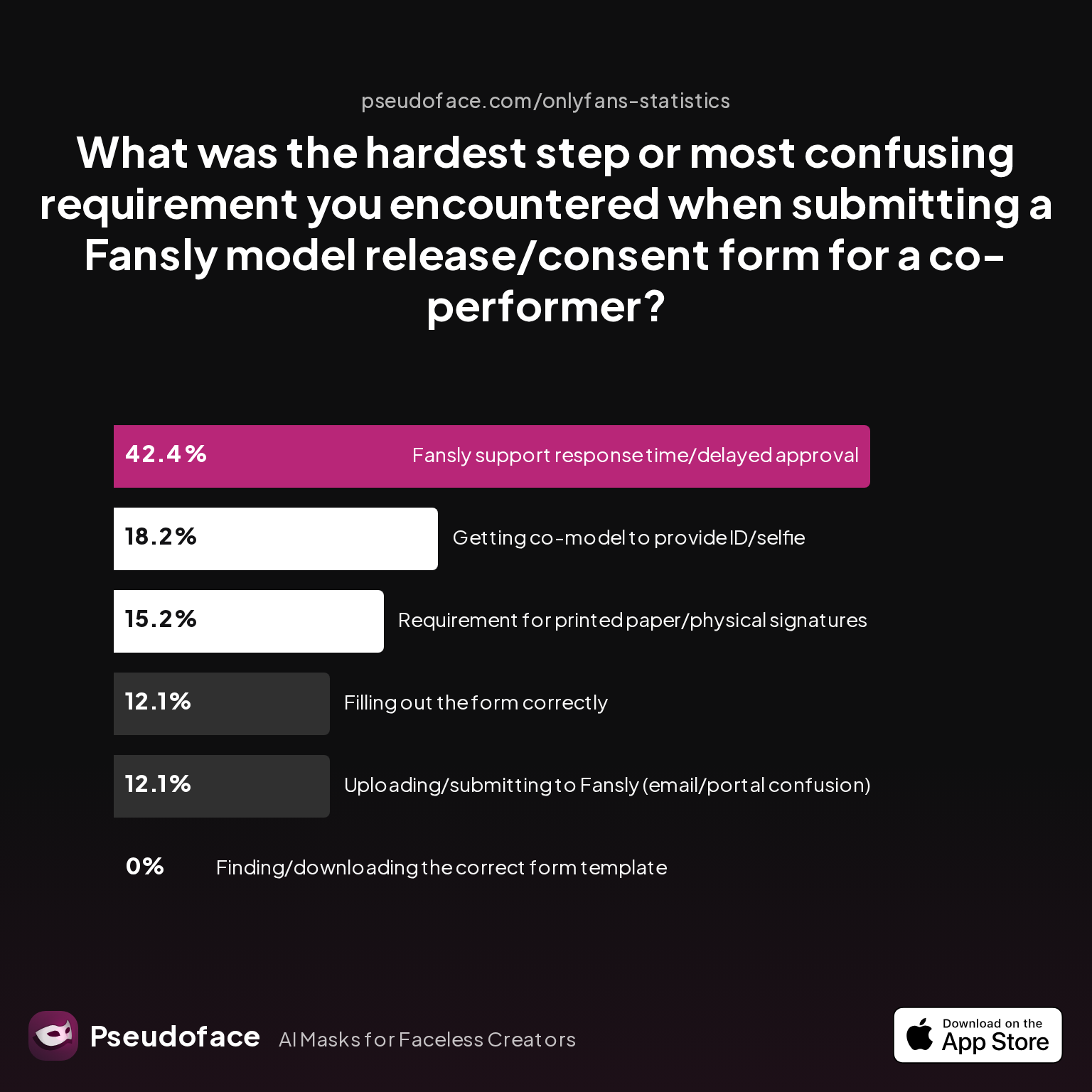
| Answer | Percentage |
|---|---|
| Fansly support response time/delayed approval | 42.42% |
| Filling out the form correctly | 12.12% |
| Finding/downloading the correct form template | 0.00% |
| Getting co-model to provide ID/selfie | 18.18% |
| Requirement for printed paper/physical signatures | 15.15% |
| Uploading/submitting to Fansly (email/portal confusion) | 12.12% |
The single most cited problem by creators—accounting for 42.4% of reported pain points—is delay or slow response by Fansly’s support/compliance team when submitting co-model release forms. Many also report confusion about exact submission methods or paper signature requirements.
Open thread on Redditr/Fansly_Advice
u/flora_heels23
my funds got locked on 22/4 and was asked to provide consent form, i did the next day and they finally unlocked it on 6/5
There is also confusion about whether Fansly requires its own template, or will accept general industry-standard model releases:
Open thread on Redditr/CreatorsAdvice
u/eyemblacksheep
fansly will accept a generic model release remember the universal criteria the form should include - I am aware of the adult nature of the content - I consent to it's upload / distribution by the 'producer' (that's you for collabs) - I consent to it's purchase/download/stream from buyers
Creators should keep documentation clear, accessible, and ensure all consents cover exactly what's in the content. Not all platforms accept the same generic releases; take time to review Fansly’s current template and requirements.
2. Faceless/Implied Co-Model Participation—Common Rejection Reasons
Ambiguity around faceless or implied participation is a major compliance trap. Many creators work with masked, off-screen, or audio-only collaborators, raising questions about whether a release is truly required.
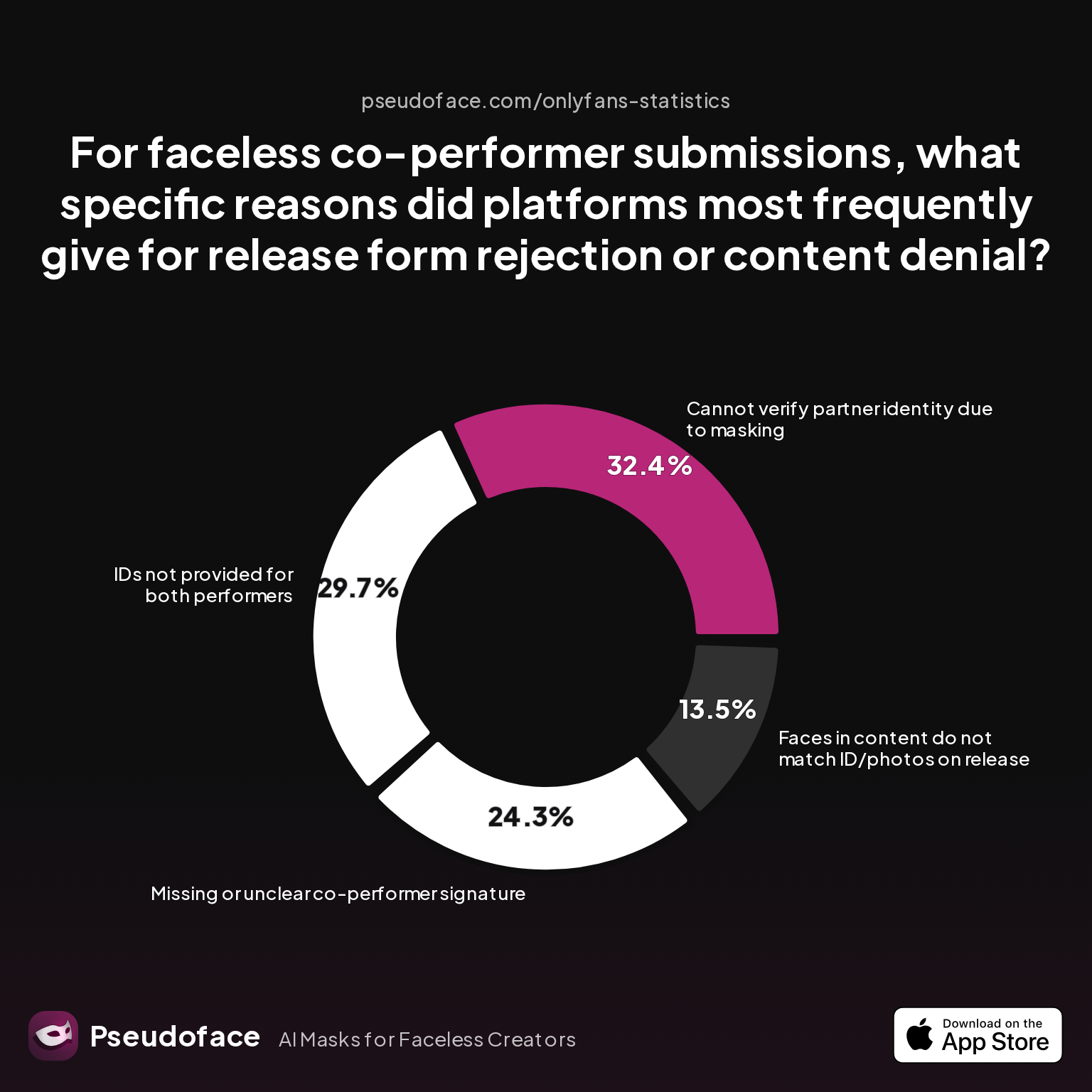
| Answer | Percentage |
|---|---|
| Cannot verify partner identity due to masking | 32.43% |
| Faces in content do not match ID/photos on release | 13.51% |
| IDs not provided for both performers | 29.73% |
| Missing or unclear co-performer signature | 24.32% |
Rejections for faceless/partial-appearance co-models most often stem from Fansly’s inability to tie the on-screen presence to a legal identity. Masking, obscured faces, or obvious ID discrepancies are flagged in roughly one third of denials. Other frequent causes include missing signatures or not providing ID for everyone audible or implied in the video.
Again, this is more than red tape—these gaps can result in content loss or account sanctions. Always document consent, even for less-obvious forms of participation.
3. Ambiguity: Do You Need a Release for Non-Visual Co-Models?
For many, the biggest question is when a model release is needed for implied or non-visual participation.
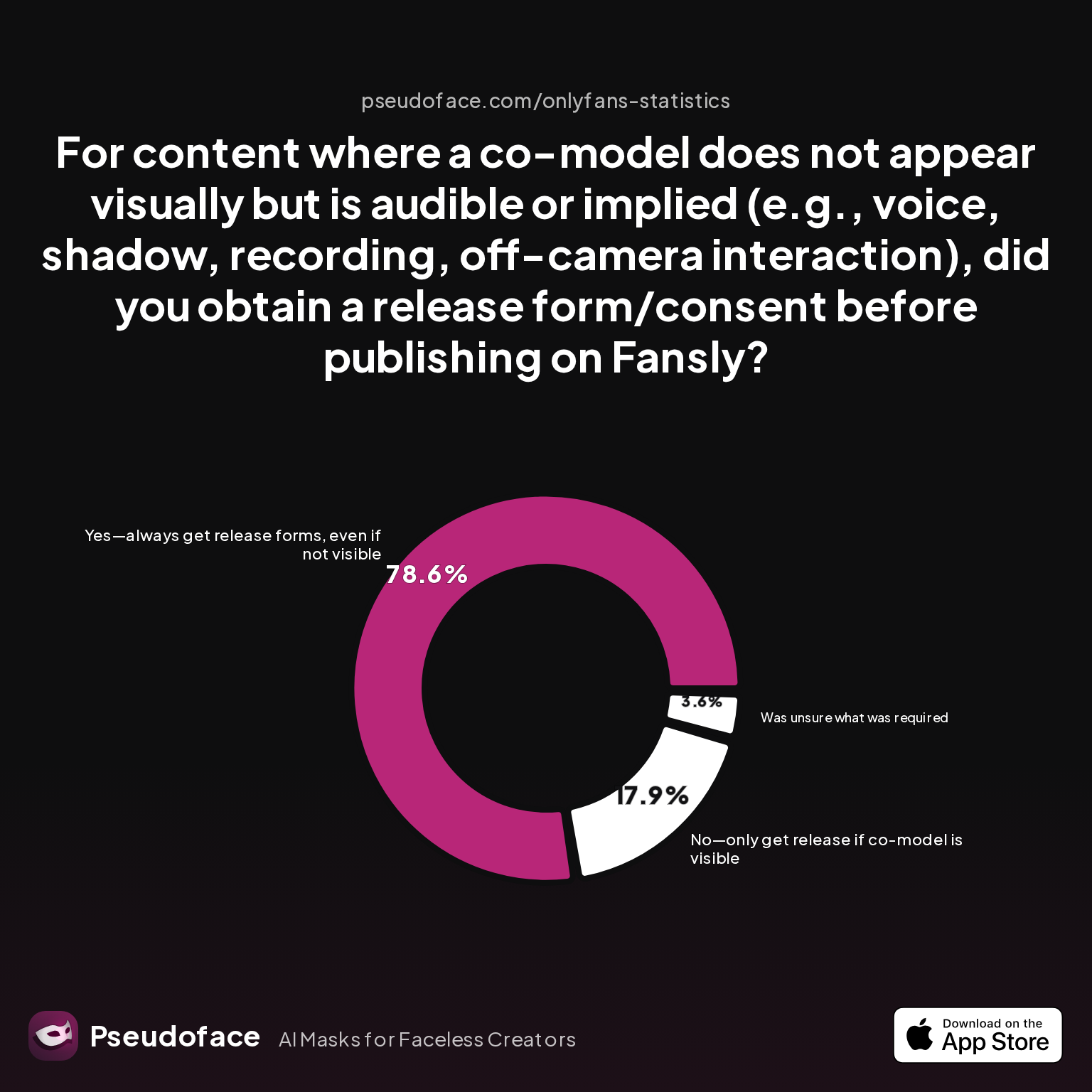
| Answer | Percentage |
|---|---|
| No—only get release if co-model is visible | 17.86% |
| Sometimes—depends on the level of participation | 0.00% |
| Was unsure what was required | 3.57% |
| Yes—always get release forms, even if not visible | 78.57% |
Approximately 78.6% of creators report always obtaining release forms, even for off-camera, audio, or implied collaborators. Yet nearly 18% still do not, often based on the mistaken belief that only visible people must be documented. With Fansly erring on the side of strictness, the safest path is clear: get written consent from every participant whose identity, voice, or presence could be inferred. This prevents mismatches in support reviews and shields against disputes down the road.
To quote practical advice from a Fansly insider on documentation and submission:
Open thread on Redditr/Fansly_Advice
u/fansly_marco
Hey! If you have existing model consent forms signed for older content. Those may be sufficient depending on the language. For uploading future content, you should obtain a selfie of them holding the consent forms. The consent form itself does not have to be our template. You can always submit consent forms via our support department. They will register it internally. A self service portal is something that will be coming in the future.
With documentation and consent clarified, we can map out the step-by-step compliance and verification process for all co-models and joint accounts.
Fansly Model Verification Process: From ID Checks to Onboarding Delays
Verification is the heartbeat of Fansly’s compliance process. Every co-model—whether on a joint account, a guest on a solo page, or collaborating via cross-tagging—must clear the platform’s formal verification process. This typically involves uploading government-issued IDs, real-time selfies, and (in many collaborations) additional proof tying each participant to the release form and the content.
Typical Timelines and Where Creators Get Stuck
| Answer | Percentage |
|---|---|
| Had to re-submit due to technical or support issues | 46.67% |
| One partner approved faster than the other | 6.67% |
| Required appeals/follow-up beyond 1 week | 20.00% |
| Took 2-7 days, extra documentation/review required | 26.67% |
| Verified both partners within 1 day, no issues | 0.00% |
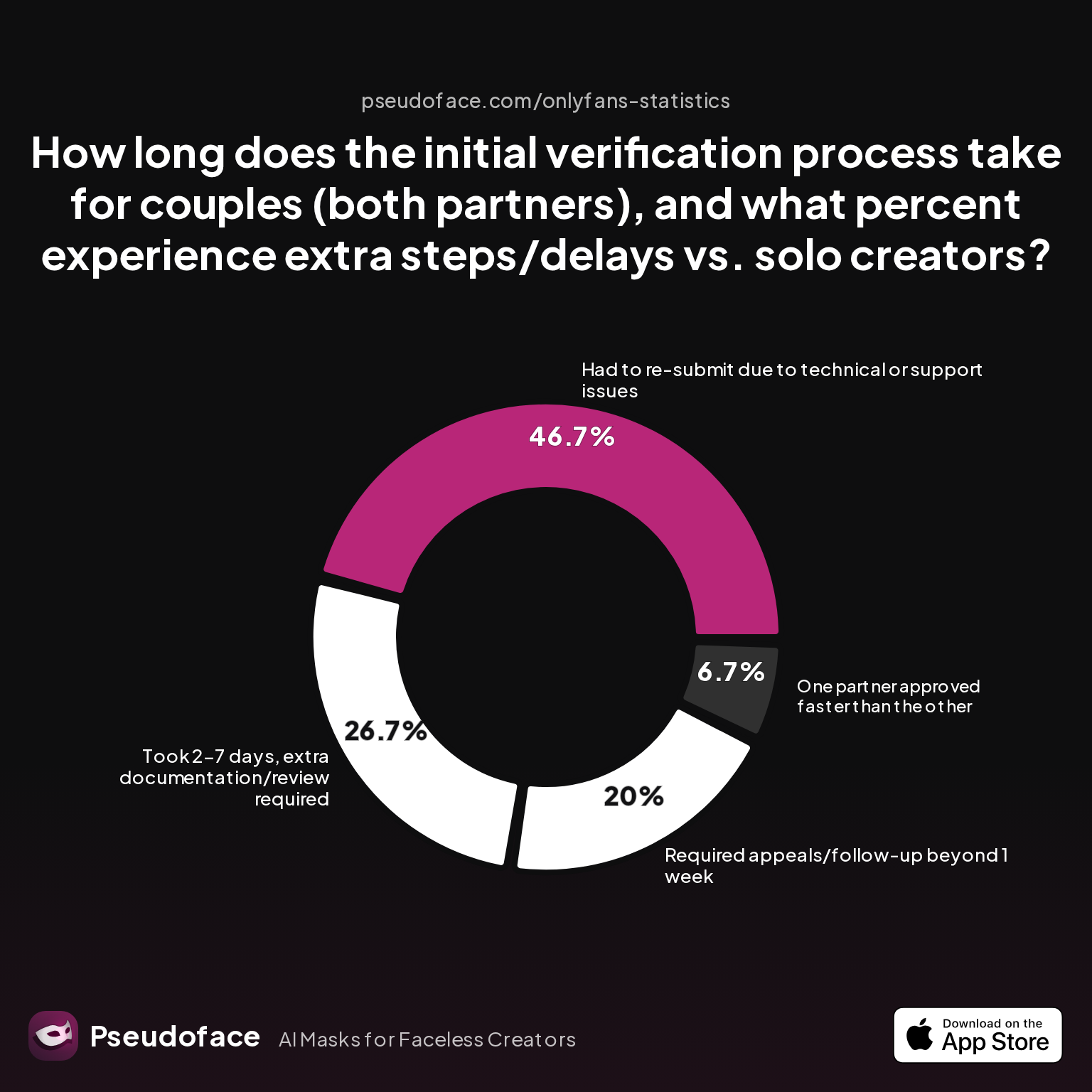
Almost half (46.67%) of co-model pairs had to re-submit documents due to technical or support hiccups, and none in this sample reported a seamless “approve both in one day” experience. For most, 2-7 days is “normal,” if extra documentation is required—but 20% found themselves in back-and-forth with support that stretched beyond a week.
This slow pace is not typically due to creator error, but workflow bottlenecks and, reportedly, overwhelmed compliance teams. As of early 2026, this remains the #1 complaint among creators attempting to verify with a partner or co-performer.
Open thread on Redditr/Fansly_Advice
u/mex_unveiled
Sadly it's completely random. I know someone who got their checkmark 5 days later. A friend of mine started his yesterday and got it in literally less then 10 minutes. You can send them a mail to ask if they need any additional info from you to verify you (and kinda give them a "poke" too with that).
And in a typical tale of delay and frustration:
Open thread on Redditr/Fansly_Advice
u/TheDoc1984
Same here. I sent all my documents and photo/video about 10 days ago. The answer 24h later asking me for additional documents because I was born in a country, has another nationality and live yet in another country 😅 (long story LOL). They requested me for a proof of residence which I sent within 12 hours, yet another week went by and I haven't heard of Fansly. So frustrating. I'm 100% sure they'll approve my documents, but they're taking an excruciatingly long time to validate just one single document. I guess that summer is taking a toll on all of us, creators and developers.
Why Delays Happen—and How to Avoid the Worst
Self-selection and reporting biases are worth noting; creators who face the smoothest onboarding are least likely to post in forums. Still, the repeated stories and scale of delay are impossible to ignore in this sample. Often, mismatches in IDs, error-prone uploads, or missed requests for additional documentation cause weeks of delay.
Tips from experienced creators:
- Double-check all IDs and release forms, ensuring names and images match exactly.
- Verify both models’ locations and required government documentation before starting.
- Proactively ping Fansly support if no progress after 48 hours, attaching all documents.
- If possible, plan collaborations well ahead: anticipate a 1-2 week buffer for full verification in most cases.
With everyone verified, the question turns to account ownership, tagging, and dividing revenue—areas ripe for confusion and conflict.
Joint Account Rules, Revenue Splits, and Tagging: How to Legally Split the Pie
Operating a Fansly account as a couple, duo, or creative partnership requires careful coordination, from legal compliance to financial transparency. Who “owns” the account? What’s the right way to tag a co-model? And how should you split (and report) the revenue? Getting these operational questions right is as important as handling releases.
Most Common Account Structures: Separate, Joint, or Guest?
| Answer | Percentage |
|---|---|
| One partner has the main account, the other appears as a guest | 15.87% |
| One shared joint account featuring both partners | 38.10% |
| Separate individual accounts that cross-promote each other | 41.27% |
| Started separate but merged into a joint account | 1.59% |
| Started with a joint account but switched to separate accounts | 3.17% |
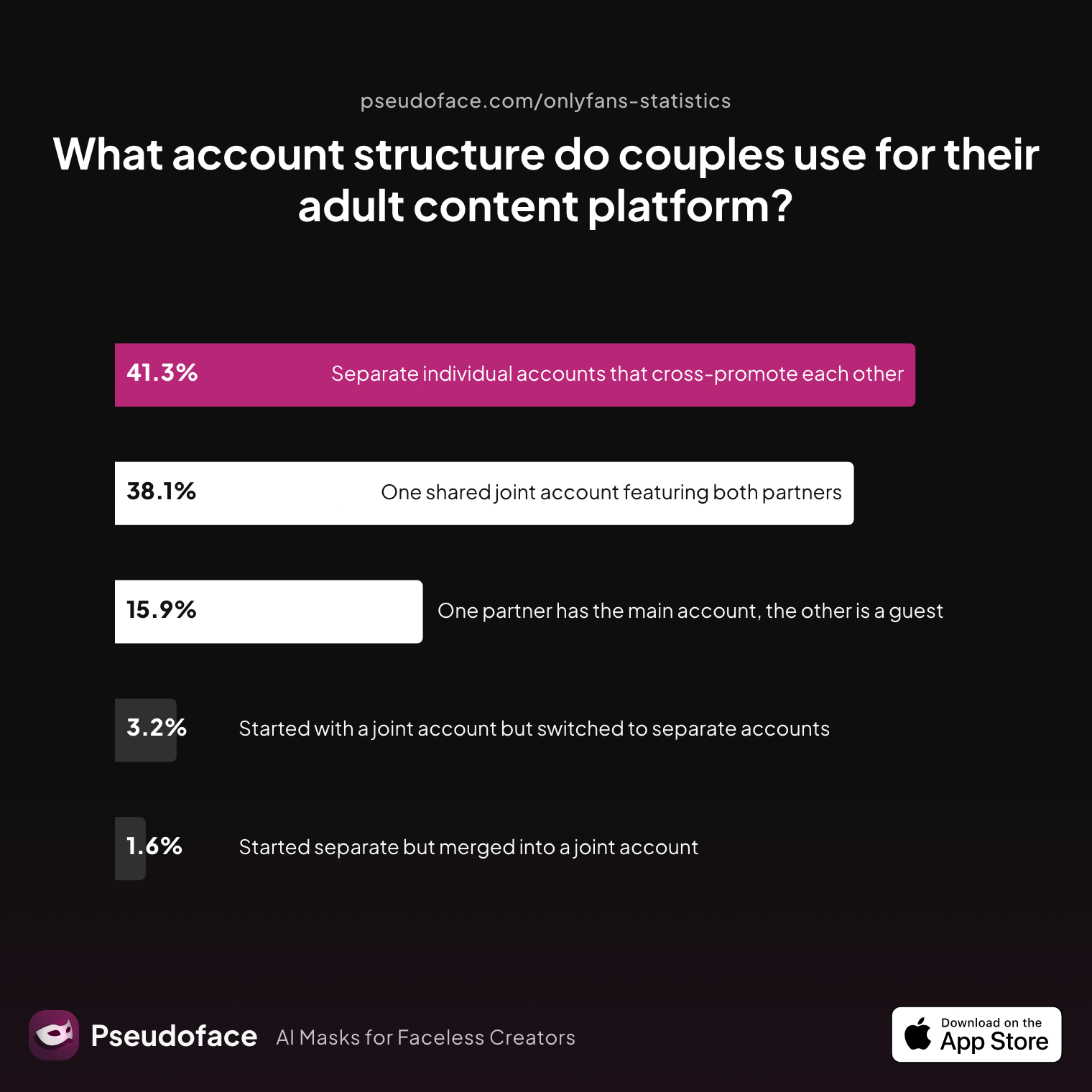
The most popular model is a “separate-but-cross-promoting” structure (41.27%), with joint accounts close behind (38.10%). Each path comes with compliance caveats:
- Joint accounts: Both parties must be independently verified, and all content must be covered by shared releases. Revenue splits must be agreed upfront. Both have account-level risk if compliance fails.
- Solo with guest: The “owner” is primary, guests must still be verified and provide releases for all collaborations. This reduces complications if parties part ways.
- Solo/cross-promo: Cleanest for taxes, risk management, and personal boundaries, but can dilute visibility.
How Do Couples and Collabs Split Revenue?

| Answer | Percentage |
|---|---|
| All revenue pooled for household expenses | 25.00% |
| Equal 50/50 split | 37.50% |
| Fixed larger share for one partner (e.g., 60/40) | 0.00% |
| Fixed salary paid to one partner | 25.00% |
| Proportional to each partner’s content contribution | 12.50% |
The 50/50 split is most common (37.5%), but a full quarter simply pool all earnings, while another quarter assign a “salary” to the less-public partner. No respondents in this segment reported using a fixed larger share, and proportional-to-content splits (e.g., by shoot hours or scenes contributed) are rare. The lack of proportional splits may reflect both trust and the administrative difficulty of calculating individual scene values.
These stats hide complexity: misunderstandings and disputes are common. Establish split before launching the account, formally (even in writing). Joint accounts require the highest mutual trust—if a dispute escalates, both risk total loss of income and platform presence.
Open thread on Redditr/Fansly_Advice
u/Titsoffwork
I wouldn’t talk to the client honestly I would only contact Fansly. I wouldn’t tie yourself to them Any more than you need to until it’s resolved.
One key lesson from Pseudoface’s dataset: the more partners, the more moving parts—each one a potential compliance or financial tripwire.
When disputes or paperwork breakdowns happen, creators have to contend with a much more serious threat: warnings, suspensions, or even outright bans.
Disputes, Account Suspensions, and the Fansly Ban Process
Joint and collaborative accounts face a unique set of risks when Fansly’s compliance team flags content or account activity. From temporary suspension to permanent ban, the pain points are often as emotional as they are financial—especially when an entire business is put on hold due to one piece of missing paperwork.
| Answer | Percentage |
|---|---|
| Account temporarily locked during compliance check | 7.69% |
| Had content removed for missing/unclear partner verification | 34.62% |
| No problems—never removed or warned | 30.77% |
| Permanently banned over couple/dual identity posting | 3.85% |
| Received warning/suspension over release form issues | 23.08% |
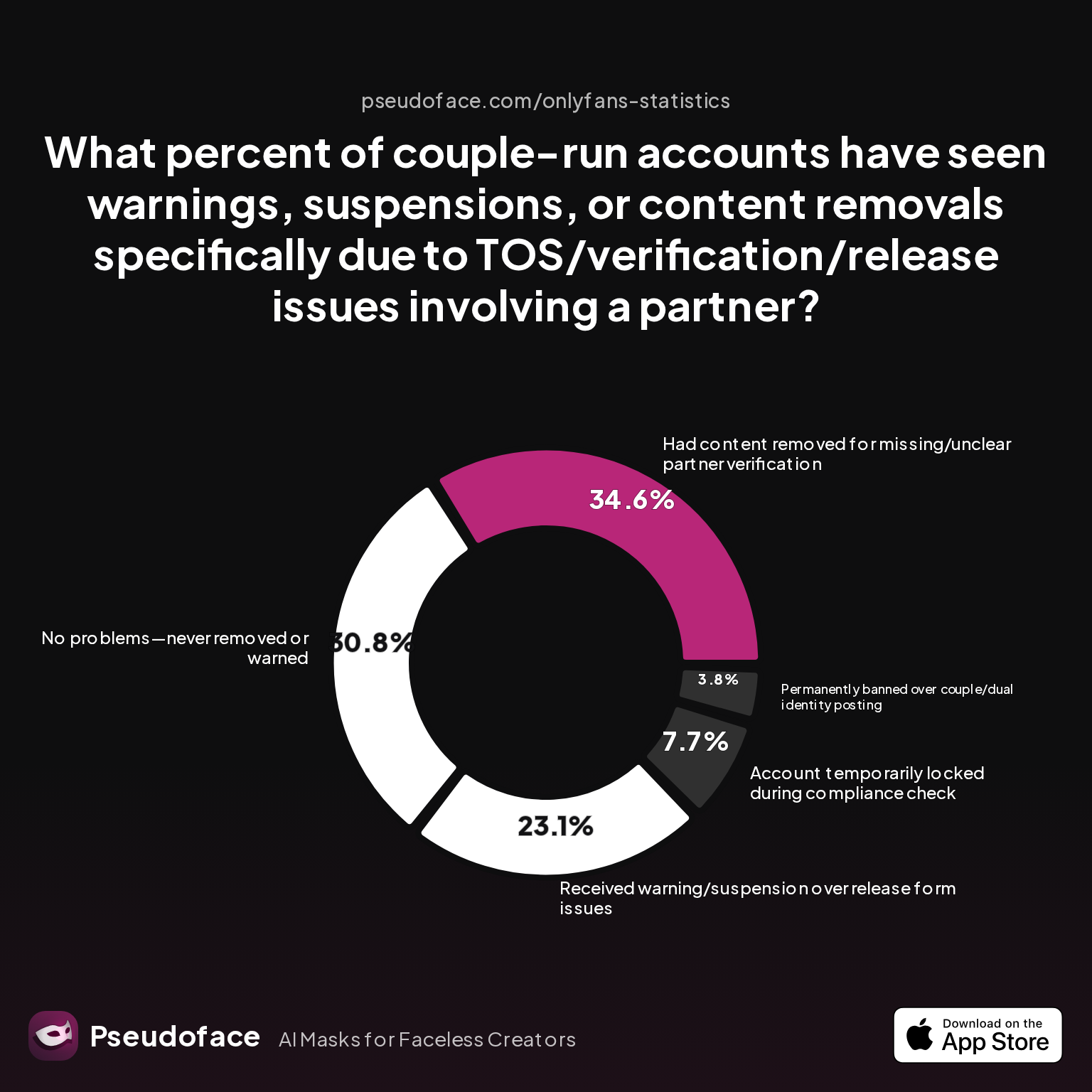
Roughly one in three couple-run accounts have had content removed over partner verification issues. A further 23% received suspensions or warnings for release form problems. Only 31% report never facing any sanction.
These numbers should be sobering: compliance is not a corner to cut, and enforcement can be unforgiving. Many creators also report that support response varies wildly—sometimes unlocks come within 48 hours, sometimes it takes weeks. For banned or locked accounts, appeals require organizing documentation, polite persistence, and patience.
If an account does get suspended or content removed, the best course is to rapidly assemble:
- All release forms (signed, dated, ideally with “form selfie” images).
- Co-model ID documents and proof of age at time of shoot.
- Evidence of communication or agreements about the content.
Common mistakes—like assuming “implied” participation needs no paperwork, or using generic release forms with missing details—are directly correlated with ban risk. When in doubt, over-document—uncertainty almost always leads to harsher outcomes.
Fansly vs. OnlyFans and Others: Co-Model Rules in Perspective
While the main concern of this guide is Fansly, no compliance strategy is complete without some contextual benchmarking. As of 2026, Fansly is considered by professional creators to be more procedurally strict (and sometimes slower to respond) than OnlyFans, ManyVids, and some White-label adult platforms, but less punishingly rigid than select EU-focused hosts with blanket bans on “faceless” appearances.
Key contrasts:
- OnlyFans accepts generic model releases for collaborations, but also enforces tagging and ID verification for all visually-present co-performers. Review times are often faster—sometimes under 24 hours—but case-by-case scrutiny means mistakes can still result in content removal or account lock.
- Fansly requires forms and explicit ID matching for even off-screen/voice participants. Faceless or implied participation is more likely to result in additional review.
- Other platforms: Some cam and video hosts—especially those catering to US audiences—now demand granular, act-by-act consent, making real-time compliance nearly impossible for certain niches.
Open thread on Redditr/Fansly_Advice
u/nevermakeawish
From what i understand of the NC law (im from TX, if that's important), the reason they switched to strictly solo content is because the new pornography laws requires each video to have a consent form that clearly writes out all the actions in the video & that they were done consensually. Sites that have live functions (like ManyVids & Fansly, and pretty much all the cam sites you can think of) cant conceivably maintain constant consent contacts for every time a couple changes positions or sexual acts. Unfortunately, them having a verified ID is no longer enough to confirm consent according to how the law is written in your state. They may adjust the rules to separate going live & posted content contracts, so id keep an eye out for that.
In short, Fansly’s compliance process is demanding—but if navigated carefully, is manageable and more predictable than some rivals. For new or growing creators, the wise approach is to treat all participants with full paperwork, clear pre-launch agreements, and regular policy checks for updates.
FAQ
What forms do all models need to submit before appearing in Fansly content?
Every visually or audibly featured co-model must submit a government-issued ID for verification and sign a Fansly-valid model release form (not necessarily Fansly-branded, but meeting their criteria).
Forms can be generic if they affirm age, explicit consent, and permission to distribute; visuals (e.g., selfie with consent form) improve acceptance. Off-camera/audio participants require the same documentation as on-screen.
How does the verification process work for couples or joint accounts on Fansly?
Each partner uploads IDs and release forms, with support review times between hours and several days—or longer if resubmission is needed.
Both must wait for explicit approval before publishing any content involving the other. Delays are common; about half must re-submit or provide extra documentation, so plan for a slow process.
Can I tag collaborators who aren’t verified Fansly models? What are the risks?
No—a collaborator must be fully verified and (if appearing) have a release on file before being tagged, or the account risks content removal.
Tagging non-verified collaborators or co-performers is a frequent cause of flags and takedowns; always check paperwork and verification status before posting.
What happens if my co-model fails verification or can’t provide paperwork?
Content is removed, funds may be frozen, and your account could face warning, suspension, or outright ban.
Appealing requires gathering any evidence of consent, documentation, and clear communication with Fansly support. Prevention—never posting without full compliance—is the least painful path.
How do revenue splits work for co-model content or joint Fansly accounts?
Revenue is either pooled, split 50/50, or assigned by agreement; Fansly does not offer built-in split payments for joint accounts (as of mid-2026).
Clarify percentages and payment processes in writing. Most disputes arise from mismatched expectations, so over-communicate up front and document agreements formally.
What are the most common mistakes that get Fansly co-model content flagged or removed?
Missing or invalid release forms, uploading with an unverified partner, ambiguous consent for faceless/audio participants, and uploading prohibited content types are the leading causes.
Careful documentation, early verification, and staying updated on policy changes prevent the majority of flags and takedowns.
How do I appeal a Fansly ban or suspension related to collaboration or paperwork?
Appeals require providing all documentation (IDs, releases, and proof of consent) and patient, persistent follow-up via Fansly support channels.
Response times vary; prepare for multiple rounds of back-and-forth and maintain professionalism in all communication to improve your odds.
Do I need model releases for non-sexual or implied-collab content?
Yes—if there is any audible, visual, or implied participation by another person, a model release should be collected and maintained.
Even “shadows” or voice-only partners must be covered, as evidenced by frequent content removals cited for incomplete paperwork.
Conclusion
Fansly co-model compliance is demanding—but entirely navigable with foresight, organization, and a healthy skepticism for "shortcuts." While processes can be slow and the documentation requirements feel relentless, the risk of skipping steps is far greater: lost content, frozen funds, and possibly losing your Fansly account. According to 2025-2026 Pseudoface analysis, about one quarter of all flagged collaborative content could have been kept online with better preparation and mutual clarity between collaborators.
In the end, treating compliance as an investment—rather than an obstacle—will not only safeguard your platform presence, but also the relationships and income streams you’re building for the long term. Stay organized, over-document, and if in doubt, double-check: your future self (and business) will thank you.


