
TL;DR
Most US and international Fansly creators cannot achieve full legal anonymity in payout withdrawals, but strategic choices and a privacy “stack” can help shield banking details and reduce personal exposure. Based on Pseudoface’s 2025-2026 analysis of over 250,000 Reddit threads from real adult creators, every Fansly payout method—whether bank transfer, e-wallet, or crypto—requires disclosing your legal identity to at least one third party. Geographic restrictions block 60% of creators from their first-choice, privacy-friendly method. Around 27% report payout privacy disappointment, most often due to method limitations or a forced switch by region. This guide clarifies where true anonymity is possible, the practical spectrum of privacy among payout options, and actionable strategies to reduce risks of leaking your identity while still getting paid.
The Reality of “Anonymous Payment” on Fansly: Definitions, Misconceptions, and Legal Constraints
When creators talk about “anonymous payment” from Fansly, what they usually want is the ability to get paid for their content without exposing their legal name, government ID, or personal bank account to Fansly, banks, or payment processors. The fantasy is simple: a clean firewall between their online persona and their real-world life, minimizing the risk of doxxing, banking complications, or family/workplace discovery.
The lived reality is messier. Globally, financial platforms face strict anti-money-laundering (AML) and Know Your Customer (KYC) regulations. These rules require platforms like Fansly and their payment partners (banks, e-wallets, even most crypto providers) to verify—and store—your legal identity before releasing funds. That requirement doesn’t vanish just because you operate under a stage name.
No payout method on Fansly provides total anonymity from all intermediaries. Even when using e-wallets or crypto, at least one third-party (often both Fansly and a payment vendor) will see your full legal name, ID, and/or banking details. This sharing may be more or less visible depending on your payout path, but a paper trail always exists somewhere.
There’s also a persistent misconception: that choosing a privacy tool, like a business bank account or an LLC, “scrubs” your real identity from the payout flow. In practice, it adds a layer—possibly hiding your legal name from your main bank, or from US-only credit bureaus, but not from all processors or statutory records. Fansly’s creator onboarding process itself demands government-issued ID and confirmation, regardless of payment choice.
The concept of “anonymous payment” on Fansly, then, is fundamentally about reducing your direct paper trail—not erasing it. It’s about who sees your data, how well you can segment your adult work from your daily life, and minimizing cross-provider leakage or accidental exposure.
Open thread on Redditr/Fansly_Advice
u/Bratty-saurus
You'd be required to use your legal name on any payout option due to financial and anti money laundering laws. Plus fansly will already know your legal name as you'll have been required to submit ID to get verified as a creator

Global legal pressure makes Fansly’s verification process unavoidable. But there are still meaningful privacy choices at each step—from which payment partner you pick, to how you shield your main financial identity downstream.
With a grounded understanding of what’s truly possible, it’s time to examine the actual options Fansly supports—and what they expose about you.
Fansly Payout Methods: What Options Exist, and What Do They Reveal About You?
Getting paid on Fansly in 2025-2026 offers more flexibility than it did two years ago, but real anonymity remains elusive. Fansly’s payout stack includes traditional bank transfers (ACH in the US, SEPA/wires internationally), e-wallets aimed at adult creators (Paxum, Cosmopayment), “challenger” fintech banks like Revolut, and limited crypto options for select regions. Each comes with its own privacy quirks and KYC requirements.
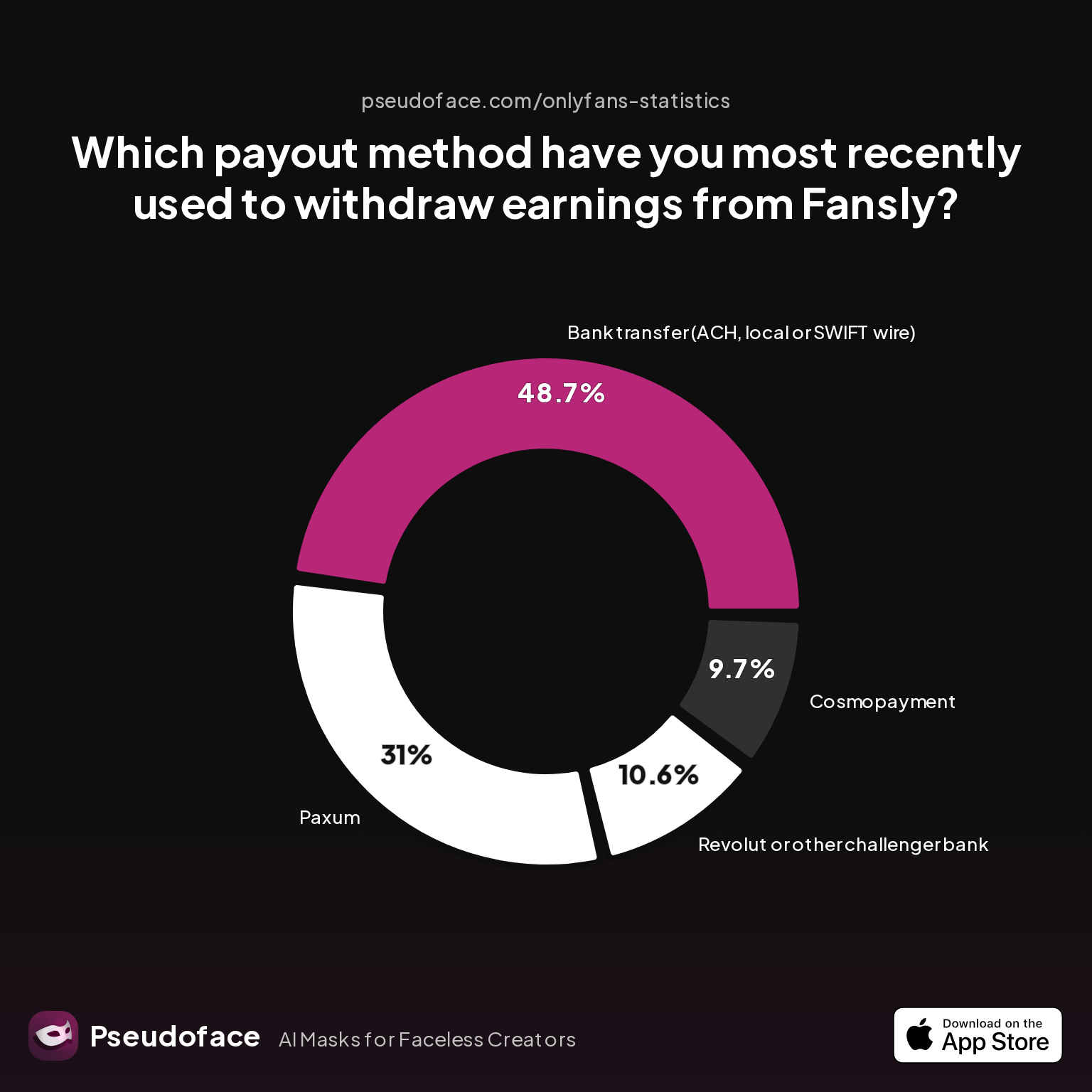
Here’s how the real-world use of these payout methods breaks down:
| Answer | Percentage |
|---|---|
| Bank transfer (ACH, local or SWIFT wire) | 48.67% |
| Cosmopayment | 9.73% |
| Paxum | 30.97% |
| Revolut or other challenger bank | 10.62% |
| Yoursafe | 0.00% |
Nearly half of creators ultimately use direct bank transfers (ACH, local/SWIFT wire) for payouts. E-wallets like Paxum (31%) and Cosmopayment (10%) together hold significant share, especially for international creators and those prioritizing a separation from their main banking profile. Challenger banks like Revolut represent around 10%—often favored in the EU and UK for their minimal transaction labeling and improved privacy controls.
- Bank transfer (ACH/local wire): Requires your legal name, bank account, sometimes address and additional documentation. Funds go directly into your named bank account—your bank will see the origin, and your identity is directly linked.
- Paxum, Cosmopayment: Both demand ID for account creation (passport, government ID), but they’re geared toward webcam/adult platforms and may offer pseudonym-handling or sub-accounts. They still retain your full KYC details, even if the bank receiving funds doesn’t see “Fansly” as a sender.
- Revolut/Challenger Banks: Legally mandated to gather your real details, though they sometimes let you mask transaction origins better than legacy banks. Privacy is at best relative, not absolute.
- Crypto: No longer widely visible as a payout option for most countries, and where available, typically requires wallet KYC and careful handling to avoid accidental exposure.
Key privacy takeaway: All these methods expose your legal identity to at least one vendor. The main variable is whether your home bank, your e-wallet, or both, have records that could tie your legal name to adult income. For most, mitigating risk is more about strategic layering, not invisibility.
Regional context matters, too. In Canada, for example, regular banks like RBC or BMO handle most payout inflow without incident—but privacy-conscious creators still take steps to avoid discussing adult content with their teller.
Open thread on Redditr/Fansly_Advice
u/Few-Session-2087
I use Royal Bank and never had a problem. I also never told them it’s OnlyFans. You don’t have to.
For every payout method, there's a spectrum of visibility and downstream risk. Creators choosing e-wallets or business accounts typically do so in search of an extra buffer—but each step still leaves a data trail at the point of KYC, and for tax documentation.
Next, let’s look at the major factor that often blocks the most privacy-preserving methods: geography.
Geographical Restrictions: When Your Preferred Payment Method Isn’t an Option
Even the best privacy plan falters if you simply can’t access your preferred payout method. Fansly’s payment stack in 2026 remains patchworked by country, regulatory environment, and, in some cases, internal risk decisions. For many creators, especially those outside North America or Western Europe, this means being nudged—or forced—into less private or higher-friction withdrawal methods.
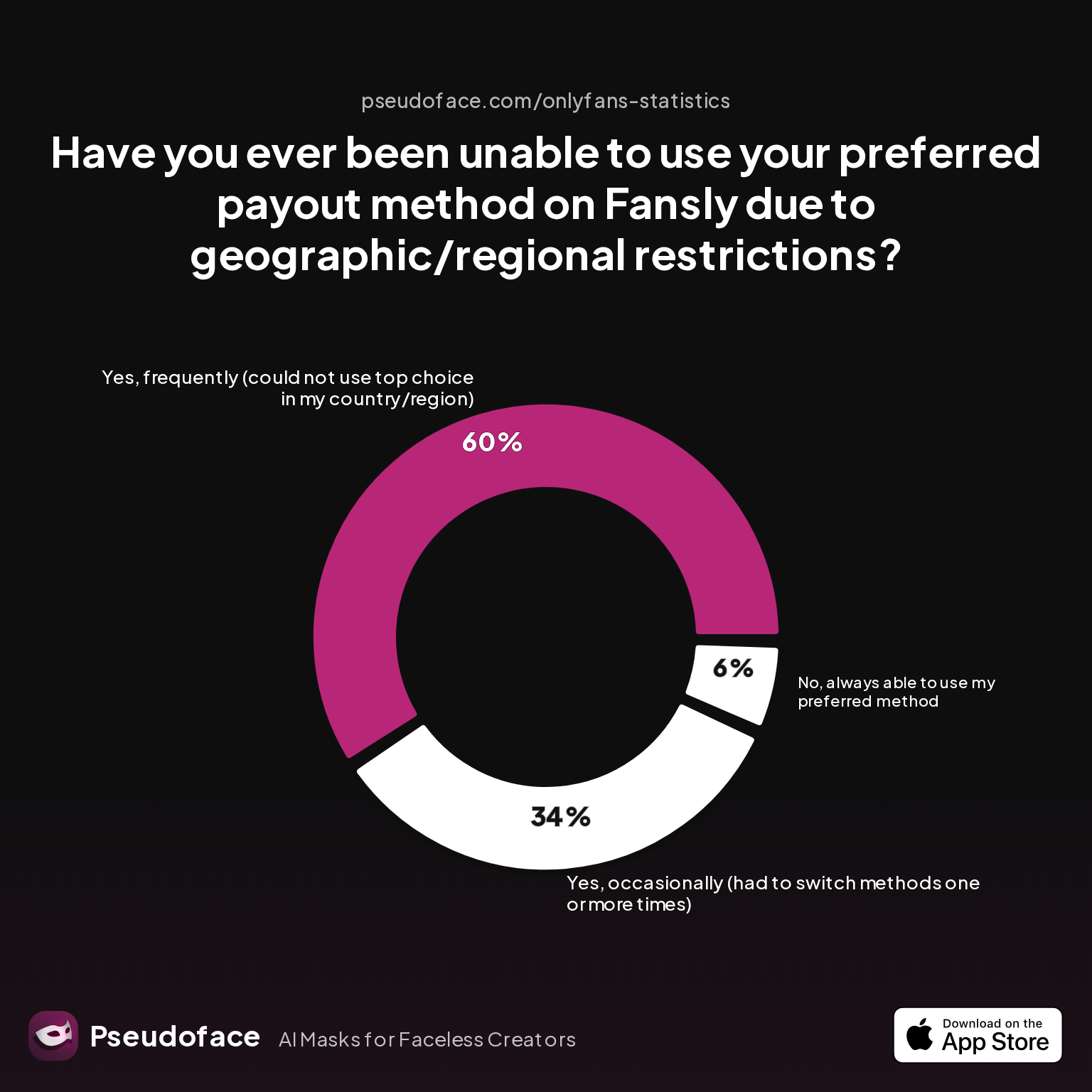
Here’s what global creators report about hitting geographic walls in their payout journey:
| Answer | Percentage |
|---|---|
| No, always able to use my preferred method | 6.00% |
| Not sure/never checked | 0.00% |
| Yes, frequently (could not use top choice in my country/region) | 60.00% |
| Yes, occasionally (had to switch methods one or more times) | 34.00% |
Only 6% of creators report always being able to use their top-choice payout method. A striking 60% are frequently blocked from their preferred method due to regional or banking restrictions, and another 34% have had to switch methods at least once. That means, at minimum, two-thirds of creators have been forced to compromise on privacy (or comfort) by external constraints—sometimes repeatedly.
This reality varies sharply by country:
- US Creators: Usually have ACH/bank transfer and at least one e-wallet option, but often lack seamless crypto/fintech bank access.
- Canada & Western Europe: Enjoy multiple viable options, including Paxum and direct bank deposit, and sometimes Revolut for enhanced privacy.
- Asia, Africa, Latin America: Face major blocks—favored methods often unavailable, resulting in slower, less private, or higher-fee alternatives.
One hidden risk: methods available at account opening may vanish or be “temporarily” disabled months later, forcing a public-to-personal bridge many aren’t prepared for. This dynamic breeds both frustration and privacy vulnerability.
For instance, a Canadian creator reported smooth sailing with BMO, reinforcing regional stability—
Open thread on Redditr/Fansly_Advice
u/Nice_Air2420
BMO for years no issues
US and international creators, by contrast, frequently share stories of sudden payout method deactivation, forcing last-minute changes.
Practical takeaway: Even if you plan the “perfect” privacy stack, regional payout restrictions may force you to accept greater personal exposure, use high-fee third-party providers, or endure long wait times. Privacy must be viewed as a living process, not a one-time setup.
With the map laid out, let’s compare the strengths, risks, and transparency trade-offs of each method on Fansly today.
Comparing Fansly Anonymous Payout Methods: Privacy, Risk, and Transparency
So how do the main Fansly withdrawal methods actually compare—when it comes to anonymity, data sharing, and risk of exposure? The privacy spectrum is shaped not just by KYC paperwork, but by how many hands touch your info, which entity can see what, and how often things go wrong.
e-Wallets vs. Bank Transfer vs. Crypto: A Privacy-Oriented Lens
- Direct Bank Transfer (ACH/SWIFT/SEPA): Fastest and often simplest, but your bank always knows your (legal) name, and may see Fansly or a payment processing partner listed as a transaction source. If your bank is sensitive to adult income or you want strict separation, this is high risk.
- Paxum/Cosmopayment: Still require legal ID for account signup, but can serve as an intermediary buffer—your bank receives funds from “Paxum” or “Cosmopayment,” not an adult site. Risk is lower for direct doxxing from bank statements, but audit and KYC logs remain with the e-wallet provider.
- Revolut/Other Challenger Banks: Favorable in developed markets for quick sign-up and improved masking, but at core, they’re subject to the same banking laws as any institution, and can close accounts upon suspected policy violations.
- Crypto: Theoretically most private, but in practice is sharply restricted and fraught with technical and compliance headaches for Fansly withdrawals.
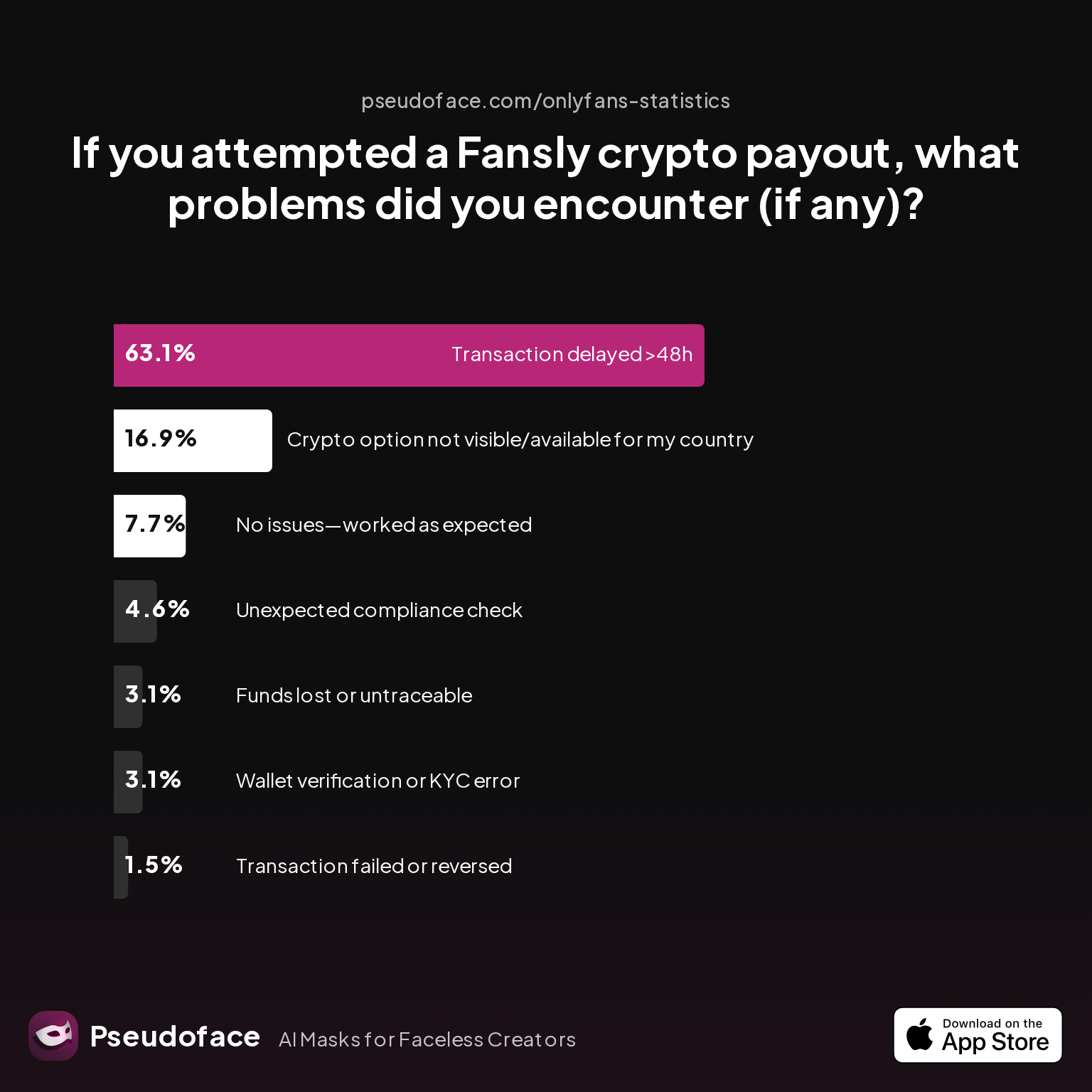
Let’s look at what actually happens when creators attempt crypto payouts:
| Answer | Percentage |
|---|---|
| Crypto option not visible/available for my country | 16.92% |
| Funds lost or untraceable | 3.08% |
| No issues—worked as expected | 7.69% |
| Transaction delayed >48h | 63.08% |
| Transaction failed or reversed | 1.54% |
| Unexpected compliance check | 4.62% |
| Wallet verification or KYC error | 3.08% |
More than 60% of creators attempting crypto payouts report delays over 48 hours. Only a scant 7.7% found the process seamless. Nearly 17% couldn’t even access the option, and a further 3% lost funds entirely. Technical friction and recurring compliance checks further erode the privacy (and promise) of crypto—rendering it a poor fit for most creators hoping to dodge traditional identity trails.
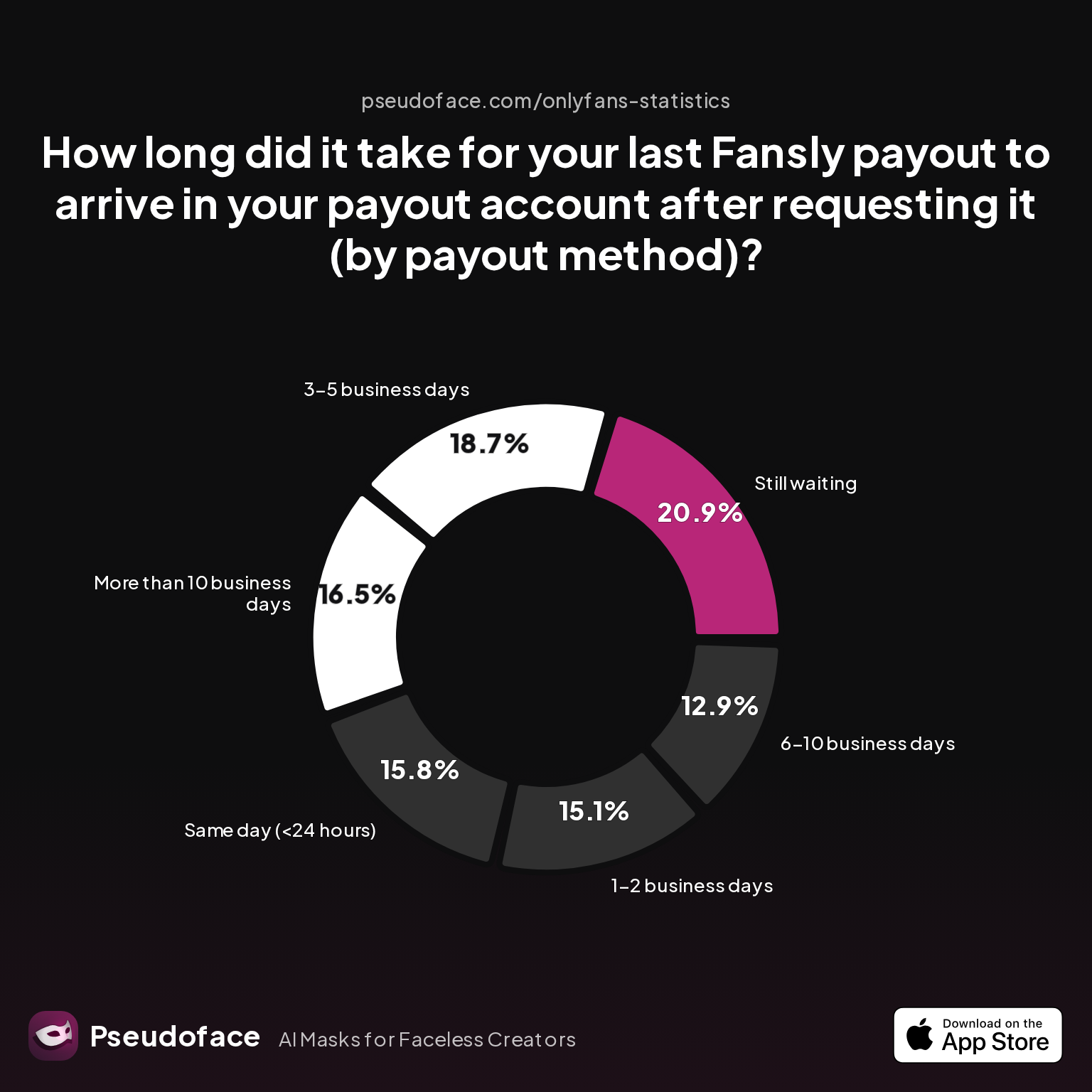
Waiting times and payout reliability affect privacy too: the more you wait, the more hands your funds may pass through, increasing reporting risk. Let’s see how payout speeds actually land:
| Answer | Percentage |
|---|---|
| 1-2 business days | 15.11% |
| 3-5 business days | 18.70% |
| 6-10 business days | 12.95% |
| More than 10 business days | 16.55% |
| Same day (<24 hours) | 15.83% |
| Still waiting | 20.86% |
One in five creators is still waiting for a payout at time of survey response, and over 29% report waits of more than six business days. Longer wait times often correlate with extra privacy steps (e.g., multi-hop payouts, switching e-wallets, or compliance checks mid-process). This highlights a tension: the more privacy you pursue via payout indirection, the worse your payout experience may become.
Bias caveat: Recall that these stats, distilled from hundreds of thousands of Reddit posts, are self-reported and likely over-represent users who’ve encountered problems, due to the help-seeking nature of online communities. That said, the trend direction—frequent delays, friction, and regional problems—is credible.
Taken together, payout privacy on Fansly is about trade-offs:
- E-wallets offer a modest privacy buffer, but at the cost of fees and occasional delays.
- Crypto delivers little practical benefit and creates major payout headaches for most.
- Direct bank transfer remains simplest, but most exposed—especially in conservative banking regions.
Those who get the most privacy tend to prepare in advance—using privacy-layered tactics before they ever plug in a withdrawal method. So what works in practice?
Building Your Financial Privacy Stack Before Fansly Payout: Real-World Tactics
It’s easy to focus only on the technical payout options Fansly offers. But for creators working hard to protect their personal life, what matters most is the financial privacy stack: everything you do from pre-launch, through payment account selection, up to the moment your earnings land.
Let’s see what real creators report using before ever requesting their first Fansly payout:
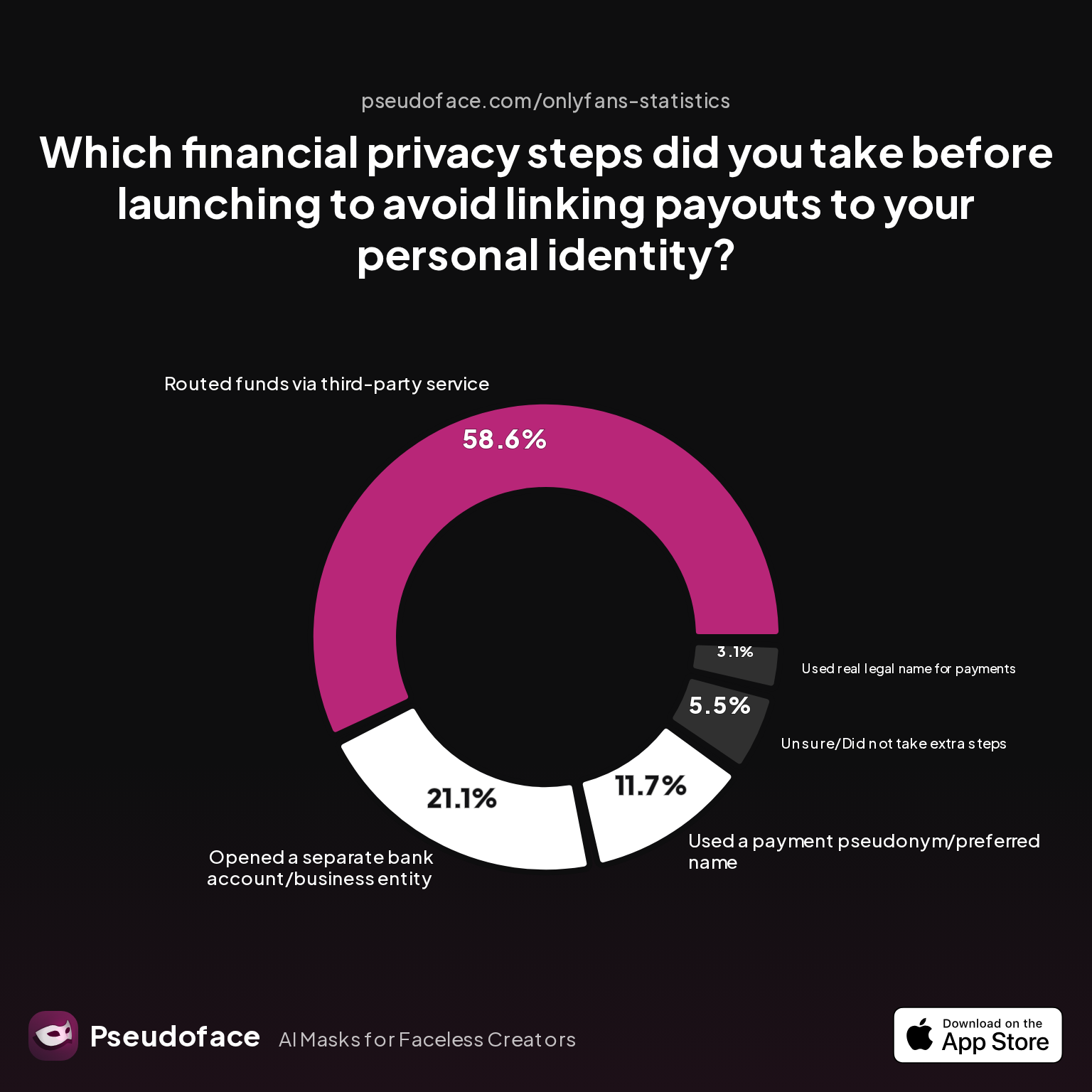
| Answer | Percentage |
|---|---|
| Opened a separate bank account/business entity | 21.09% |
| Routed funds via third-party service | 58.59% |
| Unsure/Did not take extra steps | 5.47% |
| Used a payment pseudonym/preferred name | 11.72% |
| Used real legal name for payments | 3.12% |
Just over 1 in 5 creators (21%) opened a separate bank account or business entity before launching. A robust 58% routed funds through a third-party service, seeking to buffer their identity from direct adult industry linkage. Only a minimal 3% risked using their unchecked real name for payments.
What does a practical privacy stack look like?
- Business entity (LLC, sole-proprietor “DBA”, nominee company): Allows you to open business bank accounts not directly tied to your main personal banking profile. Reduces doxx risk, but paperwork complexity varies by country.
- Armored prepaid cards and e-wallet sub-accounts: Give you an extra hop between Fansly and your day-to-day bank, limiting visibility for your primary bank (but not the e-wallet).
- Multi-hop withdrawal chains: Some creators “daisy-chain”—e.g., payout from Fansly to Paxum, then from Paxum to a prepaid card or a new fintech bank, making income origin harder for any single institution to trace.
- Payment pseudonyms: Limited in utility (since KYC is still required), but can hide your public-facing name on transaction summaries from roommates or family.
Key risk: Each privacy layer adds potential points of friction—new fees, regulatory delay, and the ever-present risk of provider policy change closing your chosen method overnight. Overly complex arrangements, especially if reliant on non-mainstream providers, can slow down payouts or result in frozen funds if any link in the chain is flagged.
Survivorship bias caveat: Many community reports come from creators who survived the multi-step privacy process; those who were tripped up by method closures or provider audits may not be represented.
For high-stakes privacy, start building your stack before making content public. Once adult income hits your main bank account, it’s near-impossible to “erase” the trail after the fact.
Common Pitfalls and Payout Issues: Delays, Privacy Leaks, and Resolution Rates
No payout method—however crafty—completely inoculates you from issues. In practice, Fansly creators face a rolling series of snag points: payout delays, missing funds, payout method deactivations, and the occasional direct privacy leak (like a mismatched payment showing “Fansly” on a bank statement).
Quantitatively, here’s how often these problems happen—and what resolution looks like:
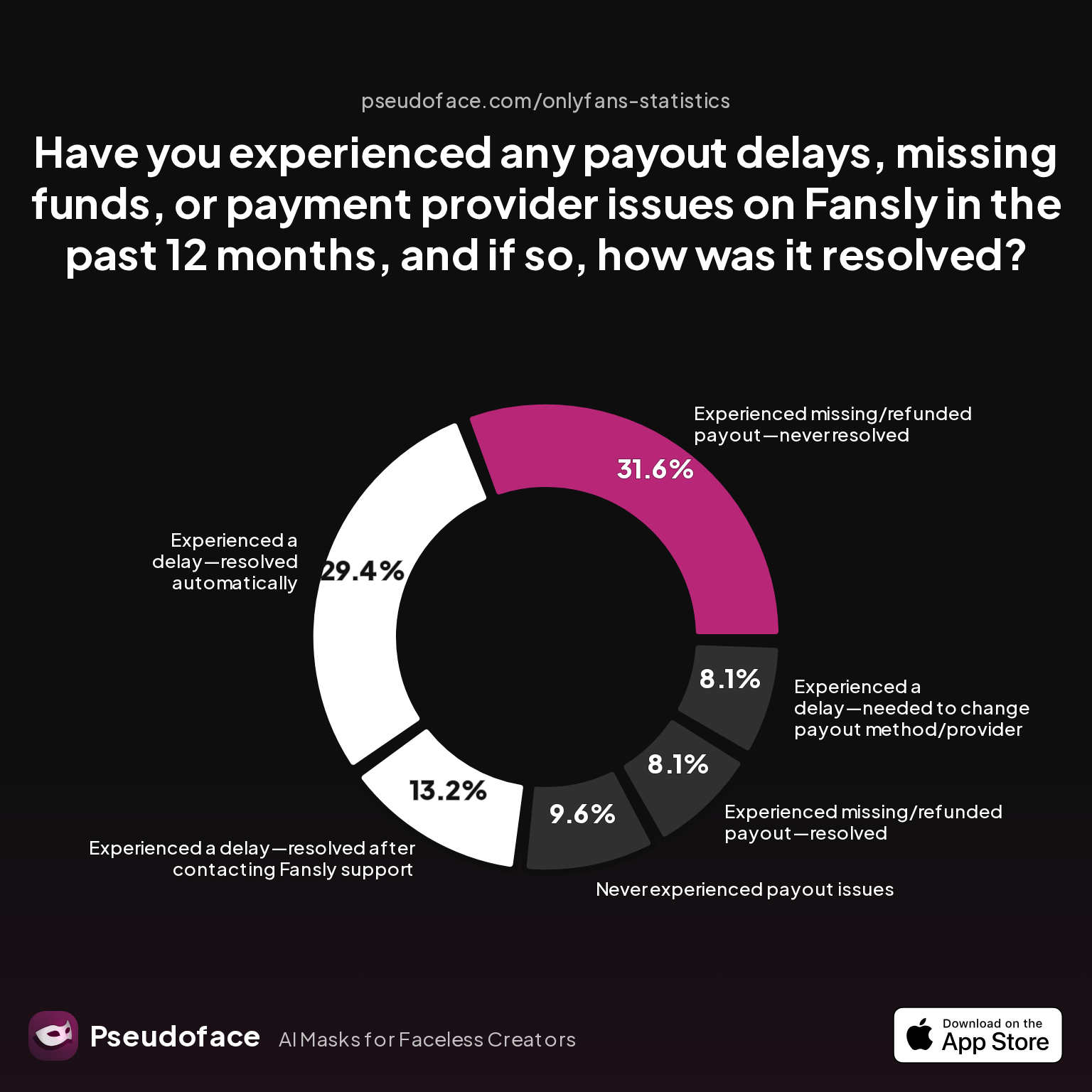
| Answer | Percentage |
|---|---|
| Experienced a delay—needed to change payout method/provider | 8.09% |
| Experienced a delay—resolved after contacting Fansly support | 13.24% |
| Experienced a delay—resolved automatically | 29.41% |
| Experienced missing/refunded payout—never resolved | 31.62% |
| Experienced missing/refunded payout—resolved | 8.09% |
| Never experienced payout issues | 9.56% |
Over 60% of creators reported either payout delays or missing funds in the prior year, with only 9.6% stating they’d “never experienced payout issues.” Most troubling: 31.6% experienced a missing or refunded payout that was never resolved. Substantial numbers had to swap payout methods (8%), and only around 13% found Fansly support responsive enough to fix issues after they arose.
The operational reality here is hard: every additional privacy or intermediary step raises the odds of support tickets, missed payments, or funds held up in compliance limbo. And, as creators overwhelmingly note on Reddit, payout failure is more common among those pushing for extra privacy layers—especially with non-mainstream e-wallets or regionally unsupported methods.
For peace of mind:
- Keep backup payout methods ready. If your preferred privacy route is revoked or closed, the fallback should already be in place.
- Store payout records and compliance proofs. If you ever need to demonstrate legal income for tax or banking concerns, clear logs avoid disaster.
- Accept some level of exposure. Absolute indemnity is impossible; “good enough” separation, not true anonymity, is the practical goal for 2026.
Legal Realities and Platform Rules for Fansly Anonymous Payment
Every creator—US-based or international—must confront this fact: at least one payout intermediary will know your legal identity and link it to your Fansly account. This is neither a quirk of Fansly nor a bug in their process, but the direct result of global banking law and compliance.
Fansly requires KYC details at onboarding and for each new payout method you add. All payout partners (bank, e-wallet, challenger bank, and most crypto services) now run parallel verification checks—often including name, government-issued ID, and regular audits for suspicious activity. Any mismatch or a “false” persona triggers payout holds or, at best, a demand for updated documents.
Platform rule reality:
- Display names are separate from your payout identity. While your persona is insulated from fans, it cannot mask your legal details from Fansly or payment partners.
- Legal changes or rule updates by processor or Fansly itself can result in rapid restriction or revocation of your preferred payout setup—sometimes with little notice.
- Tax and reporting duties remain regardless of privacy steps. Most countries require you to declare adult income, even if it arrives via multi-hop providers.
The strategic goal isn’t perfect secrecy, but resilient privacy: keeping adult activity separate from your main financial footprint, minimizing the risk of social/workplace fallout, and having contingency plans when payout paths change.
FAQ: Fansly Anonymous Payment, Payout Methods, and Privacy
How can I receive Fansly payout without revealing my legal name?
You cannot fully shield your legal name from all payout intermediaries, but you can reduce who sees it by carefully choosing privacy-friendly payout methods and using layered accounts.
The law demands that at least one KYC-verified entity (Fansly and/or payout processor) know your identity. If you route through an e-wallet or business account, you may obscure details from your main consumer bank, but not entirely remove your personal info from the financial flow.
Does Fansly support crypto payouts, and do they increase privacy?
Crypto payouts are rarely available, have region-specific restrictions, and most require KYC similar to e-wallets—meaning they do not guarantee greater privacy.
As of 2026, only a small minority of creators successfully use Fansly crypto payouts, and most report lengthy delays, KYC checks, or unavailable options (see crypto payout chart above). Purely “anonymous” crypto cash-outs are not supported by major payment processors.
Which Fansly payout methods are best for keeping my adult income separate from my primary bank?
E-wallets (Paxum, Cosmopayment) and business/LLC accounts are the most common options for separating adult income from your everyday bank.
Fansly supports direct payout to Paxum and, depending on your region, CosmoPayment or Revolut. Setting up an LLC with its own business account is a robust (if paperwork-intensive) US method that adds a privacy buffer, but all options still require legal verification.
Are there any third-party services (like CashApp or Stripe) that add extra privacy to Fansly withdrawals?
Fansly does not directly support CashApp or Stripe personal accounts, but you can sometimes add intermediary services that add a privacy layer—but this increases payout complexity and risk of disruption.
Forum users report occasional success routing through services like Paxum-to-prepaid cards, but beware of account shutdowns and added compliance checks for multi-hop money flows.
Can I create a Fansly account and receive payouts using only a pseudonym?
You can use a pseudonym as your public Fansly display name, but must submit real KYC info for payouts—your legal name and government ID are required.
Anonymous personas are for fans/customers only; back-end systems require actual documents and info, as enforced both by Fansly and all regulated payout partners.
What should I do if my preferred payout method isn’t available in my country?
You’ll need to either select from the methods Fansly lists as available for your country or investigate regionally compliant e-wallets or intermediary services; sometimes, this requires relocation of your business presence or switching to a partner platform.
Be cautious about VPNs or “fake” location tactics—many payout partners conduct independent verification and may freeze funds or accounts if they detect such behavior.
If a payout issue leaks my legal name or data, how can I limit harm?
Immediately contact Fansly support for record correction, audit your payout partners for data leaks, and consider changing payout paths going forward.
Keep clean backup documentation of all KYC submissions and earnings for your records, and if needed, escalate issues to your bank’s compliance or fraud team.
Fansly payout privacy in 2026 remains a moving target—a spectrum, not a switch. Total anonymity is legally impossible, but deliberate, layered privacy strategies allow many creators to meaningfully reduce risk, shield their main financial identity, and safeguard their safety well beyond what casual setup alone can offer. Stay alert to region-specific shifts and always keep backups for your payout stack; in this space, privacy is not guaranteed, but resilient creators still shape their destiny.


