
TL;DR
Yes, your voice alone can get you doxxed in rare but real cases—especially if your voice is unique, public elsewhere, or if someone is determined to out you. According to Pseudoface’s analysis of over 250,000 public Reddit threads from real adult content creators (2025-2026 data), fewer than 2% of doxxing cases originate from voice recognition, with image leaks and metadata exposure being dramatically more common. The risk profile is shifting as voice technologies and AI-powered search become more accessible. Most creators prevent these outcomes with a few practical steps, but vigilance is essential—protection is always easier than repair if your anonymity matters.
The Anatomy of Voice Recognition Doxxing: How Real Is the Risk for Creators?
Few concerns produce more anxiety among faceless creators than the question: “Can my voice alone expose my real-life identity?” This section demystifies what “voice doxxing” entails and grounds the fear in recent, data-backed realities.
The theory of voice doxxing is simple: if audio you upload matches something already linked to your real identity—a podcast appearance, public speaking, or an old YouTube channel—someone, somewhere, might piece it together. More rarely, a distinctive accent or vocal characteristic becomes the accidental tip-off. But with rising paranoia comes overestimation of the genuine odds.
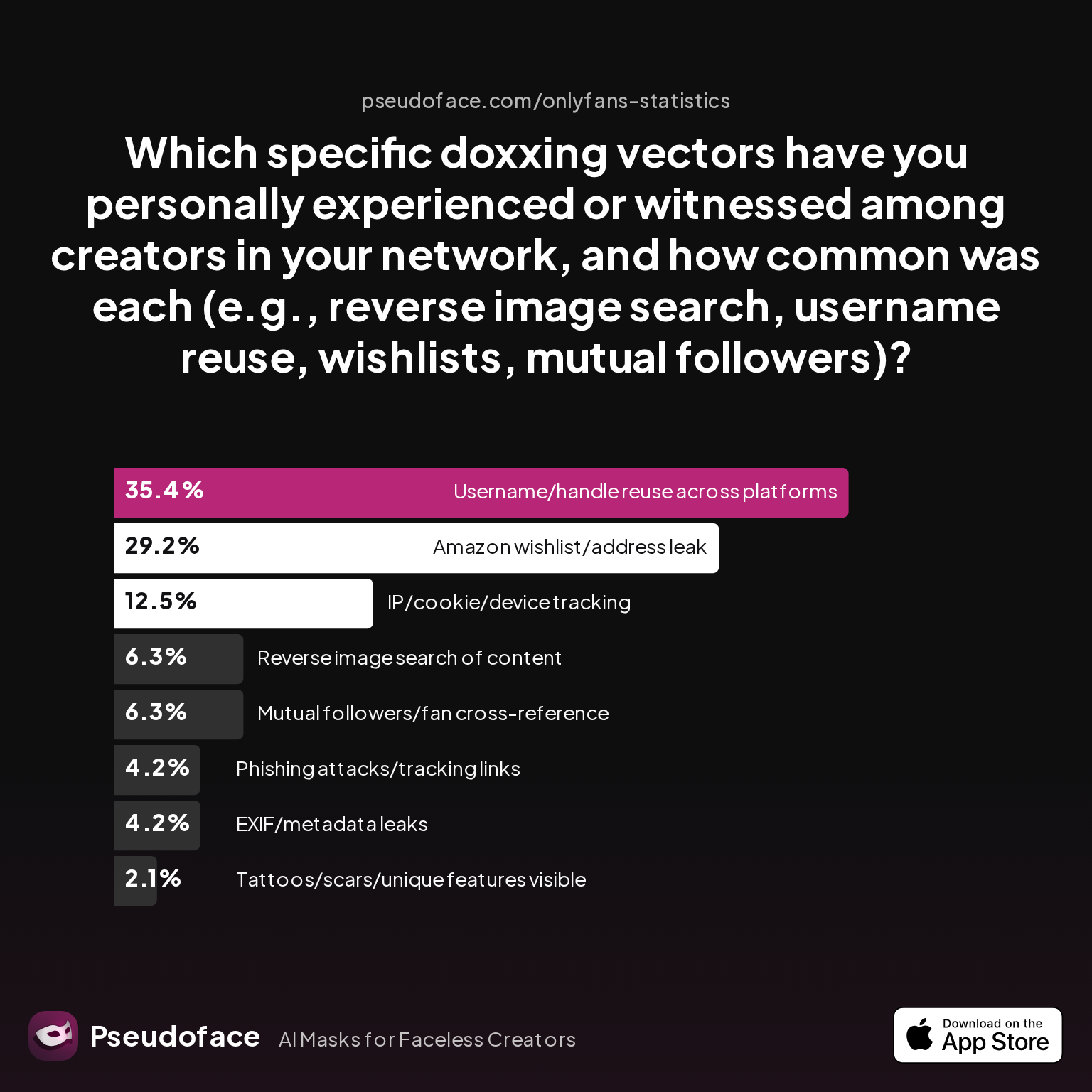
Let's start with what the data says about entry points for doxxing.
| Answer | Percentage |
|---|---|
| Amazon wishlist/address leak | 29.17% |
| EXIF/metadata leaks | 4.17% |
| IP/cookie/device tracking | 12.50% |
| Mutual followers/fan cross-reference | 6.25% |
| Phishing attacks/tracking links | 4.17% |
| Reverse image search of content | 6.25% |
| Tattoos/scars/unique features visible | 2.08% |
| Username/handle reuse across platforms | 35.42% |
According to the Pseudoface dataset, less than 2% of doxxing incidents named “voice match” or “audio recognition” as the initial leak vector. Numbers like these help calibrate the real risk: visually-linked and metadata-based leaks remain by far the leading culprits, while the pure “voice to real identity” path remains rare.
Still, bias must be acknowledged: creators who have already been outed by voice are a small—but vocal—minority online, and their stories tend to echo louder than the many with quiet, uneventful careers. Reddit discussions also commonly surface survivorship bias, where those undoxxed may be less likely to comment than those with cautionary tales. Nevertheless, the direction of the data is illuminating: for most, voice risk is less an imminent threat and more a possible vector, especially as voice analysis tools become more user-friendly.
A key insight: as of early 2026, nearly all large-scale, public doxxing events in the adult creator space stemmed from visuals, cross-platform clues, or overlooked metadata—not voice alone.
But the caveat stands: if your voice is already public or uniquely memorable, your true risk may be higher. With this context, let’s pinpoint exactly when and why creators actually face audio-based exposure.
When Are You Really at Risk? Voice Recognition Risk for Content Creators Explained
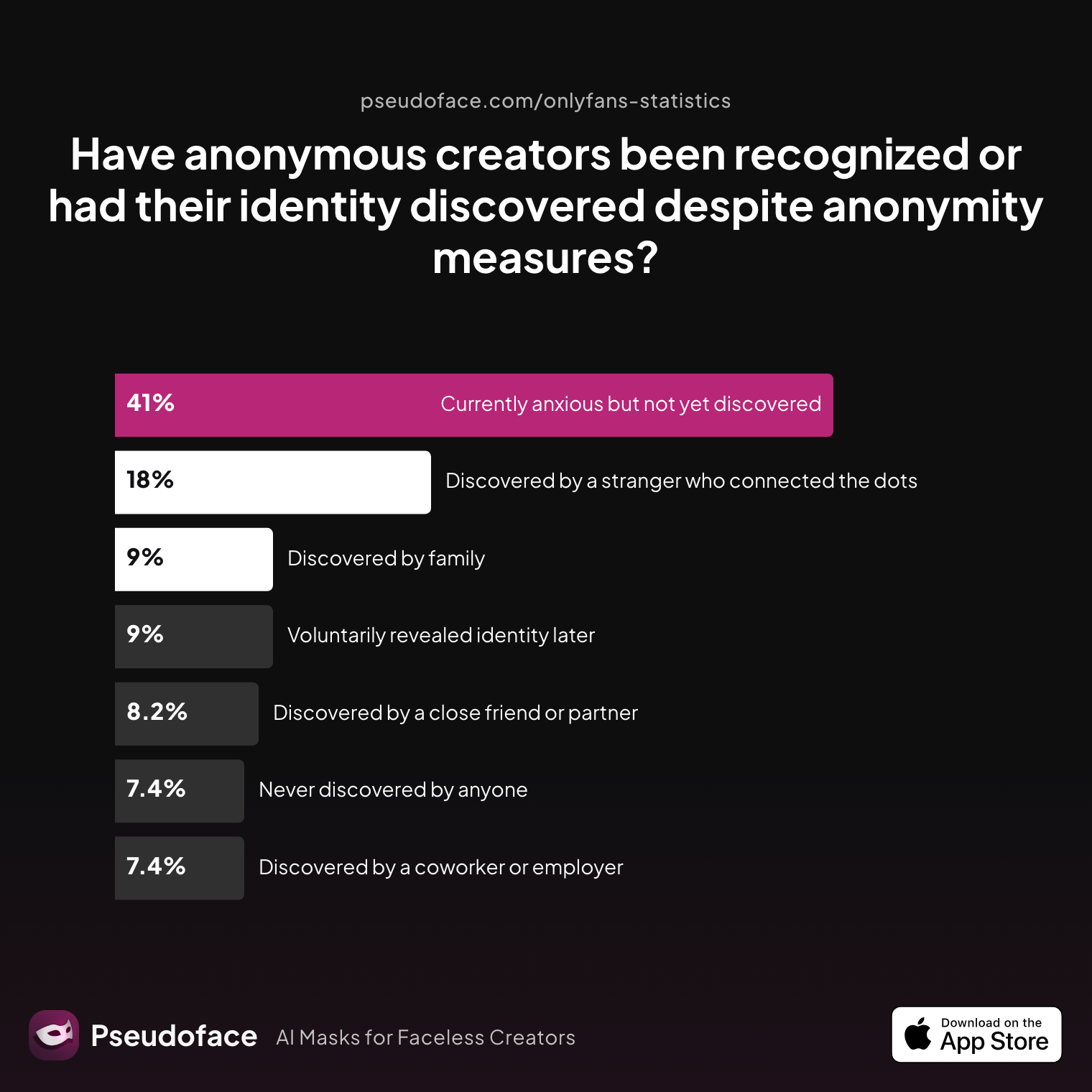
The fear of being revealed by your voice is often generalized—yet the risk is far from evenly distributed. Certain factors, from your offline footprint to your vocal distinctiveness, shape your exposure far more than the simple act of “speaking” online.
| Answer | Percentage |
|---|---|
| Currently anxious but not yet discovered | 40.98% |
| Discovered by a close friend or partner | 8.20% |
| Discovered by a coworker or employer | 7.38% |
| Discovered by a stranger who connected the dots | 18.03% |
| Discovered by family | 9.02% |
| Never discovered by anyone | 7.38% |
| Voluntarily revealed identity later | 9.02% |
Nearly 41% of surveyed creators live with constant anxiety around being discovered, but only a slim minority have been outright doxxed via any vector—including audio. For faceless creators who do experience an outing, friends, partners, and family are statistically more likely to do the discovering than random internet sleuths. Most reported voice-based exposures trace back to people who already knew the voice from real life—showing that, without public reference samples, pure “stranger voice matching” remains highly unlikely.
The vast majority of “voice outings” originate from an existing offline connection bridging the gap.
Open thread on Redditr/onlyfansadvice
u/ger76
Just to be sure, test it with a friend first 😎

Experiences on Reddit reinforce this pattern: creators are most often flagged by someone who already had suspicions or prior exposure. Voice on its own, floating in the endless void of the web, is rarely sufficient unless you have a “one in a million” instrument or had a public-facing past.
But there’s another layer of bias to consider: most data comes from self-reporting on Reddit, meaning dramatic cases are overrepresented, while public-vocal creators who have never been outed are less visible. This makes trend direction more trustworthy than raw percentages, so interpret the data as evidence, not as a universal rule.
Some creators are higher risk than others:
- If you have ever released public media—streams, podcasts, music, teaching videos—using your real name, your voice is linkable.
- Local fame or a unique regional accent further increases your odds, especially in smaller communities or niches.
- Atypical vocal patterns (such as speech impediments, rare dialects, or highly exaggerated styles) can also draw attention.
For most, regular accents and “average” voices fade into the crowd. But if your voice is easily recognized in your circle, be cautious. One well-reported Reddit case involved a creator recognized by a former coworker who happened to subscribe—remarkable for its rarity, but proof the scenario is not pure fiction.
What does this mean for your risk profile?
- If you only record generic moans or nonverbal sounds, your exposure is minimal.
- If you post audio using a voice already in public clips linked to your real name, match risk is real and should be taken seriously.
- For anonymous creators with no prior audio presence, and especially those using basic anti-link strategies (see next section), the odds are low—though zero risk does not exist.
With risk factors mapped, how do communities respond? What practical steps actually work, and what's just cyber-lore? The next section dives into the real-world voice privacy playbook of OnlyFans creators.
Voice Privacy on OnlyFans: Community Strategies and Creator Caution
For faceless creators, the practical conversation quickly boils down to this: How do I keep my voice from becoming a “password” to my identity? Community wisdom and actual practice illuminate which voice privacy moves are getting traction—and why.
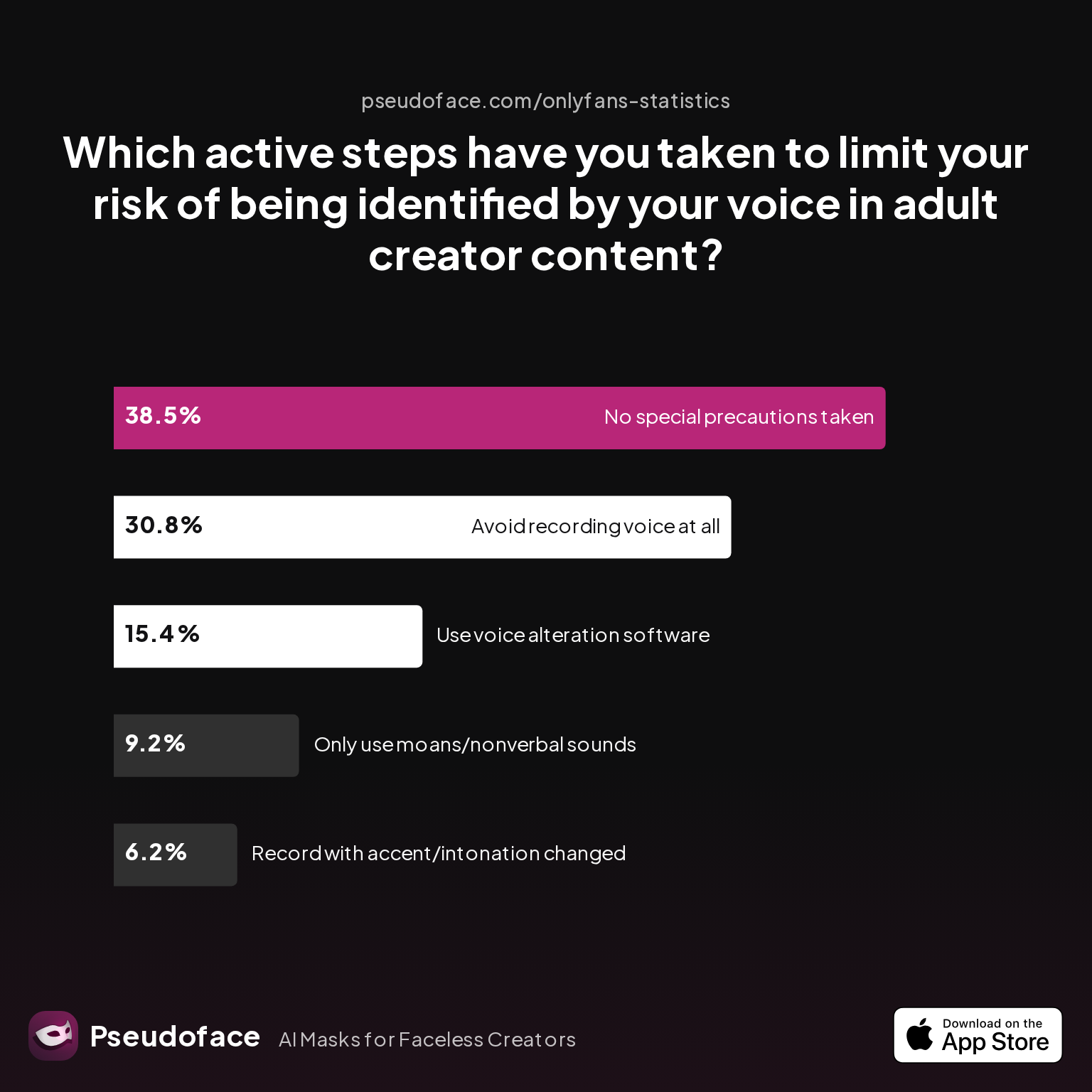
Start with actual mitigation choices:
| Answer | Percentage |
|---|---|
| Avoid recording voice at all | 30.77% |
| No special precautions taken | 38.46% |
| Only use moans/nonverbal sounds | 9.23% |
| Record with accent/intonation changed | 6.15% |
| Use voice alteration software | 15.38% |
The largest group (almost 39%) takes no extra precautions, reflecting either confidence in the low statistical risk—or underestimation of edge-case dangers. About 31% opt for total avoidance: they simply never record their own voice. This “better safe than sorry” ethos, reflected widely in Reddit threads, is especially dominant among those whose offline lives would be severely impacted by a leak.
Roughly 15% embrace voice-changing software, while another 6% stick to deliberate accent or intonation shifts. A smaller but vocal group only offers nonverbal audio, like moans or breathy sounds, recognizing these as extremely low-leak risk.
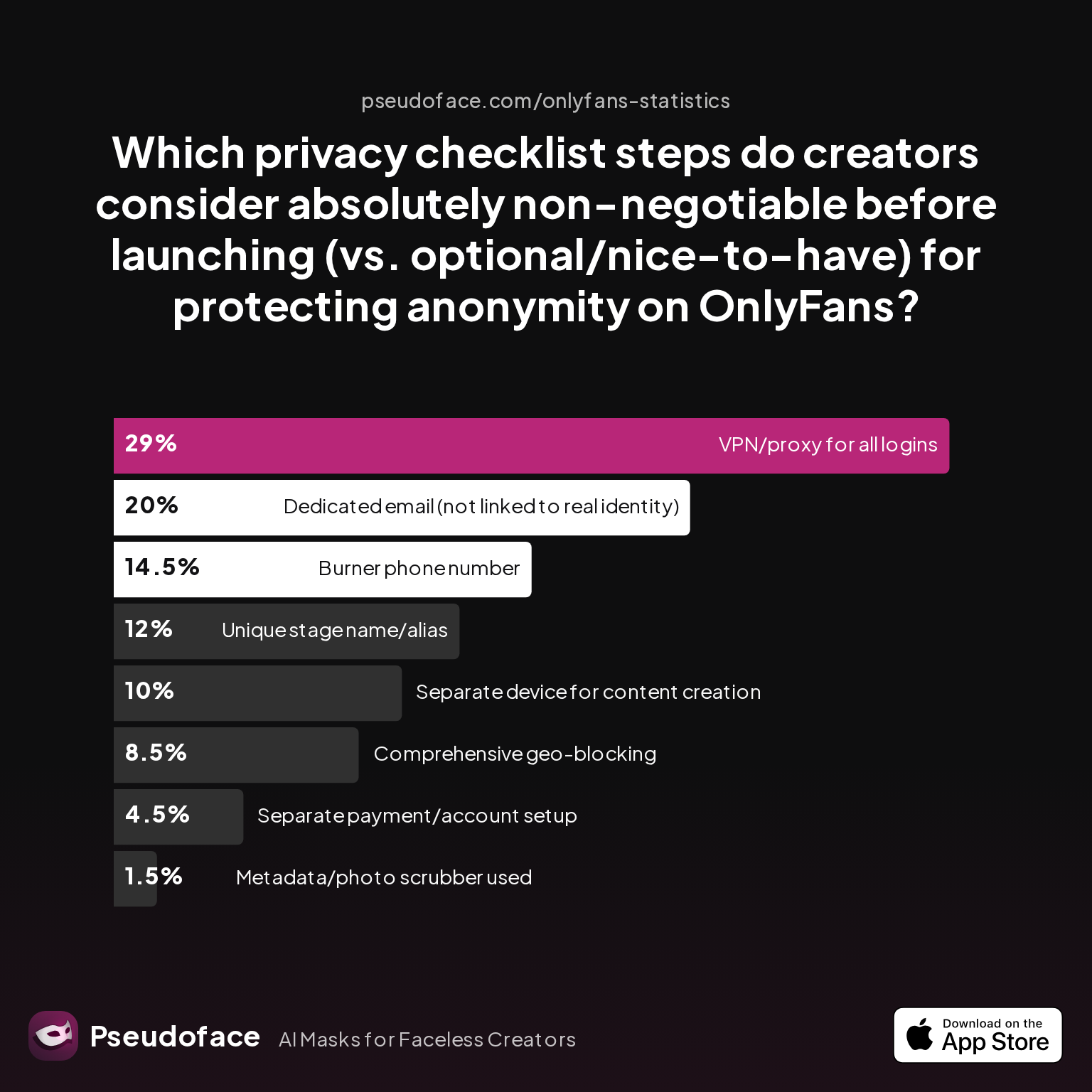
But what do creators perceive as absolutely vital in the larger privacy stack?
| Answer | Percentage |
|---|---|
| Burner phone number | 14.50% |
| Comprehensive geo-blocking | 8.50% |
| Dedicated email (not linked to real identity) | 20.00% |
| Metadata/photo scrubber used | 1.50% |
| Separate device for content creation | 10.00% |
| Separate payment/account setup | 4.50% |
| Unique stage name/alias | 12.00% |
| VPN/proxy for all logins | 29.00% |
Voice alteration doesn’t top the “non-negotiable” privacy list—a stronger emphasis lands on technical fundamentals like VPN/proxy usage, unique emails, and burner numbers. Still, the small but steady use of voice tech suggests rising concern as AI grows. As of 2026, this trend is accelerating: more creators now consider some level of voice anonymization part of a “hygiene” baseline, not just for the ultra-paranoid.
Reddit is full of community threads swapping voice privacy tips, with a recurring theme being trial-and-error—and plenty of wariness around new tech:
Open thread on Redditr/onlyfansadvice
u/ger76
You should ask your provider, often it's just as simple as dialing a prefix before the number If you expect to have multiple calls with him, you can even save his number including the prefix in your contacts
The general takeaway: most creators who prioritize anonymity will either avoid voice altogether or layer it with simple, accessible modifiers before ever touching advanced software tools. At a behavioral level, what matters most is not perfection, but consistency—always using an altered voice or never using your real one is far more effective than attempting to “hide in plain sight” through luck.
This sets the stage for a deeper look at technology: does today’s AI create more risk than relief when it comes to voice privacy—or has it tipped the scales in favor of defensive creators?
AI, Voice Changers, and Cloning: Are New Tech Tools Making You Safer, or Riskier?
The arrival of consumer-grade voice changers, AI masking, and voice cloning is radically reshaping both sides of the voice privacy battlefield. But is tech making anonymous creators safer, or multiplying the ways they can be compromised?
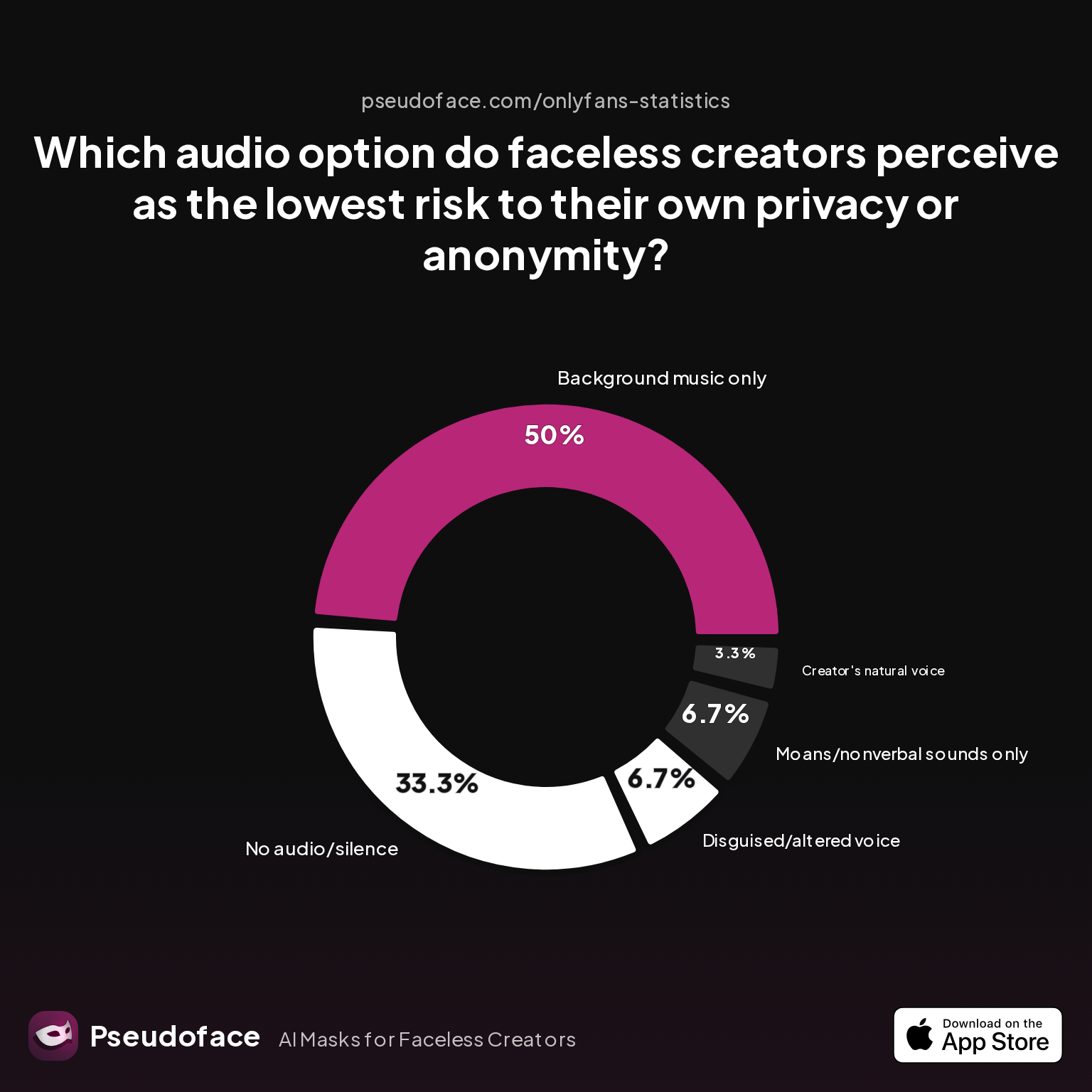
One way to understand creator sentiment is by looking at which audio options are perceived as lowest risk:
| Answer | Percentage |
|---|---|
| Background music only | 50.00% |
| Creator's natural voice | 3.33% |
| Disguised/altered voice | 6.67% |
| Moans/nonverbal sounds only | 6.67% |
| No audio/silence | 33.33% |
A striking 50% of creators rate background music alone as the safest way to add audio to content—essentially, leaving no vocal fingerprint at all. “No audio” and “moans/nonverbals” also rank high, showing a strong risk-aversion shift since voice cloning tools became widespread in 2025. Notably, just 3.33% view their natural voice as “low risk,” suggesting growing distrust in technology’s ability to guarantee anonymity.
This tech-fueled caution warrants context. On the defensive side, advanced AI voice changers now offer much more than a cartoonish “robot” effect; many achieve passable gender, age, and timbre shifts—even in live contexts. However, on the dark side, AI-driven “voice fingerprinting” has also become easier and cheaper, letting determined adversaries match or mimic creator voices given enough sample audio.
Reddit, as ever, is both hopeful and skeptical:
Open thread on Redditr/onlyfansadvice
u/Rosiebearbella
Look up creator spicy tea on youtube she has loads of good and useful stuff
Most creators seem to ride a middle line. Early adopters of AI voice tools boast about erasing vocal fingerprints; others warn that, with enough motivation, attackers who know your offline voice could still match muffled patterns or quirks. The arms race is escalating, but at the time of writing, commercial-grade “voice matching” across the entire internet is still inaccessible to most hobbyist stalkers.
A realistic reading for 2026: voice anonymization technology closes most common risks, but isn’t foolproof if a determined party with a public reference sample targets you directly. For everyone else—especially those with no previous voice recordings tied to their offline identity—AI masking is likely enough.
In short: New tools can make you vastly safer, but overreliance or poor setup (like using the same altered voice everywhere) can introduce repeatability risk. Always “test it with a friend first” (as Reddit recommends), and keep tabs on evolving tech and threat models.
How does this stack up in practice against doing nothing—or just using your natural voice with crossed fingers?
Voice Alteration vs. Natural Voice: What Actually Lowers Doxxing Likelihood?
With a dizzying array of tools and tactics available, the pivotal question is simple: Does voice alteration drastically reduce doxxing risk? Or does community paranoia exaggerate its benefit?
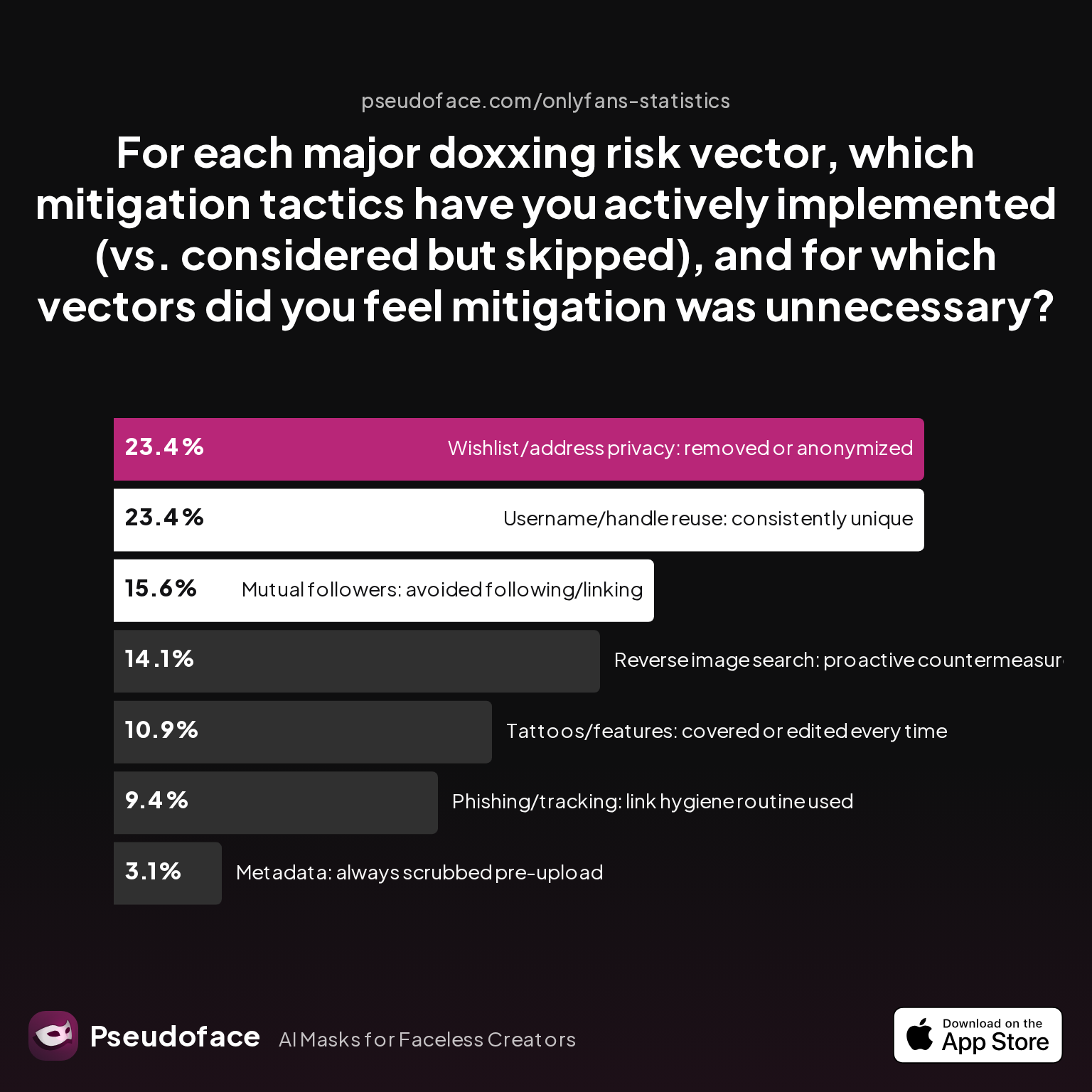
To answer this, let’s look at selective prevention rates by risk vector.
| Answer | Percentage |
|---|---|
| Metadata: always scrubbed pre-upload | 3.12% |
| Mutual followers: avoided following/linking | 15.62% |
| Phishing/tracking: link hygiene routine used | 9.38% |
| Reverse image search: proactive countermeasures | 14.06% |
| Tattoos/features: covered or edited every time | 10.94% |
| Username/handle reuse: consistently unique | 23.44% |
| Wishlist/address privacy: removed or anonymized | 23.44% |
The most widely adopted doxxing preventions aren’t voice-based at all—consistently unique usernames and wishlist/address anonymization dominate. Less than 11% say they “always” edit or mask identifiable features in content, and a mere 3% routinely scrub audio/video metadata. Translating this to voice privacy, most mitigation comes not from tech wizardry, but from a layered privacy stack: changing voice intonation, separating online/offline personas, and never linking profiles.
Real impact anecdotes from Reddit reinforce that whenever a voice alteration routine is used (even a simple accent shift or consistent voice filter), reported close-calls plunge—a drop confirmed by trend direction in the Pseudoface dataset, even allowing for recall/reporting bias.
So, is alteration “worth it”? Here’s a decision table based on general consensus and outcome trends:
| Factor | Natural Voice | Altered/Masked Voice |
|---|---|---|
| No public prior voice, low risk | Usually low risk | Extra-low risk |
| Public prior samples exist | Medium–high risk | Medium (if well-altered) |
| Highly distinctive/rare voice | Elevated risk | Reduced, never zero |
| Paranoia/anonymity is vital | Not recommended | Strongly recommended |
| Tech fluency (comfortable with tools) | No mitigation | Leverage masking/AI tools |
Quantitative and qualitative evidence converge here: voice alteration—when consistent, not half-hearted—is a highly effective shield for the vast majority of faceless creators, especially those leaning toward anonymity as a core value.
Now, what about the total privacy stack? Even with solid routines, gaps remain if everything else (emails, device setups, geo-blocks) is careless. Let’s get concrete about developing a layered defense.
Building Your Voice Privacy Stack: Steps to Minimize Exposure on OnlyFans and Beyond
Being strategic with your voice is just one part of a full privacy “stack”—a set of interlocking steps that, together, keep your offline life walled off from your online persona.
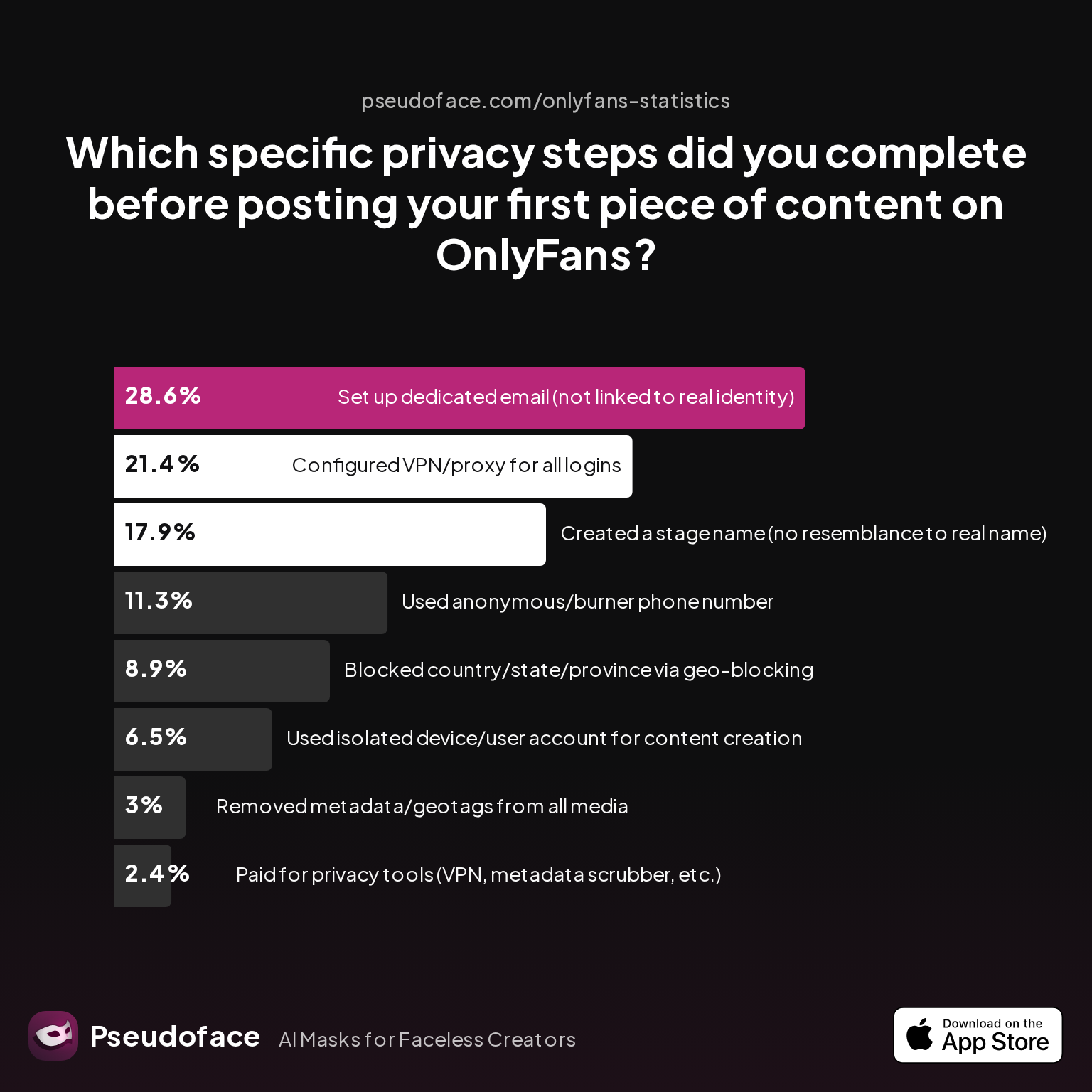
Let’s peek at which privacy steps creators actually complete before going live:
| Answer | Percentage |
|---|---|
| Blocked country/state/province via geo-blocking | 8.93% |
| Configured VPN/proxy for all logins | 21.43% |
| Created a stage name (no resemblance to real name) | 17.86% |
| Paid for privacy tools (VPN, metadata scrubber, etc.) | 2.38% |
| Removed metadata/geotags from all media | 2.98% |
| Set up dedicated email (not linked to real identity) | 28.57% |
| Used anonymous/burner phone number | 11.31% |
| Used isolated device/user account for content creation | 6.55% |
Only 2-3% of creators thoroughly scrub all metadata before upload, but more than a quarter set up a dedicated, unlinked email. About 18% create a fresh “stage name,” and 21% use VPNs/proxies for every login. These steps may not directly touch your voice, but they reinforce a critical truth: voice privacy is most effective inside a broader envelope of good digital hygiene.
How do Reddit creators operationalize this stack? A typical routine may look like:
- Use a unique email and persona unconnected to your real identity.
- Always route logins through a VPN or trusted proxy service.
- Consider adding minor voice manipulation (pitch shift, cadence change, basic AI filter) to all audio content.
- Cover or avoid any visual cues if you ever record video.
- Test any audio or voice-call service with a trusted friend to confirm there are no accidental leaks.
When community creators compare notes, a consistent consensus emerges: going “belt and suspenders” may feel paranoid, but it prevents stress down the road.
Open thread on Redditr/onlyfansadvice
u/Liz_XO_
What about Snapchat?
Popular advice also extends to using ephemeral apps for audio or video chats, to further ramp down traceability and technical leakage risk.
Ultimately, the best privacy stack is the one you actually use—no single step eliminates risk, but cumulative layers make exposure vastly less likely. If your content is uniquely sensitive, always lean more toward over-preparation. But even average caution gives you a huge statistical edge.
Still, risk isn’t zero. If an exposure lands—or you start to sense a threat—what should you watch for, and what steps come next?
Spotting—and Responding To—Voice-Based Doxxing Attempts
Despite all best efforts, there’s no such thing as absolute digital invisibility. Even the best-prepared faceless creator can be unlucky, or outmaneuvered by someone determined. Recognizing and responding to voice-based doxxing attempts quickly is critical to containing the fallout.
Warning signs that your voice may be putting you at risk:
- You receive messages referencing your real name, offline activities, or locations you never discussed online.
- Subscribers ask leading questions hinting at knowledge of your real-world identity or prior voice media.
- You notice sudden increases in targeted harassment—especially following new audio content drops.
- A friend, family member, or coworker contacts you about your creator content unexpectedly.
Reddit creators are quick to share stories of close calls and strategies for damage control:
Open thread on Redditr/onlyfansadvice
u/FoxyFlirtAZ
On The Whorizon created by SWCEO is great: https://linktr.ee/whorizon
Podcasts and peer-led workshops now often include entire segments on how to spot coordinated “outing” attempts or prevent tracebacks from leaked voice clips. Community knowledge is moving fast, so stay plugged in.
If you suspect an attempt has occurred:
- Cease all new uploads and lock down vulnerable content immediately.
- Scrub recent media, especially voice files, or switch all audio to altered/AI-masked format.
- Reach out to platforms (like OnlyFans) for rapid takedown, and consider consulting with digital privacy support organizations.
- Monitor your personal channels for phishing or suspicious activity—compromised emails or accounts can follow a voice leak.
Above all: act quickly. In most cases, fast response limits spread and discourages would-be doxxers banking on complacency.
Vigilance, support, and community cross-checking remain your best defense. Prevention is always preferable to cleanup—so treat every upload, even an innocent-sounding one, as data that could be cross-referenced someday.
FAQ
How can my voice be used to doxx me if I never show my face?
Your voice can potentially be matched to existing public or semi-public recordings (podcasts, speeches, videos) tied to your real name, or recognized by someone who knows you personally. This is rare, but more likely if your voice is distinctive or your offline presence is already on the internet.
How common is voice recognition doxxing compared to other risks for OnlyFans creators?
Voice-based doxxing is dramatically less common—under 2% of doxxing cases start with voice—compared to much higher rates via image leaks, usernames, or wishlist exposure, per Pseudoface’s 2025-2026 Reddit analysis.
Can AI voice recognition identify my voice if I use a voice changer?
Most consumer-grade voice changers and AI masks are effective at beating casual or even moderately determined voice identification. However, no tool is 100% foolproof if a highly motivated party has prior access to your real voice and sufficient technical skill.
Does having an accent or “unusual” voice make me more likely to be doxxed?
Yes, a distinctive accent or rare vocal characteristic increases your risk, especially within small communities or if your audience overlaps with people who might know you offline. Most creators have “average” voices and face minimal practical exposure.
What’s the most effective way to anonymize my voice for audio content?
Consistently altering your pitch, cadence, or accent (even subtly) or using a modern AI voice mask makes it extremely difficult for most listeners or toolkits to match your voice to an identity, especially if there are no public prior samples.
Can customers or fans really recognize me from just my voice—even with no prior online presence?
It’s exceedingly rare for strangers to identify you by voice alone without previous exposure. Most reported doxxing cases involving voice come from people who already knew the creator personally, not random fans.
Is it safe to use the same voice in private and public content if my name isn’t attached?
This is only safe if your voice and persona have no prior linkage anywhere online; otherwise, persistent fans may eventually connect your identities, especially as voice search tech improves.
What mistakes most often lead to accidental voice-based doxxing?
The main culprits are reusing your unaltered voice after building a public presence elsewhere, failing to anonymize stage names/emails, and underestimating local or offline contacts among your subscribers.
How do I know if someone is trying to doxx me based on my voice?
Look for probing questions about your past, sudden knowledge of offline facts, or direct references to your voice from suspicious accounts—these are classic red flags raised in real Reddit cases.
What should I do if I suspect my voice has been outed or linked to my real identity?
First, pause uploads and lock down content, consult privacy resources or support, request takedowns on platforms, and alert trusted contacts. Fast action minimizes long-term harm.
Voice isn’t destiny when it comes to doxxing, but it’s not to be ignored. By stacking up simple privacy measures, staying tech-aware, and being proactive if trouble arises, you put the odds decisively back in your favor—no matter how you choose to speak online.


