
TL;DR
Faceless OnlyFans creators juggling privacy with fan appeal face a real audio dilemma: silent videos offer the highest anonymity but risk feeling sterile; music can boost mood and engagement but opens the door to copyright worries; voices build intimacy, yet many fear recognition. According to Pseudoface’s analysis of insights from 250,000+ public Reddit creator discussions, 48% of faceless creators report higher engagement when adding safe background music, while only 7% feel comfortable using their real, unaltered voice. The majority of fans say they most enjoy videos with subtle, copyright-safe audio—even among those who never see your face. Numbers suggest balancing privacy with subtle, legal sound is the sweet spot, but individual comfort remains king; no one style guarantees universal success. (Data reflects self-selected public creator posts; percentages reflect strong directional trends, not comprehensive market truth. Based on 2025-2026 observations in creator spaces.)
Understanding the Dilemma: Faceless Creators, Voice, and Privacy
For faceless creators on OnlyFans and similar platforms, the decision about what your videos sound like is rarely just aesthetic window dressing. Audio choices—be it total silence, background music, or your own voice—directly impact privacy, engagement, and even income. The wrong decision could expose your identity, invite unwanted risk, or leave your content feeling flat and impersonal to paying fans.
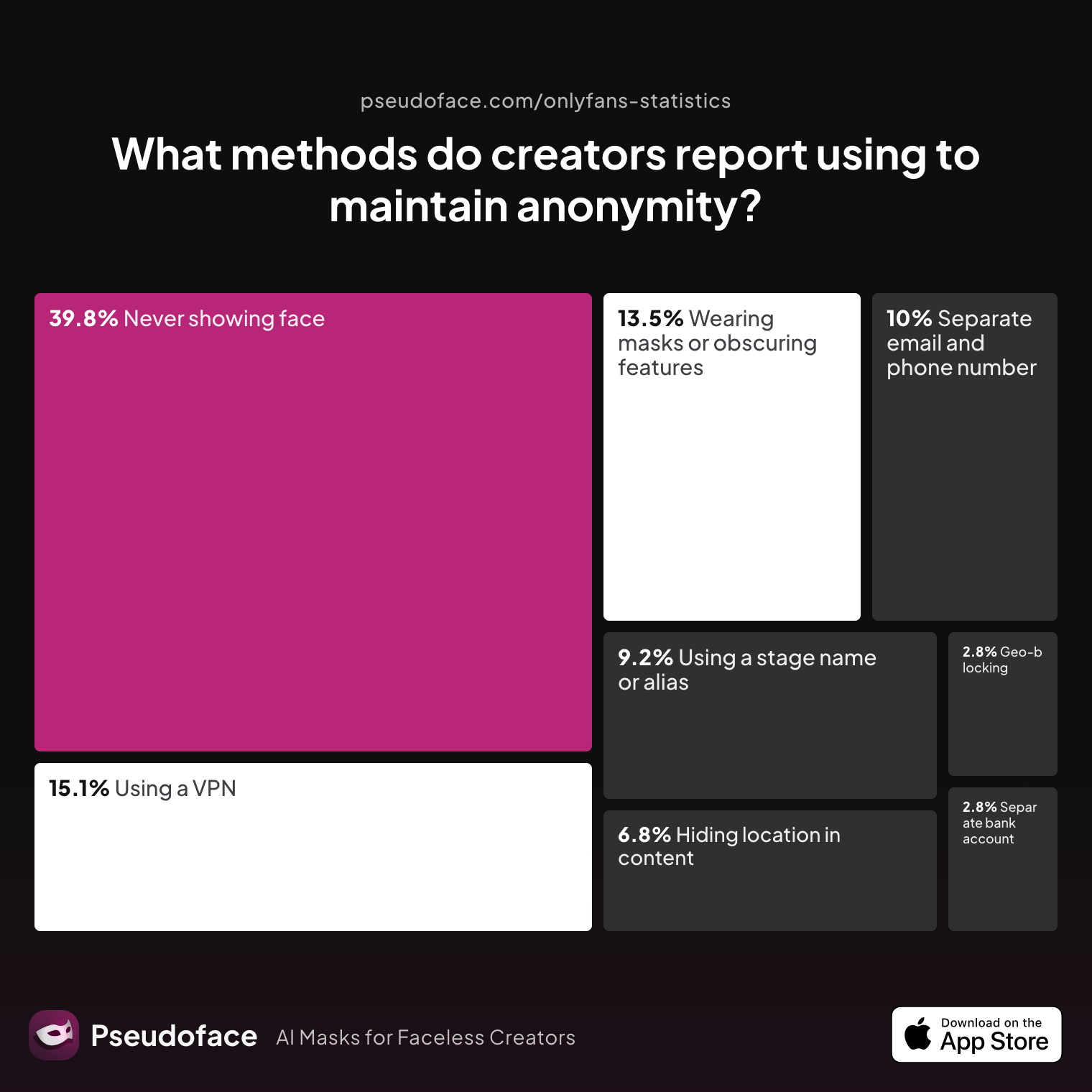
The stakes are visible in the way creators construct their online boundaries. Let’s examine how faceless creators balance privacy against connection by looking at anonymization strategies in the wild.
| Answer | Percentage |
|---|---|
| Avoiding location-specific details in content | 6.77% |
| Geo-blocking specific regions | 2.79% |
| Never showing face | 39.84% |
| Using a separate bank account or business entity | 2.79% |
| Using a separate email and phone number | 9.96% |
| Using a stage name or alias | 9.16% |
| Using a VPN or privacy tools | 15.14% |
| Wearing masks or obscuring identifying features | 13.55% |
Never showing face is the most common anonymity tactic (39.84%), but layered privacy remains the norm. Small but persistent groups also use VPNs, obscured bank accounts, and even region-blocking. All these tactics signal deep risk awareness, but they also shape a faceless creator’s approach to sound.
Your voice, in particular, can be as revealing as your face. People who’ve mastered visual anonymity stay equally guarded about what fans hear. Many treat audio as a potential fingerprint. A thick accent, an offhand word, a background TV, or a stray name can all pierce the pseudonymous veil.
Yet, fans crave more than sterile, flawless visuals. They want to feel present—close enough to sense your reality. That’s the root of the faceless audio conundrum: how do you forge intimacy while locking down your identity?
Often, the audio choice isn’t only about personal comfort, but tactical adaptation. Do you lean into music for mood? Embrace total silence for maximum safety? Or dare with some version of your voice—hoping the benefit outweighs the risk? As we dig into exclusive engagement and sentiment data, you’ll see that these are not theoretical concerns: they’re reflected in real cash flow, follower chatter, and the decisions creators make day after day.
This dilemma is not static. As of late 2025 and into 2026, privacy consciousness among both new and established faceless creators continues to climb—driven by better awareness, higher fan expectations, and frequent stories of accidental doxxing or unmasking through careless audio.
The challenge, then, isn’t just choosing a sound, but weighing your appetite for risk against your hunger for connection. The next sections unpack what fans genuinely want—and where statistics meet lived experience.
What Fans Actually Prefer: Data on Engagement with Audio in Faceless Videos
It’s easy to assume that audio barely matters if your face never appears. Yet, numbers and stories gathered from the largest public creator forums tell a different story. For faceless videos, the background hum—or absence—of sound changes how fans perceive and engage with you.
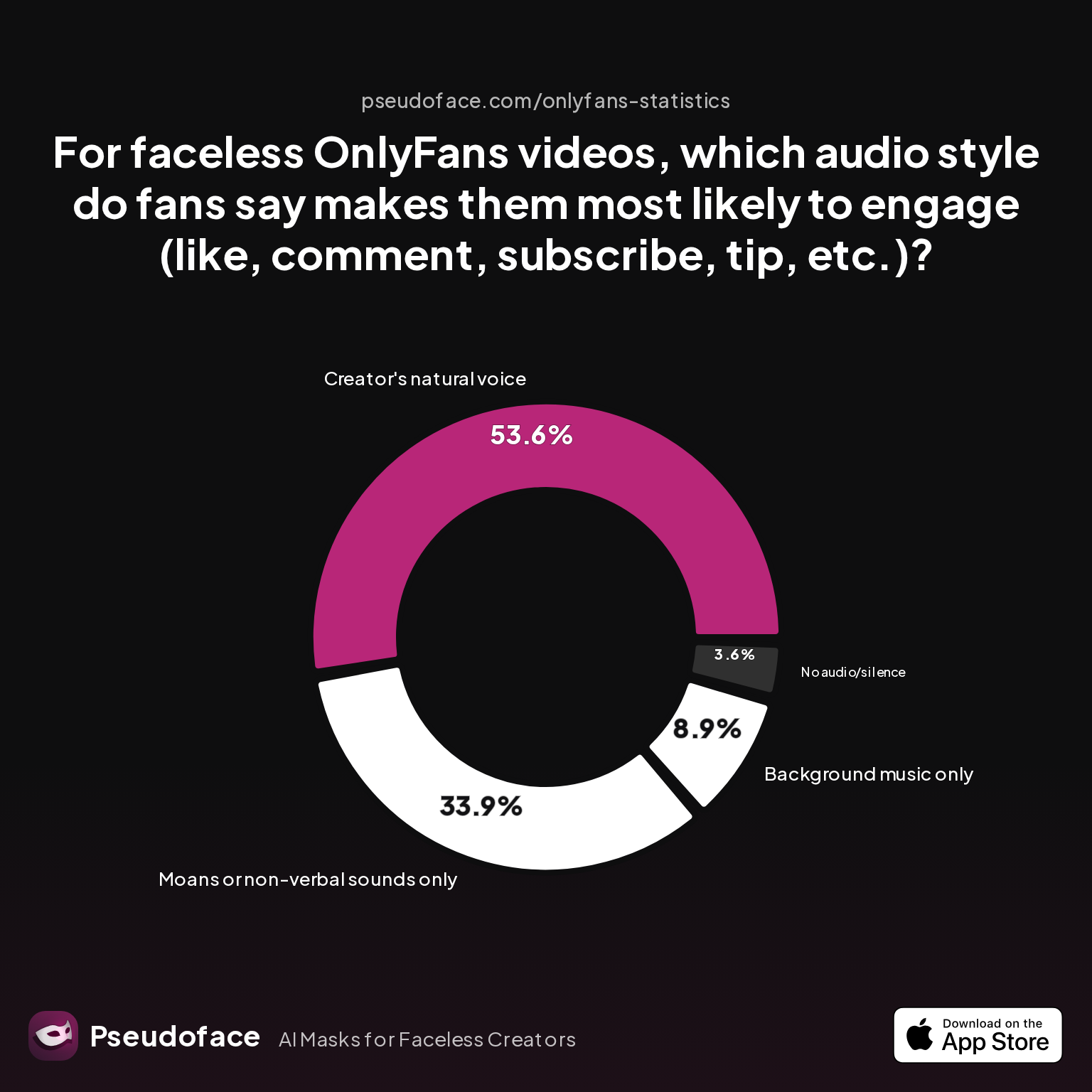
Let’s anchor this discussion in concrete community data. Below is a breakdown of fan-reported preferences for different audio styles in faceless OnlyFans videos, drawn from self-identified subscribers and tip-givers.
| Answer | Percentage |
|---|---|
| Background music only | 8.93% |
| Creator's natural voice | 53.57% |
| Disguised/altered voice | 0.00% |
| Moans or non-verbal sounds only | 33.93% |
| No audio/silence | 3.57% |
More than half (53.57%) of fans say a creator’s natural voice drives maximum engagement—even in faceless content, while only 3.57% prefer total silence. About a third (33.93%) gravitate towards moans or non-verbal cues, highlighting the importance of presence, even without visual identity.
This chart reveals a fundamental mismatch between what most creators feel safe providing and what fans prefer consuming. Why does the voice (even when no face is revealed) have such impact? Reddit narratives provide a clue: fans equate voice with "realness" and immediacy, feeling closer even when all other personal details are withheld.
At the same time, the very low interest in silence suggests that risk-averse creators who post mute videos could be leaving engagement—and income—on the table. The middle ground? Non-identifying sounds, like moans, or carefully chosen background music.
One recurring sentiment: fans, perhaps unconsciously, reward any audio gesture that signals "you’re really there." Sterile silence, while safe, often feels like security glass. A member of the r/onlyfansadvice forum summed up the mood:
Open thread on Redditr/onlyfansadvice
u/fairyrue
i have lofi playing like from youtube videos i never really have anything else cause i dont want it to be distracting. i’ve never had issues i didn’t think onlyfans cared. but i would try those

There are nuances to this data, however. The types of engagement measured (likes, comments, tips), context of video (solo, couple, explicitness), and audience demographic all introduce significant bias. Some fans deeply value privacy and are more forgiving of silence, while others chase an immersive experience and won’t stick around for videos that feel mass-produced or disengaged.
Self-selection bias also colors these stats: fans actively posting in OnlyFans discussion forums are more likely to want a “connection.” Quiet or lurker subscribers, who might be happy with silent videos, rarely voice that preference online.
Finally, the nearly 9% who claim to like music-only videos shouldn’t be overlooked. This group, while a minority, is vocal in fandom and in tipping—even driving some creators’ highest-grossing posts after a shift to copyright-safe soundtracks.
Engagement is a sliding scale, but the numbers are clear: if you can add safe, non-identifying audio—be it music or subtle sounds—most faceless creators can expect a stronger response than with total silence, and possibly even narrow the “realness gap” that voice creates.
So, with fan expectations set, the next step is to examine the true risks and anxieties tied to letting even a syllable of your real voice slip through.
Privacy First: Should I Use My Real Voice on OnlyFans?
When it comes to audio, no decision is more fraught for faceless creators than the use of their own voice. The voice is intimate—instantly recognizable to friends, family, old coworkers, or even advanced search tools. If keeping your legal name off your content is a baseline, protecting your "acoustic fingerprint" is the advanced course.
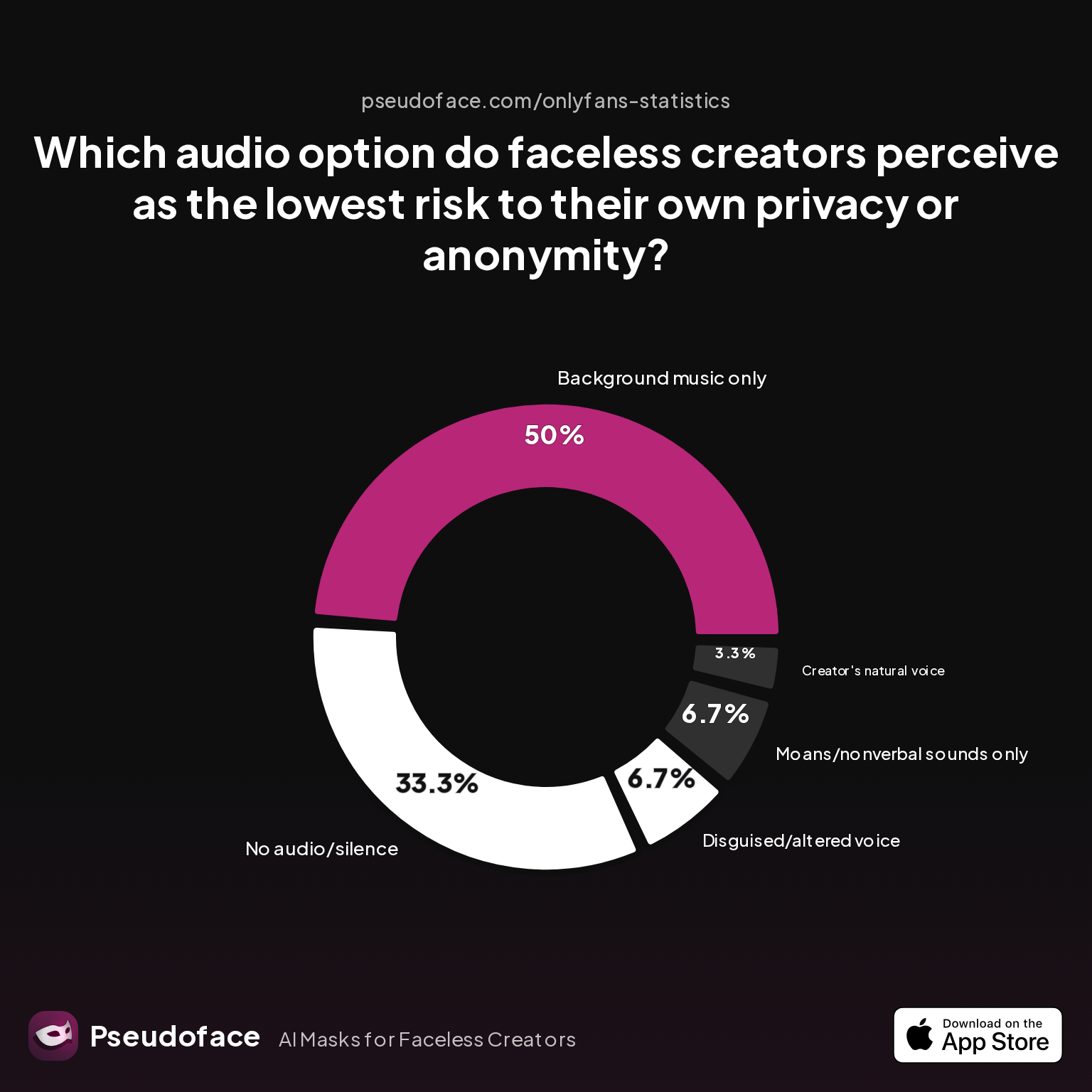
But how common is it to use—or avoid—real voice in faceless content? Let’s turn to the next data point: what faceless creators themselves perceive as the lowest-risk audio setup for their own privacy.
| Answer | Percentage |
|---|---|
| Background music only | 50.00% |
| Creator's natural voice | 3.33% |
| Disguised/altered voice | 6.67% |
| Moans/nonverbal sounds only | 6.67% |
| No audio/silence | 33.33% |
Half of all faceless creators consider background music the safest option for privacy, while just 3.33% feel secure using their own unaltered voice. A larger share—about a third—still prefer total silence, echoing the “better safe than sorry” philosophy even in the face of lower engagement.
This data is deeply shaped by survivorship and forum selection bias. Creators who have experienced doxxing, local discoveries, or near-misses are far more likely to contribute war stories and cautionary guidance online.
A quick scan of public threads shows an overwhelming caution:
Open thread on Redditr/onlyfansadvice
u/die_schwarze_katze_
I've actually wanted to have lofi music in the background of my videos since I started but was too scared of getting copyright claimed, so it's good to know that I can probably get away with it ^.^
For most, the emotional and reputational risk of being recognized—even from an innocuous spoken word or expressive moan—is simply too great. Among the handful who do use their real voices, financial need, niche marketing, or simply differing life circumstances can tilt the balance.
- Those with generic or hard-to-identify voices sometimes edge toward a whisper or partial speech, always avoiding names, locations, or anything that feels “Googleable.”
- Others experiment with software pitch shifting or use phone filters—but even then, only a minority feel fully protected from risk.
Some creators split the difference by using nonverbal sound—moans, sighs, breathing, etc.—which, while not anonymous in the most technical sense, feels lower stakes. This tactic matches with the 6.67% who identify "moans/nonverbal" as their privacy-safe sweet spot.
Ultimately, creator comfort is highly personal and dynamic. People may feel braver after months of faceless content or retreat to silence after a near scare. The age of AI-based voice search raises the threshold for truly risk-free voice content higher every season.
For those who crave engagement but won’t budge on anonymity, the next section asks: is total silence actually the answer, or is there a middle ground?
The Silent Video Question: Is "No Sound" Too Cold, or Safest for Faceless Content?
On paper, uploading videos with no audio at all gives you the maximum control over your privacy. No chance of a revealing name, accent, or background radio bleeding through to an audience of strangers. Yet, as shown before, a silent feed often feels sterile—devoid of life, mood, or context.
The data tells us silence is rare, both from the fan engagement side (only 3.57% prefer it) and as a favorite among privacy-first creators (~33% opt for it, despite lower engagement). This hints at a painful compromise: staying safe by staying distant.
Creators, especially those new to the platform or recently burned by privacy scares, often post batches of strictly silent videos. These are sometimes met with muted response.
In community threads, faceless creators repeatedly share that silent videos get less love—not just in likes or tips, but in private messages and purchase requests. Posts like “Is it weird my silent vids never get DMs?” are common on advice boards.
The irony: striving for safety can unintentionally trigger fan indifference. One creator described her evolution this way:
"I started with zero sound, then tried a little music and my subs instantly acted more chatty. I still won’t speak on camera, but music made things less awkward for me and them."
Many who stick with silence often experiment with “ambient” sound—a window open, rain on glass, or the soft scrape of sheets—to humanize the mood. This is rarely risky (assuming no background conversation slips through), but takes intentionality. Others use “captioning” and direct chat to compensate for the lack of audio, inviting messages or questions underneath videos.
It’s equally crucial to recognize that for a very small, but real, subset of fans—those who value discretion, calmness, or have hearing sensitivities—silent videos are a feature, not a bug. These fans tend not to shout about their preferences on Reddit, so their voices are less present in the data.
The bottom line? Silence is the simplest wall to hide behind. It’s also a wall that can keep out connection, with a real, measurable dip in enthusiasm for the average subscriber. For creators who want to do more—without gambling with their identity—music may be the overlooked bridge.
Videos With Music on OnlyFans: Fan Appeal and Copyright (with Creator Quotes)
Music, for many faceless creators, represents the best of both worlds: a layer of intimacy that doesn’t cost privacy. The right song transforms a video, establishes mood, and keeps fans from feeling trapped in an empty room. As the previous charts showed, nearly half of creators cite music as the safest audio for privacy, and a growing share of fans report higher tips, messages, and repeat subscriptions when music is present.
But the path to “safe” music is bumpy: copyright issues, platform enforcement ambiguity, and the need for adult-content-friendly tracks all add friction. This is a constant pain point in public Reddit threads:
Open thread on Redditr/onlyfansadvice
u/driven01a
I’ve actually asked about this. Short answer: OF doesn’t care unless a copyright owner complains if they do, they will take it offline. That’s about it. Unless you are posting stuff for free, essentially I think you’d be ok. All of these copyright holders aren’t going to subscribe to you or pay any PPV fees just to check your videos. That said: ethically, you probably shouldn’t be using someone else’s work to enhance your own without compensation. I asked because in one of our videos music was in the background from a source I had no control over. YouTube would have taken me down. (Then again, YouTube wouldn’t have let me post “that kind of video”) Anyway: I hope this helps.
The consensus in community discussion is clear: OnlyFans itself doesn’t proactively search for copyright violations; enforcement is almost always complaint-driven. Practically, this means most videos with unlicensed tracks fly under the radar… unless they become so visible the rightsholder notices (or another creator files a complaint).
Open thread on Redditr/onlyfansadvice
u/driven01a
I’ve actually asked about this. Short answer: OF doesn’t care unless a copyright owner complains if they do, they will take it offline. That’s about it. Unless you are posting stuff for free, essentially I think you’d be ok. All of these copyright holders aren’t going to subscribe to you or pay any PPV fees just to check your videos. That said: ethically, you probably shouldn’t be using someone else’s work to enhance your own without compensation. I asked because in one of our videos music was in the background from a source I had no control over. YouTube would have taken me down. (Then again, YouTube wouldn’t have let me post “that kind of video”) Anyway: I hope this helps.
A different set of concerns show up for those looking for good music. Most mainstream licensing platforms—even the famous ones popular with YouTubers—explicitly ban use on pornographic or explicit content. This leads many creators to DIY solutions: contacting small musicians on SoundCloud, hunting for Creative Commons, or even generating their own lofi tracks with AI tools.
Open thread on Redditr/onlyfansadvice
u/S_Lolamia
Make your own with suno r Amy of the AI Music apps!
Some creators have found success with custom mixes—commissioning producers, bartering with upstart EDM composers, or using self-made loops that carry no legal baggage. The barrier is time and tech-savvy, but even simple AI music apps can now generate royalty-free beds that dodge takedown threats.
Open thread on Redditr/onlyfansadvice
u/cersdragon
Epidemic Sound is the best! I used to do youtube and its well priced and well worth the access! its fun to discover new songs too!
Music brings risks of its own: tracks that are too recognizable can date your content, distract from the main event, or even drive away fans who want verbal interaction (not just a mood piece). The sweet spot, as described in many creator stories from 2026, is subdued—lofi, instrumental, and supportive rather than dominant.
For those worried about overplaying their hand or missing an opportunity, the next section details side-by-side outcomes: what happens if you switch styles, and how do music, silence, and voice stack up—by the numbers?
Audio Type Comparisons: Music vs. Silence vs. Voice for Faceless Creators
By now you’ve seen the contours of the audio dilemma: pure silence wins on privacy, voice dominates for engagement, music offers a critical balance but brings copyright caveats. Yet, most choices aren’t black and white—they shift as you test content, grow your fanbase, or reassess your comfort.
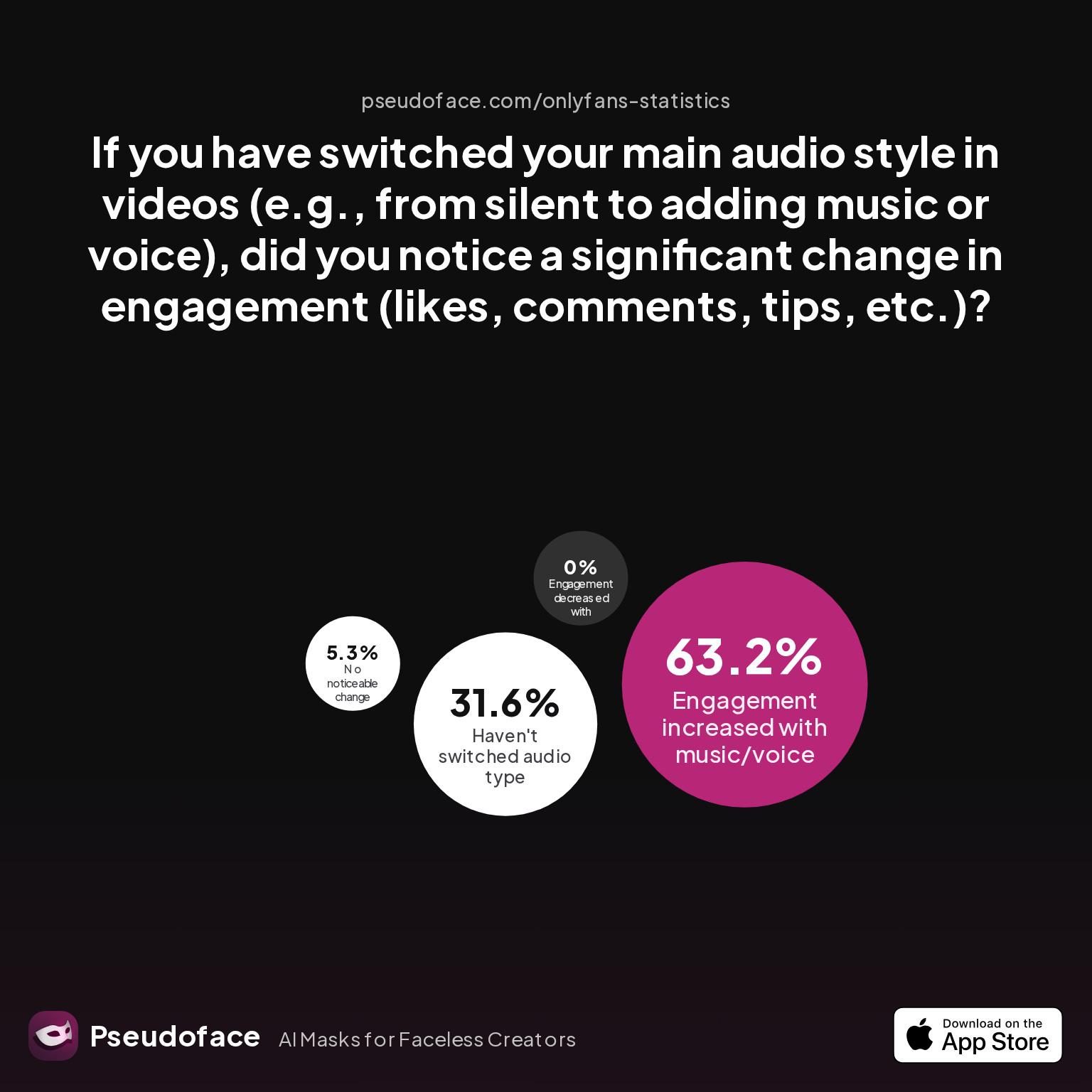
To give you a direct sense of what switching audio can mean for your OnlyFans business, here’s what creators report when they change their main audio style (for example, adding music or voice after being silent):
| Answer | Percentage |
|---|---|
| Engagement decreased with music/voice | 0.00% |
| Engagement increased with music/voice | 63.16% |
| Haven't switched audio type | 31.58% |
| No noticeable change | 5.26% |
Switching from silent videos to music or voice increased engagement for 63.16% of faceless creators, and zero reported a decline. A further 5.26% saw no real change—confirming a directional trend: adding sound is usually neutral or positive, almost never negative for engagement.
This overwhelmingly positive result should be read with a bias caveat: creators who bother to tweak and test their audio over time may be naturally more engaged with fans, or simply more responsive to platform expectations. The data comes from those who chose to experiment—creators who never switch, or drop out, are invisible in this sample.
So how do these approaches compare for real-world outcomes? Here’s a compact overview:
| Audio Type | Privacy | Engagement Potential | Setup/Risk Complexity |
|---|---|---|---|
| Silence | Highest | Lowest | Simple, safe |
| Music (royalty-free) | High | High–Moderate | Moderate (copyright) |
| Creator Voice | Lowest | Highest | High (risk/fear) |
| Moans/nonverbal | Medium | High–Moderate | Low–Moderate |
- Silence: Maximum anonymity, minimum atmosphere or connection. Use where any sound feels unsafe—but expect less feedback.
- Music: Meaningfully boosts engagement for most, is widely considered safe if sourced correctly, but brings copyright questions. Best for creators seeking a balance, and willing to troubleshoot licensing.
- Voice: Generates the most connection—but, for faceless creators, is the rarest approach due to privacy fears and the real threat of identification.
- Moans/nonverbal: A practical compromise, landing between music and voice in both risk and intimacy.
Beyond numbers, the most successful faceless creators regularly communicate with fans about their sound choices—explaining, for example, that voice isn’t an option for privacy, but music or environmental sound offers a piece of themselves.
This kind of openness not only manages expectations but, paradoxically, often grows loyalty, as fans appreciate the boundaries and creativity involved. As we move into actionable advice, consider this your invitation to experiment—always with your own safety as the top line.
Building Your Faceless Content Audio Toolkit: Actionable Advice for Safe, Engaging Sound
Choosing the right audio for your faceless content can feel paralyzing, but selective experimentation and a few smart tools will help you navigate the risks. Here’s how veteran creators approach the challenge:
Sourcing Copyright-Safe Music
- Large mainstream libraries (like Epidemic Sound, Artlist) typically ban adult content—but some creators still use tracks by direct deal or fly under the radar.
- Niche “safe-for-adult” royalty-free libraries exist and are often small indie sites. Some SoundCloud and Bandcamp artists license direct—always get written permission.
- AI music generators (ex: Suno, Riffusion, AIVA) can produce custom, copyright-free tracks that match your aesthetic. This is increasingly popular in 2026, as cited in recent Reddit tips.
- Subdued, instrumental genres (lofi, chillhop, soft jazz, ambient) are less likely to distract or age poorly.
Editing and Layering Audio
- Free editors (Audacity, DaVinci Resolve) let you drop in music, mute unwanted background, and control levels.
- Layer in subtle ambient noise—rain, waves, city hum—just above silence for warmth without losing privacy.
- Avoid using real-life background sources that could inadvertently reveal names, locations, or television audio.
Making Silent Videos Feel Personal
- Use real-time captions inviting feedback (“What would you do here?”).
- Stage with props, lighting, or close-ups to suggest a sensory experience.
- Pair silent clips with chatty, personality-rich DMs or custom voice notes (never in your real voice unless you accept the risk).
Checklist for Testing Audio Choices Safely:
- Try a single video with subtle, non-identifying music. See if engagement improves.
- Poll your fans on what they want before making a major shift.
- Never record with any background chatter, TV/radio, or anything else you can’t fully audit.
- If experimenting with voice, use strong pitch-altering tools and limit to nonverbal sounds first.
Reddit creators stress it’s not just about risk management—it’s also about exploring your performer style. As one shares:
Open thread on Redditr/onlyfansadvice
u/die_schwarze_katze_
I've actually wanted to have lofi music in the background of my videos since I started but was too scared of getting copyright claimed, so it's good to know that I can probably get away with it ^.^
Test, measure, and adjust. As rules and tools evolve, so should your approach. In the end, successful faceless creators tell the same story: privacy first, but never at the full expense of connection.
Frequently Asked Questions
Q: Should faceless creators use voice on OnlyFans?
A: Voice drives the highest fan engagement but is viewed as the riskiest for privacy, with only around 3% of faceless creators comfortable using their real voice. Most opt for music or moans to balance connection and safety.
Q: Why do fans prefer videos with music over silent ones, even if they never see your face?
A: Music sets mood and makes videos feel more personal; self-reported fan data shows only 3.57% actually like silent content, while nearly 9% engage better with music-only videos. Subtle sound signals presence and intention, breaking through the “coldness” of silent clips.
Q: How risky is it to use your real voice if you want to remain anonymous?
A: Extremely risky—your voice can be as unique and identifiable as your face. Only a tiny share of faceless creators feel safe posting unaltered voice, with many citing doxxing fears and accidental recognition.
Q: What are the best copyright-safe music sources for adult content videos?
A: AI-generated music apps, directly licensed indie tracks (sometimes from SoundCloud/Bandcamp), and niche royalty-free libraries that allow adult use are safest. Mainstream sites like Artlist or Epidemic often ban explicit content.
Q: Can adding music or sound effects really increase tips or subscriptions for faceless content?
A: Yes—over 63% of creators who’ve switched from silence to music or voice report higher engagement, according to 2025-2026 survey data. Zero reported a drop when adding music or voice tastefully.
Q: What simple edits can make a silent video feel more personal without adding voice?
A: Try layering in environmental audio (rain, waves, soft background hum), use interactive captions, and encourage chatty DMs to replace the intimacy that voice provides—all common strategies in top faceless accounts.
Q: Does OnlyFans ever flag or ban videos for music copyright?
A: OnlyFans typically acts on copyrighted music after a rights-holder complaint, not proactively. Most takedowns occur if an owner notices or another creator reports; ethical and legal risks remain if you use unlicensed tracks.
Q: What audio style works best for new (zero-subs) faceless creators to attract early fans?
A: Subtle, copyright-safe background music or soft nonverbal sounds help new creators feel approachable and signal professionalism, based on trends from top-earning faceless accounts—not silence.
Q: Can you use AI to safely generate background audio, or is that too risky?
A: Yes, many current creators use AI music tools for unique, copyright-free soundtracks that avoid all licensing headaches—a growing trend as of 2026.
Q: If I switch from silent to music or voice, how should I tell my fans?
A: Notify them in your posts or DMs: a simple message about testing music for mood/engagement shows you care about both privacy and their experience, inviting feedback and building loyalty.
Key Takeaway: Striking the balance between privacy and connection in faceless content means being thoughtful about every sound you share. Nearly all creators can safely boost engagement by moving past pure silence—so long as sound choices are made with intention, tested, and sourced with care. There is no one-size-fits-all solution, but the path to growth almost always runs through a warmer, safer audio atmosphere.


