
TL;DR
You can post “faceless” on OnlyFans—using cropping, careful blurring, light digital filters, or physical masks—but both platform rules and enforcement become far stricter if you attempt these for identity verification or use heavy AI face swaps. Over half of creators seeking anonymity end up confused or flagged, especially with AI-altered faces or aggressive filters; most minor digital edits are tolerated, but heavy masking or advanced face alteration almost always fail verification and can risk accounts. Based on 2024 analysis of 250,000+ Reddit threads by Pseudoface, real creators’ reports show where OnlyFans draws the line on filters, swapping, and face concealment—and what happens if you cross it.
Navigating OnlyFans Faceless Creation: Balancing Anonymity With Platform Rules
For adult creators, privacy and online safety aren’t abstract concepts—they’re concrete needs. The explosion of “faceless” content on OnlyFans reflects not trendiness, but this deep and ongoing desire to separate real-world identity from work that, fairly or unfairly, still carries stigma and risk. But how does that need for anonymity stack up against OnlyFans’ growing demands for ID, face visibility, and compliance?
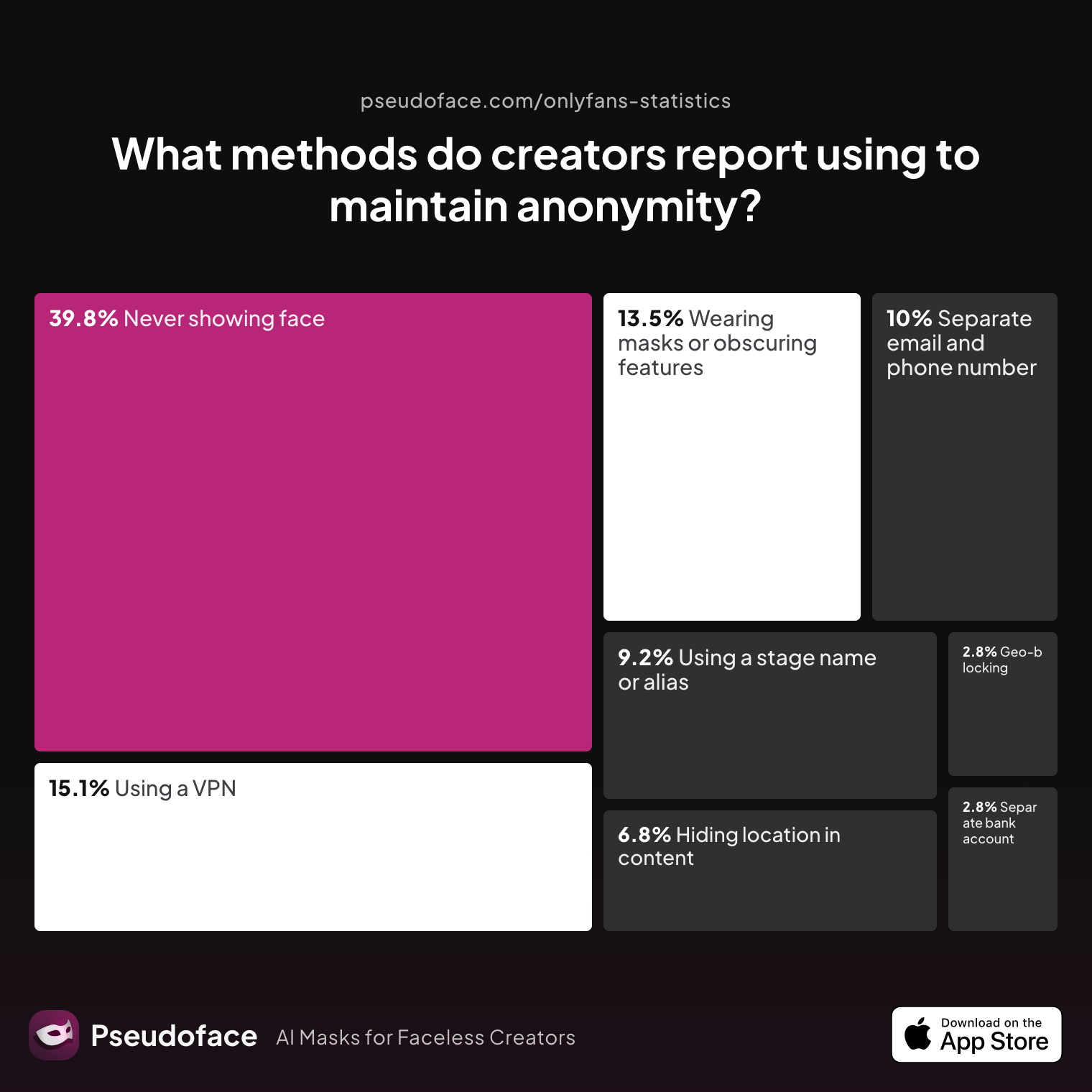
Let’s start with the big picture. According to Pseudoface’s 2024 analysis of over a quarter-million creator conversations, keeping your face hidden isn’t fringe:
| Answer | Percentage |
|---|---|
| Avoiding location-specific details in content | 6.77% |
| Geo-blocking specific regions | 2.79% |
| Never showing face | 39.84% |
| Using a separate bank account or business entity | 2.79% |
| Using a separate email and phone number | 9.96% |
| Using a stage name or alias | 9.16% |
| Using a VPN or privacy tools | 15.14% |
| Wearing masks or obscuring identifying features | 13.55% |
Nearly two in five creators surveyed report “never showing face” in at least some or all of their content. Masks and other physical “obscuring” methods, though less common, still make up a substantial 13.5% among creators prioritizing privacy.
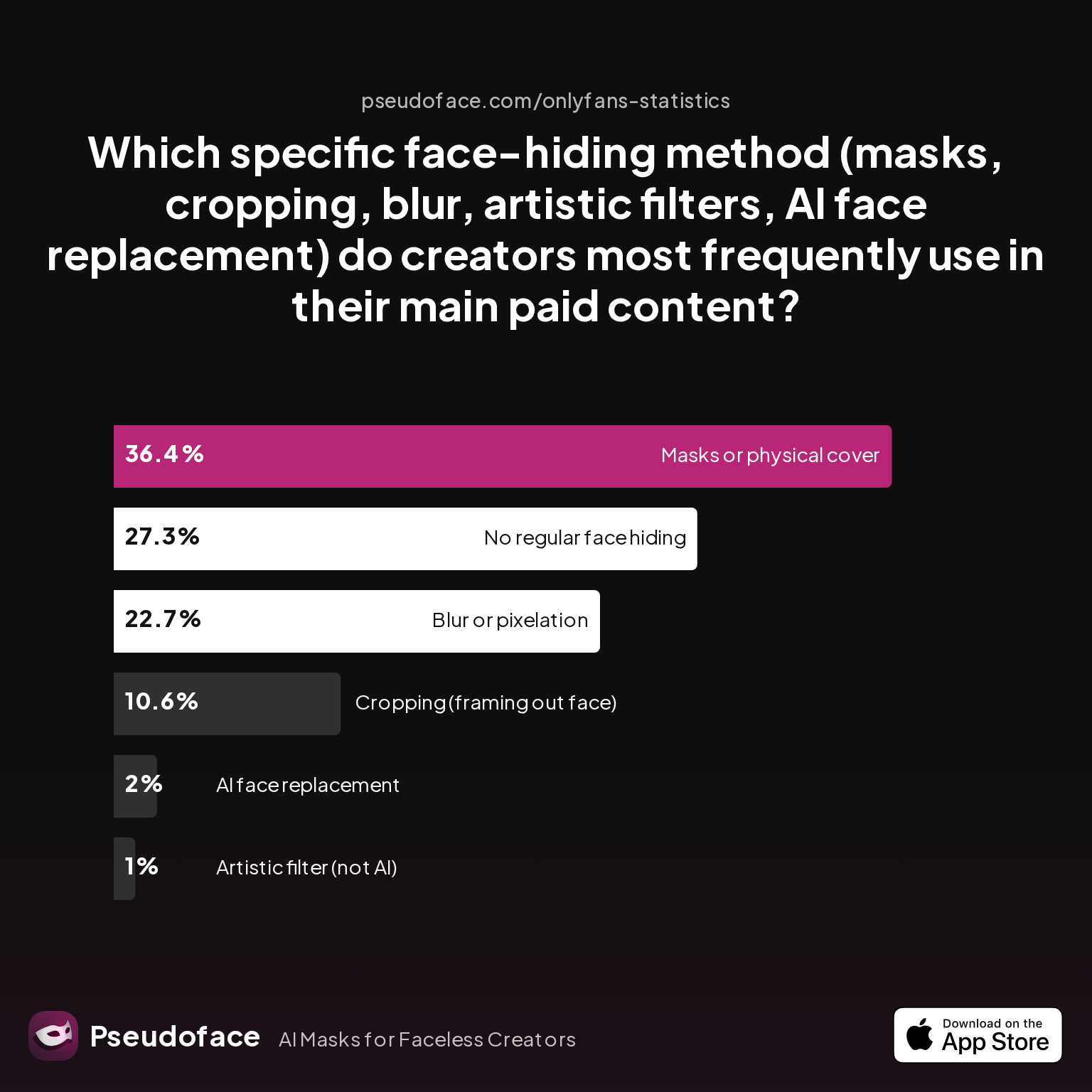
That landscape isn’t uniform: creators blend digital, physical, and social strategies to keep themselves protected. But what does this look like in terms of main, paid content?
| Answer | Percentage |
|---|---|
| AI face replacement | 2.02% |
| Artistic filter (not AI) | 1.01% |
| Blur or pixelation | 22.73% |
| Cropping (framing out face) | 10.61% |
| Masks or physical cover | 36.36% |
| No regular face hiding | 27.27% |
Physical masks and cover-ups edge out even digital edits, coming in as the most popular method for hiding a face in paid content (36%). Blur/pixelation is next (23%), followed by cropping (11%) and, notably, aggressive AI face-swaps at only 2%.
But here’s where stakes become clear: every method interacts with OnlyFans’ rules differently—sometimes resulting in takedowns, flags, or unwanted attention from moderators. “Faceless” doesn’t mean riskless; and not all strategies are created equal in the eyes of the platform or its automated review systems.
Open thread on Redditr/onlyfansadvice
u/stonerbbyyyy
considering you don’t have to show face on your content i don’t think it’s that big of a deal. but i would read the TOS to be sure, or you can probably contact support and ask.

Beneath the surface of “you don’t have to show your face” are unwritten (and often shifting) rules—especially for those who want to keep their faces altered or anonymous but still pass OnlyFans’ account verification, release forms, and payouts.
Next, we’ll break down OnlyFans’ actual written and enforced policies around digital face alteration—especially face filters and blurs.
The OnlyFans Face Filter Policy: What’s Allowed, What Risks Review
For newcomers, digital face tweaks—softening features, removing blemishes, AI beautification—can feel like a harmless shield. Many see filter use as a gray, “safe enough” way to boost privacy without a full mask or hard crop. But how much digital editing is actually allowed before OnlyFans’ moderators or algorithms cry foul?
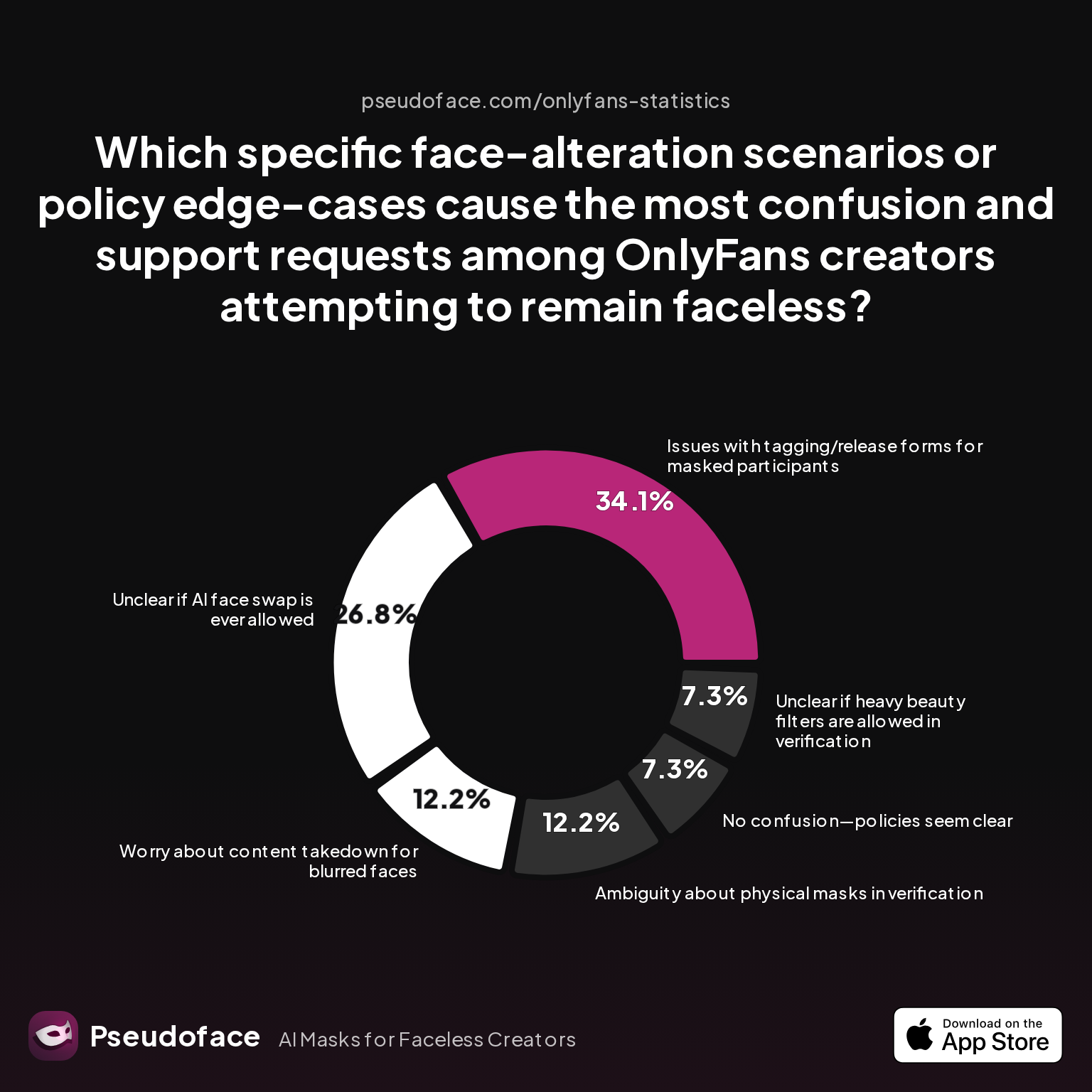
While OnlyFans doesn’t publish a granular public guide about filters, creator experience illustrates a blurry line. Mild filters typically pass, but anything that fundamentally “masks” your real features can trigger review or outright rejection. Here’s where confusion shows up most:
| Answer | Percentage |
|---|---|
| Ambiguity about physical masks in verification | 12.20% |
| Issues with tagging/release forms for masked participants | 34.15% |
| No confusion—policies seem clear | 7.32% |
| Unclear if AI face swap is ever allowed | 26.83% |
| Unclear if heavy beauty filters are allowed in verification | 7.32% |
| Worry about content takedown for blurred faces | 12.20% |
Over 60% of creators trying to obscure their faces report confusion or issues, especially where filters, AI, or physical masking intersect with OnlyFans review. Only 7% felt the policies were “clear” from the start.
The real friction is around so-called “heavy beauty filters”—Snapchat, Instagram, FaceApp, or more advanced artistic/cartoon filters. Even creators with familiarity express confusion about posting filter-heavy images:
Open thread on Redditr/CreatorsAdvice
u/Beneficial_Bit_5851
I don’t think they’d allow it but you can ask support
Three trends define OnlyFans’ approach, as reported during 2025-2026:
- Mild beautification or lighting fixes generally pass (especially if applied to non-ID-verification content).
- Heavy “masking” (cartoon, painterly, ultra-softening, or artistic distortion) can trigger human/AI review, especially if facial features become unrecognizable.
- For payout and verification, any digital modification to a face or ID photo will almost always cause rejection.
False positives (when AI flags a legitimate photo) aren’t rare; most are resolved after extra review but may delay launches or trigger extra ID checks.
Creators report a tactical “middle path”: use mild filter tweaks for content, but leave all verification media (and at least some sample content) as natural as possible. Many also note their main risk is with retroactive enforcement: OnlyFans may allow filtered posts at first, but upon manual review or user report, suddenly pull content or request resubmission.
The bottom line? Digital face filtering is an option, but must remain subtle—anything that seriously obscures your identity, or seems to “replace” your face, enters risky territory.
Now that we’ve mapped the boundaries of digital editing, we’ll tackle AI face swaps and emerging face replacement techniques—and why these cause unique compliance headaches.
OnlyFans Face Swap Policy and the Rise of AI Face Tools
By 2026, the surge in AI tools—deepfakes, face swaps, and fully synthetic “faces”—has moved from technological possibility to daily reality for many creators. But while fans may not spot the difference, OnlyFans’ moderation and compliance teams are increasingly aware. So, what actually happens if you attempt to use AI face swaps in your OnlyFans content?
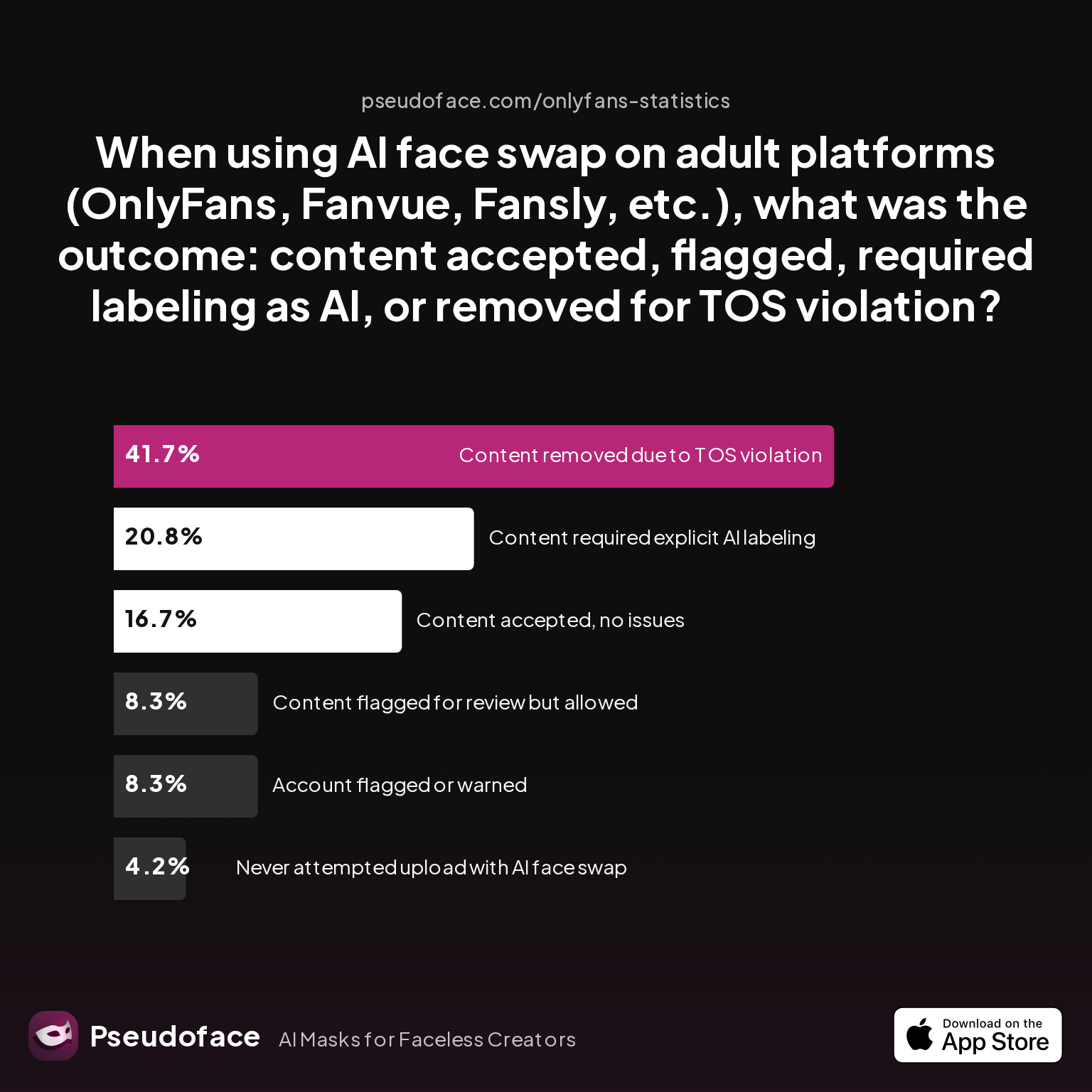
Let’s look at outcomes from Pseudoface’s Reddit analysis:
| Answer | Percentage |
|---|---|
| Account flagged or warned | 8.33% |
| Content accepted, no issues | 16.67% |
| Content flagged for review but allowed | 8.33% |
| Content removed due to TOS violation | 41.67% |
| Content required explicit AI labeling | 20.83% |
| Never attempted upload with AI face swap | 4.17% |
Over 40% of creators uploading AI face-swap content saw their posts removed for Terms of Service (TOS) violations on OnlyFans or similar platforms. Another 8% were flagged or warned, while a minority—about 17%—saw content accepted without incident.
This isn’t just a technical debate—it’s an ethical and legal minefield. What are creators worried about?
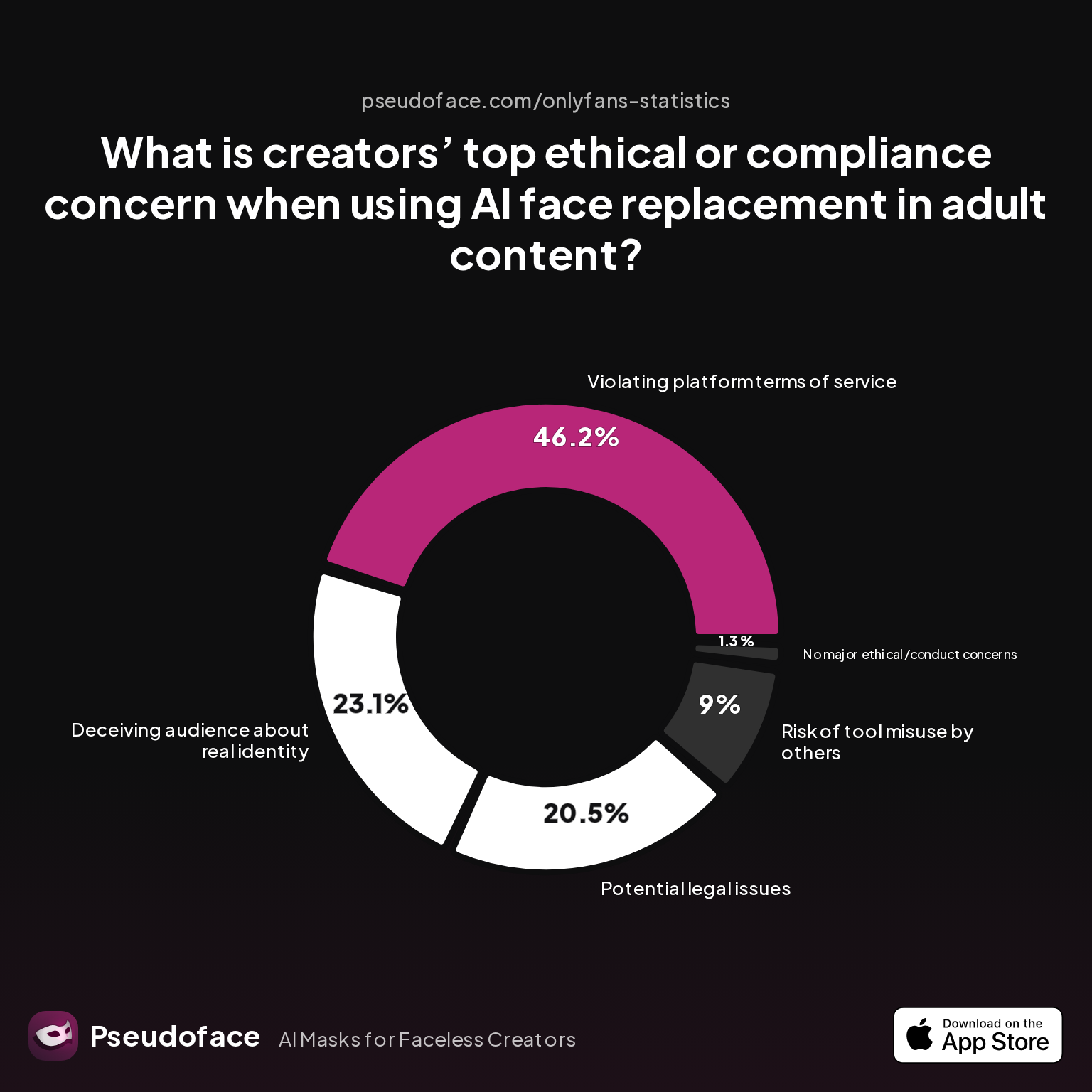
| Answer | Percentage |
|---|---|
| Deceiving audience about real identity | 23.08% |
| No major ethical/conduct concerns | 1.28% |
| Potential legal issues | 20.51% |
| Risk of tool misuse by others | 8.97% |
| Violating platform terms of service | 46.15% |
Nearly half (46%) of creators’ top concern with AI face tools is violating platform terms of service. Another quarter cite deception or potential legal problems as major worries.
And how much do creators feel aware of these grey zones? Not nearly as much as they should.
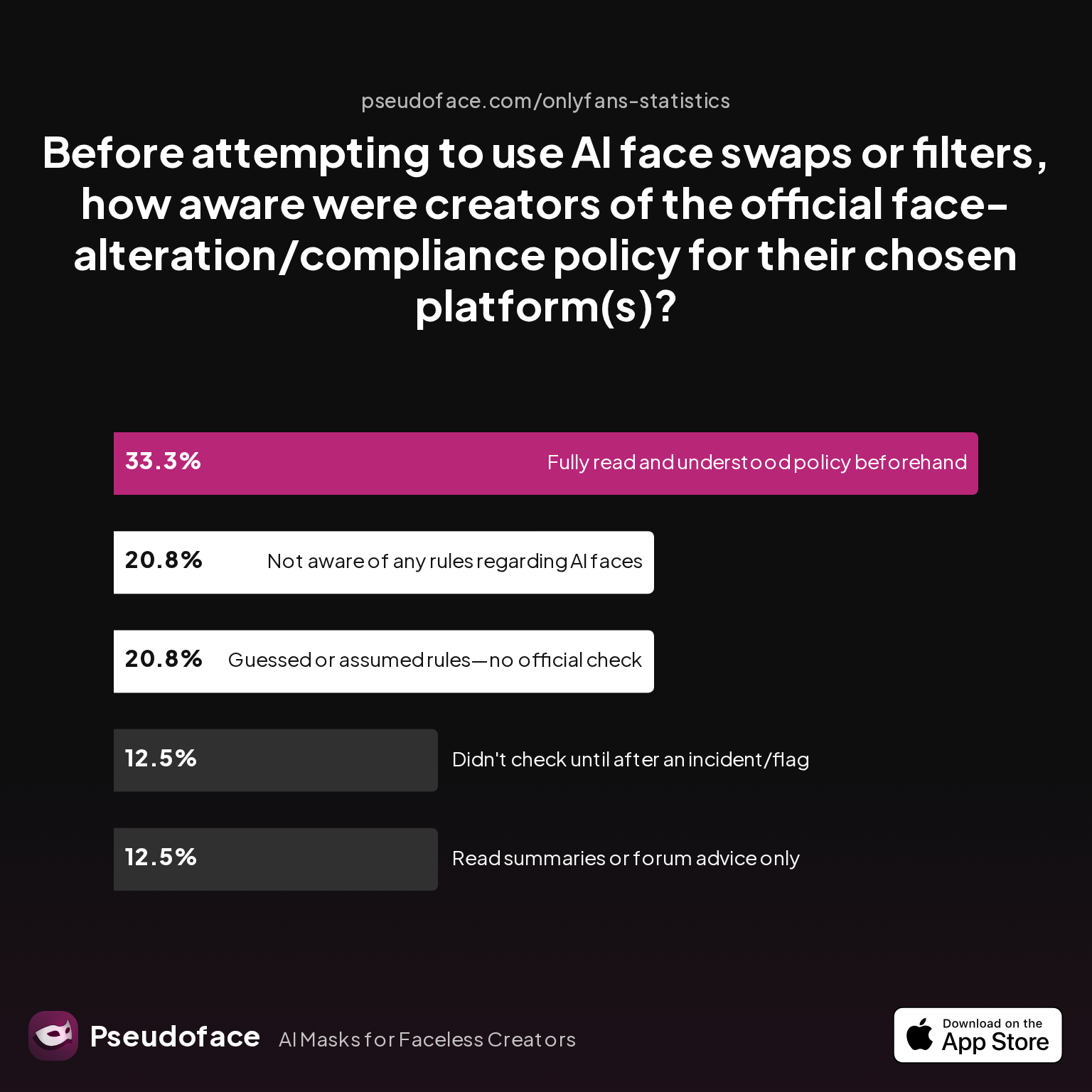
| Answer | Percentage |
|---|---|
| Didn't check until after an incident/flag | 12.50% |
| Fully read and understood policy beforehand | 33.33% |
| Guessed or assumed rules—no official check | 20.83% |
| Not aware of any rules regarding AI faces | 20.83% |
| Read summaries or forum advice only | 12.50% |
A full third of creators read and understood official policy before trying AI faces—but an alarming 41% either assumed the rules, didn’t check, or weren’t aware of any at all. That knowledge gap explains much of the carnage seen above.
Bias caveat: Forum discussions will always overrepresent those who’ve run into issues or had posts removed (creating survivorship and reporting bias). For every horror story on Reddit, there may be many “stealth successes”—but the risk trajectory is clear.
Open thread on Redditr/onlyfansadvice
u/TheRampantUnicorn
You can use your second account slot to potentially solve this issue, creators usually use this as their "free" account. Sign up to OF again using a different email, verify yourself again using the same documents as your main account, create a release form link on your main account, log into your second account, open it and fill in all the necessary information. Once you have signed and approved the release form link on your second account, you should have a tag you can use on your main account that you can use to tag yourself or posts that are being mistakenly flagged.
So what’s allowed? The evidence is nuanced:
- Light AI touch-up may go undetected or be tolerated if the primary face is still recognizable.
- Full face swap—especially if the face can’t be matched to ID or previous content—invites both takedown and potential account suspension.
- Explicitly labeling content as AI is now required by some platforms (and demanded by OnlyFans on review), but this doesn’t always prevent removal.
By 2025-2026, detection technology has improved, meaning AI edits that passed a year ago may get flagged now. If your goal is long-term account stability, heavy AI face swaps are a high-risk bet.
The gray area is shrinking. OnlyFans, in step with most regulated platforms, is moving toward clearer “natural face only” requirements, especially for anything tied to identity or proof of consent.
Many creators turn to physical anonymity strategies instead—so let’s now address masks, sunglasses, and how OnlyFans handles identity verification with hidden faces.
Masks, Sunglasses, and OnlyFans Mask Verification: Where the Line Gets Drawn
For many, physical masks, sunglasses, or heavy makeup feel like a sure way to maintain privacy while still creating content. But when it comes to platform policy—especially around verification and release forms—the answer is stark: masks almost always trigger rejection.
Review the leading rejection reasons below:
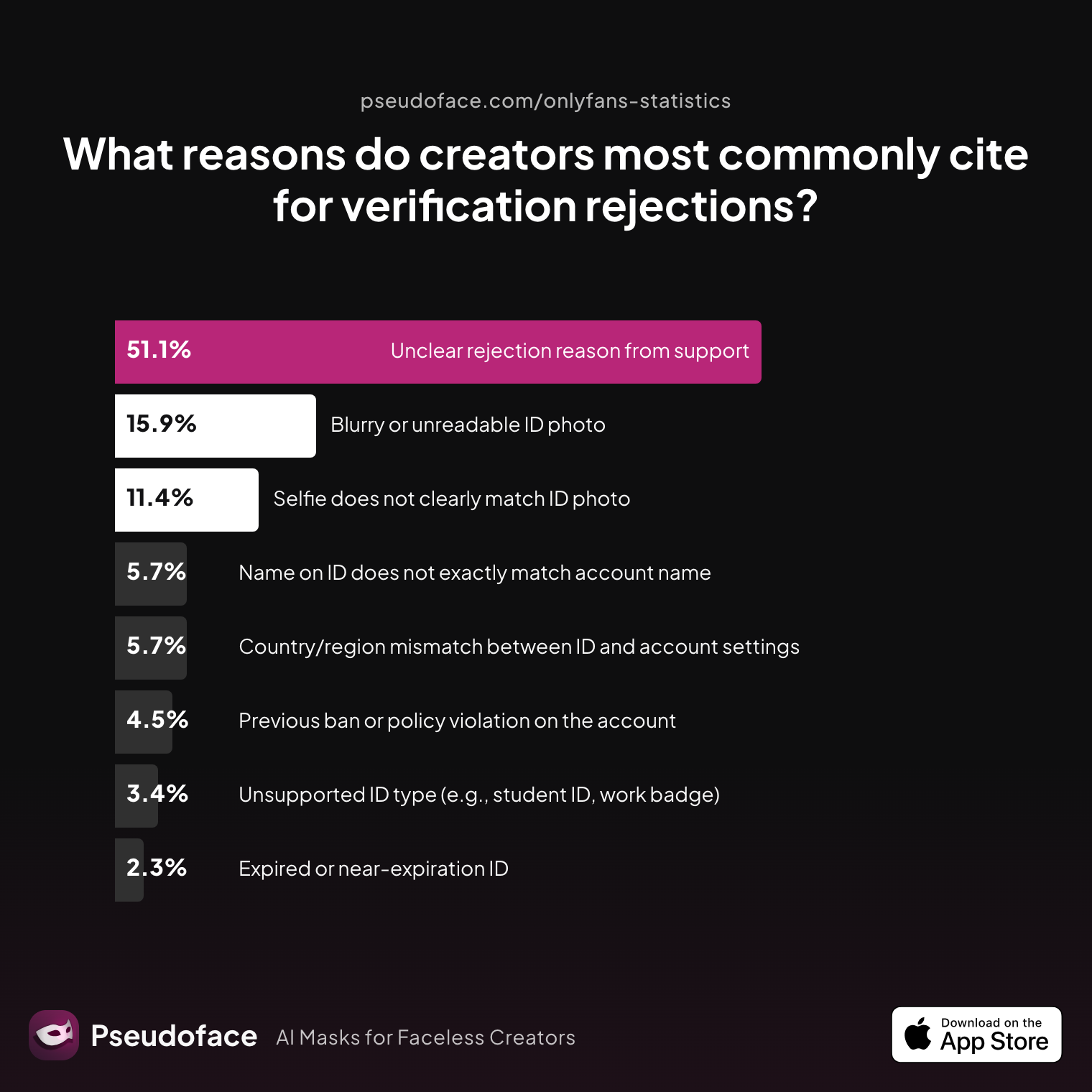
| Answer | Percentage |
|---|---|
| Blurry or unreadable ID photo | 15.91% |
| Country/region mismatch between ID and settings | 5.68% |
| Expired or near‑expiration ID | 2.27% |
| Name on ID does not exactly match account name | 5.68% |
| Previous ban or policy violation | 4.55% |
| Selfie does not clearly match ID photo | 11.36% |
| Unclear rejection reason from support | 51.14% |
| Unsupported ID type (e.g., student ID, work badge) | 3.41% |
While over half of rejections are “unclear” or poorly explained by support, a critical ~11% are because the selfie does not clearly match the ID photo. Any face obstruction—be it mask, sunglasses, or digital blur—is a likely culprit.
Multiple firsthand stories confirm this boundary:
Open thread on Redditr/onlyfansadvice
u/FrejyaaFeet
yes, you still have to do it even when you’re wearings masks. It’s not about identity, it’s about proving consent and age
Open thread on Redditr/onlyfansadvice
u/SLLS85
They don’t check every video. But if they look at your profile, either because you were reported, because you contacted support about an issue or just for a random check, they can find out and delete your account. It’s like the speed limits. Police isn’t watching every car but if you’re caught you’re punished. So you need to follow rules even though you might never be caught.
And for those hoping to keep co-stars masked and anonymous, the verdict is just as tough:
Open thread on Redditr/onlyfansadvice
u/thrHOEaway666
Short answer: there are zero legal sites where you can post content with other people without a release form.
Open thread on Redditr/onlyfansadvice
u/shinyteakettle
Honestly porn age and consent laws are everywhere and there’s no way around it. Even on pornhub everyone in the video has to have the forms filled out. With what you’re doing, I’d say the best thing would be to start an OF and advertise it as solo and only post solo until you have another consenting party to make videos with.
Idiosyncratic enforcement does occur (some masked content survives until flagged or reviewed), but the dominant outcome is this: Anything tied to legal identity—verification, release forms, or payouts—requires an unobstructed, unaltered face that matches a government ID.
Trying to sneak through with sunglasses, mask, crop, or filter is likely (though not guaranteed) to result in a failed verification, support confusion, or even account ban.
Of course, for all these methods—blur, mask, crop, AI—accidental reveals and takedowns are a persistent risk. Let’s compare which strategies creators report as safest or riskiest in practice.
Face Hiding Method Comparison: Blurring, Cropping, AI, and Masks vs. Platform Review
Now that you know the rules, which practices actually hold up over time? Which “faceless” techniques lead to the fewest accidental reveals, app failures, or moderator takedowns?
Let’s dig into reliability, especially for face-blurring apps:
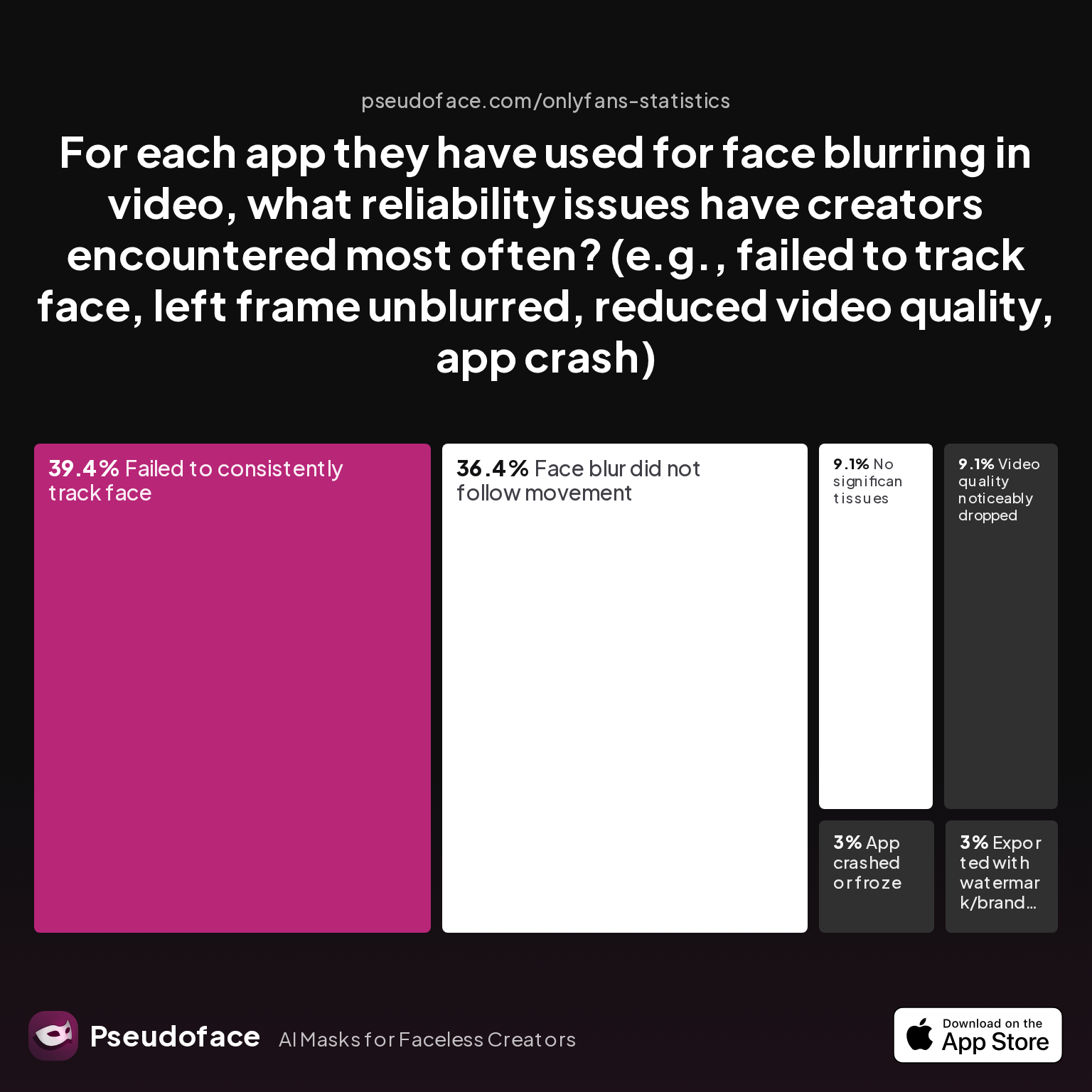
| Answer | Percentage |
|---|---|
| App crashed or froze | 3.03% |
| Exported with watermark/branding | 3.03% |
| Face blur did not follow movement | 36.36% |
| Failed to consistently track face | 39.39% |
| No significant issues | 9.09% |
| Video quality noticeably dropped | 9.09% |
More than 75% of creators using popular face-blur apps report significant tracking failures or blur “slipping” during movement. Video quality drops and watermarked exports are also common complaints.
These practical issues matter—one missed frame can leave someone’s face exposed; a blurred-out user may still be flagged if the system can match them to a previous, visible video.
Let’s compare the main strategies for face hiding, based on self-reported safety, acceptance rates, and technical reliability (see prior section stats for context):
| Method | Review Pass Rate | Accidental Reveal Risk | Tech Reliability | Common Rejection Reason |
|---|---|---|---|---|
| Mask (physical) | HIGH for content, LOW for verification | LOW (for ID), HIGH (for group scenes not all verified) | Very High | "Face not visible to match ID" |
| Blur/pixelation | MODERATE (light blur), LOW (heavy blur) | High | Low–Moderate | "Face unrecognizable," slip in video |
| Cropping | HIGH | Medium (if camera slips) | Very High | "Face only partially visible" (rare) |
| AI face swap | LOW | Low | Moderate | "Does not match ID" / labelled 'AI' |
| Mild filter | HIGH | Low | High | Only if overused—too soft to ID |
- Masks: Best anonymity in content, but almost always rejected for verification or release forms.
- Blur: Possible if light, but unreliable for movement-heavy video; most technical risks.
- Cropping: High safety for solo creators with static camera; dangerous if frame shifts.
- AI face swap: Consistently flagged/removed by 2025-2026; risky for any ID-related step.
- Mild filter: The lowest-risk for subtle privacy enhancement—but don't cross into cartoonish or “identity replacement” territory.
Interpretation bias reminder: Most data comes from those who encountered issues, so “successes” with extreme face alteration may be underreported—but the platform’s risk profile is steadily tightening.
With practical strategies laid out, we’ll now address how creators are adapting in response—and what’s realistically possible for remaining “faceless” on OnlyFans.
OnlyFans Content Review Face Filter Triggers: What Flags a Post for Extra Scrutiny?
Understanding what triggers extra scrutiny—and what slips through—can mean the difference between smooth growth and sudden account disruption for OnlyFans creators committed to privacy.
Content is most commonly flagged when:
- Faces are blurred, cartoon-filtered, or otherwise visibly altered to the point that facial landmarks are no longer easily matched to an identity in the system.
- One or more participants appear masked and cannot be facially identified, and release forms for those participants are missing or incomplete.
- AI tool use is detected, especially when the result is a fully replaced (rather than “retouched”) face.
Automated systems have become more sensitive; while reviewers aren’t looking for “artistic flair,” they are calibrated for compliance. Key moments that draw attention:
- ID checks and verification steps with any part of the face hidden or altered
- Group/partner content missing required tagging, or with participants who cannot be matched to known/verified accounts
- Use of filters known from other apps (Snapchat, Instagram), especially those that merge or cartoonize features
Reddit anecdotes back this up: accidental flags for masked content, release tags, and untaggable AI-altered faces are now common enough to be expected per Pseudoface’s 2024–2026 Reddit research.
Open thread on Redditr/onlyfansadvice
u/FrejyaaFeet
yes, you still have to do it even when you’re wearings masks. It’s not about identity, it’s about proving consent and age
Ultimately, it’s not just about “being creative” with your privacy strategy—it’s about knowing that each workaround intersects with an increasingly systematic and less-forgiving compliance apparatus.
Next, let’s cut through the remainder of ambiguity. What real, practical paths exist to faceless success, and which should be considered too risky for most creators?
Realistic Paths to Faceless Success on OnlyFans (And What to Avoid)
The harsh reality: there’s no perfect “faceless” approach that’s both frictionless and bulletproof on OnlyFans. But there are usable, lower-risk strategies if you truly want to minimize exposure while remaining compliant.
What works best as of 2026:
- Never show your face at all in content (if solo, cropping is safest and least risky for review).
- Light, not heavy, digital edits: A subtle beauty filter may boost privacy, but don’t push it past “realistic.”
- Physical masks for content are fine, but not for any verification, release, or proof-of-consent purpose.
- For partnered/group scenes, every participant must verify and sign release forms—even if faces are hidden.
- Avoid full AI replacement: Current machine-learning detection catches both deepfakes and overly perfect synth faces; these are flagged or banned more often than not.
- Read and check policies, not just forum summaries. The landscape is shifting, and OnlyFans’ own documentation is the final arbiter—at least after a flag is raised.
Avoid if you want account longevity:
- Relying on blurred faces in dynamic, high-motion videos (high risk of accidental exposure)
- Masking or sunglasses during verification, payout, or release form checks (almost universally rejected)
- AI face swaps without explicit, upfront disclosure (near-certain flag in 2025–2026)
- Assuming “once passed, always passed”; surprise spot checks do occur
Bias remains: many small creators “get away with” more, either because their content isn’t flagged or they fly under the radar. But as OnlyFans continues to harden verification and automate content review, the tolerance for ambiguity is steadily dropping.
Faceless success is possible on OnlyFans—just much narrower in practice than in myth. You’ll still need to trade a measure of safety for compliance and stability. If your need for anonymity outweighs everything else, inform yourself about policy as it evolves, and be prepared for a higher level of platform scrutiny.
FAQ
Can you use heavy Snapchat or Instagram face filters when posting on OnlyFans?
You cannot use extreme filters that make you unrecognizable, but subtle enhancements are typically tolerated for content (not verification or ID).
Heavy filters (cartoon, AI overlays) risk content review flags and takedowns. OnlyFans moderation can retroactively remove content or require original photos if facial features are overly altered, as Pseudoface’s 2024 analysis shows. Always keep some unedited content on your page to demonstrate compliance.
Will AI face swap or deepfake tools get my OnlyFans account flagged or banned?
Using AI face replacement carries high risk of content removal, flagging, or account suspension as of 2025–2026.
Statistical analysis shows 42% of those uploading AI face swap content experienced TOS takedowns. Explicit labeling as “AI-generated” is sometimes required, but even this is no guarantee of safety.
Can I verify my OnlyFans creator account while wearing a mask or sunglasses?
No, OnlyFans requires a clear, unobstructed face that matches your ID for verification purposes.
Attempts to verify while masked or with sunglasses are among the leading causes of selfie/ID rejection, according to both data and firsthand Reddit reports.
What happens if OnlyFans flags my faceless content for review?
Most flagged posts enter human review, possibly requiring re-upload with clearer faces or new release forms for all participants.
Appeals are possible, and mistakes are sometimes resolved with full documentation, but repeated offenses can risk your account.
Is light face blurring allowed on OnlyFans, or will it trigger review?
Light, realistic blurring may be accepted, but anything that renders faces unrecognizable will likely be flagged.
Three-quarters of creators using blur apps report technical failures (missed frames), so operationally, this method brings accidental exposure risks beyond policy.
Is there any way to stay fully anonymous on OnlyFans and still get paid?
No, true 100% anonymity isn’t possible—you must submit government ID and verifiable details for payout and tax compliance.
You can hide your face from your audience, but OnlyFans and its payment processor will always have your real info.
What’s the safest method for hiding my face without violating OnlyFans face altered policy?
The safest method is cropping your face entirely out of content. Otherwise, minimal, naturalistic filtering or soft blur are lower risk for solo creators, but must not cross the line into masking or full alteration.
How do I respond if OnlyFans asks for a “video verification” or extra ID check after uploading edited/faceless content?
Respond quickly, providing unedited, unobstructed photos or video that match your submitted ID.
Explain any unintentional edits and avoid further attempts at masking—transparency is your strongest appeal asset.
How strict is OnlyFans about face-altered policy compared to other adult platforms?
OnlyFans is considered stricter than most similar sites for ID, release, and facial match enforcement, especially for U.S./UK jurisdictions.
Some platforms allow heavier edits, but none permit full anonymity for ID or payout.
Will failing verification for a hidden/altered face permanently ban my account?
Not typically for first-time or good-faith mistakes; you can correct and reapply.
However, repeated or deliberate policy violations may result in permanent loss of access, according to moderator reports.
In summary: Faceless creation on OnlyFans is possible—if you know where the hard boundaries lie and are prepared for stricter review as tech and policy keep evolving. Your safest bet: keep edits subtle, faces unobstructed for any identity/payout step, and document everything. As of 2026, the line between creativity and compliance has never been sharper—or more consequential for your anonymity.


