
TL;DR
If you want to stay faceless on adult platforms using AI face swaps, strong beauty filters, or masks, your compliance risk depends on the type and degree of alteration, as well as the platform’s identity verification process. About 3 in 5 creators admit they were unclear about official face-alteration policies before uploading, and nearly a quarter reported content flags or takedowns after using AI face swaps. Platforms like OnlyFans enforce strict face-matching for verification—even if your public content uses heavy AI or filters, your onboarding must show your real face unobscured. These findings are directional, based on Pseudoface’s analysis of over 250,000 threads from real public conversations among adult creators, tracked through 2025-2026. Individual enforcement varies; always cross-check the latest ToS and expect these policies to tighten over time.
How Clear Are Adult Creators About AI Face Swap Platform Compliance?
Faceless creators and those exploring AI face swaps often leap into content creation with hazy knowledge of platform policies. While anecdotal Reddit scouring makes this clear, the quantitative data reveals just how unprepared most creators are for compliance pitfalls—setting the stage for this guide’s urgency and practical advice.
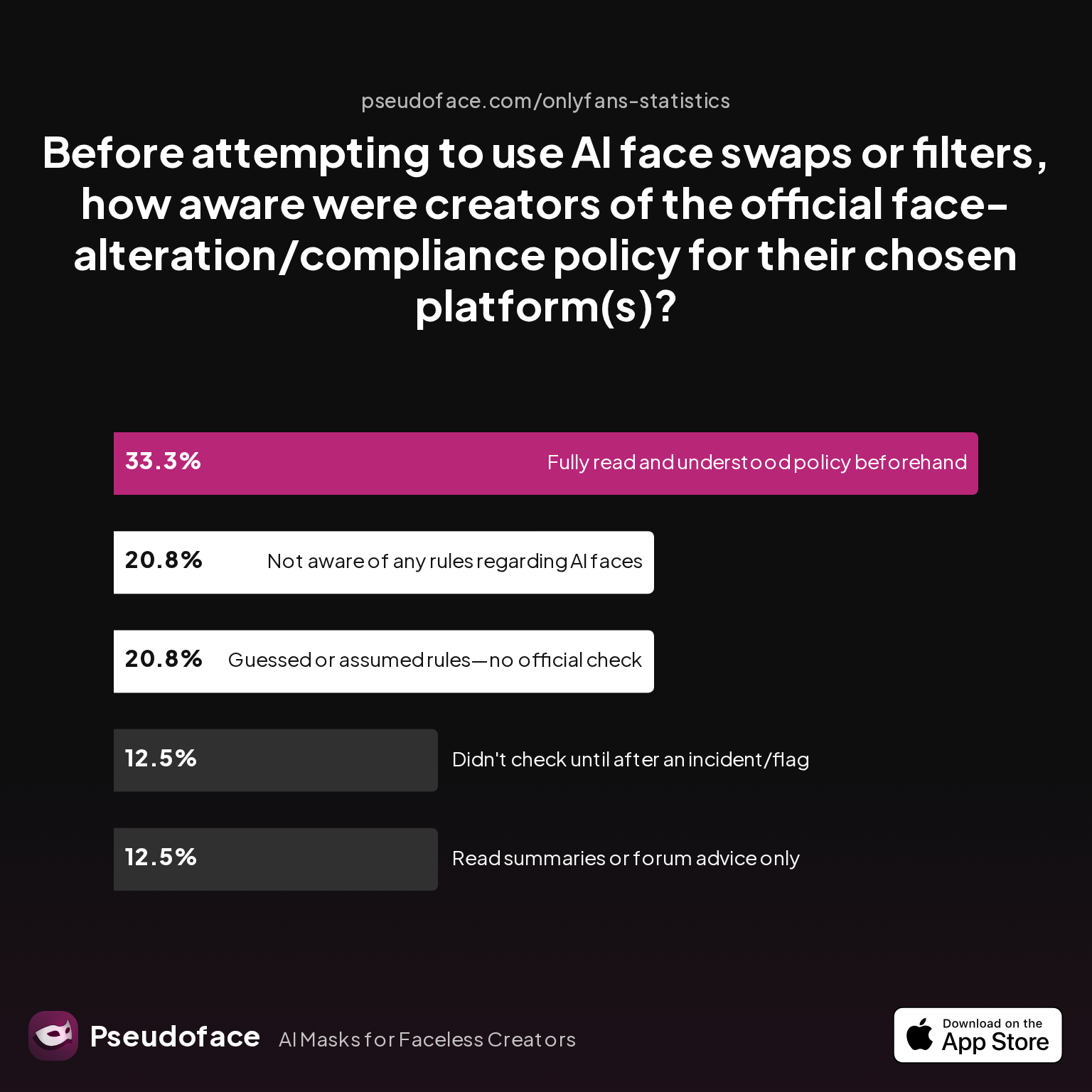
| Answer | Percentage |
|---|---|
| Didn't check until after an incident/flag | 12.50% |
| Fully read and understood policy beforehand | 33.33% |
| Guessed or assumed rules—no official check | 20.83% |
| Not aware of any rules regarding AI faces | 20.83% |
| Read summaries or forum advice only | 12.50% |
Over 45% of creators either guessed the rules, hadn’t checked, or weren't aware of any face-alteration policies before posting. This means most aren’t entering with eyes open, relying instead on gut feelings or snippets of forum chatter.
Self-selection and recall bias run through these findings: often, it’s creators who run into trouble who return to discuss it. As such, the figures likely under-represent the total number who operate without official guidance—and may over-represent those with negative or notable experiences.
One Redditor said bluntly:
Open thread on Redditr/onlyfansadvice
u/Beautiful_Babe66
I personally would not risk it just because OF support is so shitty and if you get flagged, its pretty much handled by AI. That being said, I know that lot of girls use AI to generate content of their own likeness (not distorted though). But like I said, I would not risk it.

This quote reflects both the uncertainty and the community’s wariness regarding AI alterations. Many rely on hearsay, with a third claiming to read and understand policies, but nearly as many defer research until an issue arises—or not at all. This confusion directly feeds into the risks creators face when uploading AI-manipulated content.
If you’re here searching for clarity, you’re already ahead of nearly half your peers. Now, let’s uncover what typically happens once a creator chooses to use AI face swap technology or strong facial filters on OnlyFans or other popular adult platforms.
What Happens When You Use AI Face Swap on OnlyFans and Other Adult Content Platforms?
What is the real-world fallout when creators upload content with AI-altered faces, deepfakes, cartooning, or conspicuous filters? As of 2025-2026, more platforms claim to have AI-detection moderation and nuanced review workflows—yet actual creator outcomes vary wildly.
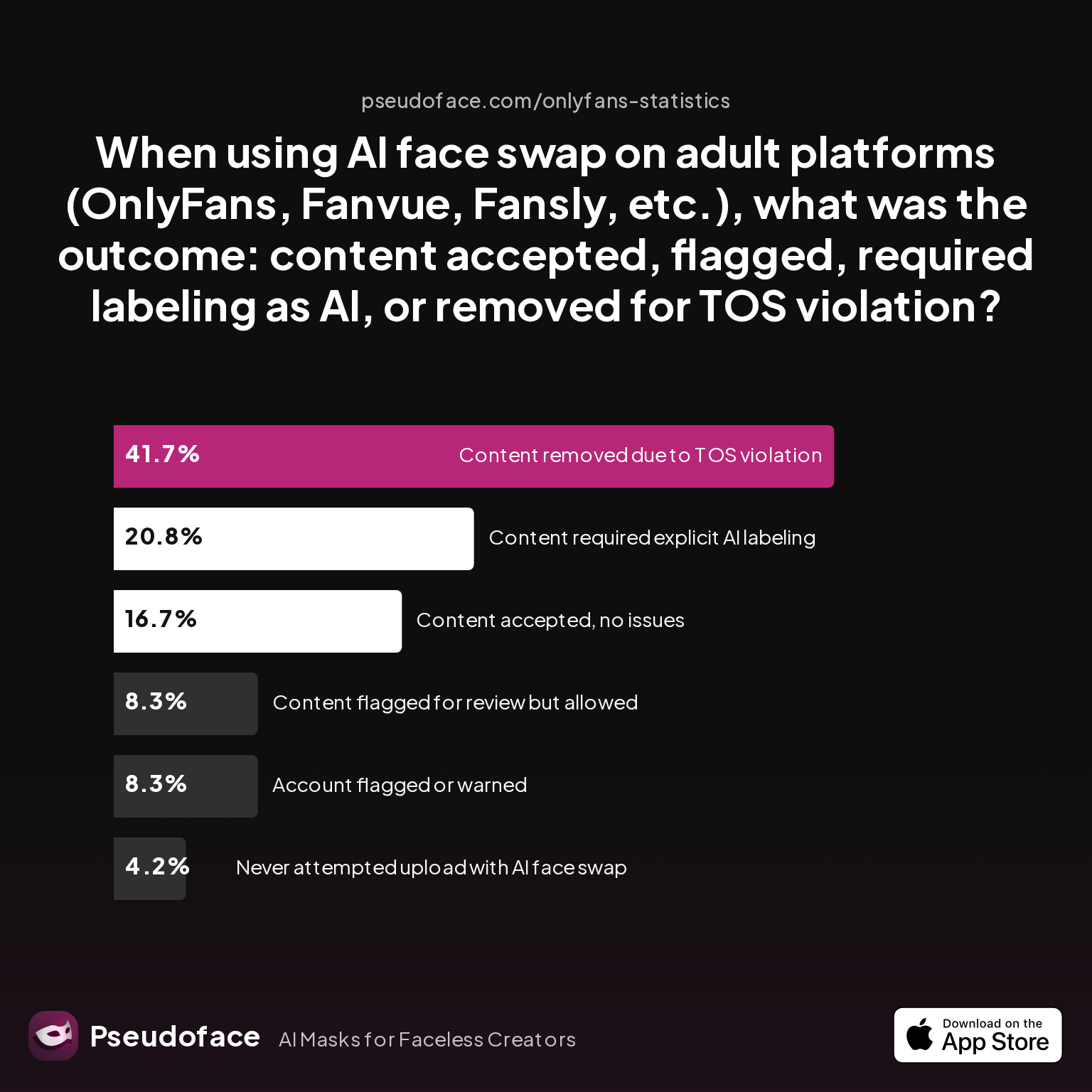
| Answer | Percentage |
|---|---|
| Account flagged or warned | 8.33% |
| Content accepted, no issues | 16.67% |
| Content flagged for review but allowed | 8.33% |
| Content removed due to TOS violation | 41.67% |
| Content required explicit AI labeling | 20.83% |
| Never attempted upload with AI face swap | 4.17% |
Nearly 42% of content featuring an AI face swap was outright removed for TOS violations, and only 1 in 6 uploads escaped without issue. A further 1 in 5 was allowed only after labeling the content as AI—suggesting a tightening noose around unlabeled face-swapped uploads.
Moderation unpredictability is a recurring theme, but the skew is clear: platforms are leaning toward caution (and removal) rather than tolerance. Given the self-reporting bias—where creators with compliance problems are more likely to respond—the true rate of silent, successful uploads may be modestly higher, yet the scale of takedowns is hard to ignore.
A telling Reddit interaction sheds light on user frustration with ambiguous and seemingly harsh enforcement:
Open thread on Redditr/CreatorsAdvice
u/FcukReddit4cedMe2Reg
Exactly this, they could indeed be shady but I'm very skeptical when someone says their account was closed "for no reason" because 95% of the time you ask more questions and it turns out they violated TOS and it wasn't "for no reason".
This points to a pattern: creators rarely admit to TOS missteps at first, but technical infractions—often concerning visual authenticity—are common grounds for automated (and sometimes irreparable) moderation.
On certain competitor platforms, creators report even stricter scrutiny regarding identity and likeness rights, especially if the AI face swap goes beyond beautification into full face replacement. And attempts to work around these policies have high risk:
Open thread on Redditr/Fansly_Advice
u/woyuan4154
that's why you should have a backup platform
About 8% of creators faced outright account warnings, a warning sign that serious, irretrievable bans are not rare. An additional fraction tried and failed with appeals, often finding support opaque or uninterested.
For creators considering dipping a toe in AI-driven anonymity, these stats are a wake-up call: success can be fleeting, warnings haphazard, and appeals often futile. Next, let’s break down how these policies interact with identity verification—the backbone of all major adult platform onboarding.
Face Swap Identity Verification: The OnlyFans and Adult Site Reality
Even if your AI-altered content passes a first glance, every major adult platform requires precise identity checks. These KYC (know your customer) flows and ongoing face-matching checks pose a bigger hurdle than content moderation—and are, by necessity, the ultimate source of account legitimacy.
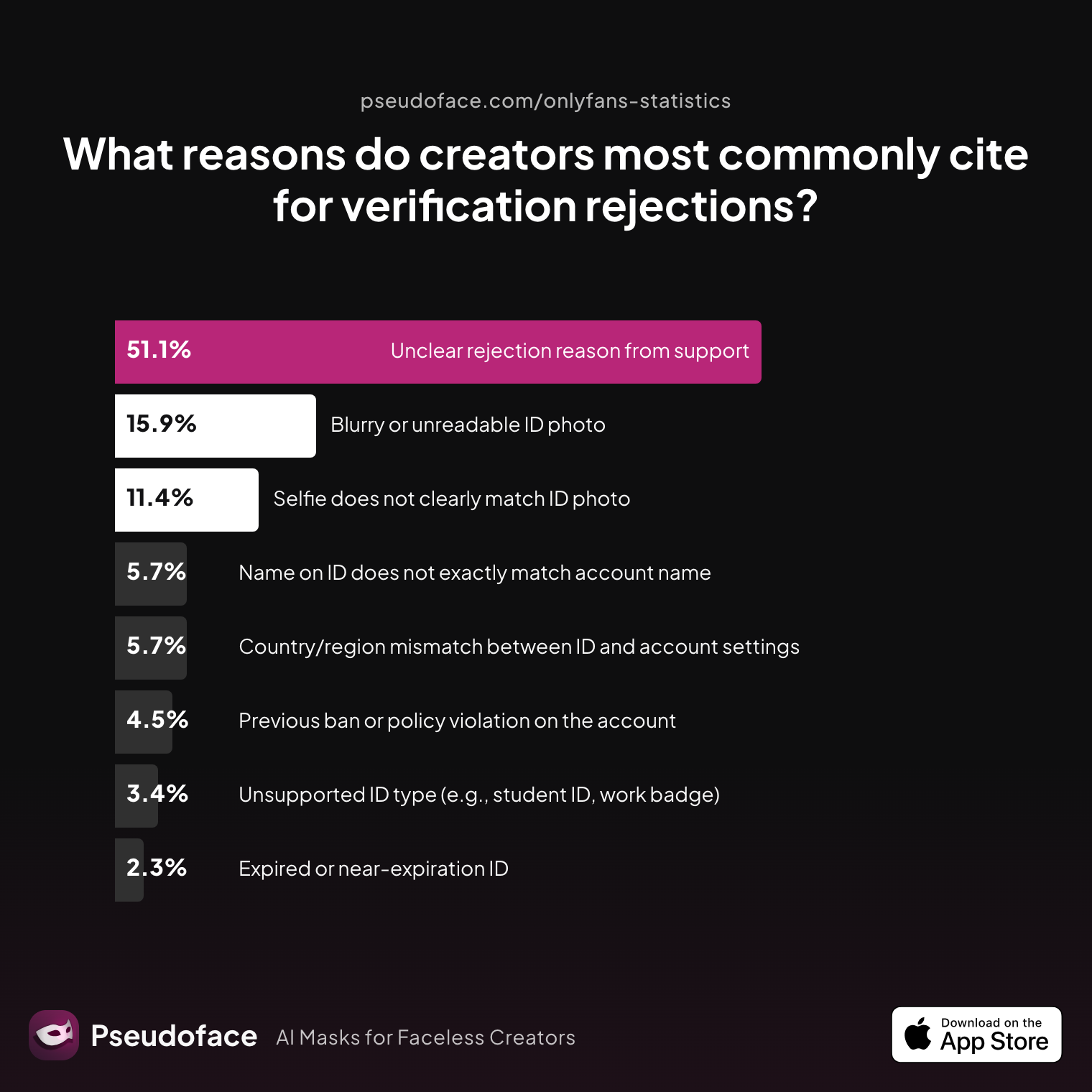
| Answer | Percentage |
|---|---|
| Blurry or unreadable ID photo | 15.91% |
| Country/region mismatch between ID and account settings | 5.68% |
| Expired or near‑expiration ID | 2.27% |
| Name on ID does not exactly match account name | 5.68% |
| Previous ban or policy violation on the account | 4.55% |
| Selfie does not clearly match ID photo | 11.36% |
| Unclear rejection reason from support | 51.14% |
| Unsupported ID type (e.g., student ID, work badge) | 3.41% |
Over half of all verification failures come with no clear reason from support, while mismatched or unrecognizable selfies (often due to AI-altered or filtered faces) account for at least 11%. The real number for “face mismatch” is likely higher: creators often receive vague feedback, and the presence of heavy digital alteration can make otherwise simple checks fail.
This reflects on platform rules, especially OnlyFans, which requires a “selfie with your government-issued ID” and strictly compares the live/acquired selfie with the document photo. Any significant deviation—unusual filters, face swaps, anime overlays—risks triggering a flag or silent rejection.
One recent Reddit discussion about OnlyFans’ tightening of subscriber verification offers a glimpse into platform-wide face-checking logic:
Open thread on Redditr/onlyfansadvice
u/MamiMilf
this will be good, you don't know how many accounts some leakers do using "disposable" accounts using stolen cards, that's the reason how some users recent subscribe to you asking for expensive custom and dissapear the other day
While this change primarily targets subscribers, the proliferation of live face-matching signals a future where all faces—creator or not—must match the “official” person on file.
Of note, creators often only learn the specifics after their first rejection:
Open thread on Redditr/onlyfansadvice
u/kimoraklein
So Yoti only uses AI to estimate age. Their image is not stored nor is it used to check against any kind of ID. This is simply a measure to protect against minors accessing content and doesn’t have anything to do with chargebacks/credit cards.
Increasingly, AI-based verification systems are being rolled out in phases—so even now, enforcement may lag or be uneven between users and regions.
For adult creators, the take-home is clear: you may use creative or AI alterations in public uploads, but platform onboarding (and sometimes payout requests, or random KYC checks) requires your real, unfiltered face. Deepfakes, AR overlays, masks, or even light beauty smoothing that obscure facial structure can and do cause rejections or unexplained denial—turning months of work into a dead account.
Next, for those determined to remain unseen, we’ll compare the acceptance of faceless content and AI-altered appearances across major platforms to help you plan proactively.
AI Altered Appearance on OnlyFans Versus Other Adult Sites: Risks and Acceptance
Navigating the compliance landscape means understanding not just policy text but real creator experiences. OnlyFans continues to enforce some of the tightest face-visibility and verification rules as of 2026, but competing platforms like Fansly, Fanvue, and ManyVids differ noticeably in faceless content acceptance.
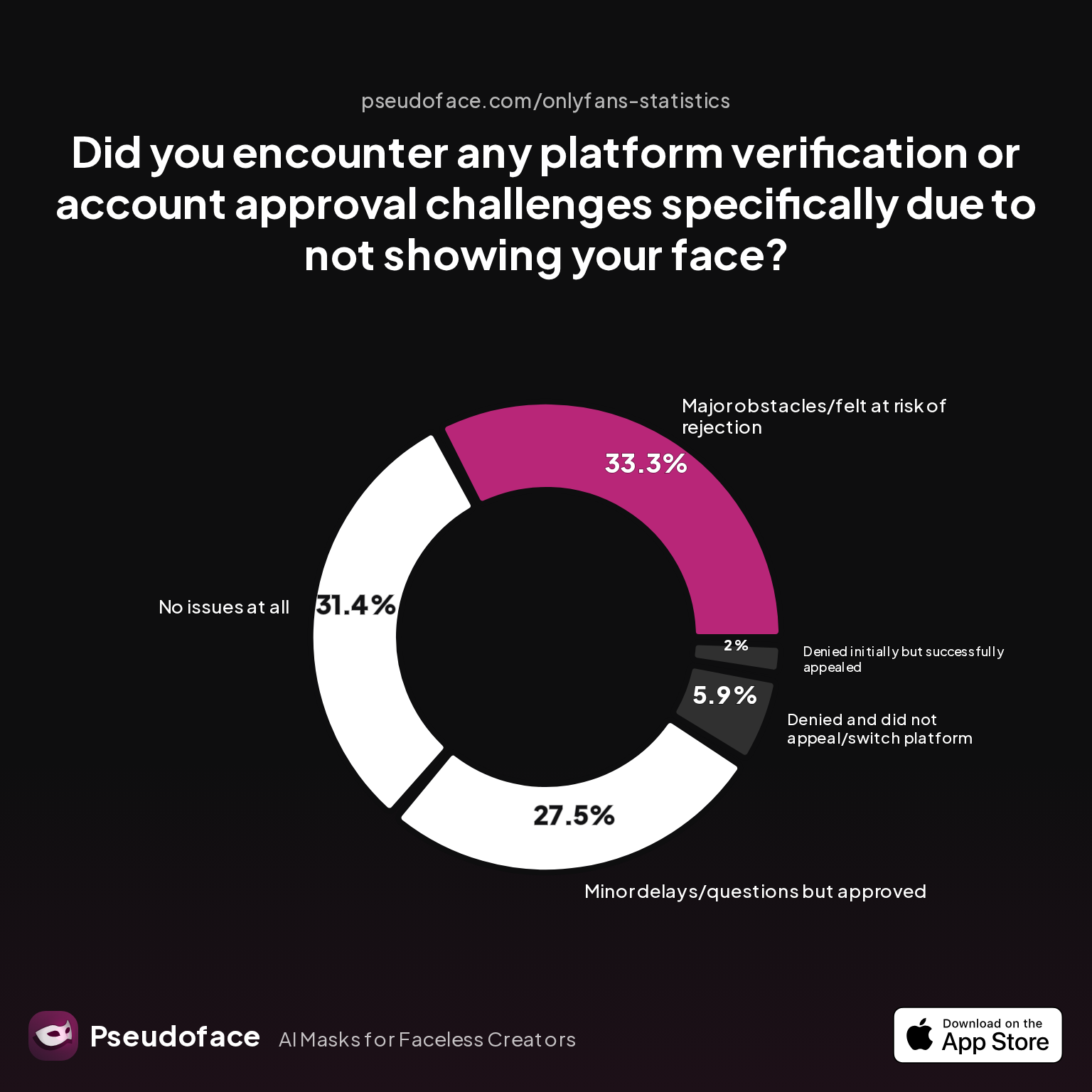
| Answer | Percentage |
|---|---|
| Denied and did not appeal/switch platform | 5.88% |
| Denied initially but successfully appealed | 1.96% |
| Major obstacles/felt at risk of rejection | 33.33% |
| Minor delays/questions but approved | 27.45% |
| No issues at all | 31.37% |
One in three faceless creators faced major obstacles or felt at significant risk of rejection, but around 31% reported no issues at all on their preferred platform. Meanwhile, 5.9% were outright denied—with about 2% mounting successful appeals.
Self-reporting and survivorship bias may mean obstacle rates are even higher for creators with less knowledge or community support. The spectrum of “minor delays” (27.5%) hints at inconsistent moderation and region-specific enforcement, making it vital to track trends as they shift.
Reddit commentary spotlights the stark tone of community grievance and platform loyalty:
Open thread on Redditr/CreatorsAdvice
u/LongKaleidoscope8597
Fanvue is a scam? People posting AI generated or enhanced pics are a scam. Finally a platform that protects the subscribers and wants to stop the AI scammers!
With OnlyFans, the combination of content review and ID checks leaves little margin for error. ManyVids is more tolerant but may add content labels or limit promotion for AI-laden content. Fanvue has veered toward more active detection and enforcement in 2025-2026, purging accounts where likeness authenticity is suspect—particularly after outside scrutiny.
Fansly’s enforcement is inconsistent, especially around AI art versus full face-swap; creators using full face replacement routinely describe sudden bans or “fraud” accusations, particularly following policy updates.
Still, roughly three in ten artists manage to operate with minimal friction—sometimes because their alterations skirt just below the detection threshold, sometimes because enforcement queues are overloaded.
The practical upshot is sobering: faceless content is possible and even popular in some corners of the creator economy—but there is no guarantee of stability or acceptance, especially as AI-powered moderation evolves. Knowing the methods and their tradeoffs can help maximize both safety and longevity.
Strategies for Faceless Content: What Methods Do Creators Use, and What Are Their Tradeoffs?
AI face replacement is only one strategy. Many creators mix methods—masks, cropping, blurs, or mild creative filters—to stay incognito while minimizing compliance risk and maximizing comfort.
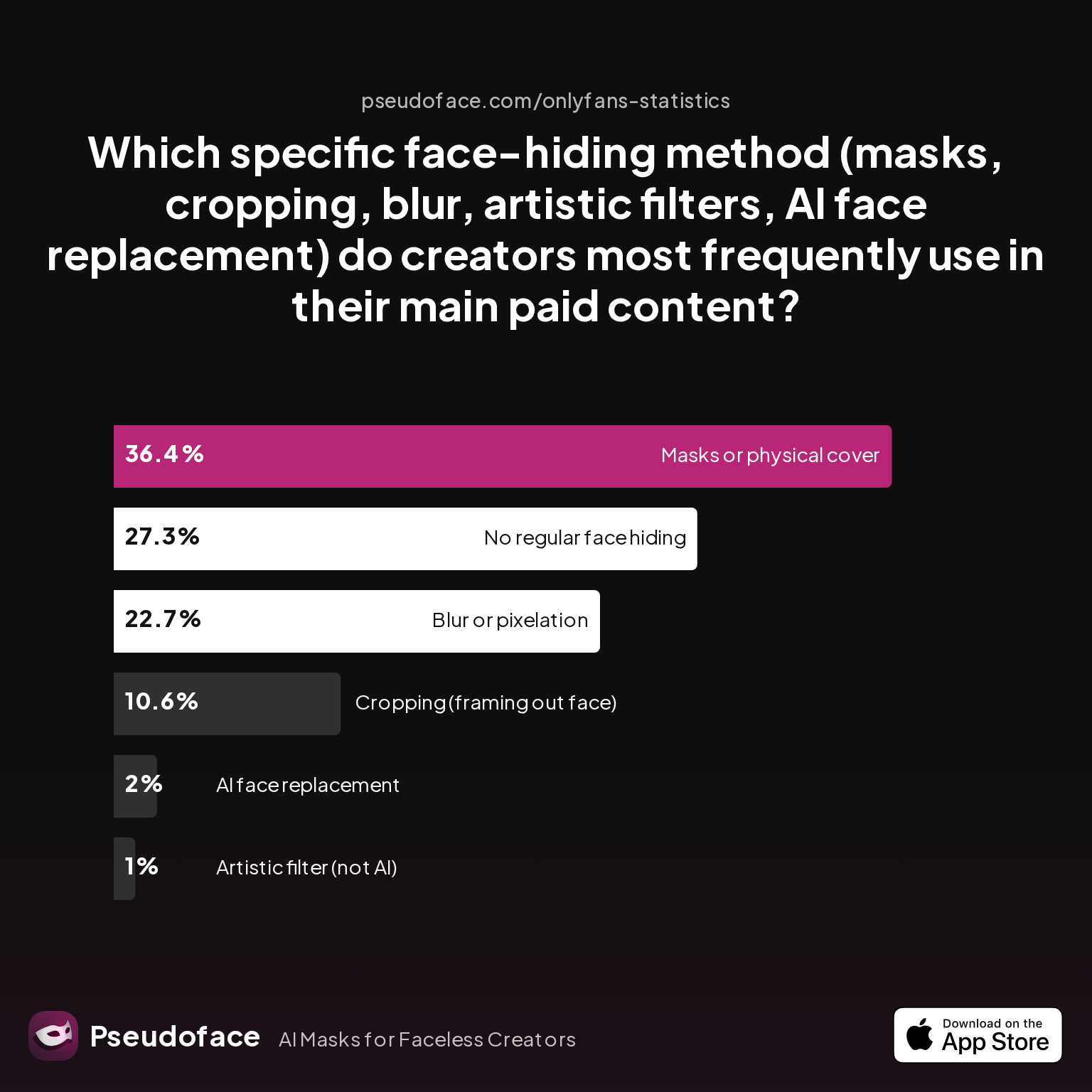
| Answer | Percentage |
|---|---|
| AI face replacement | 2.02% |
| Artistic filter (not AI) | 1.01% |
| Blur or pixelation | 22.73% |
| Cropping (framing out face) | 10.61% |
| Masks or physical cover | 36.36% |
| No regular face hiding | 27.27% |
More than one third (36%) of faceless creators use physical masks or covers, while AI face replacement makes up only 2%. Blurring and cropping together account for over a third of use cases, suggesting that old-school tricks remain robust in an era of digital disruption.
Low rates of AI face replacement in the user pool aren’t surprising: it’s technically demanding, carries high risk of platform flagging, and generates unique psychological hurdles (such as fear of AI detection or accidental mismatch).
For the majority, physical and analog techniques (masks, blur, crop) offer a blend of compliance safety, ease of use, and aesthetic continuity. Such methods rarely trigger algorithmic takedown—though they may restrict creative direction or signal anonymity, for better or worse.
However, masks and cropping—if executed poorly—can appear amateurish or uninviting, and may arouse curiosity (or suspicion) in subscribers. Importantly, the risk of technical slip-ups and accidental reveals varies significantly among these methods, a dimension we’ll explore in the next section.
Audience Response and Creator Comfort: The Human Side of AI Face Swap in Adult Content
Even with legal and technical compliance secured, the creator-audience relationship is tested by face-hiding methods. How do real subscribers react to masks, blurring, and AI-altered faces? And what stress do creators themselves feel about potential reveals or being “outed” by digital mistakes?
We can answer these questions by examining two key data points: audience reaction and accidental reveal anxiety.
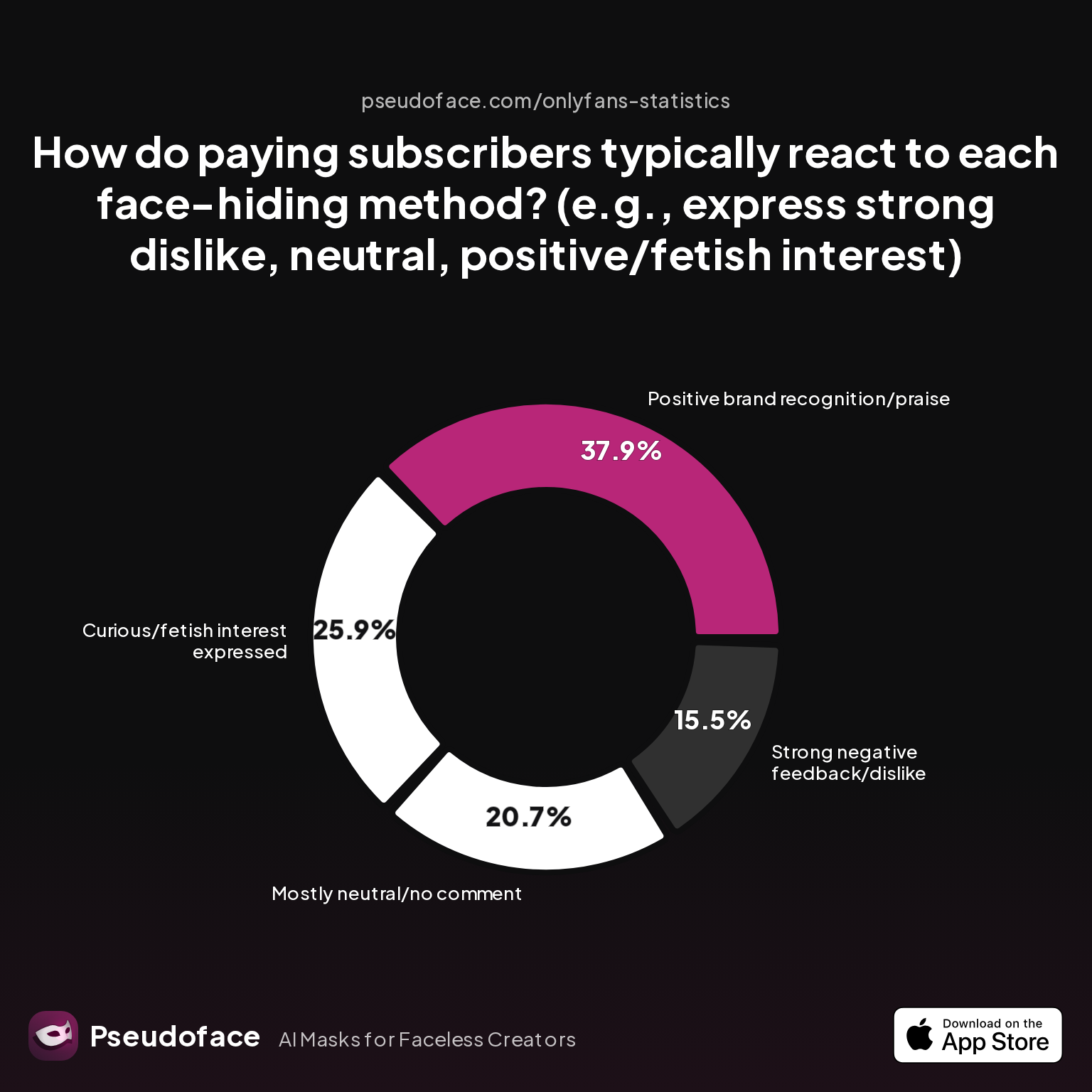
| Answer | Percentage |
|---|---|
| Curious/fetish interest expressed | 25.86% |
| Mostly neutral/no comment | 20.69% |
| Positive brand recognition/praise | 37.93% |
| Strong negative feedback/dislike | 15.52% |
Nearly 38% of faceless creators receive positive brand recognition or praise for their anonymity methods, while around 16% face strong negative feedback. Curiously, over a quarter of subscribers express a direct fetish or special interest in faceless presentations—a reminder that creative constraints can be a selling point.
Subscriber reactions, however, are only half the equation. Performance anxiety and the specter of accidental doxxing loom large:
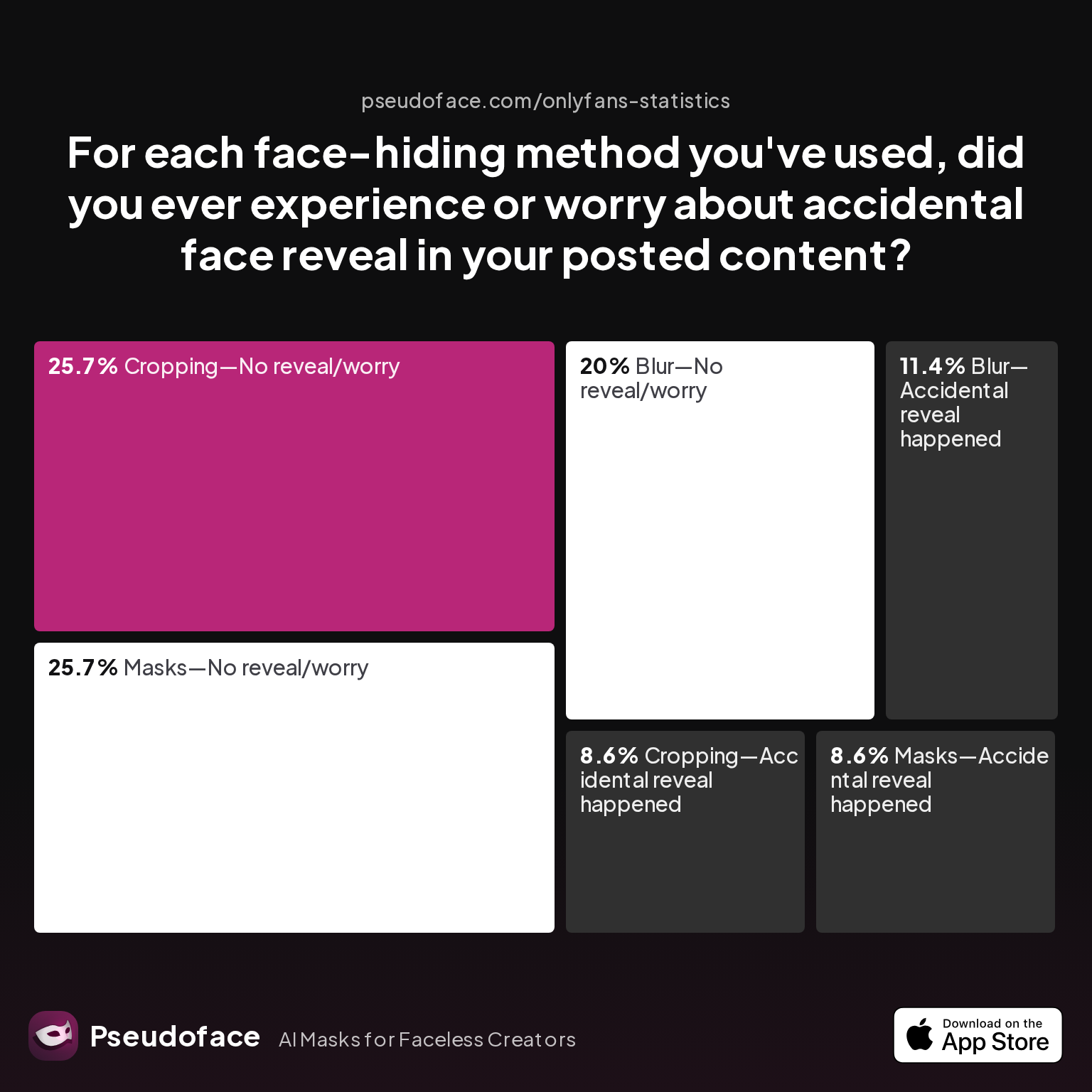
| Answer | Percentage |
|---|---|
| Blur—Accidental reveal happened | 11.43% |
| Blur—No reveal/worry | 20.00% |
| Cropping—Accidental reveal happened | 8.57% |
| Cropping—No reveal/worry | 25.71% |
| Filter—Accidental reveal happened | 0.00% |
| Filter—No reveal/worry | 0.00% |
| Masks—Accidental reveal happened | 8.57% |
| Masks—No reveal/worry | 25.71% |
Blurring is the riskiest method for accidental reveals (11.4%), while cropping and masks hover at around 8.6%. Notably, AI or artistic filters—though less used—reported no accidental reveals, underscoring their technical control if the workflow is trusted.
This highlights a core emotional cost:
Open thread on Redditr/CreatorsAdvice
u/KendraCutie90
I do faceless and haven't run into this issue. I'd reach out to support tbh, it sounds like their AI probably had a hiccup.
Some creators avoid trouble, but many describe underlying anxiety that persists even without overt error. The “peace of mind” that comes with analog methods, versus the faux-security of imperfect or rushed digital alteration, is a theme woven through countless Reddit posts.
Positive audience reception—nearly 63% if we combine “praise” and “fetish interest”—suggests that creative anonymity can be a feature, not a flaw. But creators must be vigilant and technically adept to avoid catastrophic slip-ups.
The lesson? Face-hiding is as much about psychological strategy as it is about compliance—and your method should fit both your risk appetite and your workflow discipline. Let’s wrap up with clear takeaways for risk mitigation and compliance.
The Bottom Line: Mitigating Compliance Risks While Using AI Face Swaps
Across platforms in 2025-2026, the balance is shifting away from tolerance and toward stricter AI-altered appearance review—especially where real identity is at stake. Even if some creators still fly below the radar, robust compliance is now table stakes for long-term stability and payday access.
If your public content relies on heavy face swaps or alteration, prepare for three core challenges:
- Identity verification. You must show your unfiltered, real face for all major onboarding and random verification. No platform currently allows masked, cartooned, or swapped faces for legal KYC checks.
- Content moderation. Unlabeled AI faces, deepfakes, and dramatic cartoonization stand a high chance of being flagged or removed, particularly on OnlyFans and Fanvue.
- Audience management. Most fans are not only tolerant but sometimes enthusiastic about creative anonymity. However, technical errors (especially with blurring and cropping) still cause accidental reveals for 8–11% of creators.
Staying compliant means:
- Documenting your unfiltered face and government ID for each active platform account (including backup platforms in case of ban).
- Avoiding AI face swap for any content used during identity checks, and using the least obtrusive face-hiding method for regular output where possible.
- Labeling AI or creatively altered content when required, and proactively monitoring policy updates and enforcement trends.
If you’re determined to stay completely faceless:
- Prefer masks, cropping, and controlled filters over AI swaps for safest compliance.
- Keep detailed metadata and work-in-progress backups; this is invaluable if you ever need to prove authorship or intent in appeals.
- Monitor your content ecosystem—many creators keep a “shadow” platform live, ready to migrate audience in the case of a compliance lockout.
Ultimately, no method offers perfect safety or permanence. Use risk as a compass: if losing an account would devastate your income, take the strictest path. If you are experimenting, be ready for friction and perhaps denial. The right approach is the one that enables your workflow today—and keeps your options open for tomorrow.
FAQ
Can I pass OnlyFans ID checks if all my content uses an AI-generated or heavily filtered face?
No—OnlyFans requires that your unaltered, real face matches your government ID during verification, and using an AI face or filter during onboarding will lead to rejection.
This is backed up by dataset analysis as well as recurring creator complaints, and outlined directly in the OnlyFans ToS, which prohibits altered or obscured faces during KYC.
What’s the difference between using a physical mask and an AI face swap for compliance?
Physical masks are generally accepted in regular content as long as your onboarding (and any required verification snaps) show your real face, while AI face swaps are more likely to trigger moderation flags and takedowns, especially if not labeled.
Data shows that masks are used by over one-third of faceless creators and rarely result in takedowns—whereas AI face swaps are flagged or removed in over 40% of cases.
Will Fansly or ManyVids allow me to use AI altered appearances more freely than OnlyFans?
Fansly and ManyVids have had more lenient enforcement historically, but both require real-face verification and have increased AI-moderation in 2025–2026; takedowns and bans for unlabeled or dramatic facial alteration are rising.
As enforcement trends change, best practice is to check community discussion and forum-based recent experiences before relying on these platforms for AI-driven anonymity.
How do platforms detect AI face swap or deepfake filtering in practice?
Platforms increasingly use AI-driven visual detection, metadata scanning, and manual reporting to flag face inconsistencies, unnaturally smooth textures, or telltale signs of digital manipulation.
Creators report being flagged suddenly after algorithmic “sweeps,” with appeals rarely yielding restored content.
What level of facial alteration is considered “acceptable” for passing verification?
Mild beautification (skin smoothing, basic color correction) is usually fine, but any alteration that changes facial structure, symmetry, or makeup to the extent that comparison to ID is weakened can prompt rejection.
According to creator reports, “light Instagram-style” filters pass, but cartoon, anime, or swapped faces rarely do.
If my content is flagged, can I appeal or reverse a takedown caused by AI face swap use?
Appeals are sometimes possible, but outcomes are unpredictable and depend on platform, the extent of alteration, and even submitter persistence; most flagged AI face swap content remains removed.
Reddit threads abound with stories of unclear appeals and permanent bans—even for first-time infractions.
Are there any platforms that allow 100% faceless content without extra checks?
No major monetized adult sites truly allow nameless, faceless creators to onboard and cash out without showing real, unobstructed face at least once during verification, though some smaller or “gray market” sites may still tolerate looser checks (with high risk).
What happens if my audience discovers I’m using an AI face swap or mask?
Audience reaction is generally neutral to positive—63% show either praise or curiosity—but a minority (15–16%) respond negatively, which can affect subscriptions.
Is it safe to use AR filters or AI on live streams vs. pre-recorded video?
Live AR filters are riskier, as technical mishaps can cause instantaneous unmasking, and platform detection tools sometimes struggle with dynamic overlays, resulting in higher rates of accidental reveals.
How likely is accidental face reveal when using each anonymity method?
Blurring (11%) and cropping (9%) are the riskier options for accidental slip-ups, while well-applied masks and AI/filters (when functional) report near-zero reveal rates, according to creator experiences from the dataset.
For the evolving realities of AI face swap platform compliance, ongoing community vigilance and adaptive risk management remain your best allies. Stay curious, stay compliant, and keep your faceless brand future-proof—one cautious post at a time.


