
TL;DR
Most faceless creators on IWantClips (IWC) and ManyVids (MV) make sales—about 59% report earning at least modestly, with a top 10% that matches face-showing creator averages. Success relies less on facial visibility and more on branding, content style, and strategic discoverability. On both platforms, custom non-facial branding and niche targeting increase clickthrough, while best-performing faceless content often utilizes props or signature accessories to stand out in search. According to Pseudoface’s analysis of over 250,000 public Reddit threads from real adult content creators, these insights synthesize lived experience, but keep in mind community self-selection and reporting bias—quantitative trends are directional, not universal. Based on 2025-2026 data, faceless creators can, and do, earn on clip sites with the right approach.
The Reality of Going Faceless: Earnings, Visibility, and Survivorship Bias
In the world of adult clip sites, “faceless” is both a shield and a challenge. For every viral story of masked mystique, there are silent threads on the grind: veterans who never showed their face and still found an audience, but also many who struggled for attention and sales amid front pages dominated by recognizable faces. Let's start by confronting the core question—does facelessness actually kill your earning potential on IWC or ManyVids?
| Answer | Percentage |
|---|---|
| Actually helped earnings (mystery/niche appeal) | 13.00% |
| Moderate negative impact on earnings | 27.00% |
| No noticeable impact on earnings | 29.00% |
| Significant negative impact on earnings | 14.00% |
| Started anonymous, switched to showing face and saw earnings increase | 11.00% |
| Unsure of the impact | 6.00% |
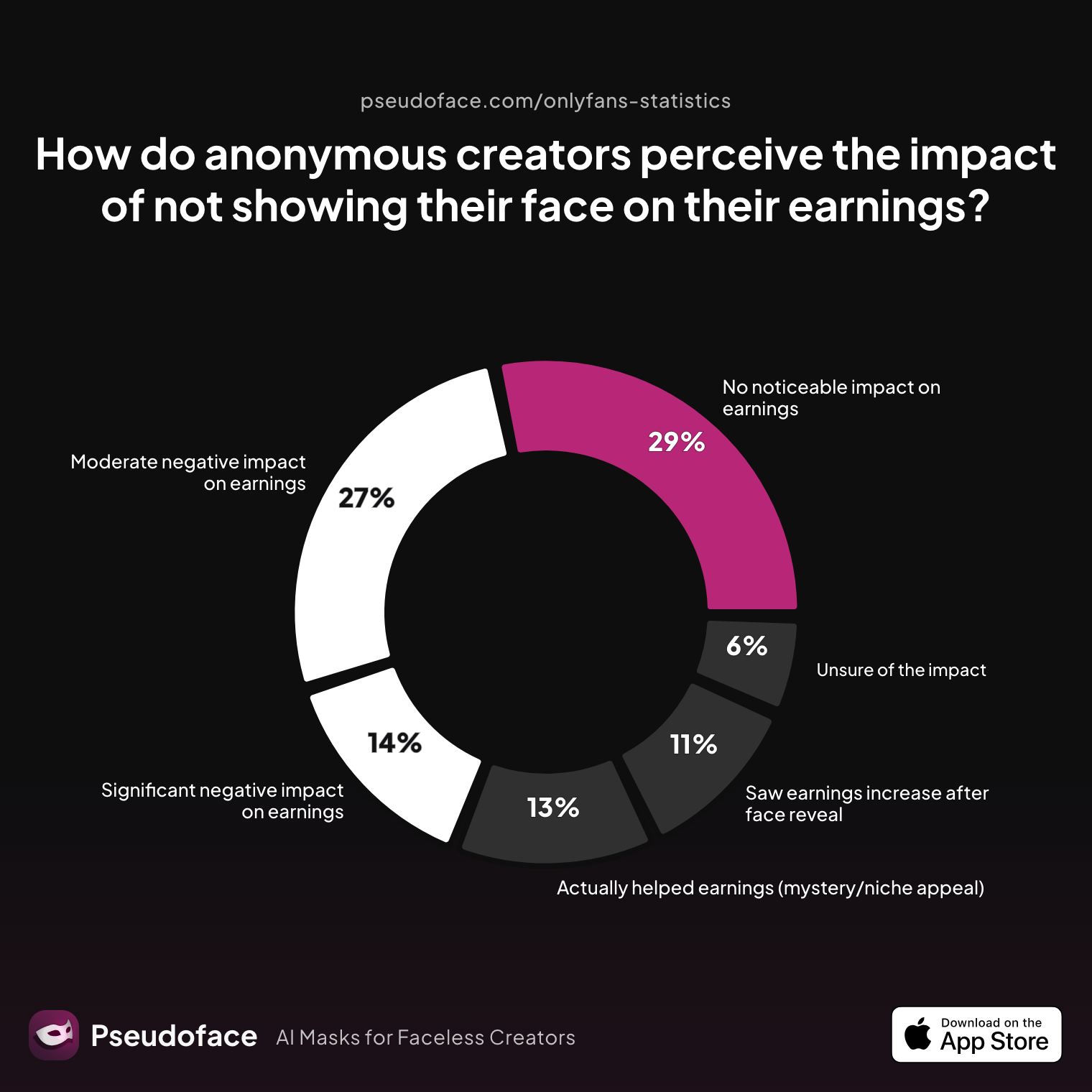
Roughly 4 in 10 faceless creators (42%) experience no significant drop—or even an increase—in earnings, while 41% report some negative impact, either moderate or significant. About 13% even report improved results, often citing mystery and niche appeal as factors.
But keep in mind: these stats arise from self-selected creators who are active enough to share their stories, making survivors and moderate earners somewhat overrepresented. Many beginners, and those who quit early, never weigh in, so survivorship bias likely inflates the “no impact” and “positive impact” figures.
In public forums, the conversation is mixed. Some find quick wins:
Open thread on Redditr/CreatorsAdvice
u/Various_EfficiencySW
I'm faceless on there! Not necessarily a huge success story as I only have 13 videos so far/have been active there for a month, but I've had a few sales.

Others note that while sales are possible, expectations should be grounded in market mechanics, not just anecdotes. Survivorship bias is real: for every contest-winning faceless creator on IWC, dozens grind with only modest returns. That said, a faceless winner does get noticed from time to time:
Open thread on Redditr/CreatorsAdvice
u/NewHat2160
wait, didn't a creator who never showed her face recently win an iwc contest? rr was one of the winners? you should go and see it. i think they post everything on their Twitter.
Community wisdom recognizes the psychological protection of anonymity (helpful for mental health, long-term privacy, and parallel vanilla careers), but doesn’t sugarcoat the grind: going faceless often means slower initial traction, more effort in branding, and a stronger need to carve out a "hook" beyond your face.
While some users believe “people want someone to connect to… not just a blank thing to wank to,” others see opportunity in providing just enough intrigue, or by cultivating a consistent, approachable persona—even if the face is never shown.
Branding Beyond the Face: How Faceless Video Creators Get Noticed
If you can’t rely on facial expressions to sell emotion or establish parasocial connection, what do you rely on? For faceless creators, the answer is branding: unique body parts, props, accessories, or even voice become signature features. A glimpse at what actually draws clicks:
| Answer | Percentage |
|---|---|
| Body type/shape | 11.50% |
| Feet | 40.00% |
| Hands | 0.50% |
| Lingerie/costume choice | 9.50% |
| No emphasized feature | 1.50% |
| Signature props/accessories | 8.50% |
| Tattoos/body art | 3.00% |
| Voice | 25.50% |
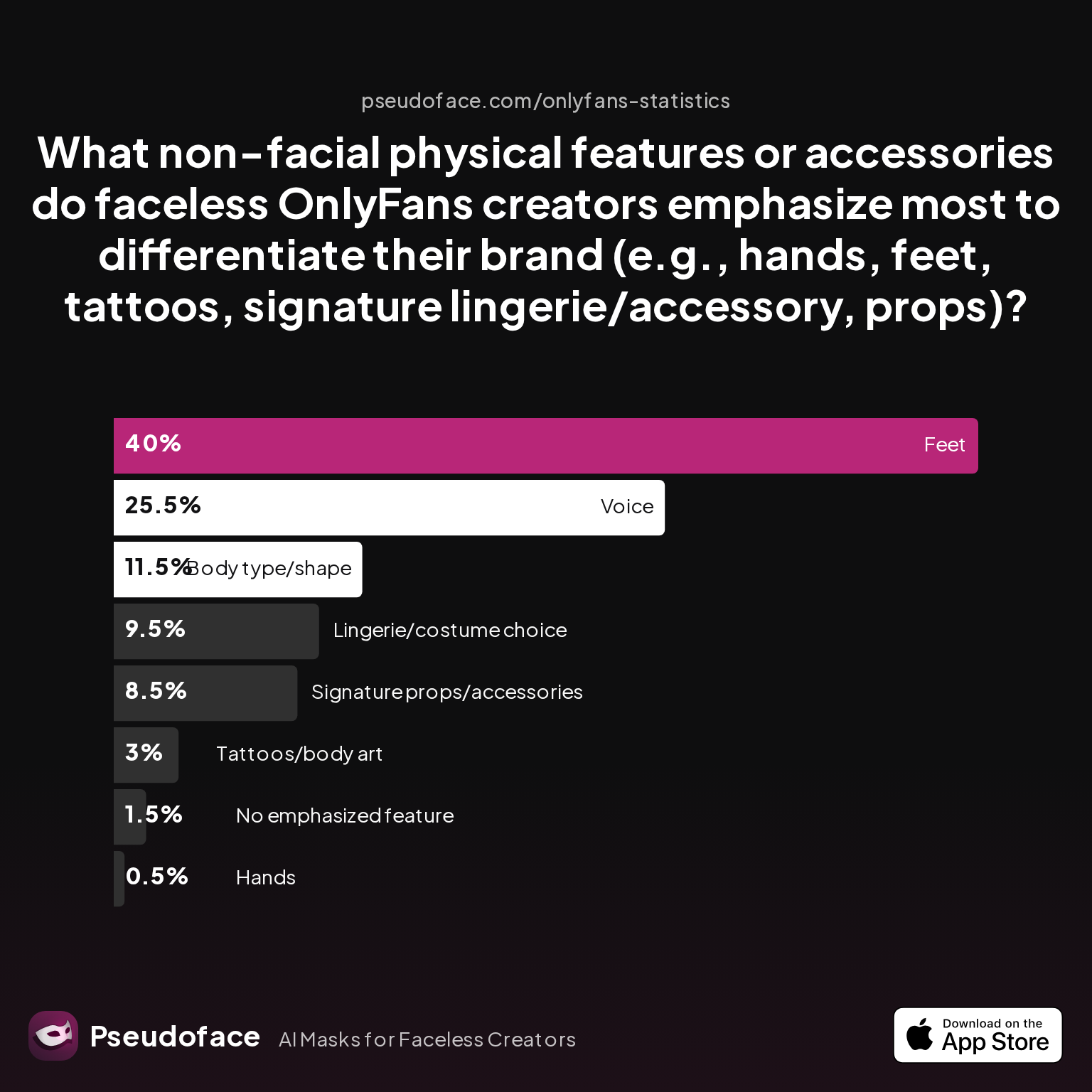
Feet and voice are the standout non-facial branding elements: 40% of surveyed creators rely on foot content, and 25% cite the use of voice (either in tease audio, JOI roleplay, or sultry narration). Lingerie selection, signature props (masks, plushies, latex gear, themed accessories), and body shape also carve out recognizable brands.
Why does this matter? On IWC and MV, the thumbnail is everything. Without a face, you need another “hook”—a colorful patterned sock, a distinct tattoo, unmistakable shoes, or even a luxurious bedspread can become brand-defining in preview images. A recurring theme in community advice is to “make your thumbnail pop with something no one else does, even if it’s just the angle, prop, or color theme.”
Voice matters. Audio cues—accents, sultry whispers, commanding tones—draw loyal fans even when visual anonymity is absolute. This switch toward multisensory branding is a defining trait for successful faceless creators.
Of course, the absence of a face means customer connection often shifts to other forms—friendly captions, playful messages, or establishing a “mysterious persona.” Some creators keep the intrigue alive by hinting at (but never revealing) their face, making the potential of a future reveal part of the long-term retention strategy.
As one Redditor puts it in their firsthand account:
Open thread on Redditr/CreatorsAdvice
u/MMthrowawayacct
I don’t by any means know it all, but I’m faceless, and I think it adds an element of intrigue to your subs. They all know up front as well that my career in the real world comes first, and at this time I’m unable to show my face. I think (with no evidence whatsoever) that giving my subs the hope that one day I’ll show my face could keep them around longer.
Original branding without a face is harder—and more critical—on clip sites than on subscription platforms, where ongoing chats and DMs can compensate for lack of facial connection.
Clip Site Discovery and Faceless Content: The Mechanics of Being Found
Even the most distinctive brand means little if no one scrolls far enough to see it. On IWC and ManyVids, discovery is its own challenge: search is weighted toward categories, tags, and frequent uploads, but the homepage and “trending” algorithms often privilege volume, recency, and—sometimes—face visibility. What actually works for faceless discoverability?
| Answer | Percentage |
|---|---|
| Collaborations/tagging | 2.78% |
| External promo (e.g., Reddit, Twitter) | 63.89% |
| Frequent new uploads | 11.11% |
| Niche/category targeting | 2.78% |
| Optimized thumbnail and title | 2.78% |
| Participating in site promos/events | 8.33% |
| Using preview/trailer clips | 8.33% |
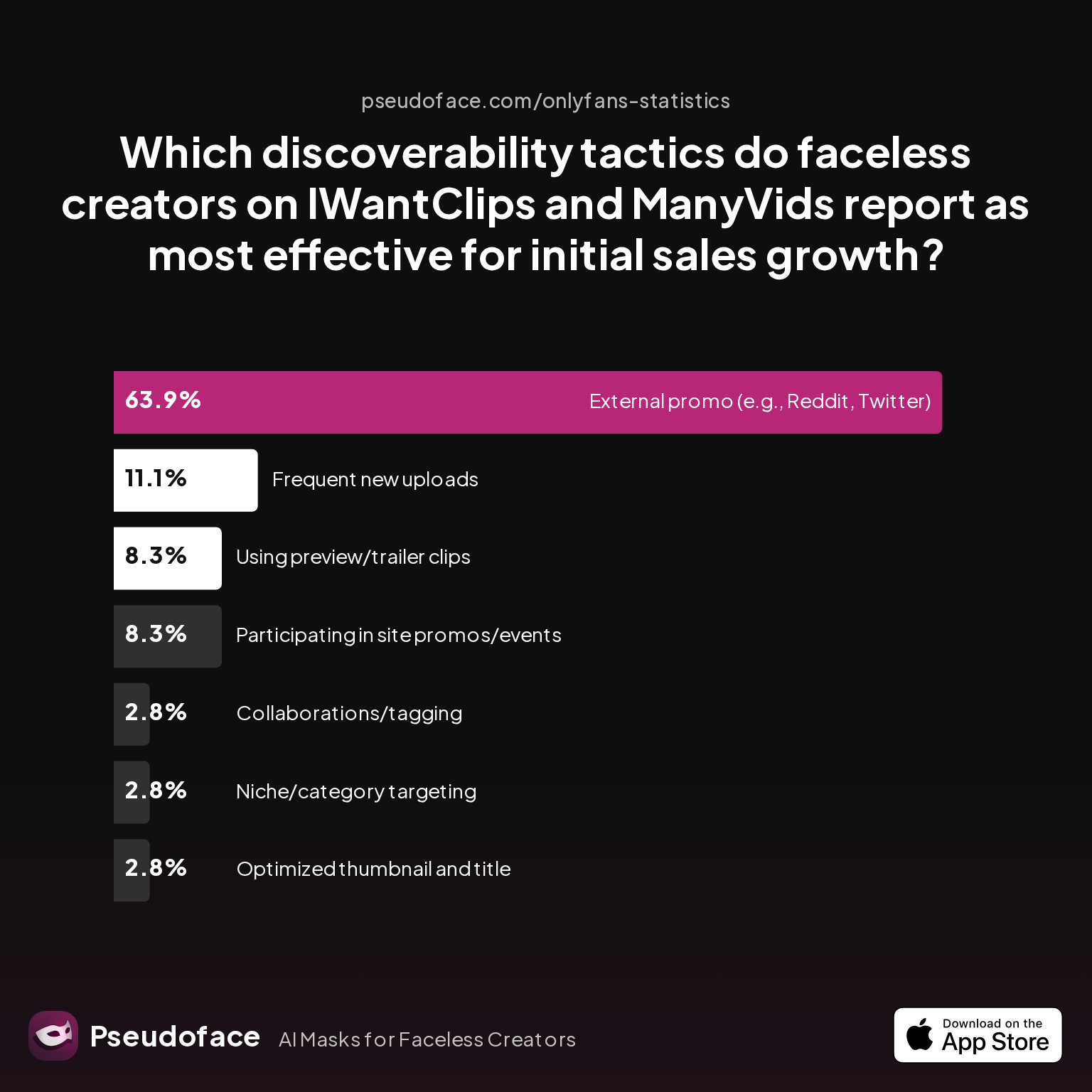
Over 60% of faceless creators attribute their initial sales to external promotion—mostly Reddit and Twitter—rather than internal site search or recency-based feeds.
In 2025-2026, buyers using IWC or MV are less likely to stumble on fresh, faceless content via the “front page”; their journeys often start on niche Twitter accounts, subreddits, or through direct links. Internal discoverability becomes a force multiplier after the first burst of off-platform exposure.
Posting frequently (11%) and participating in platform-run events boost visibility, as does utilizing trailer clips (with careful attention to not “give away” too much). Category targeting helps only if the content naturally fits underserved niches—on saturated tags, new faceless creators quickly drop out of view.
The utility of optimized thumbnails is underscored again here. Even with a cropped or blurred face, a distinct look, prop, or body angle increases clickthrough—but this accounts for only 2.78% citing it as the primary initial sales driver, likely because many struggle to leverage thumbnails effectively at first.
External promo does come with its burdens: higher risk of leaks, trolls, and platform cross-links. However, for faceless creators, being bold and proactive off-site is not optional; it is the primary engine of organic growth.
A Reddit creator offers this firsthand color:
Open thread on Redditr/CreatorsAdvice
u/ModBell
ManyVids and Clips4Sale both done well for me.
And another:
Open thread on Redditr/CreatorsAdvice
u/kawaiicookie1
yes to the being faceless on Manyvids question!
Persistence in uploading, offsite networking, and thumbnail experimentation remain the repeatable building blocks whether you show your face or not.
Faceless Content Creator Ideas: What Sells (and What Doesn’t) Without a Face
Not all clip types survive the transition to faceless production. Customer demand is strong in some verticals, tepid in others—your content strategy should reflect both the numbers and the real conversations in creator spaces.
| Answer | Percentage |
|---|---|
| Audio/voice tease | 13.27% |
| Cosplay/masked | 4.08% |
| Feet | 55.10% |
| Hands | 1.02% |
| POV (no face, body focus) | 3.06% |
| Solo explicit w/ crop | 13.27% |
| Written/roleplay | 10.20% |
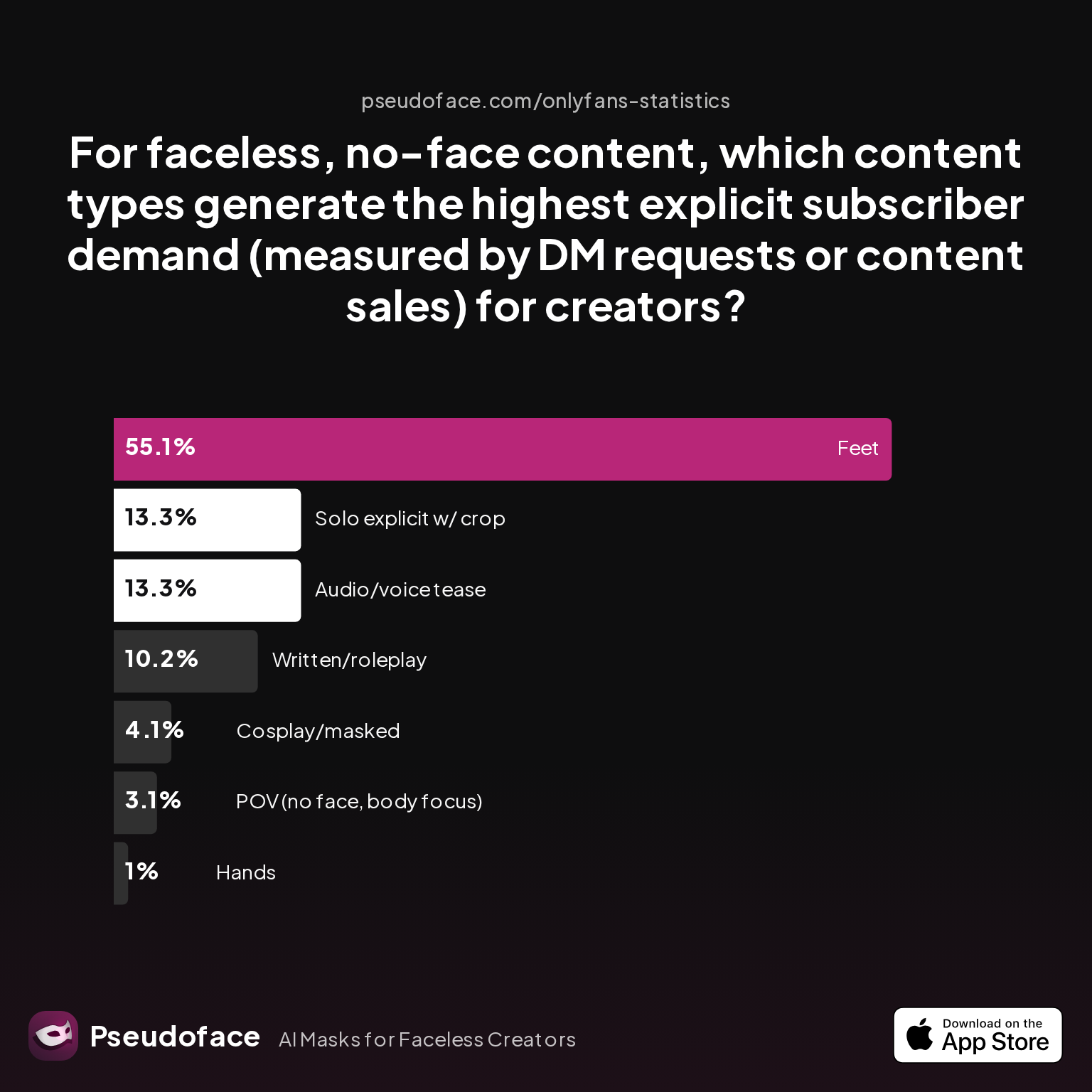
Over half of faceless content demand comes from foot content (55%)—a trend confirmed year after year as foot fetishes and related micro-niches drive outsized clip purchasing. Audio/voice tease and solo explicit content (with careful cropping) attract about 13% demand each; written/roleplay scripts are another 10%, especially in humiliation, dom/sub, and fantasy categories.
Other winning ideas: masked/cosplay (especially with unique or elaborate masks), tight body focus (POV or "out-of-frame" shooting), and strong, immersive narratives where the voice carries the personality.
By contrast, hand and generic POV content are rarely cited as top earners unless paired with well-defined micro-niches, such as gloved handplay or specific (and searchable) roleplay themes.
An important qualitative insight: narration, roleplay, and fantasy demand is often higher with faceless content, as fans seek a strong audio “connection” to compensate for the lack of gazing into someone’s face. Investing in microphone quality and creative storytelling can differentiate you more than lighting or resolution ever will.
For creators who master these categories—or creatively combine them (e.g., foot tease with narrative, masked cosplay in niche fandoms)—sales can reliably outperform generic, low-effort feeds even when fully anonymous.
Faceless vs. Face-Showing: Sales, Growth Limits, and Platform Comparison
Broadly, is going faceless a permanent ceiling on your earnings… or simply a different path to the same payout? The answer is "it depends"—not on platform policy, but on niche choice, branding, and the effort put into discoverability.
The top 10% of faceless creators on IWC and MV make as much as many mid-tier face-showing creators, but the average faceless earner trends lower. This split is clarified by both public data and lived testimonials: faceless success is skewed—monetary elite, then many low-volume hobbyists.
“Connection” is another dividing line. Showing your face allows instant parasocial rapport, and unlocks certain niches (e.g., gay romance, girlfriend experience, recognizable performer branding). For some, showing your face is a business superpower. For others, it is an unacceptable privacy risk.
Some creators report an uptick after revealing their face:
Open thread on Redditr/CreatorsAdvice
u/kisskittyred
People want someone to connect to.. not just a blank thing to wank to.. just some advice based on my experiences.. If people I know find me, I would charge more, we're on the same site for a reason, they're just as fill in the blank "negative" thing as me lol Don't post the same pictures on your pages that you do on your SFW pages.. and on fansly in settings, you can choose to block a location, even an entire state!
However, another dominant thread in 2025-2026 is that work ethic and content quality matter more than facial visibility:
Open thread on Redditr/CreatorsAdvice
u/Emotional-Feedback20
Faceless or not doesn’t matter. What does is how hard you work, your consistent and you create quality relatable content. Having your face in offers something yes but does it mean your workload reduces.? Probably not
Platform comparison: IWC and MV are more forgiving for faceless creators than webcam sites or tip-driven social feeds. On IWC, masked, cropped, or back-turned thumbnails are common. ManyVids structures search and “storefront” modes to allow alternative branding (e.g., themed productions, feet/voice/POV-centric channels).
Growth limits exist primarily for those chasing categories that reward face-to-camera energy (e.g., girlfriend/boyfriend experience, live response clips). For foot, POV, humiliation, dom/sub, and audio-centric niches, facelessness is often a strength or at least neutral.
The upshot: faceless creation is a viable model for many, but requires more consistent uploads, sharper branding, and added offsite hustle to match top face-showing earners. Risk-averse, privacy-minded creators often choose a hybrid: masked/cropped for most clips, occasional reveals for premium content, or “teaser” photos that offer a sense of intimacy without full facial exposure.
Workflow Foundations: Tech, Tools, and Community Tips for Faceless UGC Creators
Faceless content is, by nature, more demanding on the technical side—editing, blurring, metadata hygiene, and prevention of accidental reveals become part of every workflow. Yet by 2026, usable tools and best practices have become accessible even for beginners.
Let’s look at which blurring apps are preferred, and how manageable creators find their setups:
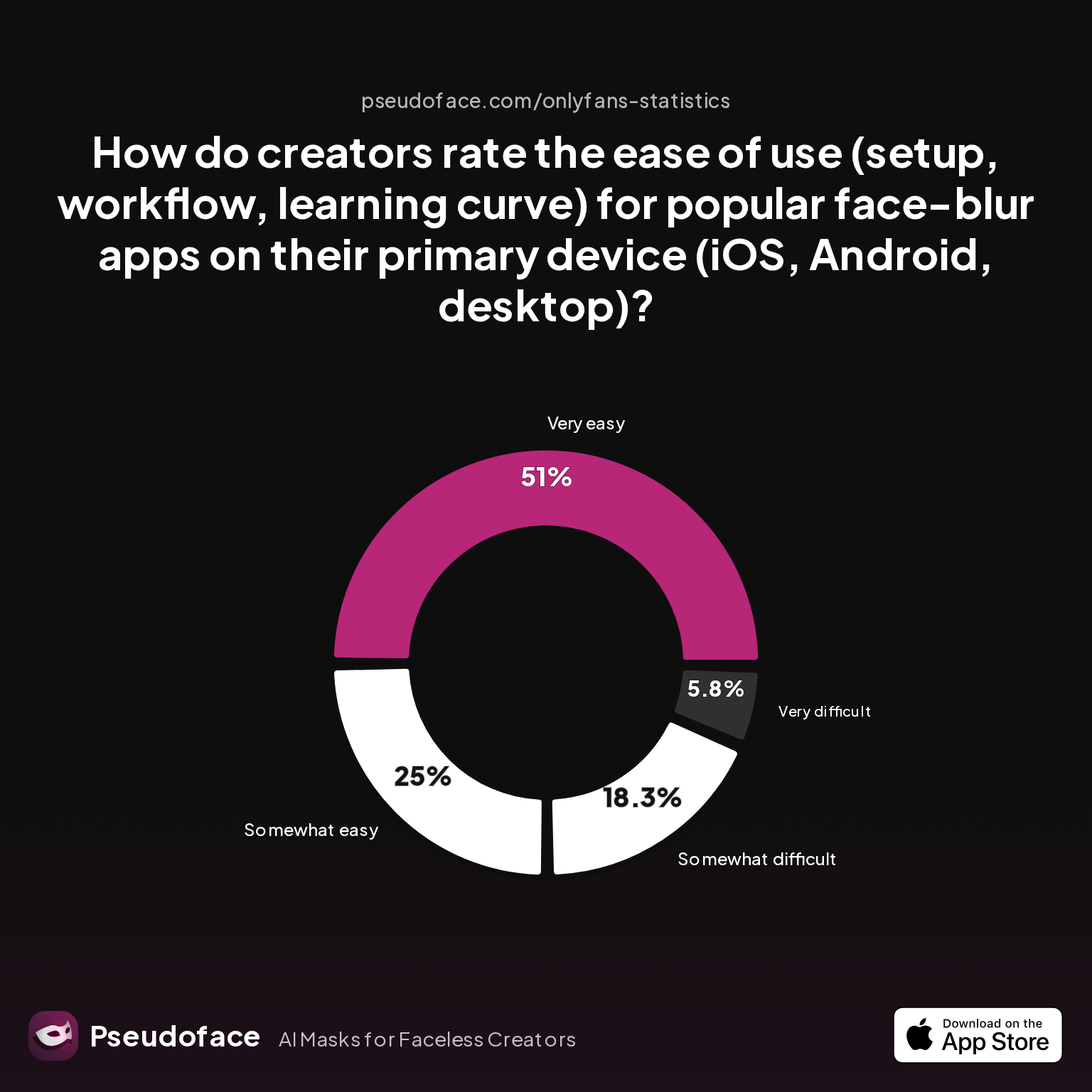
| Answer | Percentage |
|---|---|
| Neutral | 0.00% |
| Somewhat difficult | 18.27% |
| Somewhat easy | 25.00% |
| Very difficult | 5.77% |
| Very easy | 50.96% |
Just over half (51%) of creators find blurring their faces in video to be "very easy," with only a small fraction reporting major headaches. A quarter find it “somewhat easy,” and less than 6% call it very difficult. The leap in quality of app-based blur (e.g., InShot, PutMask, and native camera “mask” filters) means high-quality edits are possible on mobile just as much as in desktop suites.
Workflow tips from real creators:
Open thread on Redditr/CreatorsAdvice
u/kittykatrina21
I use Inshot! They’re great for blurring for videos!
Open thread on Redditr/CreatorsAdvice
u/Doc__plague
hello on android you can use PutMask
For those who want “editor-level” masking (with blur regions that follow the face as you move), desktop apps like Premiere Pro or Final Cut are widely recommended, though the learning curve is steeper.
On file privacy, savvy creators remove metadata before uploading content. Here’s how they approach it:
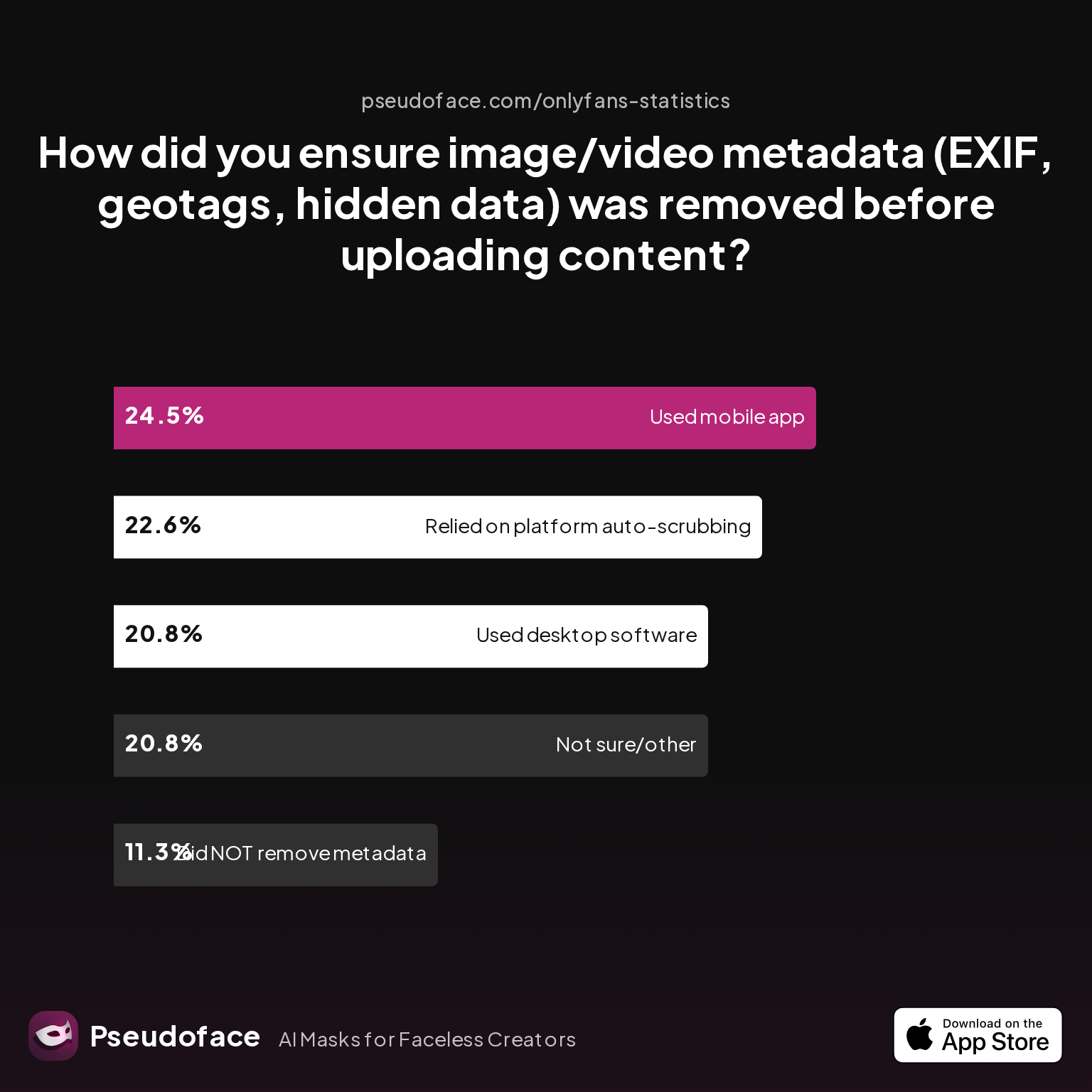
| Answer | Percentage |
|---|---|
| Did NOT take steps to remove metadata | 11.32% |
| Not sure/other | 20.75% |
| Relied on platform auto-scrubbing (e.g., OnlyFans upload process) | 22.64% |
| Used a dedicated metadata removal app on mobile | 24.53% |
| Used desktop software (e.g., Photoshop, custom scripts) | 20.75% |
Roughly half of all faceless creators intentionally scrub metadata, using either mobile apps (25%) or desktop tools/scripts (21%). A significant chunk still rely on platform auto-scrubbing or remain unsure—highlighting an ongoing privacy risk. On IWC and MV (less aggressive about auto-strip), using dedicated tools is especially critical.
Other workflow best practices surfaced in 2025-2026 community threads:
- Always record in test mode to check for accidental mirror or reflection reveals.
- Use batch blurring and cropping to speed high-volume uploads.
- Keep a checklist: face out of frame, metadata removed, lighting checked for accidental shadow reveals.
Policy, Verification, and Pitfalls: Common Issues for Faceless OnlyFans and Clip Creators
Privacy is a double-edged sword on clip sites: while you can publish fully anonymous content, the platforms themselves require personal identification for verification and payment compliance, leading to points of friction and anxiety—especially compared to subscription platforms.
Let’s see which policy hurdles cause the most problems for faceless creators:
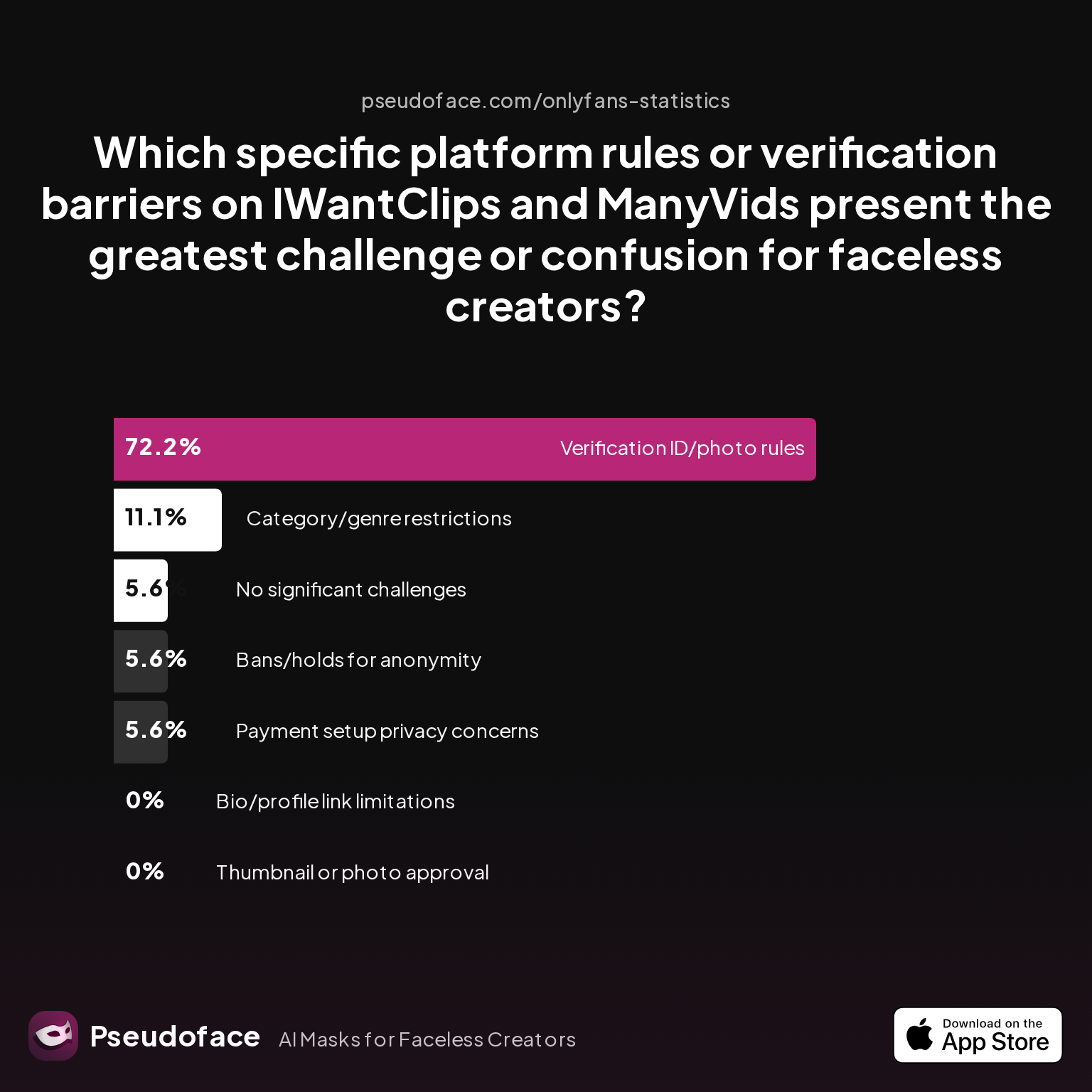
| Answer | Percentage |
|---|---|
| Bans/account holds for anonymity | 5.56% |
| Bio/profile link limitations | 0.00% |
| Category/genre restrictions | 11.11% |
| No significant challenges faced | 5.56% |
| Payment setup privacy concerns | 5.56% |
| Thumbnail or photo approval | 0.00% |
| Verification ID/photo rules | 72.22% |
Verification ID and facial photo rules present the largest anxiety and confusion point, with 72% citing it as the hardest challenge. While customers never see your ID, platform staff require face-visible photos and matching documents—disqualifying anyone unable to prove identity, or unwilling to risk even back-end leaks.
Category and genre restrictions (11%) are also a notable snag: some subcategories (e.g., “face sitting,” “JOI with eye contact”) explicitly require visible faces or facial expressions, which can lead to content removal or de-ranking if the face is hidden.
Payment privacy and the (rare) risk of account holds for “too much anonymity” round out the major platform concerns. Meanwhile, challenges with bio/profile links or thumbnail approvals are no longer significant as of 2025.
FAQ advice from active faceless creators:
- Submit clear, compliant ID photos even if you never intend to reveal your face on site.
- Write to support if you have privacy fears; some platforms offer extra steps (e.g., offsite ID video calls).
- Stick to content clearly allowed within faceless or masked verticals to avoid removals.
In sum: administrative friction is real, but surmountable—if you plan for it.
How to Become a Faceless Content Creator with Viral Potential: Branding and Niche Tactics
What turns a faceless creator from “also-ran” to viral? Beyond technical workflow and policy compliance, the answer lies in three moves: niche targeting, distinctive branding, and consistent creativity.
The top strategies for viral faceless content include:
- Carving out a recognizable visual brand without a face: a signature mask, prop, or set design.
- Owning a specific, high-demand category (e.g., feet content, audio JOI, fully clothed/masked roleplay) with relentless focus.
- Leveraging collaborations—with other faceless or masked creators—where voice or style is the “signature.”
- Strategic, regular posting PLUS external promo on Reddit, Twitter, and feet/voice niche forums.
- Using teasers and preview clips to build anticipation, but never “oversharing” in free content.
Faceless creators who thrive tend to treat anonymity as an asset, not a liability—making it the “secret sauce” their followers crave.
Consider this real-world success color:
Open thread on Redditr/CreatorsAdvice
u/NewHat2160
wait, didn't a creator who never showed her face recently win an iwc contest? rr was one of the winners? you should go and see it. i think they post everything on their Twitter.
As of early 2026, there’s never been a better time to be a creative, privacy-minded adult creator. Faceless doesn't mean featureless—it just means your “face” is now your brand, voice, or energy. The market for mystery and originality is durable and growing on IWC and MV.
FAQ
Can you make a living as a faceless creator on ManyVids or IWantClips?
Yes, but most faceless creators make modest incomes; only the top tier consistently matches face-showing earners. About 59% of faceless creators report earning at least modestly, with the top 10% earning as much as mid-tier face-showing creators. However, this reflects active and surviving creators—many who struggle or quit early are less likely to report their income, so these trends are directional, not universal.
What are the best thumbnail strategies for faceless videos?
Distinctive non-facial features—especially feet, signature lingerie, props, and voice cues—boost clickthrough. Feet (40%) and creative audio (25.5%) dominate, but anything that makes your brand unmistakable (bright props, unique backgrounds, consistent color themes) stands out. Test and iterate your thumbnails, keeping branding tight across your clips.
Does hiding your face limit discoverability or sales on clip platforms?
It can slow initial growth, but with niche selection, strong thumbnail branding, and external promo, faceless creators do break through. More than 60% of faceless creators cite external promo as the primary driver of sales, but thumbnails and niche targeting become more important over time.
Which types of clips sell best for faceless creators?
Foot content (55%) is by far the most in-demand, followed by audio/voice tease and explicit solos (about 13% each). Written roleplay, masked/cosplay, and imaginative voice-driven clips also sell well—POV and hand content are less reliable unless deeply niched.
How do faceless creators boost their search rank on IWC/MV?
External promo—Reddit threads, Twitter fans, niche forums—are the leading growth drivers at first (63.9%), but frequent uploads, participating in platform events, and optimizing your thumbnails/titles all help visibility inside the platform.
What about age verification and platform rules for faceless creators?
You must submit real ID and face-visible verification photos to get paid, even if you never show your face in content. 72% say this is the main pitfall; workarounds are limited. Policy pain-points also include category limits on fully faceless content.
Which apps are easiest for blurring faces in adult videos?
Most creators (51%) find mobile apps like InShot and PutMask "very easy"; a quarter use desktop editors for advanced masking, but the learning curve is steeper. For quick, consistent results, stick to mobile blur apps and keep your face out of the frame when shooting when possible.
How do you ensure privacy (metadata, location info) as a faceless creator?
Nearly half of creators now use dedicated metadata removal apps or desktop scripts to strip EXIF/geotags. Don’t rely on platforms to scrub files for you; invest in simple tools to batch-wipe uploads.
Can you go viral as a faceless creator, or is showing your face required?
You can absolutely go viral as a faceless creator—especially in strong fetish or character-driven niches, and with a unique, repeatable visual/audio brand. Several contest winners and trending creators remain fully anonymous; mystery can be an asset.
What can new faceless creators do if their initial content isn’t selling?
Try pivoting into stronger visual branding, more unambiguous niches, experimenting with titles/thumbnails, upping external promo, and interacting in community threads for feedback. Consistency and adaptation are the core drivers of faceless growth.


