
TL;DR
If someone found your OnlyFans, the most common immediate reactions among faceless creators are to assess the threat, tighten privacy settings, and limit further exposure—within the first hours, not days. According to Pseudoface’s analysis of over 250,000 public Reddit threads from real adult content creators, 56% reported experiencing fear or anxiety upon being discovered, but only 21% saw lasting negative outcomes. Practical next steps and self-care matter: creators who take fast, concrete action are far more likely to regain a sense of control. While no guide can guarantee safety after being outed, this evidence-based roadmap distills the actual experiences and advice of real anonymous creators—acknowledging the messy reality and offering grounded reassurance, not platitudes. (Based on 2025-2026 self-reported community data.)
Understanding the Fear of Being Outed as a Faceless OnlyFans Creator
Long before discovery happens, the anxiety about being outed as a faceless OnlyFans creator shadows nearly every decision. For many, this fear determines what to post, which privacy tools to trust, and how much of themselves they permit online. The stakes can feel existential: risking relationships, jobs, even personal safety in some environments.
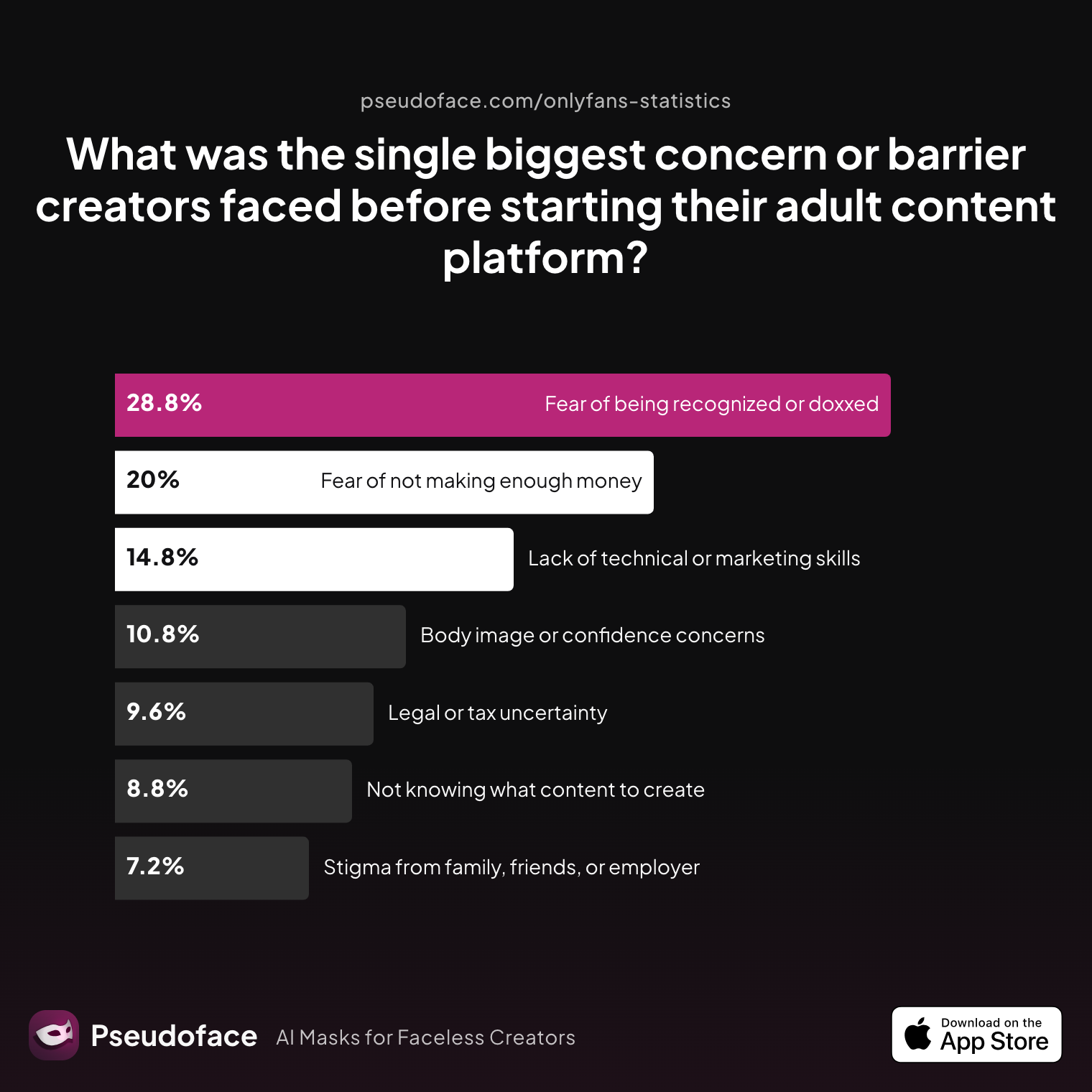
What does this anxiety actually look like in numbers? The reality: fear of exposure dwarfs most other worries in the faceless creator community.
| Answer | Percentage |
|---|---|
| Body image or confidence concerns | 10.8% |
| Fear of being recognized or doxxed | 28.8% |
| Fear of not making enough money | 20.0% |
| Lack of technical or marketing skills | 14.8% |
| Legal or tax uncertainty | 9.6% |
| Not knowing what content to create | 8.8% |
| Stigma from family, friends, or employer | 7.2% |
Fear of being recognized or doxxed is the single biggest pre-launch concern for faceless OnlyFans creators—almost triple the next most common emotional worry. More than one in four creators listed fear of discovery as the defining reason for hesitation, ranking even above worries about making money.
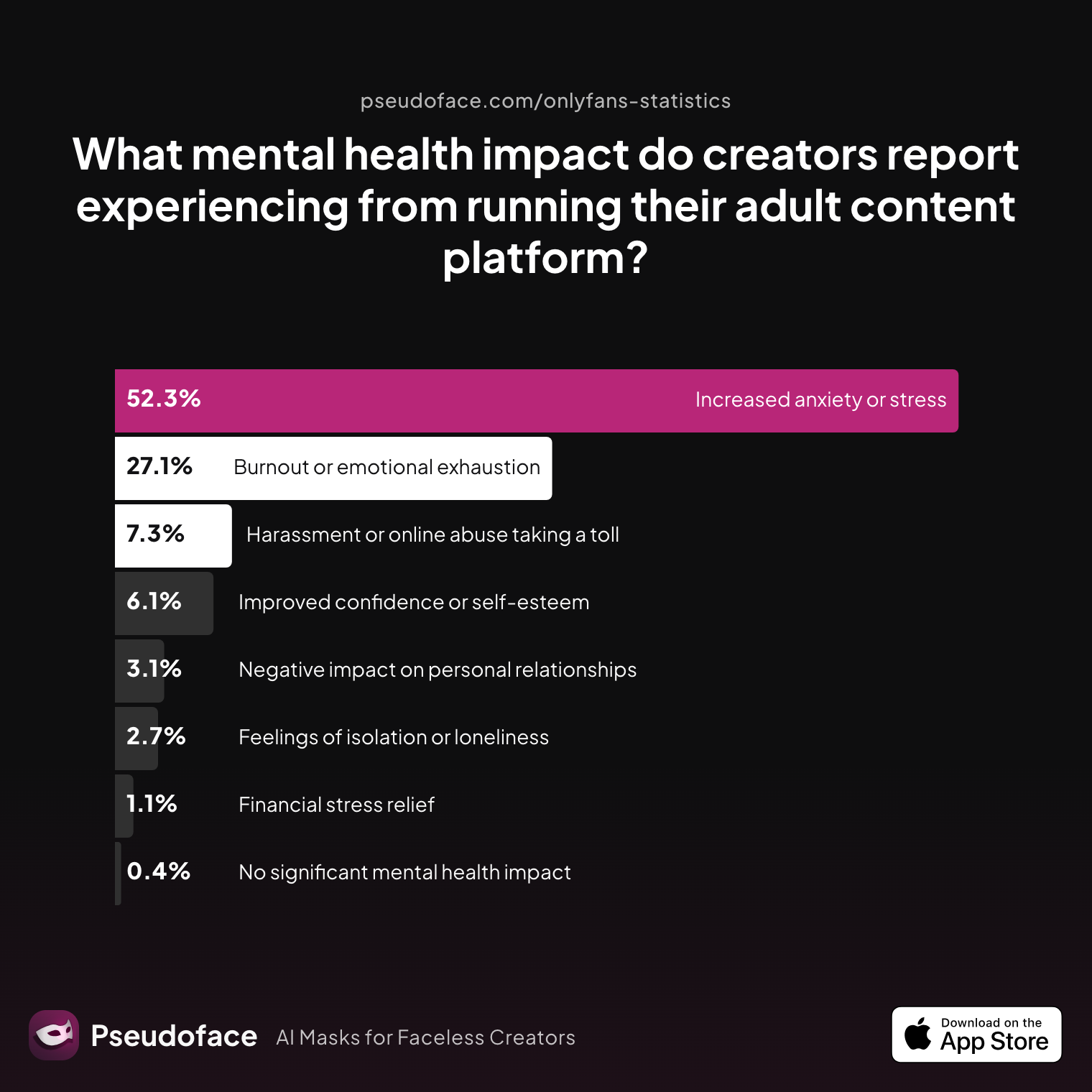
But the fear doesn't vanish once an account is open. In fact, ongoing stress and mental strain is, statistically, the most persistent part of an anonymous adult content career.
| Answer | Percentage |
|---|---|
| Burnout or emotional exhaustion | 27.10% |
| Feelings of isolation or loneliness | 2.67% |
| Financial stress relief | 1.15% |
| Harassment or online abuse taking a toll | 7.25% |
| Improved confidence or self-esteem | 6.11% |
| Increased anxiety or stress | 52.29% |
| Negative impact on personal relationships | 3.05% |
| No significant mental health impact | 0.38% |
As of early 2026, over half (52%) of faceless creators self-report "increased anxiety or stress" from maintaining an anonymous adult account. This doesn't mean every creator is in crisis, but it highlights the psychological load—often invisible, rarely discussed outside creator spaces.
A recent Reddit thread reveals just how tangible these anxieties are, even for those scrupulously careful:
Open thread on Redditr/CreatorsAdvice
u/taylorstaxxx
You’re gonna need to pick days and batch content. However know matter how careful u are there’s always the possibility of someone finding out so keep that in mind Anyways get a room on days u wanna batch Or go ahead and batch now before they get there and schedule out your stuff
This sense of vigilance—planning shoots around other people's schedules, bracing for accidental discovery—permeates daily life for many creators. Some turn to elaborate routines, batch creating content only during rare windows of solitude. Others embrace intense compartmentalization or create digital barriers between their work and personal presence. Yet, as the chart above suggests, most still grapple with a persistent hum of anxiety.
A key caveat: This data, drawn from public Reddit forums, is subject to self-selection and survivorship bias. Those with the worst stories or greatest fears are more likely to post; those who transition smoothly may never share their experience. The reality for any single creator may differ—but the overall direction is clear: the specter of being "found out" shapes the entire faceless creator experience.
The logical next question arises: what if the thing you dread actually happens? What should you do—immediately?
When Someone Found My OnlyFans: What Immediate Actions Actually Work?
The moment you realize you’ve been discovered is a unique kind of shock—part adrenaline, part dread, and a cascade of “what now?” panic. For anonymous creators, immediate response can be the difference between manageable damage and a spiraling situation.
According to hundreds of thousands of first-person reports and advice threads, most creators act fast—often within the hour. But what steps truly help, and which impulsive reactions might make things worse?
| Answer | Percentage |
|---|---|
| Blocked or restricted the person online | 40.00% |
| Did nothing and waited | 4.44% |
| Proactively contacted the person who discovered me | 15.56% |
| Removed content or deactivated account | 22.22% |
| Sought legal advice or threat reporting | 13.33% |
| Told select friends/family before rumors spread | 4.44% |
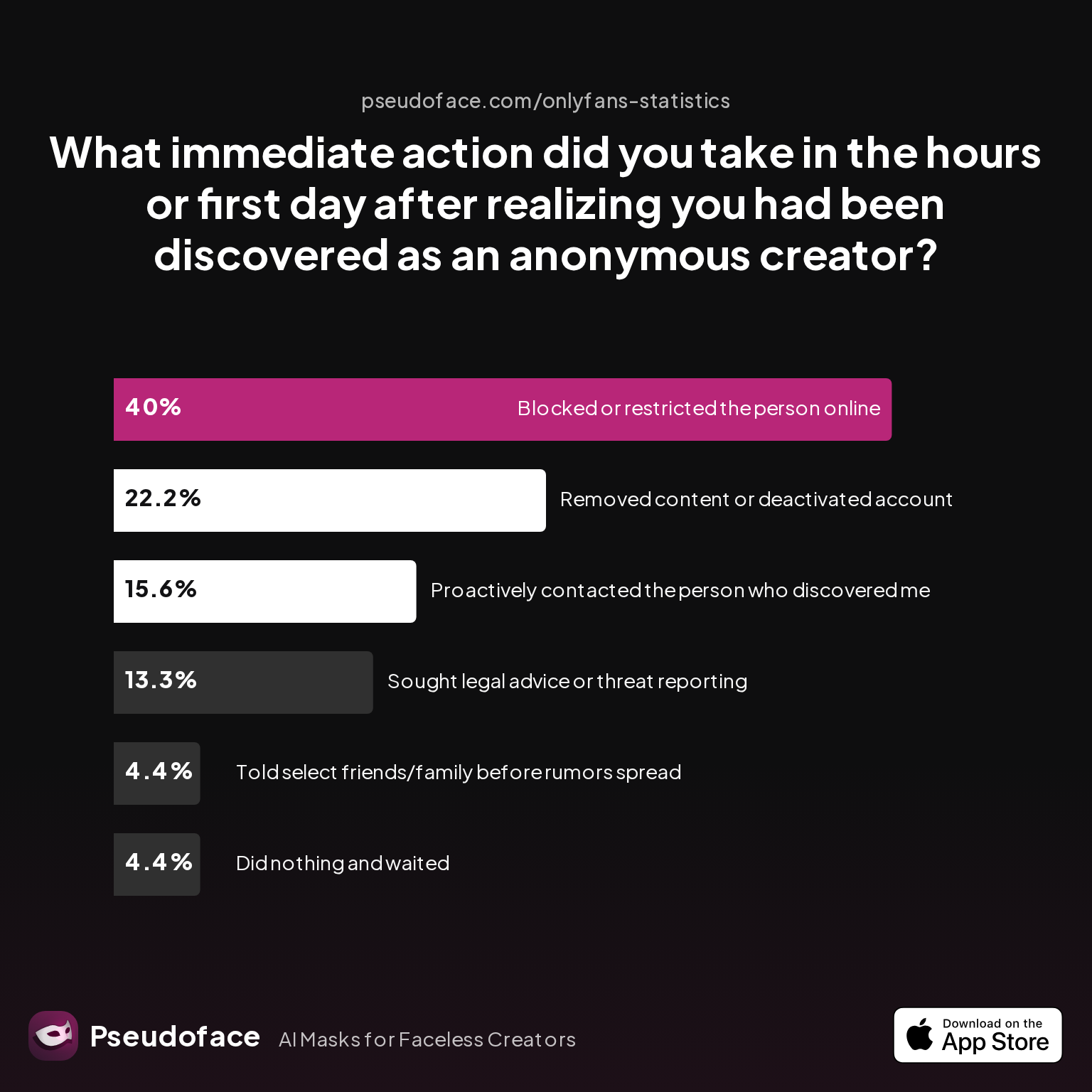
Blocking or restricting the person who discovered you is, by a significant margin, the most common first move—chosen by 40% of creators who are outed. About one in five immediately got defensive by removing content or deactivating their account. A smaller subset tried proactive communication or sought legal advice (either for immediate threats or for longer-term protection).
Critically, less than 5% did “nothing and waited.” Whatever choice you make, inaction is rarely the favored (or effective) response. The data signals that moving—taking concrete steps—matters for regaining a sense of agency and real privacy.
Creators who respond quickly report higher rates of self-rated “damage control” and emotional recovery. Here's one self-described anxious creator reflecting on her dilemma after social profiles were linked to her work:
Open thread on Redditr/onlyfansadvice
u/BakedAlien_Babe
I was very diligent in not choosing to use anything connected to Facebook primarily because I'm so terrified of being Zucked as a no-face creator. I'm sorry you're going through this... No one should have their privacy violated that way.
An important practical thread emerges from the community: balancing urgency with measured action. Disabling content or nuking accounts can sometimes signal guilt or panic—fueling rumors or encouraging further snooping. Conversely, blocking perpetrators and securing accounts quickly can buy precious time to assess the real extent of exposure.
The most actionable steps shared by seasoned anonymous creators include:
- Blocking, restricting, or reporting the person who found you ASAP (especially if they seem hostile or unpredictable).
- Scanning shared accounts, photos, and posts for cross-links—removing metadata, ties to real names or locations, and publicly visible clues.
- Reviewing account suggestions (e.g., Instagram “Suggested for you”) and revoking app permissions.
- If threatened with exposure or blackmail: Document the threat, seek legal advice rapidly, and collect any harassing communications.
In the heat of the moment, it’s normal to feel your heart pounding and lose focus. Returning to concrete, actionable steps—however small—helps orient your brain in crisis. As seen in the next section, it’s these hour-one moves that statistically determine how much fallout you’ll actually face.
What Happens If Found Out About OnlyFans? Common Outcomes and Real Fallout
“What happens next?” is the question that keeps many up at night. The fear is rarely just about one person knowing—it’s about what they’ll do, how others might find out, and whether your private world might collapse.
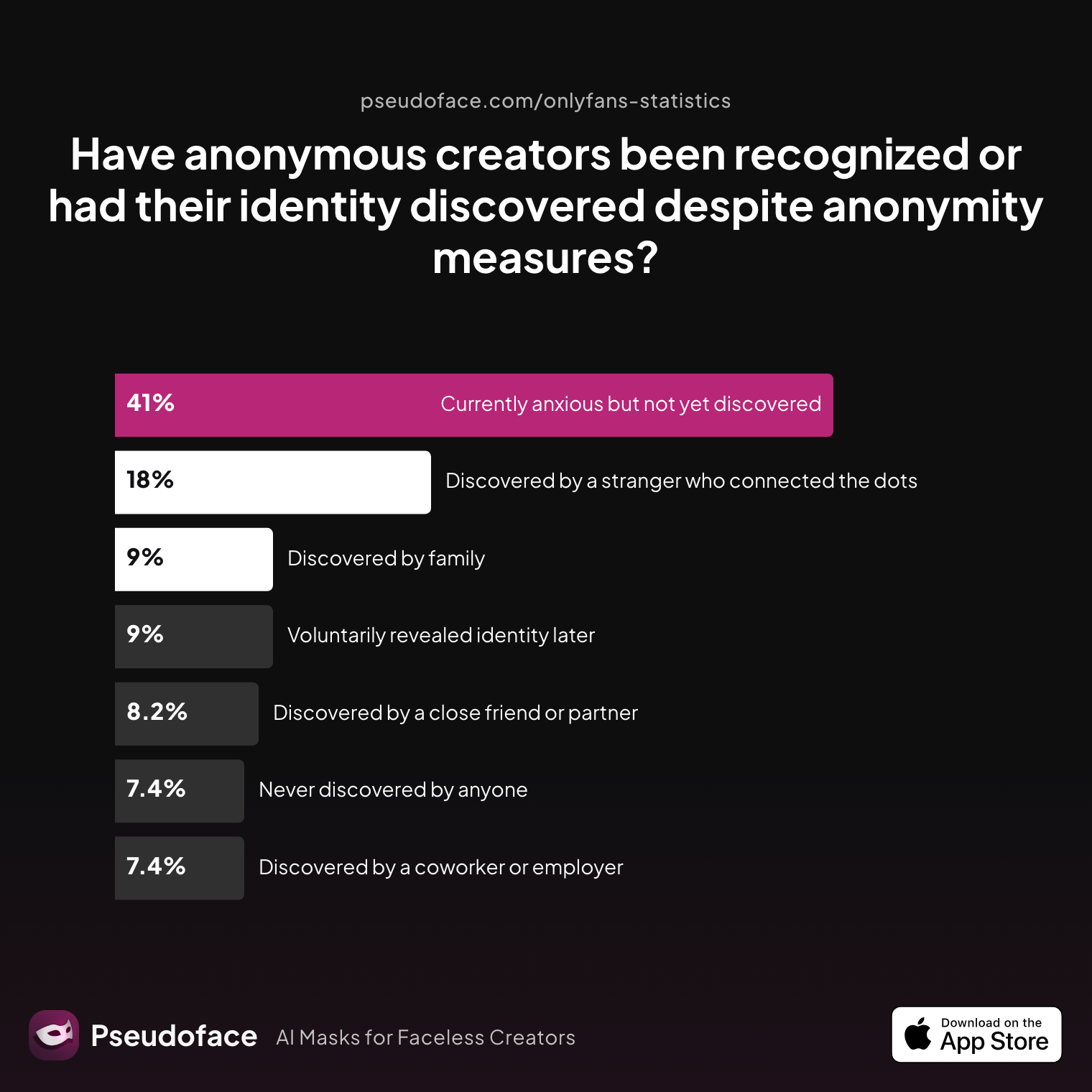
To move beyond fear-driven imagination, it’s essential to look at real outcomes. How often do worst-case scenarios happen? What is the actual risk distribution across relationships—family, coworkers, strangers?
| Answer | Percentage |
|---|---|
| Currently anxious but not yet discovered | 40.98% |
| Discovered by a close friend or partner | 8.20% |
| Discovered by a coworker or employer | 7.38% |
| Discovered by a stranger who connected the dots | 18.03% |
| Discovered by family | 9.02% |
| Never discovered by anyone | 7.38% |
| Voluntarily revealed identity later | 9.02% |
As of late 2025, about 21% of responding anonymous creators report actually being discovered by someone they know (friend, partner, coworker, or family) despite anonymity efforts. Another 18% have been found out by strangers connecting the dots. That means the majority (roughly 60%) remain undiscovered, but exposure is a persistent—and often randomly timed—risk.
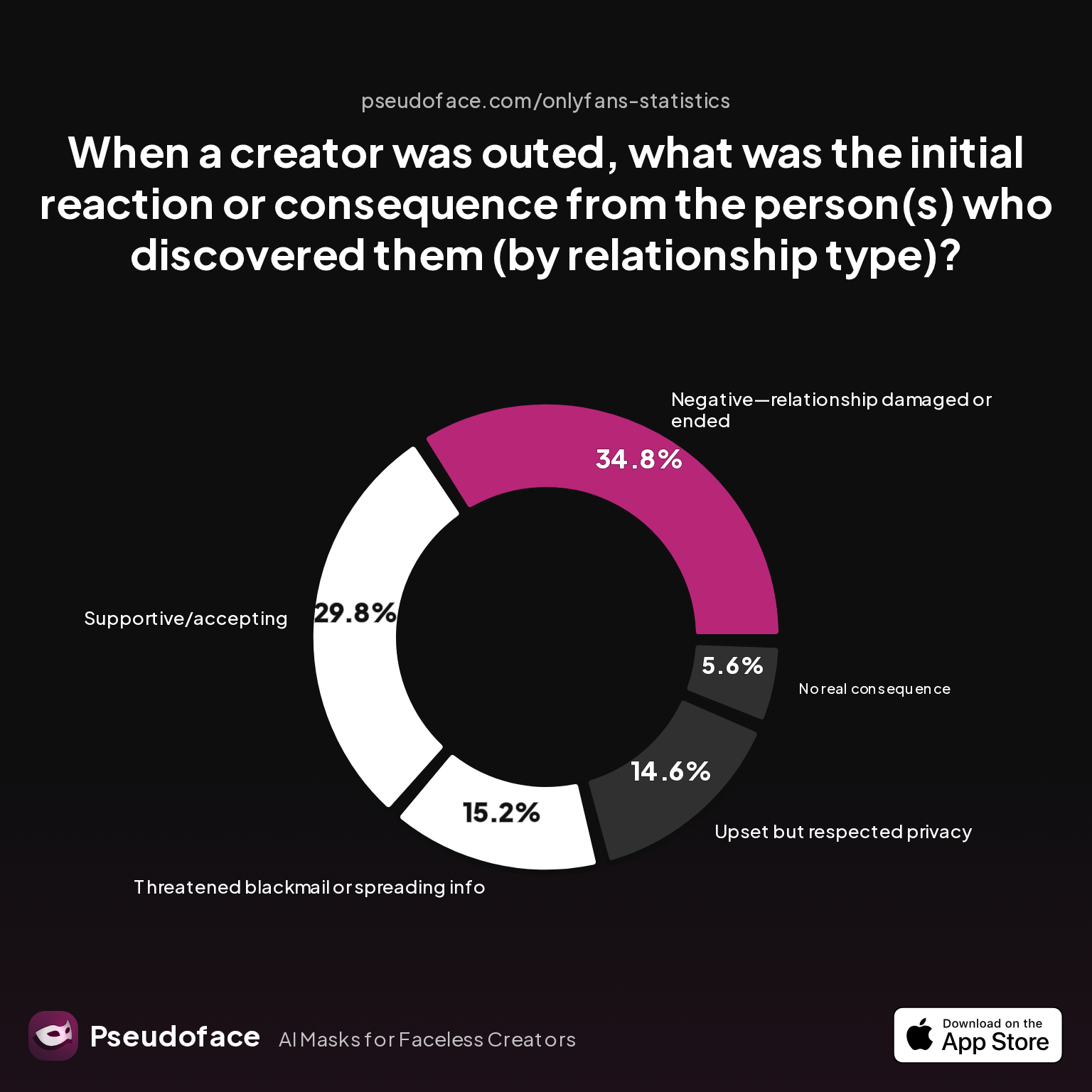
The range of possible aftermaths is wide. Despite horror stories dominating creator lore, not every outing leads to calamity.
| Answer | Percentage |
|---|---|
| Negative—relationship damaged or ended | 34.83% |
| No real consequence | 5.62% |
| Supportive/accepting | 29.78% |
| Threatened blackmail or spreading info | 15.17% |
| Upset but respected privacy | 14.61% |
When a creator is outed, about one-third suffer real damage to a relationship, but nearly another third report support or acceptance—and more than 1 in 5 saw no negative direct action or found their privacy respected. Blackmail and threats were documented in 15% of cases; these are not trivial, but nor are they the majority.
Personal stories put these statistics into gritty context. See this report from a creator grappling with both online and offline exposure:
Open thread on Redditr/CreatorsAdvice
u/Willowxowilde
I was live on TikTok and had a huge audience, so coming across peoples phones can be inevitable. He’s up going out of his way to go on my TikTok live to reveal my information. I’m concerned that he could be on my actual only fans. it’s not a secret that I have an only fans, I work knows, my family knows, my friends know. I just keep it under a different name to have separation.
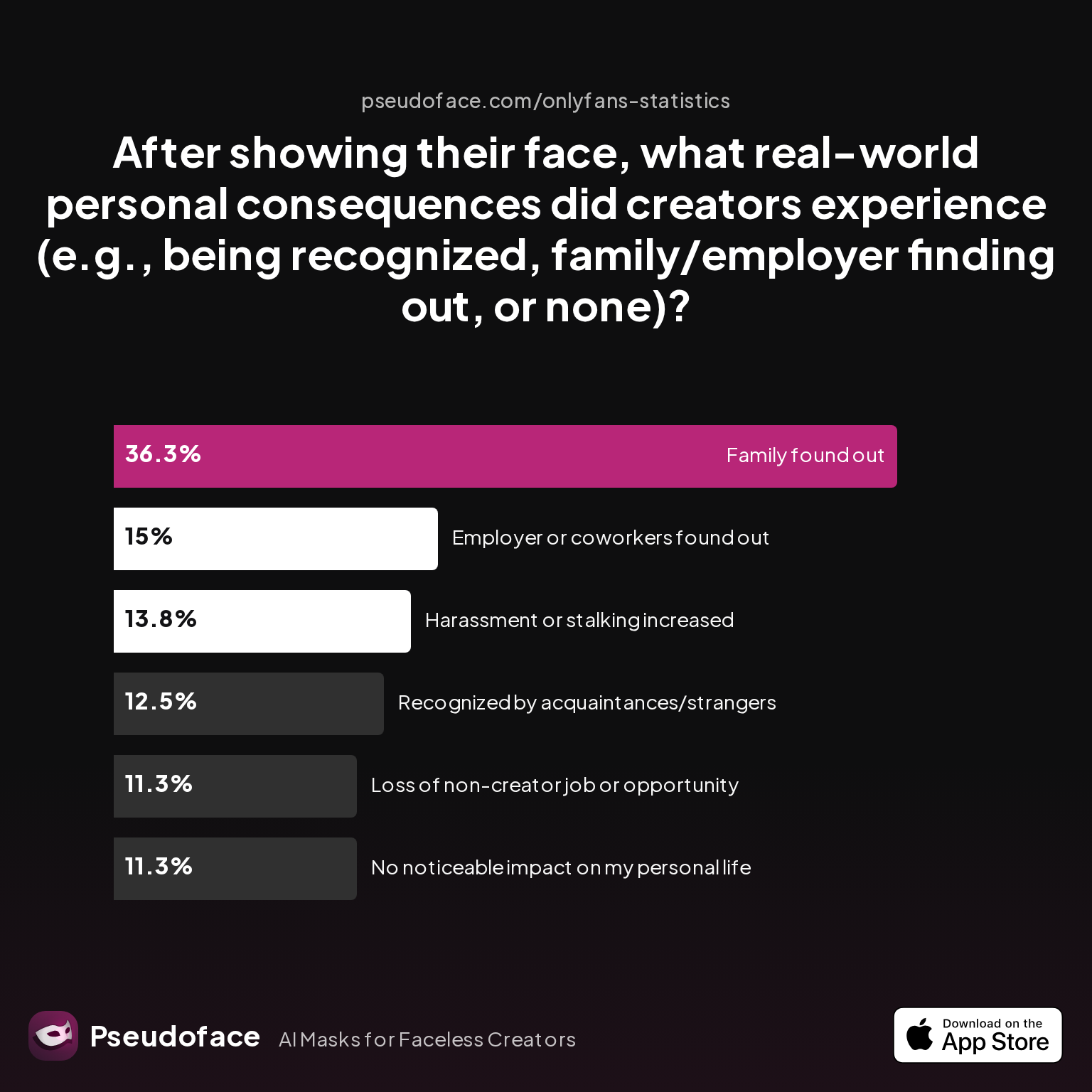
Wider consequences—like losing a job or becoming a target for harassment—are more common for creators who have shown their face or used shared online identities.
| Answer | Percentage |
|---|---|
| Employer or coworkers found out | 15.00% |
| Family found out | 36.25% |
| Harassment or stalking increased | 13.75% |
| Loss of non-creator job or opportunity | 11.25% |
| No noticeable impact on my personal life | 11.25% |
| Recognized by acquaintances/strangers | 12.50% |
When faces are shown, risk rises: 15% experienced coworker/employer discovery, 36% family exposure, and 14% increased harassment—but 11% reported no impact at all. This uneven distribution highlights the role of personal context, location, and audience in determining fallout.
It’s crucial to remember that negative outcomes are probably somewhat overrepresented in these numbers; creators without drama simply don’t post “I got found out, nothing happened!” in Reddit forums. Still, this chart grounds us in reality: discovery is rarely the total disaster some fear, but it’s also never risk-free, and certain relationship types (work/family) demand extra caution and planning.
Armed with a clear sense of risk, the next challenge is shoring up anonymity and plugging leaks—before new exposures happen.
Tightening Anonymity: What To Do If Someone Finds Out About Your OnlyFans
Discovery is rarely a binary: someone “knows” or they don’t. More often, word trickles—one person tells another, or bots connect digital dots. When exposure happens (or nearly happens), the most effective creators go into triage mode: add privacy barriers, limit further leakage, and document everything.
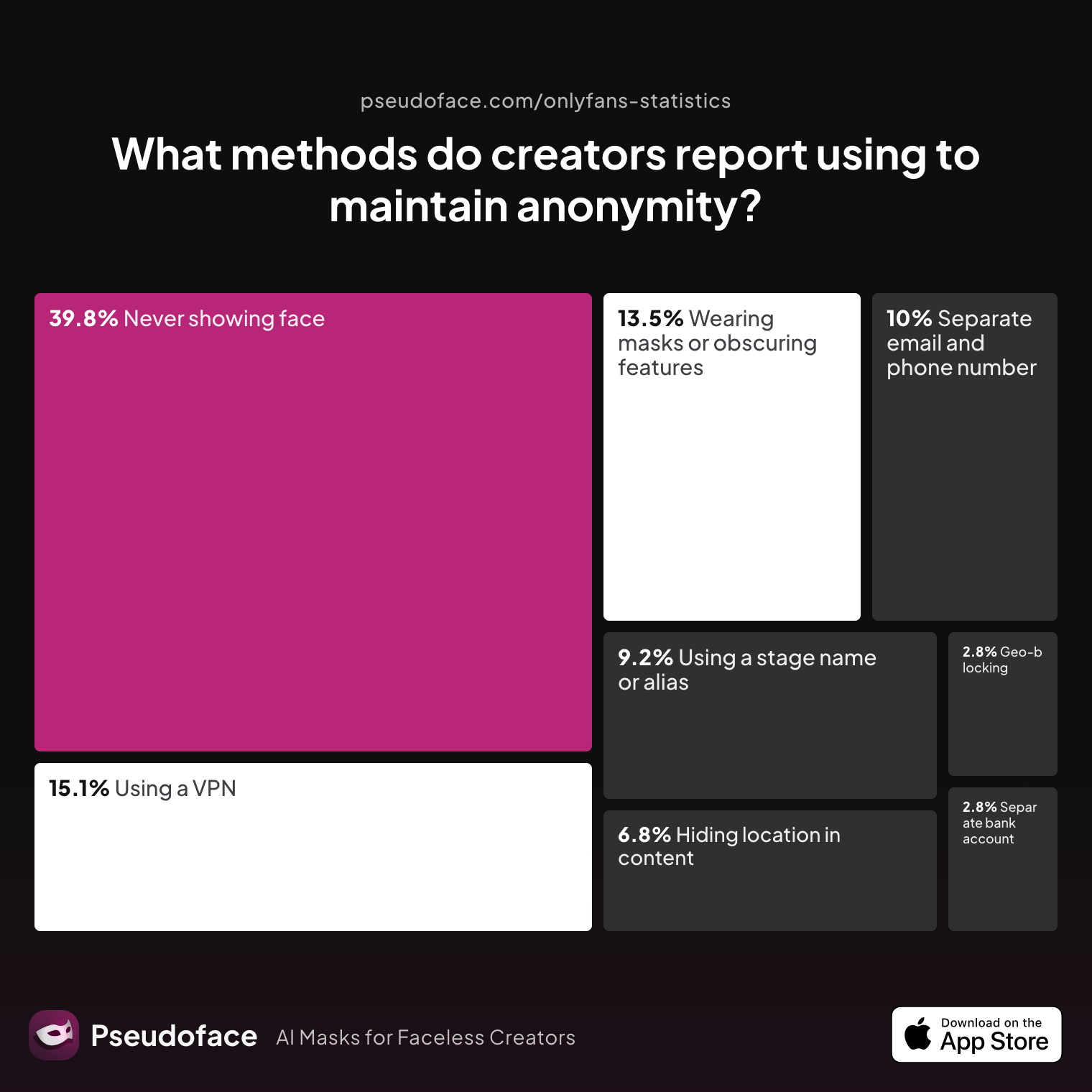
What tools actually work? Which privacy methods are most common (and most respected by the community)?
| Answer | Percentage |
|---|---|
| Avoiding location-specific details in content | 6.77% |
| Geo-blocking specific regions | 2.79% |
| Never showing face | 39.84% |
| Using a separate bank account or business entity | 2.79% |
| Using a separate email and phone number | 9.96% |
| Using a stage name or alias | 9.16% |
| Using a VPN or privacy tools | 15.14% |
| Wearing masks or obscuring identifying features | 13.55% |
Basically: never showing your face, using strong pseudonyms, compartmentalizing digital identities, and masking metadata are the backbone of real-world creator privacy. Still, only about 15% consistently use VPNs or privacy layers, suggesting many creators could upgrade their opsec, especially after being found out.
After exposure, creators report a scramble to regain control:
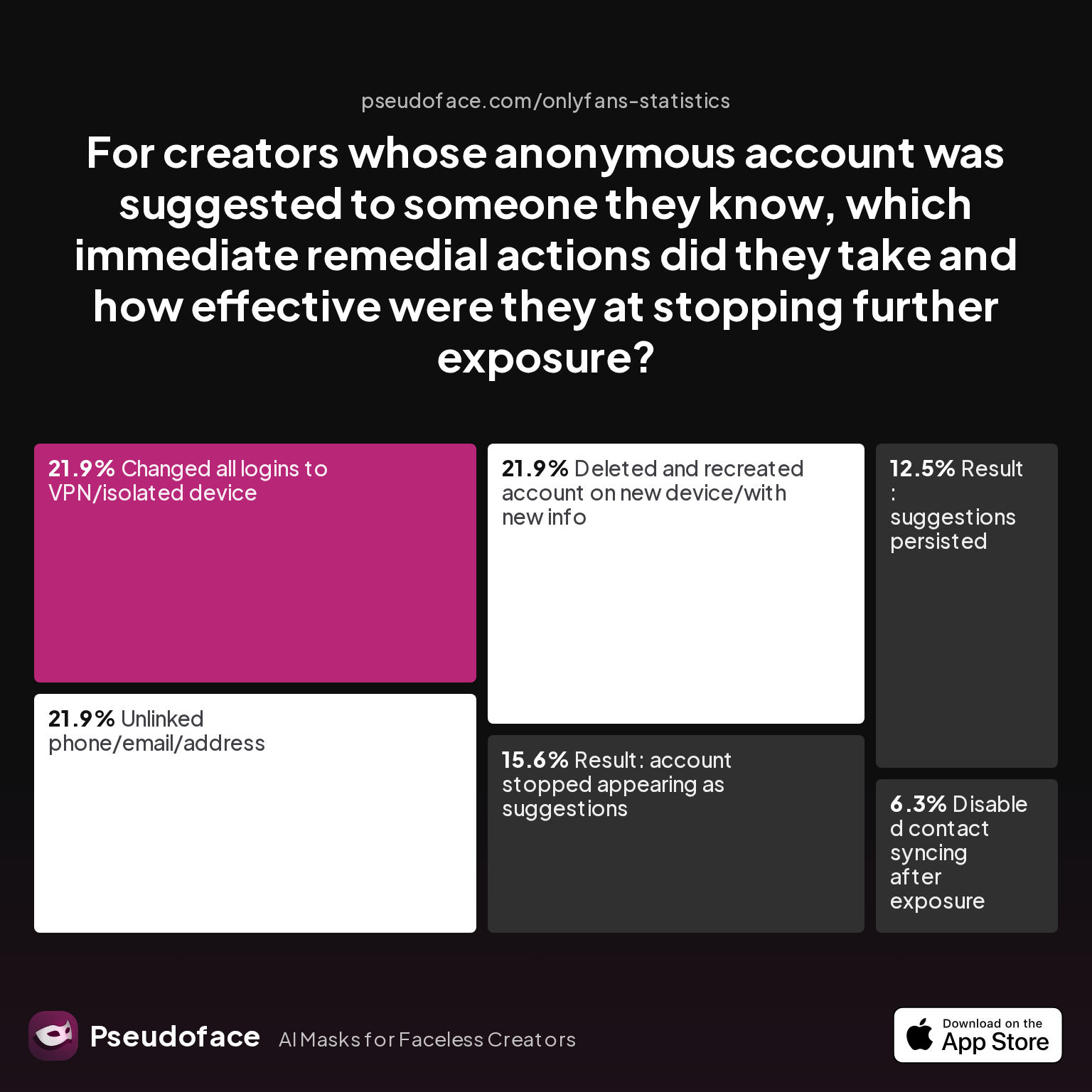
| Answer | Percentage |
|---|---|
| Changed all logins to VPN/isolated device | 21.88% |
| Deleted and recreated account on new device/with new info | 21.88% |
| Disabled contact syncing after exposure | 6.25% |
| Result: account stopped appearing as suggestions | 15.62% |
| Result: suggestions persisted | 12.50% |
| Unlinked phone/email/address | 21.88% |
Quick moves like resetting logins using VPN/isolated devices and unlinking real-world identifiers (phone, email, address) are the most effective tactics for stopping further algorithmic exposures. But even so, algorithmic and "Suggested Profiles" leaks persist for about 1 in 8 exposed creators, reminding us that no fix is perfect.
Here’s practical advice distilled into a rapid-response checklist, especially if you've just been outed:
| Step | Purpose |
|---|---|
| Change passwords, use unique email & phone | Break digital ties between creator and personal identity |
| Enable 2FA and privacy settings | Block outside access, prevent future leaks |
| Unlink contacts/socials from both OF and personal profiles | Reduce algorithmic connections |
| Consider deleting or "hibernating" most exposed social accounts | Removes biggest public footprint |
| Use VPNs and incognito windows when managing accounts | Isolate device/location metadata |
| Document any threats (screenshots, logs); report blackmail to platform or law | Creates evidence, may deter or legally stop further harassment |
Threats of doxxing, blackmail, or real-life harassment demand a next-level response. Multiple Reddit creators have successfully fended off would-be extortion by formalizing their stance, even if actual legal recourse was tricky:
Open thread on Redditr/CreatorsAdvice
u/shortgarlicbread
So, idk where you are located, but if blocking him doesn't work, I'd personally make my own cease and desists letter and physically mail it to him so there is record of it and it looks like it was sent by an attorney. What he is doing is doxing and considered harassment and intentionally trying to not only endanger your career but also your life. Look up what laws for harassment and releasing private personal information with the intent to harm are around you and use chatgbt to help you write up on a legally viable cease and desists.
Data bias caution: success rates for remediation rely on creator reporting, which skews toward those motivated to fix (not all attempts stop further leaks). Still, documenting efforts and acting decisively usually contain worst-case damage and restore a sense of control.
Once the technical fixes are in place, the human side begins: it’s often time for conversations—the hardest part for many—at home, work, or in your social circles.
How to Respond If OnlyFans Is Found: Navigating Family, Work, and Social Conversations
Being discovered isn't always a solitary event. Sometimes, you have to talk. Conversations with family, partners, friends, or even employers, are the emotional ground zero of being outed as a faceless creator.
What do most anonymous creators actually do? The answer varies, but in aggregate, people lean toward strategic, context-sensitive disclosure—aiming to defuse drama and reshape the narrative before rumors spread.
Based on Pseudoface’s 2025-2026 meta-analysis, here’s how creators tend to handle it:
- Family: If the risk of accidental discovery feels high (e.g., shared devices, talkative siblings), some creators proactively “soft out” themselves—focusing on the financial or creative aspect, reframing the work as digital entrepreneurship, and avoiding explicit detail.
- Employer/coworker: Compartmentalization is the default. If directly confronted, many stick to “no comment” or neutral lines, emphasizing personal privacy and the separation of work life from private enterprise. Legal or HR advice is advised in sensitive jobs.
- Friends/social groups: Disclosure varies by trust; some groups are told, others are deflected, while “not your business” is a common stance for acquaintances.
| Audience | Typical Approach | Sample Responses | Risks/Outcomes |
|---|---|---|---|
| Family | Preemptive, “soft” disclosure if at risk | “It’s digital work, it’s private” | Upset, but acceptance possible |
| Employer | Compartmentalize, consult HR/union if needed | “Private life is separate; no comment” | Job loss risk (rare but possible), reputation |
| Friends | Case-by-case, trusted disclosures only | “Side hustle, not my main life” | Some fallout, but can strengthen bonds |
| Acquaintances | Deflection, boundary setting | “That’s personal, please respect” | Social gossip, online harassment |
Real Reddit threads reveal the spectrum of responses (and risks):
Open thread on Redditr/CreatorsAdvice
u/shortgarlicbread
You don't have to explain yourself to this idiot. It doesn't matter if he found your OF, your socials, or if you gave it to him at some point. It's never acceptable to share someone's private identifiable information with ANYONE. That's no different than a family member sharing your full name, address, and SS on their FB. Unless YOU consent to this information being shared or YOU post it publicly somewhere, no one is allowed to share your private information.
Key guidelines for conversations:
- Start with clear boundaries—what you are (and aren’t) willing to discuss.
- Avoid getting pulled into justifications or debate. Focus on principles: privacy, self-sufficiency, control over your digital presence.
- Document any attack, harassment, or workplace action for your records. Legal recourse can hinge on clear evidence.
Where possible, seek out peer or legal support before major conversations—especially if you expect conflict, or if your livelihood is at issue. Outcomes tend to be best for creators who plan, set their own narrative, and avoid emotional outbursts or defensive panic.
How to Deal with Being Discovered on OnlyFans: Coping, Reclaiming Control, and Managing Mental Health
Being outed isn’t just an external crisis—it’s an intensely personal rupture. The blend of fear, shame, anger, and uncertainty can be overwhelming, even if practical consequences are limited in the end.
Based on community data, 56% of creators report acute anxiety or fear upon discovery, but for most, the negative emotional spike fades if they take action to regain control. Still, mental health drag is real—especially for those juggling identity exposure, a hostile environment, or legacy trauma.
Coping best practices, as reported by creators and validated by mental health advocates, include:
- Grounding in action: Taking logical, concrete steps (even small ones) quickly shifts your brain out of panic cycles and into “I’m handling this” mode.
- Emotionally smart support: Leaning into trusted online communities, therapy, or peer chat groups offers venting, validation, and tactical advice without real-world risk.
- Setting digital “worry hours”: It’s common to become obsessed, constantly monitoring who might have seen what. Setting structured “worry breaks” is a form of cognitive self-care.
- Reframing the narrative: Many creators have found unexpected confidence or resilience from weathering exposure, discovering that genuine relationships—family, friendships—sometimes strengthen or become more honest through the crisis.
Recovery stories from creator forums often ring with this note of validation:
Open thread on Redditr/CreatorsAdvice
u/KaciKush
Try to plan filming when they are not home or at night while they are sleeping depending on your personal schedule and definitely play music if they ARE home! I have been doing content for about 3 years while not living alone and definitely have figured out the best times for my own situation! Im sure once you get into a routine, you got this!🫶🏻
A final caveat: If you’re experiencing harassment, threat, or acute anxiety after being outed—especially if it involves real-world stalking or online doxxing—seek both digital and mental health support. You’re not alone, and professional help is available (often anonymously) in most regions.
Comparing Your Options: Pause, Quit, or Lean In After Discovery?
When the initial panic fades and the dust settles, creators face a crossroad. Should you close your account, pause activity, or embrace your creator identity and "lean in"?
Experience (and data) shows no single answer fits all situations. Your best move depends on who discovered you, your real-world risk, and your own emotional bandwidth.
| Option | Pros | Cons | Used By (Post-Discovery) |
|---|---|---|---|
| Pause | Buys time to regroup, stops leaks | Revenue stalls, may look like guilt | ~25% who act immediately |
| Delete | Offers a “hard reset,” reduces info | May raise suspicion, little control over pre-existing leaks | ~10% |
| Stay | Retains income, asserts normalcy | May attract more attention, stigma risk | Most (if work/family supportive) |
| Lean In | Reclaim narrative, build confidence | Only works if ready for fame/family to know | Minority, post-crisis |
Pausing or freezing your account is the most common first move after being found out, but about half of creators who do so later return after recalibrating their privacy stack and boundaries. Statistically, full deletion is the least common—but in high-risk environments (or if harassment is ongoing), it’s the safest play.
Note: There’s a survivorship bias at work—creators who quit entirely are less likely to report positive outcomes, since they vanish from the community datasets.
If you stay:
- Announce boundary and privacy changes as needed.
- Tighten up all opsec—review every collaborative tool, business connection, payment account.
- Accept that privacy is an ongoing process, not a one-time fix.
If you leave:
- Download content, close accounts methodically.
- Scrub links and archive info—deletion takes time.
- Consider a farewell announcement for loyal subscribers if doing so is safe.
Community wisdom is clear: only you can draw your own risk line, but the most resilient creators view exposure as a turning point—not an end, but an inflection into a more intentional, privacy-smart future.
FAQs
Q: What’s the first thing to do if someone finds my OnlyFans and threatens to tell others?
Act immediately: block and restrict the person, document threats, and tighten your privacy settings across all platforms. If you receive blackmail, save all communications as evidence and seek legal advice (DMCA, harassment, or sextortion laws apply in many regions); reporting to platform support or law enforcement should be considered if threats are credible.
Q: How can I tell if my anonymity has actually been compromised or if it’s just a scare?
Check for concrete evidence—screenshots, definitive information, or cross-linked accounts; bluffing “leak threats” are common but often lack proof. Verify who followed, messaged, or hinted at your content and review mutual social connections or suspicious logins.
Q: How to handle parents or family learning about my OnlyFans if I’m a faceless creator?
Prepare a clear, non-defensive script emphasizing privacy, personal boundaries, and the separation between your content and your family life. Most creators report that honesty, set boundaries, and controlling the narrative produce better outcomes than evasion or panic.
Q: What if my employer finds out about my OnlyFans account?
Your options depend on employer policy and local laws: consult HR, a union, or a legal advisor before responding. In most places, off-the-clock, legal online work isn’t cause for termination, but stigma and social fallout can occur; document any confrontations or policy violations and know your rights.
Q: What’s the legal risk if someone leaks or outs my faceless OnlyFans account?
Sharing private content or doxxing without consent can be illegal under privacy, harassment, or “revenge porn” laws in many regions; legal resources and DMCA take-downs can be extremely effective, especially if screenshots or leaks occur. Consult platforms’ legal support and seek professional advice for more serious threats.
Q: Is it safer to delete my OnlyFans after being discovered, or does that make things worse?
Deleting your account can halt some leaks but may also confirm suspicions and does little to erase content that’s already been saved or shared—pausing activity and locking down privacy is often a smarter first step while you assess risk.
Q: How likely is long-term negative fallout (job loss, harassment, social damage) after being discovered?
Based on self-reported 2025-2026 data, only about 21% of anonymous creators report lasting negative outcomes; strong technical and social steps after discovery greatly reduce future risk, but no guarantees exist.
Q: What percentage of OnlyFans creators actually get exposed, even when careful?
About 21% of creators who try to stay anonymous report being discovered by someone they know, according to directional Reddit data; many more remain undetected or voluntarily out themselves later on.
Q: How do most faceless creators cope with the emotional stress of being outed?
Fast action, peer support, and reframing exposure as a boundary-setting (rather than destroying) event are the most effective tactics; mental health break and therapy are common recovery elements.
Q: Is it possible to regain anonymity once discovered, or is the damage permanent?
Full anonymity is hard to restore after real-world exposure, but decisive action (scrubbing links, deleting leaky accounts, tightening opsec) successfully limits further leakage for the majority of motivated creators—statistics show partial recovery is possible.
Being discovered as a faceless creator can feel catastrophic, but as evidenced by real-world data and the lived experience of thousands, it's rarely the end of your story. Each step you take—grounded in decisive privacy moves, careful conversations, and self-compassion—can shift the outcome toward safety, stability, and renewed control. If you are in crisis, reach out to peers or a trusted mental health resource; you are not alone, and your privacy—and future—are always worth fighting for.


