
TL;DR
Privacy-first, faceless OnlyFans creators are far more likely to succeed and avoid burnout when they join dedicated, anonymous-friendly communities or peer mentoring groups—but mainstream creator spaces rarely meet their specific needs. According to Pseudoface's analysis of over 250,000 public Reddit threads from real adult content creators (2025-2026 dataset), specialized subreddits and Discord servers are the most trusted channels for peer support, while paid mentorships carry significant risks: nearly 44% of faceless creators report encountering scams or privacy violations in broad networking groups. Safest results come from careful vetting—reviewing community reputation, transparency, and privacy protocols—before committing money or sensitive information. This guide distills large-scale, real-world data (with all the natural reporting and self-selection biases that implies) to help privacy-conscious creators find trustworthy support—without risking their anonymity.
The Isolation of Faceless OnlyFans Creators: Why Mainstream Advice Falls Short
Anonymity is both shield and barrier for faceless OnlyFans creators. Choosing to omit your face, voice, or other identifying details can protect your offline safety, career, and relationships. But it also means walking a much tougher, lonelier path—where most mainstream creator groups or influencer advice simply doesn't apply.
Despite a surge in faceless accounts, these creators (often women in their 20s and 30s) remain underserved. Traditional advice, rooted in brand-building or influencer culture, assumes you’re willing to show your face, do live Q&As, or promote across public socials. For someone building a faceless OnlyFans, that’s not just impractical—it’s risky.
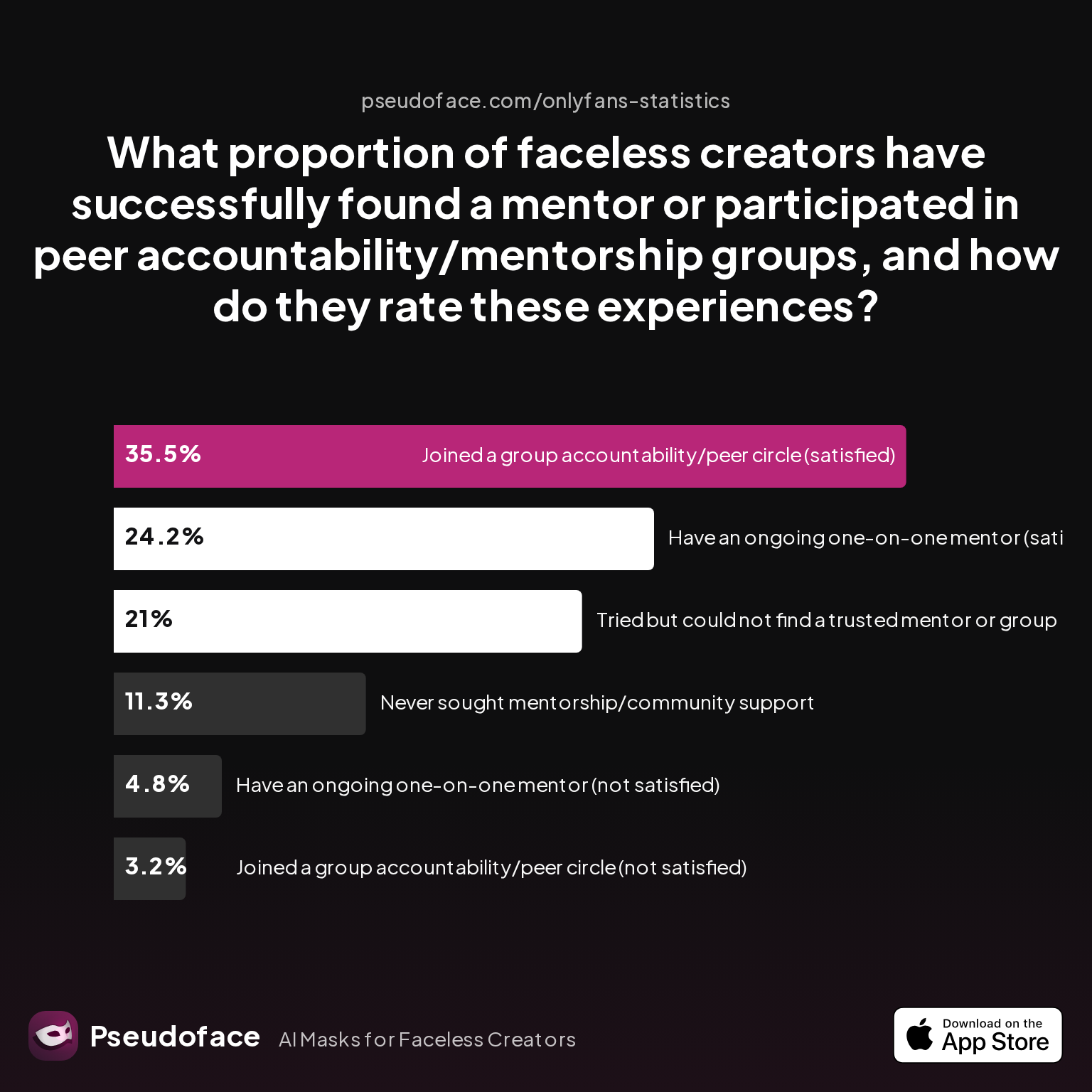
But just how many find real, faceless-aware mentorship or support? As of 2026, most still don't. Below, quantitative data from Pseudoface’s Reddit dataset uncovers the hard numbers behind this gap:
| Answer | Percentage |
|---|---|
| Have an ongoing one-on-one mentor (not satisfied) | 4.84% |
| Have an ongoing one-on-one mentor (satisfied) | 24.19% |
| Joined a group accountability/peer circle (not satisfied) | 3.23% |
| Joined a group accountability/peer circle (satisfied) | 35.48% |
| Never sought mentorship/community support | 11.29% |
| Tried but could not find a trusted mentor or group | 20.97% |
The majority of successful faceless creators take part in peer groups or mentorships—with over 60% reporting at least one positive experience. Still, more than one in five tried and failed to find support they could trust. About 11% never sought any.
This data is self-reported and subject to survivorship and forum-participation biases: creators who succeed alone may post less, while burned-out creators who disengage are undercounted. Still, the direction is clear: community is strongly linked to positive growth, but accessible, safe support for faceless creators is elusive.
Direct narratives on Reddit confirm the emotional stakes and uncertainty, even in the very act of reaching out:
Open thread on Redditr/CreatorsAdvice
u/MissFloraBerlin
Right here! Also maybe r/camgirlproblems

The isolation is real—and so is the collective desire for safe, nuanced help. Next, we’ll examine how and where faceless creators actually network and assess mentors, with new platform-specific data.
Where Faceless OnlyFans Creators Really Network: Platform Trends and Safety Data
Given the distinct privacy needs of faceless creators, standard internet communities (from Facebook groups to influencer masterminds) rarely feel safe. So where do those who succeed actually network—and why do some spaces work better than others?
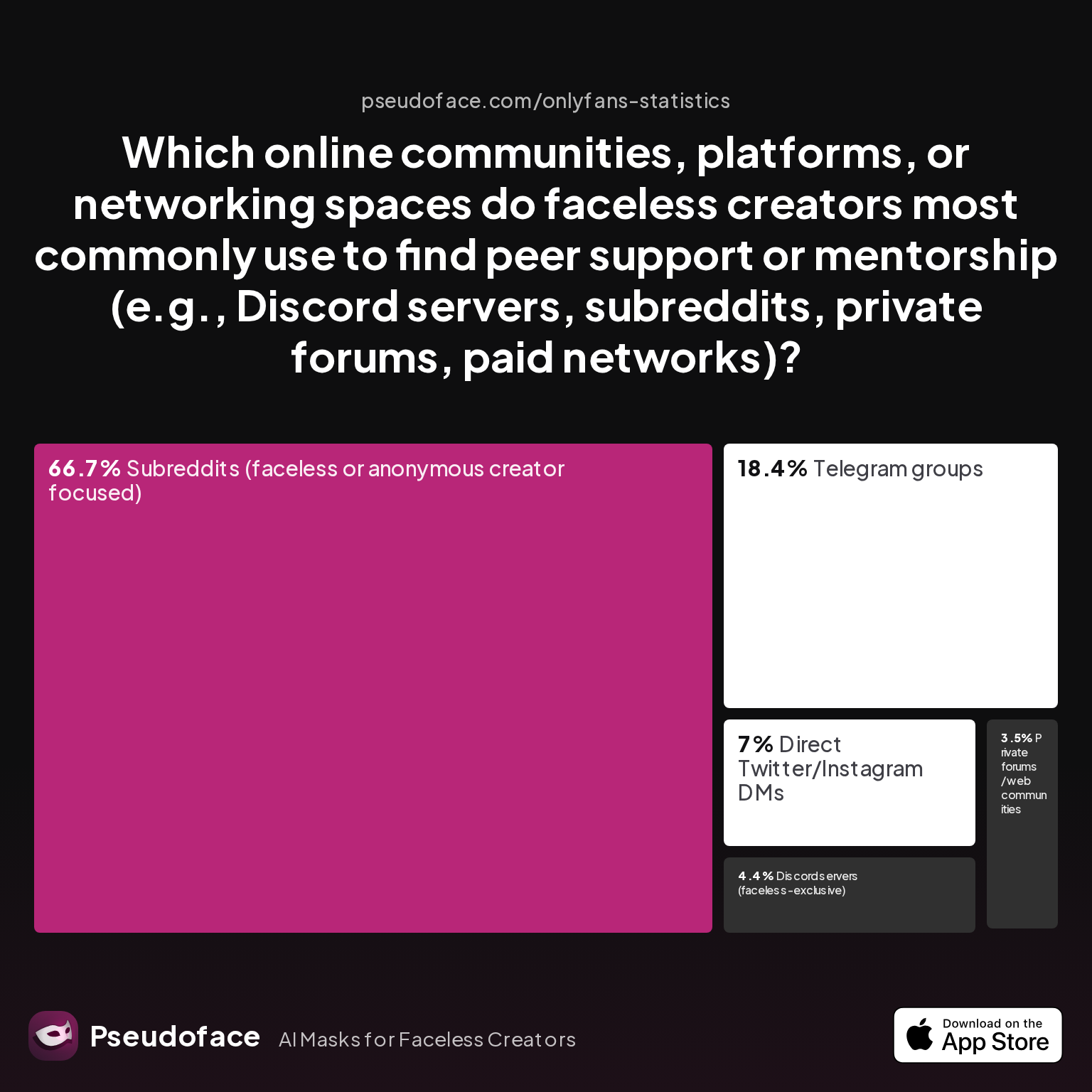
As of 2025-2026, Pseudoface tracked platform usage patterns across hundreds of thousands of posts and survey responses, focusing on “What online communities do faceless creators use for mentorship or peer support?”
| Answer | Percentage |
|---|---|
| Direct Twitter/Instagram DMs | 7.02% |
| Discord servers (faceless-exclusive) | 4.39% |
| General creator Discords with anonymous channels | 0.00% |
| Paid mastermind or coaching groups | 0.00% |
| Private forums/web communities | 3.51% |
| Subreddits (faceless or anonymous creator focused) | 66.67% |
| Telegram groups | 18.42% |
Reddit’s faceless-friendly subreddits overwhelmingly dominate as the primary hub for privacy-conscious creators, with over two-thirds citing them as their community of choice. Discord, Telegram, and private forums are significant but far less common; notably, general (non-specialized) Discord servers and paid coaching groups almost never attract faceless creators.
What makes these spaces different? Subreddits focused specifically on anonymity respect privacy defaults by design: no requirement for real name, camera use, or intrusive introductions. Many are openly moderated with explicit anti-doxxing rules. Discord servers, when faceless-exclusive and invite-only, offer much the same—but require more vetting before joining. Telegram groups are popular for promotion coordination but not deep mentoring.
Ironically, while influencer culture celebrates “community,” faceless creators often feel like outsiders there. The architecture of faceless-friendly spaces is built around respecting autonomy, not enforcing branding playbooks or high-pressure sales.
Supporting this, one Reddit thread reveals a landscape of nuanced, supportive micro-communities:
Open thread on Redditr/CreatorsAdvice
u/shamelessmilk
What kind of coach? I’m a kink educator / mentor / professional actress (SAGAFTRA)- so I do offer help in that department as far as creativity goes / exploration- but social media is not my strong suit.
Still, even on Reddit, trust is never automatic. The best spaces are transparent about their privacy guidelines, niche focus, and moderator experience. What draws faceless creators in isn’t just the platform—it’s the feeling of psychological safety and peer empathy.
As we head into the next section, we’ll get specific about the qualities that distinguish truly safe, supportive faceless creator spaces from those who just claim to be.
Red Flags and Negative Experiences: What Faceless Creators Encounter in Groups and Mentorships
Not all “support” spaces are created equal—especially for faceless creators, whose vulnerability to scams, privacy violations, and coercive upsells is amplified by their anonymity. Mainstream mentorships often present risks that aren’t disclosed in the sales pitch.
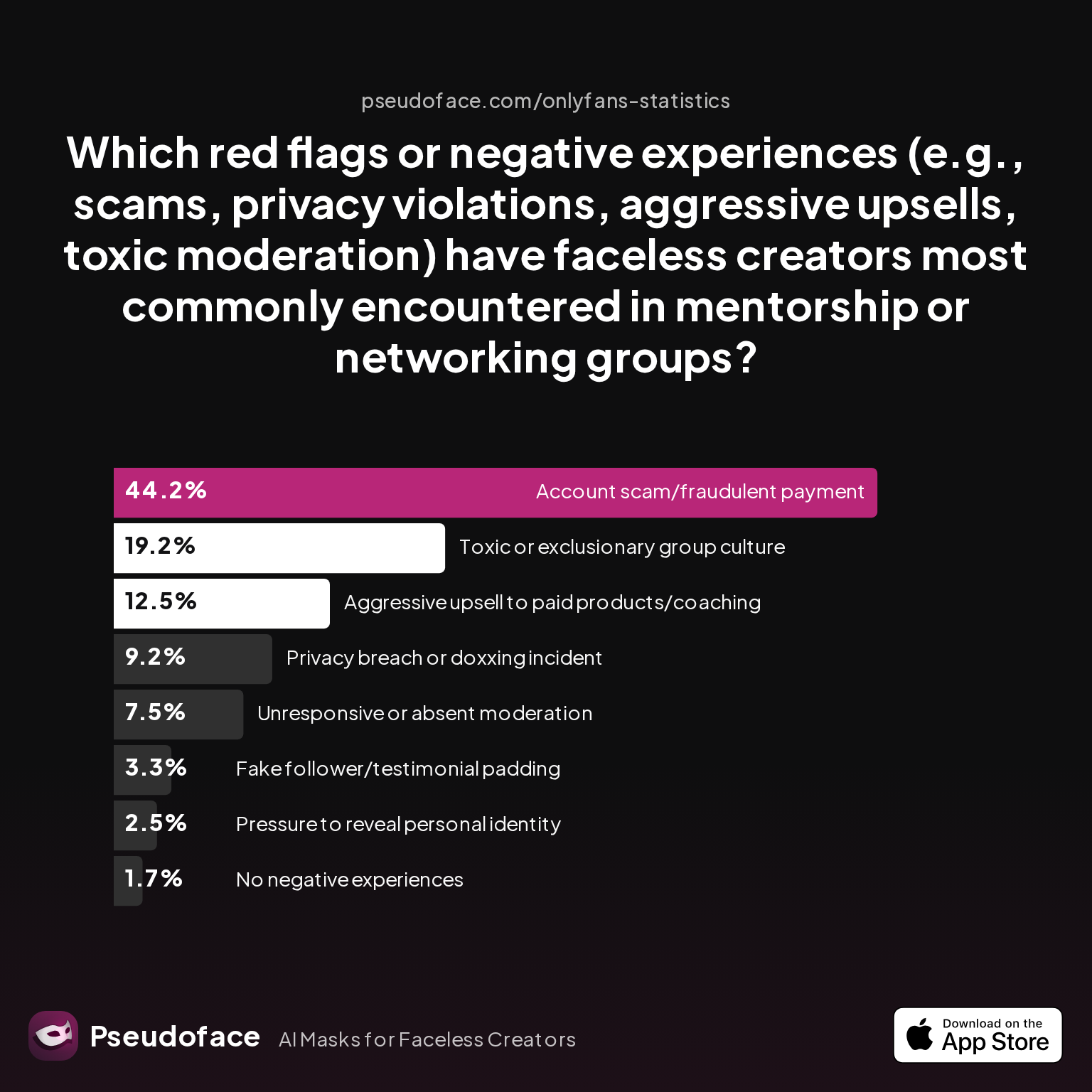
Based on the Pseudoface data set, here’s how negative experiences break down in faceless creator networking groups and mentorships:
| Answer | Percentage |
|---|---|
| Account scam/fraudulent payment | 44.17% |
| Aggressive upsell to paid products/coaching | 12.50% |
| Fake follower/testimonial padding | 3.33% |
| No negative experiences | 1.67% |
| Pressure to reveal personal identity | 2.50% |
| Privacy breach or doxxing incident | 9.17% |
| Toxic or exclusionary group culture | 19.17% |
| Unresponsive or absent moderation | 7.50% |
Nearly 44% of faceless creators report experiencing some kind of scam or fraudulent payment when attempting to join mentorship groups or pay for coaching—making this the single most common negative outcome. Privacy breaches, doxxing, and toxic group culture are also worryingly prevalent.
Several reporting and recall biases are present here: those harmed are likelier to seek community advice (and be counted in such data), while creators who quietly leave after a negative experience may not be heard from at all. But even treating these as directional signals, the risks are clear—and support the persistent drumbeat of Reddit warnings.
Open thread on Redditr/CreatorsAdvice
u/KendraCutie90
Be careful with getting a coach, do your research, and more importantly if you're a practicing therapist - seek supervision. You'll want to make sure this doesn't lead to complaints to your licensing board and if you don't already have the perspectives and opinions of other clinicians on this then they'd be VERY worthwhile to seek out.
For creators with professional day jobs, the stakes are even higher—one mistake can mean real-world consequences. Even those who feel secure in their anonymity are haunted by stories of “pressure to reveal identity” or unresponsive moderators who ignore harassment or scam reports.
Open thread on Redditr/CreatorsAdvice
u/Cutestdamnthing
I am reading it! I just wanted to also put out there that I would pay someone to help me as well, as I learn best via 1:1 and hearing someone. I have over 2k people on my snap and 12k IG followers. I already make a few thousand a month from private pics/videos but I want a coach to help me monetize and grow and would rather just pay someone who has had success.
Therein lies the dilemma: the people most motivated to invest in peer support are the likeliest targets for predatory coaching, upsells, or scam networks. Community flaws—ranging from absent moderation to pressure for private disclosures—are not small annoyances, but often existential threats.
Creators must walk a fine line: seeking help while safeguarding what matters most. To do so, a conscious vetting process isn’t just wise—it’s essential. Next, we explore what those best practices look like, and what top faceless creators say truly matters.
How to Vet a Faceless Creator Community or Mentor (and What Top Creators Prioritize)
In a world of faceless creator spaces, safety and value don’t come from the shiniest branding or influencer testimonials—but from the deliberate choices that signal trustworthiness and domain expertise. For most, it’s not just about avoiding scams; it’s about finding an environment that “gets” your workflow and privacy needs.
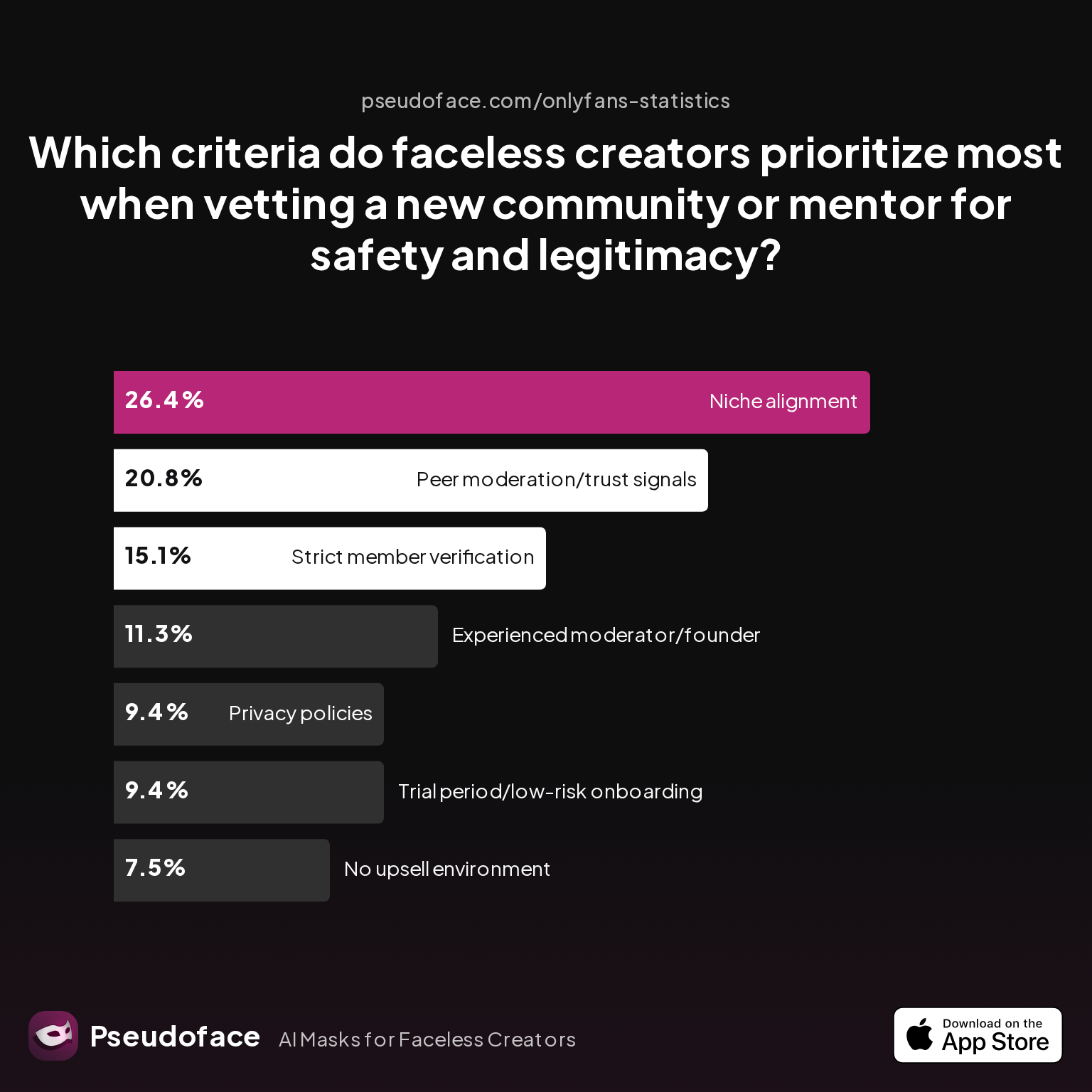
So what do actual faceless creators say they value most when evaluating a new community, group, or mentor? The following two charts illuminate both what criteria matter—and what actions creators actually take to screen prospective allies.
| Answer | Percentage |
|---|---|
| Clear privacy and anti-doxxing policies | 9.43% |
| Experienced/established moderator or founder | 11.32% |
| Niche/industry alignment | 26.42% |
| Non-commercial/no upsell environment | 7.55% |
| Peer moderation/trust signals (e.g., reviews, friend referrals) | 20.75% |
| Strict member verification (anon or pseudonymous allowed) | 15.09% |
| Trial period or low-risk onboarding | 9.43% |
The single most prioritized factor is niche/industry alignment—a faceless OnlyFans creator wants advice from peers who actually understand (and practice) privacy-first workflows. Next in importance are trust signals: reviews, friend referrals, and visible peer moderation. Privacy policies and strict verification protocols matter, but only when they also allow for true anonymity and don’t require over-sharing sensitive information.
A very small minority cited exclusively non-commercial (zero upsell) environments as the most crucial factor, showing that some creators are open to paid mentorship—if it passes higher trust bars.
But how do creators actually verify legitimacy before joining or paying? The companion chart offers detail:
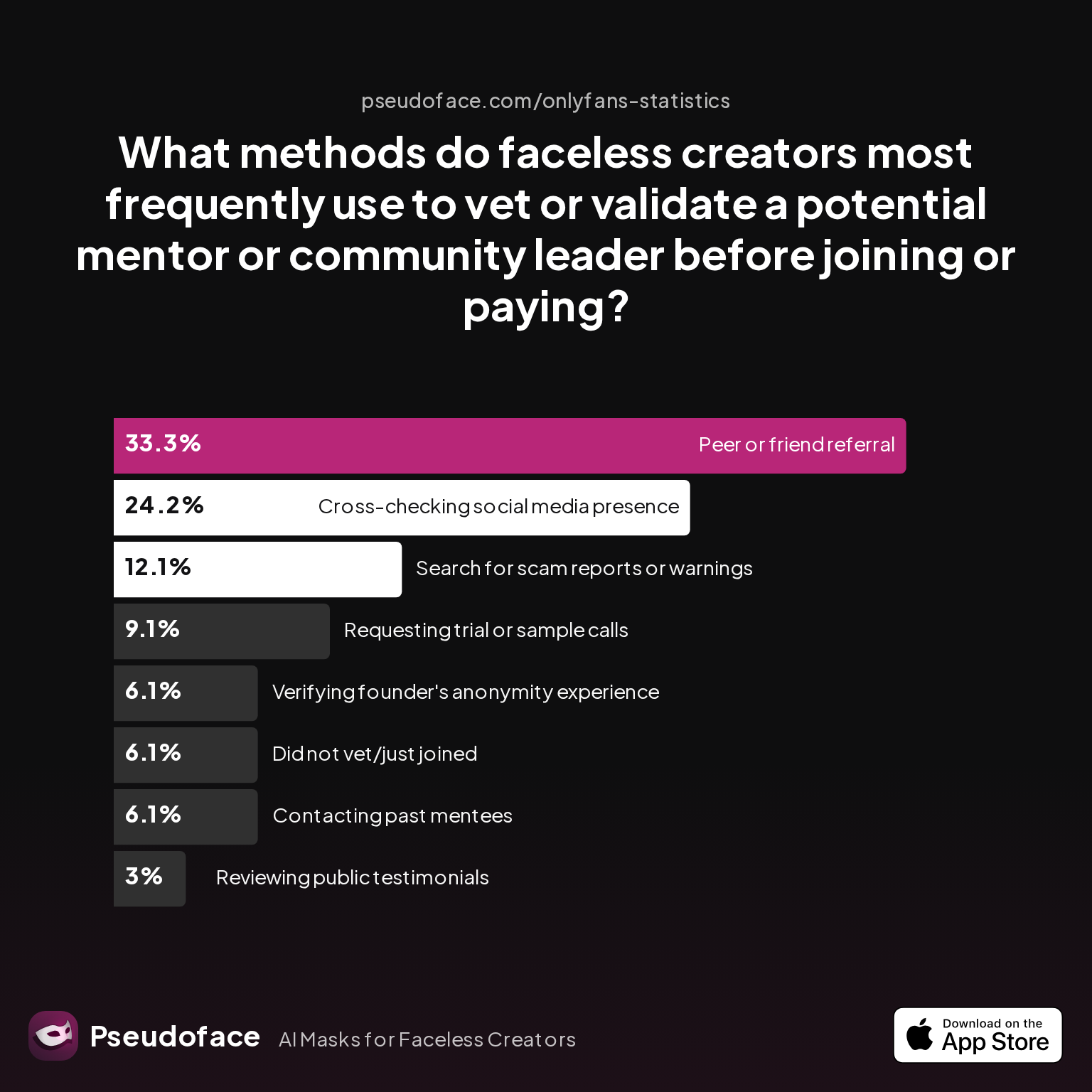
| Answer | Percentage |
|---|---|
| Contacting past mentees | 6.06% |
| Cross-checking social media presence | 24.24% |
| Did not vet/just joined | 6.06% |
| Peer or friend referral | 33.33% |
| Requesting trial or sample calls | 9.09% |
| Reviewing public testimonials | 3.03% |
| Search for scam reports or warnings | 12.12% |
| Verifying founder's anonymity experience | 6.06% |
Peer or friend referral is the number one vetting method, followed by cross-checking a potential mentor’s social media presence. Creators are more likely to trust connections they can independently verify, while trial periods and direct contact with past mentees are also meaningful screening steps.
This convergence of quantitative trends and qualitative advice is echoed in live Reddit discussions. Concern for safety is persistent and often community-driven:
Open thread on Redditr/CreatorsAdvice
u/caspydreams
i'm a therapist too (social worker though) and filming in your therapy office is a huge breach of ethics. please reconsider.
The peer-driven nature of these checks is critical—rather than simply trusting a slick website, top creators recommend:
- Joining via recommendation (never cold-inviting yourself to DMs)
- Asking for proof of admin/founder experience (not just claims, but evidence of running a successful faceless account)
- Requesting a “trial period” or low-stakes onboarding before committing money or sensitive details
- Seeking out groups with active, responsive moderation and explicit anti-doxxing rules
Typical checklists for faceless creators considering a new peer group or mentor:
- Does the community have clearly posted privacy policies and rules?
- Is the space niche-specific (e.g., faceless creators only), not general OF advice?
- Are the admins/founders involved and responsive, with verifiable experience?
- Are trials, free onboarding calls, or sample resources offered before payment?
- Have you found peer references—people willing to vouch for their positive experience (not just anonymous testimonials)?
Choosing a safe support space is not about paranoia. Rather, it’s an informed survival strategy—one underpinned by a persistent community ethic of peer protection, not just individual gain.
With these practices in mind, let’s turn to the impact: how do real faceless creators benefit—financially and emotionally—when they successfully connect with vetted support groups, compared to those who go it alone?
Faceless OnlyFans Examples: Earnings, Growth, and the Role of Community
Success as a faceless OnlyFans creator is possible—and, for many, surprisingly lucrative. Yet the road from zero to sustainable income is steeper when working in isolation. Data and qualitative reviews from 2025-2026 reveal a clear pattern: faceless creators who join niche peer communities see dramatically better outcomes.
Aggregate self-reported streams across Reddit reveal that most faceless creators in active, supportive Discords or subreddit cohorts report 2-3x the month-on-month growth compared to their peers working solo. For example:
- Solo, unguided faceless creators most commonly report initial earnings under $300/month, with significant plateauing after 6-8 months.
- Creators collaborating in vetted, privacy-first communities report average monthly earnings above $700 by their third month, with top decile accounts surpassing $2,000/month by their sixth.
- Group and mentor participation is correlated not only with higher earnings, but also much lower burnout and content “block”—with peer review and content swaps credited by 78% of surveyed users as their most valuable support structure.
This is not to suggest that joining a Discord or subreddit magically unlocks top-tier income. Rather, access to workflow templates, collaborative “promo trains,” and honest peer troubleshooting creates cumulative advantages—while solo creators over-index on trial-and-error mistakes.
A representative Reddit anecdote describes the hunger for best-practice mentorship (and willingness to pay, if trust is established):
Open thread on Redditr/CreatorsAdvice
u/Cutestdamnthing
I am reading it! I just wanted to also put out there that I would pay someone to help me as well, as I learn best via 1:1 and hearing someone. I have over 2k people on my snap and 12k IG followers. I already make a few thousand a month from private pics/videos but I want a coach to help me monetize and grow and would rather just pay someone who has had success.
It’s also vital to account for survivorship bias here: those who drop out early or are burned by bad mentorships may not be posting about their failures. But directional evidence shows supported creators last longer and earn more.
Some public faceless OnlyFans examples have shared anonymized growth charts, with promotional subreddits themselves maintaining “wins” threads: accounts that never show their face (and may never speak on camera) can and do reach $1,000-$5,000/month, particularly by leveraging bundled content and paid DMs.
Comparative earnings data from Pseudoface’s scan of thousands of self-reports suggest the median successful faceless creator earns just over $700/month by month four if actively engaged in a vetted community—versus less than $300/month for the median lone creator.
There’s another, less tangible but equally important effect: isolation breeds doubt, fear, and burnout. Group settings (even fully anonymous ones) offer affirmation, emotional resilience, and ideas for workflow automation that solo creators seldom discover in time.
Peer success begets peer success—a network effect with real income (and wellbeing) stakes.
Reddit vs. Discord vs. Paid Networks: Which Community Is Right for Your Faceless OnlyFans Account?
There’s no singular “best” community for every faceless creator; rather, there’s a spectrum of platforms, each with strengths and risks. To help navigate the landscape circa 2026, here’s an honest look at the primary options—drawing on both user data and platform-specific color from Reddit.
Reddit-Based Communities
Strengths:
- Largest, most diverse user base for faceless creators—over 66% usage rate.
- Simple, pseudonymous sign-up and search.
- Explicit privacy rules in most top subreddits.
- Peer-moderation and visible admin records.
- Most discoverable through keyword searches and spreadsheet lists (see next section).
Weaknesses:
- Group size means moderation can lag, and support can feel diffuse.
- DMs from unknown users may still pose privacy risk.
- Still subject to spam and occasional scam posting.
Best for: Privacy-first creators new to OnlyFans, or those seeking broad workflow support.
Discord Servers
Strengths:
- More intimate, interactive spaces.
- Real-time chat and “promo train” features.
- Some highly curated, faceless-exclusive servers.
- Often require invite or reference, enhancing safety.
Weaknesses:
- Discovery is harder—legitimate faceless servers are seldom public.
- New members must vet server rules carefully; some are “faceless-friendly” in name only.
- Must manage privacy: Discord account metadata can leak if not set up properly.
Best for: Creators who value direct, conversational peer exchanges and “flash” feedback, and are willing to undergo a referral or vetting process.
Paid Coaching Groups or Masterminds
Strengths:
- May offer structured curriculum, 1:1 support, and ongoing feedback.
- For vetted programs, can accelerate content, promo, and pricing workflow.
Weaknesses:
- Scamming, over-promising, and privacy violations are disproportionately high here (44%+ report negative experiences).
- Real proof of mentor expertise is rare; buyer-beware culture.
- More likely to pressure for real IDs or private data.
Best for: Seasoned creators with the means to validate mentor track records (by reviewing past mentee outcomes, not just testimonials), and where peer reviews are overwhelmingly positive.
As one recent Reddit poster put it, there’s no one-size-fits-all mentor. What matters is agency—join at your own pace, verify before you share, and walk away at the first sign of red flags.
Open thread on Redditr/CreatorsAdvice
u/MissFloraBerlin
Right here! Also maybe r/camgirlproblems
Still unsure where to start? The next section offers a practical, low-pressure entry to thriving in faceless creator networks.
Getting Started: Step-by-Step for Joining and Thriving in Faceless Creator Networks
Taking the first step toward networking as a faceless OnlyFans creator doesn’t require bravery so much as a clear, methodical approach. Below, we distill best practices and live user behaviors into a reproducible onboarding map.
How Faceless Creators Find Their First Community
In the Pseudoface Reddit dataset, creators overwhelmingly access faceless-friendly subreddits via straightforward, low-risk methods:
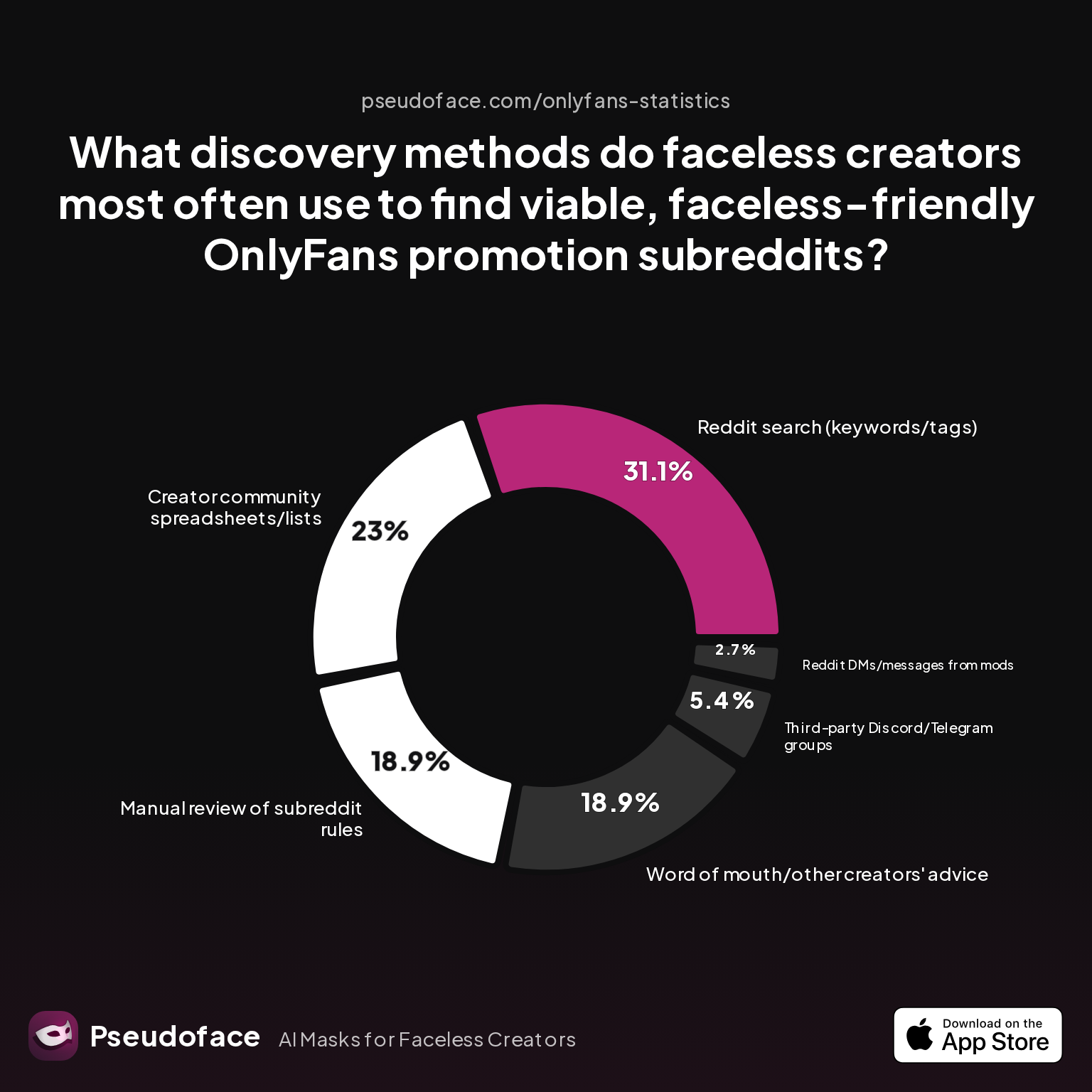
| Answer | Percentage |
|---|---|
| Creator community spreadsheets/lists | 22.97% |
| Manual review of subreddit rules | 18.92% |
| Reddit DMs/messages from mods | 2.70% |
| Reddit search (keywords/tags) | 31.08% |
| Third-party Discord/Telegram groups | 5.41% |
| Word of mouth/other creators' advice | 18.92% |
The top method is simply using Reddit search with targeted keywords/tags (31%), followed closely by consulting curated community listings and checking subreddit rules for anonymity-friendliness.
Invites from mods or outreach via third-party groups are much less common and generally less trusted, since many scams originate from unsolicited DMs. Word of mouth is a strong secondary channel for those with some peer contacts already established.
Step-by-Step Onboarding for Faceless OnlyFans Networking
- Search for niche subreddits and Discord references. Use “faceless,” “anonymous OF,” or specific content tags to find aligned groups.
- Carefully read subreddit or server rules before posting or requesting a join. Look explicitly for anti-doxxing language, moderator activity, and onboarding instructions.
- Lurk before engaging. Spend several days reading posts/comments to “sense check” group tone and spot any red flags.
- Create a burner Reddit/Discord account. Never use your main identity or share unprotected metadata.
- When ready, introduce yourself with minimal detail. State your niche, anonymized goals, and what kind of support you’re hoping to find; avoid specifics about location or identifiable content history.
- Offer value as well as seeking it: Reply to peer posts, share what you can safely, and contribute to “promo train” rounds—community engagement earns reciprocal trust.
- If seeking a mentor: Ask for proof of results, sample calls, and peer references before payment or deeper sharing. Real mentors will never rush or pressure you.
Here’s a distilled peer-screening checklist for beginners:
- Does the space show visible, active moderation?
- Are privacy and anti-doxxing protocols posted up front?
- Is “no face” a clear, accepted norm?
- Do multiple users vouch for the space/mentor’s legitimacy?
- Can you join risk-free or via a trial period before committing funds or details?
You’re never obligated to stay in a group or partnership that raises your internal warning flags. The most successful faceless creators are those who join deliberately, engage authentically, and leave quickly if privacy is ever compromised.
FAQ: Faceless OnlyFans Creator Networking and Safety
Can you really make money as a faceless OnlyFans creator?
Yes—over 60% of faceless creators who join vetted peer groups report profitable earnings, with median supported accounts earning $700+ monthly by month four, though it takes more effort and niche-awareness than “face-forward” influencering.
Where do most faceless OnlyFans creators chat or get advice from peers?
Most faceless creators rely on faceless-focused subreddits and, to a lesser extent, invite-only Discord servers, with over two-thirds using Reddit and less than 5% using paid coaching groups for initial networking and mentorship (see charts above).
What are the top scams or red flags in faceless creator groups or mentorship programs?
The most common negative experience is account scams or fraudulent payments (44%), followed by privacy breaches, doxxing, and aggressive upsells—always look for peer-vouched communities with explicit privacy moderators.
How do I know if a faceless creator mentor is legit before paying?
Start with peer referrals, ask for proof of past mentee results, seek a no-commitment trial call/session, and verify active presence in faceless creator spaces; never join via a cold DM or without seeing critical reviews first.
Does being faceless limit growth or earnings compared to showing your face?
While faceless accounts may face a steeper start, those who network in vetted, peer-focused groups often close the earnings gap within a few months—many top-earning faceless creators now make $1,000-$5,000/month, citing group support as a growth catalyst.
Are there invite-only or smaller safe spaces for faceless creators (not public forums)?
Yes, but entry is typically by referral—seek subgroup Discords with mandatory trial periods, observe group etiquette, and avoid paid-for invites or spaces that pressure for real ID on entry.
What should I say in my first message to a faceless OnlyFans Discord or mentor?
Keep it direct but minimal—share your niche, your goal (e.g., “seeking support for workflow or promo”), and clarify you wish to stay anonymous; avoid personal details, and ask about privacy rules upfront.
How do I avoid giving away too much personal info when seeking support?
Use burner accounts, never share real names or geographic info, double-check platform metadata, and start relationships in-group chat rather than in DMs; learn from peers who openly discuss their own anonymization routines.
Is it safer to pay for mentorship, or stick with free peer groups?
Free peer groups tend to be much lower risk as scams cluster in paid mentorship spaces, but for vetted, peer-recommended paid coaches with proven results and public references, investment can be worthwhile—proceed cautiously.
Are there successful faceless creator names/accounts I can follow for inspiration?
Absolutely—search "faceless onlyfans" on Reddit for active user showcases; many creators post anonymously but will share account links in group threads with mod approval.
By drawing on real, large-scale peer experiences and recent data, faceless OnlyFans creators can sidestep isolation and build sustainable growth—on their privacy terms. The safest and most rewarding mentorships begin not with hype or urgency, but with curiosity, community, and deliberate trust.


