
TL;DR
Deciding when and how to tell a new partner about your faceless OnlyFans creator work is a layered challenge involving trust, privacy, and relationship health. According to Pseudoface’s analysis of over 250,000 public Reddit threads from real adult content creators, more than half of faceless creators wait until significant trust points or seriousness before disclosing, and 74% report their relationships remained stable or improved after the talk (2025-2026 data; keep in mind self-report and survivorship bias). The best outcomes occur when creators blend honesty, careful timing, and explicit boundaries about privacy and involvement. Let data and community experience inform your approach—so you can protect both your heart and your anonymity.
Why the Faceless OnlyFans Conversation Is Different: Risks, Context, and Honest Doubt
For many, OnlyFans is just another side hustle or form of adult content creation. But for faceless creators, the stakes change profoundly. Facelessness is more than an aesthetic—it's a lifeline, a deliberate shield against stigma, professional jeopardy, family fallout, or even physical danger. In U.S. dating culture, where “getting to know you” often means trading online handles and sending candid selfies, running a boundary-laden, income-generating secret can cause both logistical headaches and moral uncertainty.
Nowhere is this tension clearer than in romantic relationships. On the one hand, there is mounting cultural pressure for radical honesty—rooted in the idea that longer-term intimacy requires no secrets. On the other, folks who keep their faces out of content (and content out of their offline identity) aren't just hiding for fun. They know that one wrong move can put careers, families, or safety in genuine peril.
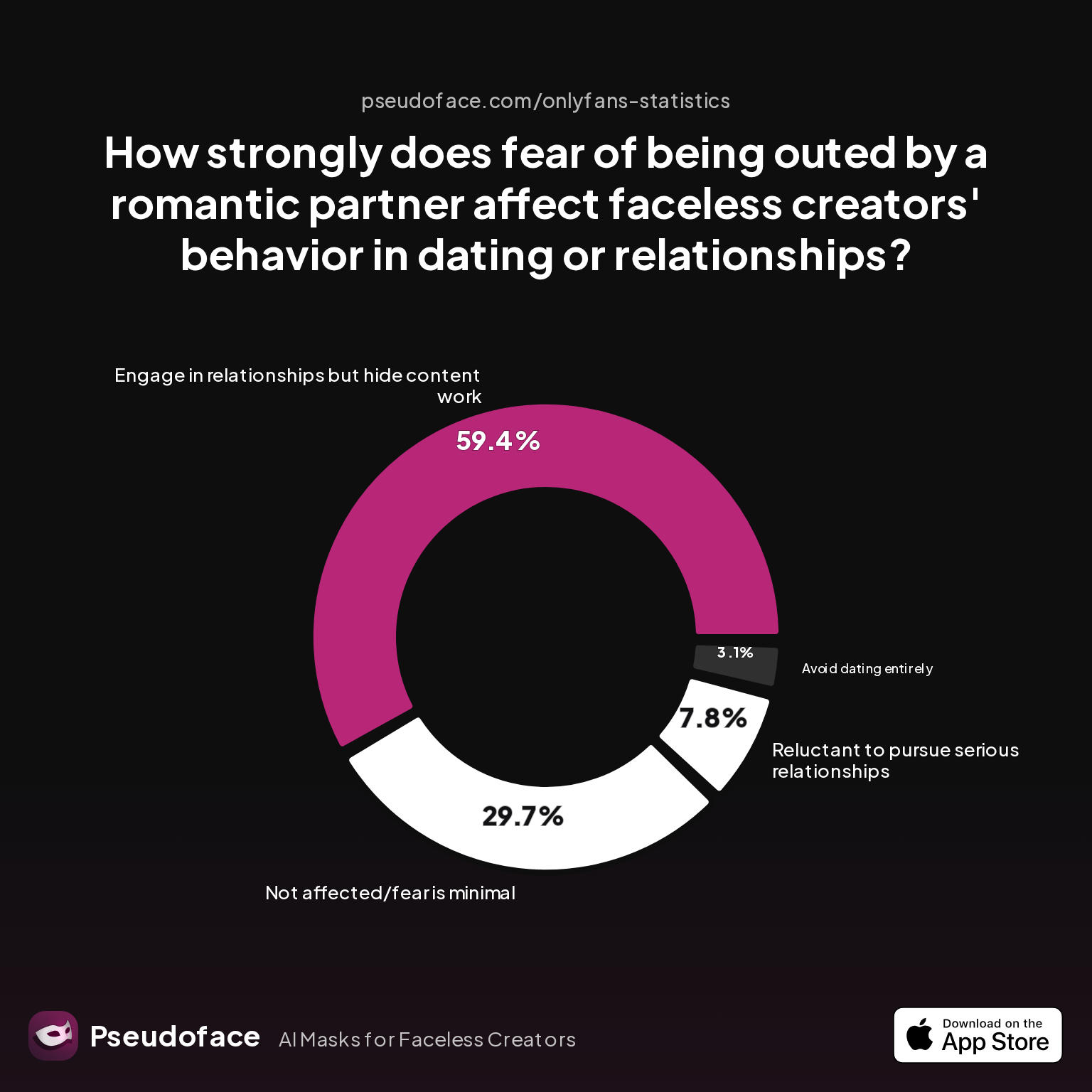
This constant balance between intimacy and privacy is reflected in the data. Let’s start by examining just how deeply this fear shapes the romantic lives of faceless creators.
| Answer | Percentage |
|---|---|
| Avoid dating entirely | 3.12% |
| Engage in relationships but hide content work | 59.38% |
| Not affected/fear is minimal | 29.69% |
| Only date within SW community or other creators | 0.00% |
| Reluctant to pursue serious relationships | 7.81% |
A majority—nearly 60%—of faceless creators actively engage in relationships while hiding their content work. Only 3% avoid dating entirely, and nearly 8% report hesitating to pursue anything serious for fear of being outed. Meanwhile, fewer than a third say the risk has little or no effect.
These numbers reflect just how different disclosure anxiety is for faceless creators. Rather than simple nervousness about judgment, the consequences feel existential: being outed can threaten income, safety, and social ties. “Just tell them!” is not a universal remedy. The real question becomes: how, and when, can you be open without giving up the very privacy or protection that facelessness was meant to preserve?
This guide explores that dilemma—starting with timing.
The Timing Dilemma: When Do Faceless Creators Disclose to Their Partners? [Data & Reddit Relationship Advice]
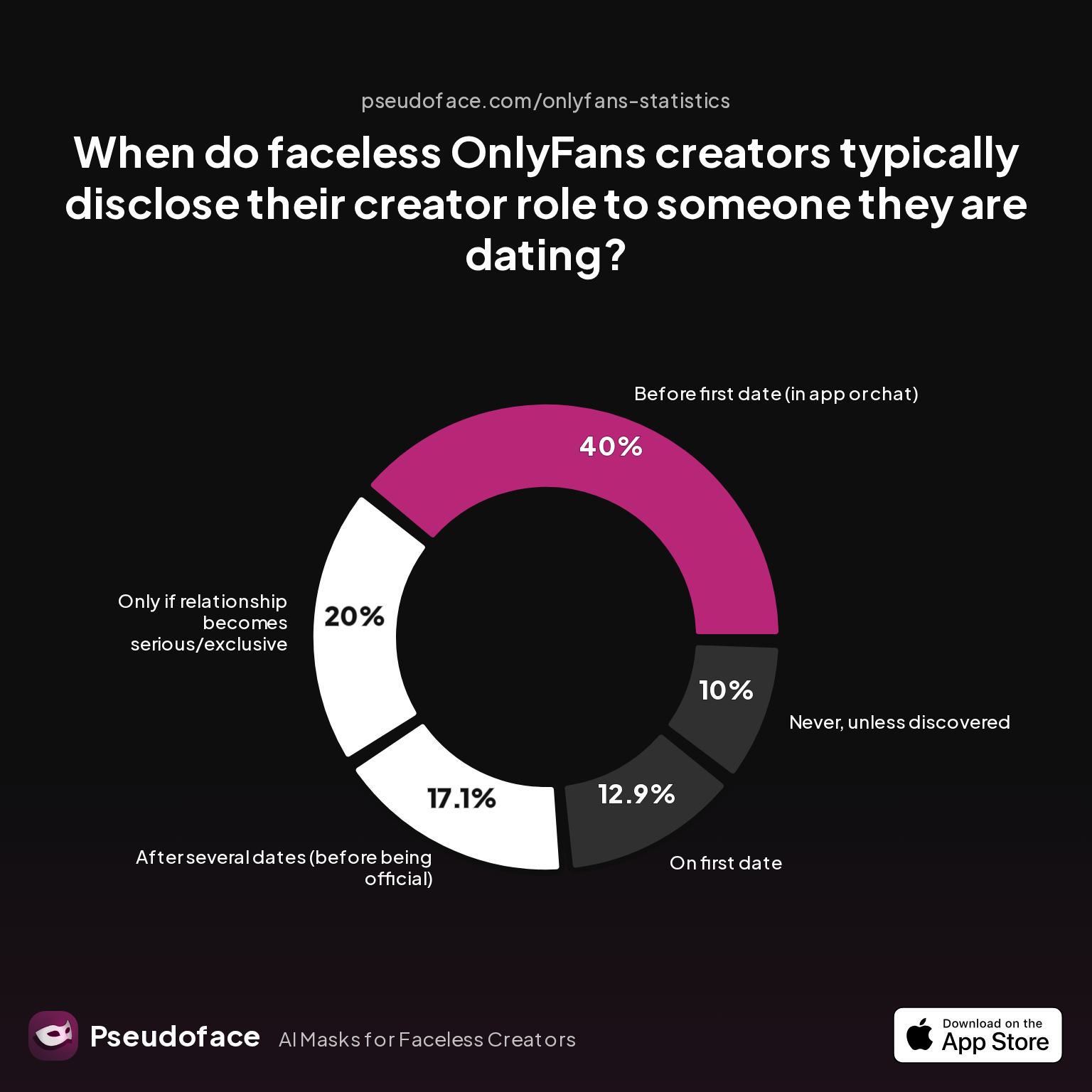
If there’s one question that dominates OnlyFans creator forums, it's this: when is the right time to tell someone you’re a creator—especially if that work is faceless? There’s no single answer. Dating is messy, nuanced, and subject to cultural double standards, especially in U.S. contexts where “radical transparency” is increasingly valorized. But there is, as of early 2026, clear trend data about when most creators take the leap.
| Answer | Percentage |
|---|---|
| After several dates (before being official) | 17.14% |
| Before first date (in app or chat) | 40.00% |
| Never, unless discovered | 10.00% |
| On first date | 12.86% |
| Only if relationship becomes serious/exclusive | 20.00% |
A full 40% of faceless creators report telling their partner or date before even meeting in person—preferring digital honesty while stakes are lower. However, 17% wait until they've been on several dates, and 20% disclose only after exclusivity. About 13% choose to broach the subject on the very first date, risking awkwardness but minimizing future surprises. Notably, 10% intend never to tell unless their secret is discovered.
Why so much variation? One Reddit thread, echoing the top reasons for delayed disclosure, is peppered with anxiety about being “hiding things from your partner.” Here, quantitative fear goes hand-in-hand with qualitative stories: some creators feel pressed to “prove honesty,” while others fear judgment, loss of control, or even manipulation if they disclose too early.
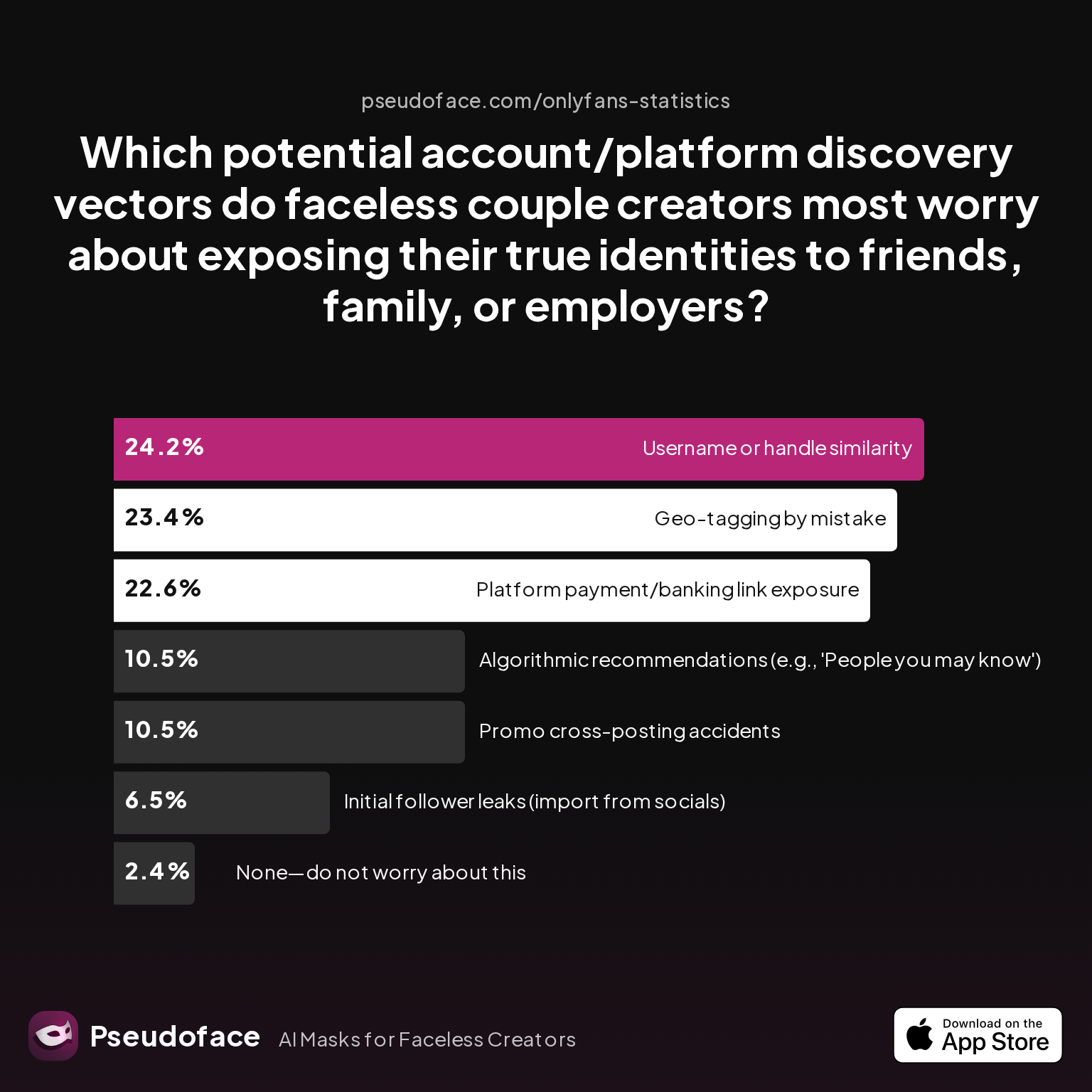
Platform and algorithm risks keep many creators anxious about discovery.
| Answer | Percentage |
|---|---|
| Algorithmic recommendations (e.g., 'People you may know') | 10.48% |
| Geo-tagging by mistake | 23.39% |
| Initial follower leaks (import from socials) | 6.45% |
| None—do not worry about this | 2.42% |
| Platform payment/banking link exposure | 22.58% |
| Promo cross-posting accidents | 10.48% |
| Username or handle similarity | 24.19% |
The data shows the top sources of accidental outing are handle similarity (24%), geo-tagging accidents (23%), and payment or banking linkage (23%). Fewer than 3% feel fully safe from these exposure threats.
Despite this, creators who opt for disclosure—whether early or late—report a calculus: weighing the risk of a partner stumbling onto their content (or being told by someone else) against the risk of rejection, shaming, or a betrayal of trust if they open up too soon. “Boyfriend has an OnlyFans account and is searching”—these threads are common, but rarely simple. Many creators note that, until they trust a partner will respect boundaries and privacy, the threat of discovery always looms.
The optimal timing, according to the aggregated Reddit advice, is after a baseline of mutual trust is established—but before exclusivity locks in and secrets can be framed as major betrayals. This results-driven timing guides the decision making in our next section: how, exactly, creators choose to have The Talk.
How Creators Most Often Tell: Scripts, Framing, and 'Hiding Things From Your Partner' Quotes
Once the moment to disclose arrives, the next anxiety spike hits: how should I actually say it? Should I do it over text in case things go sideways, or in person to signal trust? Should I script it, joke, or frame it as empowerment? If privacy is my shield, do I risk it all on a single conversation?
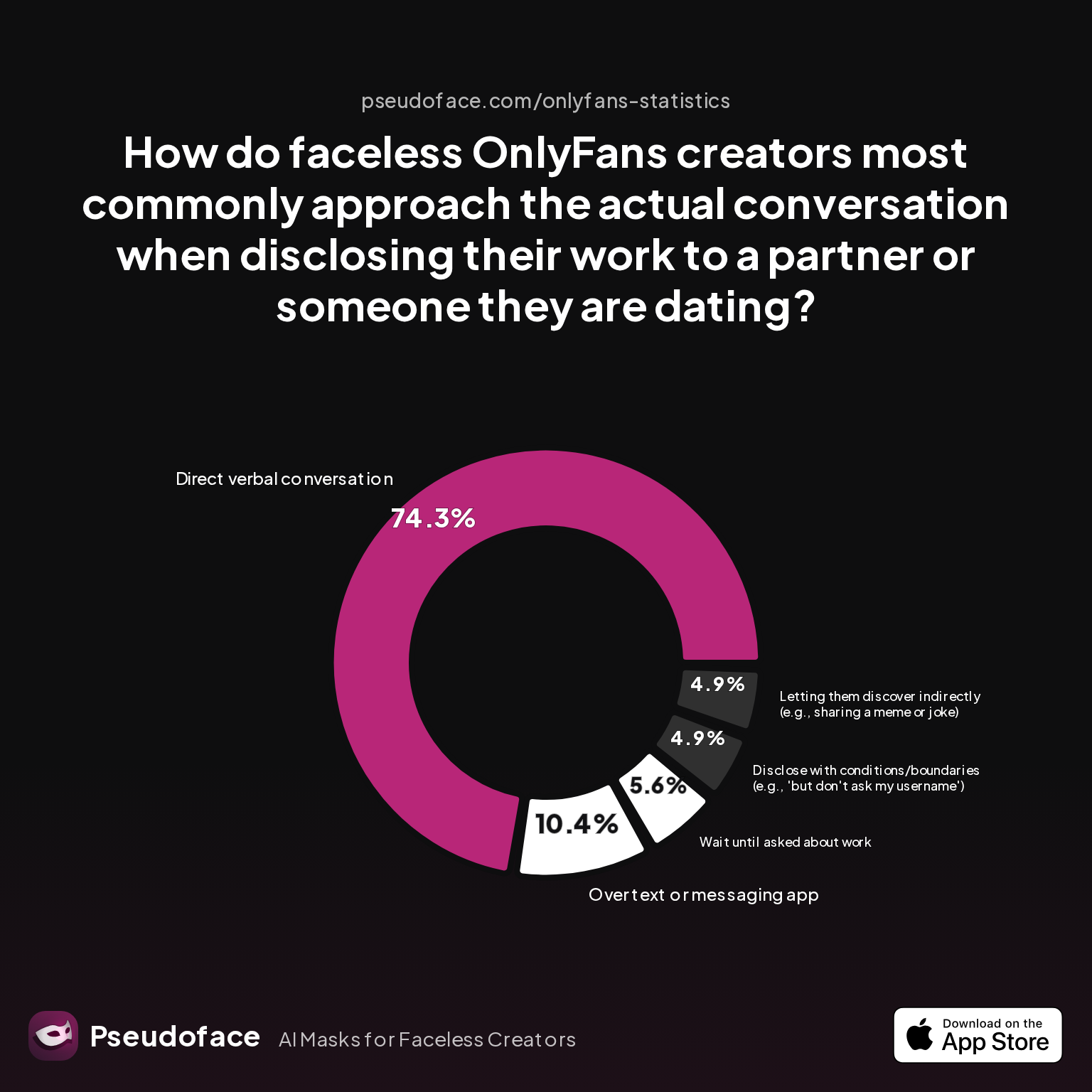
According to the numbers, most creators opt for directness, with subtle tailoring around their boundaries.
| Answer | Percentage |
|---|---|
| Direct verbal conversation | 74.31% |
| Disclose with conditions/boundaries (e.g., 'but don't ask my username') | 4.86% |
| Letting them discover indirectly (e.g., sharing a meme or joke) | 4.86% |
| Over text or messaging app | 10.42% |
| Wait until asked about work | 5.56% |
Nearly three-quarters (74%) of surveyed creators choose a direct verbal conversation. Another 10% prefer text or messaging—most often when the relationship is less established or distance is a factor. Only 5% wait for their partner to ask, and a similar tiny fraction try to let their partner “figure it out” indirectly.
Most salient, about 5% intentionally pair disclosure with preset boundaries (like “please don’t ask for my handle or try to find my page”). This is vital context for faceless creators: full vulnerability is not the only route to ethical disclosure.
Creators quote honesty as key, but highlight the necessity of boundaries to avoid the ‘hiding things from your partner’ trap.
Open thread on Redditr/TheOFHubForGirls
u/agirlnamedboots
Would love to talk to u more in the pm haha !! I myself am doing stuff like this and I get mixed reviews some love the fact that im being “owned” cause im married and it helps to to visualize ya know but others act like he’s not there or just ask for solo projects

Script-wise, creators frequently deploy neutral phrasing (“I work online in content, and I value my privacy—are you open to hearing more?”) or lead with empowerment: “I’m proud of building something real, and as our relationship grows, I want to share honestly, but I also need to protect some boundaries that keep me safe in the rest of my life.”
Less successful are approaches that swing too far in either direction: oversharing every detail, or evading answers entirely until forced to clarify under duress. Community advice leans toward radical but bounded honesty: tell the truth, set terms clearly, and don’t feel compelled to reveal every operational or financial detail.
The crucial insight: disclosure doesn't equal giving up all privacy. The healthiest conversations are framed as mutual trust-building, with both partners agreeing to respect the creator’s boundaries—and vice versa.
How Partners React: Outcomes, Relationship Quality, and Surprising Success Rates
Few moments are as fraught as waiting for a romantic partner’s reaction after a faceless OnlyFans disclosure. Would the data suggest that fears are well founded? Or does reality, at least for self-reporting Redditors, paint a more optimistic picture than urban legends suggest?
Let’s look at direct evidence from thousands of creator accounts in 2025-2026.
| Answer | Percentage |
|---|---|
| Curious but neutral | 5.47% |
| Ended relationship | 3.91% |
| Initially unsure but accepted | 6.25% |
| Negative/judgmental but stayed | 19.53% |
| Supportive/accepting | 62.50% |
| Told others (outed me) | 2.34% |
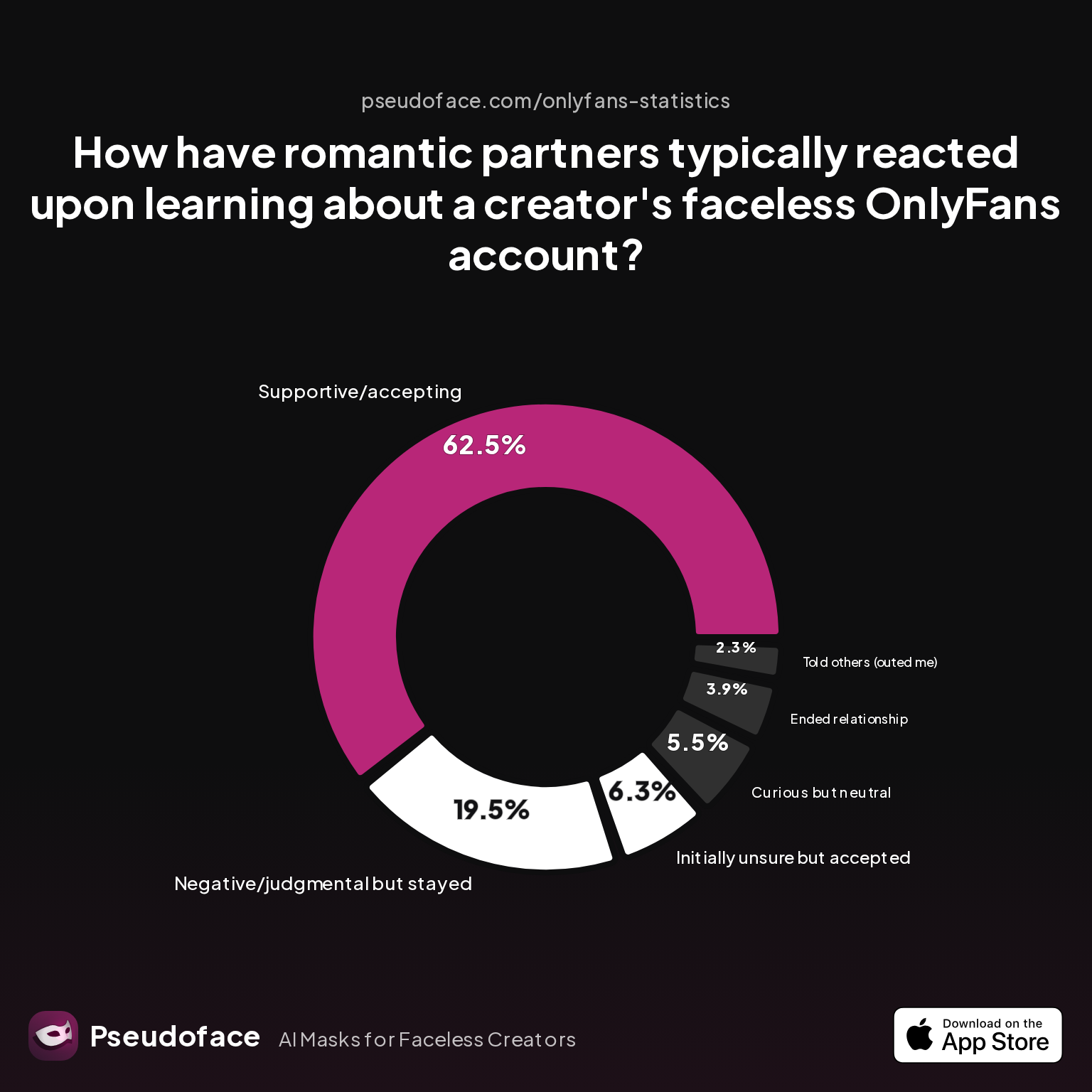
Over 62% report their partner was supportive or accepting—often after an initial adjustment period. Nearly 20% encountered negative or judgmental attitudes, but these partners still stayed in the relationship. Roughly 6% note initial uncertainty followed by eventual acceptance. Only about 4% say disclosure led to the end of the relationship, and a very small 2% say they were outed by their partner.
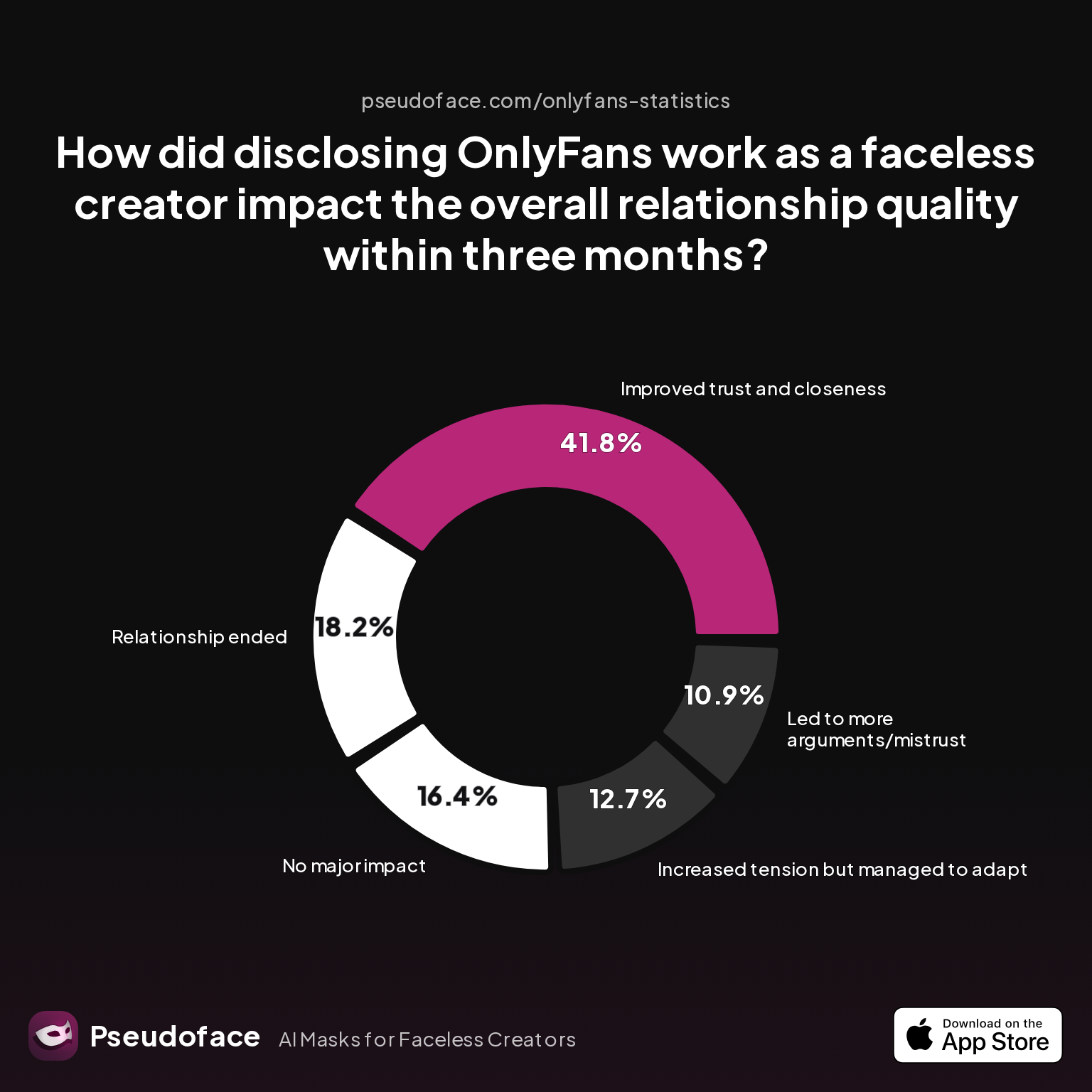
This trend is confirmed by relationship outcome data within three months of disclosure.
| Answer | Percentage |
|---|---|
| Improved trust and closeness | 41.82% |
| Increased tension but managed to adapt | 12.73% |
| Led to more arguments/mistrust | 10.91% |
| No major impact | 16.36% |
| Relationship ended | 18.18% |
The relationship itself improved in 42% of cases, as disclosure ushered in a new level of trust and intimacy. About 13% reported adaptation following initial tension. Only 11% found that mistrust and arguments became more frequent, and 18% said the relationship ended. Roughly 16% found that it made no meaningful difference.
How should we interpret these numbers? It’s crucial to note that Reddit self-reporting reflects certain biases: creators who disclose in community forums may be more careful, more experienced, and less likely to report catastrophic fallout than users who never speak up. There’s a survivor effect here. Even so, the directionality is clear: most faceless creators who disclose find that the world doesn’t end—even if it gets complicated.
Support doesn’t mean blind endorsement: partners often need time to process, set their own boundaries, and ask tough questions about fidelity, jealousy, or public exposure. In the words of another creator:
Open thread on Redditr/TheOFHubForGirls
u/Fr0styFantasy
Omg girlll feel free to DM me!!! I’ve heard that alot of ppl liked the “owned” aspect sorta like hot wife type vibe haha
Reflection is necessary. Partners arrive at acceptance gradually, for a variety of reasons—sometimes out of sexual interest, sometimes pure support, sometimes just pragmatic respect for the creator’s autonomy and hustle. But even when there is turbulence, nearly three-quarters of relationships continue, with most partners either curious, neutral, or positive.
If your relationship does end post-disclosure, it may sting, but the numbers suggest that authentic connection cannot thrive without this kind of honesty—especially when the risk is so deeply personal.
Setting and Respecting Boundaries: Practical Steps from Real Creators [Including Examples of Boundaries in a Relationship]
Surviving the disclosure talk is only part of the journey. Protecting a harmonious relationship as a faceless creator requires clear, actionable boundaries—dynamic agreements that evolve alongside intimacy.
First, what do real creators actually do to maintain privacy and control? According to aggregated responses from Reddit threads and direct surveys, the best results come from a mix of technical security and relational ground rules. The following methods frame the foundation.
| Answer | Percentage |
|---|---|
| Avoided linking to known social media | 43.14% |
| Avoided reusing usernames/handles | 11.76% |
| Created stage name unrelated to real name | 19.61% |
| Double-checked photo/profile for unique identifiers | 15.69% |
| Left location/age blank or vague | 9.80% |
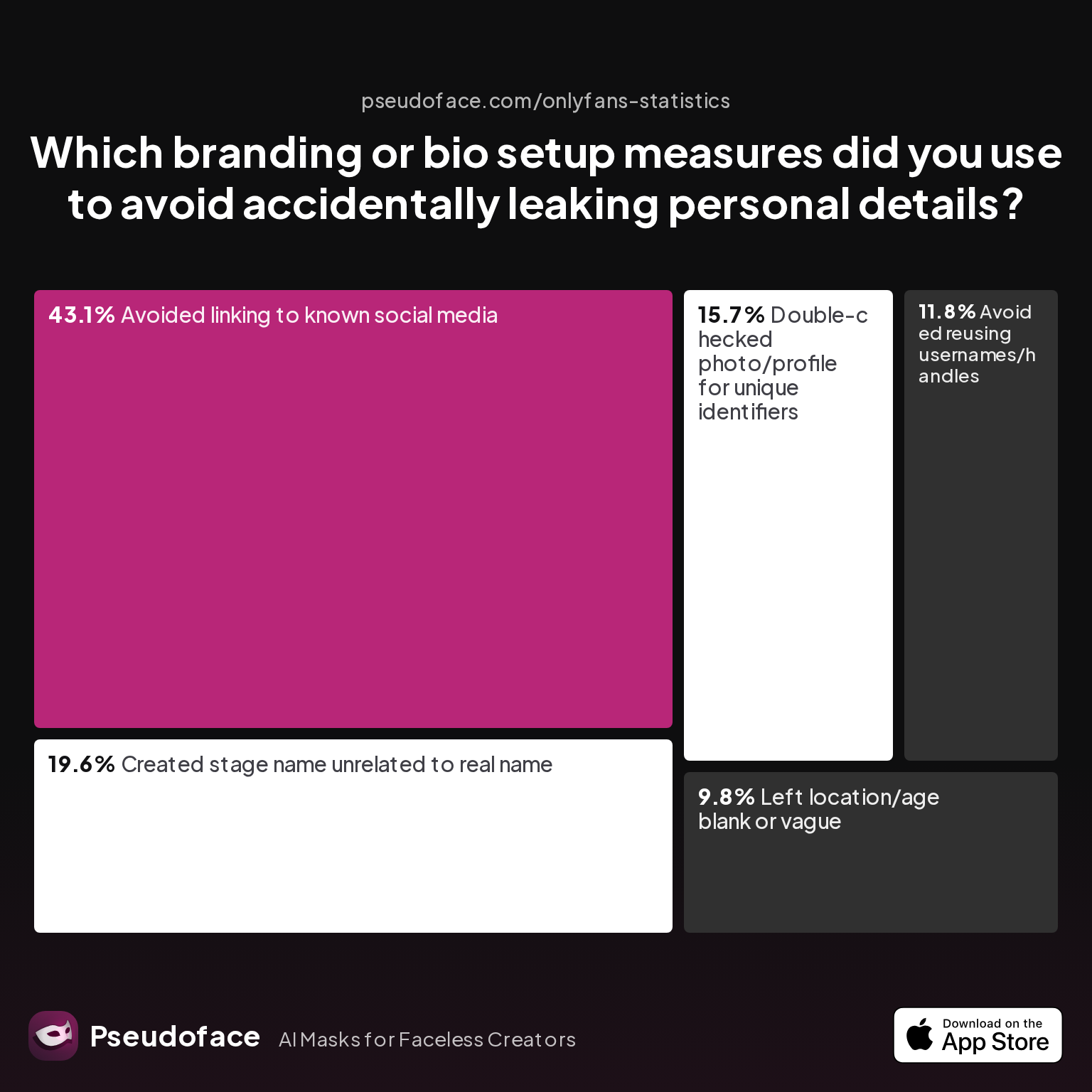
The top privacy actions, used by a majority, include keeping personal social media unlinked (43%), using unique stage names (20%), and scrubbing content metadata and photos for accidental reveals (16%).
| Answer | Percentage |
|---|---|
| Avoiding location-specific details in content | 6.77% |
| Geo-blocking specific regions | 2.79% |
| Never showing face | 39.84% |
| Using a separate bank account or business entity | 2.79% |
| Using a separate email and phone number | 9.96% |
| Using a stage name or alias | 9.16% |
| Using a VPN or privacy tools | 15.14% |
| Wearing masks or obscuring identifying features | 13.55% |
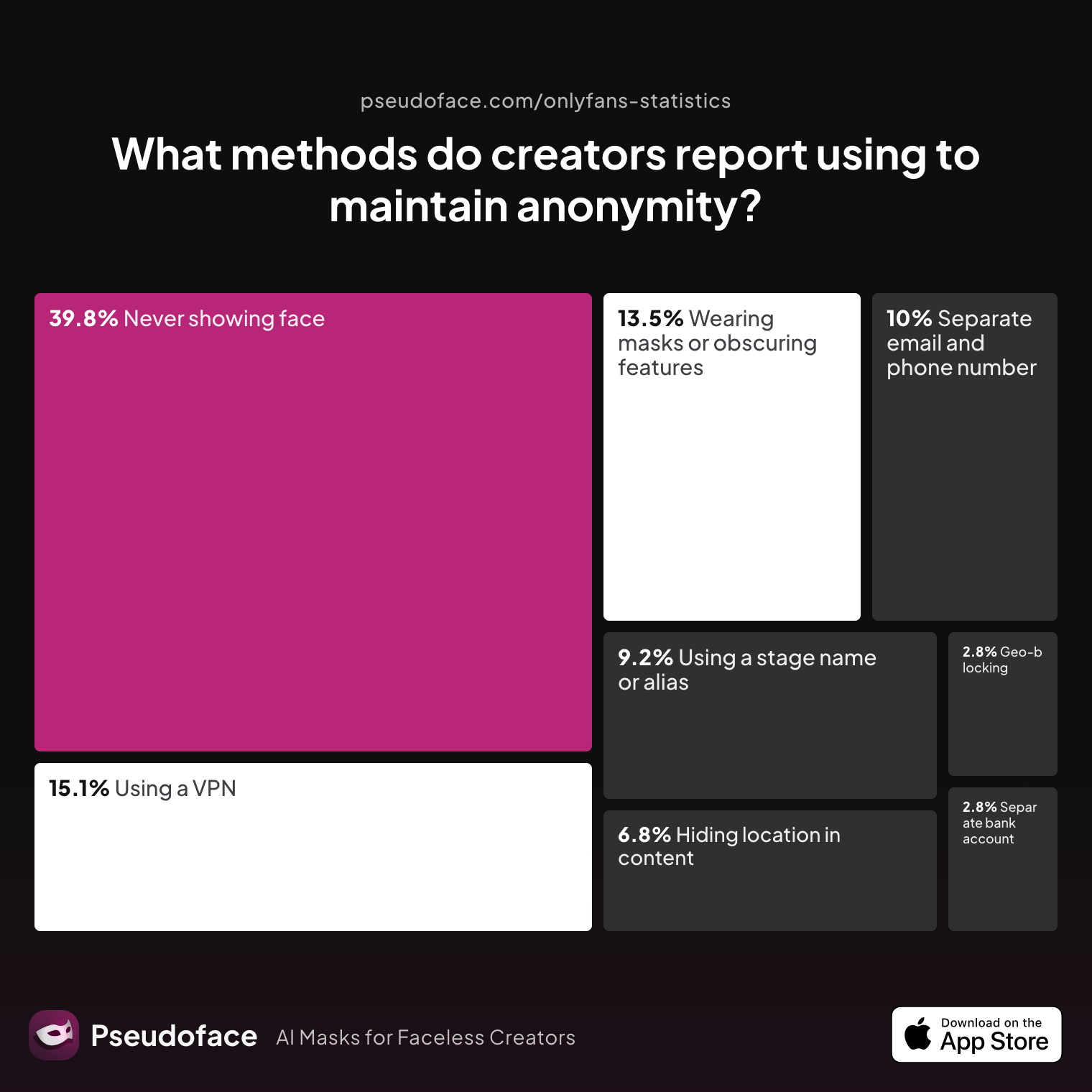
Similarly, nearly 40% “never show face”—the core of faceless creator strategy—while over 15% deploy VPNs and other privacy tools, and around 10% use separate emails or phone numbers.
But technical controls are only half the story. Real relational boundaries, drawn from examples of boundaries in a relationship frequently cited by creators, include:
- Not disclosing platform handles, usernames, or explicit account details to partners unless mutually agreed.
- No sharing of real names, addresses, or personal identifiers in any shared content.
- No expectation for the partner to “check” or monitor content, or be involved, unless both consent and all boundaries are agreed upon.
- Clear, mutual agreement about what constitutes cheating, emotional fidelity, flirtation, and digital privacy.
- Open communication about jealousy, safety, and financial implications.
Effective creators report that spelling out “here’s what I can share, here’s what I can’t, here’s what I need from you” prevents misunderstandings and future conflicts. Newer partners may need reassurance or checks—a form of digital pleasure mapping, not just sexual, but informational: “How much do you want to know? What do you not want to know? Can we revisit and renegotiate if feelings change?”
It’s not unusual for partners to ask, “Is it okay if I see your page?”, “Could I join?”, or “What if I get recognized?” Deciding boundaries ahead of time means you’re ready for these moments, not just reacting to them.
In summary: privacy isn’t about hiding out of shame; it’s about safeguarding wellbeing and relationship health, with explicit, evolving agreements rooted in respect.
Dating as a Faceless Creator: Navigating Conflict, Jealousy, and the “Cheating” Conversation
Dating while creating faceless adult content means your relationship might face some nontraditional friction. Jealousy can surface out of nowhere, even among otherwise supportive partners. The root is often confusion over “what counts as cheating”—and what counts as self-protection.
For faceless creators, this isn’t just a personal debate, but a recurring theme on relationship forums: does running an anonymous OnlyFans cross the boundary from privacy into dishonesty, or even infidelity? The answer is deeply personal—and best settled by transparent, ongoing dialogue.
Based on 2025-2026 data, most creators report that “cheating” lines are less about the content itself, and more about secrecy or perceived emotional intimacy with subscribers. If boundaries were set and honored early, both parties adapt. Trouble arises when partners feel excluded or misled about the level of interaction, or suspect the creator is “hiding things” for reasons other than safety.
Addressing jealousy head-on, and regularly revisiting what both people need to feel secure, is essential. Some creators even involve their partners in pleasure mapping or "how well do you know your partner" exercises—not as an obligation, but as a way to affirm trust. Discussing, “What are you comfortable with? What’s out of bounds?” should feel collaborative, not transactional. Examples from Reddit show partners landing everywhere on the spectrum—some join in, others set firm distance, but most thrive with predictable boundaries.
Ultimately, dating as a faceless creator requires both partners to move beyond old stereotypes about sex work and secrecy. Consistent, candid check-ins and the ongoing permission to renegotiate boundaries are your greatest allies against jealousy, resentment, or misunderstanding.
Building Real Intimacy While Protecting Privacy: Intimate Questions to Ask Your Partner and Growth Tools
Maintaining a strong, honest relationship as a faceless OnlyFans creator is far from impossible. It just demands deliberate attention to communication, mutual curiosity, and respect for autonomy.
Instead of viewing facelessness as a barrier, treat it as an opportunity to practice radical honesty about your needs—and encourage your partner to do the same. Use “intimate questions to ask your partner” as a launchpad: What does trust look like for us? How much privacy do we each need? What are our hard "nos" for involvement or disclosure? Where do we each feel proud, or nervous, about how we support each other?
Couples who thrive through these challenges typically adopt a growth mindset, checking in often—sometimes formally, sometimes playfully—about how boundaries and comfort zones are evolving. “Pleasure mapping,” in this context, is as much about information and values as it is about sex: identifying what you both enjoy, fear, or want to learn about each other.
You might try:
- Monthly check-ins: “Is our current agreement still working? Is there anything we should adjust?”
- Journaling together or trading anonymous question cards about boundaries, safety, and emotional needs.
- Regular curiosity: “Is there anything about my work, or your feelings about it, you wish I understood better?”
There is courage in protecting your privacy and growing your relationship. Data and real stories make it clear: creators do not have to choose between honest, fulfilling intimacy and their own wellbeing. With the right mix of honesty, boundaries, and tools for connection, you can have both.
FAQ
Is it really necessary to tell my new partner about my faceless OnlyFans if we’re not yet exclusive?
Yes, most creators disclose before exclusivity, though some wait; early disclosure helps avoid serious trust issues later. Data shows 40% of creators tell before the first date, but 20% wait for exclusivity—a balance between honesty and protection. Ethically, consider what secrecy might mean if things turn serious.
What are the biggest risks of my boyfriend finding out about my OnlyFans if I keep it faceless?
The biggest risks are accidental outing through usernames, geo-tags, or payment links, rather than visual recognition. Up to 24% of creators cite handle similarities, with another 23% citing accidental geo-tagging—so it pays to bulletproof your privacy setup even if your face never appears.
How can I bring up OnlyFans work without scaring off someone I just started dating?
Approach with direct, calm honesty and clear boundaries: most successful creators have a verbal conversation that includes reasons for privacy. Scripts like “I make faceless online content to support myself—but I keep it private for my safety and career” are common (74% disclose directly).
What are non-negotiable boundaries to set for privacy and relationship health as a faceless creator?
Non-negotiables include not sharing exact usernames or account details, keeping personal information protected, and agreeing together on what “involvement” looks like. Examples include never requiring your partner’s participation, and keeping all contact with subscribers strictly professional.
If a partner thinks OnlyFans is cheating, how should I respond?
Begin by clarifying what cheating means to both of you, discuss the boundaries you hold, and reassure your partner with both data and open communication. Most creators report that trust-building conversations, plus transparency about limits, diffuses this issue.
My partner wants to know more about my creator work—how much should I share?
Only share details you feel safe and comfortable with, and revisit your boundaries regularly; it’s healthy to set limits on what is discussed. Many creators keep platform information vague, but offer honest context about what faceless work is and is not.
How do other creators handle situations when a partner asks to be involved in their content?
Creators usually discuss boundaries openly before agreeing to involvement; some draw hard lines, while others collaborate if trust is high and consent is clear. Successful introductions of partner content often follow mutual planning, never pressure.
What are the first warning signs a relationship might become unsafe after I disclose?
Watch for pressure to break boundaries, attempts to access your accounts, jealousy-driven ultimatums, or refusal to respect your safety needs. Take early warning signs seriously, seek community support, and protect your identity above all.
Navigating the intersection of faceless OnlyFans work and new love isn’t just about disclosures. It’s a series of thoughtful choices, ongoing dialogue, and mutual respect. Use real creator data, true community experiences, and your own intuition to create the love—and safety—you deserve.


