
TL;DR
Most anonymous OnlyFans creators keep their work confidential, with only about one in four proactively disclosing to family. According to Pseudoface's analysis of over 250,000 public Reddit threads from real adult content creators, as of early 2026, those who do tell family report a mix of outcomes—regret isn’t rare, especially if relationships are already tense, but outright disaster is uncommon. Scripts emphasizing independence or creativity are most used and help soften reactions, though no script guarantees safety. If discovered unexpectedly, direct and honest communication leads to the best outcomes, yet privacy slip-ups remain the main cause of accidental exposure. Protecting your anonymity matters as much as planning your words.
Should I Tell My Family About OnlyFans? A Data-Driven Decision Framework
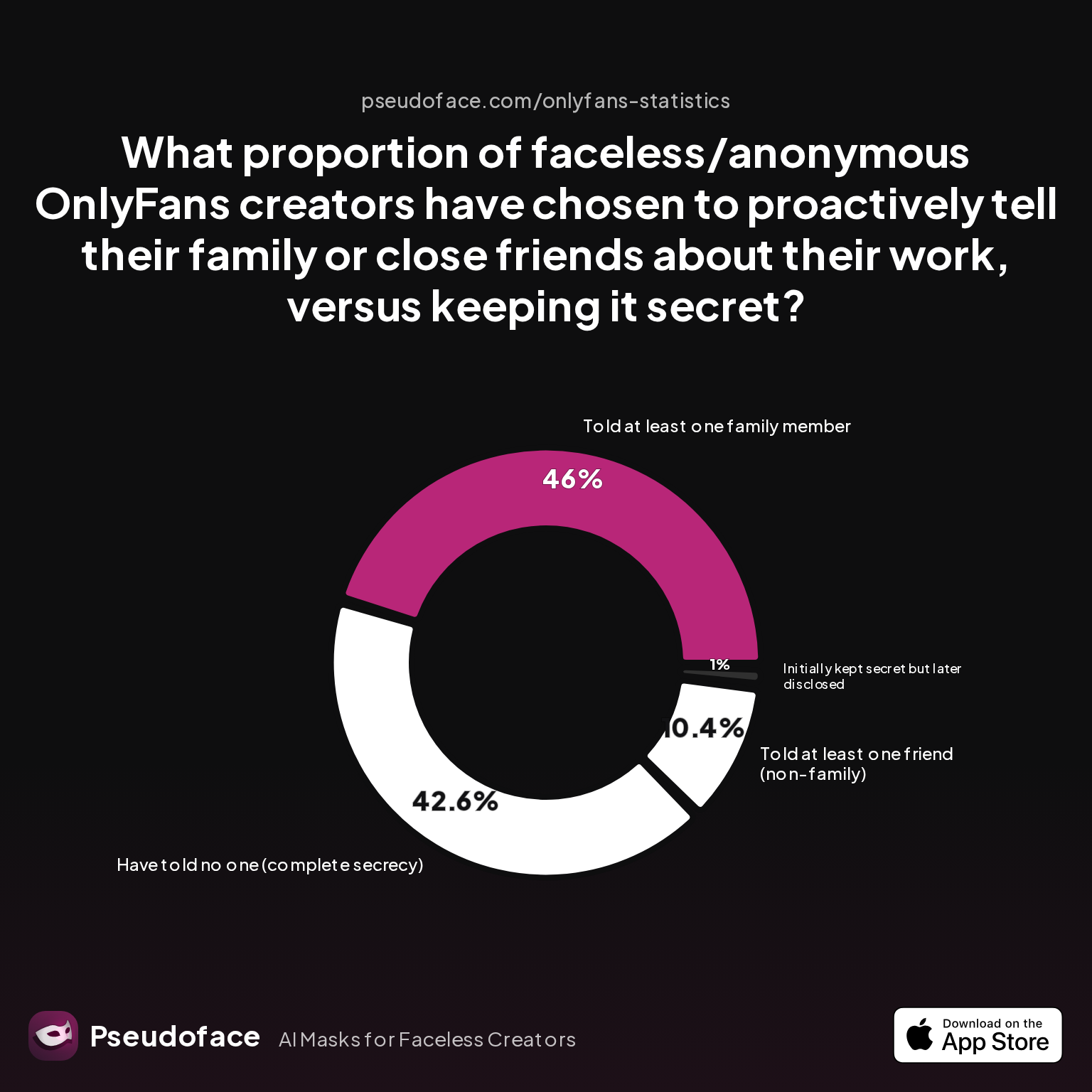
The decision to disclose your OnlyFans work to family is deeply personal—and fraught with trade-offs. For every proud story of acceptance, there’s one of disappointment, even estrangement. To answer “should I tell my family about OnlyFans?” we need to start with the facts: how many creators actually do?
| Answer | Percentage |
|---|---|
| Have told no one (complete secrecy) | 42.57% |
| Initially kept secret but later disclosed | 0.99% |
| Told at least one family member | 46.04% |
| Told at least one friend (non-family) | 10.40% |
According to the Pseudoface dataset, as of 2025-2026, about 43% of anonymous OnlyFans creators have told absolutely no one, not even close friends. Only 46% have disclosed to at least one family member, and just over 10% have told only a friend. This pattern—where secrecy is the norm—highlights the persistent stigma and unpredictable ripple effects of disclosure.
From reading thousands of public Reddit stories, it’s clear that most creators keep their OnlyFans activity private not because they’re ashamed, but because the risks feel too big: judgment, gossip, and family stress top the list.
But secrecy is also draining. Many creators describe the tension of hiding part of their lives. A few thread excerpts capture this dichotomy:
Open thread on Redditr/TheOFHubForGirls
u/u/Goldembers
Yes! I’m in a similar boat. Definitely using a separate email address for everything related to selling content. For promotion I use x (formerly Twitter) and I just started trying to promote on here. I made my OF in October. People who have a large following already will accept a small fee and drop your hottest pics in groups to help you gain traction. It feels sort of like a porn MLM tho so be careful.

Others crave openness for the relief it promises—no need to lie, less risk of a shocking reveal. And as seen in the numbers, a significant minority do choose disclosure.
However, it’s crucial to note reporting and survivorship bias in the data. Those who suffered the worst situations may not post follow-ups, while those who had smoother conversations may be overrepresented in positive threads. For most, the fear behind keeping OnlyFans a secret is well-grounded in social reality.
So, with secrecy as the norm and tension as the trade-off, many creators are left wondering: what actually happens if you take the leap and tell?
Disclosure Outcomes: Regret, Relief, or Relationship Rupture?
Disclosing OnlyFans work to family is never just a question of “will they accept me?” It’s about fallout: Will relationships strengthen, or break? Is the burden of secrecy replaced with relief or just a new version of anxiety?
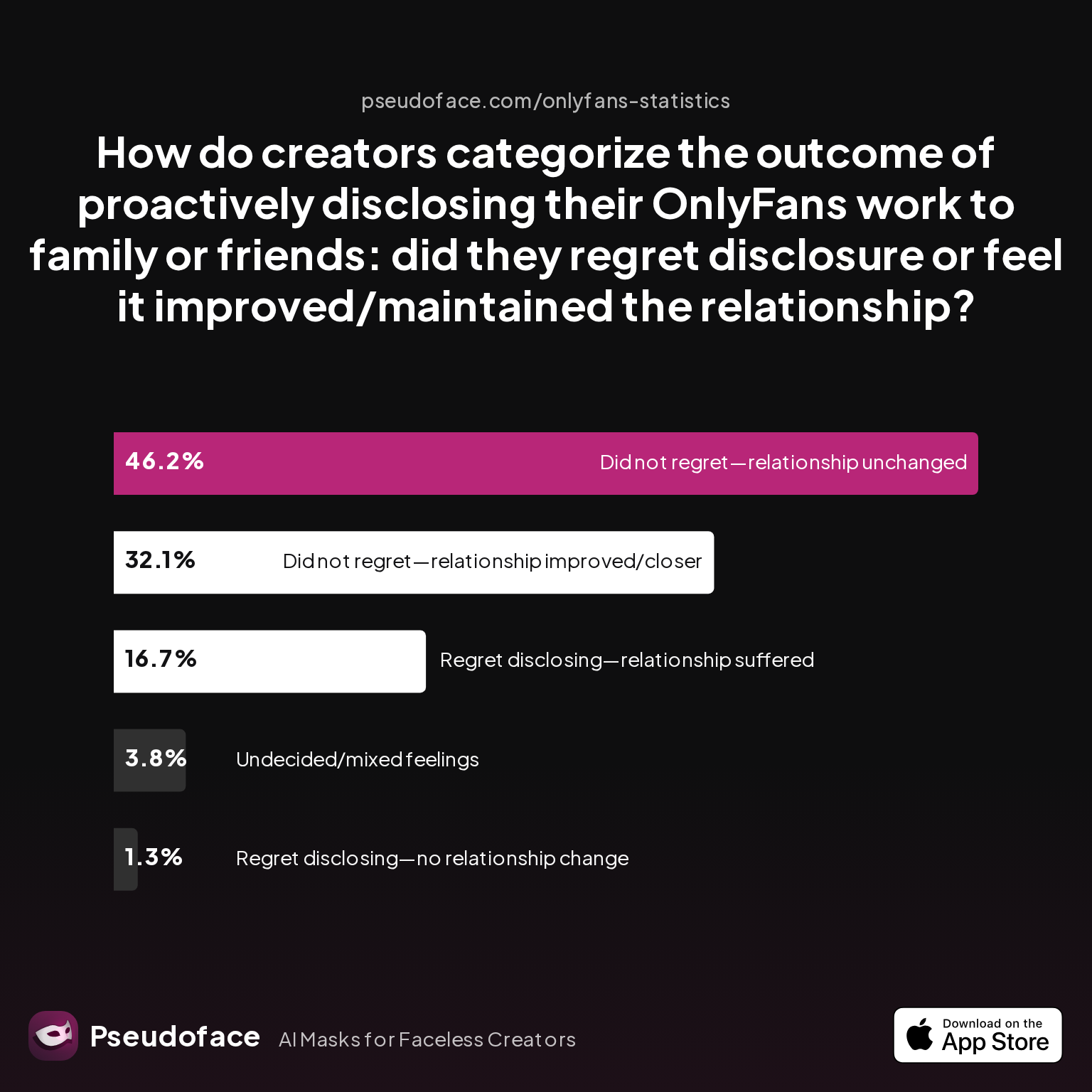
Let’s turn to the self-reported data:
| Answer | Percentage |
|---|---|
| Did not regret—relationship improved/closer | 32.05% |
| Did not regret—relationship unchanged | 46.15% |
| Regret disclosing—no relationship change | 1.28% |
| Regret disclosing—relationship suffered | 16.67% |
| Undecided/mixed feelings | 3.85% |
Most creators who proactively told family did not regret the choice: about 78% report improved or unchanged relationships. But nearly 17% say telling harmed their relationships, while about 5% were undecided or had a mix of good and bad.
It’s notable that actual “relationship disaster” (total rupture, estrangement) is less common than feared—but it’s not rare enough to ignore, especially for those whose families already had significant tension or conservative beliefs. Recall, too, that these numbers reflect self-reported outcomes and may skew toward those who feel able to share at all.
Creators who regretted disclosure often did so because family reactions confirmed fears—judgment, disappointment, or ongoing tension.
Open thread on Redditr/CreatorsAdvice
u/u/savagecamgirls
Sex work is not something to "get off your chest" with traditional parents. You do not need to tell them, and you probably shouldn't to be honest. Just tell them you're a consultant or that you work in sales. You're grown, girl. Don't let them have an unhealthy amount of control over you're life.
On the flip side, many who disclosed say transparency relieved anxiety, and even if the conversation was rocky, ongoing relationships usually found a new equilibrium. Family might never fully approve, but with time, the conversation moved on.
What comes through in hundreds of posts is not a binary of total disaster versus perfect acceptance, but a spectrum: temporary hurt, awkward silences, eventual adaptation. Scripts matter, as does family culture—but you can’t predict every reaction.
The take-home? Disclosure most often results in relationships staying the same or improving, but regret—sometimes deep or lasting—is a real risk, and creators with pre-existing family friction report the most hardship. Knowing this helps set expectations if you choose to tell. The next step: planning that conversation with as much control as possible.
How to Tell Family About OnlyFans: Scripts, Framing, and Emotional Prep
If you choose to tell your family or friends about OnlyFans, how you say it matters nearly as much as what you say. The right script can ease shock, frame the conversation around independence or creative goals, and help you stand your ground when emotions escalate.
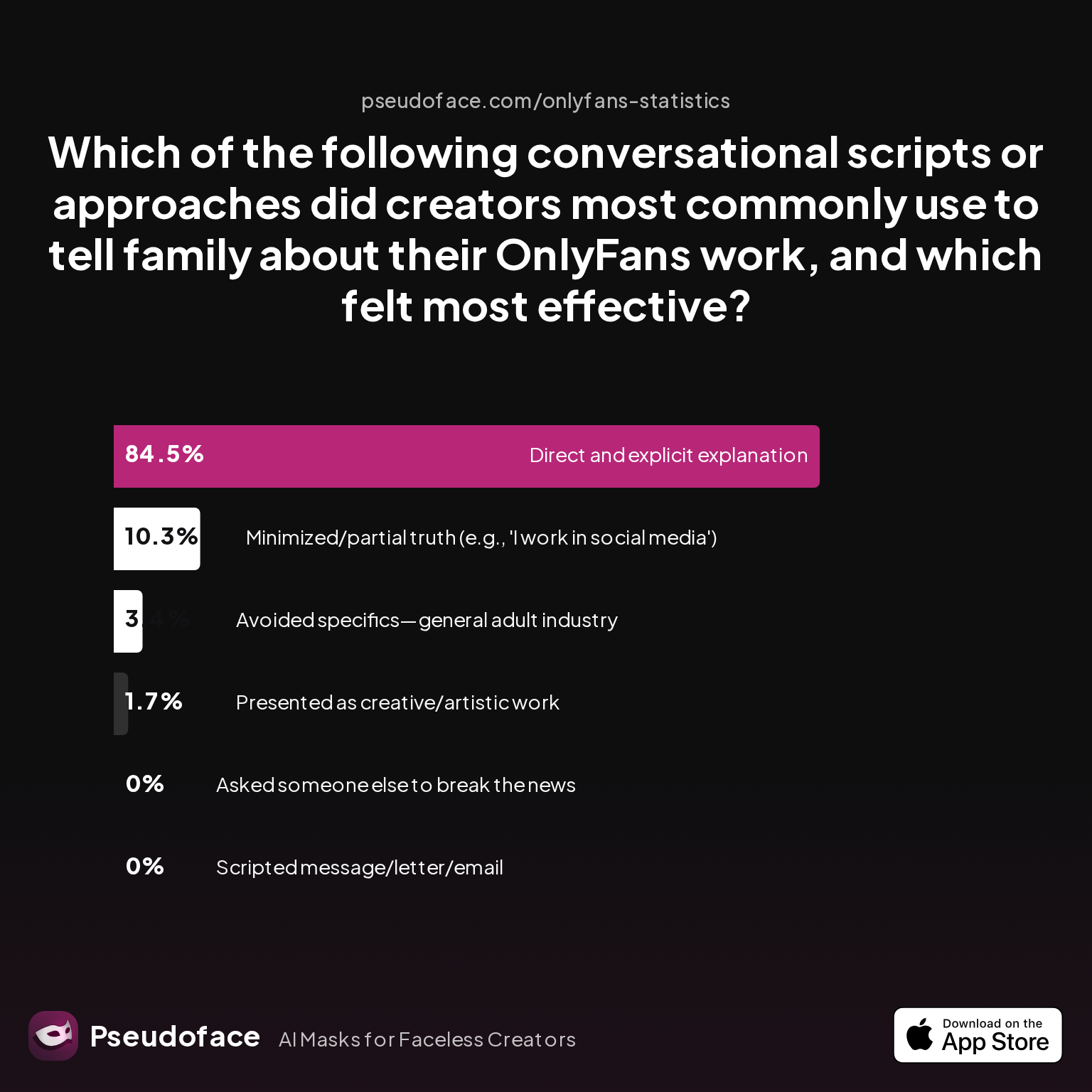
Let’s look at the actual communication strategies creators reach for:
| Answer | Percentage |
|---|---|
| Asked someone else to break the news | 0.00% |
| Avoided specifics—general adult industry | 3.45% |
| Direct and explicit explanation | 84.48% |
| Minimized/partial truth (e.g., 'I work in social media') | 10.34% |
| Presented as creative/artistic work | 1.72% |
| Scripted message/letter/email | 0.00% |
The overwhelming majority—over 84%—used a direct and explicit explanation when disclosing OnlyFans work to family. Attempts at “softening” through euphemism or third parties are rare and, by creator accounts, less effective in the long run. Directness builds trust and allows you to control the story and the context.
Still, many creators prepare carefully, framing their work not just as a job, but as a source of autonomy, financial freedom, or even creative satisfaction. For those telling parents or more traditional relatives, emphasizing safety and agency is common.
Open thread on Redditr/onlyfansadvice
u/u/c_carlax
You’re grown and capable of making your own decisions xx
Anecdotal reports suggest these themes:
- Autonomy: “This is my choice and I’m safe.”
- Pragmatism: “This work pays my bills and supports my goals.”
- Creativity/freedom: “I like the independence and flexibility.”
- Boundaries: “I keep safe online and my personal life is separate.”
For friends or siblings, creators often use a lighter touch—sometimes even humor or self-deprecation to break tension.
Emotional prep is equally important. Many creators describe rehearsing the conversation, sometimes with a trusted ally. Internal scripts help manage nerves but don’t guarantee composure if reactions turn emotional or confrontational.
Some report using written explanations (emails or letters) when a face-to-face talk felt unmanageable, but this approach is rarely preferred or effective for family (as reflected in zero percent in the Pseudoface chart).
A few sample openers, adapted from real posts:
- “I want to share something important and be upfront about my work—so there aren’t any secrets.”
- “I do online content creation that’s adult-oriented. It’s my choice and it supports me financially.”
- “I know this might be surprising. My goal is to be independent; I’m safe and have thought this through.”
There’s no universal “safe” script, but directness, respect, and clarity set the best stage for manageable outcomes. If you’re not ready to share, or know your family is unlikely to handle it well, skipping disclosure is still common and valid.
Next, let’s examine best practices for those keeping their work private—because most creators still do.
How to Keep OnlyFans a Secret from Family: Opsec and Privacy in Practice
For many faceless and anonymous OnlyFans creators, secrecy isn’t just a preference—it’s essential for personal safety, career survival, or family peace. Operational security (opsec) becomes an everyday discipline, but perfection is rare. What actually works to prevent accidental discovery?
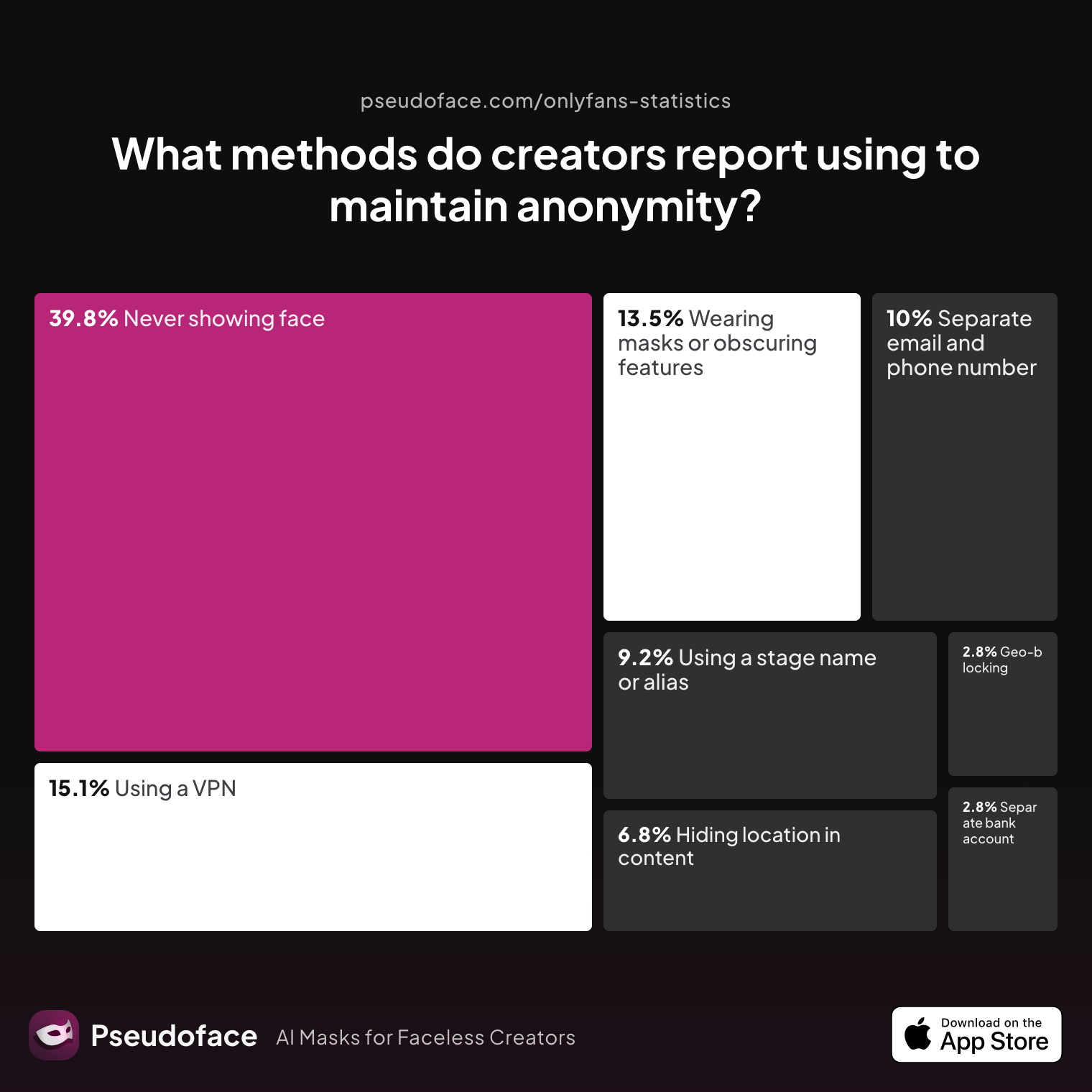
First, let’s see what strategies creators most report using.
| Answer | Percentage |
|---|---|
| Avoiding location-specific details in content | 6.77% |
| Geo-blocking specific regions | 2.79% |
| Never showing face | 39.84% |
| Using a separate bank account or business entity | 2.79% |
| Using a separate email and phone number | 9.96% |
| Using a stage name or alias | 9.16% |
| Using a VPN or privacy tools | 15.14% |
| Wearing masks or obscuring identifying features | 13.55% |
Never showing their face is the most-used anonymity tactic (nearly 40%), followed by privacy tools like VPNs (15%) and obscuring features (14%). Separate emails, staged names, and blocking location clues are also routine. But as any seasoned creator knows, the devil is in the details.
Most privacy failures aren’t technical lapses—they’re behavioral slip-ups or overlooked settings. Here’s what gets missed most often:
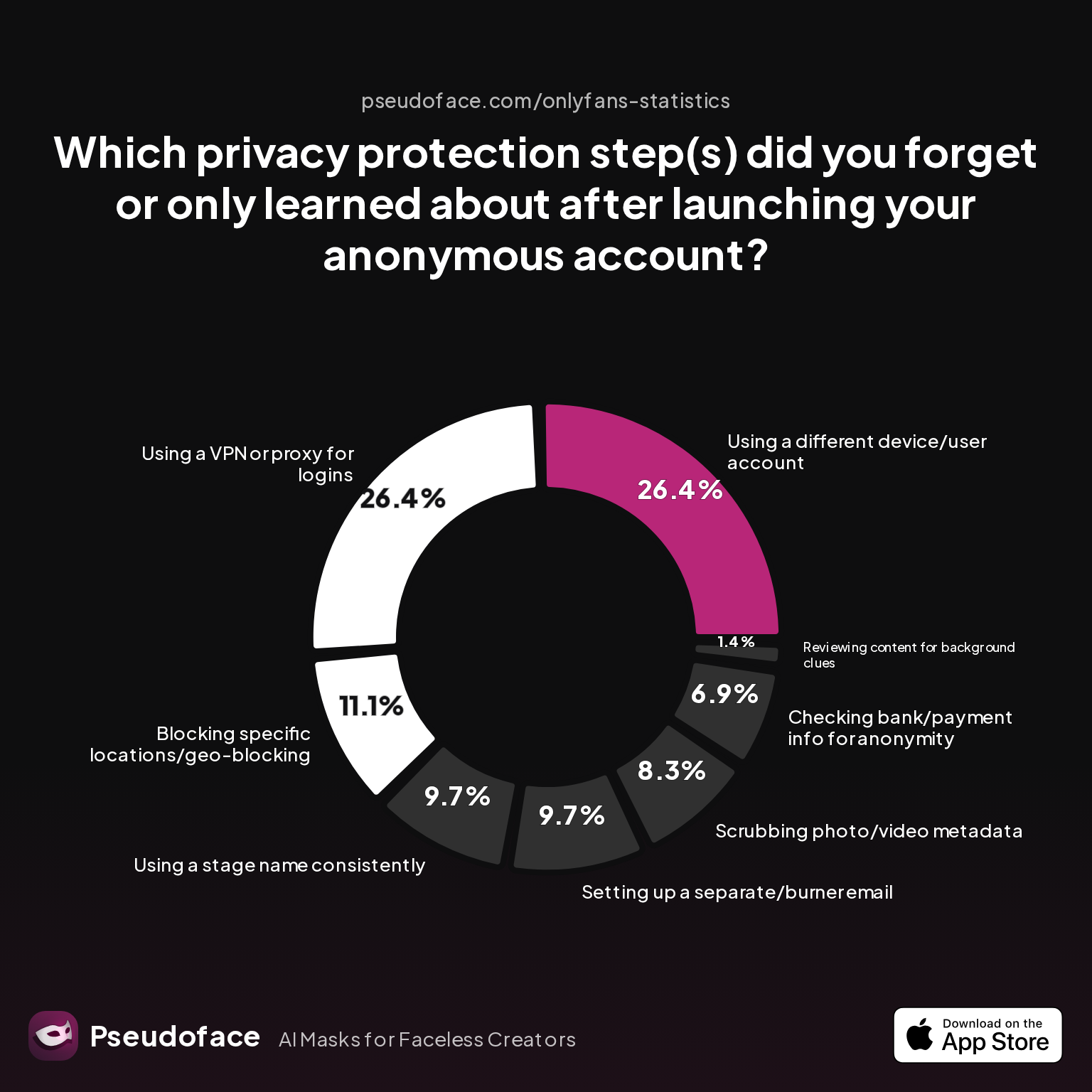
| Answer | Percentage |
|---|---|
| Blocking specific locations/geo-blocking | 11.11% |
| Checking bank/payment info for anonymity | 6.94% |
| Reviewing content for background clues | 1.39% |
| Scrubbing photo/video metadata | 8.33% |
| Setting up a separate/burner email | 9.72% |
| Using a different device/user account | 26.39% |
| Using a stage name consistently | 9.72% |
| Using a VPN or proxy for logins | 26.39% |
One in four creators forgets to use a different device or VPN for logins—a crucial mistake, as platform algorithms and IP tracking can betray even faceless accounts. Geo-blocking, scrubbing metadata, or consistently using an alias are also overlooked by 7-11%.
Reporting/recall bias applies here: creators who suffered a “leak” are likelier to recall and share their mistakes, while others may not realize what protective step they’ve missed until it’s too late.
Reddit is full of horror stories about tech-driven exposure:
Practical advice is continually refined:
Open thread on Redditr/onlyfansadvice
u/u/[deleted]
block them before they see you
The most consistent operational security tips include:
- Use separate phones (or at least separate user accounts) for creator work and personal life.
- Block all family, colleagues, and local acquaintances on new social accounts proactively.
- Regularly review posts for background identifiers (decor, locations, pet names).
- Avoid any contact syncing or phone book integration on social platforms.
- Scrub photo metadata before uploading.
Living with the stress of secrecy isn’t trivial. Many creators describe an underlying fear of being “outed,” which can lead to hypervigilance, avoidance of real-world social events, and even guilt when family probes about income or work. But for those in unsupportive environments or with jobs at risk, robust privacy hygiene isn’t just wise—it’s survival.
Yet even the most careful can face exposure. So, what happens if your secret is discovered?
How to Handle Family Finding Out About OnlyFans: Before, During, and After the Fallout
No amount of opsec can guarantee total anonymity. Even with the best precautions, platform glitches, mutual contacts, or a careless DM can blow your cover. When family finds out by accident—or through others—the emotional stakes rise sharply. What does the data reveal about discovery, typical fallout, and recovery strategies?
First, let's examine how often anonymity fails and what that looks like.
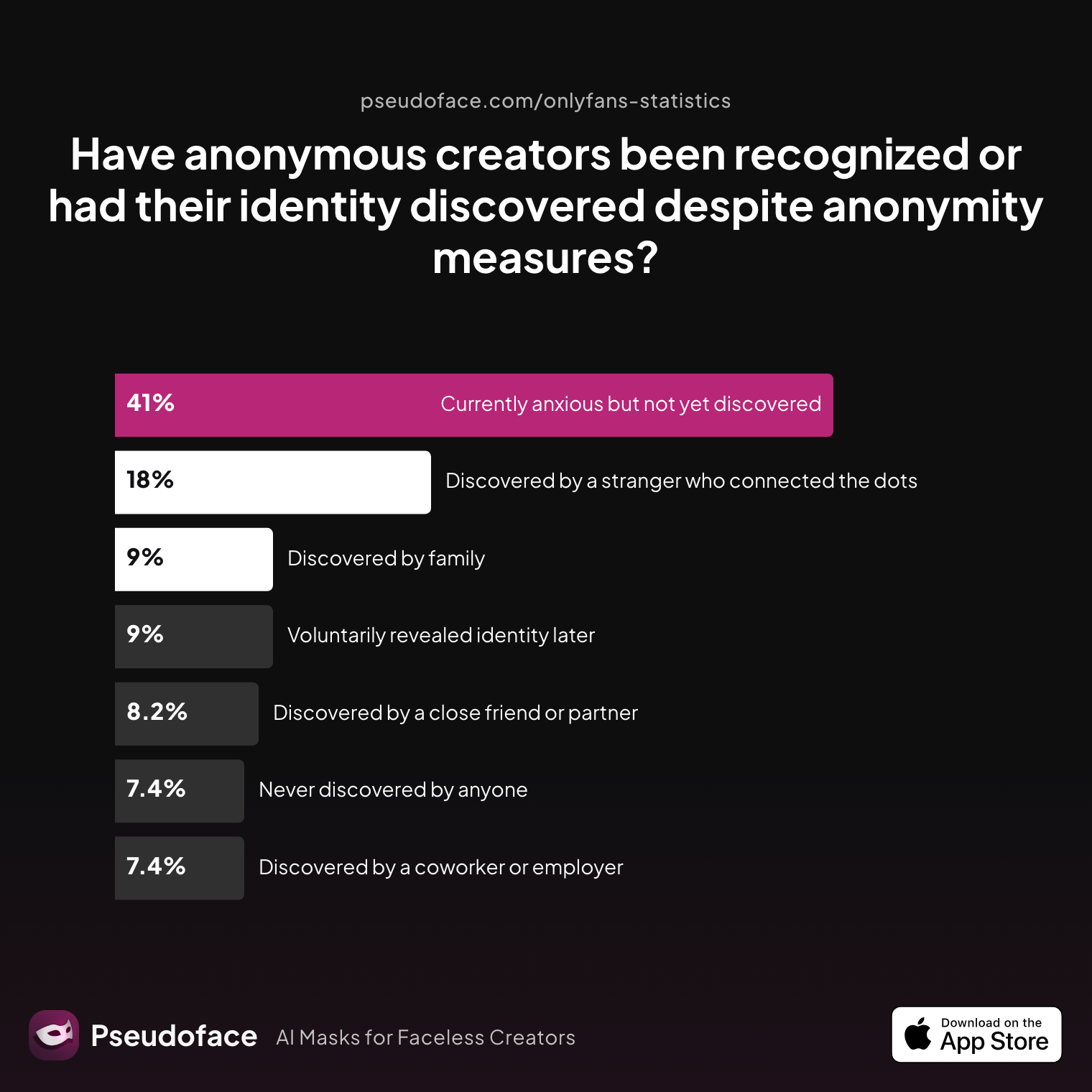
| Answer | Percentage |
|---|---|
| Currently anxious but not yet discovered | 40.98% |
| Discovered by a close friend or partner | 8.20% |
| Discovered by a coworker or employer | 7.38% |
| Discovered by a stranger who connected the dots | 18.03% |
| Discovered by family | 9.02% |
| Never discovered by anyone | 7.38% |
| Voluntarily revealed identity later | 9.02% |
Nearly 41% of creators live with persistent anxiety but have not yet been discovered, while 9% report family discovery, another 8% by close friends or partners. About 18% were “outed” by a stranger connecting online clues. Less than 8% report never having any scare—a caution that “forever anonymity” is rare.
The initial reaction to being found out, especially by family, ranges from supportive to catastrophic:
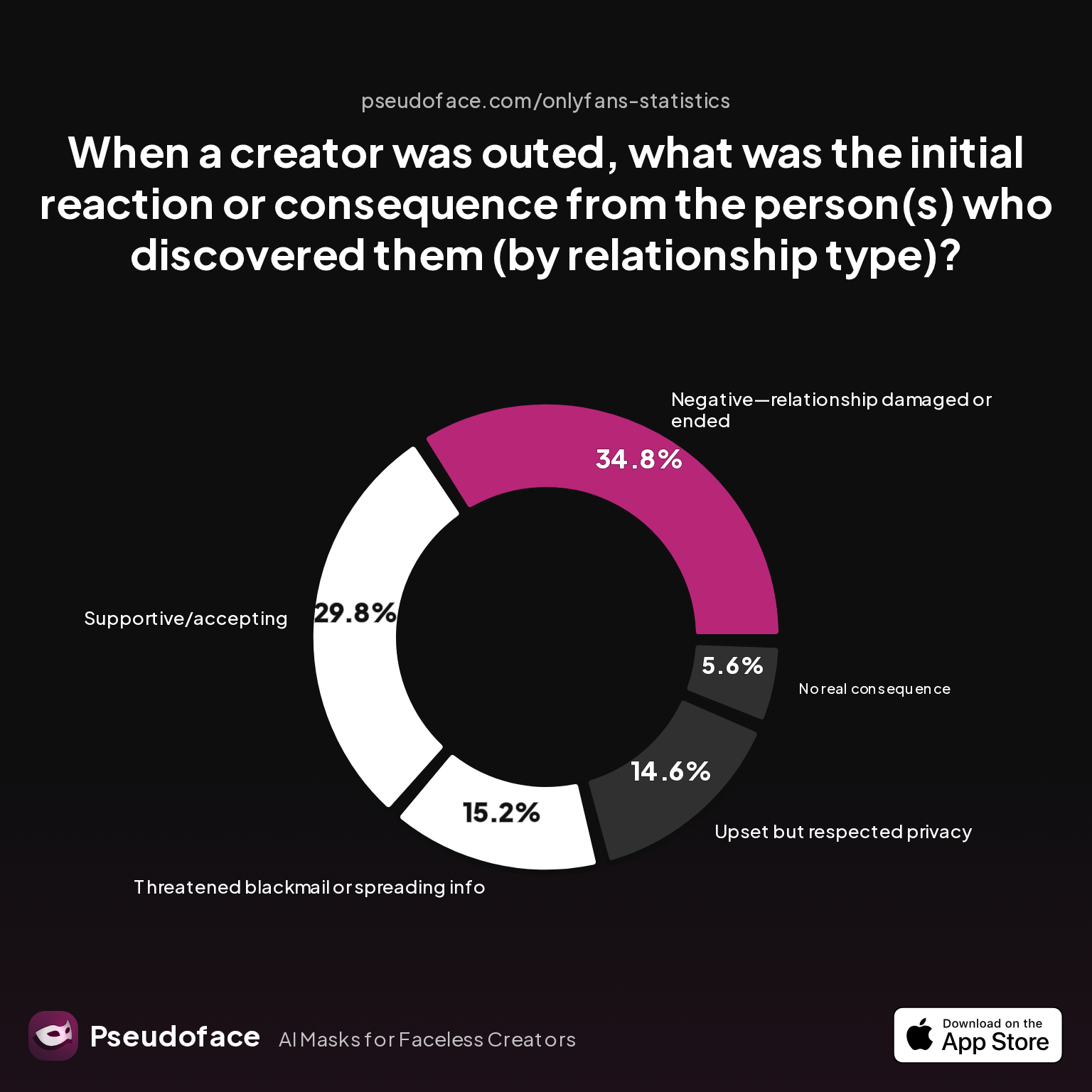
| Answer | Percentage |
|---|---|
| Negative—relationship damaged or ended | 34.83% |
| No real consequence | 5.62% |
| Supportive/accepting | 29.78% |
| Threatened blackmail or spreading info | 15.17% |
| Upset but respected privacy | 14.61% |
A third of creators say being outed to family caused real relationship damage; yet nearly the same proportion (30%) found the outcome supportive or at least accepting. Blackmail or threats—an especially painful, often underreported category—were cited by 15%. About 15% described family as “upset, but respected privacy.” Bland or “no real consequence” outcomes remain a minority.
But the story doesn't end there. What you do after discovery shapes the long-term outcome more than the event itself. Here's what the stats say about communication strategies post-discovery:
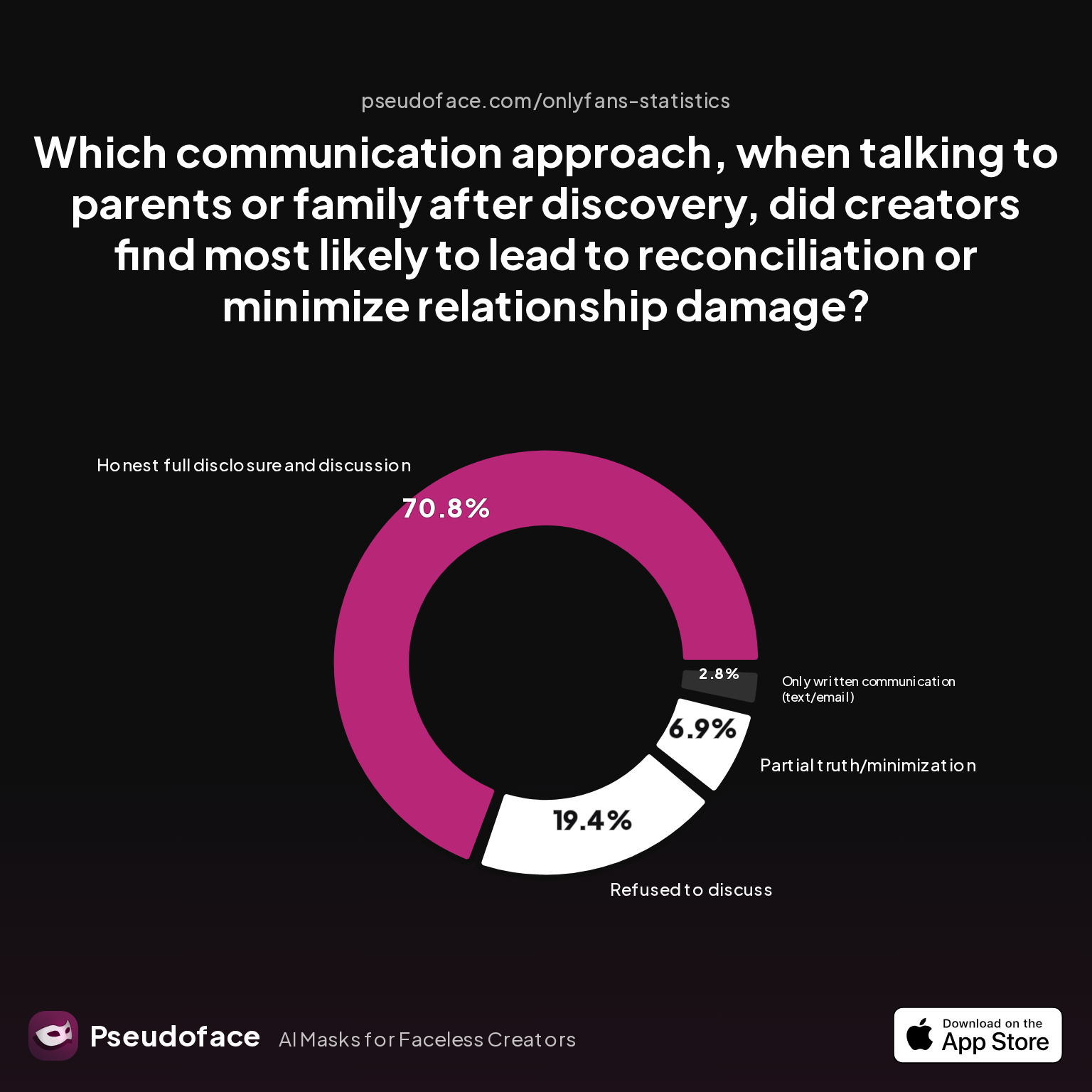
| Answer | Percentage |
|---|---|
| Apology and promise to stop | 0.00% |
| Asked a mediator (friend/family/therapist) to help | 0.00% |
| Directed to third-party info/resources | 0.00% |
| Honest full disclosure and discussion | 70.83% |
| Only written communication (text/email) | 2.78% |
| Partial truth/minimization | 6.94% |
| Refused to discuss | 19.44% |
A clear finding emerges: honest, full disclosure and a willingness to talk openly is linked with the best odds of reconciliation and relationship repair (nearly 71%). By contrast, apologizing and promising to stop—often suggested in panic—is not correlated with better outcomes; nor are mediators or generic information handoffs. Attempting to minimize or refuse conversation altogether usually worsens or prolongs family distress.
Many Reddit stories back this up:
Open thread on Redditr/onlyfansadvice
u/u/c_carlax
Put your pages to private so you have to accept any requests, don’t use your face on your profile pictures. Make sure your phone isn’t syncing with contact and block anyone you don’t want to know. The risk you always take though is friends and family finding out and if they ask, just own it. You’re grown and capable of making your own decisions xx
When blindsided, the most survivable path is a calm, direct conversation—acknowledging emotions, setting boundaries, and refusing shame. It’s not about groveling or endless explanations, but reclaiming agency and focusing on “I’m safe, I chose this, and my values haven’t changed.”
Checklists for crisis moments:
- If possible, pause and collect yourself before responding—don’t fire off reactive texts.
- Acknowledge shock or hurt on both sides, but remain steady: “I understand why you’re upset. I want to talk about it directly.”
- Don’t over-explain or apologize for the core of your decision.
- Offer reassurance on safety, privacy, and intentions going forward.
- Set boundaries on future discussion.
The bottom line: Even if privacy fails, your next steps can limit or even repair the damage—if you open the conversation and keep your dignity.
Coming Out as an OnlyFans Creator vs. Keeping It Secret: Pros, Cons, and Creator Insights
Somewhere between total secrecy and open disclosure lies a continuum of trade-offs. Which is “better” depends on your life stage, relationship quality, and risk tolerance. By synthesizing survey data, countless Reddit threads, and creator testimonies, a nuanced pattern emerges.
The Pros of Coming Out
- Reduced anxiety: No more fear of being “outed” by accident.
- Relationship honesty: Less compartmentalization day-to-day.
- Authenticity: Ability to share major life events openly.
- Access to support, in some cases: Some family members surprise with private reassurance.
The Cons of Coming Out
- Risk of judgment/gossip: Especially in conservative, religious, or close-knit families.
- Relationship strain: Potential for disappointment, awkwardness, or even estrangement.
- Loss of control over narrative: News can spill beyond your intended confidant.
The Pros of Keeping It Secret
- Autonomy: You set boundaries and minimize external stress.
- Risk containment: Family can’t overreact to what they don’t know.
- Professional protection: Critical for those with day jobs vulnerable to stigma.
The Cons of Keeping It Secret
- Chronic stress: Living with “what if they find out?” becomes exhausting.
- Barriers to intimacy: Gaps in conversation or evasive answers—especially around money/work.
- Risk of accidental exposure: As the earlier charts show, even perfect opsec isn’t foolproof.
Some creators thread the needle with selective disclosure—telling only the family members they trust, or only after reaching specific life milestones (moving out, achieving big earnings, etc.). As seen in the decision rate chart earlier, “telling only friends” or “waiting to reveal” are minority paths, but real.
Firsthand accounts reinforce these trade-offs:
Open thread on Redditr/TheOFHubForGirls
u/u/Big_Booty_Goddess
I created a new email that matches my OnlyFans account and is linked to it. I created a new Instagram account and blocked anyone I knew. Also created a TikTiok but I don't know what to post since there.
Open thread on Redditr/CreatorsAdvice
u/u/VoluptuousVen0m
If you only tell those who directly ask you’ll get nowhere (that said I’m also into metal detecting, that’s cool!)
The right path changes over time, too. Many creators report starting out in secrecy, then coming out to family after moving out or gaining financial independence, or after accidental discovery removes the option.
As of 2026, there’s no universal “best practice”—just an evolving, sometimes messy balance of safety, secrecy, and self-acceptance.
Scripts for Telling Family About OnlyFans: Adaptable Language for Real Scenarios
Bracing for “the conversation” can leave even the most confident creators tongue-tied. Whether you’re prepping a proactive talk with parents, a casual admission to siblings, or a crisis disclosure after being found out, having language at the ready is empowering.
Below are script templates adapted from real Reddit posts and consistent with strategies most likely to foster understanding or at least minimize drama. Tailor them to your voice and relationship context:
Proactive Disclosure: Telling Parents
“I want to be upfront about something I know might be surprising. I’ve started creating online content through a platform called OnlyFans. It’s adult-oriented, and I made this choice for myself. This work gives me financial independence, safety, and control over my life. I know you may have questions or concerns, and I’m open to talking about them.”
Crisis Disclosure: If You’ve Been Found Out Suddenly
“I realize this isn’t how I wanted the conversation to happen. I want to answer your questions honestly. I chose this work carefully—I keep myself safe, and this decision is about supporting myself, not about hiding from anyone or hurting you. I hope we can talk about it calmly.”
Telling Siblings or Close Friends
“I wanted to let you know first—I do online content that’s for adults. It’s not something I advertise to the family but you matter to me, and I’d rather you hear it from me directly.”
Deflecting Indirect Questions (Not Ready to Disclose)
“Right now, I’m working in online content/social media management. It’s remote and helps me pay the bills. Maybe I’ll share more details when the time is right.”
From emotional prep tips to tactical pivots, creators offer hard-earned advice:
Open thread on Redditr/CreatorsAdvice
u/u/MissyCrimson
Work from home, virtual personal assistant. Lots of data entry. Problem solved 😉
Open thread on Redditr/CreatorsAdvice
u/u/eab1006
I’d just say I work from home… it’s so common in this day and age
Tone is as important as content. Stay calm, don’t rush to fill every silence, and avoid over-sharing technicalities. Framing your work as just one part of your identity helps loved ones recalibrate and see beyond the initial shock.
A final practical tip: consider writing out your message in advance, even if you don’t send it as a letter. Preparation builds confidence, whether you’re sitting across a kitchen table or answering an anxious midnight text.
FAQs
Q: Should I tell my family about my OnlyFans if I’m anonymous?
No—most anonymous creators do not tell family, and the majority report manageable secrecy with good opsec.
Disclosure is only as beneficial as your family’s likely reaction: if you foresee judgment, estrangement, or risk, it’s safer to remain private. Based on 2025-2026 survey data, only about 25% of creators disclose proactively to family; the rest maintain secrecy, underscoring that you aren’t alone or abnormal for choosing privacy.
Q: What’s the best way to tell my parents about OnlyFans without it becoming a disaster?
The most effective strategy is calm, direct disclosure—framing your work around independence, planning, and safety.
Avoid euphemisms or asking others to break the news. Instead, use scripts that communicate agency (“I made this choice for myself and my wellbeing”) and preempt fears by addressing risks. Most creators who led with honesty and openness reported either improved or stable relationships, while minimized or dodged conversations were less successful.
Q: How do I keep my OnlyFans account a secret if I live with family?
Use robust operational security: separate devices/accounts, block family on all platforms, never sync contacts, and scrub metadata.
Data shows the most missed steps are using a dedicated device (26%), failing to use VPN/proxies (26%), and not proactively blocking locals or relatives. Diligent opsec greatly reduces, but doesn’t eliminate, risk of exposure.
Q: What do I do if someone outs me to my family?
Pause, gather yourself, then respond with a direct, honest conversation—don’t default to apologies or panicked explanations.
According to Reddit-reported outcomes, “owning” the situation and calmly explaining your reasoning is far more likely to restore or preserve your relationships than avoidance or denial. If safe, set boundaries about privacy and limit discussion to trusted relationships.
Q: Are there examples of conversations that went well when telling family about OnlyFans?
Yes—about 78% of creators who chose to disclose proactively reported either improved or unchanged family relationships.
These conversations often succeeded by addressing fears up front, staying composed, and framing the work as a personal, informed choice. Every family is different, but many creators report surprising acceptance or at least gradual adjustment with time.
Q: How do I minimize the risk of accidental discovery?
Use a combination of privacy tools and behavioral precautions: VPNs, burner emails, blocking contacts, and consistent use of stage names.
Technical lapses—like reusing a device or connecting payment information to real-world identities—cause many leaks. Block all family/locals on every app or promo platform from day one, and double-check background details in every post.
Q: What are the biggest regrets creators have after disclosure?
Regrets center on family distress and fractured trust—but are usually tied to pre-existing relationship challenges, not disclosure alone.
About 17% of creators who disclosed regretted it, often due to relationship fallout or ongoing tension; very few regretted disclosure when relationships were stable or communication was calm and direct.
Q: Can I “come out” to select family members and not others?
Yes—selective disclosure is common and can protect relationships or privacy, but be cautious about information leaks.
Some creators tell only the relatives they trust, relying on their discretion; this works best when you set clear boundaries and understand the risk of news traveling within close-knit families.
Q: What should I say if family asks directly about my income or content creation?
Offer a plausible, professional-sounding cover (e.g., “remote content/social media work” or “online creative business”), or gently pivot without lying.
Reddit advice often highlights “work-from-home” or “content management” as believable explanations, especially if you’re not ready to disclose.
Q: Will keeping it a secret from family damage my relationships in the long run?
Generally, secrecy in itself does not cause relationship harm unless it fuels chronic anxiety or affects your mental health over time.
Many creators experience guilt or stress but preserve strong family connections, especially if secrecy is due to self-protection rather than shame. Regular self-check-ins and outside support (friends, therapists) can help manage this long-term tension.
If you’re grappling with the question of telling family about OnlyFans, remember: privacy is not dishonesty, and disclosure is not a guarantee of relief or ruin. Play to your context, lean on community wisdom, and set boundaries that prioritize your safety and peace.


