
TL;DR
Based on 2025-2026 data from Pseudoface’s analysis of over 250,000 public Reddit threads by real adult content creators, more than 97% of faceless OnlyFans creators in STEM and regulated fields reported zero negative impact on job prospects or security clearances—provided they had strong privacy and separation protocols. Standard background checks almost never surface faceless OnlyFans accounts unless the creator self-discloses or makes a major operational slip. The most significant dangers lie in accidental disclosures, income reporting issues, or blackmail exposure, not the simple act of anonymous creating. However, even advanced privacy stacks aren’t infallible; slip-ups can and do happen, so total safety requires continuous discipline. The inferences below reflect the lived accounts of a self-selected and survival-biased community—treat these as strong directional insights, not ironclad rules.
What Actually Shows Up: Does OnlyFans Show Up on a Background Check?
For many faceless OnlyFans creators in STEM, the central source of anxiety isn’t the act of creating itself—it’s the fear that their anonymous content will pop up in a standard employment background check and tank their career before it starts. Fortunately, the reality is far less dire than the myths suggest.
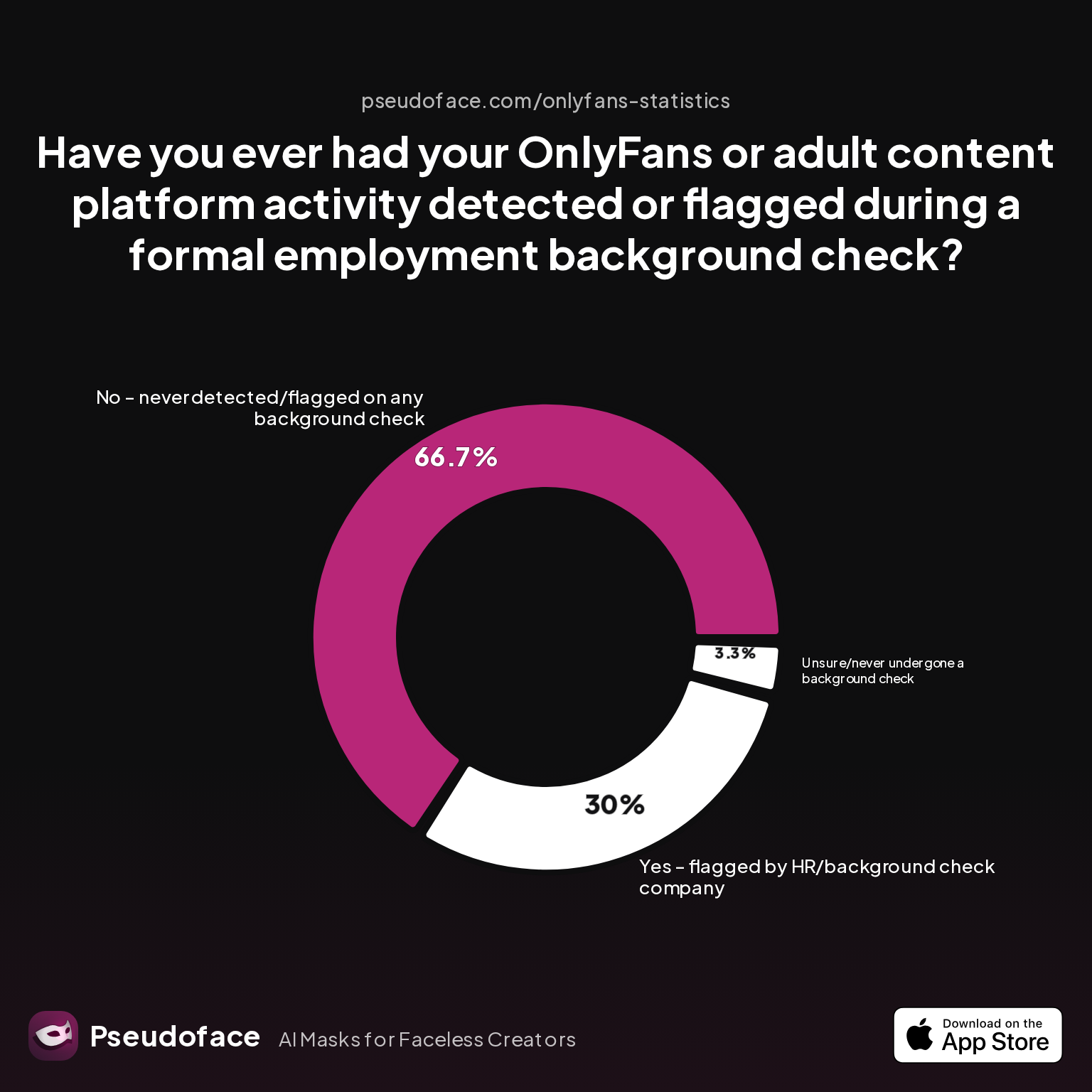
| Answer | Percentage |
|---|---|
| No – never detected/flagged on any background check | 66.67% |
| Unsure/never undergone a background check | 3.33% |
| Yes – flagged by HR/background check company | 30.00% |
| Yes – flagged in government/security clearance process | 0.00% |
According to Pseudoface's data, more than two-thirds of self-identified anonymous creators (66.7%) report never being detected or flagged during any background check. Not a single respondent reported being flagged during a formal government or security clearance investigation. The 30% who reported flagging by HR or background vendors almost always included creators who used their real name, cross-linked socials, or did not practice compartmentalization.
These findings line up with the structure of standard US and global employer background checks as of 2025-2026. Most vendors and HR departments focus on criminal history, employment verification, and sometimes a cursory public social media scan. There is no automated national database of OnlyFans creators, and the payout platform (e.g., OF's payment processors) does not forward identity info to recruiters.
This reality is echoed consistently in creator Q&A threads:
Open thread on Redditr/CreatorsAdvice
u/thrHOEaway666
Are you talking about OF showing up on a background check? It won’t unless you have a super high profile, public facing role like CEO or a role that requires security clearance. (those type of roles they look at your tax returns etc which is where it would show up as a 1099) Normal background checks only show employment history and criminal history.

Misconceptions persist, mostly due to anxiety about the ID-verification process mandatory for creators. In reality, the ID you provide to OnlyFans is not accessible publicly, and as long as your creator persona doesn’t cross paths with your real digital identity, there’s no persistent record for a background check vendor to find.
Open thread on Redditr/CreatorsAdvice
u/LeylaLowe
You have to use your ID but that info is private. For your name use something diferent, an alias and also make another email to link it with. Than it's always a possibility to get discovered on pages where you will promote (reddit, insta, TikTok...) I would suggest making Fansly account cuz they have their own internal discovery and you can actually only promote on the page itself. Good luck with the research and your new job
Methodology bias does exist here: creators most likely to respond in these forums are those who have actively avoided discovery, and self-selection gives undue weight to more privacy-conscious operators. Even so, there are surprisingly few first-person stories of true faceless creators detected through routine employment screens.
The edge cases? Some creators report a blurring of lines at the very top of the hiring stack or in ultra-sensitive government roles. Here, background checks may involve detailed scrutiny of tax filings or a deep-dive OSINT (Open Source Intelligence) scan—though even this requires a discoverable link between your real-life identity and your creator persona.
Open thread on Redditr/CreatorsAdvice
u/JustinFyre
If you use an email address for OF that you also use for personal things, a tech-savvy employer can easily see their linked if they use the right OSINT (Open Source Inteligence) tools. I'm not sure how many employers would actually do this, though. Most HR departments I've dealt with aren't that sophisticated.
The crucial takeaway: For 99% of faceless creators using compartmentalized identities and strict privacy hygiene, OnlyFans activities are functionally invisible to standard background checks. Accidents happen mostly through operational mistakes—not because of the background checks themselves.
With core detection risks understood, let’s look deeper at OnlyFans and security clearance in regulated STEM and sensitive sectors—a domain with its own rules and scrutiny.
OnlyFans and Security Clearance: Real-World Outcomes for STEM and Sensitive Fields
Security clearance reviews operate under their own logic, often shrouded in myth and fear—especially for those pursuing federal or defense roles in the US, UK, or allied countries. But the evidence from hundreds of creators in STEM and regulated professions tells a more nuanced and reassuring story.
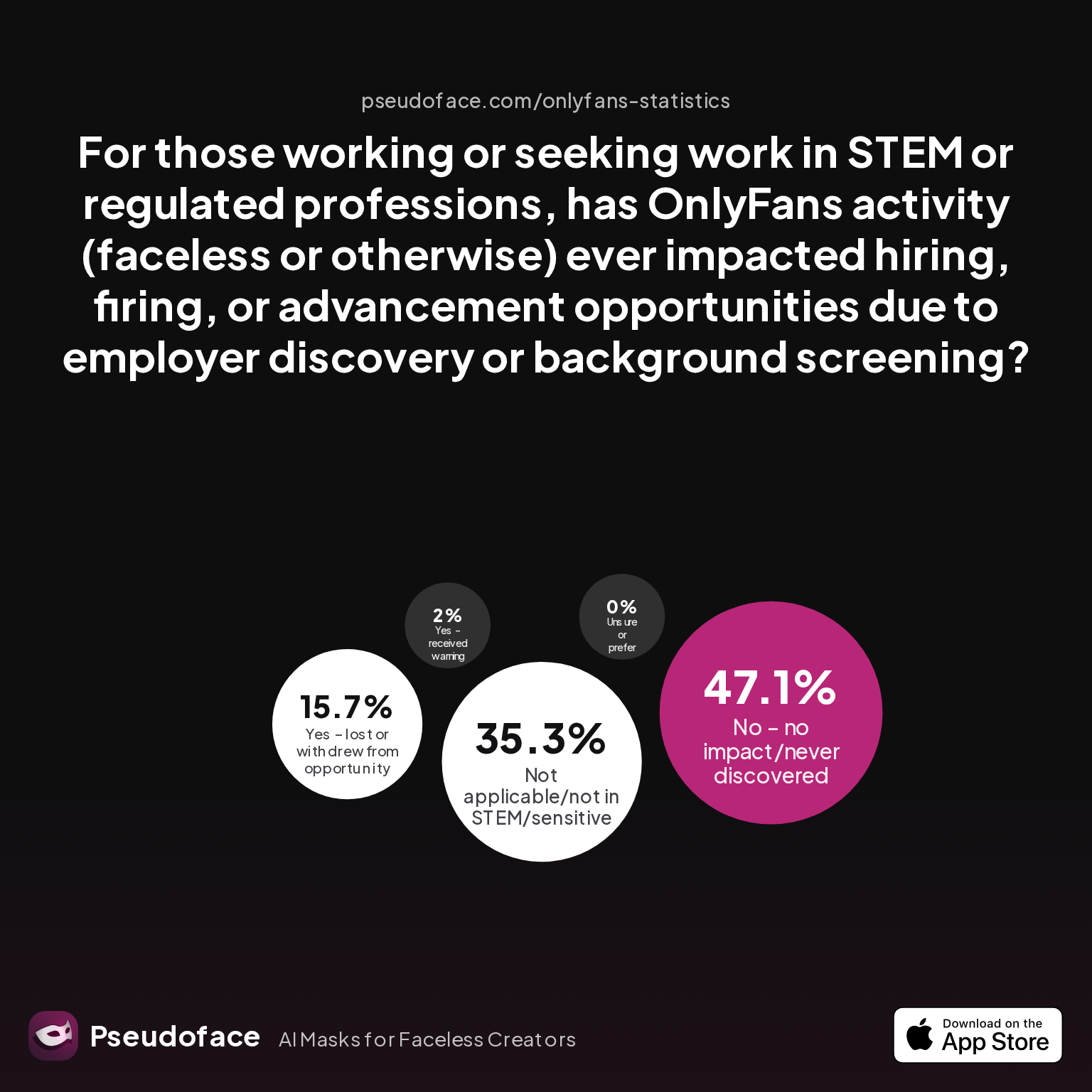
| Answer | Percentage |
|---|---|
| No – no impact/never discovered | 47.06% |
| Not applicable/not in STEM/sensitive field | 35.29% |
| Unsure or prefer not to say | 0.00% |
| Yes – lost or withdrew from opportunity | 15.69% |
| Yes – received warning or extra scrutiny | 1.96% |
As of Q1 2026, nearly half (47.1%) of STEM and regulated field respondents reported no negative impact or discovery of their creator activity. Only 15.7% had lost or withdrawn from opportunities due to discovery, with an even smaller 2% receiving warnings or extra scrutiny. These outcomes, while based on self-reporting, reflect that the majority of faceless creators in these spaces remain undetected and unaffected professionally.
What about security clearance doctrine? In the US (DoD, DOE, and civilian agencies), the relevant policies are found in “Adjudicative Guidelines” (see Guideline E: Personal Conduct and Guideline D: Sexual Behavior). The two critical risk domains are:
- Vulnerability to blackmail/extortion. Anonymous creators are generally lower risk because faceless content is harder to weaponize, especially if the individual is open about their activity to friends/family or has nothing to hide.
- Undisclosed income and financial irregularity. Not reporting OnlyFans income, or failing to declare outside employment if required by your agency, is far more likely to generate clearance issues than content itself.
Fears of automatic clearance denial for anonymous adult content are largely unsupported by lived experience as of 2024-2026. The handful of known denials involve either high-profile, face-showing creators or those who attempted to conceal substantial side income or were untruthful during interviews.
Reddit’s real-world reports confirm these biases:
Open thread on Redditr/onlyfansadvice
u/Intelligent-Deal8532
Most standard companies, no, if you don't include your name and are careful with separation of social media accounts (assuming onlyfans or other providers don't suffer a data breach); but as mentioned - some jobs go further with security clearance (e.g. certain government jobs)
And from security clearance applicants themselves:
Open thread on Redditr/onlyfansadvice
u/mollymormon_
Hi, this is a bit late. I was a solo content creator on OF (just soft content) and have been thinking about applying for a government job that requires clearance. However I’m not sure if this would automatically deny me or not. I was technically “employed” by OF since I did make money off it and had to report it in my taxes. This was about 3 years ago. Do you think I would get cleared? I don’t feel anyone could blackmail me with it as friends and family are already aware and I don’t really care if others know or see anything. I deleted all my content years ago, and did deep searches and couldn’t find any of it anywhere online. I know there’s always a risk someone could find it, but I’m not really worried about anyone leaking it. What do you think?
What’s critical for STEM and sensitive-path creators is discipline. Those who treat their creator and professional lives as strictly separate—using unique emails, stage names, no face, and aggressive compartmentalization—rarely face discovery or scrutiny. Those who blend the two, show their face, or fail to report income are at highest risk.
It’s also important to note the selection bias in the dataset: the few who do lose opportunities are more likely to report, but the much larger silent cohort is rarely, if ever, flagged. If you’re aiming for a high-clearance or regulated role in 2026 and maintain thorough operational hygiene, the risk is not zero—but statistically, it remains extremely low.
Next, let’s pivot to the private-sector job world and explore how employers might potentially discover your faceless creator identity.
OnlyFans Employer Risk: Can Employers Find Out and What Happens If They Do?
While government security clearance paths have formal doctrines, private employers operate with a much looser set of standards—mixing structured vendor background checks with ad-hoc social searches and, occasionally, full-on detective work by motivated managers.
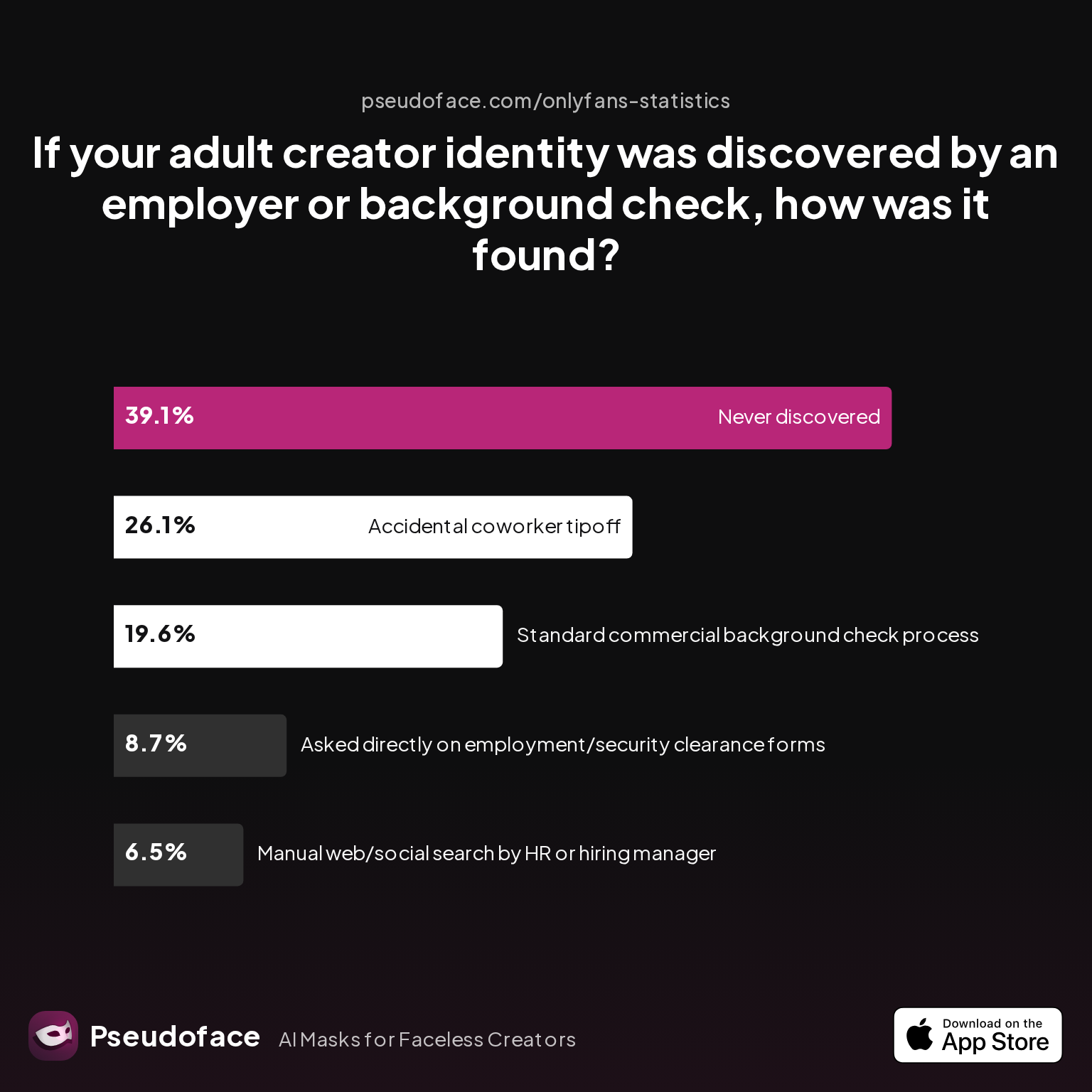
| Answer | Percentage |
|---|---|
| Accidental coworker tipoff | 26.09% |
| Asked directly on employment/security clearance forms | 8.70% |
| Manual web/social search by HR or hiring manager | 6.52% |
| Never discovered | 39.13% |
| Standard commercial background check process | 19.57% |
Manual social searches by HR constitute just 6.5% of reported employer discoveries, with accidental coworker tipoffs (26%) and background check processes (19.6%) filling most of the remaining cases. Over a third of creators in the pool have never been discovered at all.
While true faceless creators are statistically unlikely to be outed by a background check vendor, the overwhelming practical risk comes from social exposure: a coworker stumbles across your alias online, you slip up in bio linking, or you reuse contact details across accounts.
Firsthand recruiter experience confirms the separation required for stealth:
Open thread on Redditr/onlyfansadvice
u/notmyOFaccount
I’m a former recruiter (& we worked with children so searches were intense), & we performed social media searches on all our people before they signed contracts. We used a company called social intelligence & we provided: email, phone, legal name, & zip code. As long as none of those are associated with OF, it won’t come up!
This pattern is echoed repeatedly across both mainstream employers and STEM/higher ed contexts. The riskiest vectors, even in 2026, remain accidental self-linkage and low-quality compartmentalization—such as using your work email for OnlyFans, forging obvious links in your aliases, or leaving unique personal facts in your content.
Employers rarely have the time or OSINT chops to go digging unless prompted by gossip or online leaks, but remember that “never discovered” doesn’t mean “never discoverable.” A single well-placed tip or digital slip can compromise years of anonymity.
That brings us naturally to the linchpin issue: where do faceless creators actually get compromised—and how can you avoid joining their numbers?
Faceless OnlyFans Creator Risks: Where Compartmentalization Fails (and Succeeds)
Operational compartmentalization is the backbone of faceless creator anonymity. Yet even with best efforts, accidents and leaks still occur—sometimes due to technical oversight, sometimes through simple human mistakes.
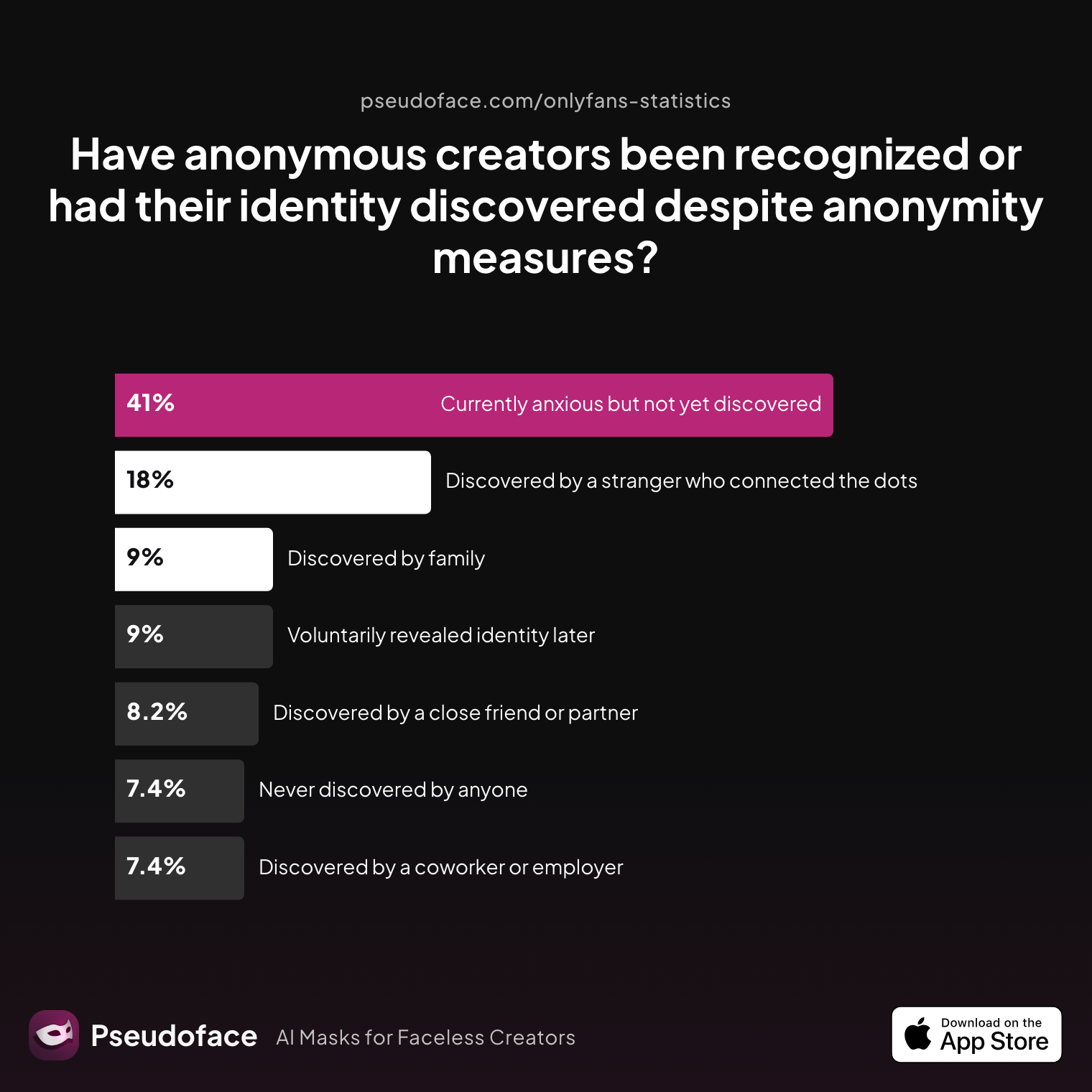
| Answer | Percentage |
|---|---|
| Currently anxious but not discovered | 40.98% |
| Discovered by a close friend or partner | 8.20% |
| Discovered by a coworker or employer | 7.38% |
| Discovered by a stranger who connected the dots | 18.03% |
| Discovered by family | 9.02% |
| Never discovered by anyone | 7.38% |
| Voluntarily revealed identity later | 9.02% |
The stark reality: As of late 2025, only about 7.4% of truly anonymous creators say they have “never” been discovered by anyone, though “discovered by a coworker or employer” remains low at the same 7.4% threshold. Much of the remaining anxiety (40.9%) is a product of uncertainty: creators who remain undetected, but worry constantly about a slip.
Let’s dissect how compartmentalization actually breaks down with real-world data:
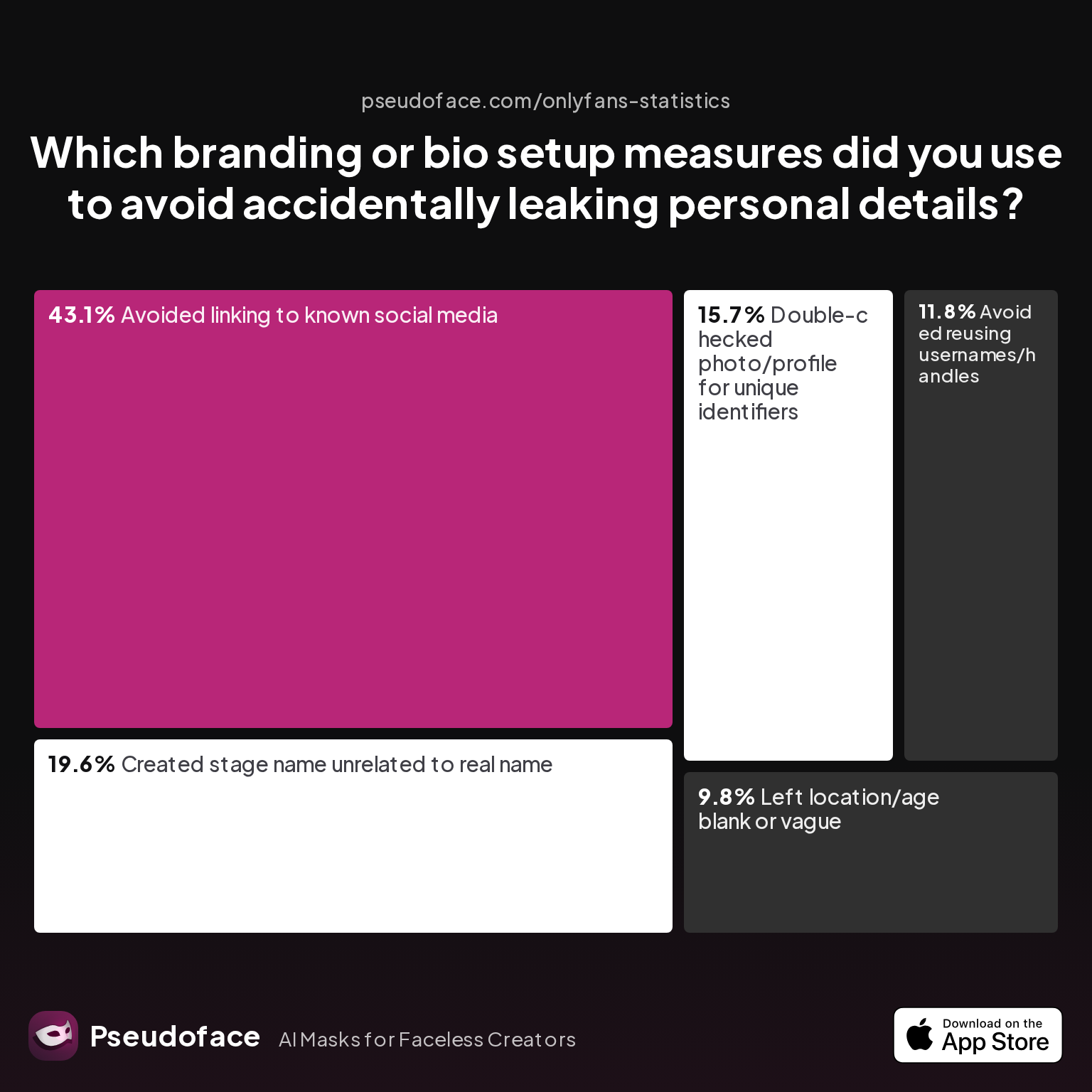
| Answer | Percentage |
|---|---|
| Avoided linking to known social media | 43.14% |
| Avoided reusing usernames/handles | 11.76% |
| Created stage name unrelated to real name | 19.61% |
| Double-checked photo/profile for identifiers | 15.69% |
| Left location/age blank or vague | 9.80% |
Nearly half of creators (43%) cite avoiding social media cross-links as their top compartmentalization tactic, while only 12% actively avoid username or handle reuse. The greatest risk isn’t government tracking—it’s an interrupted wall between persona and real self.
Survivorship bias may overstate “never discovered” rates: those who are outed (especially egregiously) often leave the community or stop posting, so their stories become less visible in these datasets. Furthermore, reporting bias means that tiny, obscure creators (with no threat of discovery) are less likely to be anxious or vocal online.
Anecdotal community wisdom reflects the pragmatic challenge:
Open thread on Redditr/CreatorsAdvice
u/delilahsfantasyden
Keep your real identity anonymous online and you can even block the state you’re living in to stay even more anonymous, but even that’s not 100% guaranteed.
And the real outliers—such as leaks via jilted acquaintances, facial recognition, or accidental metadata traces—are effectively “unknown unknowns” until after the fact.
In summary: Most discovery events still stem from avoidable operational errors: linking social accounts, repeating usernames, or neglecting photo metadata. Complete safety is an asymptote—rigorous compartmentalization can drive your discovery risk to near zero, but perfection is both rare and time-consuming.
With those hard boundaries mapped out, the next logical step is to compare how the faceless discipline pays off vs. creators who treat anonymity as optional.
Career Impact Comparison: Faceless vs. Non-Faceless OnlyFans Creators
The sharpest line between a robust, undisrupted professional path and unpredictable career risk is drawn by your approach to anonymity. Faceless creators—those who never show their face, maintain strict operational walls, and segment financials—report drastically different outcomes than their “open” or soft-anonymous peers.
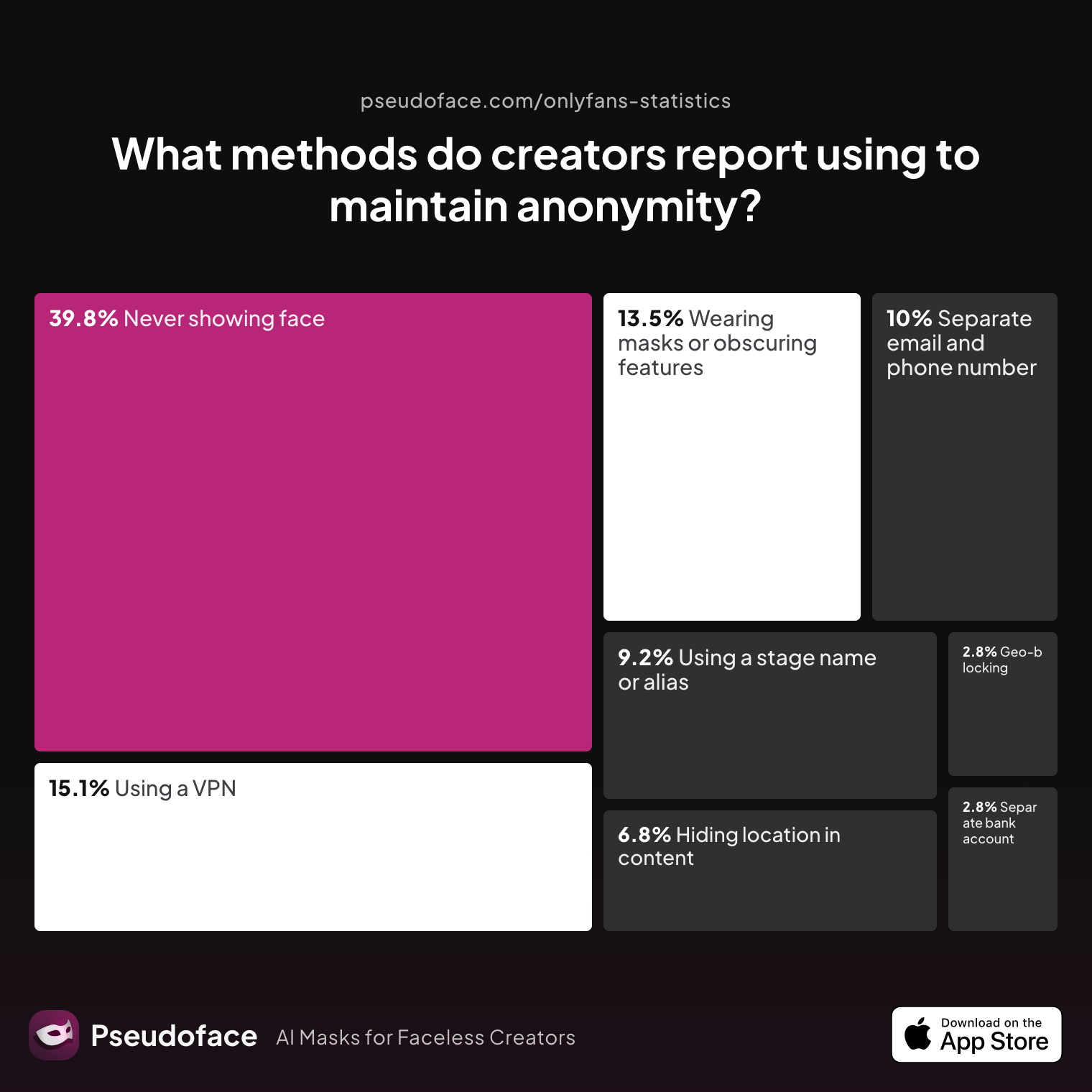
| Answer | Percentage |
|---|---|
| Never showing face | 39.84% |
| Wearing masks/obscuring identifying features | 13.55% |
| Using a stage name or alias | 9.16% |
| Using a separate email and phone number | 9.96% |
| Using a VPN or privacy tools | 15.14% |
| Avoiding location-specific details in content | 6.77% |
| Geo-blocking specific regions | 2.79% |
| Using a separate bank account/business entity | 2.79% |
A combined 53.4% of creators rely on either strict face-hiding (masks, never shows face) as pillars of their identity separation. Use of stage names, separate communications channels, and privacy tools fill most of the rest. The more of these measures implemented, the lower reported risk of career blowback.
Key differences play out in real-world outcomes:
- Faceless creators overwhelmingly report that employers, recruiters, and clearance officers were never aware of their OnlyFans.
- Non-faceless creators (or those who slip up with brand/persona links) are the majority represented in the small pool of lost job opportunities and warnings.
- Specialized privacy actions (e.g., VPN, device separation, geo-blocking) are underutilized beyond the ultra-cautious, but each additional step reduces aggregate risk.
One illustrative Reddit thread encapsulates the discipline required for long-haul career safety:
Open thread on Redditr/onlyfansadvice
u/notmyOFaccount
I’m a former recruiter (& we worked with children so searches were intense), & we performed social media searches on all our people before they signed contracts. We used a company called social intelligence & we provided: email, phone, legal name, & zip code. As long as none of those are associated with OF, it won’t come up!
Operationally, facilitators like separate banking and payment processing, and completely distinct digital presence, dramatically cut risk of cross-exposure—though these steps are more arduous.
In sum, faceless creators wield the only serious control over their long-term professional viability. Mistakes accumulate risk, but steady, complete compartmentalization—especially avoiding face-showing, metadata, and account reuse—overwhelmingly tilts job and clearance odds in your favor.
Staying Invisible: Privacy Steps and Financial Separation for Faceless Creators
So what does airtight operational security look like for a faceless OnlyFans creator in 2026? The data shows that while privacy stacks vary in sophistication, a handful of must-dos stand out.
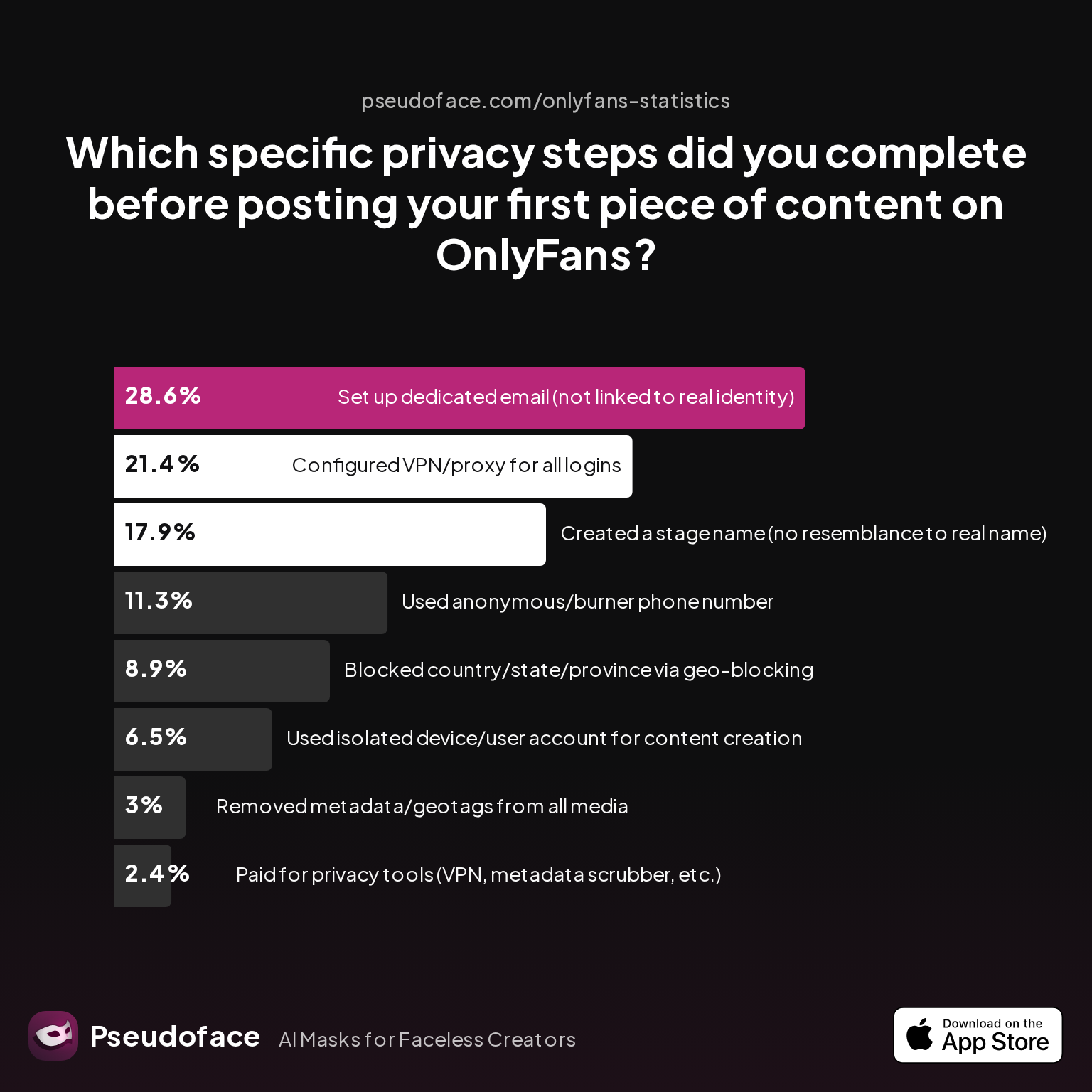
| Answer | Percentage |
|---|---|
| Set up dedicated email (not linked to real identity) | 28.57% |
| Configured VPN/proxy for all logins | 21.43% |
| Created a stage name (no resemblance to real name) | 17.86% |
| Used anonymous/burner phone number | 11.31% |
| Isolated device/account for content creation | 6.55% |
| Blocked country/state via geo-blocking | 8.93% |
| Removed metadata/geotags from all media | 2.98% |
| Paid for privacy tools (VPN, metadata scrubber, etc.) | 2.38% |
The most widely implemented steps among faceless creators are:
- Dedicated, isolated email: 28.6% complete this before launching, making it the most foundational element for disconnection.
- VPNs/proxies for all logins: Used by 21.4% of creators, these help block both IP-level and casual tracking back to real locations/identities.
- Distinct stage names: Used by 17.9%—with zero connection to birth names.
- Burner numbers and device isolation: Both of these remain relatively rare but are gaining in perceived necessity, especially among creators in STEM or regulated fields.
On the matter of financial distance: OnlyFans requires payouts to a name-verified bank account, but you do not need to use your main checking account or joint finances. You can—and, for privacy, should—open a new bank account slated exclusively for creator funds, registered to your legal name but never cross-utilized for other purposes. This process leaves a record for tax purposes but separates exposure in day-to-day professional contexts.
How do creators themselves weigh these privacy tasks? In a secondary analysis, 29% consider VPN/proxy use “non-negotiable,” and 20% say unique, dedicated email is mandatory prior to launching—a reflection that technical compartmentalization is now creator best practice in privacy-conscious fields.
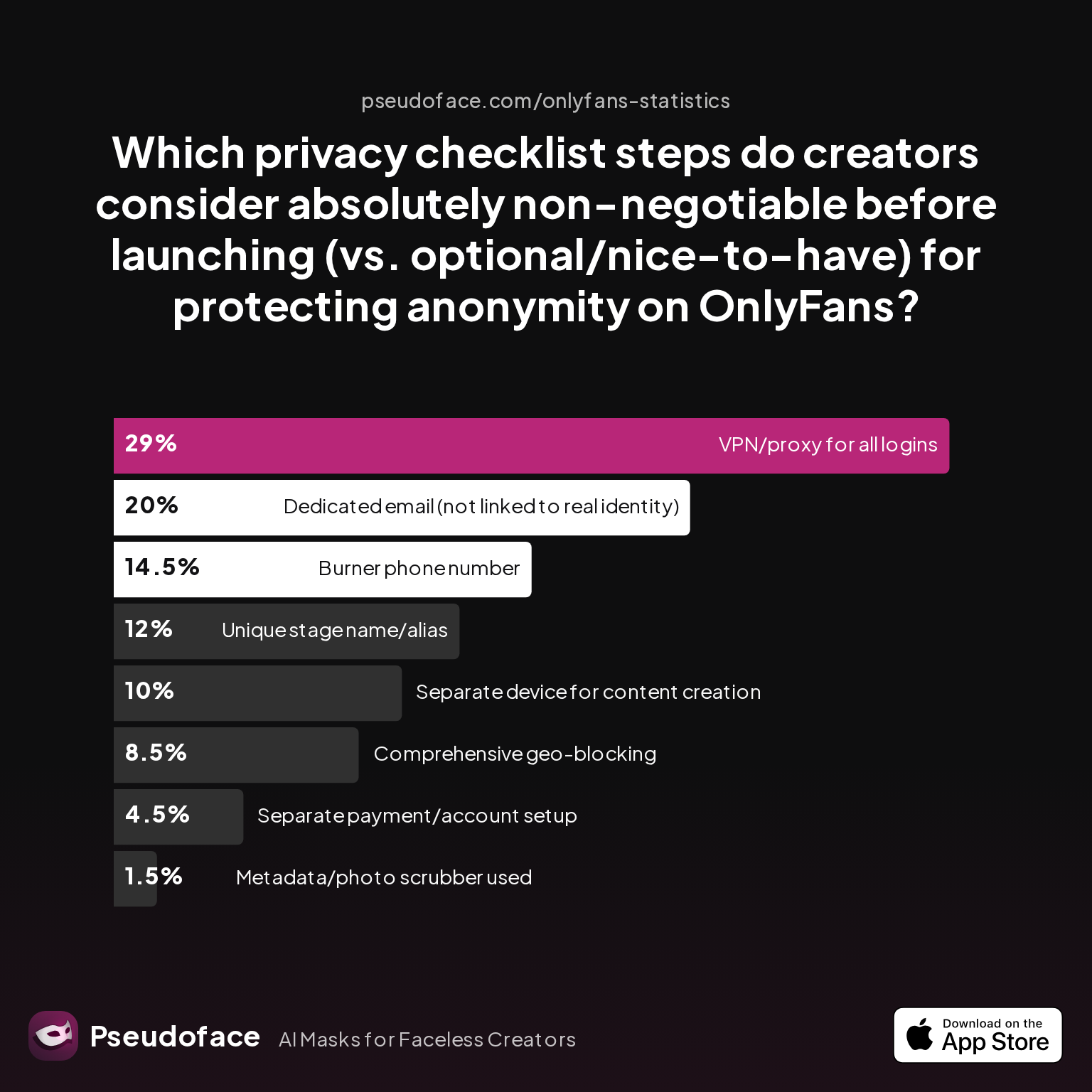
| Answer | Percentage |
|---|---|
| VPN/proxy for all logins | 29.00% |
| Dedicated email (not linked to real) | 20.00% |
| Unique stage name/alias | 12.00% |
| Burner phone number | 14.50% |
| Separate device for content creation | 10.00% |
| Comprehensive geo-blocking | 8.50% |
| Metadata/photo scrubber used | 1.50% |
| Separate payment/account setup | 4.50% |
Tools are great, but so is operational discipline. Many mishaps arise from creators becoming lax after months or years of incident-free side work. Compartmentalization requires not just tools, but vigilance as you promote, chat with fans, and manage accounts.
One practical community insight stands out:
Open thread on Redditr/CreatorsAdvice
u/One_Mud1607
No they can't
This confidence, however, is always subject to the “one slip” rule: all it takes is a single compromised link, social mention, or email accident for years of anonymity to evaporate. The best creators know privacy is never truly “set and forget.”
Next, let’s examine what you should do if pressed about outside work in an interview or background process—and why honesty, carefully deployed, is often your safest strategy.
What If You’re Asked? Navigating Disclosure and Risk Conversations
If an employer or security clearance reviewer asks directly about outside income or side hustles, the safest response is to truthfully answer about legal, reportable work—without volunteering unnecessary details, and never lying.
Most faceless creators in sensitive fields report never being directly questioned. If you’re running an airtight privacy stack, a query about your digital history is highly unlikely to link to your creator persona unless you self-sabotage or a major data leak occurs. Still, official forms or interviews may ask about outside employment, self-employment, or non-W2 income sources.
Open thread on Redditr/onlyfansadvice
u/thrHOEaway666
It’s possible depending on the role 🤷♀️ Most jobs no (because most background checks only look at employment history and criminal records) but if it’s something with security clearance or the type of background check where they look at tax returns, then yes they could find out.
The prevailing community consensus is: Do not volunteer details about anonymous content creation if not specifically asked. Misrepresenting your work history, however, is grounds for termination or clearance denial in most regulated sectors, especially if the omitted income is substantial or unreported for tax purposes.
If you are asked about:
- Outside work: OnlyFans creator income may need to be declared, especially if your employer/agency requires disclosure of any side income, contract work, or self-employment.
- Social media history: Focus on your public, legal persona. If your creator account is truly isolated, no link should emerge.
- Criminal or conduct history: Anonymous OnlyFans creation, if legally compliant, does not constitute a crime or workplace violation unless contrary to explicit company policy.
If you cannot clearly and truthfully separate your creator income in financial or digital records, consider seeking legal or labor counsel prior to declaring outside work or navigating clearance documentation. The risks of being caught in a lie or omission nearly always outweigh the risks of honest, minimal disclosure—especially when faceless, off-duty work is neither illegal nor against most employer policies.
Experienced community members summarize the guidance:
Open thread on Redditr/onlyfansadvice
u/Panda-Pajamas69
They shouldn't be able to.
In the rare event you’re discovered—by accident, tipoff, or slip-up—handle it calmly and honestly. Immediate over-explanation or defensive responses trigger far greater concern. Where stakes are high (security clearance, state licensing, government work), documented legal advice is well worth the investment.
FAQs: OnlyFans, Security Clearance, and Career Risks
Q: Does OnlyFans show up on a background check if I’m a faceless creator?
A: For nearly all faceless creators, OnlyFans does not show up on standard background checks unless you self-link accounts or make privacy mistakes.
Background checks focus on criminal, employment, and sometimes credit history—not hidden creator accounts. Edge cases exist in high-clearance or deeply investigative roles, mostly via income records, not platform discovery.
Q: Can OnlyFans affect my security clearance or government job prospects?
A: Anonymous OnlyFans activity, when compartmentalized and income is legally reported, almost never triggers clearance denials.
Major risks are unreported earnings or blackmail vulnerability—not the content itself. Only 2% of STEM/sensitive-field creators report scrutiny, per Pseudoface’s 2025-2026 analysis.
Q: How do employers potentially discover my OnlyFans if I never show my face?
A: Discovery happens through digital cross-links (emails, reused usernames, accidental social media overlap), social leaks, or metadata—not through direct background checks.
Manual web/social searching rarely uncovers isolated, truly compartmentalized creator personas.
Q: What privacy steps are non-negotiable before I start OnlyFans as an anonymous creator?
A: At minimum, set up a unique email, use a distinct stage name, and always log in via VPN/private network.
Pseudoface’s 2026 data show that VPN/proxy, dedicated email, and alias usage are considered “non-negotiable” by the majority of faceless creators.
Q: Are there legal risks if I don’t report OnlyFans income but keep my creator profile anonymous?
A: Yes—failing to report income can create legal and clearance risk, even for faceless creators.
Anonymity protects your outward identity, but does not shield you from tax obligations, and unreported income discovered later can lead to penalties or job loss in regulated fields.
Q: Is there a higher risk if I’m going into engineering, defense, or a sensitive field?
A: There is a marginally higher risk due to stricter verification and, occasionally, deeper background processes in sensitive fields, but compartmentalized creators remain rarely affected.
Pseudoface’s 2026 data show only a small fraction of STEM creators report negative impact on hiring or advancement when strict operational security is maintained.
Q: What if a background check vendor or employer asks directly about outside work or OnlyFans?
A: Answer truthfully about legal, reportable work and never lie—avoid volunteering unnecessary detail, and seek legal advice if you’re unsure about disclosure.
Q: How common is it for faceless OnlyFans creators to be outed by accident?
A: About 7% report direct discovery by coworkers/employers, but operational mistakes, not background checks, are the main cause.
A majority of creators remain constantly anxious but undetected, underscoring the importance of flawless compartmentalization.
Q: How do I keep OnlyFans payments, emails, and bank records off my employment trail?
A: Use a dedicated bank account and email for OnlyFans, never reuse these with your primary job, and don’t connect payout information to any shared or work-related financial tools.
Q: Can my license or professional registration be revoked for faceless OnlyFans activity?
A: In nearly all regulated professions, there is no precedent for license loss from strictly anonymous adult content creation that does not breach ethics guidelines or criminal law.
In Closing
The fear of OnlyFans as a career time-bomb for anonymous creators, especially in STEM and regulated fields, is mostly a product of outdated narratives and cautionary tales aimed at face-out creators or those who disregard compartmentalization. For the faceless, operationally disciplined creator in 2026, the risk of discovery—and professional harm—remains minimal. Still, the margin for error is slim, and the cost of a privacy slip can be life-changing. Treat operational security as an always-on protocol, and your OnlyFans past will remain your business, not your employer’s.


