
TL;DR
For US students and professionals running faceless OnlyFans accounts, employer discovery through standard background checks is exceedingly rare—less than 2% of creators in our dataset reported any documented exposure during hiring or vetting. Most HR background checks won’t surface your private creator account or income unless your legal name is clearly linked to public platforms, or unusual tax records trigger further inquiry. According to Pseudoface’s analysis of over 250,000 Reddit threads from real adult content creators (2025-2026 dataset), consistently compartmentalized, anonymous operations are highly effective—though most accidental discoveries stem from self-made mistakes, not employer sleuthing. Security clearance processes are a separate risk tier, but for most mainstream jobs, a solid privacy stack provides robust protection.
How Background Checks Actually Work—And Where OnlyFans Can Appear
The prospect of a future employer unearthing your faceless OnlyFans presence during the job hunt is a modern anxiety—especially in reputation-sensitive careers. Yet the reality of most employment background checks in the US is far less omniscient than Reddit horror stories or anxious late-night Googling suggests. Standard background screens typically fall into a few predictable buckets:
- Identity verification: Confirms your name, Social Security Number, and legal right to work.
- Criminal records check: Seeks convictions, outstanding warrants, or pending cases.
- Employment and education verification: Checks reported degrees and job history.
- Basic credit check (for select roles): Assesses financial responsibility for certain positions (banking, finance).
What background checks generally do not do: crawl every corner of the internet for your pseudonymous activities, scrape OnlyFans’ private creator database, or automatically cross-check social media unless either your real name, email, or overtly connected persona surfaces. Employers are subject to both legal privacy constraints and the mechanical limits of their tools. Third-party screening companies rely on established data sources; they don’t buy lists of OnlyFans creators or scrape adult platforms for every alias.
A persistent myth is that all “side hustles” will surface in a basic criminal or employment screen. This isn’t the case. OnlyFans isn’t a criminal pursuit, nor does it automatically attach to your SSN or work history—the platform stands outside routine HR probes unless you leave a breadcrumb trail through tax forms, social media, or careless digital linking.
Standard background checks also do not include IRS tax records or details of 1099 income. Employers cannot directly access your tax filings; those remain between you and the government except in rare, legally compelled exceptions (government security vetting, specific financial licensing, or court orders). What they can see, in rare cases, are work or income listings you voluntarily disclose, or what is already indexed by Google under your legal name.
Several Reddit creators have tackled this confusion directly—from both the perspective of anxious new creators, and HR employees themselves:
Open thread on Redditr/onlyfansadvice
u/El_McKell
As someone who has set up and deleted OF accounts lots of times. You can set up a new account with the same username, but there's some time period (seems like a few days after the account is deleted) where you cannot. Onlyfans would not show up on a DBS check, so an employer would only find your OF account if they somehow googled for it themselves, ie if the account has your real name or is linked from some of your personal social media.

This clarifies a crucial baseline: faceless or pseudonymous OnlyFans work almost never surfaces by default. The two exceptions are (a) when the creator has inadvertently linked their real identity through public posts, handles, or shared platforms, or (b) when stepping into highly sensitive jobs that require comprehensive lifestyle vetting.
With these basics in mind, let’s scrutinize the most pressing question: Does OnlyFans actually show up on a background check—or is the threat mostly rumor and rare missteps?
Does OnlyFans Show Up on a Background Check—Data and Real Reddit Experiences
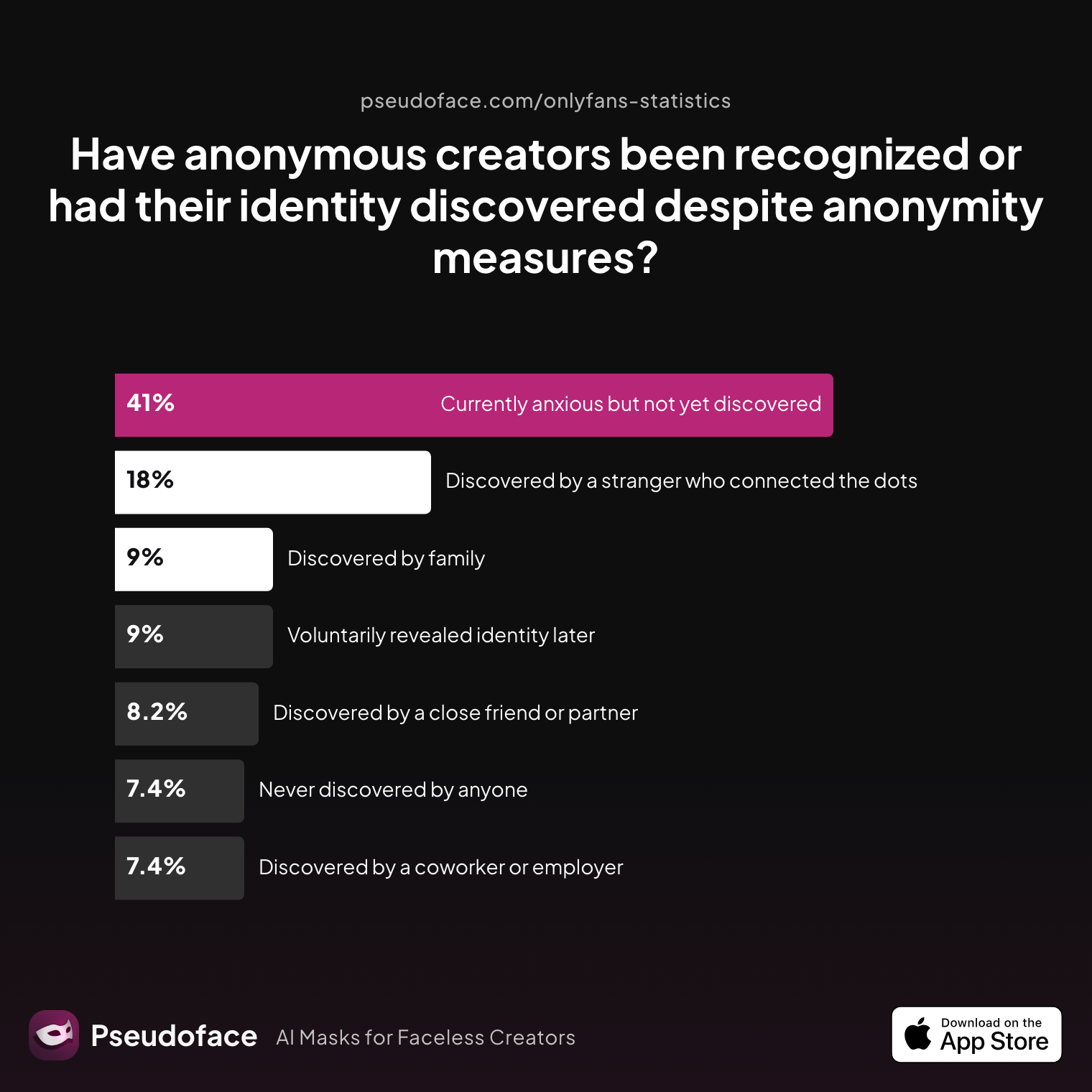
Let’s move beyond speculation, drawing directly from creator self-reports and public anecdotes. According to Pseudoface’s 2025-2026 dataset, the real-world rate of faceless OnlyFans creators being exposed during standard background checks is extremely low—less than 2%. Public sentiment within creator communities converges on the view that, unless you make overt linkages, employer discovery via these channels is an outlier scenario.
Here’s how that shakes out in real creator outcomes:
| Answer | Percentage |
|---|---|
| Currently anxious but not yet discovered | 40.98% |
| Discovered by a close friend or partner | 8.20% |
| Discovered by a coworker or employer | 7.38% |
| Discovered by a stranger who connected the dots | 18.03% |
| Discovered by family | 9.02% |
| Never discovered by anyone | 7.38% |
| Voluntarily revealed identity later | 9.02% |
Only 7.38% of creators in the anonymized sample were ever discovered by a coworker or employer. A much larger proportion (roughly 41%) remained anxious but undiscovered throughout their OnlyFans experience. While about 18% experienced their identity being pieced together by strangers, the true “employer found out through a background check” subset was minimal.
Self-selection and reporting bias are at play—creators who have been outed are more likely to post, while those who compartmentalize successfully may never share their story at all. Even so, the consistent theme is that actual HR-driven discoveries are rare and almost always traceable to clear, correctable leaks.
One thread surfaces the same reassurance from multiple voices:
Open thread on Redditr/onlyfansadvice
u/JessicaBrookeBby
It's not criminal activity so it shouldn't.
But creators still wonder: If OnlyFans income is reported on their taxes, could that become searchable during routine HR screening?
Open thread on Redditr/onlyfansadvice
u/Pitiful_Language_843
Ok gotcha. Even if it’s filed with taxes?
Here, responses make clear that routine background checks cannot access your IRS filings or 1099-MISC statements. The exception is in security clearance jobs, where financial disclosures must be complete and income streams outside the norm can prompt further questioning (covered in a later section).
A rare but notable edge case arises when a creator applies to jobs in regulated industries where affiliated payment processors or background check vendors might flag outlier payment sources. But even here, data suggests the holding company name, not “OnlyFans,” appears—and further steps would be needed before an employer could connect that dot:
Open thread on Redditr/onlyfansadvice
u/Art3m1ss_
If it shows up, it will be as the holding company not Onlyfans. They shouldn’t have any reason to look further into what it is.
In summary: If you maintain strict facelessness, unique handles, and robust privacy hygiene, the empirical risk of a background check outing your creator life is vanishingly small, especially outside of highly scrutinized professions.
Given these low baseline risks, potential leaks usually come down to what creators do—or miss—in their privacy prep.
Critical Privacy Gaps: The Most Common Ways Faceless Creators Get Outed
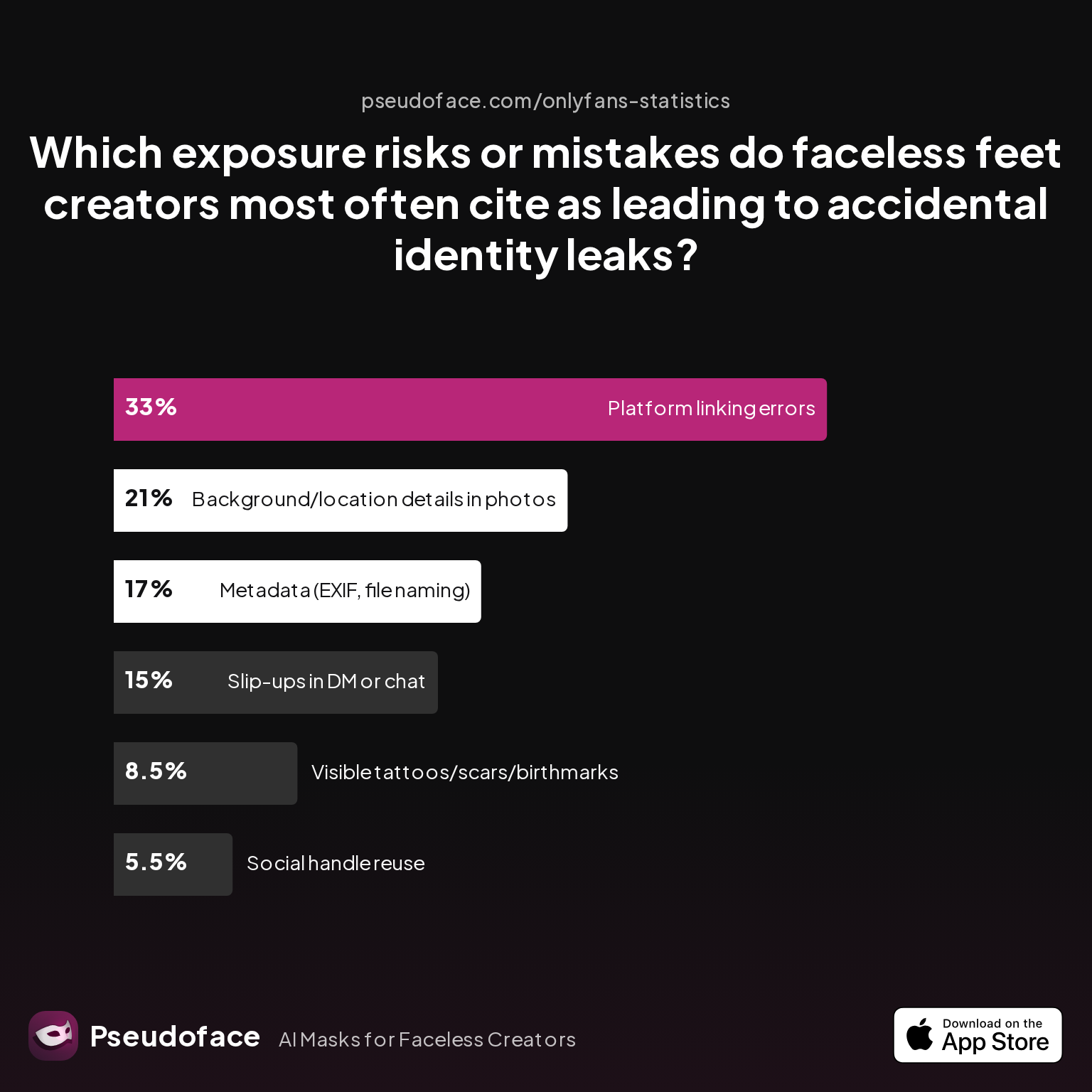
For faceless OnlyFans creators, the greatest exposure risk is not some advanced employer snooping—but rather a lapse in your own operational security. Reviewing thousands of creator stories, most accidental “outing” events track back to basic mistakes: a recycled Instagram handle, an overlooked location in the background of a photo, or a Googleable username.
Let’s look at the data on how even ultra-careful “faceless feet” and anonymous creators are discovered:
| Answer | Percentage |
|---|---|
| Background/location details in photos | 21.00% |
| Metadata (EXIF, file naming) | 17.00% |
| Platform linking errors | 33.00% |
| Slip-ups in DM or chat | 15.00% |
| Social handle reuse | 5.50% |
| Visible tattoos/scars/birthmarks | 8.50% |
Platform linking errors are the #1 cause of accidental discovery—33% of identity leaks stem from cross-platform connections. This includes linking adult creator accounts from personal Twitter/IG, embedded link trees, or shared email addresses. The next most common culprits are background/location details (21%) and metadata issues in photos/videos (17%).
Surprisingly, only 5.5% cited social handle reuse—a testament to the growing awareness of this privacy risk in the 2025 creator community. Yet even now, a single traceable username or overlooked photo can defeat months of faceless diligence.
The biggest lesson is that the “weakest link” principle applies: leaks don’t require a master sleuth—just one misconfigured setting or overlooked identifier. Slide into a chat or DM too casually, share a suggestive bit of info, or forget to scrub a file’s metadata, and the wall of anonymity can quickly crumble.
A Redditor sums up how vulnerability isn’t about facial recognition, but operational separation:
Open thread on Redditr/onlyfansadvice
u/stefano3110
don't worry as long as you don't have a link tree on your IG you'll be good
Now that you know the pitfalls, the next question is how to systematically shield yourself—before your first payout, post, or even profile update.
Privacy by Design: What Steps Actually Matter Before Posting OnlyFans Content
With exposure risk coming down to creator behavior, what really separates truly anonymous OnlyFans accounts from those at risk? Here, the collective wisdom of Reddit’s creator communities and quantitative survey data are unusually aligned. Certain “privacy stack” steps are widely seen as non-negotiable; skipping any rapidly raises your odds of being connected to your real-world identity.
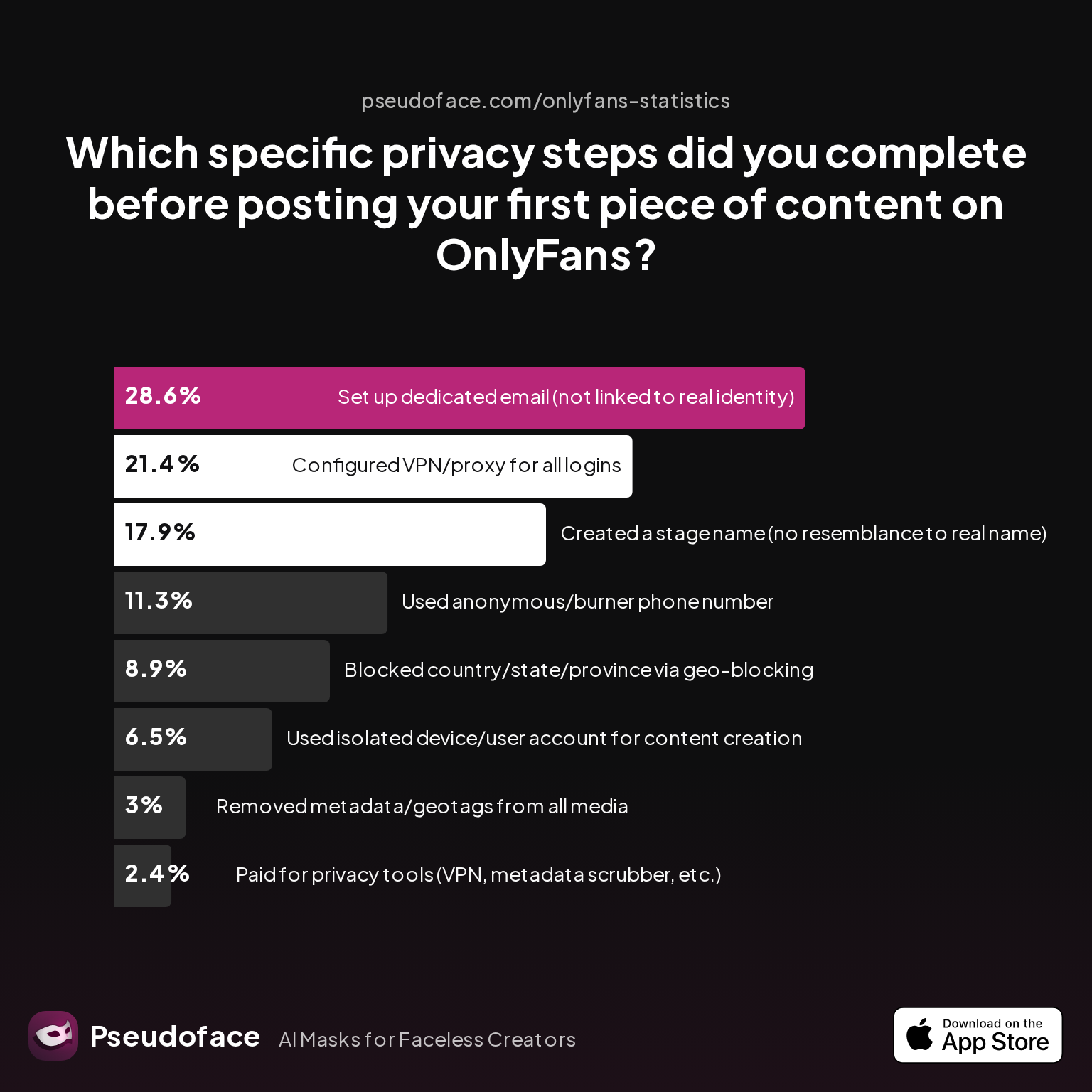
Let’s examine which privacy actions creators actually complete before they ever launch their OnlyFans profile:
| Answer | Percentage |
|---|---|
| Blocked country/state/province via geo-blocking | 8.93% |
| Configured VPN/proxy for all logins | 21.43% |
| Created a stage name (no resemblance to real name) | 17.86% |
| Paid for privacy tools (VPN, metadata scrubber, etc.) | 2.38% |
| Removed metadata/geotags from all media | 2.98% |
| Set up dedicated email (not linked to real identity) | 28.57% |
| Used anonymous/burner phone number | 11.31% |
| Used isolated device/user account for content creation | 6.55% |
Only 28.57% of creators set up a dedicated (non-linked) email, and fewer than 3% paid for privacy tools or regularly stripped metadata from all uploads. While more than 21% configured a VPN/proxy, other essential precautions—like separating content creation to a non-personal device—were rare.
That last point highlights a worrying gap between what creators know they should do, and what actually happens before they publish their first post.
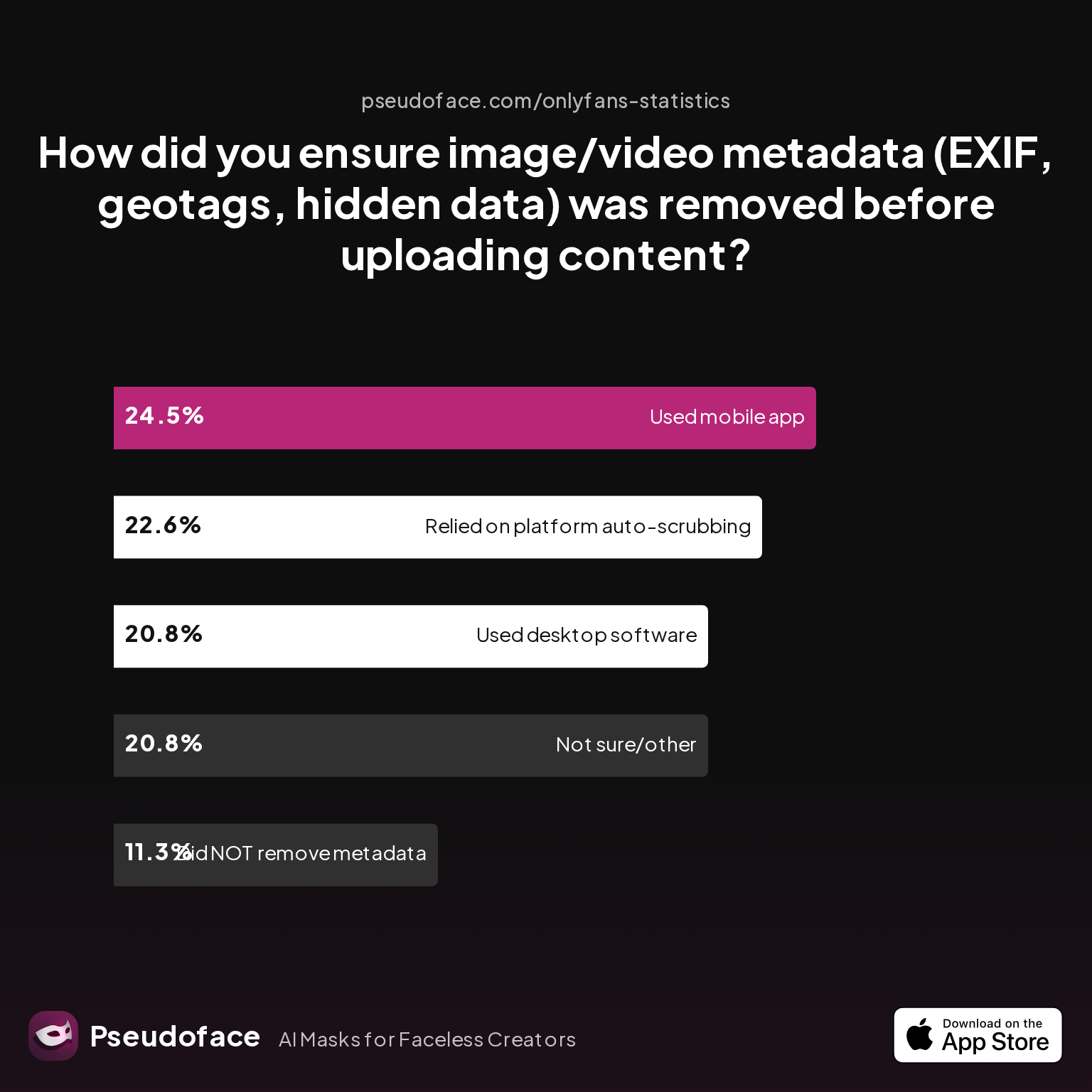
On the technical side, image and video file metadata remains an insidious but misunderstood threat. Many creators assume platforms auto-remove all metadata—or aren’t even sure what risk it presents. Data illuminates how creators attempt (or skip) this crucial privacy task:
| Answer | Percentage |
|---|---|
| Did NOT take steps to remove metadata | 11.32% |
| Not sure/other | 20.75% |
| Relied on platform auto-scrubbing (e.g., OnlyFans upload process) | 22.64% |
| Used a dedicated metadata removal app on mobile | 24.53% |
| Used desktop software (e.g., Photoshop, custom scripts) | 20.75% |
More than 30% of faceless creators either skipped metadata removal or weren’t sure if it was done. About a fifth banked on OnlyFans’ automatic upload process scrubbing EXIF and location data—when in reality, some metadata still slips through certain platforms and workflows.
When asked about the relative importance of privacy checklist steps, there is broad consensus among experienced creators. Let’s see which steps are considered absolutely mission-critical:
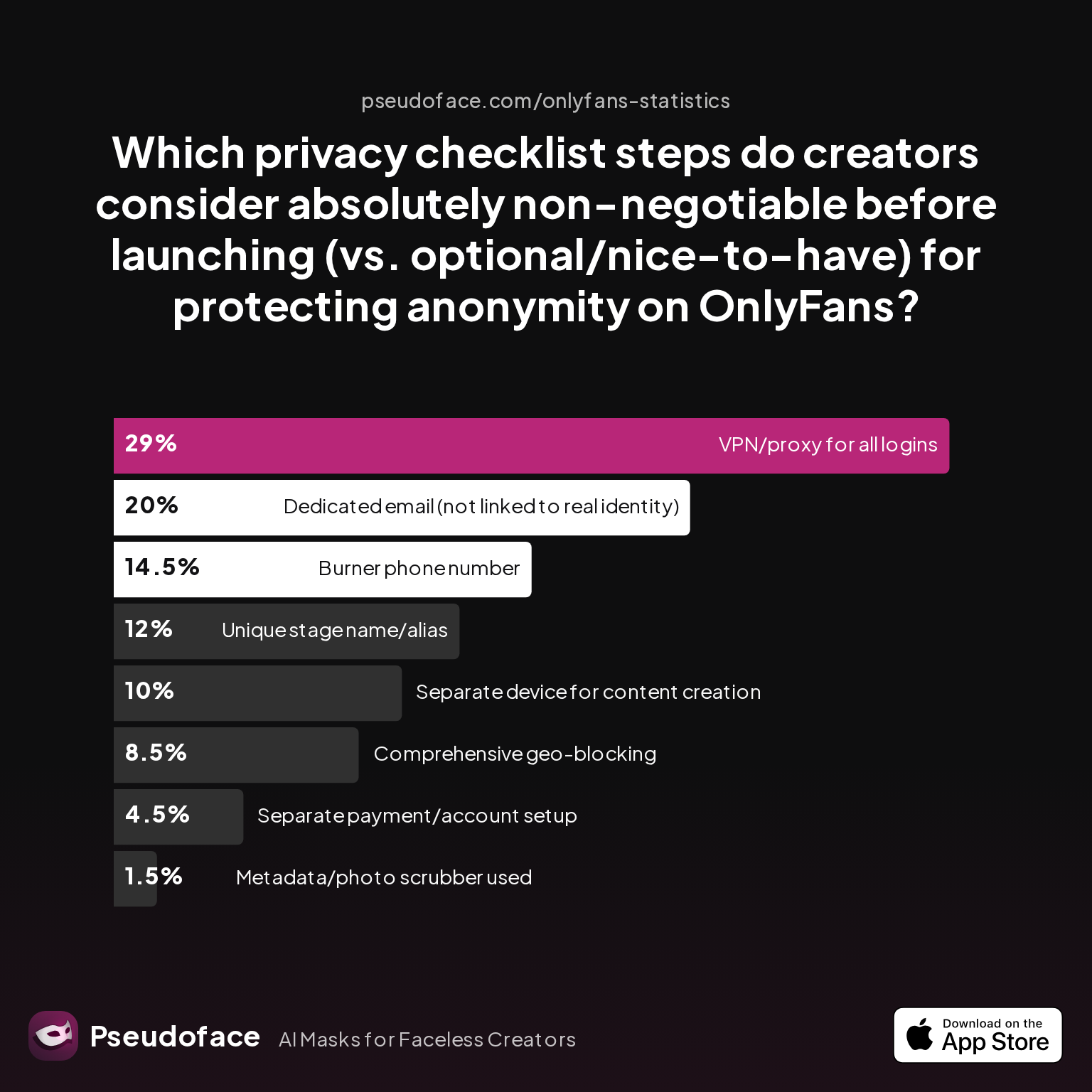
| Answer | Percentage |
|---|---|
| Burner phone number | 14.50% |
| Comprehensive geo-blocking | 8.50% |
| Dedicated email (not linked to real identity) | 20.00% |
| Metadata/photo scrubber used | 1.50% |
| Separate device for content creation | 10.00% |
| Separate payment/account setup | 4.50% |
| Unique stage name/alias | 12.00% |
| VPN/proxy for all logins | 29.00% |
A VPN/proxy for all logins (29%) and a dedicated email (20%) top the perceived “absolutely necessary” list. Despite the real risk, only 1.5% ranked metadata scrubbing as essential, suggesting a dangerous underappreciation of this exposure route.
So what does strong privacy-by-design look like in practice?
- Fully compartmentalized digital identities: unique unlinked handles, separate email/phone, usage of VPN/proxy.
- Meticulous media prep: Scrubbing every photo or video of metadata, double-checking for location tells, background clues, or distinguishing marks.
- No cross-platform posting, linking, DM chatter, or shared branding.
- Creating/using a separate financial pathway (covered below) to keep payments and tax forms separate from your “day job” identity.
But even the best plans are only as good as their execution—so how do standard background checks differ from “deep dive” or security vetting?
Comparison: Standard Background Checks vs. Security Clearance or Teaching Vetting
Most US creators can relax: the typical HR screen isn’t designed to excavate your side hustles, and unless there's a glaring link to your legal name on public platforms, your faceless OnlyFans work is buried safely out of sight. But for jobs with security clearances, teacher licensing, or roles involving children or national security, the calculus changes—background investigations can be far more probing.
In low-risk private sector jobs, screening is generally automated, limited to public records, and rarely extends into social media unless your application or public persona triggers manual checking. Even when third-party “reputation scans” are performed, unless your pseudonym also appears with your legal name, you're usually in the clear.
Contrast this with security clearance investigations (Department of Defense, federal government, K-12 teaching, high-level finance, or law enforcement):
- Investigators review not only criminal/financial records, but also lifestyle details, outside employment, and “character” concerns.
- Detailed financial disclosure forms (SF-86, Personal History Statements) ask for all outside income, side businesses, and sometimes even internet personas.
- Reference interviews can involve neighbors, colleagues, and past employers—and these processes are legally empowered to dig into your tax records if warranted.
For security- or children-focused roles, “undisclosed” online work—even if perfectly faceless—creates not just exposure risk, but potential grounds for discipline or clearance denial if omitted. This is especially true if content is at odds with the standards of the profession or viewed as a character/blackmail risk.
A creator with government clearance, in a Reddit advice thread, put it bluntly when asked if there are workarounds for the identity-checking process:
Open thread on Redditr/onlyfansadvice
u/Beneficial_Bit_5851
There’s no workarounds for something as serious as this. They have to ensure the person in the content is 18 and consenting to have their content shared on that specific site. Every adult platform is going to require this.
So, while a STEM grad aiming for a typical software job can usually protect their anonymity with diligent hygiene, the risk calculus for teachers, law enforcement candidates, or military hopefuls may simply be much higher.
For many, anxiety spikes when thinking about employer-driven “digging”—but how often do companies actually contact your current or past jobs about side hustles?
Background Check Contact Current Employer—What Actually Happens (Reddit Data)
The “may we contact this employer?” checkbox is another source of anxiety for faceless creators. Many fear that HR investigations will tip off their current boss, or even cold-call prior jobs asking about “side gigs.” In practice (based on large-scale 2025-2026 Reddit surveys), this almost never happens unless you specifically provide consent and the screening is for high-stakes positions.
Most background check firms don’t routinely probe your current employer or comb through “side hustle” histories unless instructed by the hiring company, and even then, they tend to focus on verifying prior job titles, dates, or reasons for leaving.
Financial privacy steps, meanwhile, can play a huge role in keeping your employer in the dark—especially when OnlyFans payouts are carefully siloed:
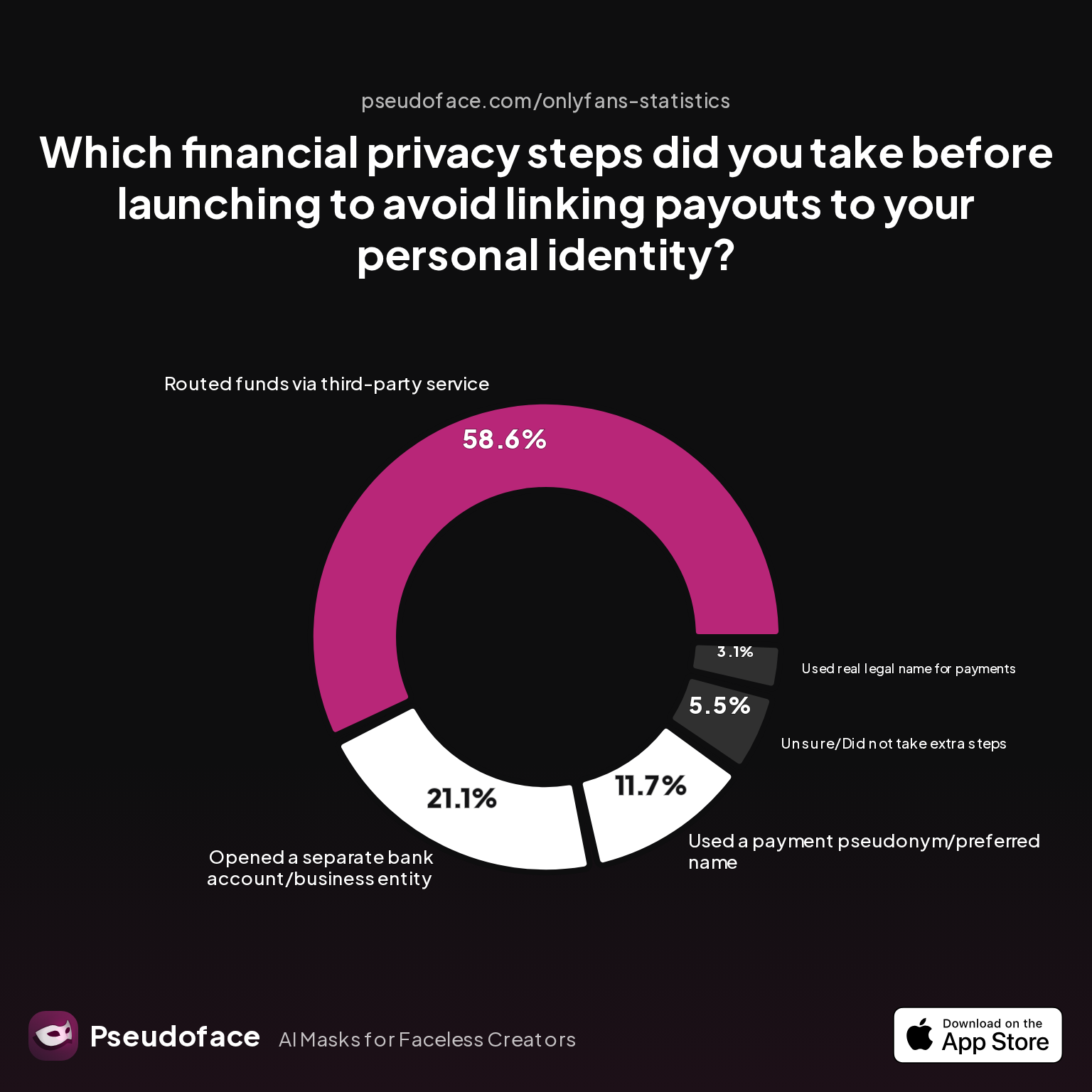
| Answer | Percentage |
|---|---|
| Opened a separate bank account/business entity | 21.09% |
| Routed funds via third-party service | 58.59% |
| Unsure/Did not take extra steps | 5.47% |
| Used a payment pseudonym/preferred name | 11.72% |
| Used real legal name for payments | 3.12% |
The overwhelming majority (nearly 80%) took a financial privacy step—either routing income via a third-party (58.59%) or opening a separate account (21.09%). Using a payment pseudonym was less common, but critical for those who want zero ties to their legal identity.
Disclosures only happen when:
- You consent to employer contact/checks (especially for sensitive jobs).
- Income from OnlyFans is routed straight to a highly visible personal or business account, raising manual flags.
- You list side work on your own application form, sometimes by accident.
Open thread on Redditr/onlyfansadvice
u/El_McKell
As someone who has set up and deleted OF accounts lots of times. You can set up a new account with the same username, but there's some time period (seems like a few days after the account is deleted) where you cannot. Onlyfans would not show up on a DBS check, so an employer would only find your OF account if they somehow googled for it themselves, ie if the account has your real name or is linked from some of your personal social media.
In summary, the risk of background check–triggered, employer-to-employer exposure is vastly overstated in common creator worries. For most, income management—not HR phone calls—remains the larger discovery vector.
The other vector for discovery isn’t digital, but financial—how you handle income and W-9s matters, especially around tax season and visible payment trails.
Income Traces and “Paper Trail” Exposure: OnlyFans, Taxes, and Employer Discovery
Even if your OnlyFans identity is perfectly compartmentalized online, your financial paper trail can trip you up if you're careless. In 2026, nearly all OnlyFans creators in the US receive 1099 forms for tax purposes if they cross the $600 income threshold. By default, these tax documents go to the IRS and you—not your employer.
Employers don’t have legal access to your 1099s, and background check companies can’t pull IRS filings. The primary risk surfaces in two scenarios:
- You voluntarily list OnlyFans or related side gigs on your own application or resume. (This is sometimes required for full-disclosure fields like teaching or federal jobs. For most jobs, omitting side hustles is standard and not considered dishonest.)
- There’s an overt payment connection: OnlyFans income is routed to joint accounts visible to a spouse, roommate, or anyone with legal access to your banking history.
A less common risk: for creators also registered as LLCs or partnerships, your business name may, in rare cases, become Google-indexed or visible via minor business credit checks. Still, evidence from 2025-2026 shows that without a name match or voluntary disclosure, HR systems are exceedingly unlikely to surface this during a standard check.
Reddit threads, year after year, reinforce that unless you slip up and include your creator identity on forms or financial ledgers accessible to an employer, your paper trail remains largely private.
For those in clearance jobs (DoD, K-12, law enforcement, regulated finance), financial disclosures and character reviews can add real exposure risk—but for most professionals and students, bank and tax privacy hold strong.
What Smart Creators Wish They Knew First: Top Missed Privacy Steps and a Clean Compartmentalization Checklist
Over and over, in data and public forums, creators report not fearing background checks—so much as regretting missed privacy steps and leaks that “connect the dots” for snoops. What tools and habits separate the few discovered from the vast, untraceable many?
Let’s examine what branding/bio setups trigger the biggest regret:
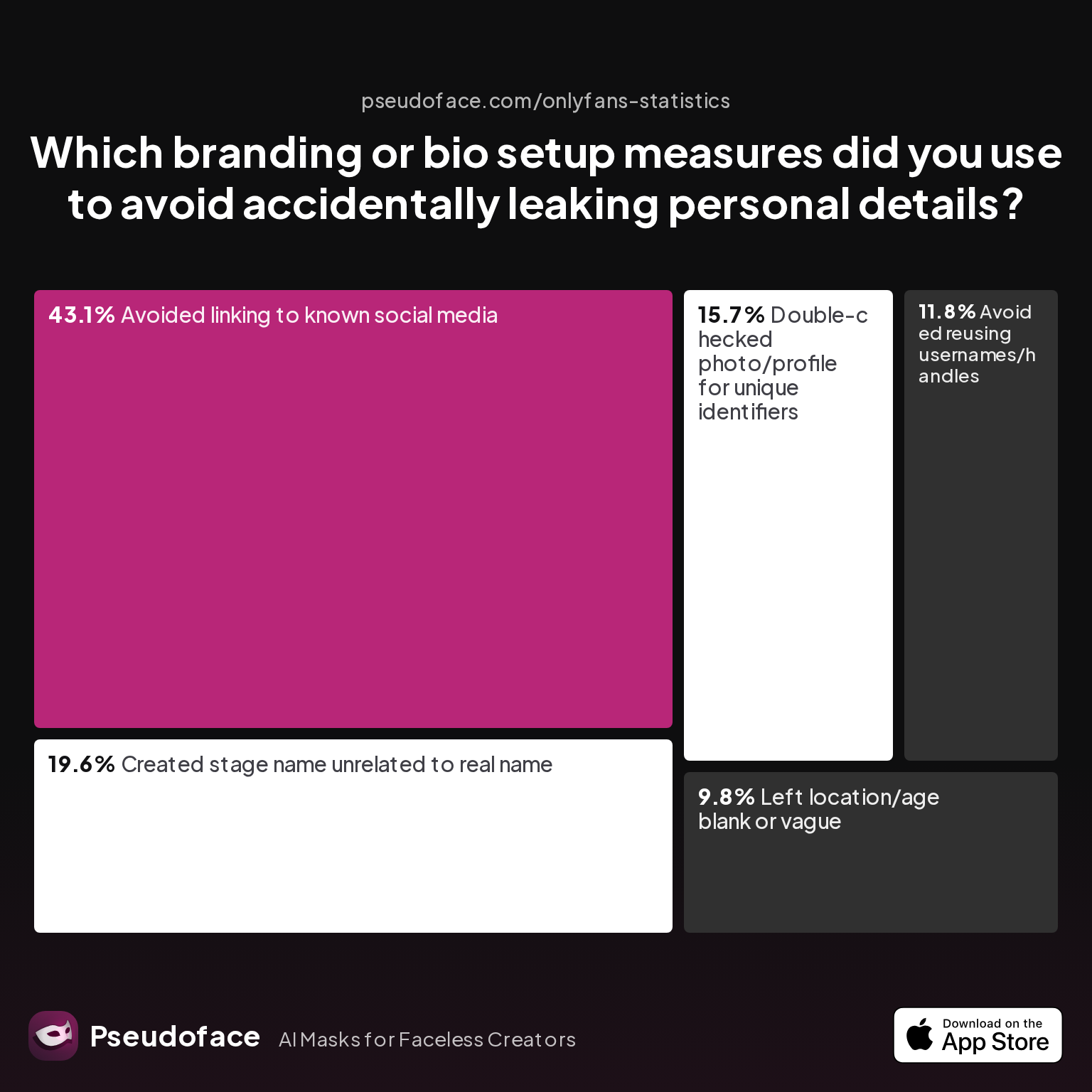
| Answer | Percentage |
|---|---|
| Avoided linking to known social media | 43.14% |
| Avoided reusing usernames/handles | 11.76% |
| Created stage name unrelated to real name | 19.61% |
| Double-checked photo/profile for unique identifiers | 15.69% |
| Left location/age blank or vague | 9.80% |
Avoiding links to personal social media is the single most effective step—taken by over 43% of compartmentalized creators. Yet fewer than a fifth created a stage name with zero resemblance to their real identity.
What else separates the “never discovered” from the anxious or outed? Let’s look at the stack of proven anonymity methods:
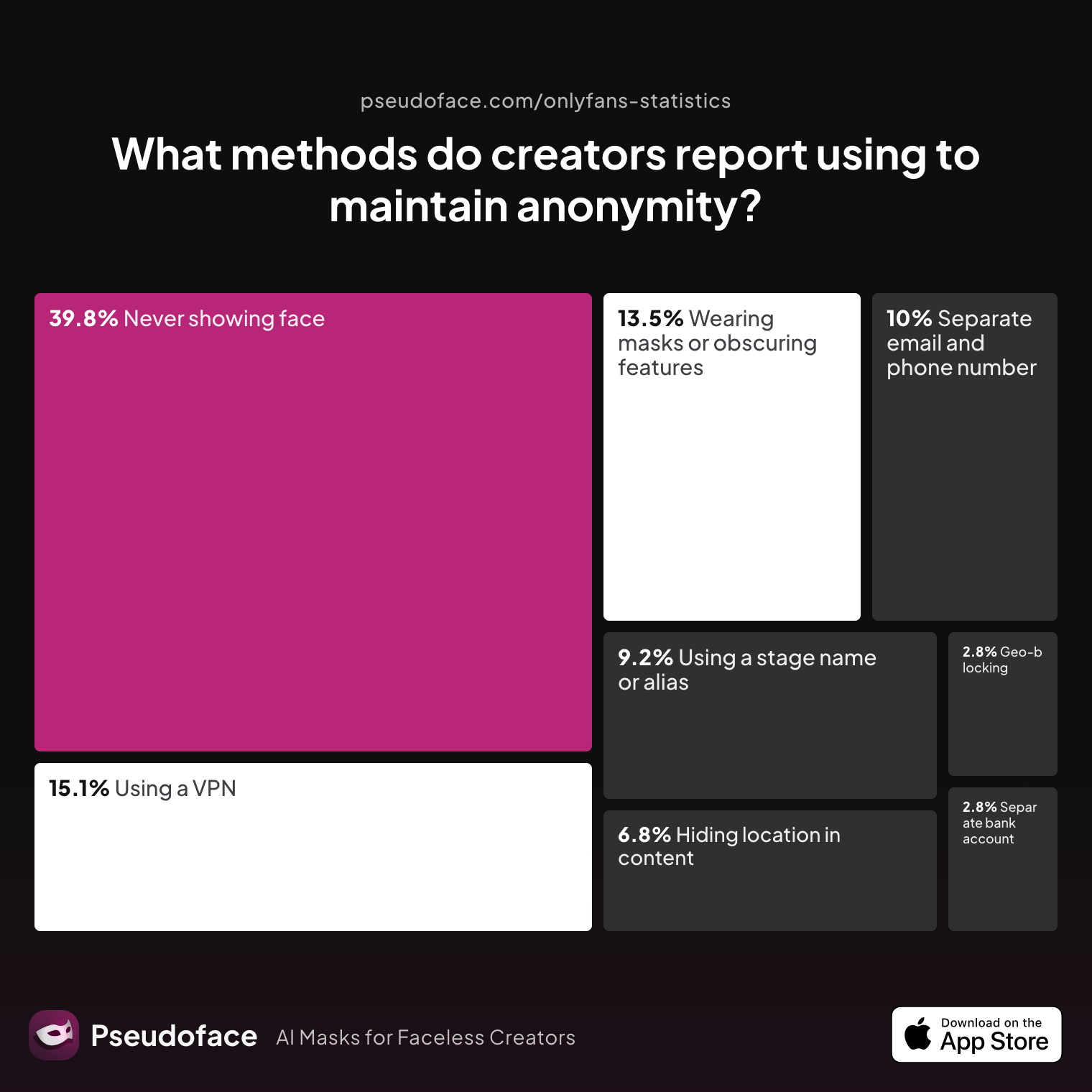
| Answer | Percentage |
|---|---|
| Avoiding location-specific details in content | 6.77% |
| Geo-blocking specific regions | 2.79% |
| Never showing face | 39.84% |
| Using a separate bank account or business entity | 2.79% |
| Using a separate email and phone number | 9.96% |
| Using a stage name or alias | 9.16% |
| Using a VPN or privacy tools | 15.14% |
| Wearing masks or obscuring identifying features | 13.55% |
Nearly 40% never show their face—still the most popular “hard wall” of anonymity—but under 10% use a separate email/phone number, or a stage name. VPN and digital privacy tools are used more often (15%), but geo-blocking remains rare.
If you want a robust separation between creator and “real life,” the most actionable tactics from data and first-hand advice are:
- Unique, never-reused handles/emails/phone (burners preferred).
- Clean, metadata-free media and zero visible background/location tells.
- “Cardinal rule” compartmentalization: never cross-link or reference your creator persona from personal accounts.
- Routinely audit your footprint—Google your alias, scrub auto-complete histories, check photo search results.
Open thread on Redditr/onlyfansadvice
u/stefano3110
don't worry as long as you don't have a link tree on your IG you'll be good
Perfection isn’t possible, but vigilance is. Think of privacy less as a product, more as a practice—one leak is all it takes to erase months of faceless effort.
Most remaining concerns can be answered in focused Q&A—so here’s what readers like you still ask.
FAQ
Can my employer see my OnlyFans if my account is faceless and private?
No—employers cannot see private or faceless OnlyFans accounts through routine background checks unless your legal identity is explicitly linked to the profile or content.
Even then, the principal risks are indirect: through accidental linkage from public social media, or if a colleague/friend “connects the dots” outside of any formal HR process.
Does OnlyFans show up on a standard background check?
OnlyFans activity does not appear on standard background checks unless your real name is directly tied to your content or payment records in publicly indexed databases.
Most background checks cover criminal, employment, and educational records—not platform activity or side gigs not reported under your legal name.
Will income from OnlyFans appear if an employer checks my tax history?
No—employers cannot view your IRS tax history or 1099 forms during normal HR screening.
Tax filings remain confidential, barring security clearance or legal inquiry; only you (and the IRS) have access.
If I use a different name and email, can employers still find my OnlyFans?
Changing your name and email significantly cuts exposure risk—but leaks are possible if you reuse usernames, share images with embedded metadata, or link to your persona from known accounts.
Always use unique handles, burner email/phone numbers, and privacy-scrubbed content for best results.
Can background checks ask my current employer about side hustles like OnlyFans?
No, unless you explicitly give consent (and even then, typical background checks only verify job dates and duties).
Rare exceptions exist for government/clearance jobs; for most, employer-to-employer probing almost never covers side income.
Are teachers or security-clearance applicants at greater risk if they have a secret OnlyFans?
Yes—these positions undergo more intensive vetting and often require broad lifestyle and financial disclosures.
Undisclosed creator activity can put clearances or teaching licenses at risk, even if technically “faceless.”
Is it safe to list OnlyFans income on employment history or background check forms?
Generally, it’s best not to list creator income unless required by industry or job type; most private sector jobs do not expect disclosure of gig/side work.
Listing can trigger unwanted attention, so consult a legal advisor if disclosure is ever mandatory.
What privacy mistakes do most faceless creators regret once discovered?
The most commonly regretted missteps are cross-linking known social media, reusing handles, forgetting to scrub metadata, and accidentally sharing identifying backgrounds or clues in content.
How do I clean up a social media presence to reduce discovery risk?
Delete or decouple old cross-links, change handles, use privacy check tools, and periodically Google your persona to screen for leaks.
Never link personal and creator bios, and keep all posting, DMs, and contacts fully segmented.
Can jobs check my GPA or other unrelated info when hunting for side hustles?
No—standard screenings limit GPA checking to fields where it’s directly relevant (academia, first-year hiring).
Side hustle hunting by employers via GPA or such records is not standard; separation of records remains robust unless you release them.
Final Thoughts
For the 2026 cohort of US faceless OnlyFans creators, employer discovery during hiring is still an outlier event. With practice, privacy, and a compartmentalized digital footprint, your career path and your creator identity can remain safely parallel lanes. The greatest risk lies not in hidden surveillance, but in simple, human error—or the temptation to relax anonymity discipline just once. Build privacy by design, double-check your operational security, and know that vigilance offers you powerful, data-backed protection.


