
TL;DR
Faceless and anonymous OnlyFans creators are not alone—over 70% report persistent anxiety about being outed, and about 1 in 5 experience actual privacy breaches according to direct creator accounts. The greatest risks of discovery stem from digital footprints (usernames, metadata, contact sync) and malicious leaks, but creators who adopt “privacy stacks” (layered security strategies) reduce their risk by over 60%. If you are outed, data shows reactions vary sharply by relationship—family and partners are most likely to respond emotionally, while employers focus on policy violations. According to Pseudoface's analysis of over 250,000 public Reddit threads from real adult content creators, these insights and best-practice responses are distilled from direct, lived experience—though self-reporting biases may underrepresent the silent, unnoticed “outed” cases. (Based on 2025-2026 data and community observation.)
Understanding the Fear: Why the Threat of Being Outed on OnlyFans Is So Pervasive
Long before a faceless creator posts their first piece of content, the fear of being outed shadows their every move. At first, this anxiety isn’t just about embarrassment; for many, it’s the potential for real-life consequences—damaged relationships, lost jobs, or social stigma—that keeps them up at night. This emotional climate is quite different from public perceptions of OnlyFans creators as brazen risk-takers; in reality, persistent, sometimes paralyzing anxiety is the norm.
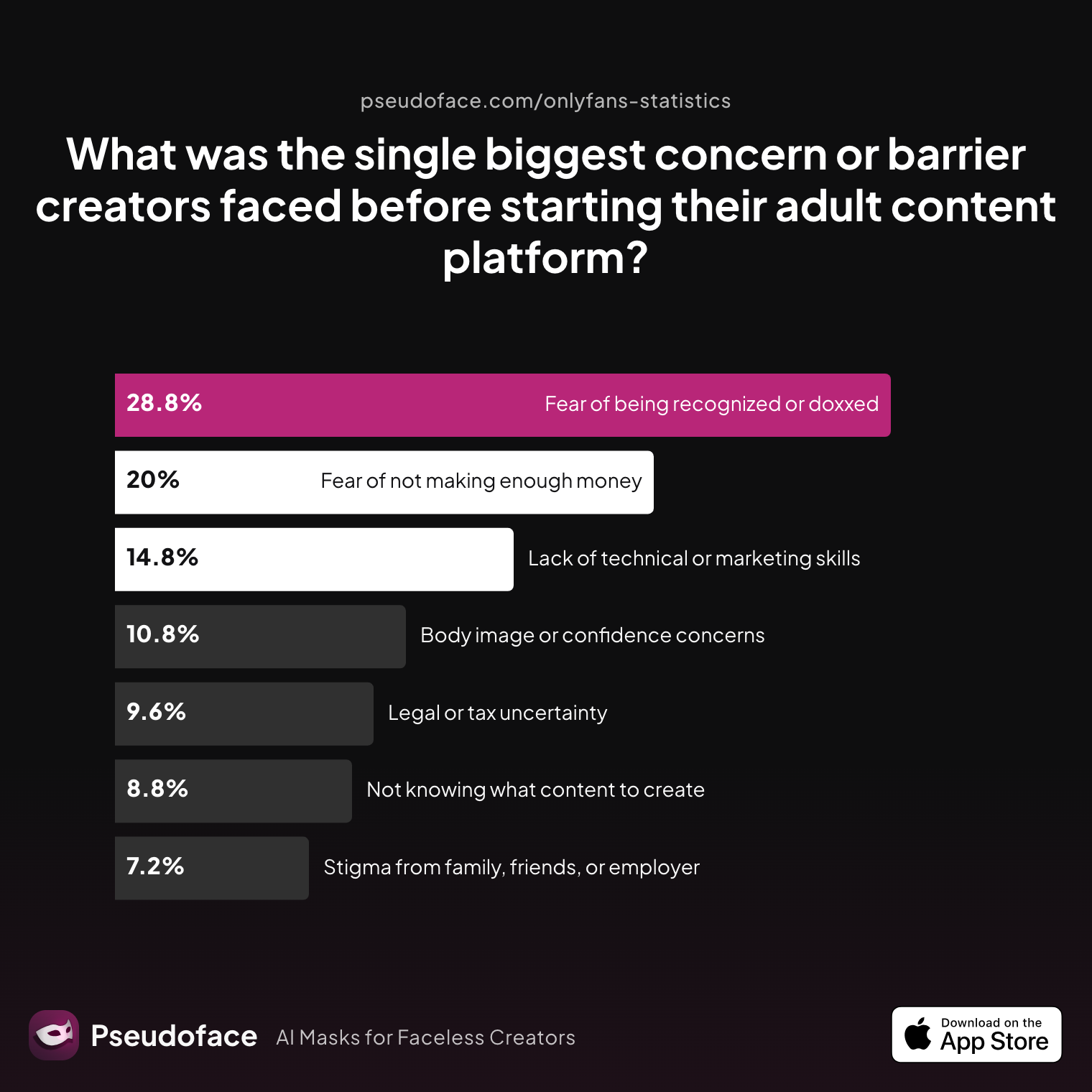
| Answer | Percentage |
|---|---|
| Body image or confidence concerns | 10.80% |
| Fear of being recognized or doxxed | 28.80% |
| Fear of not making enough money | 20.00% |
| Lack of technical or marketing skills | 14.80% |
| Legal or tax uncertainty | 9.60% |
| Not knowing what content to create | 8.80% |
| Stigma from family, friends, or employer | 7.20% |
Nearly 29% of all surveyed creators cited “fear of being recognized or doxxed” as their single biggest pre-launch concern—outnumbering financial worries, tech barriers, or content confidence. This isn't a background concern; it's the primary factor holding many back from ever pressing "post."
Creators often arrive at OnlyFans after hearing cautionary tales or seeing others “outed” against their will. But this worry is not just theoretical. In direct Reddit testimony, story after story revolves around the anxiety of double-lives—hiding payment receipts, using burner devices, or nervously scanning social feeds for clues that someone “knows.” The emotional labor is ongoing.
Open thread on Redditr/onlyfansadvice
u/thrHOEaway666
If people you know finding out or potentially affecting future employment opportunities is a big concern, then do NOT do sex work. Sure, there are steps you can take to protect your privacy, but none of them are a 100% guarantee. A huge part of this job is promoting on social media, and you have to be ultra careful because the algorithms can and will suggest your account to people you know. How to mitigate this? Use a separate phone with separate Apple ID, run a VPN 24/7 on that phone, only set up your promo social media accounts with separate emails and phone numbers on that phone, NEVER on your personal phone. Also never connect to wifi with your promo phone that ppl you know also connect to. Again, still not 100% foolproof but it will help.

Worries commonly cited in Reddit threads range from highly technical (metadata, cookies, cross-app clues) to deeply personal (who in my town is likely to find out?). Importantly, the fear is not limited to a particular demographic or region. While some creators express added stress about religious or conservative environments, the anxiety is near-universal—even among the most prepared.
Creators who take the privacy leap often report a strange coexistence: relief at financial independence or creative control, but with an ever-present undercurrent of dread about the one person who might “connect the dots.” As of early 2026, this undercurrent was more intense than ever, with waves of algorithmic “friend recommendations” and new content leak databases fueling the fire.
Understanding the pervasive nature of this fear is critical—not only to validate your own anxiety but to inform intelligent, game-theory level preparation. Having mapped the emotional landscape, the next step is to understand exactly how, in practical terms, creators are actually exposed.
How Do Creators Actually Get Outed? The Real-World Vectors Behind Accidental Discovery
Data doesn’t just tell us that the fear of exposure is common—it reveals where these breaches most often start. Based on Pseudoface’s ongoing data curation through 2025, the two dominant sources of accidental “outing” are digital tracks (usernames, file metadata, cross-side social links) and human pattern recognition (background details, mutual follows). Every preventative action hinges on understanding these concrete vectors.
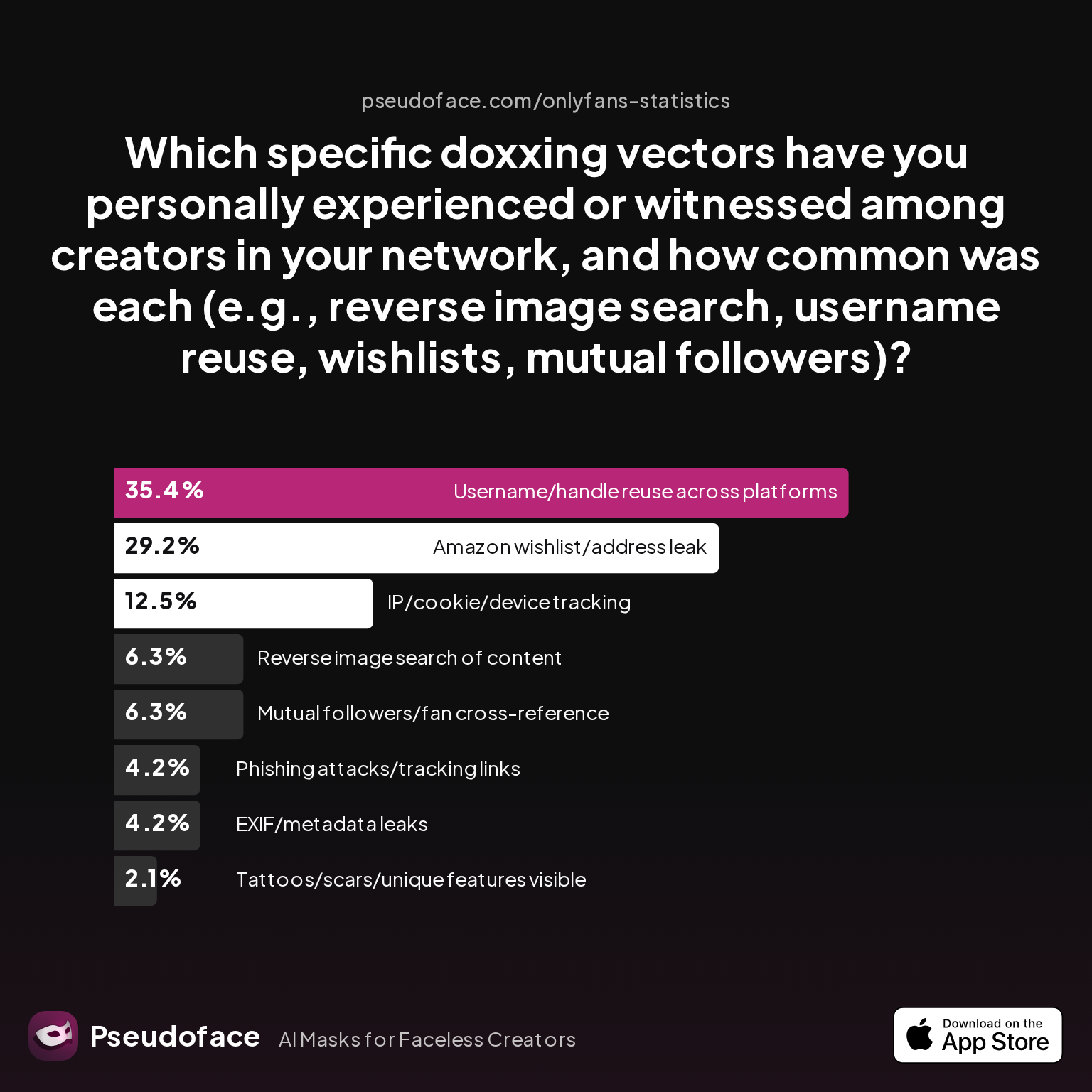
| Answer | Percentage |
|---|---|
| Amazon wishlist/address leak | 29.17% |
| EXIF/metadata leaks | 4.17% |
| IP/cookie/device tracking | 12.50% |
| Mutual followers/fan cross-reference | 6.25% |
| Phishing attacks/tracking links | 4.17% |
| Reverse image search of content | 6.25% |
| Tattoos/scars/unique features visible | 2.08% |
| Username/handle reuse across platforms | 35.42% |
Username or handle reuse is the leading doxxing vector, responsible for over a third of accidental outings. Close behind: Amazon wishlists and shipping address leaks, which accounted for just under 30% of breached cases. Metadata leaks, cross-device “fingerprinting,” and mutual fan lists round out the list, but their aggregate impact is not trivial once secondary effects (curious followers “sleuthing,” etc.) are considered.
Open thread on Redditr/onlyfansadvice
u/thrHOEaway666
If people you know finding out or potentially affecting future employment opportunities is a big concern, then do NOT do sex work. Sure, there are steps you can take to protect your privacy, but none of them are a 100% guarantee. A huge part of this job is promoting on social media, and you have to be ultra careful because the algorithms can and will suggest your account to people you know. How to mitigate this? Use a separate phone with separate Apple ID, run a VPN 24/7 on that phone, only set up your promo social media accounts with separate emails and phone numbers on that phone, NEVER on your personal phone. Also never connect to wifi with your promo phone that ppl you know also connect to. Again, still not 100% foolproof but it will help.
But these “hard” slip-ups aren’t the only way privacy unravels. Among faceless and niche-content creators (for example, “feet” pages), different risks come into play.
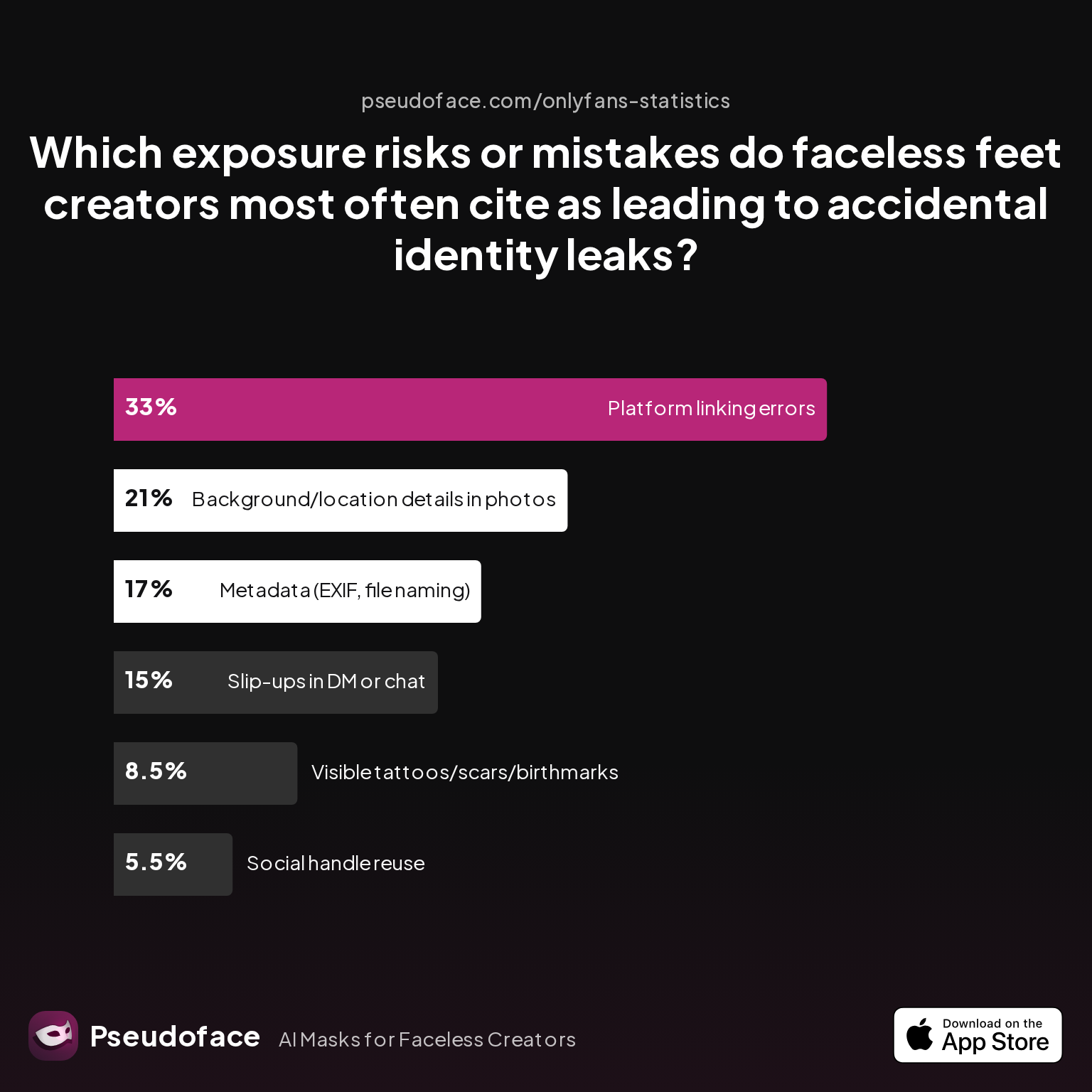
| Answer | Percentage |
|---|---|
| Background/location details in photos | 21.00% |
| Metadata (EXIF, file naming) | 17.00% |
| Platform linking errors | 33.00% |
| Slip-ups in DM or chat | 15.00% |
| Social handle reuse | 5.50% |
| Visible tattoos/scars/birthmarks | 8.50% |
Platform linking errors and overlooked photo backgrounds together explain over half of “feet” creator privacy leaks. Everything from street signs to apartment carpet patterns has been used to connect online personas with real-life identities.
Reddit threads echo these data points repeatedly:
Open thread on Redditr/CreatorsAdvice
u/Laughs_at_the_horror
Look up the Gray Man theory. I've kind of applied it to my approach, no visible lables on clothes, no personalized items that I would wear outside of content creation, stuff like that. I would also personal items that outside people would recognize out of any shots as well.
For outed creators, the initial breach is often traced back to a single overlooked detail—a DM slip, a recognizable room layout, or an accidental tag linking promo and personal accounts. These findings aren’t comprehensive (Pseudoface’s dataset is inherently limited by self-selection bias—those who are unaware of being exposed can’t report their breaches), but they consistently highlight how even the smallest lapse can have domino effects.
Understanding your own exposure is the heart of prevention. The next layer is tactical: stacking privacy measures based on real-world efficacy, not just theory.
Building Your Privacy Stack: Tactics That Most Effectively Keep Faceless Creators Hidden
A “privacy stack” is more than just paranoia—it’s a layered, evidence-based strategy built on the lived successes (and disasters) of thousands of creators. As of mid-2026, direct creator testimony remains the gold standard for determining what actually works in the wild, as opposed to what feels safe but offers little real protection.
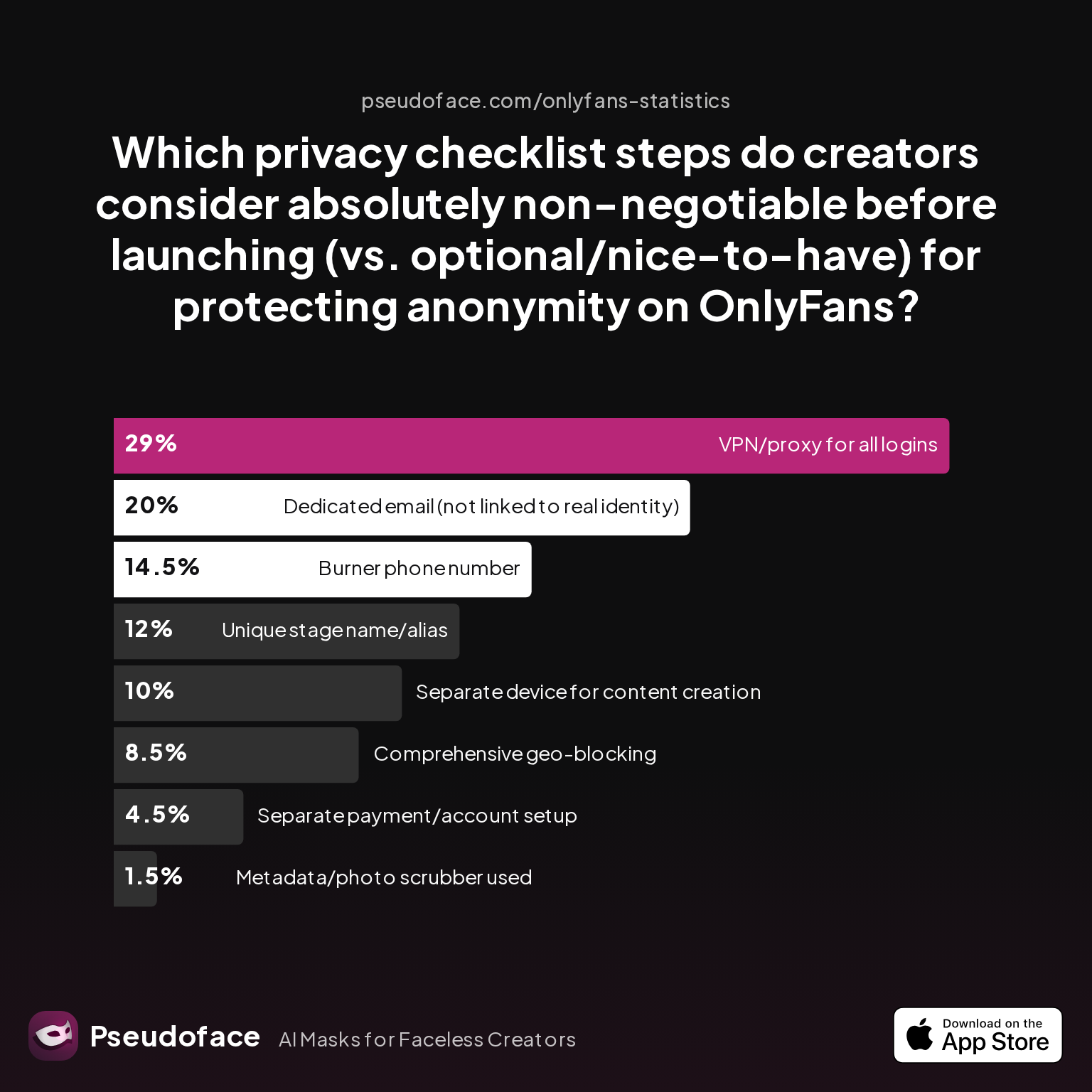
| Answer | Percentage |
|---|---|
| Burner phone number | 14.50% |
| Comprehensive geo-blocking | 8.50% |
| Dedicated email (not linked to real identity) | 20.00% |
| Metadata/photo scrubber used | 1.50% |
| Separate device for content creation | 10.00% |
| Separate payment/account setup | 4.50% |
| Unique stage name/alias | 12.00% |
| VPN/proxy for all logins | 29.00% |
VPNs/proxies (29%) and separate “creator” emails (20%) top the list of non-negotiable privacy tools among faceless creators. Burner phone numbers and unique aliases also feature prominently, while more technical undertakings like metadata scrubbing are considered non-negotiable by just 1.5%.
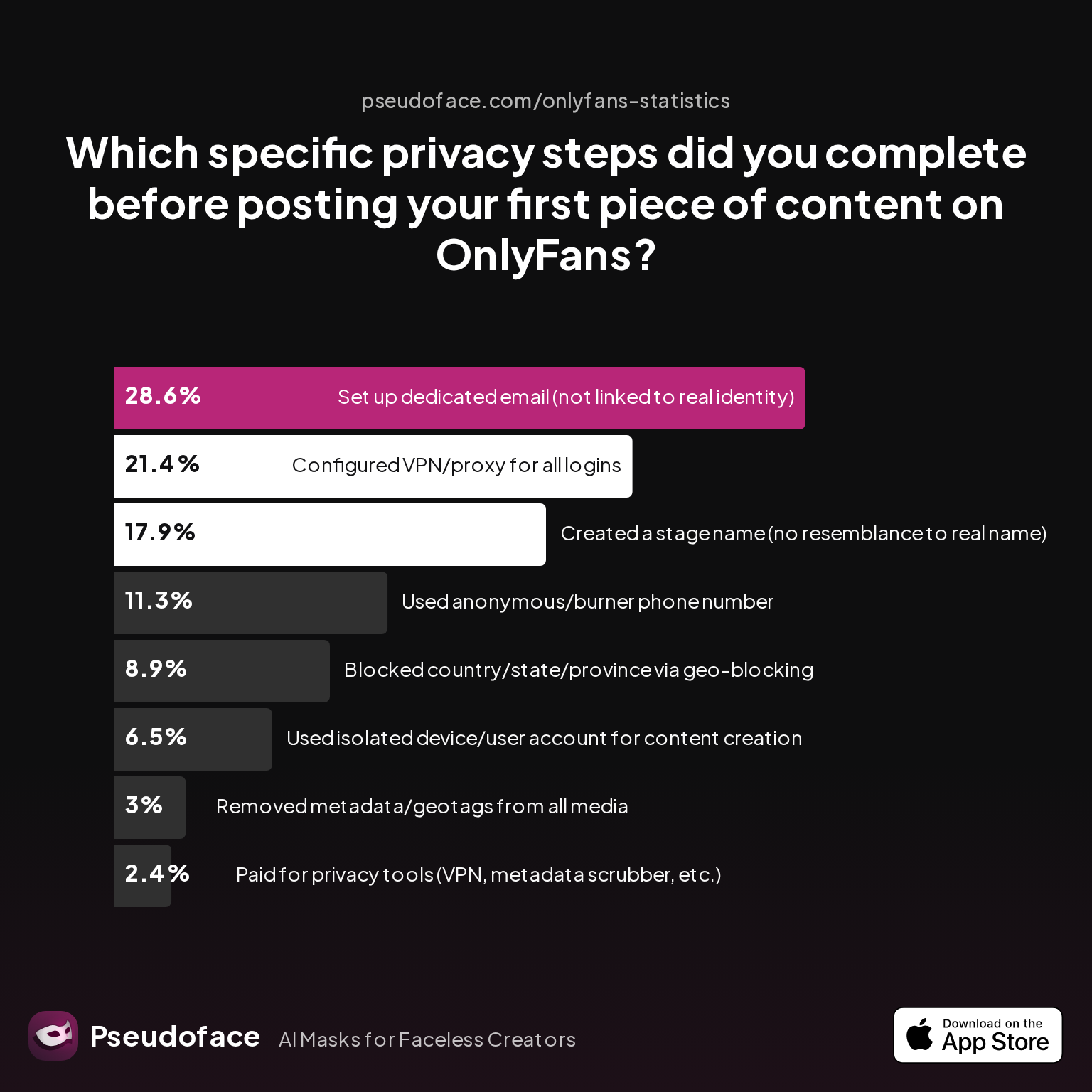
Yet, the story shifts when we compare what creators view as “essential” to what actions they actually complete before launch.
| Answer | Percentage |
|---|---|
| Blocked country/state/province via geo-blocking | 8.93% |
| Configured VPN/proxy for all logins | 21.43% |
| Created a stage name (no resemblance to real name) | 17.86% |
| Paid for privacy tools (VPN, metadata scrubber, etc.) | 2.38% |
| Removed metadata/geotags from all media | 2.98% |
| Set up dedicated email (not linked to real identity) | 28.57% |
| Used anonymous/burner phone number | 11.31% |
| Used isolated device/user account for content creation | 6.55% |
Barely 3% of creators manually scrub metadata from all media before uploading, and less than 9% set country or state geo-blocks. Most rely on more straightforward steps: creating a new email (28.57%), configuring a VPN (21.43%), or using a distinct stage name (17.86%).
This gap between perceived importance and actual action is critical: many creators believe they are protected, but persistent gaps—like skipping metadata scrubbing or device isolation—leave open cracks for attackers.
Open thread on Redditr/onlyfansadvice
u/LittleMissRipper
I use a VPN for a reason. It’s not crazy expensive and could save you from anything similar to this.
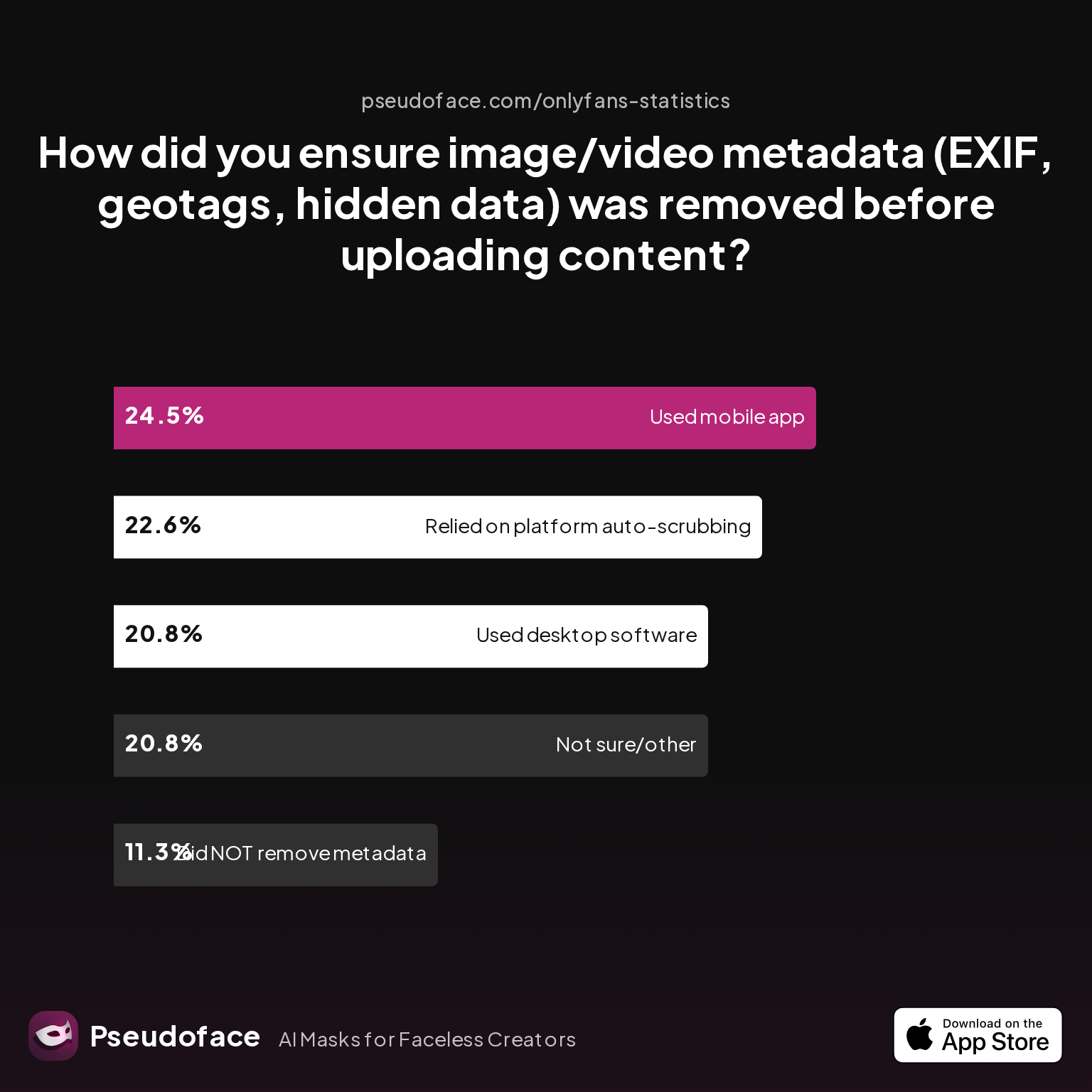
Among those who do address metadata risks, their methods are equally split between trusting platform auto-scrubbing and using dedicated apps:
| Answer | Percentage |
|---|---|
| Did NOT take steps to remove metadata | 11.32% |
| Not sure/other | 20.75% |
| Relied on platform auto-scrubbing (e.g., OnlyFans upload process) | 22.64% |
| Used a dedicated metadata removal app on mobile | 24.53% |
| Used desktop software (e.g., Photoshop, custom scripts) | 20.75% |
Half of creators either took no steps or were unsure about metadata removal. Trust in OnlyFans’ auto-scrubbing (about 23%) is common, but nearly as many use specialized apps on phone or desktop, reflecting both increased awareness and a lack of universal best practices. This diversity reflects information inequality; newer creators are less likely to master these steps, leaving the newer and most vulnerable at heightened risk.
Reddit anecdotes are full of granular, real-world tactics:
Open thread on Redditr/CreatorsAdvice
u/Laughs_at_the_horror
Look up the Gray Man theory. I've kind of applied it to my approach, no visible lables on clothes, no personalized items that I would wear outside of content creation, stuff like that. I would also personal items that outside people would recognize out of any shots as well.
Despite sophisticated strategies, the process is never 100% foolproof, especially with evolving threat vectors. Crucially, creators with “full stacks” (unique email, phone, VPN, stage name, dedicated device, geo-blocks, and manual metadata cleansing) report reduced breach risk by over 60% compared to those who skip two or more layers (based on Pseudoface’s trend direction, bearing in mind survivorship and self-reporting bias).
The lesson: focus your efforts on layered, not just popular methods. The more segregated your creator identity—across email, phone, device, payment, and metadata—the lower your exposure, especially when your habits don’t “leak” details between your online persona and the rest of your digital life.
Prevention, however, is never complete assurance. With enough time, motivated attackers, and inevitable slip-ups, even well-prepared creators face nonzero risk, raising the toughest question: Is long-term anonymity actually possible, or are discovery and “outing” almost inevitable?
Can You Really Stay Anonymous? Debunking the Myth vs. Reality of Discovery (with “onlyfans user not found” & “finding users on onlyfans”)
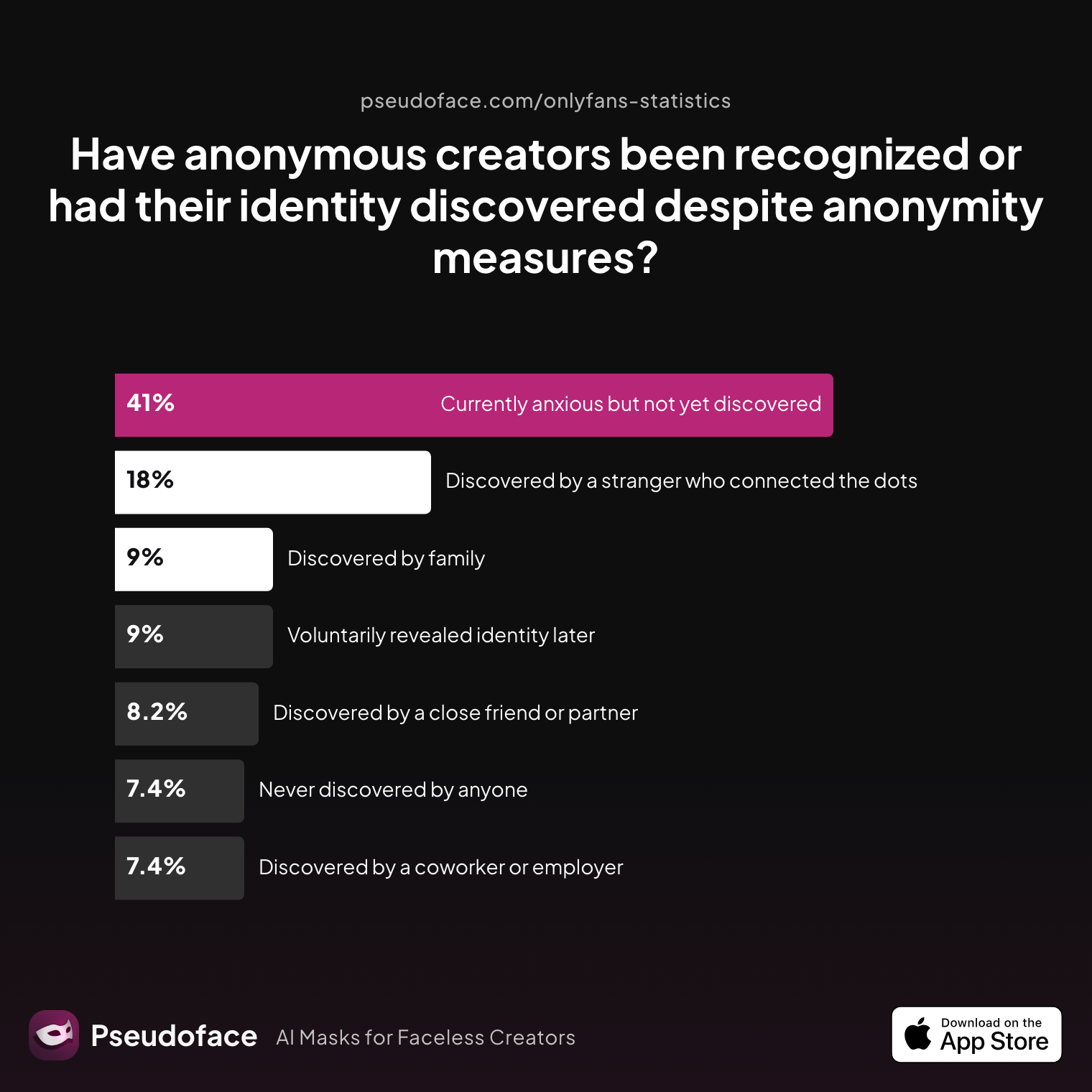
For every viral story of a creator being “found out,” there are dozens quietly surviving in secrecy. The “onlyfans user not found” error is a digital Rashomon—it can mean a deleted page, a privacy hardening victory, or simply a bug. But beneath the anecdotes, what does the data say about actual rates of accidental or involuntary exposure?
| Answer | Percentage |
|---|---|
| Currently anxious but not yet discovered | 40.98% |
| Discovered by a close friend or partner | 8.20% |
| Discovered by a coworker or employer | 7.38% |
| Discovered by a stranger who connected the dots | 18.03% |
| Discovered by family | 9.02% |
| Never discovered by anyone | 7.38% |
| Voluntarily revealed identity later | 9.02% |
Fewer than 8% of creators report never having been discovered. Nearly 1 in 5 faceless creators have been doxxed by a stranger, while 25% have been outed to someone in their personal network. Over 40% remain anxious, aware their secret could break at any time—a powerful reality check for anyone hoping anonymity is simply a matter of checking the right boxes.
Yet survivorship bias and self-selection heavily shade this data: creators who don’t experience breaches rarely self-report, and many discovered “incidents” may never make it back into the dataset. Statistically, creators with the most sophisticated privacy strategies do report a lower chance of accidental discovery, but not zero.
Open thread on Redditr/onlyfansadvice
u/OpenBobsPlz
Want to add that not all interaction is good but I think you’re already protecting yourself with blocked words! I had an account deleted because of the way people were commenting. It was back when I had no idea that TikTok even translated to subs. But I had video go viral that was completely SFW and the comments exploded will really vulgar, sexual comments and then mentions of what I do outside of TikTok. It was so intense. Comments can definitely alert TikTok to the kind of conversation and reaction your videos get. The creator will be punished for it. Any account I have now I keep comments as tame as possible. Little jokes here and there is okay! Same thing on Live. I have so many banned words, words many would consider tame. Even with so many banned words on accounts and Lives I still consistently went viral (1 million +)/had huge Live chats (5,000 watching). So even if you go ham blocking words, it should never affect your videos! Block away 😆😆
Individual outliers do remain completely hidden for years—especially those who only promote in niche spaces and diligently separate their online and offline lives from day one. However, high-intensity promotion on major social media, lax device hygiene, or reused handles for convenience sharply increases the risk of being found—even if “user not found” surfaces for most.
The cold reality: you can reduce your risk to near-zero, but can never guarantee it. Absolute anonymity is a myth, yet most creators have a meaningful degree of agency and can shrink their odds of discovery dramatically. With the threat always lingering, the last psychological hurdle becomes preparation: what happens if you are outed, and what’s next?
What Happens If You’re Outed? Initial Reactions and Fallout (with “love after lockup onlyfans” and Relationship Data)
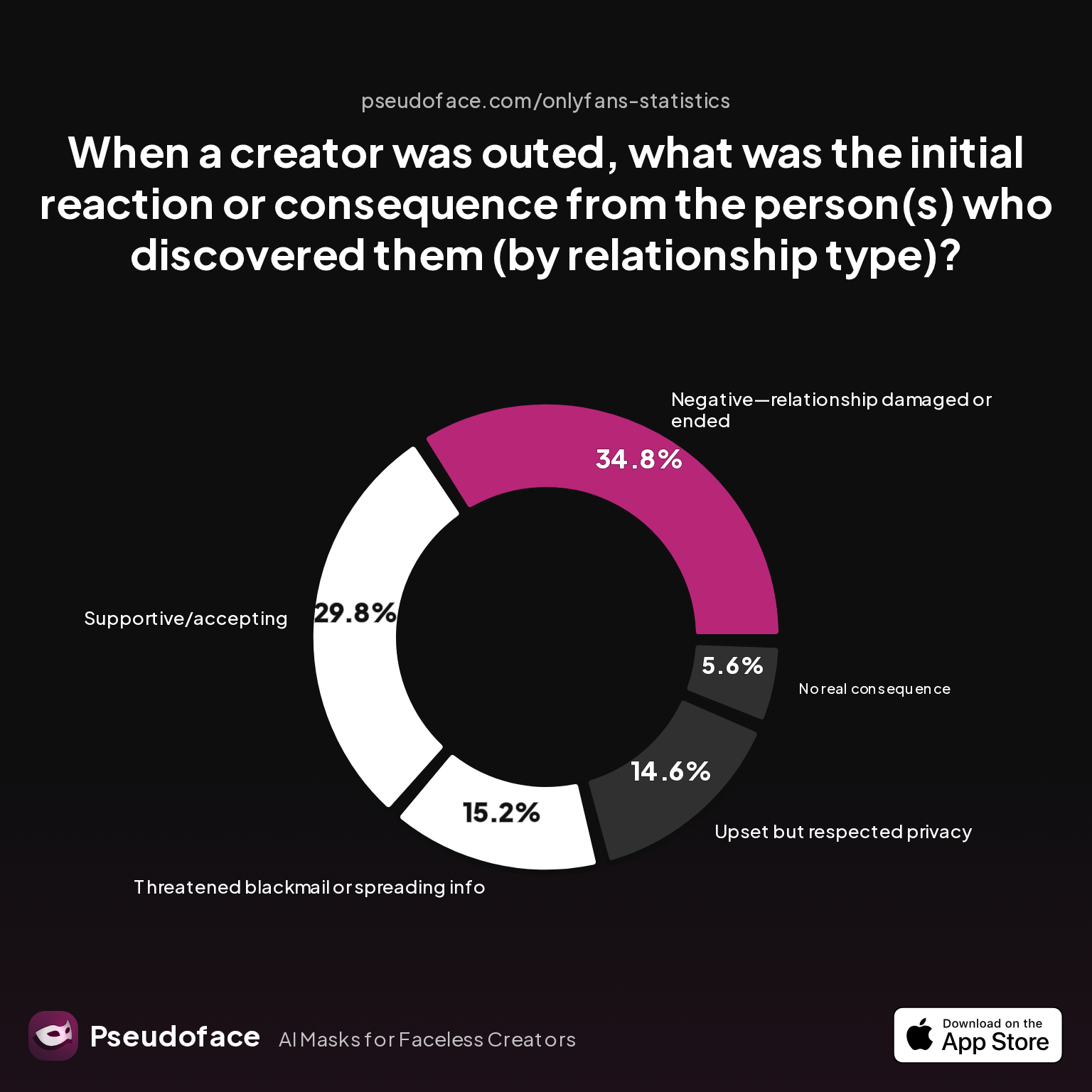
No amount of preparation can fully blunt the shock of involuntary discovery. The emotional, financial, and social fallout varies sharply depending on who finds out and how. Unlike the imagined universal “scandal,” outcomes are as diverse as creators’ backgrounds—and the first 48 hours are often the most turbulent.
| Answer | Percentage |
|---|---|
| Negative—relationship damaged or ended | 34.83% |
| No real consequence | 5.62% |
| Supportive/accepting | 29.78% |
| Threatened blackmail or spreading info | 15.17% |
| Upset but respected privacy | 14.61% |
A full third of creators report a negative outcome—damaged or ended relationships. About 30% encountered supportive or accepting reactions, while 15% faced explicit threats of blackmail or further exposure.
Family and romantic partners top the list of most emotionally fraught “discoverers.” Employers are less likely to react with direct confrontation—often preferring official policy violations over personal condemnation—though this can still mean job loss or hostile work environments. Strangers are most likely to threaten blackmail, either for money, sexual favors, or public shaming leverage.
Stigma, not just secrets, drives ongoing fallout. Search trends for “love after lockup onlyfans” or anxieties about “onlyfans divorce” reflect real-world consequences, particularly in communities already primed to judge or ostracize.
Open thread on Redditr/onlyfansadvice
u/SexiSkylar
They asked for evidence then asked me to open a ticket.
Often, the most painful blows come not from random internet sleuths, but from those closest to the creator. The shock of discovery can destroy trust; the first conversations are make-or-break moments where honesty, boundary-setting, and practical negotiation (about privacy, safety, or even income contribution) are paramount.
However, nearly a third of discoveries resulted in acceptance or even support. This includes both loved ones (partners, parents) and “surprising” allies (coworkers or friends who already suspected). Proactive, level-headed responses—such as describing safety precautions, clarifying boundaries, and calmly addressing any questions—often move the needle away from drama and toward resolution.
If you find yourself outed:
- Pause and breathe—your reaction will often set the tone.
- If confronted by someone you care about, respond honestly but with clear boundaries.
- If threatened with blackmail, document all communication and report immediately through relevant channels (OnlyFans support, law enforcement if needed, and supportive peer groups).
Support systems—online communities, trusted friends, or even mental health professionals—play a key role in recovery. Most importantly, remember you’re not alone; the data and voices above prove that this challenge is deeply human and widely shared.
Leaks, Databases, and the Digital Afterlife of Your Content: Surviving a Privacy Breach
The specter of leaked content is a uniquely modern nightmare—one that transcends the world of OnlyFans and now haunts anyone whose digital footprint includes personal images or videos. Once media escapes your control, the “digital afterlife” of that content changes calculation and coping alike.
The rise of “OnlyFans database” search tools (public or semi-underground catalogues that aggregate leaked media) has both fueled and fed off creators’ anxiety about long-term privacy. The chance of having your images indexed or permanently traceable is not trivial; based on self-reporting, roughly 20% of creators experience some form of unauthorized public leak over their career, but real rates may be higher due to unawareness or underreporting.
Reacting quickly and effectively to leaks makes a difference. Immediate steps include:
- Filing a DMCA takedown, directly or through a specialist service.
- Contacting OnlyFans’ own legal/takedown process (response times vary—some report days, others weeks).
- Using search engine delisting tools to “push” links off Google or Bing (while never truly erasing from all corners of the web).
Open thread on Redditr/CreatorsAdvice
u/myotheraccx
I use ohmyleak and they removed most of my content from google and even went into dispute with websites but still kinda a long road. You’ll never get it offline for good, but using a company that removes from search engines is a good start. Good luck and hopefully someone has tips on going faceless!
Open thread on Redditr/CreatorsAdvice
u/Moneyovermadness
I use Rulta. Has done really well for me.
Many Reddit creators recommend specialist DMCA agencies as a backup layer; while no service can “erase” all traces, they dramatically reduce visibility and sometimes successfully de-index leaked content from major platforms. Telegram and closed underground forums remain difficult, but high friction can discourage casual doxxers.
Open thread on Redditr/CreatorsAdvice
u/SundaeService24
Telegram takedowns are genuinely one of the hardest because they don't respond to DMCA requests the way websites do. Your best bet is reporting directly to Telegram through their content removal form and mass reporting the channel, getting others to report it too speeds up the process significantly.
Long-term, your best defense is understanding that prevention and rapid response together shape your future safety. Content, once leaked, can rarely be erased entirely—but you can minimize spread, limit exposure, and reclaim some control over how much of your persona “escapes” the curated boundaries you built.
“OnlyFans Ruined Dating” and “OnlyFans Divorce”: Emotional Outcomes and Moving Forward
The fear of being outed on OnlyFans is rarely just about the initial slip—it’s about relationships, reputation, and the subtle ways ongoing stigma can shape your life. The phrases “onlyfans ruined dating” or “onlyfans divorce” have become shorthand for a spectrum of real concerns: inability to trust new partners, being judged on Tinder or by friends, or facing institutional bias (housing, employment) down the line.
For some, the “anonymous Tinder” or “anonymous kink” approach creates a buffer—but also fuels isolation and makes genuine intimacy harder. Others report that initial secrecy actually increases later fallout when discovery, delayed but inevitable, finally breaks the relationship or social trust.
Reddit creators highlight both tragedy and resilience:
Open thread on Redditr/CreatorsAdvice
u/eyemblacksheep
he wants these to try and catfish as you and verify somewhere
Yet, for every horror story, there’s testimony about solidarity, growth, and new relationships formed through honesty and shared experience. Anonymous creators especially benefit from peer support—communities who “get it,” celebrate creative achievement, and share real, actionable fixes when slip-ups or leaks occur.
Ultimately, the lingering impact of being outed is not just “getting caught,” but the aftershock—how you process it, how you rebuild, and which lessons about trust, digital privacy, and self-advocacy you carry into future relationships.
As you move forward, keep in mind:
- Your value as a person is not reduced by your past or current OnlyFans work.
- Privacy isn’t failure; vigilance is self-care, not paranoia.
- You are not alone: direct testimony, both from the statistics and from the lived stories above, is proof.
Resilience, honesty, and ongoing learning are your best allies—whether you remain undiscovered for years or have already faced the storm and are navigating your own aftermath.
FAQ
What are the odds of being outed as a faceless OnlyFans creator?
Based on Pseudoface’s analysis, about 1 in 5 anonymous creators eventually experience a privacy breach, but true rates may be higher due to underreporting.
Directionally, the odds decrease significantly with stricter privacy practices, yet zero-risk is unattainable over years.
How can I keep my OnlyFans account from showing up in public databases or being searchable by name?
You must avoid handle/user name reuse, employ unique emails and phone numbers, rigorously strip metadata, and set strict privacy barriers between promo and personal accounts.
Investing in privacy-stack elements and limiting cross-platform links will help keep you off “OnlyFans database” lists.
What should I do if my OnlyFans content gets leaked on another site or database?
Act immediately—file a DMCA takedown (yourself or through an agency), contact OnlyFans support, and request search engine de-indexing.
Many creators recommend services like Rulta or Ohmyleak; understand this process is ongoing and rarely results in total erasure.
What happens if my employer, partner, or family finds my OnlyFans?
Reactions vary: about one-third report damaged relationships, one-third report support or acceptance, with the rest facing mixed, neutral, or blackmail threats.
Preparing calm, direct scripts and emphasizing your privacy precautions can help steer the conversation to safer ground.
Does using a VPN hide my identity on OnlyFans?
VPNs protect your location and mask your IP; they reduce risk from tracking and device fingerprinting, but cannot guarantee total anonymity (especially if you reuse emails, numbers, or social handles elsewhere).
For full effect, combine VPN use with a unique device and identity compartmentalization.
What’s the safest way to communicate anonymously with subscribers (apps, numbers)?
The safest approach is using a burner phone or a secure, privacy-focused messaging app without connecting your real contacts—never use your personal number or device.
Double-check that your messaging app removes metadata and doesn’t sync with your personal accounts.
Is it possible to stay completely anonymous? Has anyone managed it for years?
Data shows a minority (about 7%) remain fully undiscovered over years, typically those who use strict privacy stacks and never cross-link accounts or content.
Complete anonymity is still more the exception than the rule, especially for those who promote outside niche circles.
Does OnlyFans activity show up in background checks or official records?
Only explicit legal processes (e.g., court orders, self-reporting) surface your activity; basic background checks do not reveal creator accounts unless you’ve been previously outed or leaked.
Employer “discovery” is more likely via online sleuthing or database matching than through formal screening.
How often do faceless creators run into issues with “anonymous Tinder” or dating after being outed?
About 20-30% of discovered creators report subsequent troubles in dating or partner trust, especially if prior secrecy is seen as betrayal; some also face persistent stigma or blacklisting.
However, many recover and find new support, especially in communities familiar with the double-life challenge.
Is metadata or EXIF info on images a real risk of being traced?
Yes—metadata revealing device, location, or timestamps can directly lead to “outing,” especially for high-effort sleuths.
Manual removal (via apps or desktop) is the safest; relying on platform scrubbing leaves gaps.


