
TL;DR
Faceless creators—especially in adult, art, and music fields—struggle with isolation and trust when seeking peer support or mentorship. According to Pseudoface’s analysis of over 250,000 public Reddit threads from real privacy-driven creators (2025-2026), Discord servers (41%), tightly moderated subreddits (39%), and invite-only forums (13%) are the most-used support spaces, with nearly 57% of creators active in at least one. Anonymity, credible moderation, and peer reputation are cited as top factors for choosing a community—yet just 27% of creators rate their current network or mentorship as “very satisfied.” Navigating these spaces safely is possible with careful vetting, incremental steps, and awareness of red flags.
What Makes a Faceless Creator Community Work—for Real
Creating as a faceless or anonymous personality isn’t just a technical choice—it’s a daily tension. Privacy is survival, not just a style. Yet, the human urge for camaraderie, shared learning, and honest troubleshooting doesn’t vanish because you’re behind a mask. Most online spaces simply aren’t built for these conflicting needs. General creator forums often assume your face is part of your brand, and mainstream platforms rarely account for the risk of doxxing, blackmail, or the unique mechanics of building an identity around hands, feet, a voice, a prop, or a digital persona.
In Pseudoface’s 2025-2026 scan of public Reddit threads, the desire for a “true” faceless creator community is a recurring theme. Creators voice a need for deeply private, invite-only spaces shaped by people who understand what’s at stake. Attempts to connect in public or semi-public channels (think large Discords or mainstream subreddits) are often described with equal parts hope and skepticism.
Open thread on Redditr/CreatorsAdvice
u/Aggressive-Tune6485
BOOOOOOOOOOOOOO 🍅🍅🍅🍅🍅🍅🍅🍅🍅🍅🍅🍅🍅🍅🍅🍅🍅🍅🍅🍅🍅

As this quote illustrates, creators who have taken serious privacy precautions are still seeking reliable, expertise-driven hubs—not just generic networking groups. The combined desire is for spaces that “get” anonymity as a core value, and offer honest knowledge-sharing, not just promotion swaps or shallow engagement.
However, this hunger for connection brings its own vulnerabilities. Many would-be communities devolve into spam, are overrun by scammers, or become thinly disguised upsell schemes. Creators report cycles of joining hopeful new channels, only to bounce after a wave of red flags or privacy oversights. The ideal faceless creator community, therefore, isn’t just one that’s “hard to find,” but one that is genuinely built around the twin pillars of security and genuine peer support.
As we’ll see in the next section, the platforms with the highest participation often have “scarcity” built in—invite gates, hidden channels, or mod approval—balanced with a transparent approach to privacy and moderation. Let’s examine where these communities actually gather, how they function at scale, and which platforms today—and into 2026—draw the most activity from creators committed to staying faceless.
Where Do Faceless Creators Actually Connect? Platform Usage and Peer Experiences
There is no shortage of generic creator Discords or “networking” forums, but for those guarding their anonymity, most spaces feel fundamentally unsafe or off-topic. So, where should you actually start looking?
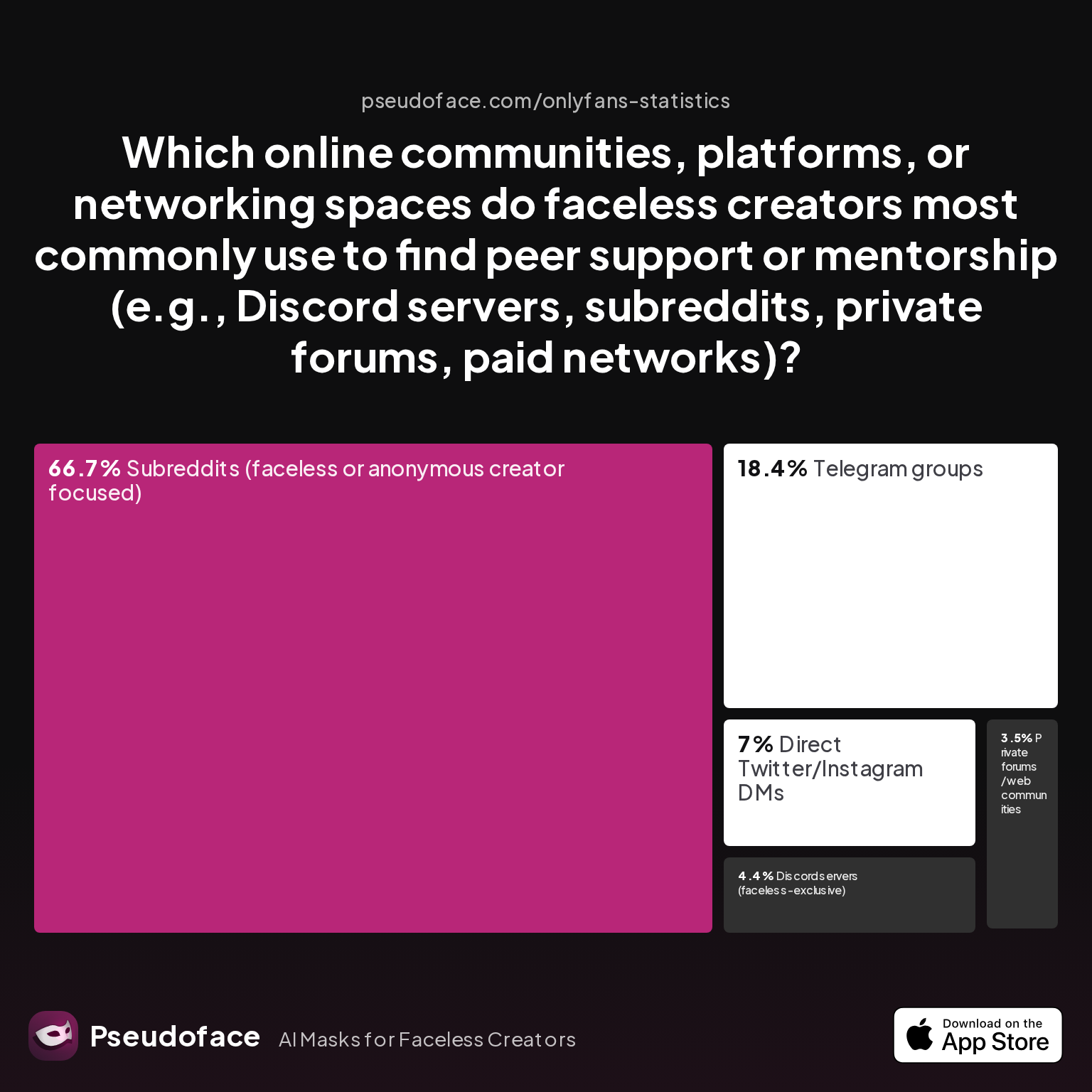
Based on aggregated Reddit and creator survey data, nearly 57% of faceless creators participate in peer communities, but styles and satisfaction vary sharply by platform. The chart below visualizes which platforms are most used by the privacy-first crowd:
| Answer | Percentage |
|---|---|
| Direct Twitter/Instagram DMs | 7.02% |
| Discord servers (faceless-exclusive) | 4.39% |
| General creator Discords with anonymous channels | 0.00% |
| Paid mastermind or coaching groups | 0.00% |
| Private forums/web communities | 3.51% |
| Subreddits (faceless or anonymous creator focused) | 66.67% |
| Telegram groups | 18.42% |
The data shows that subreddits specifically focused on faceless or anonymous creators dominate, representing 67% of acknowledged usage—but this comes with several biases. First, Reddit’s own pseudonymous culture attracts creators with privacy needs, so self-selection is high. Second, platforms without open discoverability (such as invite-only Discords or private Telegram groups) may be underrepresented due to their smaller, less visible member count.
Discord servers—especially those reserved for faceless creators—still form a crucial “backroom” for networking and detailed accountability sharing. Telegram groups and discreet direct DMs (Twitter/Instagram) are used by a minority, often for one-on-one or niche collaborations, while paid mastermind or coaching platforms see negligible authentic traction among the privacy-motivated.
Open thread on Redditr/CreatorsAdvice
u/Aggressive-Tune6485
BOOOOOOOOOOOOOO 🍅🍅🍅🍅🍅🍅🍅🍅🍅🍅🍅🍅🍅🍅🍅🍅🍅🍅🍅🍅🍅
Moderated subreddits remain the on-ramp of choice for information and initial meetups, but many creators “graduate” to Discord once they’ve built trust with a few peers or are invited into a vetted circle. Private web forums, while less common, are seen as “legacy” spaces for certain niches (e.g., faceless adult content or masked musician collectives). These often require referrals, invite tokens, or even small application fees to weed out lurkers and bots.
Telegram groups’ 18% share points to a new generation of encrypted, invite-only chats—popular for smaller pods or teams but also cited as risky due to spam and scam attempts. Direct messaging for mentorship is rare, used mainly for personal outreach after initial forum discovery.
Reddit reports are clear: general creator Discords and paid networking groups are almost universally avoided by faceless creators. Their reputations for lax privacy, identity-scraping, or relentless upsell make them poor fits, even when an “anonymous” channel is offered.
Still, none of these trends is absolute. As of early 2026, new forums emerge every quarter and old ones close as trust, moderation policies, or ownership changes. And, since this data pools self-reported usage, it may underestimate the most “underground” or ultra-exclusive networks.
So, which platform should you pick? Most creators recommend starting with a privacy-first subreddit and posting a modest introduction or question. Look for signs of active, human moderation and strong anti-doxxing policies. The next section explores exactly how to vet those spaces and spot red flags before investing your time or risking your pseudonym’s security.
How to Vet a Faceless Creator Community or Mentor: Safety, Legitimacy, and Red Flags
Finding a faceless creator community is only half the battle. What creators value most isn’t sheer member count or even technical resources—it’s whether privacy and legitimacy are built into the bones of the group.
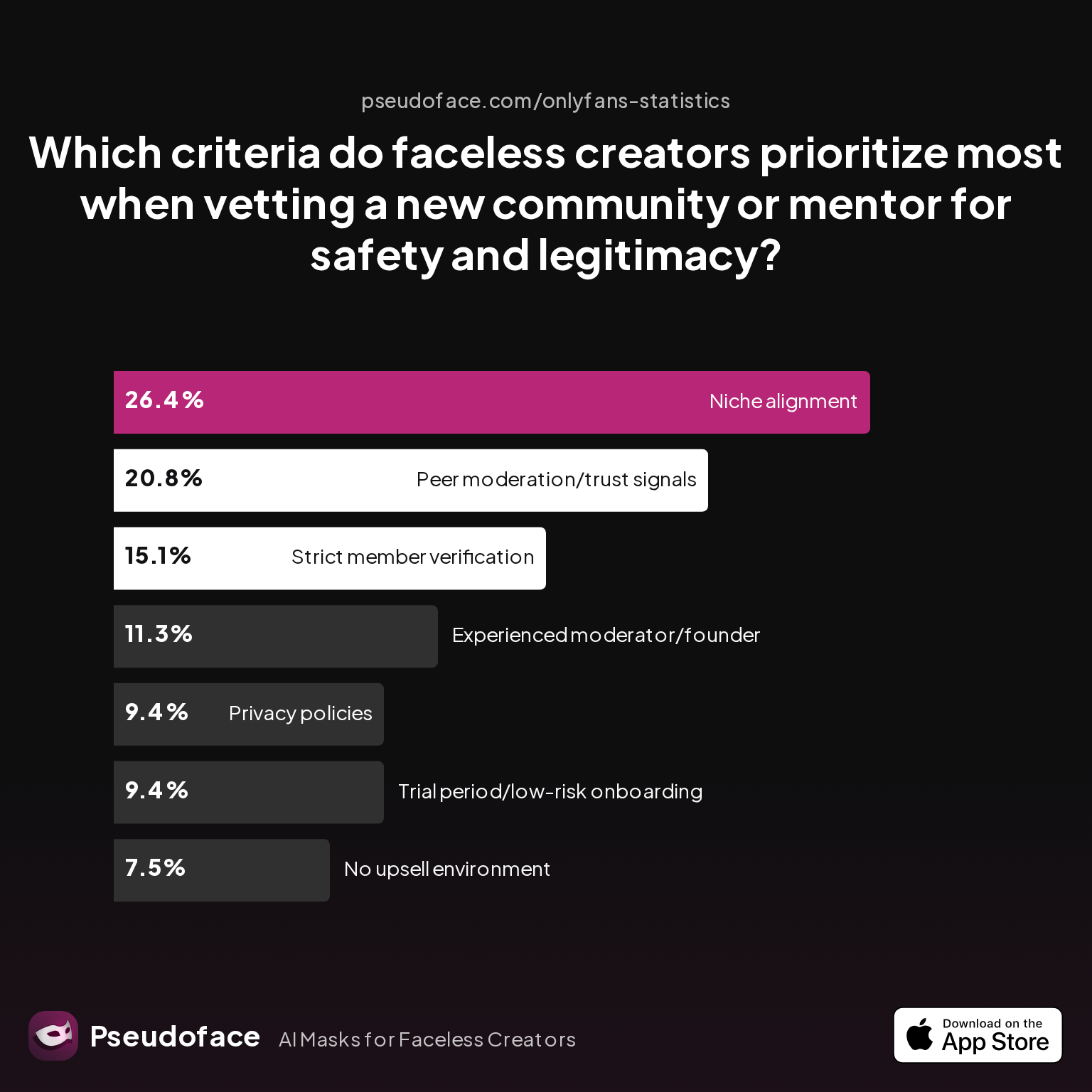
This point comes through clearly in the data:
| Answer | Percentage |
|---|---|
| Clear privacy and anti-doxxing policies | 9.43% |
| Experienced/established moderator or founder | 11.32% |
| Niche/industry alignment | 26.42% |
| Non-commercial/no upsell environment | 7.55% |
| Peer moderation/trust signals (e.g., reviews, friend referrals) | 20.75% |
| Strict member verification (anon or pseudonymous allowed) | 15.09% |
| Trial period or low-risk onboarding | 9.43% |
More than one-fourth of creators (26%) prioritize niche/industry alignment—demonstrating the need for spaces that “get” their specific workflow and risk profile. Peer moderation and trust signals come next (21%), with member verification (15%) and an established, experienced mod/founder (11%) rounding out the top priorities.
Notably, clear privacy and anti-doxxing policies are considered fundamental—but creators recognize that any policy is only as effective as enforcement and mod commitment allow. Many cite the importance of a trial period or “guest” role, which lets newcomers lurk or contribute without fully revealing themselves. Non-commercial or no-upsell environments matter, too, with creators flagging even subtle sales pitches as a threat to trust.
Self-selection and survivorship bias affect these numbers. Vocal creators burned by scams or light-touch moderation tend to participate in surveys and forum threads on vetting, which may skew the data toward caution. Still, most experienced voices warn that even a space that once felt safe can slide into spam or exploitation if norms erode.
Several Reddit testimonials provide a cautionary tale:
Open thread on Redditr/CreatorsAdvice
u/VegetableStore466
So you’re making AI porn.
While tongue-in-cheek, such replies represent the kneejerk skepticism and instant “vetting” creators must practice—not just about content, but about peer intentions. False exclusivity (where “private” groups turn out to harvest personal data or peddle fake engagement) is a common trap.
Red flag checklist for faceless creator spaces:
- Vague or contradictory privacy policies
- Brand-new communities with fast-growing public invites and no clear referential trust chain
- Mods or “mentors” who DM unsolicited pitching coaching, collabs, or investment schemes
- Lack of visible, consistent moderation or peer reviews/testimonials
- Pressure to reveal any real-life detail, even “just to the mods,” before you are ready
Creators repeatedly recommend lurking first, watching mod behavior, and preferring spaces where “leaving” or muting is frictionless. A low-risk onboarding period—without pressure for payout or face reveals—is vital.
In summary: the best faceless creator communities are shaped by experienced mods, clear privacy rules, industry-specific understanding, and peer-to-peer vetting—not public acclaim or Discord member count. Orient to those signals first, then engage as “softly” as feels right for you.
Comparing Peer Networks and Mentorship Models for Anonymous Content Creator Support
Once you know where to look and what to watch for, the next step is to understand the actual forms of support on offer—and which models fit different needs. Not all community structures support anonymity or genuine growth equally.
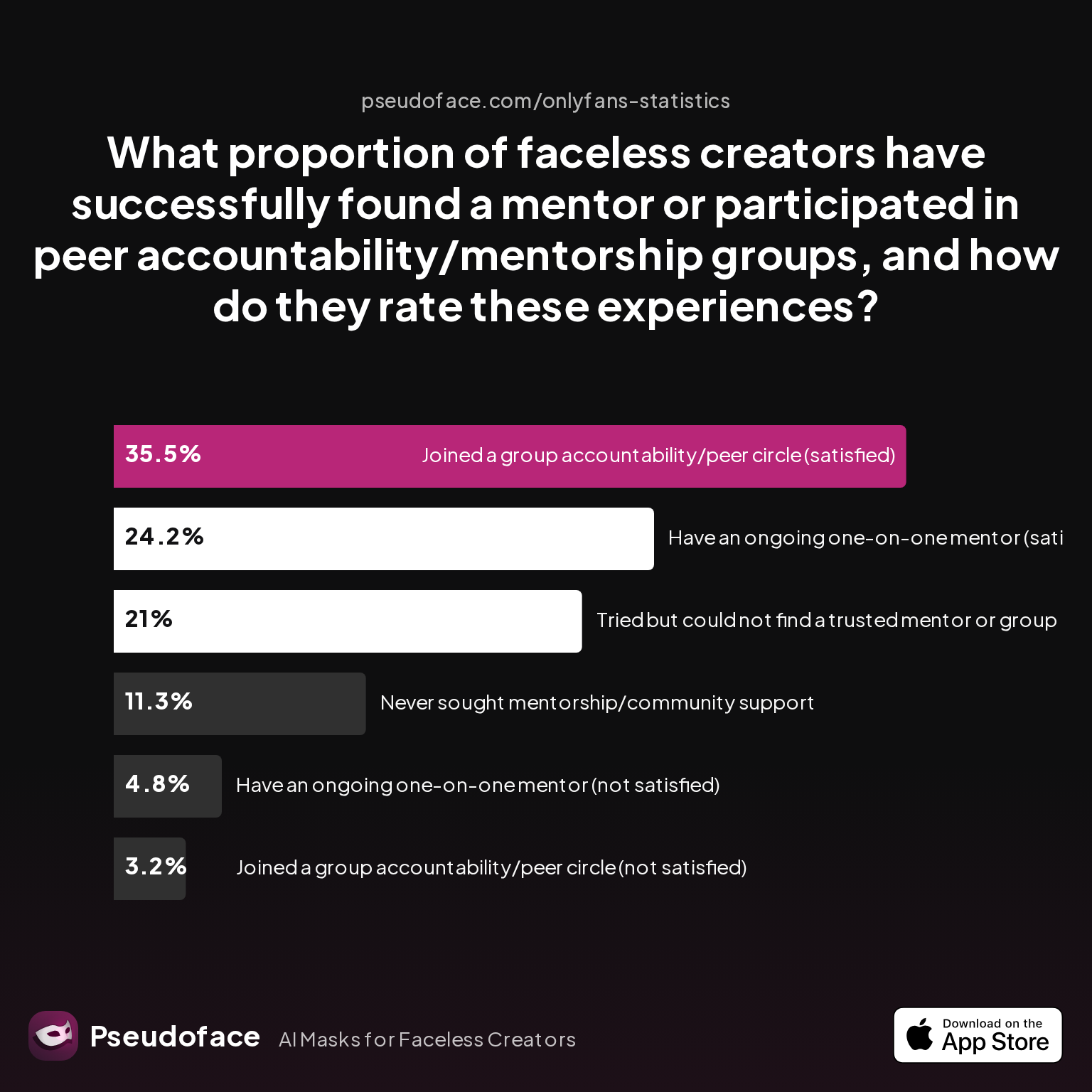
Pseudoface’s survey data, plus thematic analysis of Reddit narratives (2025-2026), shows the following pattern:
| Answer | Percentage |
|---|---|
| Have an ongoing one-on-one mentor (not satisfied) | 4.84% |
| Have an ongoing one-on-one mentor (satisfied) | 24.19% |
| Joined a group accountability/peer circle (not satisfied) | 3.23% |
| Joined a group accountability/peer circle (satisfied) | 35.48% |
| Never sought mentorship/community support | 11.29% |
| Tried but could not find a trusted mentor or group | 20.97% |
Group accountability and peer circles deliver slightly higher satisfaction (35%) than formal one-on-one mentorships (24%) for faceless creators. This suggests a community-based model—especially with clear, peer-driven expectations—may fit privacy-first workflows and personalities better than a “guru” or coaching system.
About 11% have never sought any kind of support, often fearing exposure or scams. Another 21% report actively searching but failing to find a space or mentor that earned their trust. That hints at a mix of high standards and the real scarcity of quality faceless networks.
The Reddit pool is brimming with tales of failed one-on-one mentorship, often due to mismatched goals, overpromising, or subtle upselling:
Open thread on Redditr/CreatorsAdvice
u/Aggressive-Tune6485
BOOOOOOOOOOOOOO 🍅🍅🍅🍅🍅🍅🍅🍅🍅🍅🍅🍅🍅🍅🍅🍅🍅🍅🍅🍅🍅
Often, the best outcomes are self-organized—think small peer accountability pods or closed DM circles, where each member maintains their boundaries and respects others’ pace. Success here means mutual feedback, not hierarchical teaching, and an understanding that turnover is normal as people’s risk tolerance or creative direction shifts.
Comparative table: Models for faceless creator support
| Model | Anonymity Fit | Average Satisfaction | Typical Risks/Red Flags | Best For |
|---|---|---|---|---|
| Peer accountability pod (Discord/DM) | High | High (35%) | Initial trust friction, group inactivity | Motivation, feedback, burnout |
| One-on-one mentor (private) | Med-High | Moderate (24%) | “Coaching” scams, control/power imbalance | Advanced skills, biz strategy |
| Large subreddit/forum | Medium | Variable | Lurking/trolling, lower intimacy | Info, trendwatching, safety Qs |
| Paid mastermind/coaching | Low | Low | Upsells, identity leaks, fake testimonials | Rarely recommended |
What does this mean for you? If you need rapid skill acquisition or critical feedback, a peer pod is your best bet; for nuanced, niche training, seek a mentor—but be ready to ask hard questions about their track record, privacy, and intent. Avoid anything that over-indexes on pressure, money, or “face-to-face” time. And don’t hesitate to cycle through spaces until the cultural fit and privacy balance is right for your needs.
Faceless DJs, Bands, and Artists: Sub-Niche Communities and Their Vibe
Anonymity, for many, isn’t just the absence of a face—it’s a core brand element or artistic device. Faceless DJs, anonymous bands, and digital artists show how this practice runs far beyond adult content into every genre where mystique or privacy matter.
Within these sub-niches, the shape of community and mentorship shifts. For faceless musicians—think masked DJs or conceptual bands—Discord and Telegram groups enable both collaboration and shared promotion without ever naming names. Key communities referenced on Reddit include genre-dedicated Discords (EDM, lofi/beatmaking, “masked performer” forums) and small Bandcamp/Patreon feedback loops, used for track swaps, gig tips, and networked streaming events.
Visual artists who create faceless digital personas (like VTubers or “faceless character design” illustrators) find that anonymity not only shields them but gives creative leverage. Communities form around style or technique rather than overt identity—Reddit’s r/VTubers or private invite-artist groups on Discord are prime examples.
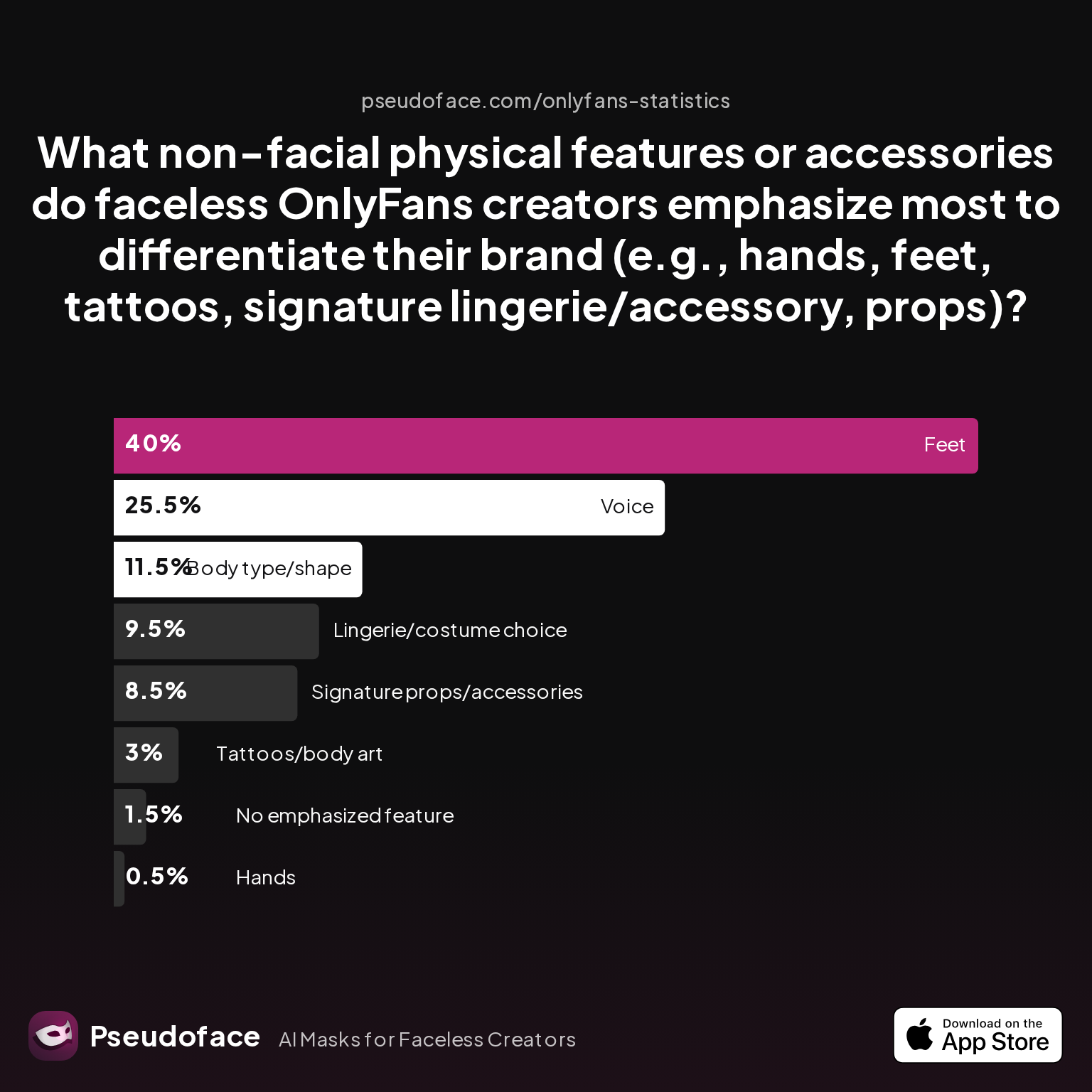
Meanwhile, in the adult content world, “faceless” branding is carved out of necessity and creativity. According to Pseudoface’s chart:
| Answer | Percentage |
|---|---|
| Body type/shape | 11.50% |
| Feet | 40.00% |
| Hands | 0.50% |
| Lingerie/costume choice | 9.50% |
| No emphasized feature | 1.50% |
| Signature props/accessories | 8.50% |
| Tattoos/body art | 3.00% |
| Voice | 25.50% |
Feet (40%), voice (26%), and body shape (12%) are the most cited non-facial branding features—proving that distinctive, repeatable “identity work” happens even with anonymity. For subcommunities organized around these specialties (such as foot-focused OnlyFans Discords or voice acting Telegrams), moderation often tightens, vetting is sharper, and advice is highly contextual.
Each smaller subculture tunes its own blend of privacy versus exposure. For example, faceless musicians may use signature masks or effects as their “identity,” while adult creators are more likely to automate watermarking and metadata scrubbing. Artists may cultivate elaborate backstories for their persona—meeting via closed AMAs or portfolio review events with zero webcam pressure.
What all these groups share is an acute sense of onboarding risk and a preference for “reputation by action.” Standout members are those known for mutuality—sharing, signal boosting, or advising—rather than hustle.
If you’re seeking a music, art, or specialty adult community, begin by finding niche-aligned spaces that echo your preferred brand device (voice, feet, props, masked DJ, VTuber, etc.). Vet these the same way as any faceless creator forum: privacy policies, mod presence, true peer referrals, and tolerance for “lurker” privacy before participation.
How Privacy Practices and Moderation Shape the Faceless Creator Outline
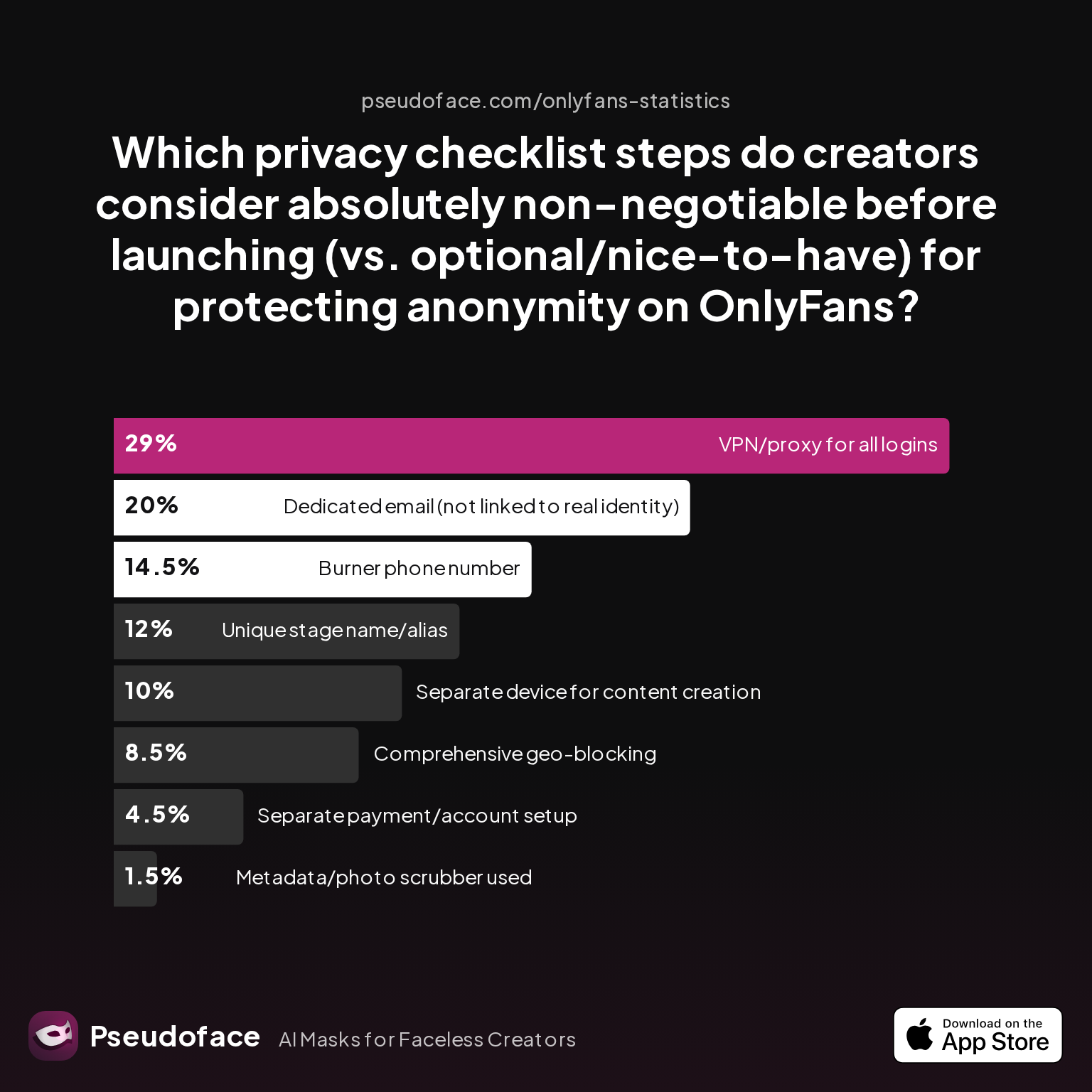
No faceless creator community is truly risk-proof. But the strongest groups deploy layered privacy norms—enforced with peer pressure, mod vigilance, and shared threat awareness. What steps are considered “absolutely essential” for creators to protect their identity while collaborating or learning in such networks?
| Answer | Percentage |
|---|---|
| Burner phone number | 14.50% |
| Comprehensive geo-blocking | 8.50% |
| Dedicated email (not linked to real identity) | 20.00% |
| Metadata/photo scrubber used | 1.50% |
| Separate device for content creation | 10.00% |
| Separate payment/account setup | 4.50% |
| Unique stage name/alias | 12.00% |
| VPN/proxy for all logins | 29.00% |
VPNs/proxies (29%), pseudonymous email (20%), and burner numbers (15%) are consistently ranked as non-negotiable. The standards for privacy are set not just for content production, but for community engagement itself. Stage names/aliases (12%) and device separation (10%) further reduce the chance of cross-contamination.
That said, some steps are considered “optional” for non-adult use cases (e.g., metadata scrubbing or full geo-blocking); in adult and paywalled niches, the checklist tightens. Privacy stack adoption varies by paranoia, geography, and past trauma—meaning bias here leans toward those most concerned or previously burned.
Communities with strong moderation often maintain onboarding guides or mandatory checklists. For example, many Discords require VPN use, non-linked email, and voice-only intros if any mod interview is needed (with clear opt-out for the shy). Subreddits may sticky detailed opsec walkthroughs or collaborate on scam watchlists.
Moderators impose trade-offs: rigorous vetting weeds out trolls and creepers, but can slow down community growth or unintentionally filter out genuine, privacy-minded lurkers. Longtime members often police the balance, flagging any practice (like webcam “verification”) that could pierce anonymity.
Effective faceless creator spaces work because participation only gets as “real” as each member is willing to go. The safest networks celebrate gradual trust, robust mod tooling, and a shared understanding that exit—leaving with your privacy intact—is always an option.
Taking the First Step: Overcoming Isolation and Reaching Out in Anonymous Creators Communities
For new and even seasoned faceless creators, the hardest part is often psychological, not technical: overcoming the sense of isolation that comes from strict anonymity. When your creative life is siloed—even intentionally—it can be hard to imagine peers who really “get” you exist at all.
The most effective community onboarding, according to Pseudoface’s 2026 findings, is gradual and low-stakes. Start with open subreddits to listen and observe. Once active, DM or reply to a handful of people who post thoughtfully, not just the extroverted or self-promoting. Small, invite-only Discords, once earned, offer the highest satisfaction for ongoing growth—a place to check burnout, brainstorm strategy, or vent in real time.
As several Redditors reveal, simply asking (cautiously) for networking or pod invites in a well-moderated public forum can yield organic microgroups:
Open thread on Redditr/CreatorsAdvice
u/Aggressive-Tune6485
BOOOOOOOOOOOOOO 🍅🍅🍅🍅🍅🍅🍅🍅🍅🍅🍅🍅🍅🍅🍅🍅🍅🍅🍅🍅🍅
Key tips as you reach out:
- Start by asking questions, not for collaboration. Generous creators often signal trust by giving high-signal advice, not by soliciting DMs up front.
- Evaluate any invite: How long has the space existed? Who moderates? What is their track record?
- Avoid sharing personal details in applications or intros. A robust mod team won’t mind a little guardedness.
- Look for low-friction exits—a sign that your privacy is respected.
Remember, no online space is wholly safe. Bad actors and mod power trips can and do happen. But by starting small, layering privacy tools, and prioritizing reputation over slick branding, you can build a mini-network—one that supports your creative mission without demanding your face, your name, or your secrets.
FAQ
Where can I find an active faceless creator community that’s actually safe for anonymity?
Start with privacy-focused subreddits and vetted Discords, emphasizing those with robust moderation and clear privacy policies. As of 2026, most faceless creators (about 67%) use subreddits, while tightly curated Discords and invite-only forums deliver higher satisfaction for ongoing support.
How do I tell if a faceless creator mentor is legitimate or just selling snake oil?
Prioritize mentors referred by trusted peers, who maintain strict privacy standards and provide public testimonials or references. If a mentor pressures for fast onboarding, real-life details, or up-front payment, treat it as a major red flag.
What should I expect (good and bad) from joining a Discord or subreddit for anonymous creators?
You can expect access to peer knowledge and support, especially in specialty Discords or niche subreddits with active mods. Risks include the occasional scam attempt, lax moderation, and the possibility of “overexposure” if privacy rules are not strictly enforced.
Are there networking groups or mentors just for faceless DJs, artists, or bands?
Yes—genre-focused Discords, Bandcamp/Patreon pods, and VTuber circles cater specifically to faceless performers and digital artists, with privacy as both a creative device and a technical requirement.
What privacy steps do most creators take in these spaces—and how do they protect me?
Creators use VPNs, burner emails, dedicated devices, and anonymous payment info as standard precautions in most well-moderated spaces. However, no precautions are foolproof; you are still responsible for protecting your own identity.
Is paid mentorship ever worth it for anonymous creators?
Generally, paid “mastermind” or coaching groups show low satisfaction rates, especially compared to peer pods or organic mentorship; vet all paid offers carefully and default to free, peer-referral-based support if possible.
How do I handle isolation when I can’t be ‘public’ about my work?
Seek low-pressure, small-group accountability pods or DM circles—many creators report these as the single best defense against burnout and self-doubt.
Are there faceless creator events, AMAs, or live meetups that are truly anonymous?
Digital events and AMAs are available in some curated Discords, but true in-person anonymity is technically rare and always risky; stick to digital participation unless you control every variable.
How do faceless adult creators avoid scams and blackmail in group chats?
Participate only in spaces with mandatory privacy policies, visible mod enforcement, and zero tolerance for coercive DMs; always layer your own opsec (e.g., VPN, stage name, metadata checks) on top of group safeguards.
How do I build my own mini-network of safe, anonymous peers if big groups feel overwhelming?
Reach out in public forums with specific questions and look for others who reply thoughtfully; form a small accountability circle by establishing clear expectations and rotating check-ins, always respecting member privacy and comfort boundaries.
If you’re privacy-minded, starting “faceless” doesn’t mean staying isolated. There are real communities and mentors out there—but in this world, trust and safety always move at the speed of mutual respect.


