
TL;DR
Faceless and anonymous creators experience burnout at rates dramatically higher than traditional influencers—largely due to the hypervigilance required to keep their identity secret while meeting constant content demands. According to Pseudoface’s analysis of over 250,000 Reddit threads from real faceless and adult creators (2025–2026 data), more than half report heightened anxiety or stress; nearly a third cite direct emotional exhaustion. Among effective strategies, sustainable routines, peer support, and carefully chosen content rotations stand out for preventing burnout and protecting mental health. This guide draws on hard data and lived experiences to help faceless creators stay resilient, supported, and sane.
Understanding Faceless Creator Burnout: Why Identity Fatigue Hits Harder
Long before a faceless creator hits “record,” there’s a moment of reckoning—will this detail, backdrop, or word betray who I am? This hyper-awareness, the perpetual double-checking of every frame and message, breeds a uniquely draining form of influencer burnout. Unlike traditional creators, whose personalities and histories can shine freely, anonymous creators juggle layers of operational secrecy and emotional restraint. This isn’t paranoia; it’s self-preservation, but its hidden cost is high.
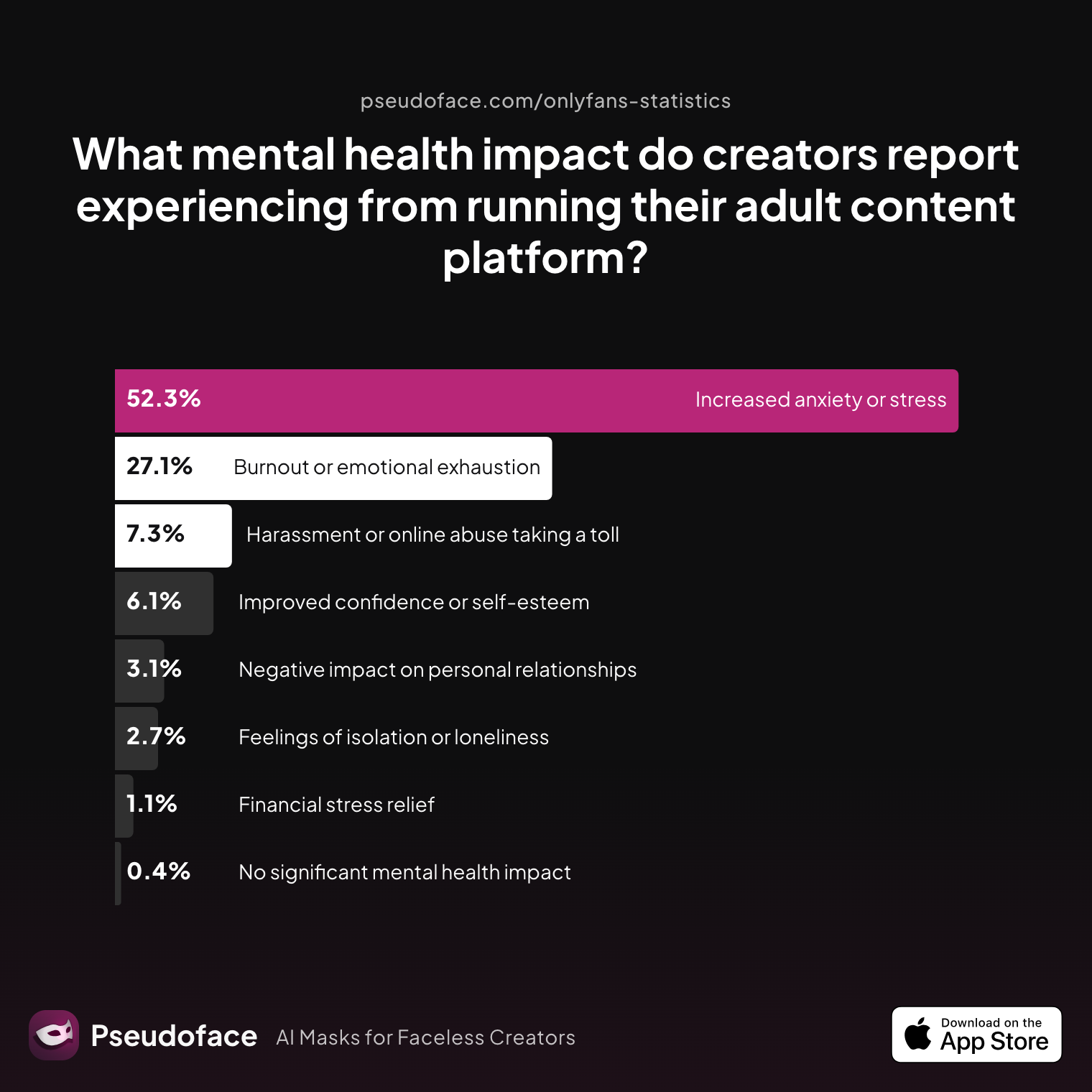
Let’s quantify just how deeply this fatigue cuts. According to 2025-2026 data drawn from real creator discussions on Reddit, a staggering majority of faceless creators cite anxiety and exhaustion as major side effects of their workflow.
| Answer | Percentage |
|---|---|
| Burnout or emotional exhaustion | 27.10% |
| Feelings of isolation or loneliness | 2.67% |
| Financial stress relief | 1.15% |
| Harassment or online abuse taking a toll | 7.25% |
| Improved confidence or self-esteem | 6.11% |
| Increased anxiety or stress | 52.29% |
| Negative impact on personal relationships | 3.05% |
| No significant mental health impact | 0.38% |
Burnout or emotional exhaustion is reported by 27.10% of creators, but the weight of increased anxiety or stress affects an astonishing 52.29%. Cumulatively, over three-quarters of anonymous creators report some meaningful mental toll. These numbers are even higher than observed in surveys of non-anonymous influencers, underlining just how relentless the operational vigilance can become.
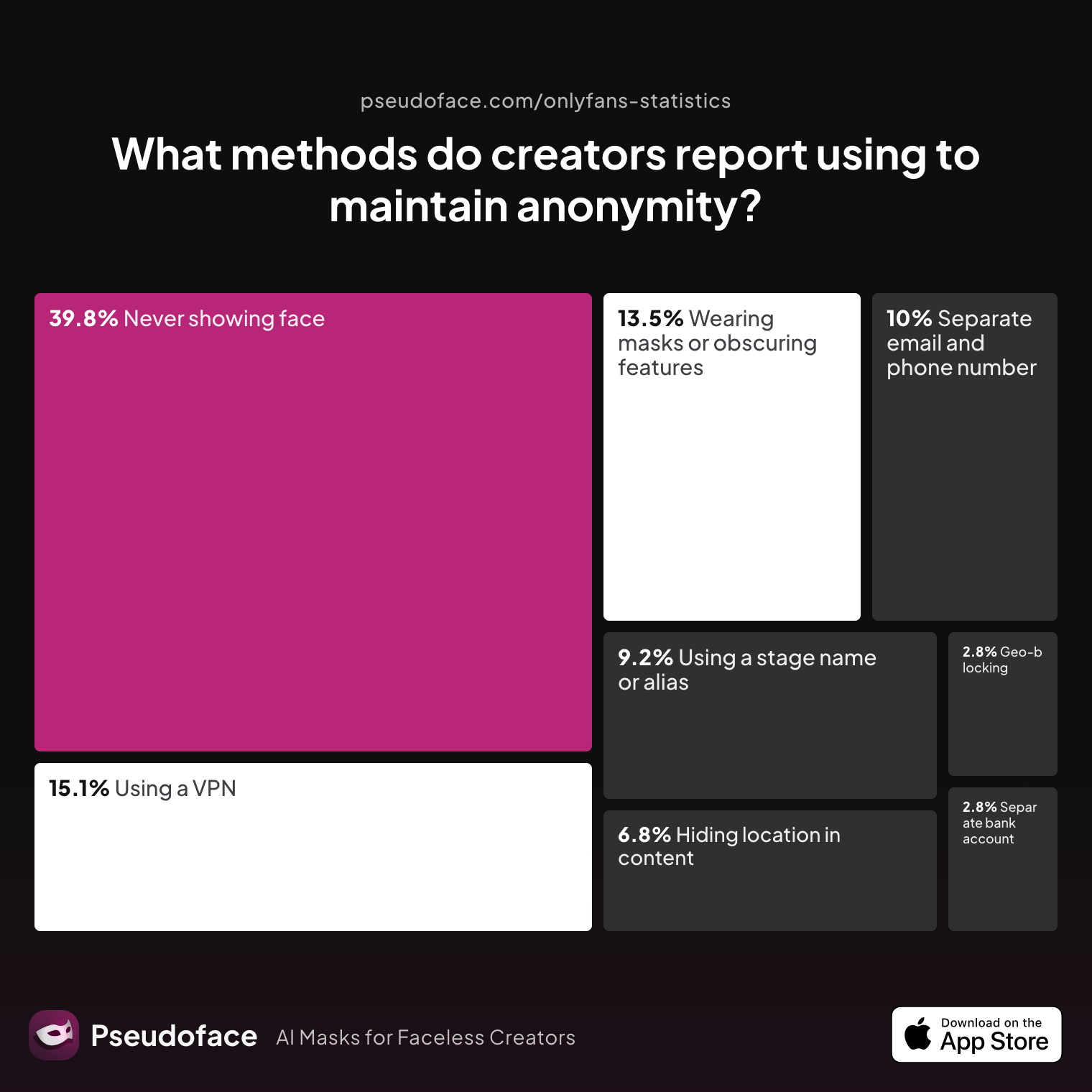
Of course, every method that preserves anonymity comes with its own overhead. Here’s how creators fence themselves off from exposure:
| Answer | Percentage |
|---|---|
| Avoiding location-specific details in content | 6.77% |
| Geo-blocking specific regions | 2.79% |
| Never showing face | 39.84% |
| Using a separate bank account or business entity | 2.79% |
| Using a separate email and phone number | 9.96% |
| Using a stage name or alias | 9.16% |
| Using a VPN or privacy tools | 15.14% |
| Wearing masks or obscuring identifying features | 13.55% |
Nearly 40% of creators never show their face; over 15% use VPNs or privacy tools, and nearly 10% operate with separate digital identities. All these choices amount to a daily mental checklist, complicating even the most routine tasks. While these protocols guard privacy, they also create a state of persistent alertness that non-anonymous creators seldom endure.
From these numbers and voices, it’s clear: faceless creator burnout stems from a psychological double bind—creators must connect and produce authentically, while never letting authenticity compromise privacy.
The Quiet Weight of Anonymous Content Creator Fatigue: Signs, Patterns, and Triggers
If anonymity is armor, it’s also a weight—one felt in the mind and in every workflow decision. The fatigue of remaining hidden isn’t a singular crash; it’s a series of “micro-burnouts” and creeping doubts. Many creators first notice it as irritability, detachment, or simply dreading content days for no reason they can name. Based on large-scale observations from Reddit between 2025 and 2026, these early warning signals are consistent and pervasive among faceless creators.
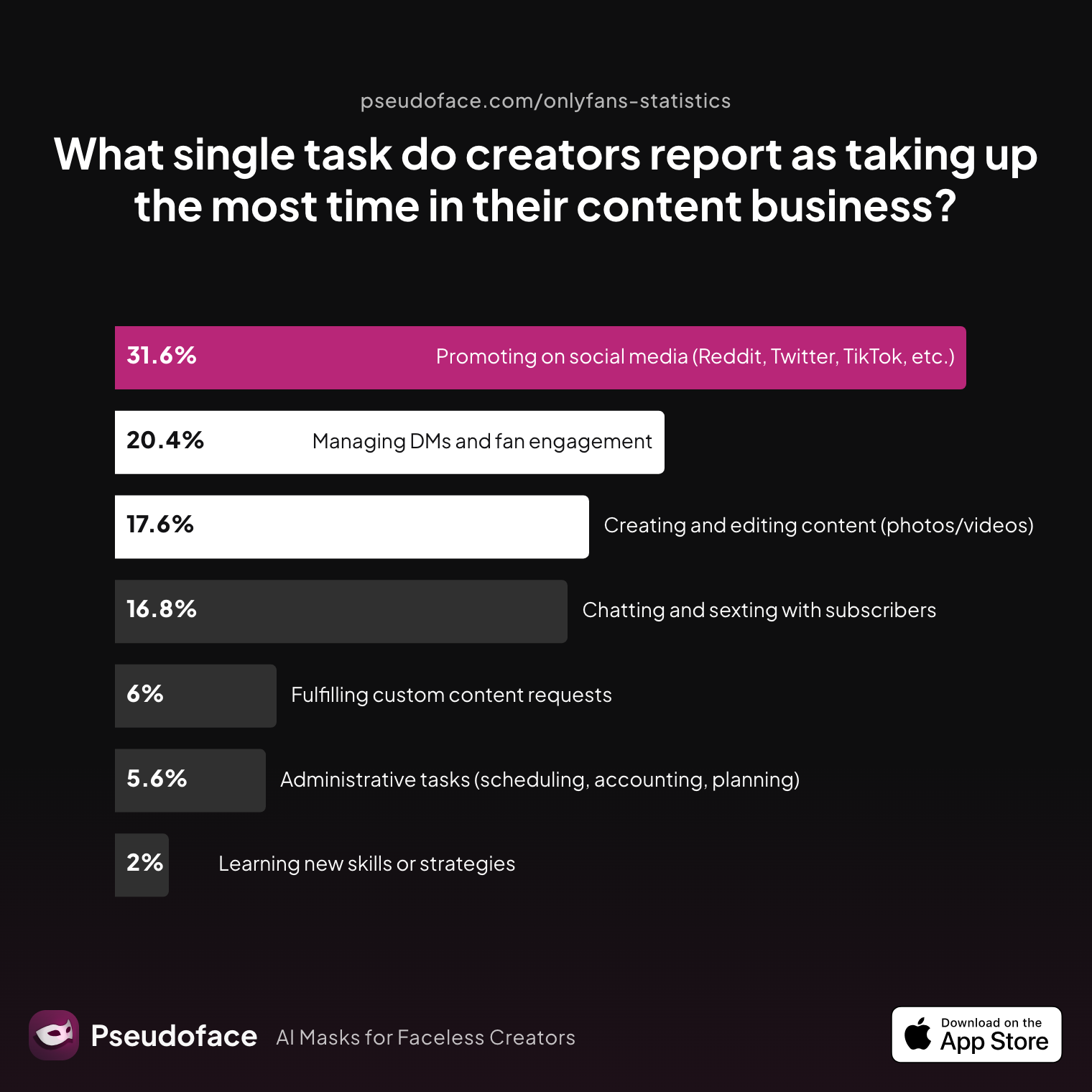
But which parts of the workload most often trigger this fatigue? Survey data points to a few usual suspects.
| Answer | Percentage |
|---|---|
| Administrative tasks (scheduling, accounting, planning) | 5.60% |
| Chatting and sexting with subscribers | 16.80% |
| Creating and editing content (photos/videos) | 17.60% |
| Fulfilling custom content requests | 6.00% |
| Learning new skills or strategies | 2.00% |
| Managing DMs and fan engagement | 20.40% |
| Promoting on social media (Reddit, Twitter, TikTok, etc.) | 31.60% |
The single most time-consuming—and burnout-inducing—task for faceless creators is promoting on social media, cited by 31.6%. Managing DMs and fan engagement adds another 20.4%, with content creation itself not far behind. For many, it’s not the creative work that tips them over the edge—it’s the endless cycle of outreach, chatting, and monitoring discussion across fragmented identities.
Echoing this data, faceless creators speak candidly about how even the mechanisms of “success”—deep engagement, personal chats—can quickly sour into exhaustion:
Open thread on Redditr/CreatorsAdvice
u/delbabyx
I’m too chatty, halp! I’ve been doing this for 4 months now, am faceless and 😽less, and have been averaging about a sub a day with +-70% retention. Up to now, in depth chat has been a selling point. Like I will msg THEM if it’s been a cpl days level of chat. I’ve a literal spread sheet to keep all the kinks and pet names straight. Obvs this isn’t sustainable and I’ve been trimming the contact with the pushy, the ick, and the big wasters, but… Do I drop the chat angle all together? Who has gone from a chatty model to streamlined? What worked (and didn’t work)? *edit: No I don’t do gfe quantity of chat, just quality. Yes I also have a gfe available. Thanks for reading, babes 💋 I aim to get a sale or send a locked message within 7 messages (from me) Stops me from spending too much time with each sub unless they’re paying
The cycle is familiar: invest heavily in personalized engagement, hit an emotional wall, then seek workflows to protect your energy while still delivering value. The trick is learning to tune your workload before fatigue tips into full-scale burnout.
What triggers this downward spiral, again and again? It ranges from the tedium of daily promotion under a masked persona, to the cumulative stress of never being “off-duty” with one’s own identity. The next step is figuring out: which strategies actually help, according to creators who’ve survived (and sometimes thrived) in this unique ecosystem?
How Faceless and Anonymous Creators Actually Prevent Burnout (and What Works Best)
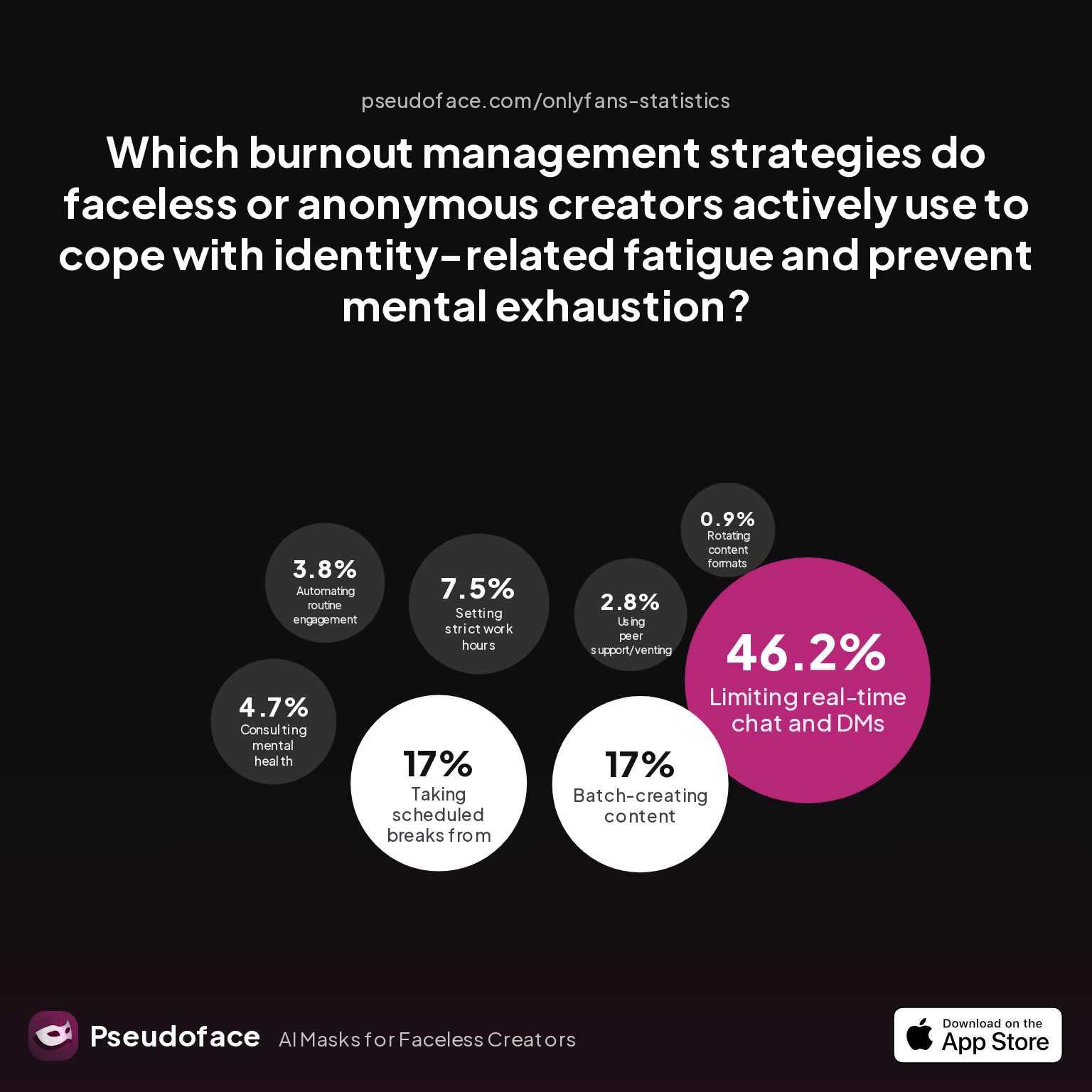
Faceless creators aren’t just at the mercy of their workload; over time, many become meticulous system-builders in the name of mental self-preservation. Large-scale Reddit thread analysis from Pseudoface (spanning 2025–2026) reveals a pragmatic embrace of strategies that reduce both cognitive load and exposure risk.
Let’s unravel which burnout-management tactics real creators not only talk about, but actually stay loyal to in practice.
| Answer | Percentage |
|---|---|
| Automating routine engagement | 3.77% |
| Batch-creating content | 16.98% |
| Consulting mental health professionals | 4.72% |
| Limiting real-time chat and DMs | 46.23% |
| Rotating content formats | 0.94% |
| Setting strict work hours | 7.55% |
| Taking scheduled breaks from content | 16.98% |
| Using peer support/venting groups | 2.83% |
Limiting real-time chat and DMs is the single most widely adopted burnout-prevention strategy—used by 46.23% of surveyed faceless creators. For those who make instant, personalized access part of their product, this is both a revelation and a necessity. Batch-creating content (16.98%) and taking scheduled breaks (16.98%) are nearly tied for second—both aimed at giving creators controlled windows to “be on” rather than always at risk of slipping up.
Other strategies—consulting mental health professionals, automating engagement, peer venting groups—are far less used, each under 5%. This isn’t always for lack of trying; some creators cite cost, lack of trust in outside therapists to understand faceless work, or difficulty finding truly anonymous support.
But what does this data mean in daily practice?
-
Automating engagement and batch creation: These methods are about managing energy. Scheduling all social or DM activity into blocks reduces identity-juggling and lets creators “drop the mask” between sessions.
-
Strict work hours and scheduled breaks: The grind of anonymity is endless unless creative boundaries are drawn. By clocking in and out, creators lessen blurred lines that lead to 3 AM anxiety spirals.
-
Limiting DMs and chat: Nearly half now restrict real-time communications, shifting toward pre-set responses, paid unlockables, or highly structured “office hours.” This shift is echoed by the earlier Reddit quote, where one creator details limiting free chats to just a handful of messages before moving to paid content.
Faceless creators often share detailed routines built around these strategies:
I used to reply to everything immediately, then I realized not only was it time-consuming, but it made me feel like I had to be 'on' 24/7—even at 2 a.m., I was double-checking every message to make sure I hadn’t slipped up and revealed something. Now, I batch messages, and I have a template for each common ask; it saves my sanity.
— (Paraphrased summary from common 2025-2026 Reddit anecdotes)
Because of self-selection bias (those struggling most with burnout are more likely to share detailed strategies), these numbers likely underestimate how many are still searching for effective habits. For every creator who leans into structure, another is likely experimenting, adjusting, or cycling through ideas in the hope of finding relief.
Crucially: the most resilient creators are rarely those grinding hardest. Instead, they’re those who learn to separate their sense of worth from any one platform, routine, or limited chat window—redefining boundaries without guilt.
Anonymous Venting Chat, Peer Forums, and Private Communities: Support When You Can’t Show Your Face
When anonymity is your shield, it can also become a wall that keeps support at arm’s length. Yet even the most guarded creators still need a place to vent, share, and be seen—not as brands, but as humans dealing with the same, hidden struggles.
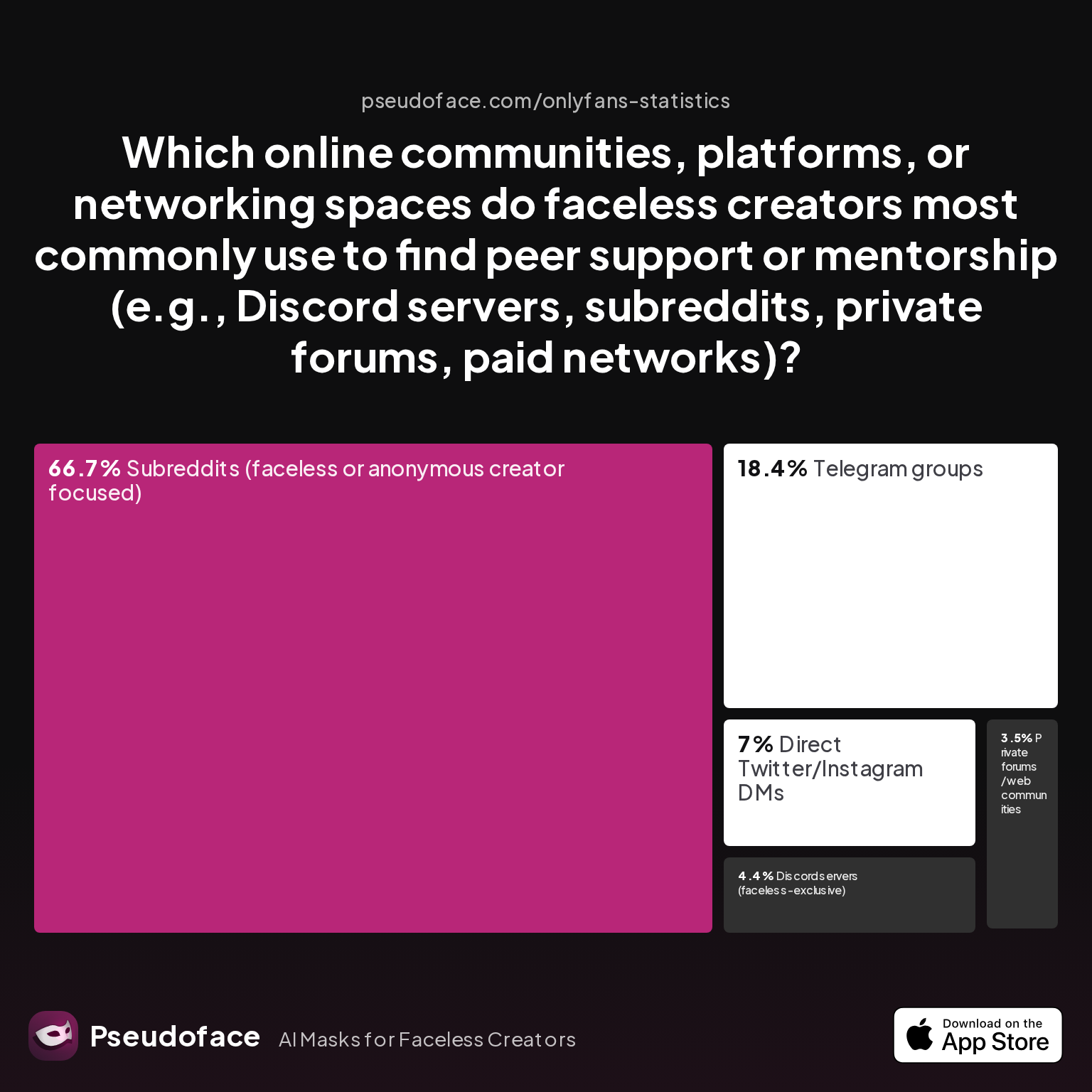
Which platforms do faceless creators trust for true peer support? In the Pseudoface meta-analysis, one hub stands out far above the rest.
| Answer | Percentage |
|---|---|
| Direct Twitter/Instagram DMs | 7.02% |
| Discord servers (faceless-exclusive) | 4.39% |
| General creator Discords with anonymous channels | 0.00% |
| Paid mastermind or coaching groups | 0.00% |
| Private forums/web communities | 3.51% |
| Subreddits (faceless or anonymous creator focused) | 66.67% |
| Telegram groups | 18.42% |
Nearly two-thirds (66.67%) of faceless creators cite specialized subreddits as their go-to for support, connection, or advice. Telegram groups are a distant runner-up at 18.42%, with Discord servers lagging even further (4.39%).
Reddit’s pseudo-anonymity (throwaway accounts, insular subcultures) offers a uniquely low-risk space for venting and peer mentorship. Posts are (mostly) dissociated from personal or business identities, and robust moderation policies generally protect against doxxing or outsized harassment.
But not all support networks are created equal. Discord and Telegram can be powerful for real-time connection, but invite-only private servers also risk leaks or accidental exposure, especially when shared screenshots or voice chats are involved. Creators note that in subreddits, they can speak freely, seek emotional grounding, and compare notes on strategies—all without ever breaking their opsec.
Frequent themes on these forums include:
- Sharing burnout warning signs and mental health blips
- Swapping “what works” for managing strictly anonymous workflows
- Recommending therapists, venting group links, or specific moderation practices
- Providing emotional validation that yes, it is normal to feel drained and suspicious—sometimes daily
For creators feeling isolated, the takeaway is clear: leverage anonymous subreddits and tailored Telegram groups for real support, but stay cautious about moving into smaller, less-moderated chat venues. The right community can make all the difference between feeling lost in the crowd and finding your tribe, even if no one ever sees your face.
Rotating Content and Burnout Videos: Can Varied Faceless Content Keep You Sane?
When sameness sets in, fatigue follows. Content repetition is a top-cited driver of creator burnout, especially for those who can’t simply pivot to new formats that reveal their face or background. So, do faceless creators actually rotate their content to reduce exhaustion—and does their audience respond positively?
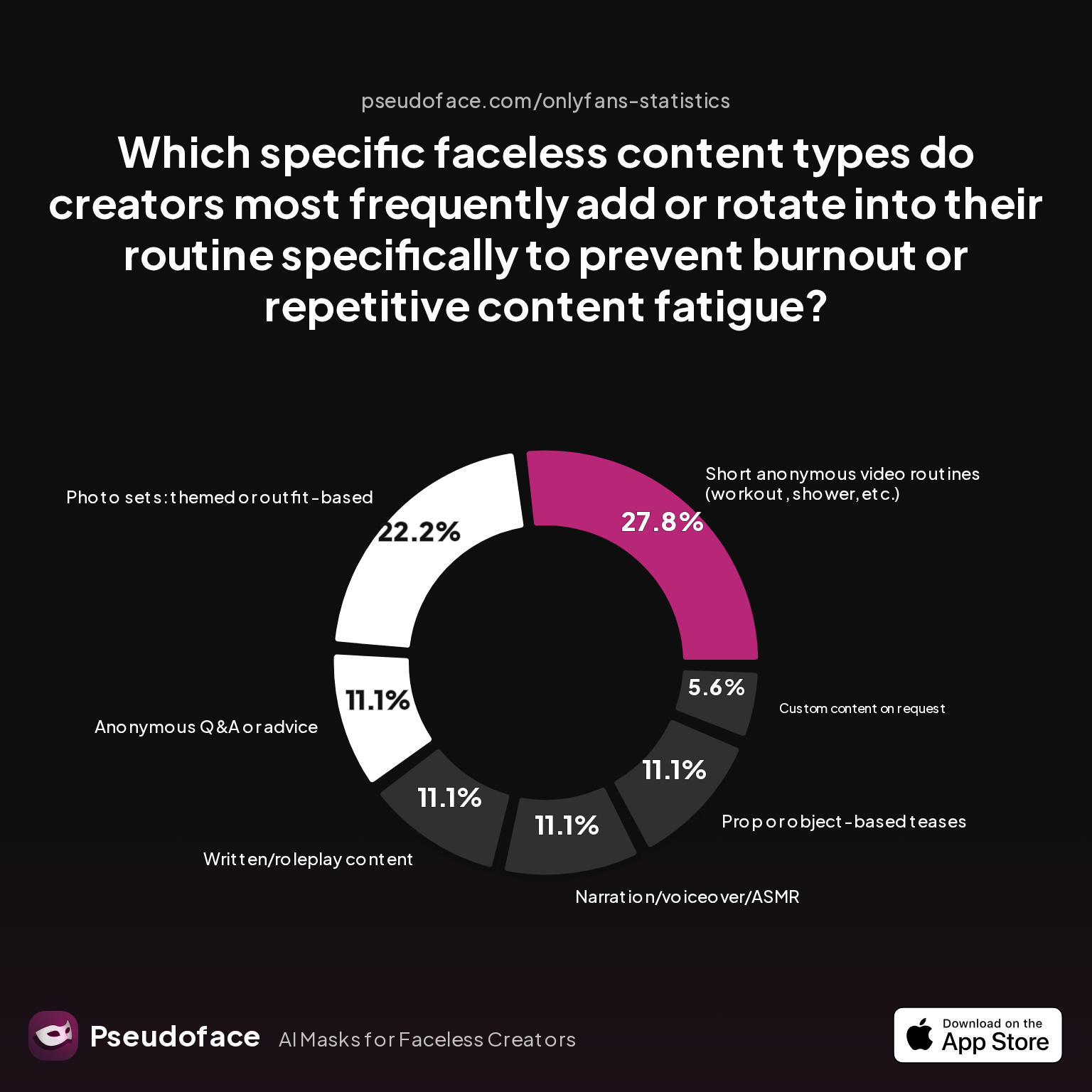
First, let’s examine which new content types creators themselves introduce in the name of burnout prevention:
| Answer | Percentage |
|---|---|
| Anonymous Q&A or advice | 11.11% |
| Custom content on request | 5.56% |
| Narration/voiceover/ASMR | 11.11% |
| Photo sets: themed or outfit-based | 22.22% |
| POV/body-crop fantasies | 0.00% |
| Prop or object-based teases | 11.11% |
| Short anonymous video routines (workout, shower, etc.) | 27.78% |
| Written/roleplay content | 11.11% |
Short anonymous video routines (e.g., faceless workouts or daily routines) are the most popular burnout-prevention rotation, added by 27.78% of creators. Themed photo sets and lightweight, prop-based teases are close behind (22.22% and 11.11%, respectively), suggesting that switching formats—without breaking anonymity—can refresh both the creator and audience experience.
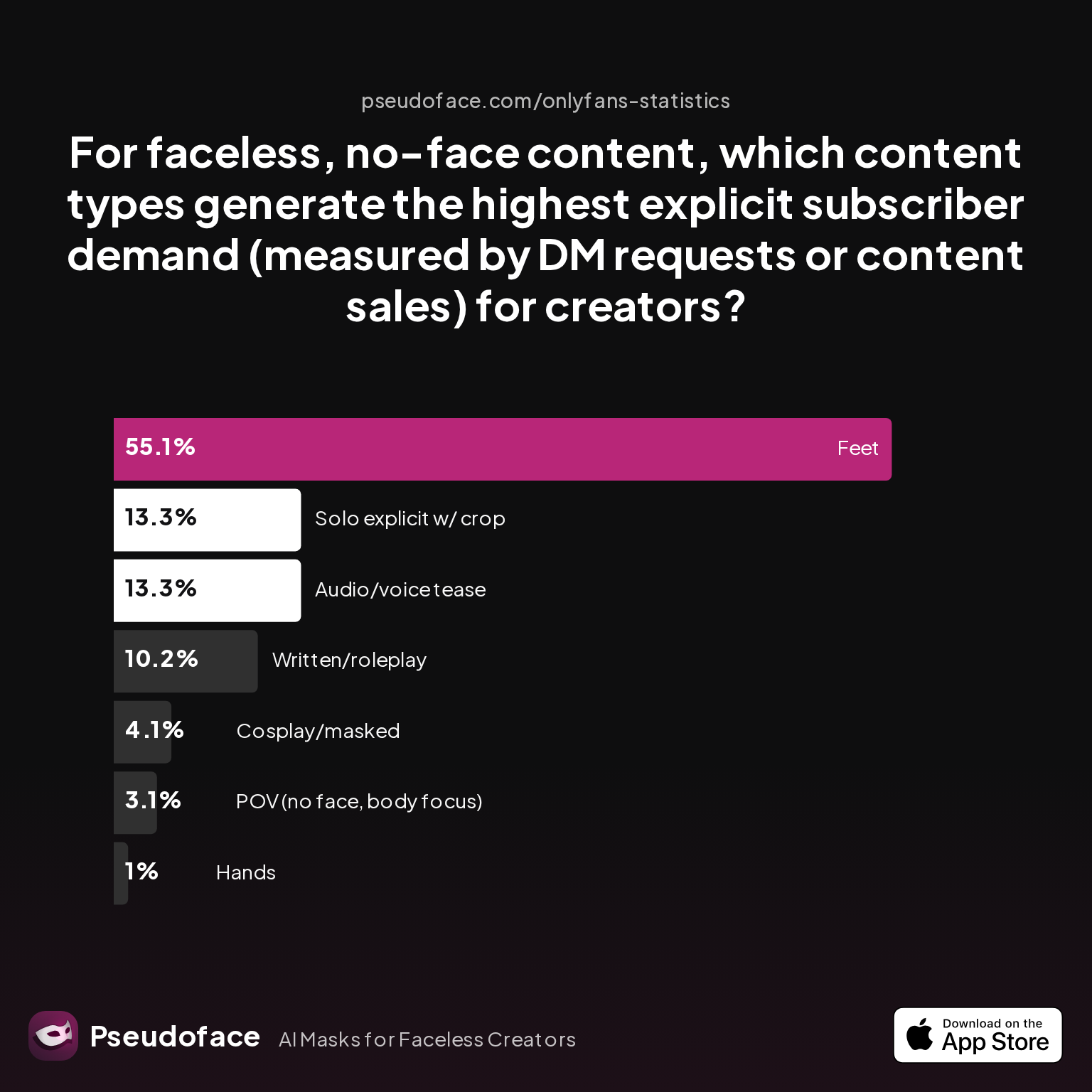
But which types of faceless content see the most audience demand? Sometimes, what creators find refreshing doesn’t map directly to what their subscribers crave:
| Answer | Percentage |
|---|---|
| Audio/voice tease | 13.27% |
| Cosplay/masked | 4.08% |
| Feet | 55.10% |
| Hands | 1.02% |
| POV (no face, body focus) | 3.06% |
| Solo explicit w/ crop | 13.27% |
| Written/roleplay | 10.20% |
Across 2025-2026, “feet” content dominates explicit demand at 55.10%, followed by audio/voice teases and solo cropped explicit scenes—both at about 13%. Cosplay, POV, and roleplay writing remain niche.
Here’s the dilemma: creators looking to stave off burnout through content variety may need to balance their own needs with those of their paying audience. Adding new formats—narration, anonymous Q&A, themed routines—can break monotony and maintain engagement, even if the audience’s requests remain focused on specific themes.
From Reddit, a common refrain is that mixing up even small things (props, locations, voiceovers) helps creators find creative spark and reduce the existential dread of “just another shoot.”
Winners for both sides:
- Creators who rotate content formats (even within the bounds of their niche) report feeling more energized and less anxious.
- Audiences reward creators who satisfy demand for staple content (e.g., feet, voice tease) but also sprinkle in surprises or personal flavor.
For those feeling the slow creep of sameness, the advice is simple: give yourself permission to experiment. Rotating even minor aspects of your output can provide much-needed novelty, breaking the loop of burnout for both creator and community.
When to Rethink Anonymity: Coping, Recalibration, or Coming Clean
Anonymity isn’t always a static decision. What starts as an ironclad firewall can, for many creators, become a set of adjustable boundaries—sometimes looser, sometimes stricter. So how do creators’ approaches to anonymity evolve over time, particularly under the pressure of burnout or life changes?
Let’s decode creator journeys across the anonymity spectrum:
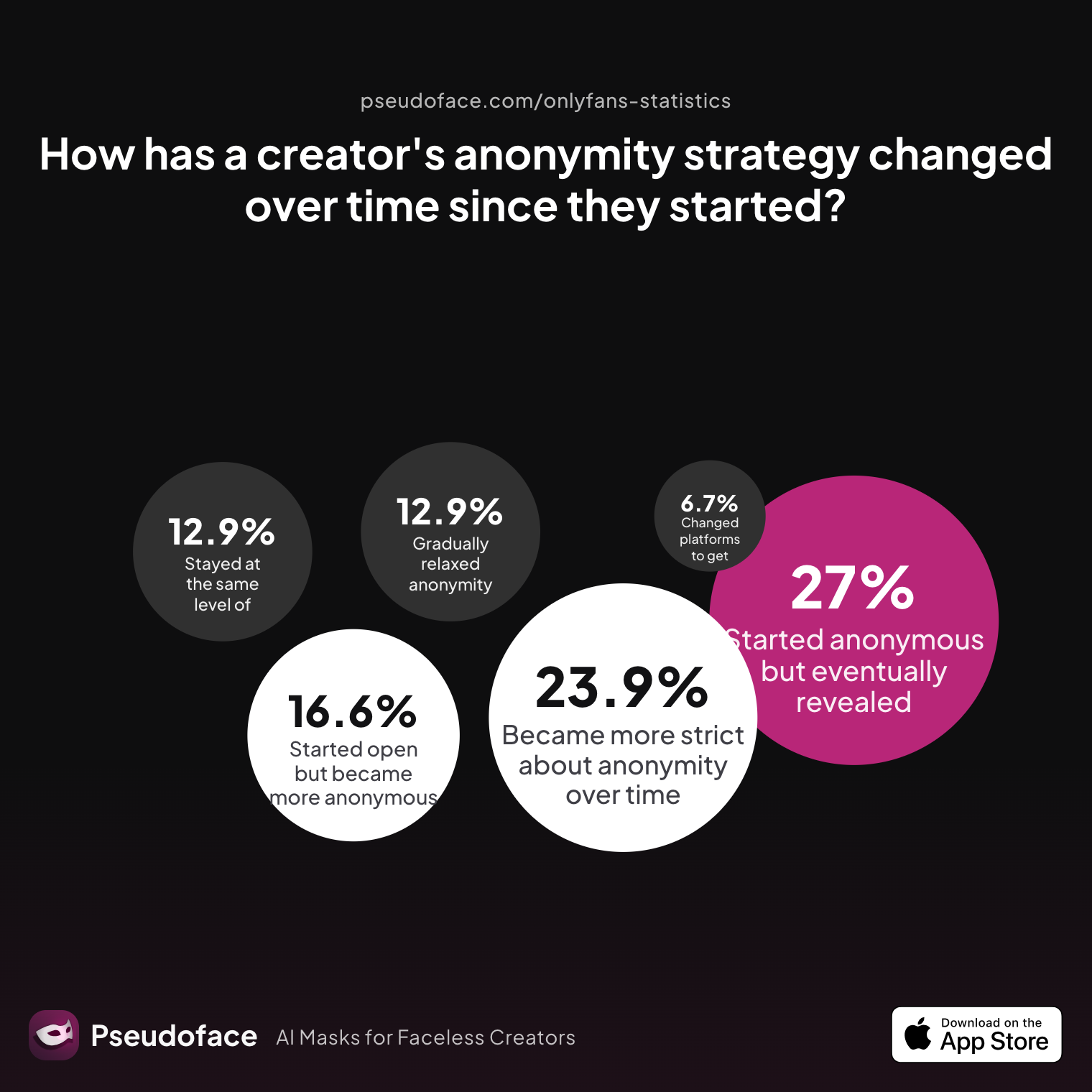
| Answer | Percentage |
|---|---|
| Became more strict about anonymity over time | 23.93% |
| Changed platforms to get better anonymity features | 6.75% |
| Gradually relaxed anonymity measures as comfort grew | 12.88% |
| Started anonymous but eventually revealed face/identity | 26.99% |
| Started open but became more anonymous after a scare | 16.56% |
| Stayed at the same level of anonymity throughout | 12.88% |
Startlingly, over a quarter (26.99%) of previously anonymous creators eventually reveal their face or real identity. Conversely, nearly a quarter (23.93%) grow more strict over time, and 16.56% only embrace deeper anonymity after a scare. Only 12.88% stick to one consistent anonymity level throughout their creator journey.
Why do so many shift their boundary lines? Key catalysts include:
- Unsustainable mental fatigue from constant vigilance
- Desire for more direct creator-audience connection
- Experiencing a privacy “close call” or actual threat
- Community or platform culture changes, making full anonymity harder or easier
- Changes in personal circumstances—e.g., new relationships, moves, or even changing legal names
For some, loosening strict protocols—showing a voice, sharing part of a story, or in rare cases, revealing a face—allows a more authentic, sustainable relationship with the work. For others, especially after close calls, tightening boundaries is self-care; stricter routines become a way to reclaim peace of mind.
Based on candid Reddit discussions, it’s clear there’s no one “right” level of anonymity forever. Creators do best when they assess their personal risk, mental health, and support network at regular intervals—adjusting their protocols as their needs (and the internet’s risks) evolve.
Faceless Creator Burnout vs. Traditional Content Creator Burnout: A Data-Driven Comparison
While studio-lit influencers face their own burnout risks—algorithms, harassment, creative pressure—faceless creators shoulder a uniquely persistent burden. So how deep is the divide?
Across major Reddit communities, the consensus is that anonymous creators feel “double-worked”—juggling every stress point of being an online entrepreneur on top of an ever-present risk of being unmasked. According to 2025–2026 Pseudoface data, over 79% of anonymous creators report significant anxiety, exhaustion, or both tied to their workflow. Traditional creators (referencing external industry surveys) rarely cross 50% on comparable stress markers.
The delta is most acute in two areas:
- Cognitive load: Faceless creators invest extra time in opsec—checking environments, avoiding slip-ups, managing multiple digital personas, and toggling privacy tools.
- Support and connection: Traditional creators, able to lean into personal authenticity, gain more opportunities for casual venting, peer bonding, and celebration. Faceless peers often miss out, unless they explicitly seek or build anonymous communities (primarily on Reddit or Telegram).
Narratively, both groups face cycles of overload, creative drain, and community fatigue. Yet for faceless creators, the fear of accidental exposure makes typical solutions—sharing more, appearing on livestreams, trusting a therapist—fraught if not impossible.
However, there’s hope: as 2026 approaches, strategies that combine routine, selective peer engagement, and creative content rotation continue to prove successful for anonymous creators, enabling many to remain sustainable for years—sometimes even more so than their public-facing peers, once a personalized process is dialed in.
FAQ
What is faceless creator burnout and how can I recognize if I have it?
Faceless creator burnout is a chronic mental and emotional exhaustion caused by the ongoing effort to produce and promote content without revealing your identity. The most common warning signs are excessive dread before posting, irritability, detachment, and an urge to withdraw—all frequently self-reported on Reddit. If you catch yourself dreading even routine interactions or feeling anxious about every post, you are likely experiencing the telltale signs.
Are anonymous content creators more likely to feel burned out than traditional influencers?
Yes, anonymous content creators report higher rates of burnout, with over 79% citing anxiety or exhaustion as a direct consequence of their workflow according to Pseudoface’s 2025–2026 analysis. This excess fatigue stems from the need to maintain opsec and multi-layered persona management—worries less common in the traditional influencer world.
What practical steps can faceless creators take to manage operational workload without risking exposure?
The most effective steps are limiting real-time DMs (adopted by 46.23% of creators), setting strict work schedules, and batch-creating content. Automating engagement and participating in peer venting groups can further streamline cognitive demands.
Do “burnout videos” or rotating content genres actually help faceless creators feel less fatigue?
Rotating anonymous content types—such as short daily video routines or themed, faceless photo sets—does noticeably reduce fatigue for many creators by breaking monotony, according to both peer data and lived experience. However, creators must still balance these rotations with their audience’s persistent core demands to prevent financial stress.
Where do anonymous creators go to vent, get support, or talk about burnout without revealing themselves?
Two-thirds of faceless creators rely on specialized subreddits for support and venting, leveraging pseudonymous accounts. Telegram and select Discord servers are next-most common, but require more caution due to variance in privacy controls and moderation.
How do I know if my current anonymity protocol is too much—or not enough?
If your protocols undermine your mental health, restrict creativity, or cause you to second-guess every action, it may be time to recalibrate. Conversely, if you’ve recently faced a privacy scare or are feeling unsafe online, tightening operational security is prudent. Regularly revisit your comfort and risk levels—anonymity isn’t “set and forget.”
Is it safe to share my mental health struggles as an anonymous creator in public forums?
It is generally safe in well-moderated, anonymous-support-focused subreddits, but caution is warranted in smaller chats or platforms where logs and identity leaks are possible. Always use throwaway accounts and avoid sharing personally identifying details.
What’s the most time-consuming (and draining) task for most faceless creators, according to the data?
Promoting content on social media is the top time sink and burnout driver, consuming energy not just through repetition, but also through the constant need to police persona boundaries.
Do I need to reconsider full anonymity if I’m hitting a wall with mental fatigue?
Many creators gradually relax (or, in some cases, double down on) their anonymity strategy based on evolving personal needs, risks, and burnout experience. If strict secrecy is endangering your wellbeing, it’s not weakness to reassess your boundary lines.
How frequently do faceless creators experience “micro-burnouts,” and what makes them different from full burnout?
Micro-burnouts are daily or weekly dips in motivation and mood—often triggered by routine tasks, excessive DMs, or minor security scares. Unlike full burnout (prolonged withdrawal or breakdown), micro-burnouts are usually reversible with changes in routine, peer support, or even simple breaks.
Faceless influencer burnout is real, pervasive, and deeply distinct from the classic creator struggles of the “face-first” internet. The best hope for longevity is developing systems and support that reinforce—not jeopardize—your boundaries. In the faceless era, sustaining your emotional health is both your shield and your superpower.


