
TL;DR
Dating while maintaining anonymity as a faceless OnlyFans creator is an ongoing negotiation between personal intimacy, privacy, and professional survival. Based on 2025-2026 findings from Pseudoface's analysis of over 250,000 public Reddit threads by real creators, most faceless creators wait until trust is established—often the second or third date—before disclosing, and 62.5% of partners are supportive or neutral if told. Those who proactively establish boundaries and leverage geo-blocking report fewer accidental exposures. There is no universal playbook, but tactics, lived experience, and large-scale peer data point to practical ways to reduce anxiety and protect both your heart and your online persona.
Understanding the Faceless OnlyFans Creator Experience
Even before the first date, faceless OnlyFans creators stand at a crossroads: maintain professional anonymity, or risk exposure to satisfy the quest for romantic authenticity. In a world where digital footprints often linger forever, the stakes can be profoundly high—especially for women, nonbinary people, or anyone facing judgment, doxxing, or career consequences for their online sex work. Most creators in this space do not seek facelessness for the aesthetics; anonymity is the shield that makes this career even possible.
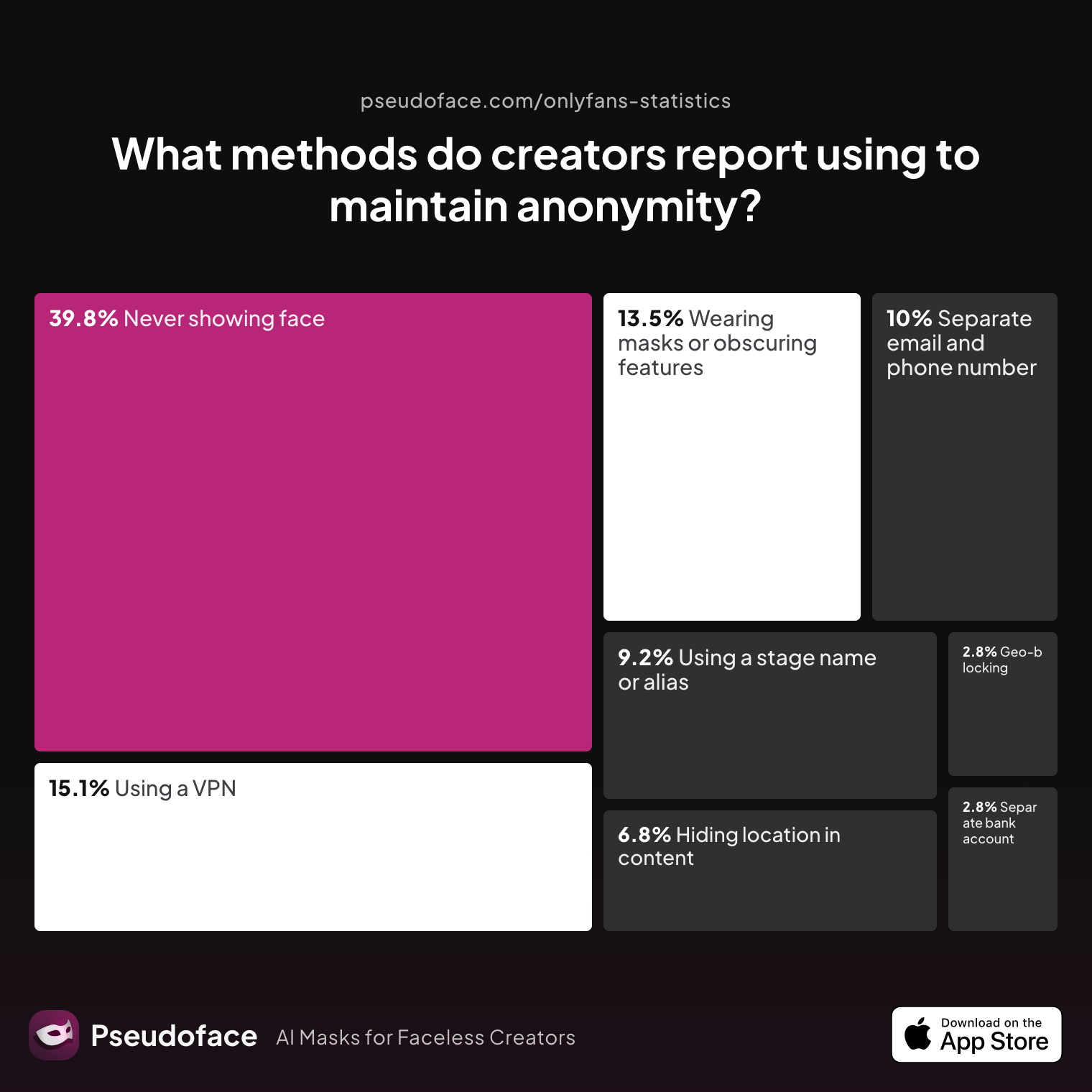
Let’s look at how faceless creators actually protect their identities in 2025, grounded in large-scale, real-world data:
| Answer | Percentage |
|---|---|
| Avoiding location-specific details in content | 6.77% |
| Geo-blocking specific regions | 2.79% |
| Never showing face | 39.84% |
| Using a separate bank account or business entity | 2.79% |
| Using a separate email and phone number | 9.96% |
| Using a stage name or alias | 9.16% |
| Using a VPN or privacy tools | 15.14% |
| Wearing masks or obscuring identifying features | 13.55% |
Nearly 40% of creators surveyed never show their face, and another 13% rely on masks or techniques to hide identifying features. VPNs and privacy tools are in widespread use (15%), and a smaller but significant share constructs entirely separate digital and financial lives around their creator identity. This convergence of privacy tactics underscores just how deliberate and technical this lifestyle can be.
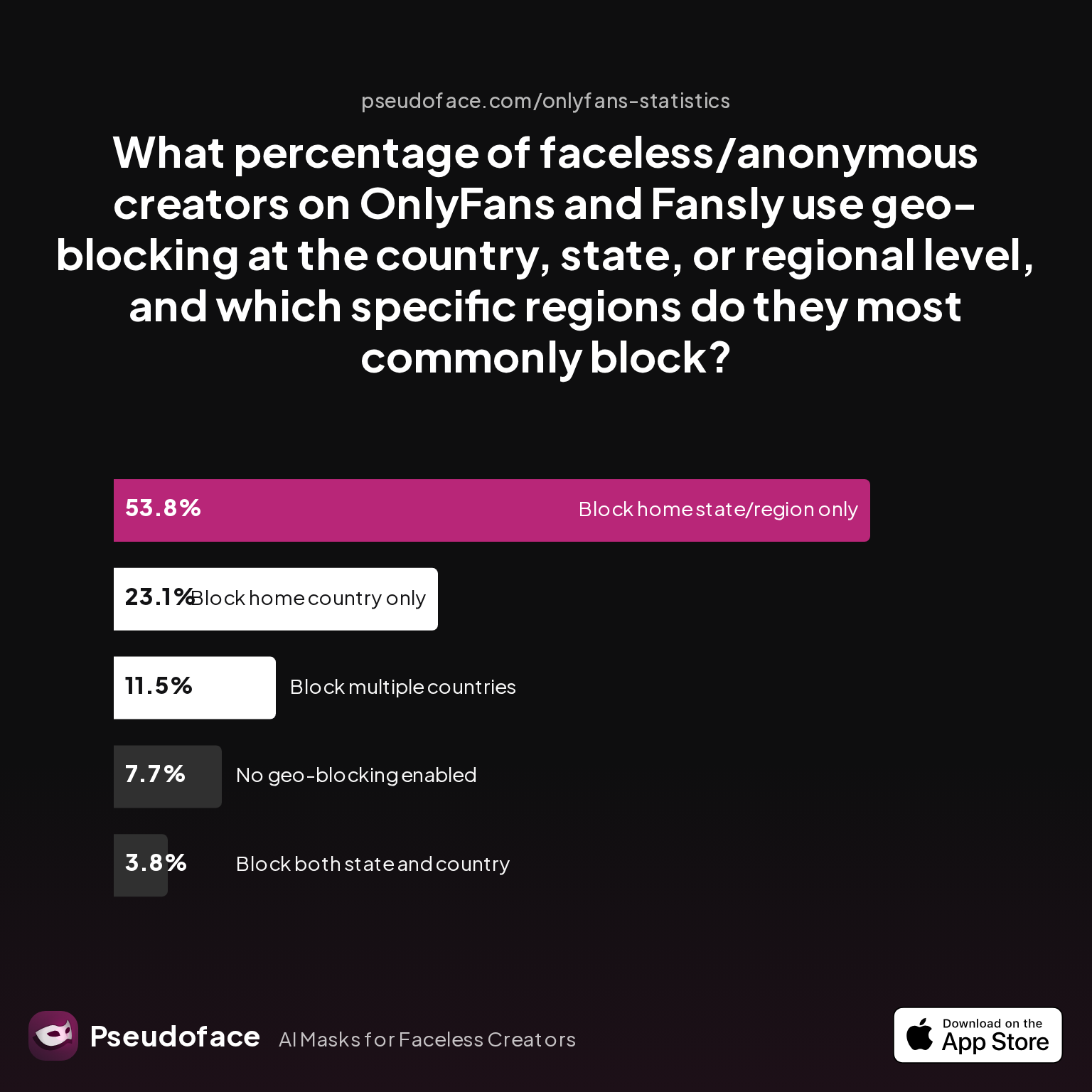
Geo-blocking is one of the most powerful lines of defense—shielding your content from people in your immediate real-life sphere (family, partners, colleagues, or even your entire region):
| Answer | Percentage |
|---|---|
| Block both state and country | 3.85% |
| Block home country only | 23.08% |
| Block home state/region only | 53.85% |
| Block multiple countries | 11.54% |
| No geo-blocking enabled | 7.69% |
A full 54% of creators block their home state or region, and another 23% block their entire home country. Just 8% forgo geo-blocking altogether—evidence that among faceless creators, risk is rarely underestimated.
The decision to operate faceless is not simply a branding preference; it’s a deeply held strategy for self-preservation in personal, legal, and professional realms. This constant vigilance seeps into every dating interaction, especially when the line between intimacy and exposure grows thin.
With this backdrop, we turn to one of the toughest decisions: when (and whether) to disclose your creator role to someone you’re seeing.
Breaking the Silence: When Do Faceless OnlyFans Creators Disclose Their Secret?
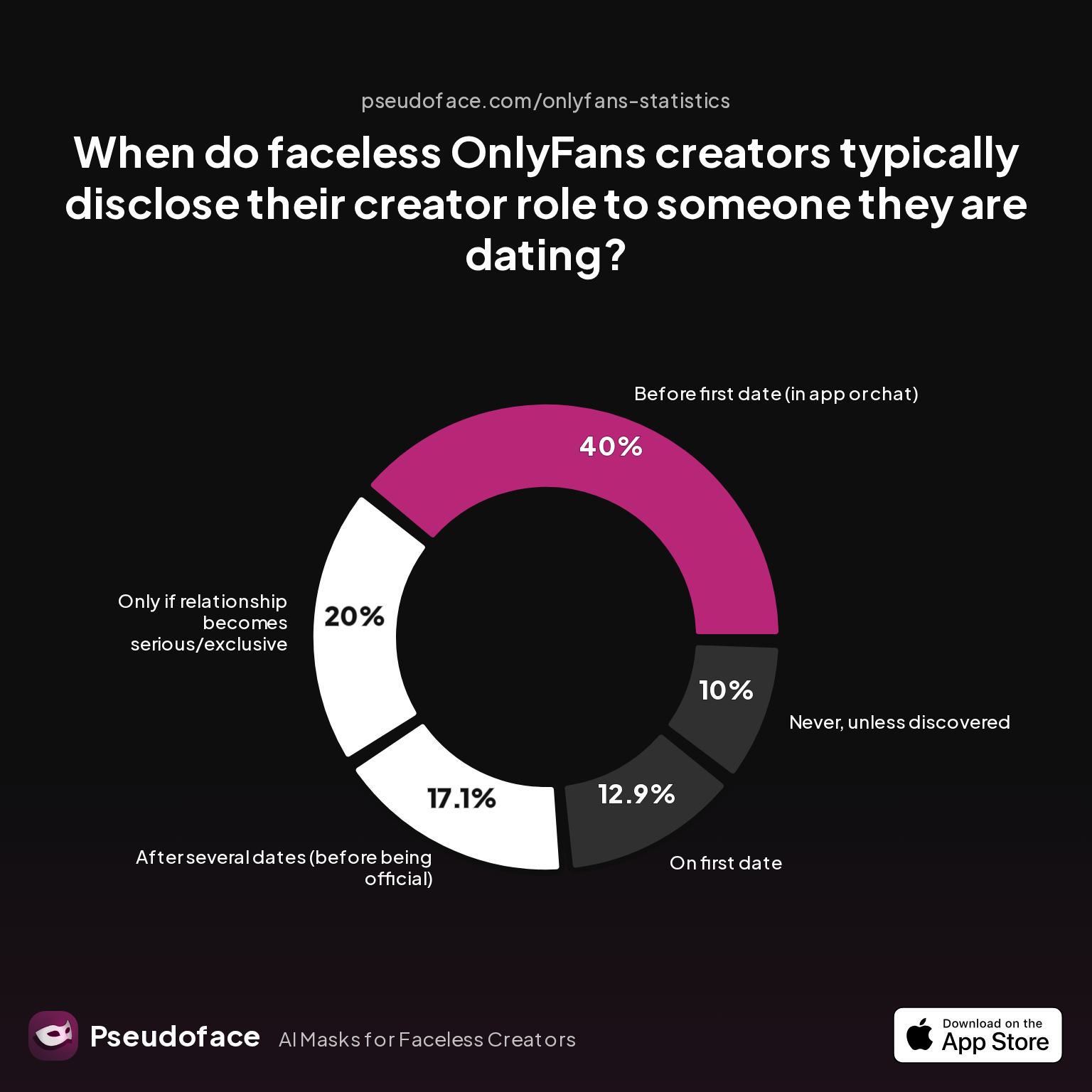
The moment of disclosure—if it comes at all—is a fraught one. The data from the OnlyFans faceless creator community reveals no consensus, but several leading patterns emerge.
| Answer | Percentage |
|---|---|
| After several dates (before being official) | 17.14% |
| Before first date (in app or chat) | 40.00% |
| Never, unless discovered | 10.00% |
| On first date | 12.86% |
| Only if relationship becomes serious/exclusive | 20.00% |
40% of faceless creators choose to disclose before the first date via chat or dating app, but another 37% wait until multiple dates have passed or the relationship has become serious. The “never disclose (unless discovered)” group remains a notable minority at 10%.
Why such variation? The calculus is brutally personal: risk of premature outing versus the anxiety of holding onto a secret, the desire for authentic connection versus the terror of potential judgment.
Open thread on Redditr/onlyfansadvice
u/FionaFoxxx9
I don’t tell them till the 2nd or 3rd date. I want them to get to know ME on the first date & then realize I’m no different before or after they find out. I’m still a human looking for love lol. I just have a sexy side hustle
This sentiment echoes through much of the advice on OnlyFans subreddits. Creators want to be known as full people, not reduced to the label of “sex worker,” but also seek to limit the power of this secret to disrupt their sense of normalcy at the start.
Trust and relationship seriousness are persistent themes. As another creator points out:
Open thread on Redditr/onlyfansadvice
u/catcar8888
I would be honest about it in person and as soon as you feel that it is getting more serious and that you can also trust them. It would kinda suck if it didn't work out and then some guy is walking around knowing this about you when nobody else in your personal life knows
But caution is also common, especially for those who have been burned:
Open thread on Redditr/onlyfansadvice
u/kuzagirl
I would wait and build trust before telling them. Just had a bad experience with someone I met online and had spent a lot of time talking with, FaceTiming etc. When I told him I was taking a step back(because of some behaviors from him I didn’t like) he basically told me I was a whore and that he had found my Reddit etc(I never shared any of my online SW info with him). I honestly felt creeped out and regretful that I had trusted this person to share personal details with him. Just be careful out there.
Self-selection and survivorship bias affect these numbers: creators sharing successful or failed disclosure stories are not a perfect cross-section of all outcomes. Still, the common thread is that disclosure is far from automatic, and always weighed against the creator’s evolving risk tolerance.
Timing is only half the story—the next question is what happens once you do open up.
What Happens After Disclosure? Real Outcomes and Partner Reactions
For faceless OnlyFans creators, the greatest fear around disclosure is not only judgment—it’s the threat of rejection, humiliation, or even being outed to others. Yet, aggregated self-reported outcomes are surprisingly hopeful, though decidedly complex.
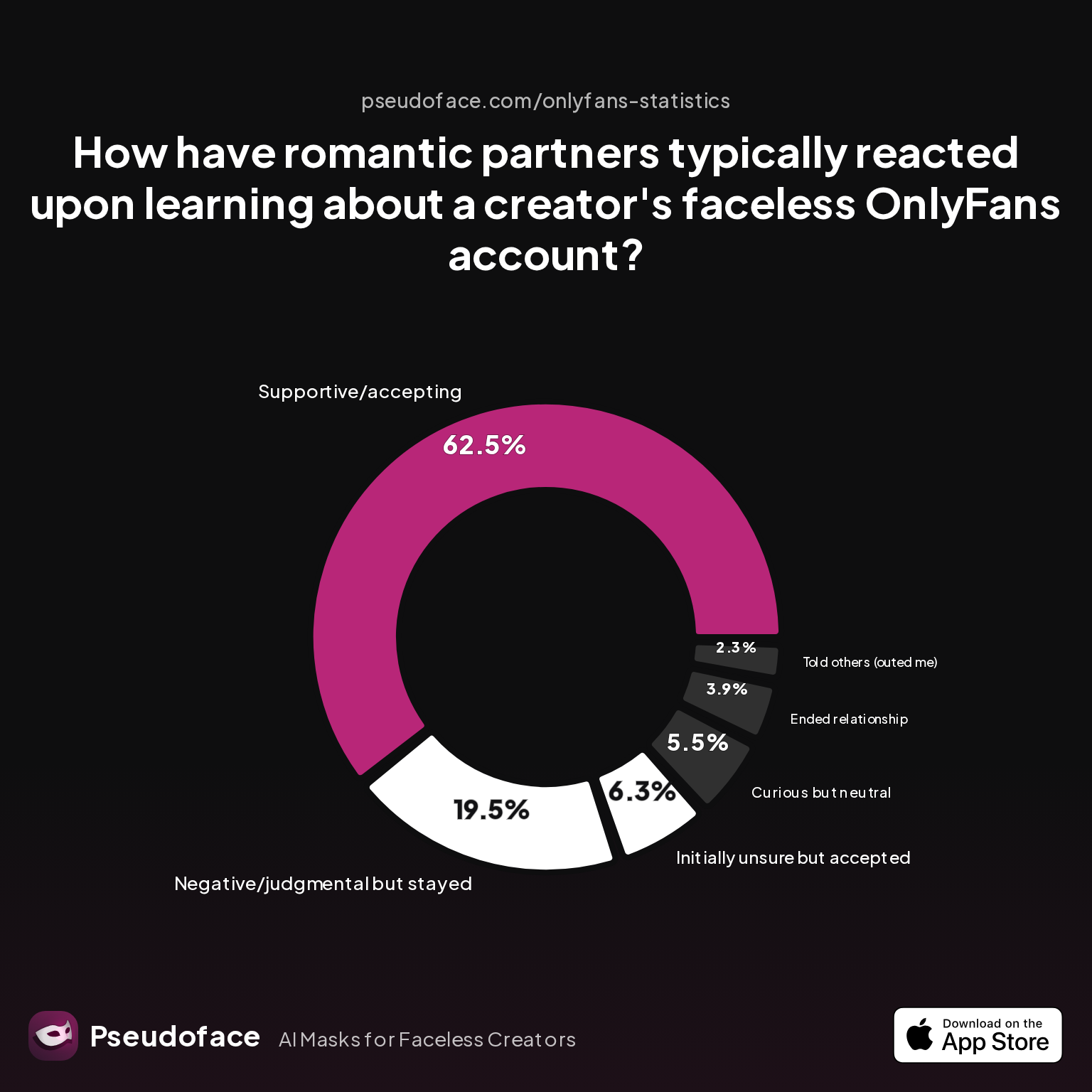
| Answer | Percentage |
|---|---|
| Curious but neutral | 5.47% |
| Ended relationship | 3.91% |
| Initially unsure but accepted | 6.25% |
| Negative/judgmental but stayed | 19.53% |
| Supportive/accepting | 62.50% |
| Told others (outed me) | 2.34% |
62.5% of creators report that their partners were supportive or accepting after disclosure; less than 4% say the relationship ended because of it, and just 2.3% were outed to others. However, nearly 20% found their partner stayed but was negative or judgmental, underscoring a very real emotional tax.
This is both reassuring and sobering. The majority of partners, when trusted with the truth, move forward with acceptance. But the risk of negativity or breach of privacy is not negligible.
Reddit’s lived experience brings these stats to life. Here, creators weigh honesty against hard-won caution—and sometimes disappointment:
Open thread on Redditr/CreatorsAdvice
u/AVixenDistraction
I make it clear what I do and what variation of content creation, but I won't go into a lot of detail, and I NEVER show them anything from work (or even share my brand name) until well into a serious relationship. One of MANY reasons for this is that your exes that know your work name will eyeball you there FOREVER. Ask me how I know. :( As to how to deal with parents, that's another story and you have to leave that kind of up to the partner.
This tale of ongoing vulnerability is common: disclosure does not end the risk, even if the reaction is initially positive. Exes and past partners who retain knowledge of your brand or links remain a persistent source of anxiety. On the other hand, some creators see disclosure as a filter:
Open thread on Redditr/CreatorsAdvice
u/malika-meteorite-
I'm upfront about it, if there's any interest. There's no compatibility between me and someone who doesn't support my work, and I don't want to waste my time or theirs!
From a risk analysis perspective, creators face a spectrum: outright rejection is statistically rare, leak or long-term judgment slightly more common, but the biggest group land in some zone of acceptance or pragmatic negotiation. Here, too, the bias is instructive: these numbers are drawn from those willing to self-report or who sought advice after difficult or positive disclosures. Many who never disclose (or are never discovered) may not report, so treat these as directional trends, not destiny.
For those creators at the crossroads—vividly aware of both support and scars in others’ stories—the decision becomes a deeply personal calculation. For many, avoiding being outed remains the overriding mission, and leads to the next crucial internal debate.
For those deciding whether or not to disclose, weighing risks and benefits is crucial—so let's examine the emotional pros and cons, both for you and for your relationship.
The Internal Debate: To Share or Not to Share? (Comparison)
Disclosing your faceless creator identity is never a simple pro/con calculation. Still, comparing the emotional, practical, and relationship-level tradeoffs can help clarify the stakes. Let’s anchor this with Pseudoface’s dataset on actual discovery events:
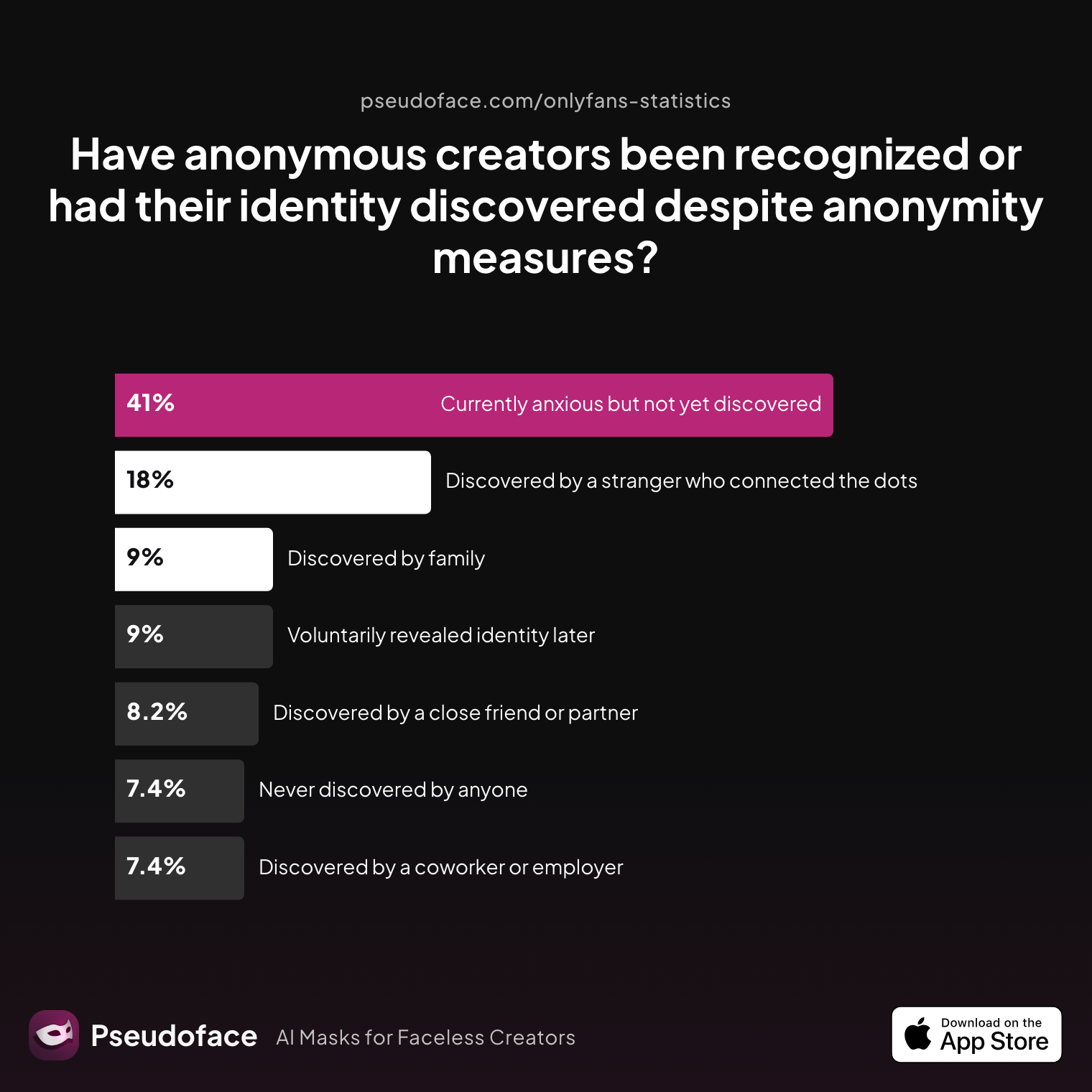
| Answer | Percentage |
|---|---|
| Currently anxious but not yet discovered | 40.98% |
| Discovered by a close friend or partner | 8.20% |
| Discovered by a coworker or employer | 7.38% |
| Discovered by a stranger who connected the dots | 18.03% |
| Discovered by family | 9.02% |
| Never discovered by anyone | 7.38% |
| Voluntarily revealed identity later | 9.02% |
41% of anonymous creators live with near-constant anxiety about eventually being discovered, while only 8% have actually been unmasked by a partner or friend. Discovery by strangers or family is notably higher, highlighting how risk is not confined to romantic contexts.
Here’s a comparison of the two major pathways:
| Scenario | Upsides | Downsides/Anxieties |
|---|---|---|
| Disclose to partner (early or timely) | Reduces anxiety, creates space for support; | Possible rejection, risk of being outed, negative |
| gives partner agency to opt in/out | judgment, trust breach by exes | |
| Do not disclose (unless discovered) | Avoids awkwardness, possible smoother dating | Ongoing anxiety, risk of surprise outing, emotional |
| in short-term/casual contexts | distance, loss of control over narrative |
Many more creators grapple with anxiety about potential discovery than are actually exposed—a classic sign of self-selection and anxiety bias, but a reality that shapes daily choices.
A sober Reddit voice captures the essence:
Open thread on Redditr/onlyfansadvice
u/Ok-Negotiation-4820
If you are serious about him, I think he deserves to know
And a counterpoint, tuned to the risks:
Open thread on Redditr/onlyfansadvice
u/MobileCreme494
You can’t keep something like that a secret if you’re serious about the relationship
Ultimately, the “right” answer can only be negotiated between your emotional needs, your partner’s openness, and your risk tolerance. For some faceless creators, the ongoing anxiety of being discovered is itself a dealbreaker; for others, the fear of rejection or breach outweighs the toll of secrecy. The community data makes clear: there is no silver bullet—only tactics and boundaries that must be tested, guarded, and revised in real relationship time.
Regardless of disclosure decisions, all creators face one unifying challenge: how to maintain privacy and protect your identity, especially as intimacy deepens.
Setting and Holding Boundaries: Scripts and Tactics from the OnlyFans Faceless Creator Reddit Community
Disclosing, or choosing not to disclose, is only the start. For every creator, relationships demand boundaries—ways to communicate, enforce, and occasionally defend the line between public intimacy and private work. Lived wisdom from the OnlyFans Reddit community highlights both the power of scripts and the necessity of adaptability.
One common tactic: be direct and factual, while withholding unnecessary details or specific links. As one experienced creator cautions:
Open thread on Redditr/CreatorsAdvice
u/AVixenDistraction
I make it clear what I do and what variation of content creation, but I won't go into a lot of detail, and I NEVER show them anything from work (or even share my brand name) until well into a serious relationship.
Another crucial script: setting expectations early around privacy and trust—not just in what you do, but in how your partner is expected to handle it.
Sample boundary-setting statements, distilled from high-rated threads:
- “I do content creation for adults as a side hustle. I can’t share my username or links for privacy reasons, and it’s important you don’t look for it.”
- “If we get serious, I’ll answer your questions about my job, but I keep my work life and personal life separate for both our safety.”
- “Supporting me means trusting my boundaries about what I choose to share.”
Boundaries are not only about disclosure; they’re also about enforcing consequences if lines are crossed. As seen in this no-nonsense Reddit exchange:
Open thread on Redditr/onlyfansadvice
u/pornky-chops
You need to just message your boyf and ask directly... It's not gonna work out in the long run if he's already decided to breach your trust like that 😅 sorry to be so blunt!
Trust and privacy are explicitly conditional. The OnlyFans community is nearly unanimous: secretive or boundary-crossing behaviors on the part of a partner (like seeking out your content, pressuring you for details, or threatening to “out” you) are grounds for hard boundaries or reconsidering the relationship altogether.
On a more reflective note, managing these conversations is about emotional readiness, too:
Open thread on Redditr/CreatorsAdvice
u/shinyteakettle
It's okay to have feelings and deal with them… happens to all of us. But be careful not to make any quick irrational decision… let the feelings pass and then when you have a clearer mind decide what it is that you really want to do and achieve. As other people have said, I think blocking him… and the state would be a good start.
Most critically, community wisdom underlines that scripts work best when tailored. The right boundary for a one-off date may be wrong for a partner who’s proven trustworthy. The point, consistently echoed, is to own your story—and your “no”—at every step.
Technical privacy protections also play a vital role, tightening the safety net even when relationship boundaries are respected.
Practical Privacy Protections: Beyond Anonymity Basics for OnlyFans Faceless Creators
Setting boundaries with partners is essential—but even the most watertight relationship can’t prevent all risks. Technology, metadata, and even casual bio details can betray a faceless creator’s secret if not managed meticulously.
Let’s examine the most-cited privacy steps and pitfalls, both prelaunch and ongoing.
Bio and branding are the first lines of defense:
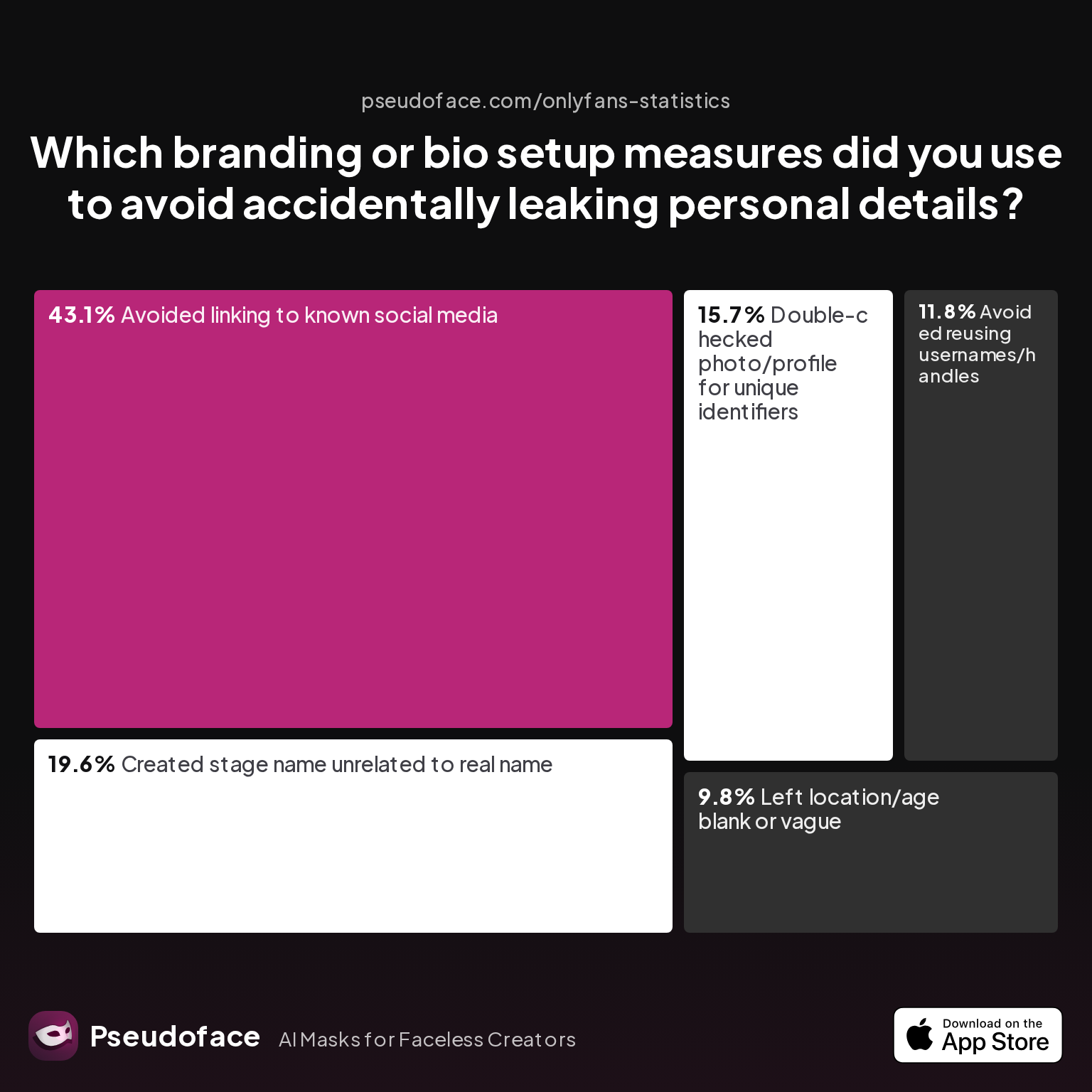
| Answer | Percentage |
|---|---|
| Avoided linking to known social media | 43.14% |
| Avoided reusing usernames/handles | 11.76% |
| Created stage name unrelated to real name | 19.61% |
| Double-checked photo/profile for unique identifiers | 15.69% |
| Left location/age blank or vague | 9.80% |
More than 43% avoid linking their creator profile to any known social media, and nearly 20% create entirely unrelated stage names. This is about more than brand differentiation—it’s about minimizing every breadcrumb that could connect your real identity to your faceless persona. About 16% do the forensic work of scrubbing photos and profiles for unique identifiers, and nearly 10% don’t list their location or keep it purposefully vague.
When it comes to accidental exposure, the biggest culprits may surprise you:
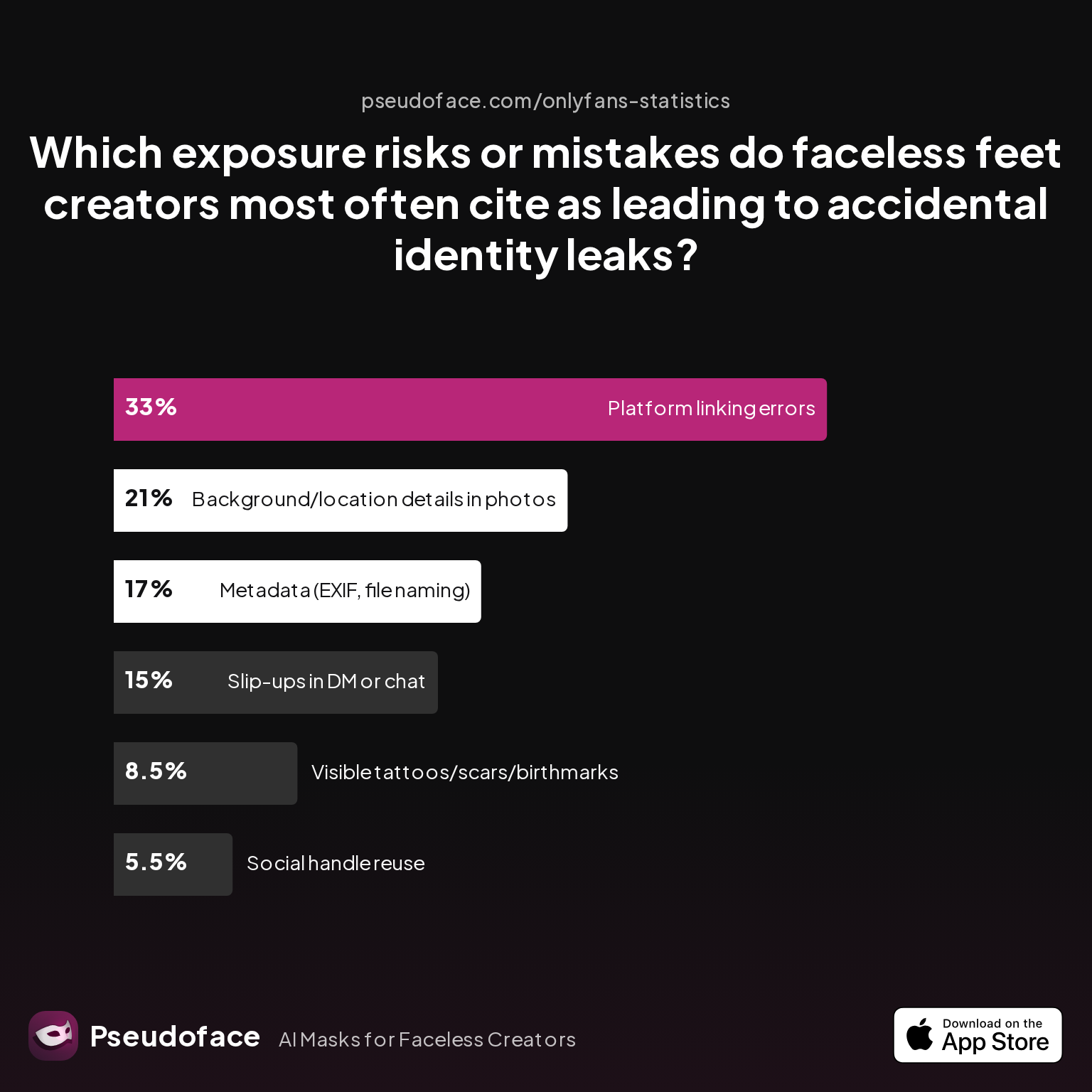
| Answer | Percentage |
|---|---|
| Background/location details in photos | 21.00% |
| Metadata (EXIF, file naming) | 17.00% |
| Platform linking errors | 33.00% |
| Slip-ups in DM or chat | 15.00% |
| Social handle reuse | 5.50% |
| Visible tattoos/scars/birthmarks | 8.50% |
Platform linking errors (33%) and background/location slip-ups in photos (21%) rank as the top causes of accidental anonymity breaches, closely followed by metadata leaks (17%). Even “faceless feet” creators—perceived as ultra-anonymous—are at risk if tech hygiene slips.
Ongoing privacy isn’t just what you do after you launch; it begins before your first upload or payout:
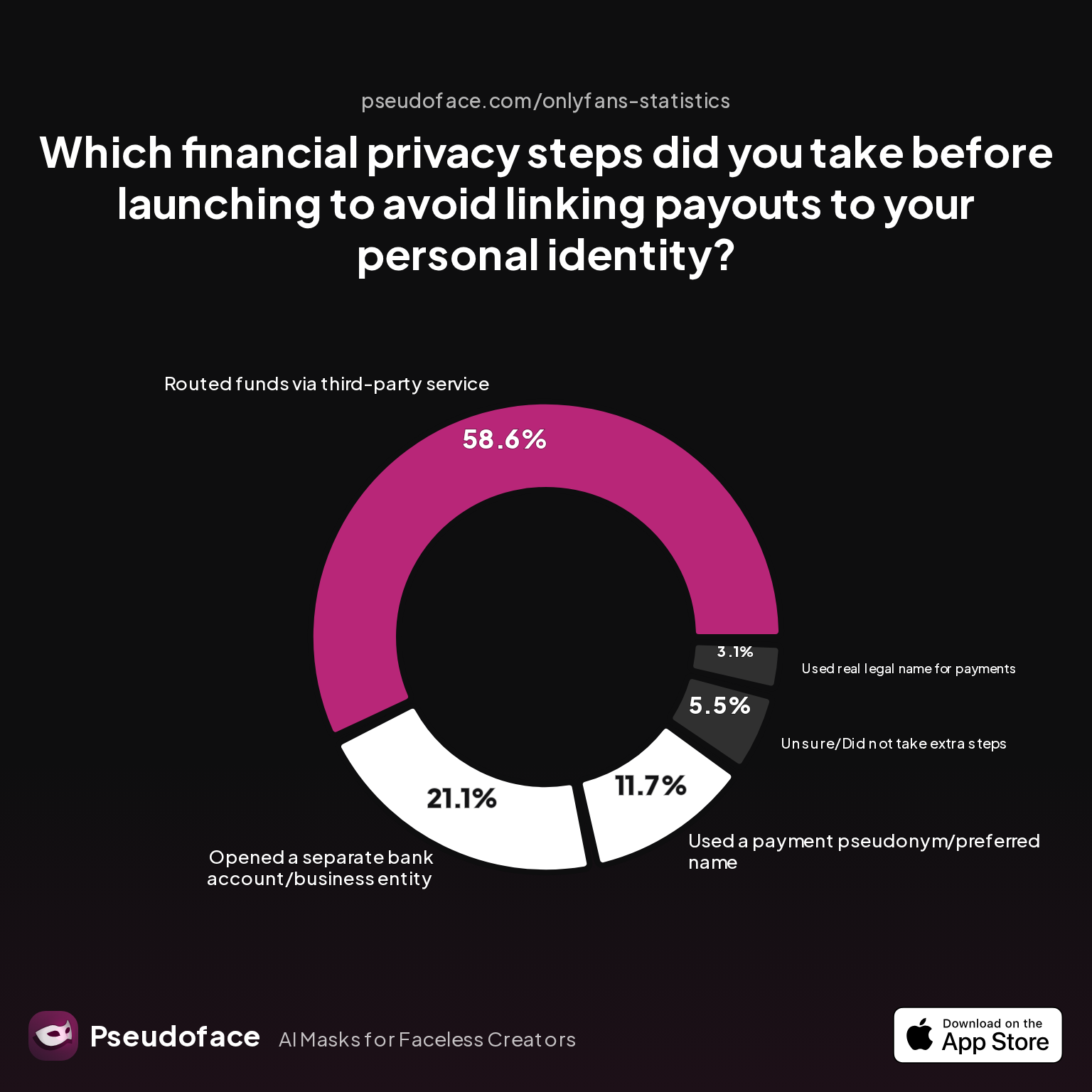
| Answer | Percentage |
|---|---|
| Opened a separate bank account/business entity | 21.09% |
| Routed funds via third-party service | 58.59% |
| Unsure/Did not take extra steps | 5.47% |
| Used a payment pseudonym/preferred name | 11.72% |
| Used real legal name for payments | 3.12% |
Nearly 59% of faceless creators route funds through third-party services, while 21% open entirely new bank accounts or business entities. Less than 4% risk linking their real name to payments, reflective of the immense caution that governs every facet of the faceless lifestyle.
Bias and reporting gaps shape these findings—creators willing to discuss mistakes are, by definition, not those whose identities remain completely undetected. But the bottom line is consistent: the wider your safety “stack,” the lower your risk of exposure, and the more stable your boundaries will be, regardless of your relationship status.
Faceless OnlyFans Earnings: Does Being Anonymous Limit Your Income or Opportunities?
One persistent myth is that faceless OnlyFans creators are doomed to lower earnings than those who show their faces. While there is some truth to the popularity premium associated with “full reveal” creators, the reality—drawn from the community in 2025-2026—is more nuanced.
Anecdotally, many high-earning creators choose anonymity for safety, niche branding, or market positioning. The most common financial anxiety actually ties back to privacy, not productivity: will payment processors, digital footprints, or bank records expose your identity?
As reviewed in the previous section, only 3% use their real legal name for payouts, and a decisive majority rigorously separate finances and identities. The tradeoff is rarely about pure profit; it’s about trading the hypothetical ceiling of “mainstream viral fame” for a sustainable, lower-risk, and personally sustainable practice.
Community wisdom emphasizes adaptability:
Open thread on Redditr/onlyfansadvice
u/sam_my_friend
I'm super proud of my OF, and every guy who's been after me knew about it. I'm open about having it. I was more ashamed of confessing that I was working 50+h/week for the minimum salary a year ago, to be honest. I hurt no one, I do nothing wrong, and I can actually make a living now!
Across the dataset, reports of successful, mid-five-figure annual incomes are common for creators who never reveal their face. However, it’s true that “anonymous” niches grow almost entirely via specialized, explicit marketing and strong privacy practices, rather than through viral mainstream crossover.
Practical takeaway: being anonymous can slow growth, but does not preclude making serious money. The true limit is often marketing constraints and niche appeal, not an audience’s willingness to pay for faceless content. For creators who value control, safety, and sustainable income over breakout fame, the faceless route remains a viable—even attractive—model.
Reframing Intimacy, Control, and Self-Worth: Advice from the Faceless OnlyFans Creator Reddit Community
If anonymity is a tradeoff, many creators report that the gains—safety, professional separation, emotional stability—outweigh the costs. But these tradeoffs do impact how one approaches intimacy, honesty, and self-image within relationships.
Above all, community wisdom revolves around agency: The power to choose, set terms, and adapt.
Open thread on Redditr/onlyfansadvice
u/sexycherrykatmama
Given the fact that no one else knows this about you. I would not tell him right off the bat. Last thing you need is something to go wrong after the 2nd or 3rd date or a month down the road, and he knows this secret about you. It's private & personal. You & him need to get to know each other & have trust. When it gets to that point in time & he's for real, he will understand when he finds out.
Others push toward self-celebration and the right to pride:
Open thread on Redditr/onlyfansadvice
u/sam_my_friend
I'm super proud of my OF, and every guy who's been after me knew about it. I'm open about having it. I was more ashamed of confessing that I was working 50+h/week for the minimum salary a year ago, to be honest. I hurt no one, I do nothing wrong, and I can actually make a living now!
In a meta sense, faceless creators discover what many outside the industry rarely see: relationships can, and do, thrive on negotiated disclosure, practiced boundaries, and healthy professional pride—just as easily as they can collapse under secrecy, shame, or betrayal.
For more tactical specifics on disclosure, boundaries, and risk, see the FAQ below.
FAQ: Navigating Dating and Disclosure as a Faceless OnlyFans Creator
Should I ever disclose my faceless OnlyFans creator status to someone I’m dating?
There is no universal rule; it depends on your risk tolerance, the seriousness of the relationship, and your comfort level.
Disclosure builds trust and can filter out incompatible partners, but it may also increase the risk of judgment or being outed. The data shows most partners react supportively, but the emotional calculus is personal and deserves deliberate reflection. Many creators use scripts like, “I do adult content creation as a side hustle; for privacy, I don’t share work links, but I’m happy to answer questions.”
When is the best time to tell a partner about my OnlyFans account if I keep my face hidden?
Most creators wait until the second or third date, or once they detect emotional trust, but 40% disclose in chat before even meeting.
Timing depends on how quickly trust develops and your assessment of the partner’s discretion. As one creator notes:
Open thread on Redditr/onlyfansadvice
u/FionaFoxxx9
I don’t tell them till the 2nd or 3rd date. I want them to get to know ME on the first date & then realize I’m no different before or after they find out. I’m still a human looking for love lol. I just have a sexy side hustle
How do I protect my privacy on dating apps as a faceless OnlyFans creator?
Avoid sharing personal or creator-specific details, use a unique set of bios/pics, and never reuse handles or photos visible elsewhere.
The top risks to anonymity are accidental platform linking, background/location slip-ups in photos, and metadata leaks. Many creators use stage names entirely unrelated to their real identity, and double-check all photos and bios for unique identifiers before uploading.
What are good ways to explain my boundaries around OnlyFans to someone I’m seeing?
Be direct, use concise scripts, and firmly state what you will and will not share—then stick to it.
For example, say: “I never share my work links for privacy reasons. I am happy to talk about what I do, but not to share content or my creator name.” Reinforce that supporting you means respecting these boundaries, rather than trying to “solve” or cross them.
What if my partner reacts badly or threatens to out me?
Make an immediate safety plan: limit future disclosures, seek support (online and offline), and set or enforce consequences for breach of trust.
Although less than 3% of creators are actually outed by partners, these are high-impact events. Community consensus is to step back, document threats, and lean on peer or legal resources if needed.
Are there financial or career downsides to being a faceless creator on OnlyFans?
Faceless creators can make strong incomes, but may grow slower due to narrower marketing and fewer viral opportunities.
Still, only 3% of creators risk payouts linked to their real name, with a majority separating finances for security. Many successful faceless creators earn sustainable five-figure incomes; the main limitation is brand reach, not earnings potential per se.
How common is it for faceless OnlyFans creators to be discovered by people they know?
About 8% have been discovered by partners or friends, while 41% report persistent anxiety about being outed.
Most accidental exposures result from technical slip-ups (photos, metadata, handle reuse), not casual partner snooping—highlighting the need for privacy vigilance at every stage.
Navigating love, honesty, and privacy as a faceless creator is neither easy nor one-size-fits-all. But with hard-won data, community wisdom, and purposeful boundaries, it is entirely possible to protect your secret and your heart—no matter where your relationships take you.


