
TL;DR
For creators weighing the transition from faceless to showing their face, real-world data points to a mix of outcomes: approximately 66% describe closer audience connection and faster follower growth, but 27% also report unexpected personal consequences such as being recognized in public or worries about their day job. Most creators choose a gradual reveal—although sudden reveals, like Dream's famous face reveal, can create viral spikes, they're riskier for personal adjustment. According to Pseudoface’s analysis of over 250,000 public Reddit threads from actual adult content creators, these insights reflect reported experiences—not guarantees. Self-selection bias and community-specific context mean your journey may look different, but the core challenges and rewards are widely shared.
Should I Reveal My Face as a Creator? Examining the Real Stakes
Standing at the doorway between anonymity and showing your face as a creator is a uniquely modern decision. Many creators—whether they rose on OnlyFans, YouTube, TikTok, or somewhere on the web’s fringes—wrestle with not only the practical but also the personal implications of stepping into the spotlight. The experience of being "the faceless creator" comes with distinct freedoms and, often, limitations. So, is it time to let your audience see the eyes of the creator? Or does privacy’s shield offer benefits worth preserving?
Let’s ground this ongoing debate in real-world advice patterns pulled from creator communities, based on discussions active through 2025–2026.
| Answer | Percentage |
|---|---|
| Depends entirely on your niche | 5.00% |
| Go hybrid or partial face | 16.00% |
| Show your face if you possibly can | 16.50% |
| Start faceless, decide after you learn the ropes | 26.00% |
| Stay faceless permanently if privacy matters | 36.50% |
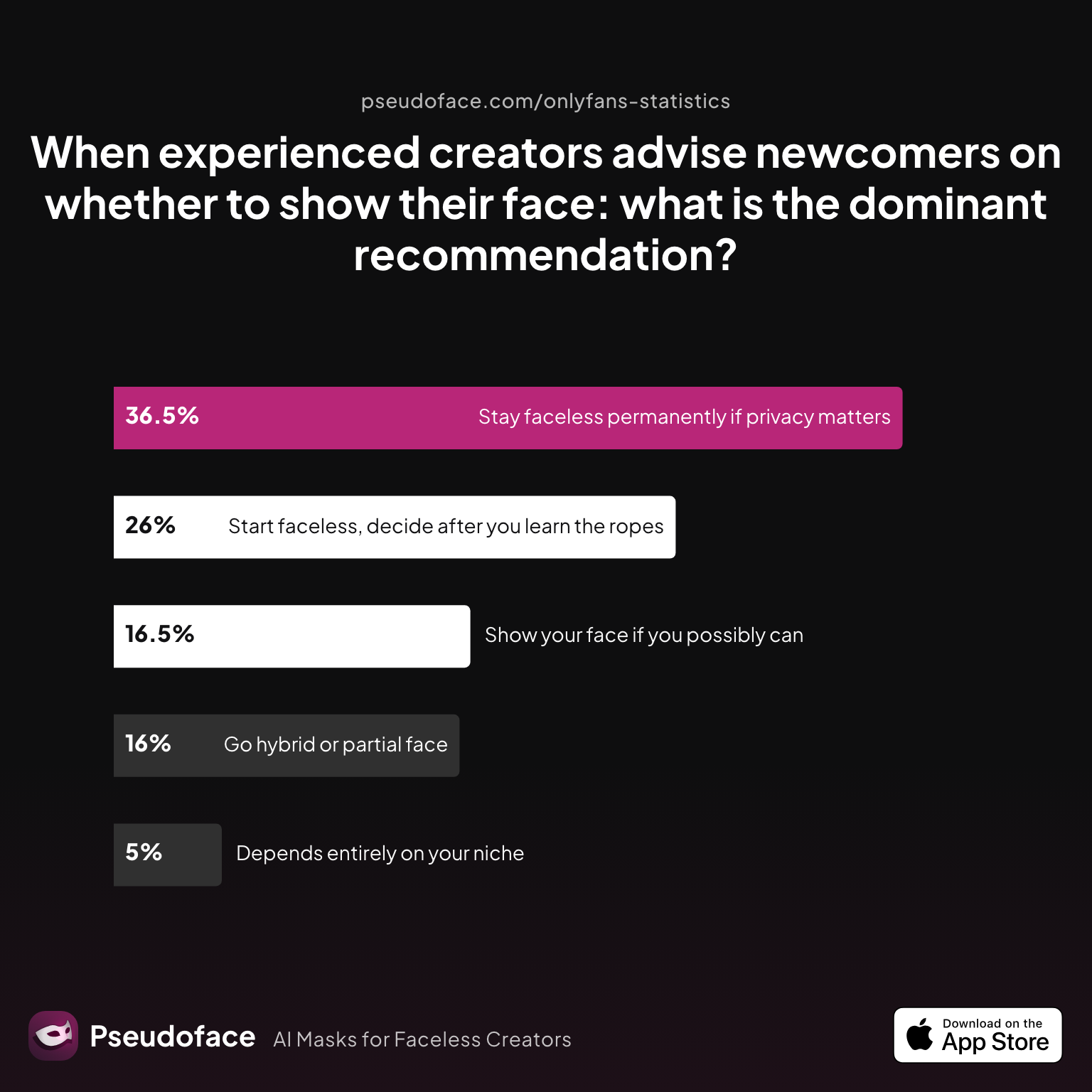
A majority of proven creators tell newcomers: “Stay faceless permanently if privacy matters”—a stance that clocks in at 36.5%. Another 26% recommend starting faceless and only deciding about a reveal once you understand the platform, fans, and your own boundaries more deeply. Just 16.5% flatly say to “show your face if you possibly can”; the community leans caution-first.
Most creator veterans recommend staying faceless if privacy is important, but over 40% advocate for at least partial or conditional reveals. The rest stress adaptability: your audience, content type, and comfort level all matter.
A typical sentiment comes through from a Reddit advisor in answer to a worried peer:
Open thread on Redditr/CreatorsAdvice
u/SaintBunnie
if you’re asking the question, you have your answer. you’re concerned about your future being affected so don’t do it. the internet is forever, you will be recognized eventually.

Yet, the real reason so many wrestle with “should I stop being faceless?” is that the line isn’t just about privacy; it’s about opportunity. Does showing your face tangibly help your career, or is it a risky myth?
How Anonymity (Really) Impacts Earnings
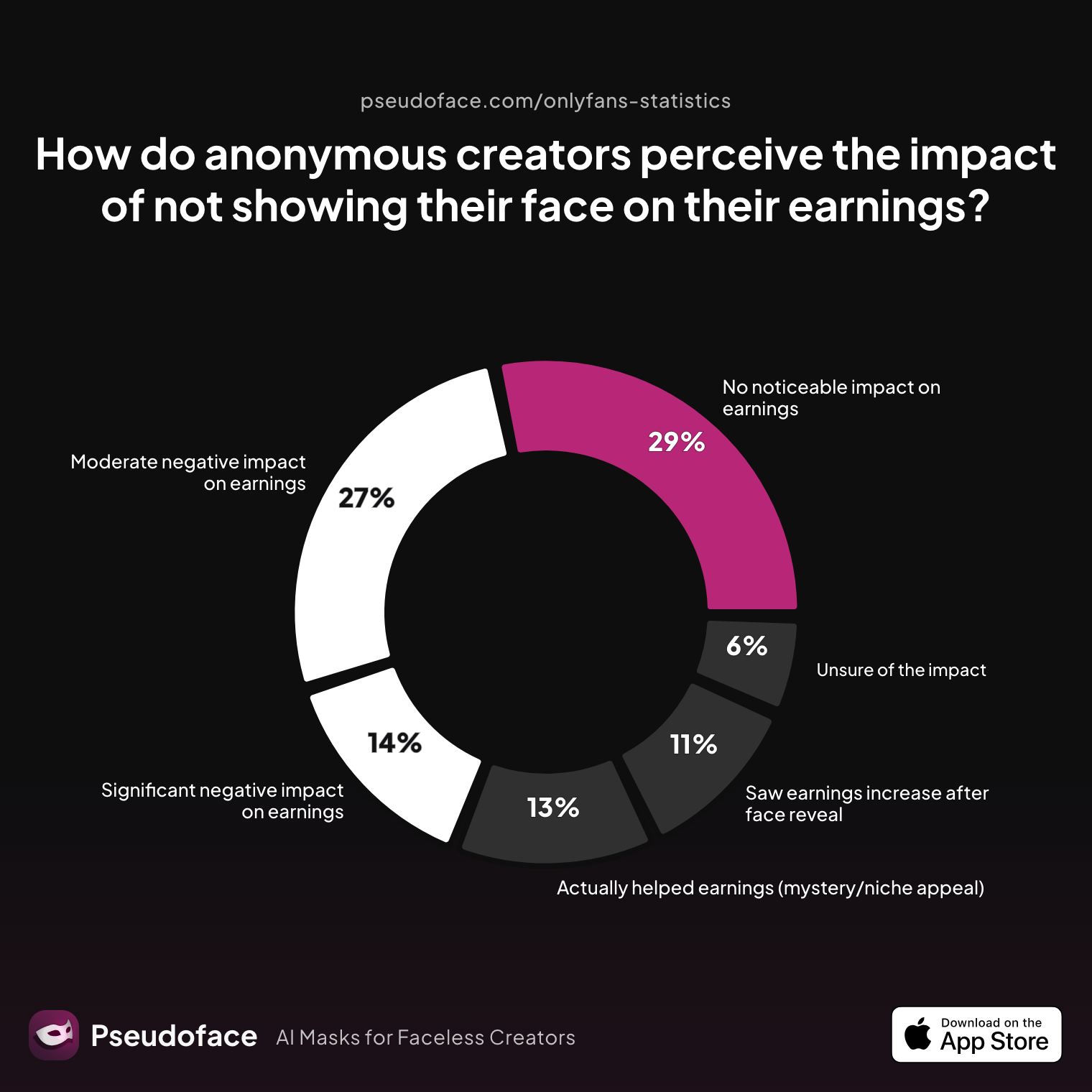
There’s a persistent belief that showing your face directly boosts income. Here’s what creators self-report:
| Answer | Percentage |
|---|---|
| Actually helped earnings (mystery/niche appeal) | 13.00% |
| Moderate negative impact on earnings | 27.00% |
| No noticeable impact on earnings | 29.00% |
| Significant negative impact on earnings | 14.00% |
| Started anonymous, switched to showing face and saw earnings increase | 11.00% |
| Unsure of the impact | 6.00% |
Only about 11% saw an earnings boost specifically after making the jump from faceless to face-out. Nearly a third said anonymity had no clear impact on earnings. Meanwhile, 14% experienced a significant negative impact—but, surprisingly, 13% found that facelessness helped due to its mysterious or niche appeal. The self-selection bias here is real: creators who stick around long-term often find ways to make facelessness itself into a signature or brand.
A contrasting viewpoint is visible on Reddit:
Open thread on Redditr/onlyfansadvice
u/Scars515
i toss between faceless and showing my face with no real price difference. typically I stay faceless when doing promos on x and here (when im able to.. im still too new here😅) but then on my OF and Fans/ly pgs i will show my face more often. i also put the same content on all the platforms but i cant tell if thats hurting or helping me
So, while the fear that you have to show your face to succeed is widespread, data suggests it isn’t quite so universal. Some thrive in faceless niches, while others grow weary of the grind and plateau.
With the stakes laid out, we next explore the psychological impacts of becoming visible—and what creators actually experience after the change.
Psychological Impact: Beyond the Mask for Faceless Creators
The leap from anonymity to visibility isn’t just cosmetic; for most, it’s intensely psychological. For some, the mask becomes a shield—a way to keep “content self” separate from real life. For others, it’s a constraint that eventually chafes. But what do creators actually feel in the months after a reveal?
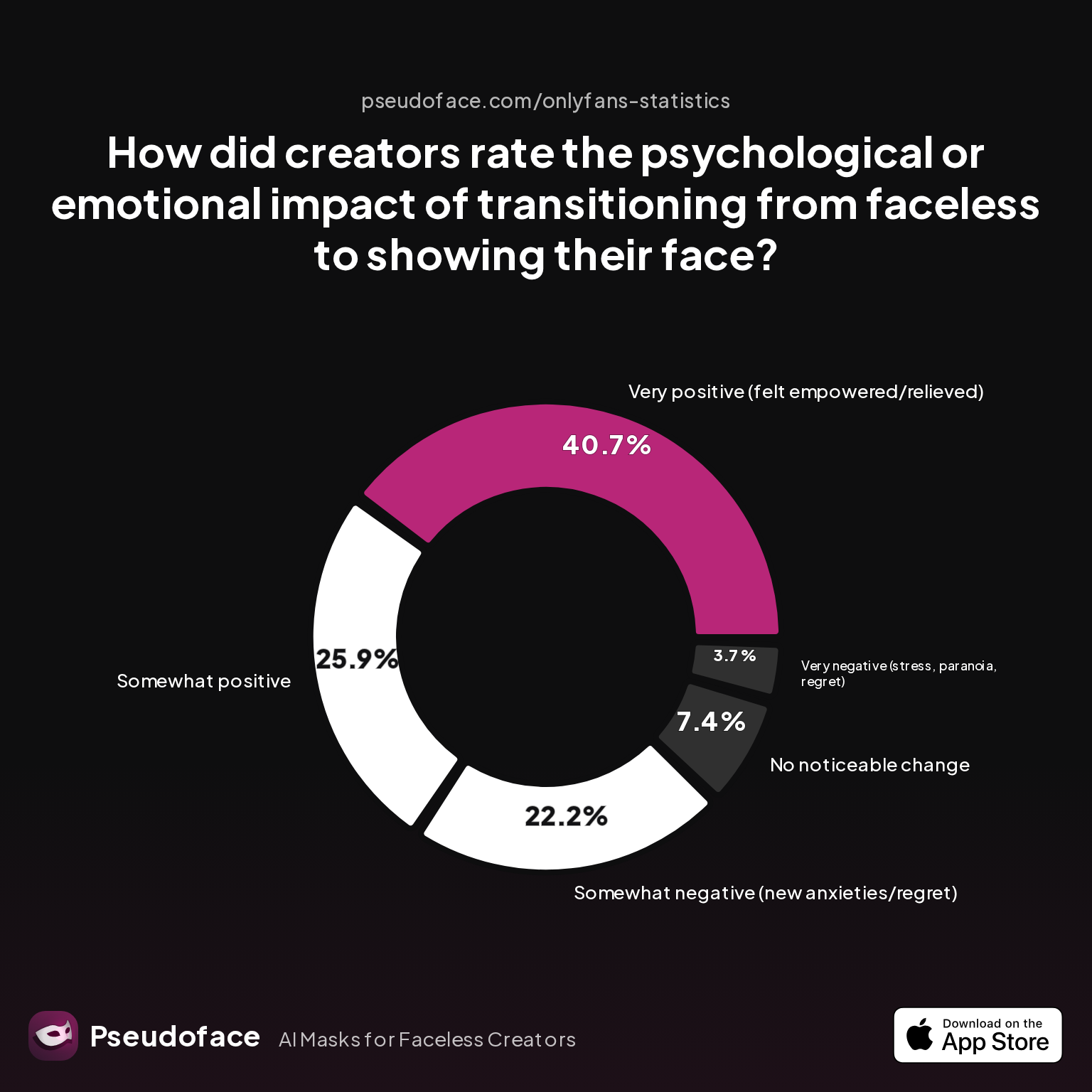
Let’s look at self-reported emotional outcomes:
| Answer | Percentage |
|---|---|
| No noticeable change | 7.41% |
| Somewhat negative (new anxieties/regret) | 22.22% |
| Somewhat positive | 25.93% |
| Very negative (stress, paranoia, regret) | 3.70% |
| Very positive (felt empowered/relieved) | 40.74% |
About 66% of creators who revealed their face experienced some level of positive psychological impact, including relief, empowerment, or greater confidence. But “trippy” aftereffects are not rare: over 22% report somewhat negative emotional outcomes (increased anxiety, regret, new forms of vulnerability), and a smaller group (3.7%) experienced very negative reactions, including stress or even paranoia.
These numbers, based on 2025–2026 posts and polls, should be read with the caveat that creators happy with their outcome are generally more likely to report it; those who regret the change may simply disappear from public view, introducing a classic survivorship bias.
Others find the psychological stakes too high to gamble with. From Reddit:
Open thread on Redditr/onlyfansadvice
u/emoratbitch
If people think you’re hiding your face or it’s only available for higher tiers they’re more likely to leak it. Men get off on knowing they’re doing something without consent so regardless of what you end up choosing you need to know that there is a high likelihood of leaks
Some creators slide seamlessly into their new public persona; for others, anxiety about leaks and digital permanence never really fades. Many, however, describe an unexpected internal shift: the act of showing their face forced them to own their work, clarify their boundaries, and experience greater pride in their creations.
But understanding inner change is just a start; the next step is acting on that insight—by planning out the "how" of your reveal.
Faceless Creator Revealing Face: How Should You Transition?
Once you’ve settled on “yes,” the next question is how. Should you announce and slow-drip your reveal, or reserve it for a big-bang, “trippy face reveal” rollout? What are most creators actually doing in 2026?
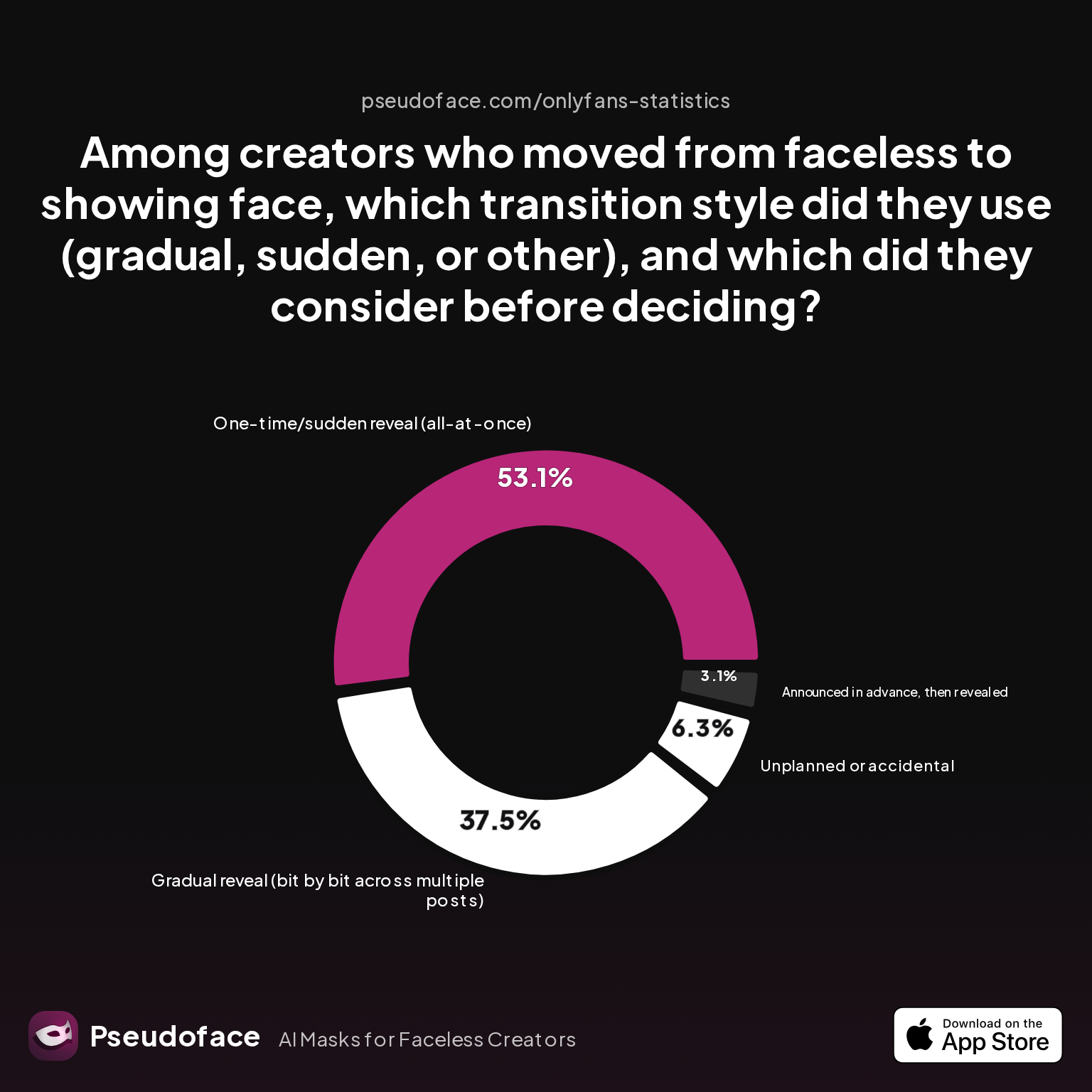
Here’s what peer data shows:
| Answer | Percentage |
|---|---|
| Announced in advance, then revealed | 3.12% |
| Gradual reveal (bit by bit across multiple posts) | 37.50% |
| One-time/sudden reveal (all-at-once) | 53.12% |
| Still undecided / avoided decision | 0.00% |
| Unplanned or accidental | 6.25% |
Despite popular wisdom around “taking it slow,” over half of reported reveals are sudden, all-at-once events: a single video, photo drop, or livestream moment. Around 37% favor a gradual approach (slowly introducing SFW selfies, partial shots, or face-blurred teasers before going explicit); only 3% made a formal staged announcement for a future reveal.
Case in point: Dream’s YouTube face reveal in 2022. The event was sudden and viral, generating instant mass attention—along with as much criticism and meme culture as praise. The path you choose should align with both your personal readiness and your niche’s culture. For instance, adult creators on subscription platforms often “test the waters” by introducing face content behind a paywall, or in safer SFW formats, as this Redditor describes:
Open thread on Redditr/onlyfansadvice
u/AuroraCordelia
I ran a poll on my OF last week asking if my fans would rather have a sub price increase and see my face in sfw shots or have everything stay as it is. 2/3 of them voted for the price increase, so we're doing that 😁 I agree that it's a bit risky, that's why I'm going with sfw pics for now. Id rather take baby steps than show too much and regret it later. Hope this helps 💖
Others focus on platform strategy:
Open thread on Redditr/CreatorsAdvice
u/FeralGirl666
You can write in your OF bio something like "Yes, I show face here" or "This is the only place you can see my cute face
Practical tips surfaced frequently from creators:
- If testing, start with member-exclusive content or SFW face shots before NSFW
- Consider polls to let fans vote on timing or format
- Only reveal on platforms you control (paywalled or private), avoiding “public” corners that fuel leaks
Ultimately, the reveal style you choose will also shape not just your own adjustment, but the intensity and tone of your fans’ response. That’s the next critical puzzle.
Audience Response: When Eyes of the Creator Meet the Fans
It’s one of the most emotionally-charged variables: Will fans celebrate your new openness, or recoil because “the mystery is gone” or your appearance doesn’t match their mental image?
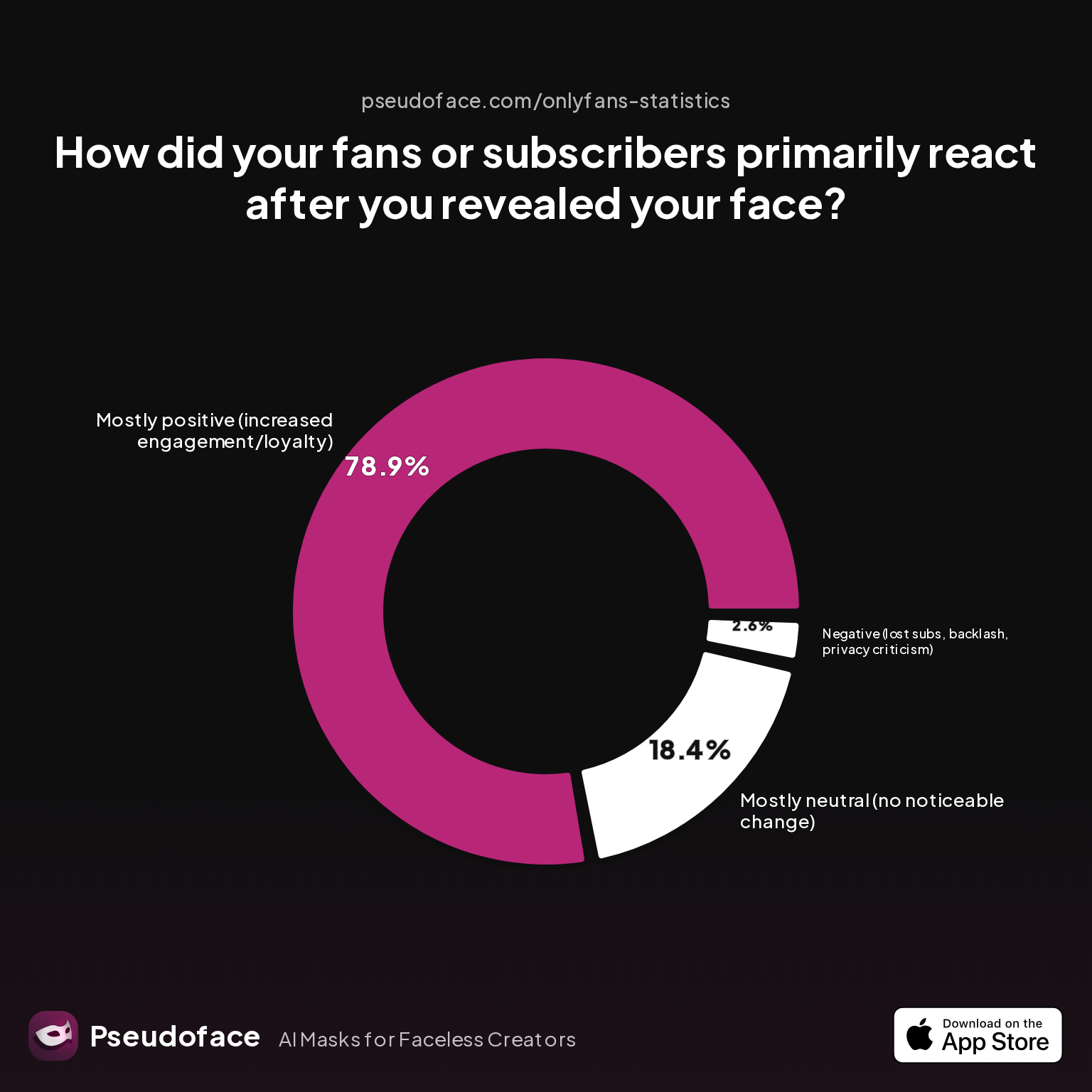
Direct creator survey data cuts through the anxiety:
| Answer | Percentage |
|---|---|
| Mixed—some excitement, some unsubscribes or negativity | 0.00% |
| Mostly neutral (no noticeable change) | 18.42% |
| Mostly positive (increased engagement/loyalty) | 78.95% |
| Negative (lost subs, backlash, privacy criticism) | 2.63% |
Nearly 79% of creators who revealed their face experienced mostly positive fan reactions, with higher engagement and loyalty. About 18% saw little change, while outright backlash or loss of subscribers was rare (just 2.6%).
This welcoming attitude is reinforced by niche fans who see face reveals as “leveling up”:
Open thread on Redditr/onlyfansadvice
u/SkinnyScarlett
I’ve been a faceless creator for years, and I can verify that the men who ask will generally still be ok with not seeing your face. If they aren’t respectful about it, I don’t feel like they’re worth your time or energy :)
Notably, there is zero “mixed” category in the data—creators tend to process their audience’s reaction as either uneventful or decisively positive/negative. This likely reflects reporting bias: creators who experience backlash often discuss it as the main takeaway, while those who see support describe it as holistic community growth.
Still, caution is warranted. “The eyes of the creator” moment is sometimes hyped up beyond reality. Many fans, it turns out, value the content and personality above the specific way it’s delivered. Aesthetics matter less than authenticity.
But external reactions are only half the story; the true-life consequences can ripple far beyond social media and into your everyday world.
Personal Life Fallout: What Happens After the Reveal?
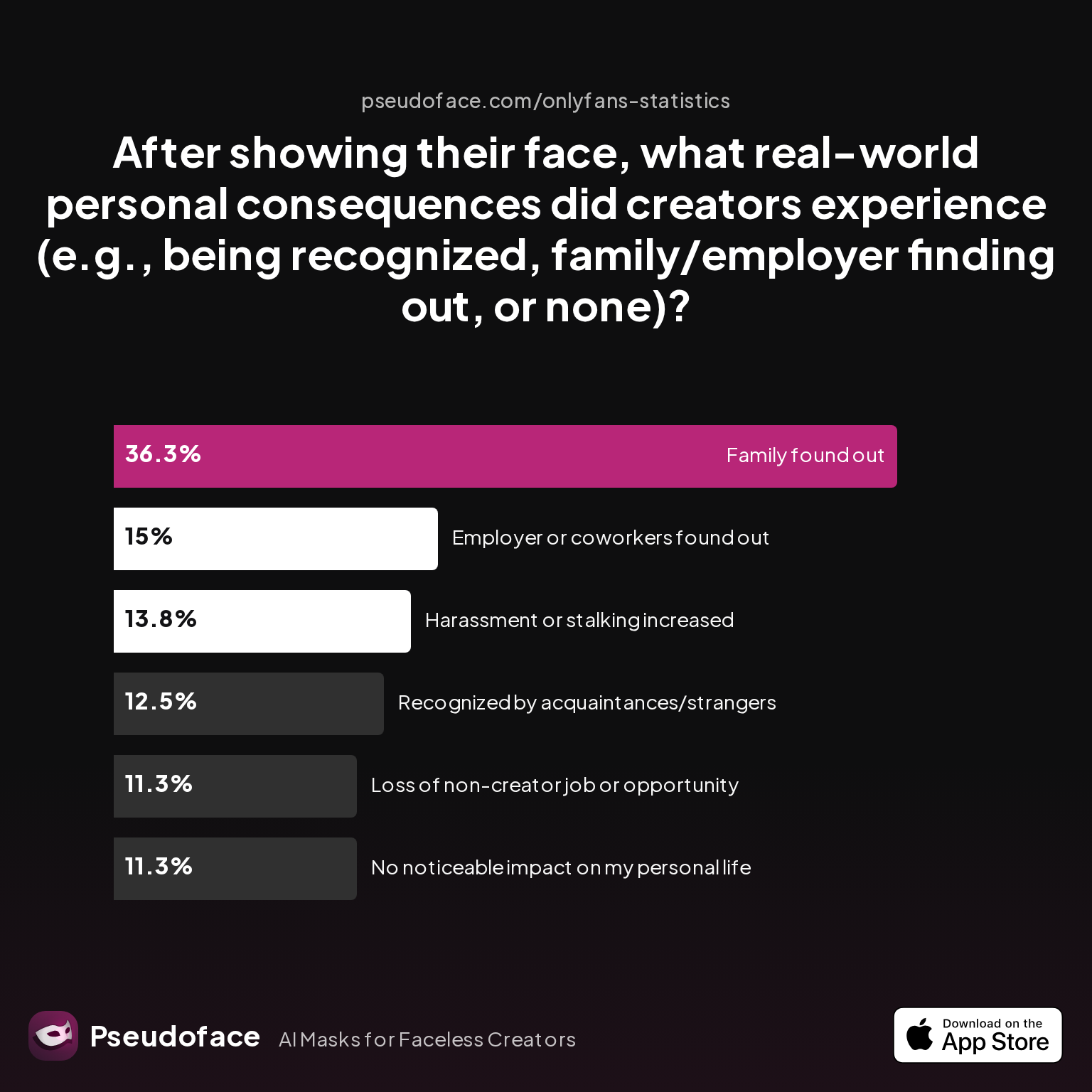
The pathway from faceless to face-out leads not only to new opportunities, but sometimes into unexpected territory: bosses, distant relatives, or old acquaintances connecting dots. The aftershocks can vary wildly, so let’s ground the expectations in creator-reported fallout.
| Answer | Percentage |
|---|---|
| Employer or coworkers found out | 15.00% |
| Family found out | 36.25% |
| Harassment or stalking increased | 13.75% |
| Loss of non-creator job or opportunity | 11.25% |
| No noticeable impact on my personal life | 11.25% |
| Recognized by acquaintances/strangers | 12.50% |
After revealing their face, 36% of creators report their family found out, and around 15% were discovered by employers or colleagues. About 14% cite increased harassment or stalking; 11% suffered career setbacks beyond the creator world. Only 11% say the reveal brought “no noticeable impact” to their personal life.
A recurring theme is how discoverability increases. Even if you reveal your face only in paid, private content, leaks happen—and reverse image search, Google, and persistent fans blend the previously-separated walls of online and offline life. One Redditor's strategy to mitigate risk:
Open thread on Redditr/onlyfansadvice
u/AuroraCordelia
I ran a poll on my OF last week asking if my fans would rather have a sub price increase and see my face in sfw shots or have everything stay as it is. 2/3 of them voted for the price increase, so we're doing that 😁 I agree that it's a bit risky, that's why I'm going with sfw pics for now. Id rather take baby steps than show too much and regret it later. Hope this helps 💖
For many, the only line that remains uncrossed is geographic separation (living far from fans) or being private with their offline circles about what they do. But "no impact" is increasingly rare in this data—creators must plan for at least some real-world effect.
Still, not all approaches to revealing your face are alike. Let’s compare: Which style fits which type of creator, and what can you learn from others’ regrets or successes?
Gradual vs Instant Reveal: The Faceless Double Dilemma
Some creators treat revealing their face like an artistic unveiling; others approach it as a business pivot. Which proves less risky, and which yields more benefits? Using peer stats and Reddit’s deeply candid accounts, a pattern emerges: transition style meaningfully shapes regret and satisfaction.
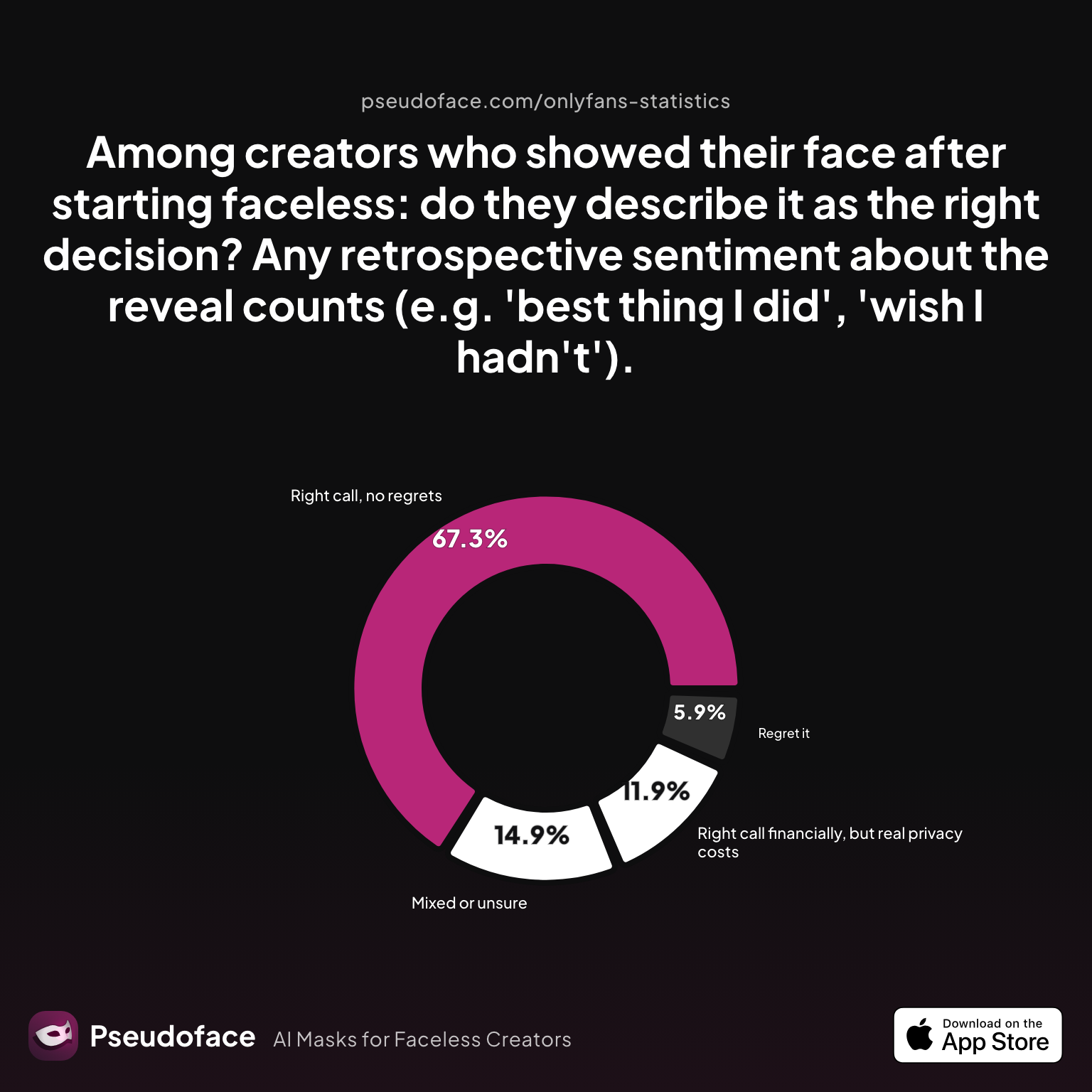
First, rates of satisfaction versus regret:
| Answer | Percentage |
|---|---|
| Mixed or unsure | 14.85% |
| Regret it | 5.94% |
| Right call financially, but real privacy costs | 11.88% |
| Right call, no regrets | 67.33% |
Roughly 67% of creators who reveal their face describe it as the right move with no regrets. 12% acknowledge it was a strong financial move but admit real privacy costs, sometimes irreversible. A much smaller set (about 6%) outright regret it—a figure that is likely understated due to non-reporting and survivorship bias.
So how does style influence sentiment? Among those who went gradual (controlled, paywalled, or drip-fed face reveals):
- More report smoother psychological adjustment
- Audience gets multiple touchpoints to respond/adapt
- Privacy remains easier to defend for longer (at least initially)
Sudden, “viral” reveals—as with Dream’s face reveal and many one-time drops—offer unmatched attention and rapid subscriber spikes, but also make creator adaptation harder. High expectations, “the trippy face reveal” effect (where a fan’s mental image meets reality), and sudden loss of privacy trigger more regret and anxiety, per qualitative discussion.
One creator’s baby-steps approach:
Open thread on Redditr/onlyfansadvice
u/AuroraCordelia
I ran a poll on my OF last week asking if my fans would rather have a sub price increase and see my face in sfw shots or have everything stay as it is. 2/3 of them voted for the price increase, so we're doing that 😁 I agree that it's a bit risky, that's why I'm going with sfw pics for now. Id rather take baby steps than show too much and regret it later. Hope this helps 💖
And yet, for some, a big reveal plays to their strengths or fan culture—and works out fine, even if the initial shock is intense. The double-edged sword: with a structured, gradual reveal, creators retain more control, but risk less buzz. Fast reveals create viral moments, with both positive and negative spikes.
As we wrap up, it’s crucial to address common doubts, burning follow-up questions, and secondary worries that always surface in community spaces.
Common Regrets, Surprising Rewards, and the Trippy Face Reveal (Case Examples, incl. Dream’s Face Reveal)
To put human shape to all the quantitative findings, let’s look closer at stories that surface again and again: the irreversible loss of privacy, the unexpected catharsis, the occasional “trippy” sense of identity shift, and viral spectacles like Dream’s widely-memed YouTube face reveal.
When a faceless creator posts their face for the first time, jokes and memes often trail them for weeks. Dream—known for a stylized avatar, not his real face—surged in mainstream awareness but faced a period of intense scrutiny, body-shaming, and “I preferred the mystery” commentary.
Some peer-to-peer cases:
- Creators who planned a gradual, controlled reveal (often to exclusive fans) report less stress and more lasting satisfaction.
- Sudden reveals bring a “rush” of attention, which is thrilling but overwhelming; regret in this group is more pronounced if fan reaction is negative or privacy is breached.
- The truly “trippy” moments come where creators see themselves reinterpreted by their own audiences—memes, reactions, and in some cases, aggressive doxxing attempts or media coverage.
Reddit is rife with lessons:
Open thread on Redditr/onlyfansadvice
u/emoratbitch
If people think you’re hiding your face or it’s only available for higher tiers they’re more likely to leak it. Men get off on knowing they’re doing something without consent so regardless of what you end up choosing you need to know that there is a high likelihood of leaks
For those who succeed, the greatest surprise is often a new sense of liberation or creative possibility. For those who struggle, the regret nearly always stems from unforeseen personal-life spillover or slow-building anxiety that outweighs any short-term business gains.
What ties these stories together is the honesty: the transition from faceless to face-out is never a purely technical choice. It reverberates through identity, community, and day-to-day existence.
FAQ
How do I know if I’m ready to stop being a faceless creator?
You’re ready when you’ve assessed the personal, financial, and psychological stakes—and accept that face reveals cannot be reversed. Some markers: feeling safe with fans knowing your face, no longer anxious about leaks, and a clear purpose for revealing (growth, creativity, authenticity).
Many creators describe readiness as a turning point: “I realized the benefits outweighed my fears, and leaks seemed less catastrophic than missing out on connection.”
What are the most common regrets after a creator face reveal?
Privacy breaches and feeling unable to “put the genie back” top the list of regrets, per survey data. About 17% of creators who revealed their face express mixed feelings or regret—often citing job risk or family fallout.
Will revealing my face help me earn more or grow faster?
Face-revealing only dramatically boosts earnings for a minority of creators—about 11% in community self-reports. For most, the impact on money or subs is modest unless your format or niche puts heavy emphasis on authenticity or visual intimacy.
How do I announce a face reveal to my fans to maximize support?
Best practice is to communicate your intentions clearly, either by posting a poll, hinting at what’s coming, or making the reveal an exclusive “event” for your loyal community. Member-only drops, special streams, and advance notice (“This is the only place you can see my cute face”) all help shape a positive narrative.
Can I limit the personal fallout after my face is public?
You can reduce but not fully control offline consequences: share only on platforms you control, avoid cross-posting to indexable public spaces, and set clear boundaries with family or coworkers if possible. Still, recognize that leaks and crossovers can happen even with good operational security.
What are the safest ways to test the waters before a full reveal?
Start with partial reveals (e.g., SFW, behind a paywall, or limited time), poll your fans, and give yourself time to process feedback. Gradual reveals lower adjustment stress and give you “off-ramps” if anxiety spikes.
Should I ever do a sudden, viral-style face reveal like Dream or is gradual better?
For most creators, gradual is safer and less stressful—but a sudden reveal might be right if your brand thrives on surprise and spectacle, or if you want a one-time publicity spike. Consider your temperament: if you’re anxious about real-life impact, gradual is usually better.
If fans or employers find out, what’s the norm for fallout?
About 15% of creators are discovered by coworkers or bosses post-reveal, with varied outcomes: some report increased acceptance, others risk lost jobs or strained relationships. Prepare for at least some personal world cross-pollination.
Can I go back to being faceless after showing my face?
No, not truly. Once your face is online, especially if it’s been shared or leaked, total erasure is near-impossible. A few creators have re-masked, but caution: fans often feel deceived if you retreat, and content archives linger.
Is it worth showing my face if I’ve already built a loyal fanbase without it?
Not necessarily—some audiences value facelessness as a unique feature. Many creators plateau, then experiment; others thrive forever in the faceless niche. Your motivation (burnout, desire for connection, artistic itch) matters more than chasing a perceived “ceiling.”
Ultimately, the transition from faceless to showing your face is less about one right answer and more about fit. Your story, boundaries, and goals are unique—but the lessons forged by thousands before you can light the way, no matter which mask (or face) you wear next.


