
TL;DR
Most creators who went from faceless to showing their face report mixed experiences: roughly 61% plan the reveal weeks in advance, involving privacy reviews and branding prep. According to Pseudoface’s analysis of over 250,000 public Reddit threads from real adult content creators (2025-2026 data), audience responses split between excited engagement and neutral curiosity, while around 17% report regret, typically due to privacy tradeoffs. Revealing your face is largely irreversible—previous anonymous content can resurface, and audience expectations shift. Preparation, boundary-setting, and proactive communication determine a smoother transition.
Understanding Why Creators Stay Faceless—and Why That Changes
Creators first drawn to content platforms like OnlyFans, YouTube, or TikTok face an immediate, personal decision: show their face or build an identity without it. This choice isn’t just about privacy—it shapes every aspect of their career, influence, emotional comfort, and vulnerability to real-world consequences.
| Answer | Percentage |
|---|---|
| Neutral | 1.47% |
| Somewhat dissatisfied | 16.18% |
| Somewhat satisfied | 44.12% |
| Very dissatisfied | 5.88% |
| Very satisfied | 32.35% |
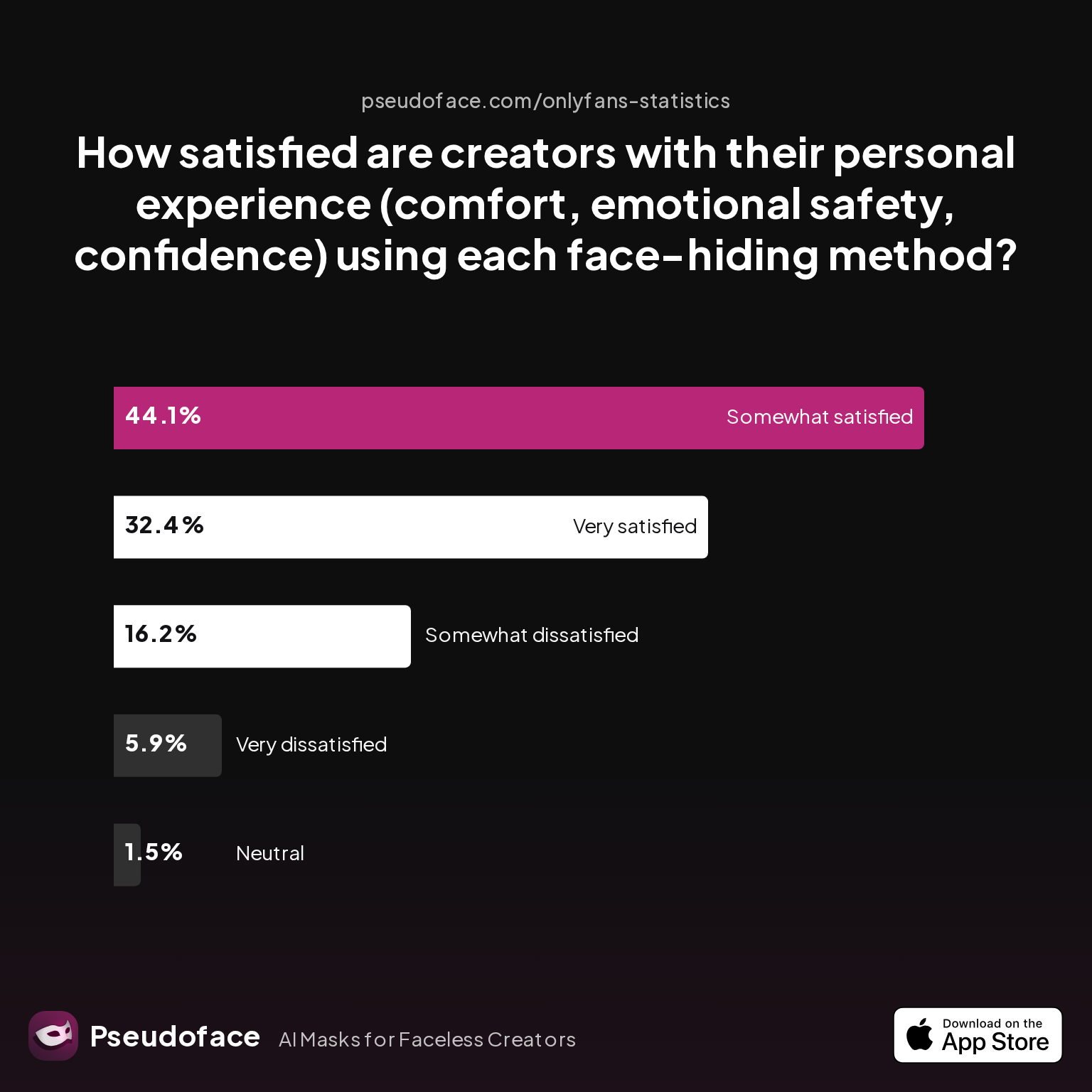
Based on Pseudoface’s 2025 panel, a combined 76% of creators describe themselves as "somewhat" or "very" satisfied with their face-hiding approach, underlining that, for many, staying faceless is a comfort zone worth protecting. Satisfaction, however, is not universal: about 22% feel dissatisfied or neutral, a signal that facelessness can chafe over time—whether because of content constraints, emotional fatigue, or the longing for deeper creative freedom.
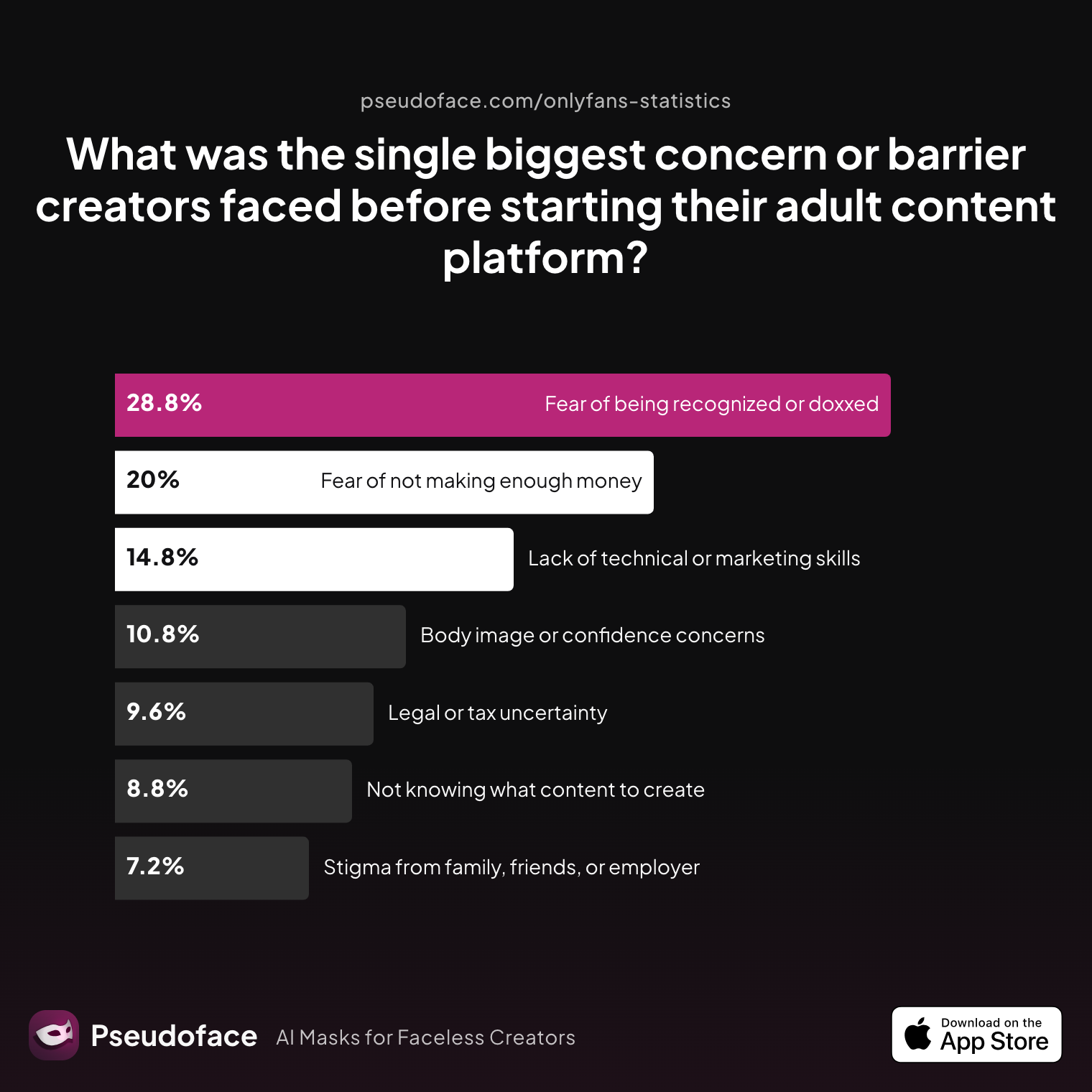
Fear of being recognized or doxxed is by far the leading pre-launch concern, cited by nearly 29% of creators.
| Answer | Percentage |
|---|---|
| Body image or confidence concerns | 10.80% |
| Fear of being recognized or doxxed | 28.80% |
| Fear of not making enough money | 20.00% |
| Lack of technical or marketing skills | 14.80% |
| Legal or tax uncertainty | 9.60% |
| Not knowing what content to create | 8.80% |
| Stigma from family, friends, or employer | 7.20% |
Safety, both real and perceived, drives that hesitation: any slip can mean being outed to employers, family, or a wider public. Even so, about 1 in 5 wrestle more urgently with monetary anxiety, torn between opportunity and threat.
Open thread on Redditr/CreatorsAdvice
u/MissHoodie
No. I feel if you're faceless you're doing it out of safety or privacy concerns (at least for me). Once you show your face there's no going back.

For some, the faceless approach is creatively freeing—enabling roleplay, persona-building, or simply offering an emotional buffer. Others stumble on practical frustrations: branding limitations, audience engagement walls, or platform-specific barriers to growth.
A growing share, as of early 2026, cite external opportunities (like brand deals or cross-platform collaborations) as a reason to revisit their stance. While satisfaction with being faceless remains high overall, momentum does quietly build toward face reveals as creators outgrow anonymity, adjust goals, or respond to changing audience expectations.
Next, we'll look at real-world advice and how creators know when—or if—to show their face.
The Decision Point: Should I Stop Being Faceless?
For every creator pondering a reveal, the central dilemma is this: Is showing my face worth it for where I am in my journey? The desire for growth, connection, or monetization often collides with personal risk tolerance.
| Answer | Percentage |
|---|---|
| Depends entirely on your niche | 5.00% |
| Go hybrid or partial face | 16.00% |
| Show your face if you possibly can | 16.50% |
| Start faceless, decide after you learn the ropes | 26.00% |
| Stay faceless permanently if privacy matters | 36.50% |
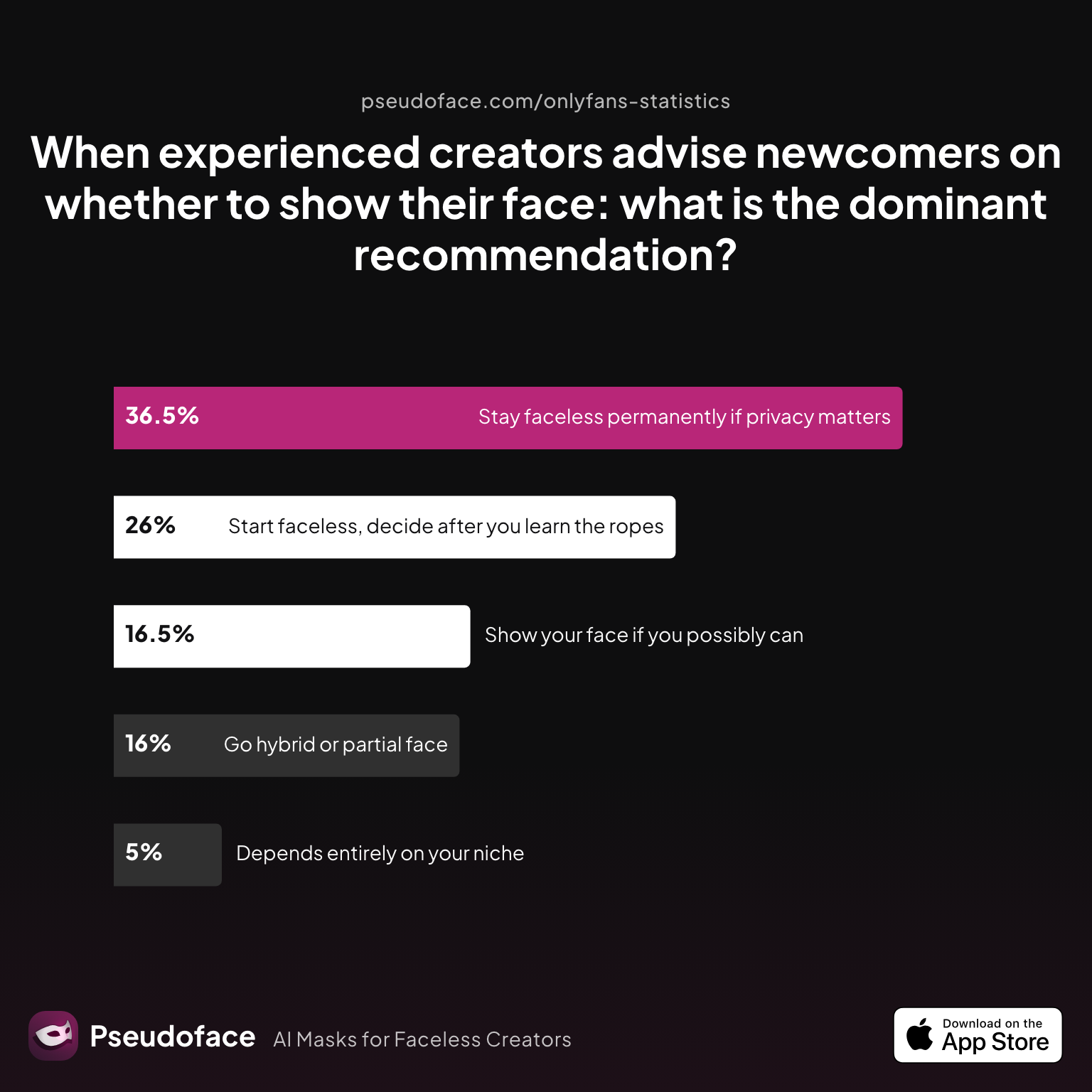
The dominant advice from experienced creators is clear: 36.5% recommend staying faceless if privacy is a priority, while 26% strongly advise starting faceless and deciding later. Only 16.5% are unequivocally pro-face-reveal. This means most real creators, as of early 2026, lean toward a caution-first approach—reflecting the weight of potential consequences.
Open thread on Redditr/onlyfansadvice
u/Imnotclevernsfw
Reddit gets it's content stolen and posted in other places, so you have to ask yourself if you are comfortable with that risk.
Niche and content type carry major influence. Those doing voice work, gameplay, or other non-visual acts feel less pressure, while creators in “personality-driven” or erotic spaces report faster audience growth when faces are visible.
Hybrid solutions—showing eyes, mouth, or using creative masks—also earn meaningful support: about 16% actively promote a “partial face” model, balancing curiosity with caution.
Open thread on Redditr/CreatorsAdvice
u/MissFloraBerlin
I know a couple of faceless creators who wear really cool and sexy latex masks. Just an idea!
Discussions repeatedly highlight the value of learning before leaping. Many successful creators recommend starting faceless, testing content and boundaries, then revisiting the face reveal question once better informed about both personal risk and audience demand.
Peer advice underscores two recurring themes:
- Once you show your face, reversing that choice is nearly impossible.
- Financial upside is real but uneven, and privacy losses may be permanent.
Open thread on Redditr/onlyfansadvice
u/AccomplishedPain2688
I'm literally in the middle of a rebrand myself and I'm not gonna lie it's tough because it's just like starting out all over again especially if your nieche or look has changed. I did have a second profile that I opened up while I was closing out my 1st one so I overlapped So I wouldn't start from total scratch as well as rebuilding new socials. I did repurpose some of my stuff but I reused it from my drive I save everything on and just reupload it with the new watermarks I'm not sure about the vault situation within the same profile if you can change it.
So, when should you stop being faceless? The data and peer narrative say: only when you’re confident in your privacy boundaries, have assessed your risk tolerance, and see that a face reveal will genuinely advance your creative or financial goals. The process, as we’ll see, demands deliberate preparation.
With the stakes in mind, let’s explore how creators who crossed that bridge prepared for the transition.
Transition from Faceless to Showing Face: How Prepared Creators Make the Jump
The gap between private deliberation and public face reveal is rarely impulsive. Most creators who successfully transition invest days, often weeks, into preparation—both tangible and emotional.
| Answer | Percentage |
|---|---|
| Consulted with other creators who had revealed | 3.85% |
| Made public announcement/surveyed fans for input | 7.69% |
| No special preparation—just did it | 23.08% |
| Set up new branding/graphics/socials | 15.38% |
| Sought legal/employment advice | 0.00% |
| Studied or updated privacy settings | 50.00% |
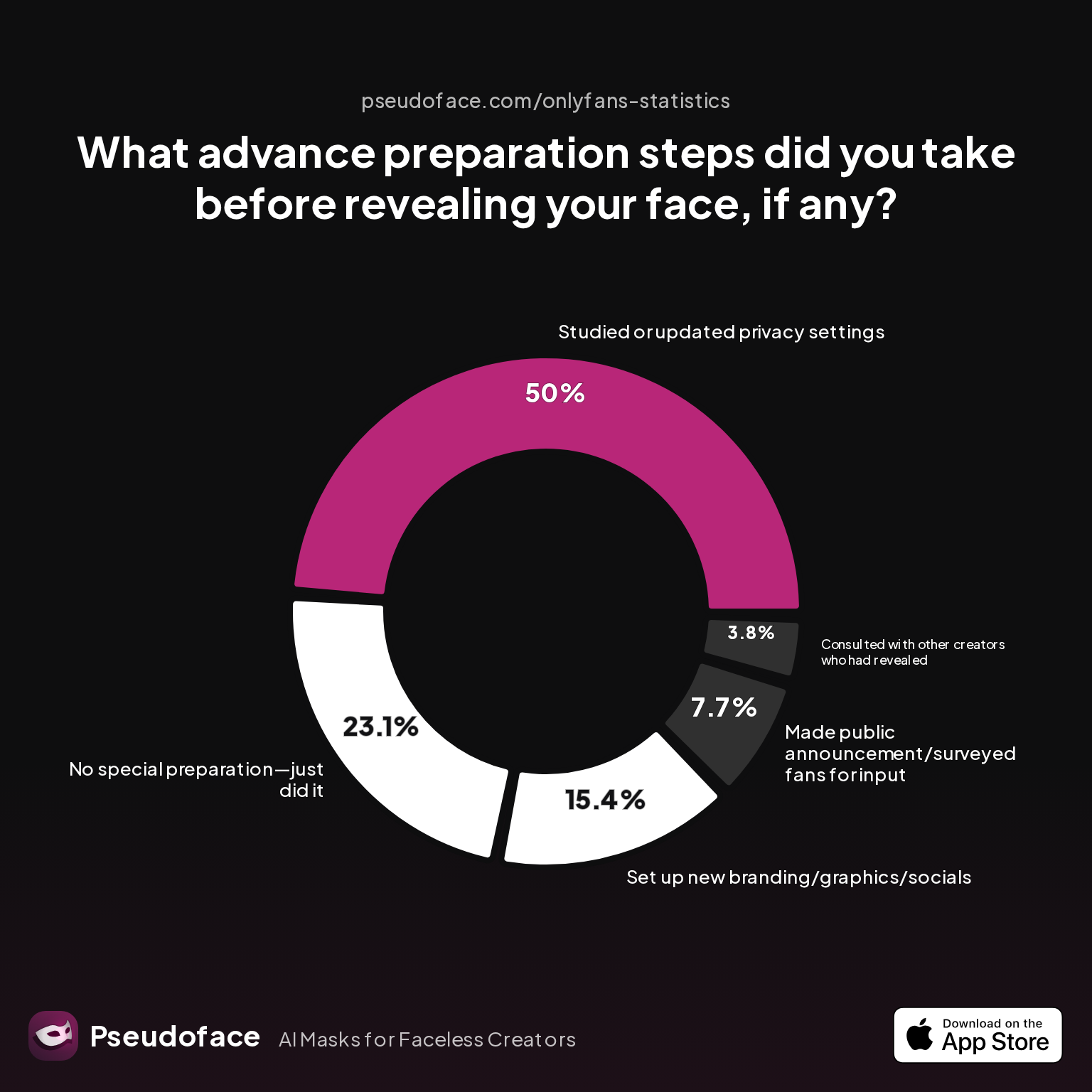
Half of creators (50%) study or update privacy settings prior to a face reveal. This can mean scrubbing metadata from old files, tightening account security, locking down alternate social accounts, or removing traces of true name/location from bio fields.
Branding updates (15.4%)—such as refreshed banners, new handles, and adjusted profile pictures—help a creator visually “turn the page.” Only 3.9% consult with others first, showing a surprising lack of direct mentorship, while 7.7% survey fans, seeking a sense of anticipation (or warning signs).
But almost one in four (23.1%) “just did it”—no preparation at all—suggesting that some transitions are still driven by fatigue or spur-of-the-moment decisions, rather than strategic calculus.
The most satisfied revealers tend to invest in both emotional and logistical prep:
- Practicing candid speaking or video to overcome awkwardness
- Doing test-runs with a limited group (e.g., customs, private PPV)
- Reading up on the privacy horror stories and best practices from others
Open thread on Redditr/CreatorsAdvice
u/YourHiddenKink
Faceless male here. I do neck down to be safe. Eyes are telling.
This testimonial highlights a critical point: some creators mitigate risk through partial reveals or feature cropping (from the nose down, blurring, or creative angles), “easing in” before any full face exposure. Tools like masks, elaborate makeup, or AR filters remain popular for creators who want to flavor their persona without full de-anonymization.
Open thread on Redditr/CreatorsAdvice
u/focus_on_semantics
If you're worried about privacy, also consider doing more stuff with calls and texting - like through niteflirt or sextpanther! I never show my face and people are fine with that. If they ask, I send them a selfie (one that is not anywhere on social media) from my nose down and tell them that's as much as I'll provide.
Self-selection bias must be noted here: those sharing preparation tips on Reddit are likelier to be risk-aware and process-oriented; impulsive revealers (who may later regret it) are underrepresented. The takeaway is clear—careful preparation correlates with smoother transitions and lasting satisfaction.
Equipped with these tactics, creators are left with the next big choice: Should the reveal be sudden—a single, dramatic moment—or gradual, easing into visibility?
Face Reveal Approaches Compared: Sudden vs. Gradual Reveal
Revealing your face doesn’t have to be a binary flip. Among creators who crossed the line, strategies diverge sharply: a sweep from bold, all-at-once reveals to cryptic, staged reveals that test the waters before full exposure.
| Answer | Percentage |
|---|---|
| Announced to fans before reveal, then revealed | 0.00% |
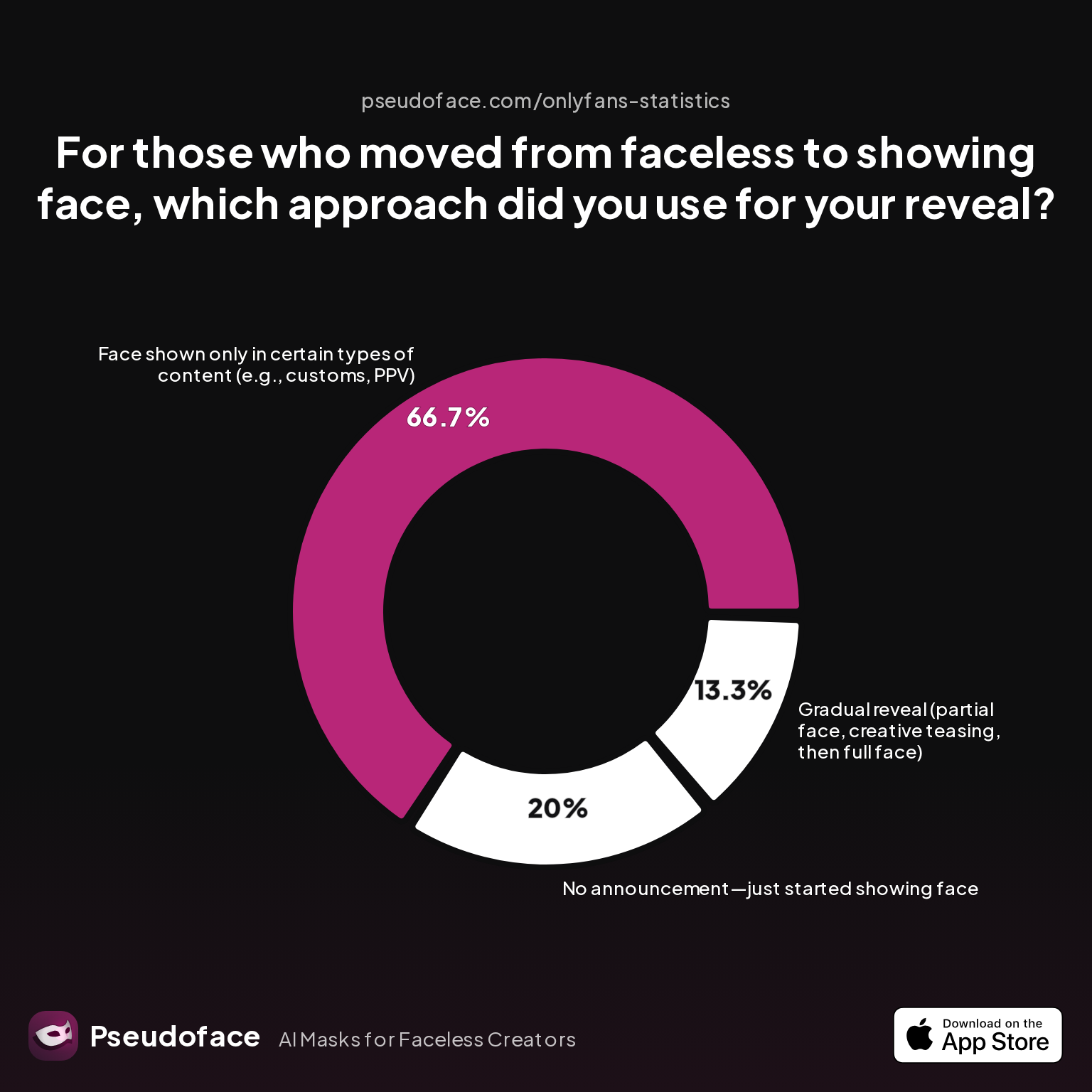
| Face shown only in certain types of content (e.g., customs, PPV) | 66.67% |
| Gradual reveal (partial face, creative teasing, then full face) | 13.33% |
| Immediate reveal (sudden switch in new content) | 0.00% |
| No announcement—just started showing face | 20.00% |
Two-thirds (66.7%) take the incremental path: first showing their face in selected, often paywalled content. Gradual reveals (13.3%) involve partial exposures—eyes, mouth, or creative teasers—before transitioning to full face. Only a minority leap directly to prominent, public facing features, and none in the sampled dataset staged a dramatic “big bang” announcement before revealing.
A surprising 20% simply add facial visibility in regular posts with no fanfare; this cohort often reports “Let’s just get it over with” as motivation, skipping over audience acclimatization.
But what of regret?
| Answer | Percentage |
|---|---|
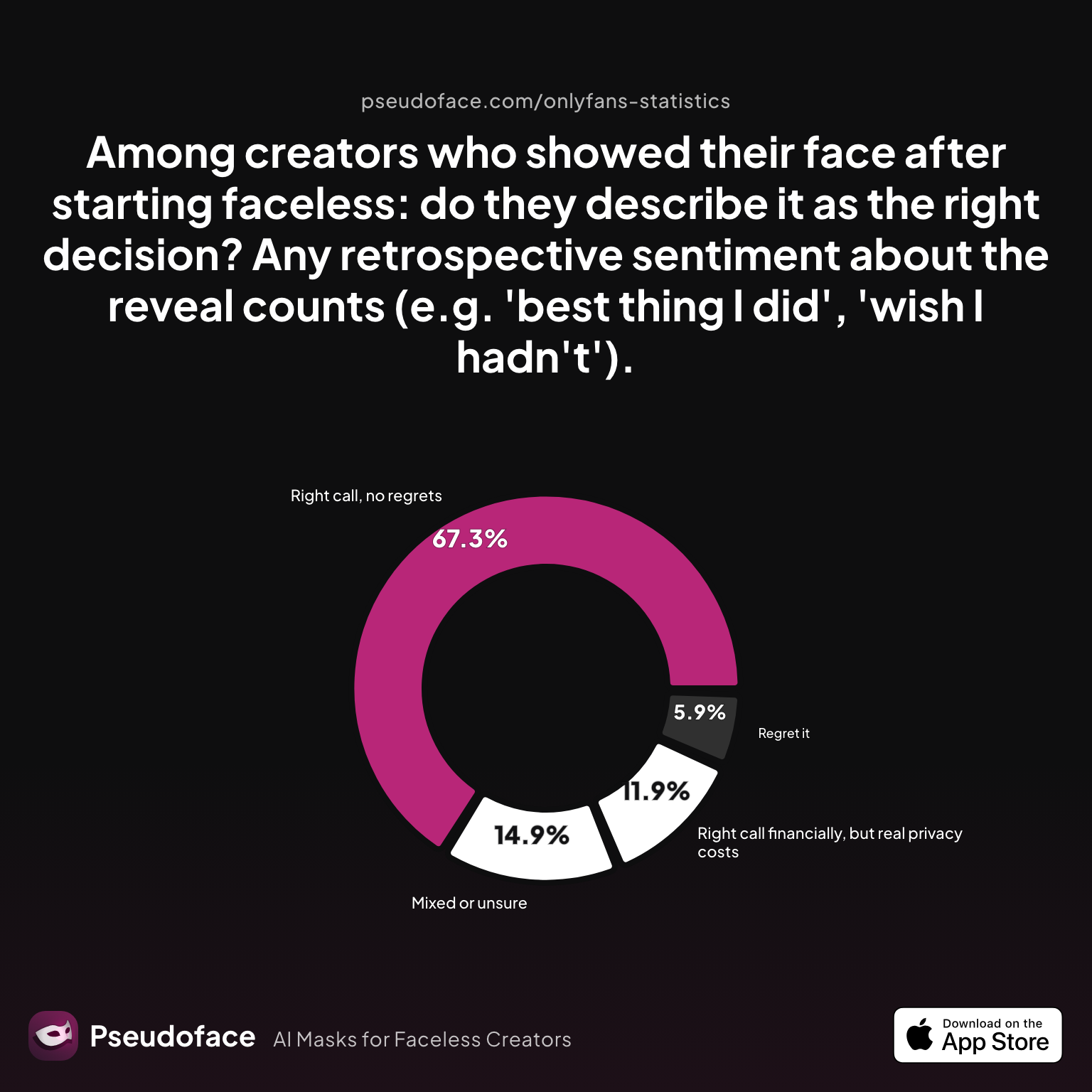
| Mixed or unsure | 14.85% |
| Regret it | 5.94% |
| Right call financially, but real privacy costs | 11.88% |
| Right call, no regrets | 67.33% |
Roughly 6% outright regret revealing their face. An additional 15% are “mixed or unsure.” More telling: 11.9% call it “the right decision financially, but with real privacy costs.” Only about two-thirds are unequivocally positive after the fact.
This means nearly 1 in 3 creators feel ambivalence or pain, even after the (usually) carefully planned path to visibility.
Open thread on Redditr/onlyfansadvice
u/SuperShyCharlotte
Whatever you decide, just remember whatever you post on Reddit is there forever, even if you delete it people can access it
Among the most common regrets: underestimating how widely face-revealed content gets saved, downloaded, and re-shared—the “genie out of the bottle” problem. Once your face is out there, platforms and audiences rarely, if ever, let you “go back.”
Case in point: high-profile creators—like the Minecraft YouTuber Dream’s face reveal—provide mass-scale experiments. Dream’s sudden, highly public reveal sparked a whirlwind: memes, critique, devoted fan edits, and a lasting shift in his online identity. Reddit and Twitter exploded with both excitement and backlash, highlighting just how uncontrollable the narrative can become.
For everyday creators, the best practice—embodied in the data—is to reveal gradually, test with trusted fans or premium content, and prepare for both immediate reaction and long-term consequences. It’s seldom just about the first week of feedback; it’s about what happens over months and years, especially as old content is dug up or recontextualized.
As we’ll see next, audience reaction is often positive—but that’s not the whole story.
What Actually Happens After? Audience Reaction to Dream Face Reveal and Real-World Reveals
Audience response is the wild card: titillating in prospect, daunting in reality. High-profile reveals like Dream’s draw a spectrum of reaction—cheer, critique, and uncomfortable scrutiny all in one sweep. But what should solo creators realistically expect after unveiling their face?
| Answer | Percentage |
|---|---|
| Mixed—some excitement, some unsubscribes or negativity | 0.00% |
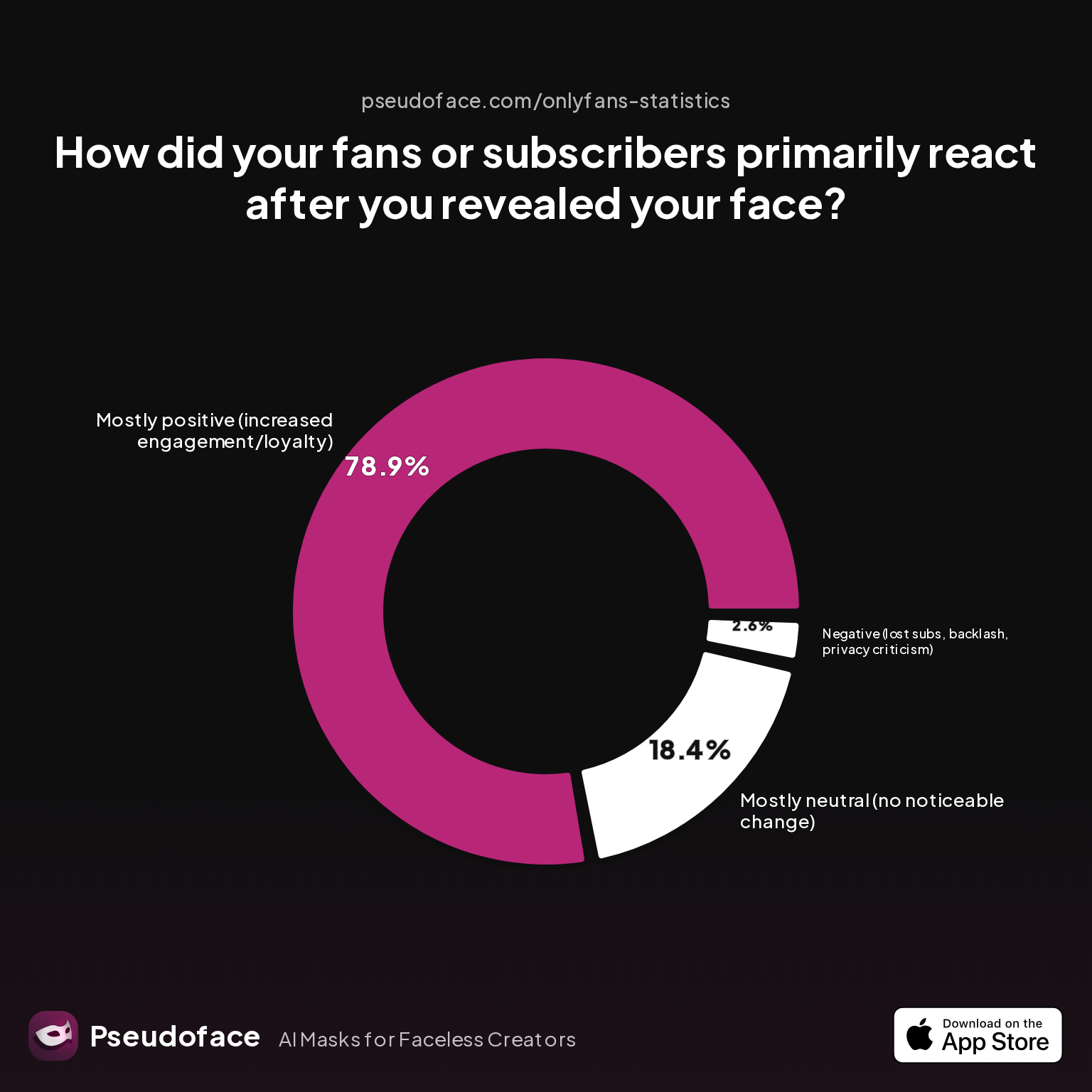
| Mostly neutral (no noticeable change) | 18.42% |
| Mostly positive (increased engagement/loyalty) | 78.95% |
| Negative (lost subs, backlash, privacy criticism) | 2.63% |
Data from real-world creators as of late 2025 shows that roughly 79% experience an uptick in engagement and fan loyalty. Fewer than 3% face backlash or overtly negative outcomes. The remaining 18% see little to no shift—neither surge nor sting.
This skews more positive than many fear, but survivorship bias is at play: creators who experienced calamitous reveals may be less likely to share, skewing the sample toward those who made the transition without major incident.
For figures like Dream, the “reaction to face reveal” hit global Twitter trending lists, drawing both adulation and mockery. More ordinary creators report a quieter boom: curious DMs, short-term tip spikes, and honest excitement from fans finally putting “a face to the voice.” Sometimes, curiosity cools back to routine after days or weeks.
Open thread on Redditr/CreatorsAdvice
u/adviceandthat
All faceless. However I do have a personal TikTok account (85K) however I don’t really post sexual stuff I literally just yap about random things 😂 Maybe I’ll milk it for a bit and say face reveal on OF 🤔 and then later down the track use my personal accounts when I’m over it (over the faceless promotion tbh cause I hate having to be creative lmao)
Themes extracted from Reddit:
- Personality-heavy niches (“girl next door,” “comedy,” “relationship”) see larger, more positive engagement shifts post-reveal.
- Anonymous, purely erotic, or roleplay-based creators sometimes see muted change; the audience is more invested in fantasy or concept than individual identity.
- In rare cases, a face “fails to meet” fan imagination—leading to letdowns and unsubscribes, but these are the exception, not the rule.
Monetization can see a pronounced bump: creators often charge a premium for initial face reveals. Reports of $100+ PPV for selfies are not uncommon, and long-term subscribers sometimes upgrade as a show of hype or appreciation.
Open thread on Redditr/CreatorsAdvice
u/adviceandthat
$300 for a nude with face and $150 for just a face/selfie reveal
Yet the euphoria is tempered by a new emotional reality. Creators who were anonymous must now recalibrate their boundaries—from casual DMs (“now I know what you look like in real life!”) to requests for more revealing content, or even IRL meetups.
Some experience relief—finally able to integrate their creator self with “real life”—while others feel a new, persistent vulnerability.
Above all, the “forever” aspect of a face reveal looms largest—the topic of our next section.
Irreversible and Life-Long: Privacy Concerns After a Face Reveal
Crossing from faceless to face-shown is a one-way door. Even the most careful creator routinely discovers, sometimes too late, how the Internet archives and circulates their image. Simple protection tactics, which once felt sufficient, quickly become outmoded.
| Answer | Percentage |
|---|---|
| Avoiding location-specific details in content | 6.77% |
| Geo-blocking specific regions | 2.79% |
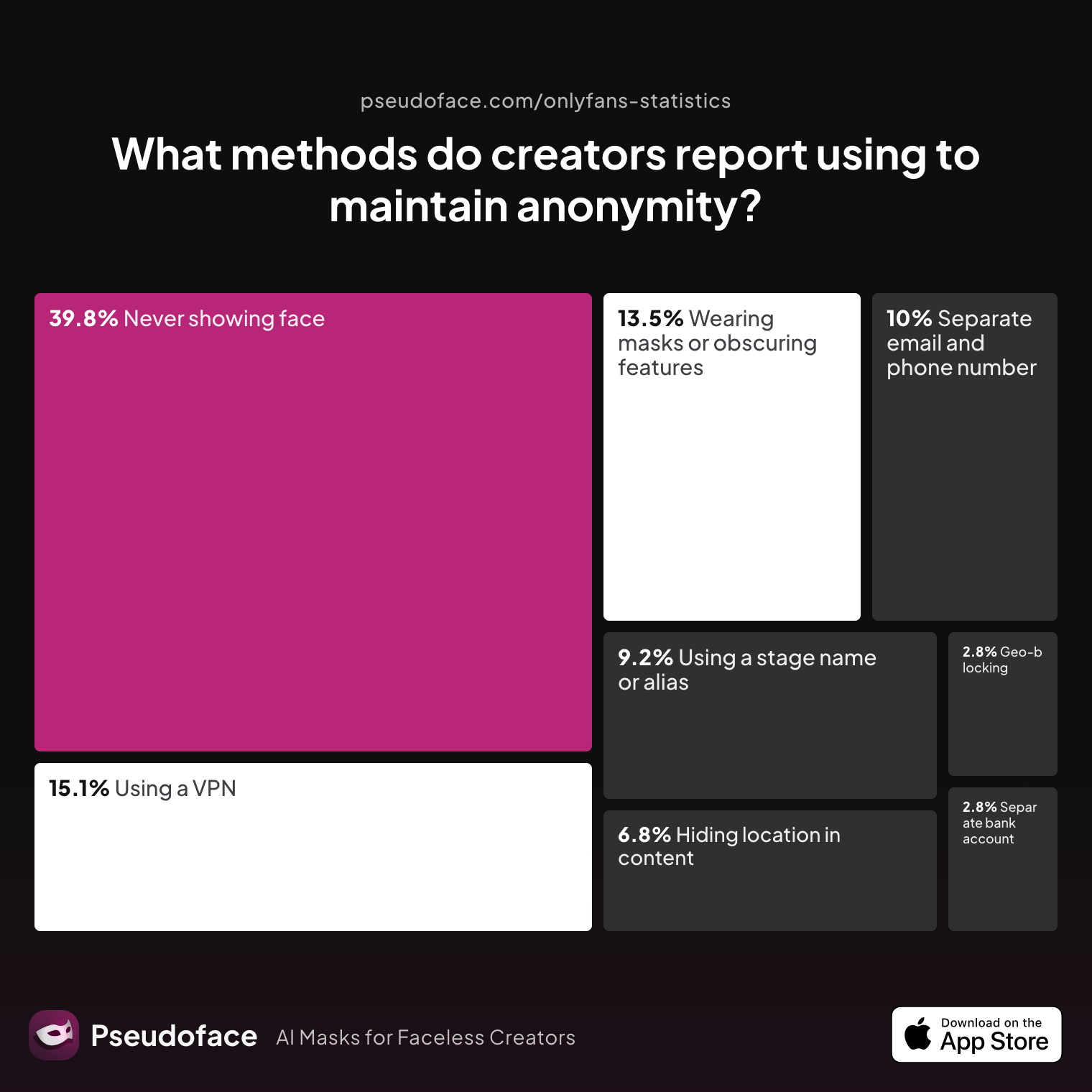
| Never showing face | 39.84% |
| Using a separate bank account or business entity | 2.79% |
| Using a separate email and phone number | 9.96% |
| Using a stage name or alias | 9.16% |
| Using a VPN or privacy tools | 15.14% |
| Wearing masks or obscuring identifying features | 13.55% |
Prior to revealing their face, just under 40% “never show face,” a core strategy for privacy protection. Only modest percentages use technical steps like VPNs (15.1%), alternate emails (10%), or geo-blocking (2.8%). Most lean on simple stage names and masking features (13.5%), means often rendered moot post-reveal.
Once revealed, former methods of anonymity rapidly diminish in protective value. A single face-shot can be reverse-searched; one viral meme may connect stage name and birth name across platforms.
Open thread on Redditr/CreatorsAdvice
u/MissHoodie
No. I feel if you're faceless you're doing it out of safety or privacy concerns (at least for me). Once you show your face there's no going back.
Legal or workplace discovery risks also spike. Creators with day jobs (especially teachers, healthcare, civil servants) routinely worry about being outed. Geo-blocking, previously a fallback, is imperfect—VPNs, leaks, and whistleblowers remain threats.
Open thread on Redditr/onlyfansadvice
u/SuperShyCharlotte
Whatever you decide, just remember whatever you post on Reddit is there forever, even if you delete it people can access it
For those later regretting their reveal, the practical options are grim. While you can scrub official profiles and rebrand, fan-saved media and screen captures persist. Public records of usernames, archived by aggregators or even nosy ex-subscribers, show up in search for years.
Mitigating after-the-fact exposure takes vigilance:
- Requesting takedowns from major platforms
- DMCA filings (often ignored by aggregators)
- Coordinating with legal advisors or privacy pros (rare, costly, and mainly for big names)
But the best protection remains up-front: only reveal your face if you’re truly, permanently comfortable with the possibility of being publicly associated with your creator persona—for years to come.
For some, this knowledge is clarifying. For others, it heightens anxiety, reinforcing that anonymity is not “paranoia,” but strategic protection in a sticky, unpredictable internet age.
Let’s close with a practical, self-reflective framework for making the move.
A Decision Framework for Faceless Creator Transition
Facing the fork—move from faceless creator to face reveal—demands both practical audit and honest self-assessment. Here is a roadmap distilled from Pseudoface’s synthesis of creator data and Reddit wisdom:
1. Start with core questions:
- Why do I want to reveal my face—growth, connection, monetization, or personal integration?
- What privacy boundaries am I unwilling to cross, even for career upside?
- Is my audience invested in me or the persona I play?
2. Prepare a “reveal readiness” checklist:
- Scrub all public social links for traceable personal details.
- Update privacy settings across platforms.
- Rebrand—or at least consider—your visuals, bio, and username.
- Practice “soft” reveals with trusted fans or paywalled content.
- Talk with peers who've made the jump for unfiltered feedback.
3. Decide style:
- Gradual or partial reveal is less risky and allows audience acclimation.
- Sudden “just do it” approaches have higher short-term risk but may fit certain brands.
4. Own the consequences, positive and negative:
- Expect a spike in curiosity and (usually) engagement.
- Plan for the likely permanence: old content will circulate, and private fans may become public ones.
- Have a response ready for family, friends, or employers who might find your content.
5. If regret sets in:
- Focus on legal takedowns, brand pivots, or hybrid anonymity going forward.
- Learn, adapt, and be cautious about future boundary shifts.
Above all—there is no universal “right moment.” The only right moment is the one where risk, preparation, and creative vision all align according to your real life, not imagined scenarios. It’s normal to hesitate and revisit the choice; smart creators do.
For those still pondering, the most common sentiment is: better to wait and reconsider than to reveal too soon.
Next, explore detailed questions in the FAQ below.
Frequently Asked Questions
Q: How do I know if it’s time to reveal my face as a creator?
It’s time only if you’re confident in both your risk tolerance and your motivation for revealing. Most creators wait until privacy boundaries are well considered and goals (like brand deals or engagement) make the risk worthwhile.
Q: What’s the safest way to show my face for the first time online?
Reveal behind paywalls or to trusted fans first, update all privacy settings, and use branded watermarked content; soft-reveal with partial face shots is safest for testing the waters.
Q: Do most creators regret their face reveal afterward?
About 6% express clear regret and another 27% have mixed or privacy-related regrets, but 2/3 report long-term satisfaction—most who plan carefully adapt well.
Q: How do fans usually react after a faceless creator face reveal?
Most fan bases respond with excitement or increased loyalty (about 79%), though a minority remain neutral; negative backlash is rare but possible, especially if fan expectations are subverted.
Q: What privacy steps should I take before making a face reveal?
Scrub public accounts of identifying info, review all platform privacy settings, prepare fresh branding, and test with small or private segments before going public.
Q: Is it possible to “go back” to being faceless after a reveal?
No, it’s nearly impossible to fully retract a face reveal; digital footprints and fan-saved content make true reversal unlikely once your face is online.
Q: How does showing your face affect creator earnings or brand opportunities?
Face reveals can enable higher rates for customs and PPV, and sometimes unlock sponsorships or cross-platform branding, but results vary by niche and audience preference.
Q: What happens if my face gets reposted elsewhere without consent?
Act quickly: submit DMCA takedowns, contact platforms, and alert your audience. Some reposting is inevitable, but legal and community support can limit the spread.
Q: Can I stay anonymous in other aspects after a face reveal?
Yes, you can retain a pseudonym, avoid revealing personal details, and use geo-blocking or VPNs, but total anonymity is lost once your face is public.
Q: How do I manage the emotional impact of suddenly being recognized online?
Expect an adrenaline spike, lasting vulnerability, and even awkwardness in DM interactions. Peer support and setting new boundaries are crucial for mental well-being.
For creators at this crossroads, the journey from faceless to face-revealed is both liberating and daunting. With a plan, clear boundaries, and honest self-assessment, the risks become manageable—and the rewards, if aligned with your values, can be genuinely life-changing.


