
TL;DR
For creators weighing the ManyVids Store (pay-per-view sales) against Club (subscription) features, income reliability in 2025-2026 is shaped by content format, retention effort, and platform shifts. Recent quantitative evidence shows Club income suffers from high subscriber churn—over 36% experience monthly losses of 30% or greater—while Store revenue is far more spiky and momentum-driven, tied to release timing and buyer enthusiasm. Data from Pseudoface’s analysis of more than 250,000 public Reddit threads by active adult creators confirms most steady earners combine both, using the Store for large sales spikes and Club for monthly baselines. As with all forum-driven data, results reflect survivorship bias and self-selected reporting; take trends as directional, not prescriptive.
Understanding ManyVids Store vs Club: Core Mechanics and Monetization Logic
ManyVids offers a split model: the Store for one-off pay-per-view (PPV) sales and the Club (previously “Crush Club”) for paid, ongoing subscriptions. These two channels are structurally different—not just in revenue flow, but in the psychology of both buyers and creators. Understanding this operational divide is the first step to assessing which model may suit you best, how to balance them, and what kind of stability (or volatility) to expect.
The Store works as a digital content storefront, where buyers purchase individual clips, bundles, or digital goods à la carte. Creators set prices per asset; there’s no obligation to maintain a posting schedule, but real income depends heavily on active promotion, regular releases, and strong asset value perception. It appeals to buyers seeking a specific “hit” or custom request, and can generate large, unpredictable spikes tied to new drops, trending niches, or marketing pushes.
The Club is closer to a recurring-membership model. Subscribers pay a set monthly fee for access to an exclusive feed—often including videos, photos, behind-the-scenes drops, or member-only perks. The hook is ongoing intimacy and a promise of continuous new material or personal access. On the surface, this suggests steady, predictable income. In practice, though, stability depends on how long subscribers stay, what incentives keep them engaged, and the creator’s ability to prevent mass churn.
A decision to focus on Store, Club, or both touches every part of a creator’s workflow, audience relationship, and stress levels. For many, the Store offers freedom and bigger spikes, but greater risk. The Club, meanwhile, can provide “rent money consistency,” but easily slips into a treadmill of grind and subscriber loss. As we’ll see in the sections ahead, real-world results are mixed—often requiring adaptive strategies and a clear-eyed view of what each channel realistically delivers.
With the mechanics mapped out, the next section delves into real patterns of Store earnings, the psychology that drives PPV conversions, and how these sales play out across a creator’s month.
The ManyVids Store Feature: Spiky Earnings, Audience Psychology, and Conversion Patterns
The ManyVids Store is prized by many for its high-reward, low-commitment model: upload a compelling video or series, price it well, and single-buyer sales can outstrip monthly subscription fees in one swoop. But Store earnings are notoriously uneven, swinging from major launch weeks to barren stretches with little income at all. What determines these peaks and valleys?

| Answer | Percentage |
|---|---|
| 0‑1 | 67.86% |
| 2‑3 | 10.71% |
| 4‑6 | 7.14% |
| 7‑10 | 0.00% |
| 11 or more | 14.29% |
The vast majority—nearly 68%—of paid subscribers purchase just 0-1 PPV asset per month, while only 14% become heavy buyers (11+ assets/month). This tells us that for most creators, buyer “whales” are rare, and spikes come from a small pool of big spenders or occasional, high-interest content releases.
PPV sales do not drive steady, repeatable income for most creators—Store success hinges on regular product launches and cultivating rare big buyers. Yet the top-tier earners can see outsized revenue if they hit the right niche at the right time.
This aligns with real creator sentiment:
Open thread on Redditr/CreatorsAdvice
u/baby_twirls
$29.99. Depends how good it is, how many people see it, and how many you sell

For many, the PPV model offers an escape from the subscription treadmill—especially if your audience wants something unique, custom, or outside the scope of “subscriber wall” content.
Next, we need to understand what leads creators to prioritize Store (PPV) sales over subscriptions. Is it simply about money, or does audience and time-management play a bigger role?

| Answer | Percentage |
|---|---|
| I aim to maximize earnings per transaction | 25.68% |
| I have limited time to post daily content | 8.78% |
| I wanted to keep subscription price low to attract more followers | 28.38% |
| My audience prefers occasional premium content | 3.38% |
| My niche works better as PPV (e.g., custom requests) | 33.78% |
Roughly one-third of creators cite their niche’s compatibility with PPV models as their top motivation. Another 26% focus on maximizing earnings per transaction, favoring high-ticket sales over lower-value ongoing subscriptions. Notably, only a relatively small group (about 9%) emphasize lack of time to post daily as the main draw; most understand that PPV sales still require real promotional and launch effort, just in bursts rather than a steady grind.
Niche alignment and transaction maximization are the primary reasons creators choose PPV-focused Store strategies over Club subscriptions. If your content is well-suited to “occasional premium” (fetish customs, collaborations, or exclusive drops), or your audience responds more to instant gratification than ongoing engagement, the Store becomes the clear winner—at least for revenue potential, if not stability.
But these strengths are counterweighted by volatility. “Drop” launches may bring in hundreds in a night, only to leave creators hustling for the next big idea as income drops back to zero between releases. Buyer psychology, too, leans toward cherry-picking: many fans save up or selectively buy only when something truly irresistible goes live.
Having mapped the revenue rhythm and motivations behind Store-first strategies, we now turn to the Club—where stability is promised, but churn and retention create their own unique challenges for creators.
The ManyVids Club Feature: Subscription Revenue, Churn Risk, and Stability in Practice
ManyVids Club tempts creators with the idea of passive, recurring revenue—set up a paywall, post regular content, and watch your subscriber count march steadily upward. But as of early 2026, the reality is far more dynamic: churn rates are high, retention is labor-intensive, and sustainable growth requires constant, creative engagement.
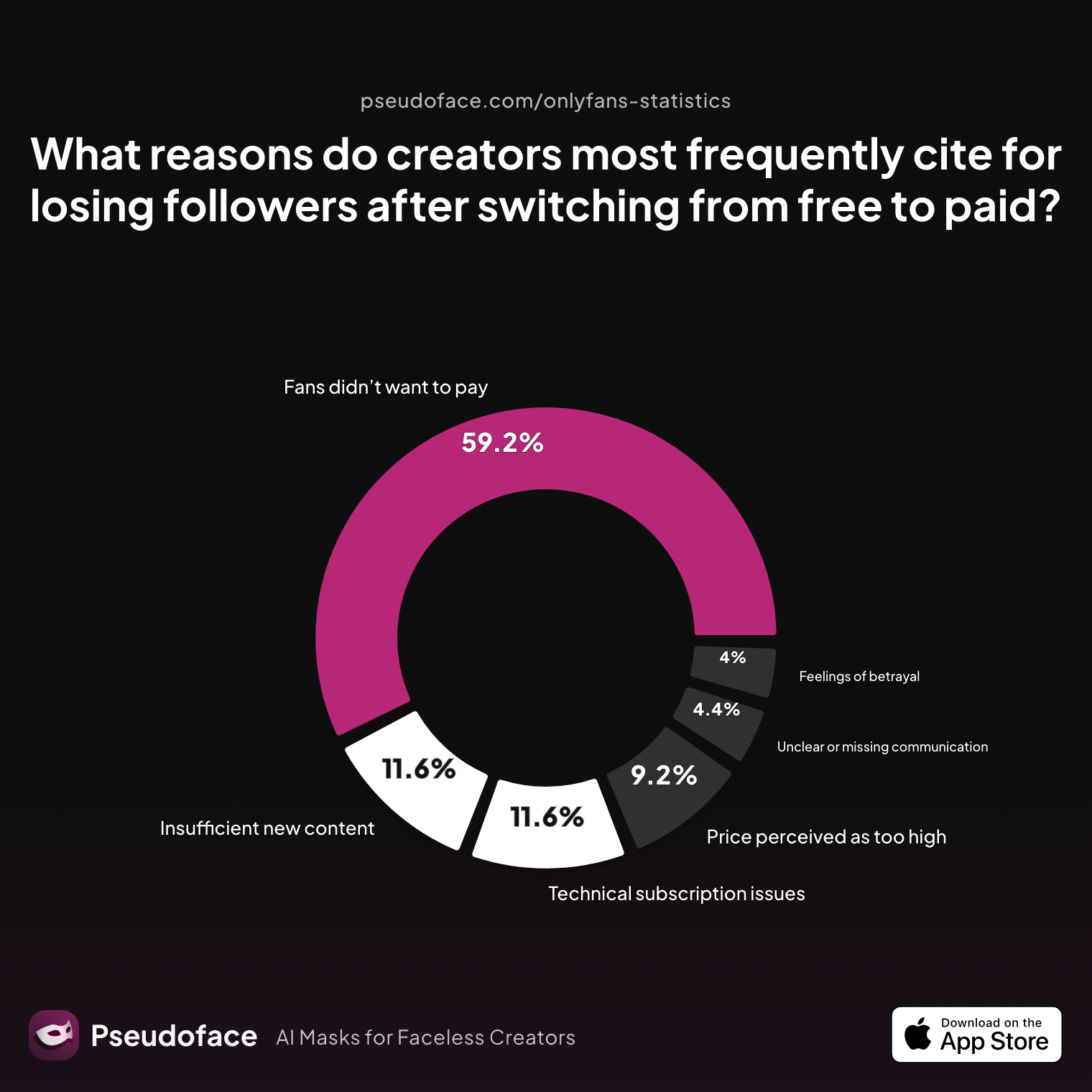
| Answer | Percentage |
|---|---|
| Fans didn’t want to pay | 59.20% |
| Feelings of betrayal | 4.00% |
| Insufficient new content | 11.60% |
| Price perceived as too high | 9.20% |
| Technical subscription issues | 11.60% |
| Unclear or missing communication | 4.40% |
Self-reported losses after switching from free to paid overwhelmingly stem from fans simply not wanting to pay (59%), with insufficient new content (11.6%), technical barriers, and unclear communication rounding out other core causes. While price is a concern (9%), it is rarely the main factor—suggesting that creators struggle more with audience conversion and transparency than with fee setting alone.
Creators report that Club subscriber loss is primarily due to fans unwilling to pay, not just pricing or platform mechanics. This insight is consistent whether you’re a veteran or just pivoting to subscriptions, and highlights the need for frequent communication, value explanation, and realistic expectations about trial-to-paid conversion rates.
Real-world Club creators echo these findings:
Open thread on Redditr/CreatorsAdvice
u/Cobalt_FTM
You only do solo, but do you make different types of content that could be differenciated in value? For me, collabs are higher value and solo lower value; from now on I'll post collabs in the Store and Solo in Crush Club, but for you it could be different: a specific fetish or type of clips. You could also simply upload only pics in Crush Club, and Clips in the Store. Now, depending on your pricing you could even do the opposite : lower value in Store and Exclusive higher value in MV Crush Club; but in my experience Crush Club is hard to sell, so I bet my money on Store clips instead, but use Crush Club as an advertising space for my Store Clips. I've had a few different models over the years so here it is: 1/ Downloads in Store - Pics and stream for Subs -> I used to think stream-only clips wouldn't sell, but know that fansites are more popular, people are used to content they can't download. Also when I gained more visibility and strated doing collabs, I started having more people who steal content, I don't want to help them by offering downloads. (however I never found a clip in the wild stolen from MV, they're all stolen from my partner's OF lol) -> I have never managed to sell pics as a MV Item, so I prefer to just upload them to MV Crush Club. -> I wouldn't advise offering downloads in this era of Telegram channels and widespread piracy, but to each their own 2/ Full-length Clips in Store - Part 1 for Subs + Pics -> I would upload only the first part of the clip to MV Crush Club, so that they would still need to buy the full clip if they want to see the cumshot and full video. -> I kept on uploading full-length solo clips as an incentive to sub, because MV Crush Club is inferior to OF/JFF/Mym since it doesn't offer good messaging options anymore: All buyers can DM you in the 30 days after they buy content or sub, so it's not an incentive to sub. And if they sub for a longer time, they won't be able to DM you after the 30 days. 3/ Pics + Full-length Solo Clips -> This is what I'm transitioning to at the moment. I post on 5 different fansites, so I don't want to spend too much time on those that don't make me a lot of money (MV Crush Club is a low-performing one for me). But I still want to use MV Crush Club, because it's a recurring income + the goal is to make fans want to buy your clips. Store and Crush Club feed each other -> I offer discounts on my Clips for my subs, that is an extra thing you could do an advertise to get subs -> Collabs will only be in the Store
But once you’ve converted subscribers, what keeps them around? The next chart sheds light on the most formidable retention challenges Club creators face:
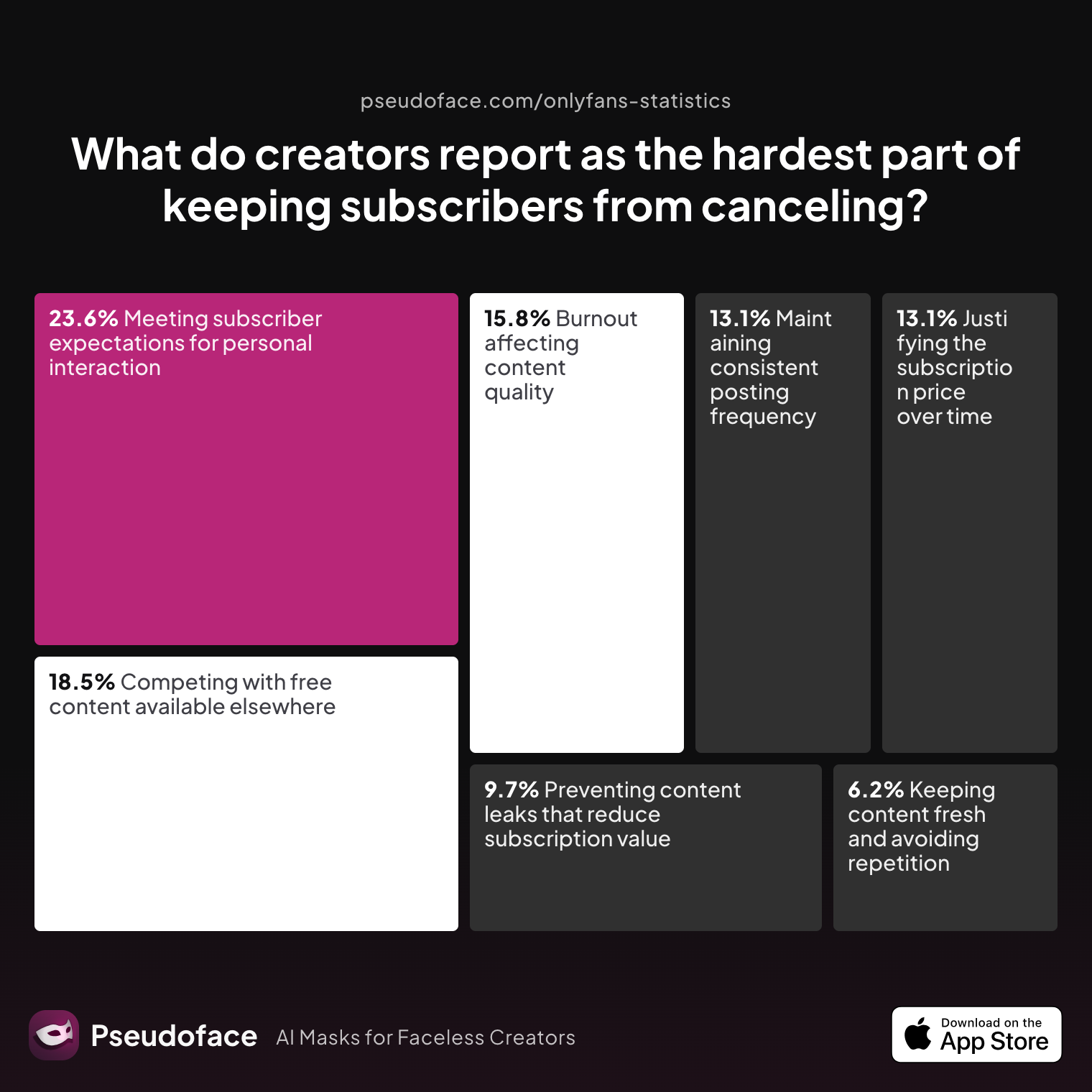
| Answer | Percentage |
|---|---|
| Burnout affecting content quality | 15.83% |
| Competing with free content available elsewhere | 18.53% |
| Justifying the subscription price over time | 13.13% |
| Keeping content fresh and avoiding repetition | 6.18% |
| Maintaining consistent posting frequency | 13.13% |
| Meeting subscriber expectations for personal interaction | 23.55% |
| Preventing content leaks | 9.65% |
The leading retention struggle is meeting subscriber expectations for personal interaction (24%), followed by burnout (16%), and competition with free alternatives (19%). Justifying value, posting frequency, and content freshness all matter, but pale next to the demand for creator accessibility—a challenge almost unique to Club models.
Personal interaction is the single most cited barrier to retaining Club subscribers, with burnout and outside competition close behind. The baseline promise of ongoing, direct attention is why many fans join Clubs in the first place—making it both a unique selling point and a taxing, ongoing responsibility for the creator.
Practically, Club may offer steadier income for some—if you can maintain engagement, privacy, and variety. But the risks of rapid churn and emotional burnout are real, especially as more creators compete for a relatively fixed pool of subscription buyers.
With the mechanics and risks of both channels in focus, it’s time to face their head-to-head comparison: which model drives more stable, reliable income, and how do real creators map their own transition or blend?
ManyVids Store vs Club: Income Predictability, Revenue Mix, and Transition Mapping
Comparing Store and Club means weighing volatility against retention grind, and recognizing how revenue streams fluctuate with time, season, and creator effort. Directional data—as of 2025—shows that while Club dominance has grown, stability is still elusive, and many creators operate hybrid models to manage risk.

| Answer | Percentage |
|---|---|
| Balanced | 4.50% |
| Mostly PPV | 36.04% |
| Mostly subscription | 59.46% |
A majority (59%) of creators now report that most earnings come from subscriptions (Club), while over a third (36%) remain primarily PPV-driven. Strikingly, only 4.5% achieve a true balance—revealing that hybrid approaches are often theorized but, in practice, creators usually lean hard towards one model based on personal workflow, audience, and tenure.
The data shows that 59% of ManyVids creators now earn the bulk of their income from subscriptions, compared to 36% from PPV—yet the vast majority are not balanced, but subscribe to one model as dominant. This is important for creators hoping to “do both” without overextending; most find that, over time, one side wins out, often dictated by which model aligns with their energy or audience.
Hybridization—using both Store and Club—still plays a crucial role for many, usually as a fallback against unexpected income drops or algorithm shifts. It’s not a simple split, though: creators must decide how to tier offerings, price content, and reward loyalty to wring the most from each channel.
Looking at how these choices shape growth, let’s examine initial subscriber-building tactics:
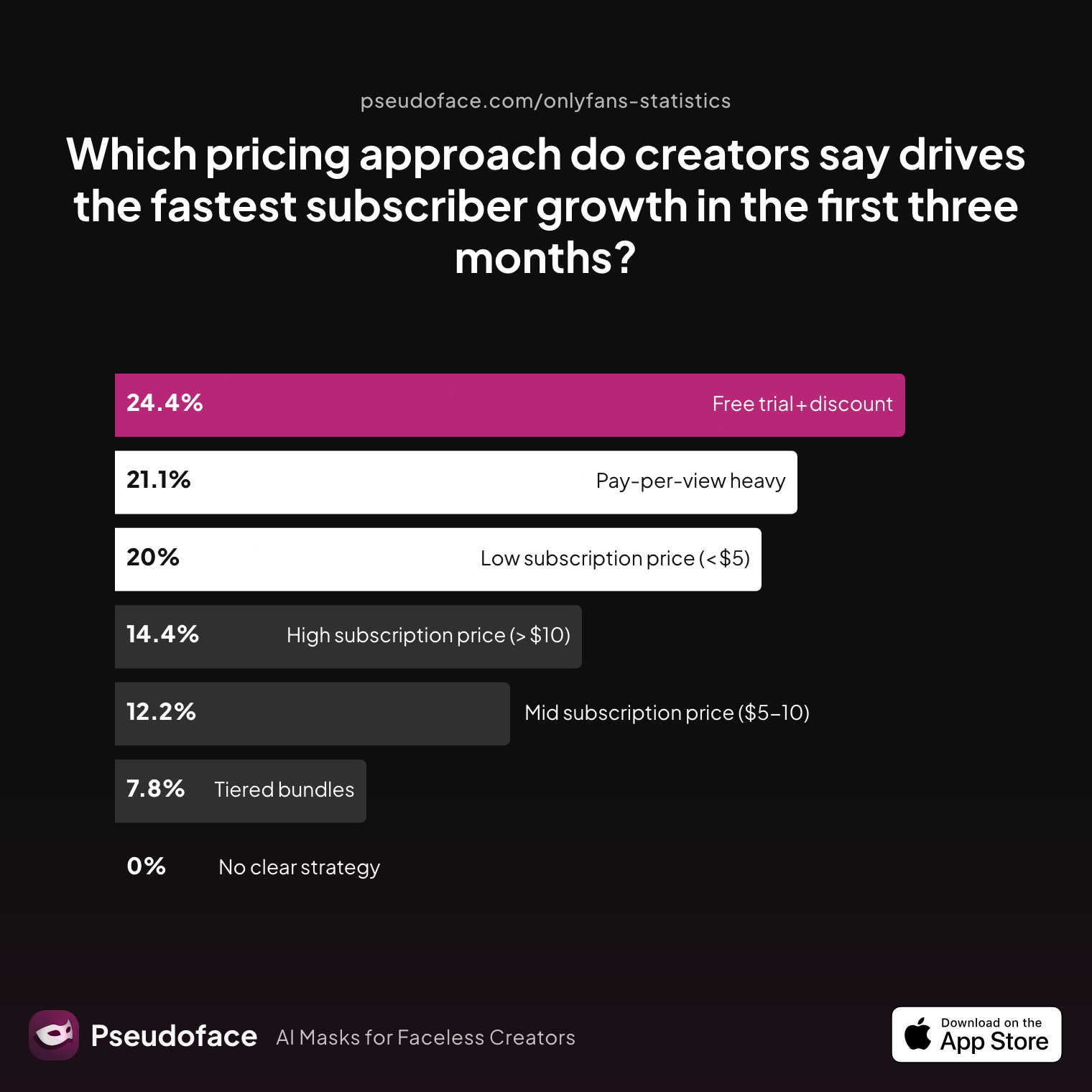
| Answer | Percentage |
|---|---|
| Free trial + discount | 24.44% |
| High subscription price | 14.44% |
| Low subscription price | 20.00% |
| Mid subscription price | 12.22% |
| Pay‑per‑view heavy | 21.11% |
| Tiered bundles | 7.78% |
| No clear strategy | 0.00% |
Nearly a quarter (24%) of creators say free trials or discount entry offers spur the fastest early subscriber growth, another fifth swear by low subscription prices, while 21% report that a “pay-per-view heavy” setup works best. High sub prices appeal to a narrower set—often those with strong brands or exclusive appeal.
This leans into adaptive strategies: many begin with low-barrier offers to attract critical mass, shifting toward PPV or higher-priced Club membership as their audience becomes “sticky.” The zero-reported “no clear strategy” response emphasizes how rare it is to succeed without deliberate experimentation and adjustment to feedback.
A Reddit comment summarizes the logic behind this experimentation:
Open thread on Redditr/CreatorsAdvice
u/VivaDance
Yes, it has two types of subscription, but it doesn't brings as much as separate selling. Except if you make very low price. I have club subscription for $4 and few subscribers for all my 4 years there. Check other creators on the site: how many videos they sell and how much for all and make your price.
In sum: If you’re entering the market now, expect to iterate on price, mix, and launch timing. The most sustainable paths tend to be those where creators know when to shift tactics—raising Club prices only after building loyalty, dropping big Store launches after subscriber slumps, or blending both for a baseline.
Club, for all its draw, does not always deliver the steady income it once promised—retention and engagement have become the new battlegrounds. Let’s dive into what’s actually working (and what’s myth) on the engagement front.
Retaining ManyVids Club Subscribers: What Actually Works for Engagement and Churn Prevention
Retention—keeping Club subscribers coming back—remains a central challenge for creators. Beyond platform mechanics, it’s creative connection and perceived value that make the difference between one-month churn and growing, sticky membership. But what really works, according to peer-reported outcomes?
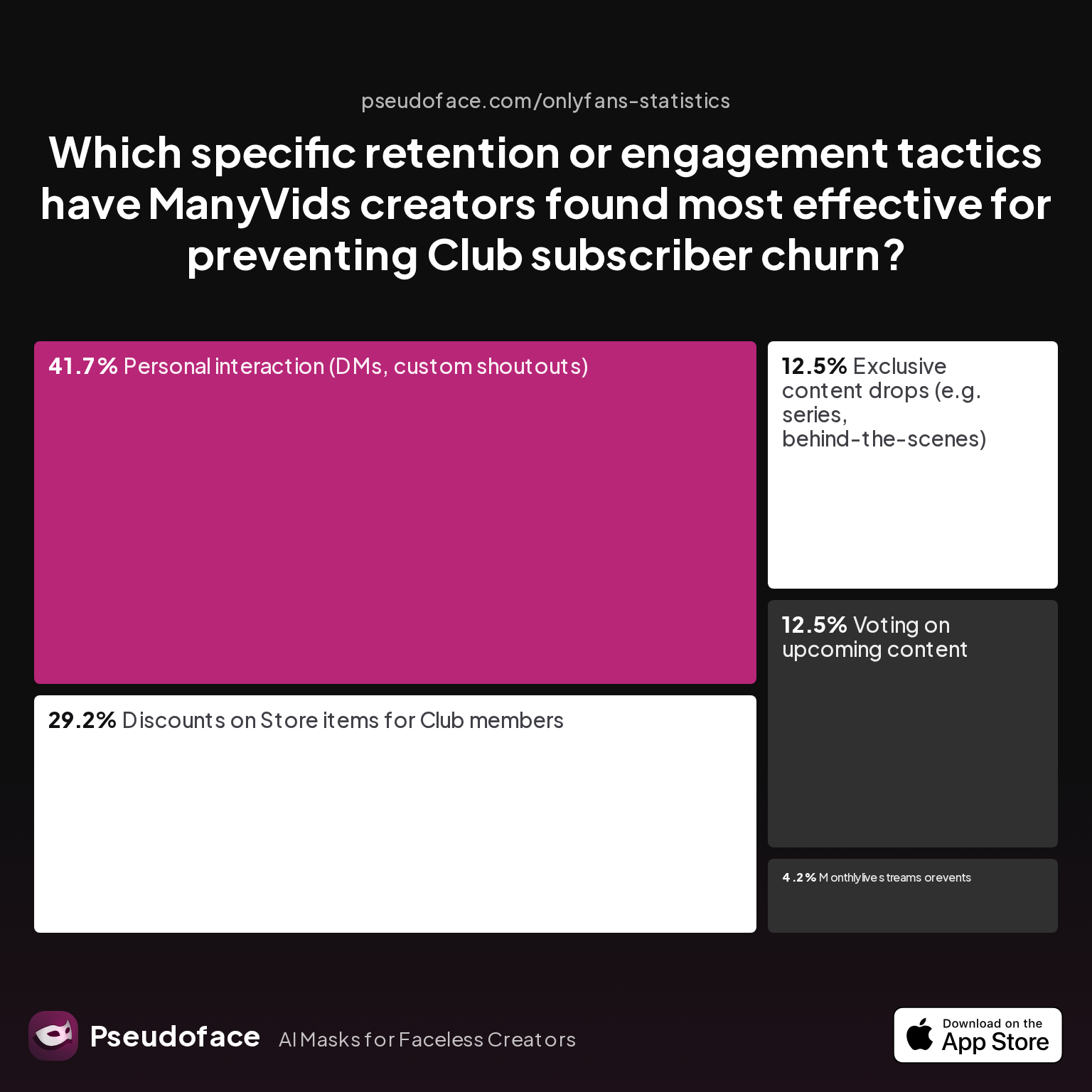
| Answer | Percentage |
|---|---|
| Discounts on Store items for Club members | 29.17% |
| Exclusive content drops (series, behind-the-scenes) | 12.50% |
| Monthly live streams or events | 4.17% |
| Personal interaction (DMs, custom shoutouts) | 41.67% |
| Voting on upcoming content | 12.50% |
Peer data reveals that personal interaction through direct messages or customized shoutouts drives the best subscriber retention, at 42% effectiveness. Discounts on Store items for Club members are the next most successful strategy (29%), indicating that cross-pollination between Club and Store can build meaningful loyalty. Surprisingly, monthly livestreams or events account for just 4%—suggesting the marginal value of high-effort spectacle over routine, intimate engagement.
Exclusive drops and content voting matter (12% each), but fall short of the outsized impact that one-on-one interaction and financial cross-rewards seem to have.
As always, these stats reflect both the realities and the inherent limitations of self-reported Reddit data: creators likely to respond are those active enough to be concerned with retention, and the biggest voices are generally those who have found at least moderate success or survived platform shakes.
Several Reddit creators reinforce the effectiveness (and existential demands) of direct engagement:
Open thread on Redditr/feetfinderadvice
u/MillieRover
It’s pretty normal although, I don’t offer a subscription as it gives them the option to download all of my content for only the subscription price. It isn’t like Fansly or OF where people can only view content for the duration of the subscription period
Open thread on Redditr/feetfinderadvice
u/PeachyPetalToes
Try spicing it up maybe, toe rings , stockings, taking off socks
Successful retention, then, isn’t about volume or spectacle—but consistent value, communication, and “making the subscriber feel special.” Setting clear boundaries to avoid burnout is critical: creators who automate parts of their offering, set up batch discounts, and communicate what’s truly new (“here’s why you should stay!”) tend to fare best.
Having analyzed what works for retention, let’s situate these lessons in broader strategies—helping creators adapt to ever-changing platform realities and get the best from both Store and Club in 2026.
How to Make Money on ManyVids: Adaptive Tactics for Today’s Creator and Platform Environment
The adult creator landscape on ManyVids, as of 2026, is one of rapid adaptation: policy tweaks, shifting buyer mood, and more competition mean static strategies lose edge quickly. The most successful creators—whether Store, Club, or hybrid—focus less on any one “perfect” model, and more on cycle-driven adaptation while protecting their creative sanity.
For new entrants or those facing a subscriber dip, a few practical lessons emerge:
- Start flexible: Launch with both Club and Store content if possible, but keep value propositions distinct. What’s “subscriber-only” must feel different from a $10 PPV clip—be it intimacy, format, or series exclusives.
- Use early discounts/free trials to build your first subscriber base. Data from 2025 shows these drive far faster initial growth than high prices or pure PPV.
- Cross-pollinate perks: Club members crave Store discounts, while PPV buyers may upgrade for subscriber exclusives. Reward both sides.
- Watch and pivot: Monitor which releases or campaigns drive actual purchases—not just likes or comments—and let data, not ego, steer your time investment toward what works.
- Set clear boundaries and batch content: To prevent burnout (a top-cited Club retention challenge), schedule release days and automate messaging where possible. Protect downtime.
- Lean into personal interaction—but only to sustainable limits: Automated shoutouts, short video replies, and meaningful responses work better than mass livestreams or endless texting.
The reality: for most indie creators, “how to make money on ManyVids” is not a story of discovering a single model, but cycling between Store and Club focus with the seasons, personal energy, and evolving audience. Both require hustle, but each pays off differently—spikes (Store) versus slow build (Club).
For creators at the tipping point—Club slumping, Store spikes drying up—the next section offers guidance for when, and how, to shift your focus for maximal, sustainable gains.
When (and How) to Switch Focus: Lifecycle Signals and Sustainable Income Strategies
No income stream lasts forever, and very few creators avoid the cyclical “feast and famine” that comes with shifting algorithms, audience burnout, or niche saturation. Knowing the right moment to lean into Club, pivot toward Store, or rebalance your efforts can preserve both your wallet and your mental health.
When should you shift focus? The best signal comes from noticing one of two patterns:
- Club subscriber churn rises above 30% month-over-month for three consecutive months, and direct outreach, fresh content, or perks fail to reverse the trend.
- Store earnings stay flat or drop for two or more major launches, even as mailing list or follower engagement remains high (suggesting a new value proposition or niche is needed).
From within the Reddit creator community, transition experiences abound:
Open thread on Redditr/CreatorsAdvice
u/VivaDance
Yes, it has two types of subscription, but it doesn't brings as much as separate selling. Except if you make very low price. I have club subscription for $4 and few subscribers for all my 4 years there. Check other creators on the site: how many videos they sell and how much for all and make your price.
And recall:
Open thread on Redditr/TheOFHubForGirls
u/Clit_Chick
You would need to set your page as free first but all will be visible until you change them to ppv one by one as you can’t change them whilst it’s set on paid subscription to ppv is my understanding when I tried it some months ago
Lifecycle red flags for switching from Club to Store focus:
- Club revenue drops below “minimum viable” (your rent baseline) and retention tactics plateau out.
- New Club subscribers are only staying long enough to download and leave (see earlier churn stats).
- Store releases still draw sales and comments—even from lapsed or trial Club members.
Signals to switch from Store to Club focus:
- PPV sales dry up—but you have a consistent handful of repeat buyers who might prefer exclusive access.
- Burnout from “sales launch” cycles is sabotaging your creative wellbeing.
- You have enough content back catalog to justify a compelling Club archive.
Best practice: Don’t wait for one stream to hit zero. Begin shifting focus, communication, and incentives before a full-blown crisis. And always document what tactics, campaigns, and price points actually improved your earning stability.
In creators’ own words, managing the Store/Club balance is a fluid process—requiring honest reflection, peer benchmarking, and willingness to experiment. Survival, and real income growth, depend not on platform loyalty but adaptive, data-driven pivots.
Frequently Asked Questions
Q: How much can you really make with the ManyVids Store vs Club in 2024?
A: Most creators make less than $500/month from either model at first, but top percentiles see 4-5 figure spikes from Store launches and mid-three-figure monthly steadies from Club. Results depend on experience, audience niche, and tactical adaptation. For most, blending both with a lean toward one is the path to consistency.
Q: What retention tactics stop Club subscribers from canceling?
A: Direct personal interaction (DMs, custom shoutouts) and Store discounts are the two most effective retention strategies, according to creator-reported experience. Consistency and value matter, but perks that make Club members feel “special” outperform generic content drops.
Q: Should I lower my Club price or focus more on Store sales during a subscription slump?
A: Data shows that initial low prices or time-limited free trials boost subscriber numbers fastest, but if Club churn remains high, shifting temporarily to Store (with incentivized PPVs) may restore income until you can retool your Club offer.
Q: How do I know when it’s time to switch from Club to Store (or vice versa)?
A: If Club churn spikes for months and retention attempts plateau, or Store earnings suddenly outpace Club (especially with new buyers), pivot focus and offers accordingly. Always track numbers and act before one side dries up completely.
Q: What content types sell best pay-per-view vs as subscription exclusives?
A: Custom, collaborative, or high-effort niche videos thrive as PPV Store assets; consistent solo, daily-life, or softcore builds recurring Club value. Test across both before locking content to any one channel.
Q: Can I manage both Store and Club or is that a recipe for burnout?
A: While most creators begin with both, long-term success typically means specializing or batching output. Use automation, boundaries, and cross-perks to minimize grind. Prioritize your own wellbeing first.
Q: What ManyVids features help (or hurt) income predictability most?
A: Club analytics, mass messaging, and “set and forget” subscription templates help plan. Unpredictable algorithm boosts or discoverability shifts can swing Store sales wildly. Always own your off-platform communication (mailing list, socials) to buffer against sudden drops.
Q: How risky is it to rely on Club for primary income now?
A: Club income is at higher risk of sudden loss due to churn and price undercutting, especially below 100 active subs. A diversified approach, with fallback Store launches or bundled offers, is safer for rent-level stability.
Q: Are big Store launches (drops) more effective than steady small uploads?
A: Major launches can bring windfalls but require preparation and audience momentum. For new or plateaued creators, a steady drumbeat builds trust and reveals top buyers for later drops.
Q: What happens to old Club content when subscribers leave—reuse, repurpose, or retire?
A: Most creators repurpose select old Club content into Store bundles or “best-of” drops, but check platform rules and avoid accidental leak risks. Always notify members about where/when previously exclusive content may reappear.
For today’s ManyVids creators, the Store vs Club split is not just a technical setting, but a foundation for career longevity. Lean into your strengths, adapt to real feedback, and trust peer data—but give yourself grace to change models as seasons (and the platform’s algorithm) shift.


