
TL;DR
If you're privacy-conscious but want to market yourself or your business using TikTok, Instagram Reels, or YouTube Shorts, SFW faceless content is trending—nearly 39% of surveyed creators choose faceless video as their primary style, with hands-only, B-roll, and captioned trend-audio formats outperforming selfie formats on average. According to Pseudoface's analysis of over 250,000 public Reddit threads from real creators (analysis includes 2025-2026 data), requests for how-to, workflow, and visually aesthetic SFW short-form content have doubled year over year. Real users caution: protect your anonymity carefully, but don't overthink visual perfection—audiences respond better to authentic, creative ideas than slick camera tricks. The evidence below uncovers what actually works and how you can do it.
Why Faceless SFW Content is Booming on Short-Form Video
The rise of faceless content on TikTok, Instagram Reels, and YouTube Shorts isn’t an accident or just a byproduct of camera shyness. Over the last two years, the creator economy has matured: privacy and safety are now just as empowering as personal brand-building. If you feel uneasy about showing your face online, you’re increasingly in step with the market—especially as the culture shifts toward valuing creativity independent of personal identity.
Creators cite a mix of reasons for going faceless: digital privacy, future employability, region-specific stigma, and, in some cases, simply a wish to separate their public and private personas. As of early 2026, the algorithms on TikTok and Reels no longer strongly favor faces in the frame; SFW creators who specialize in hands-only demos, aesthetic cutaways, or text overlay content consistently report comparable reach and engagement compared to self-facing videos.
A look at the data clarifies the breadth of creative, non-facial strategies in use.
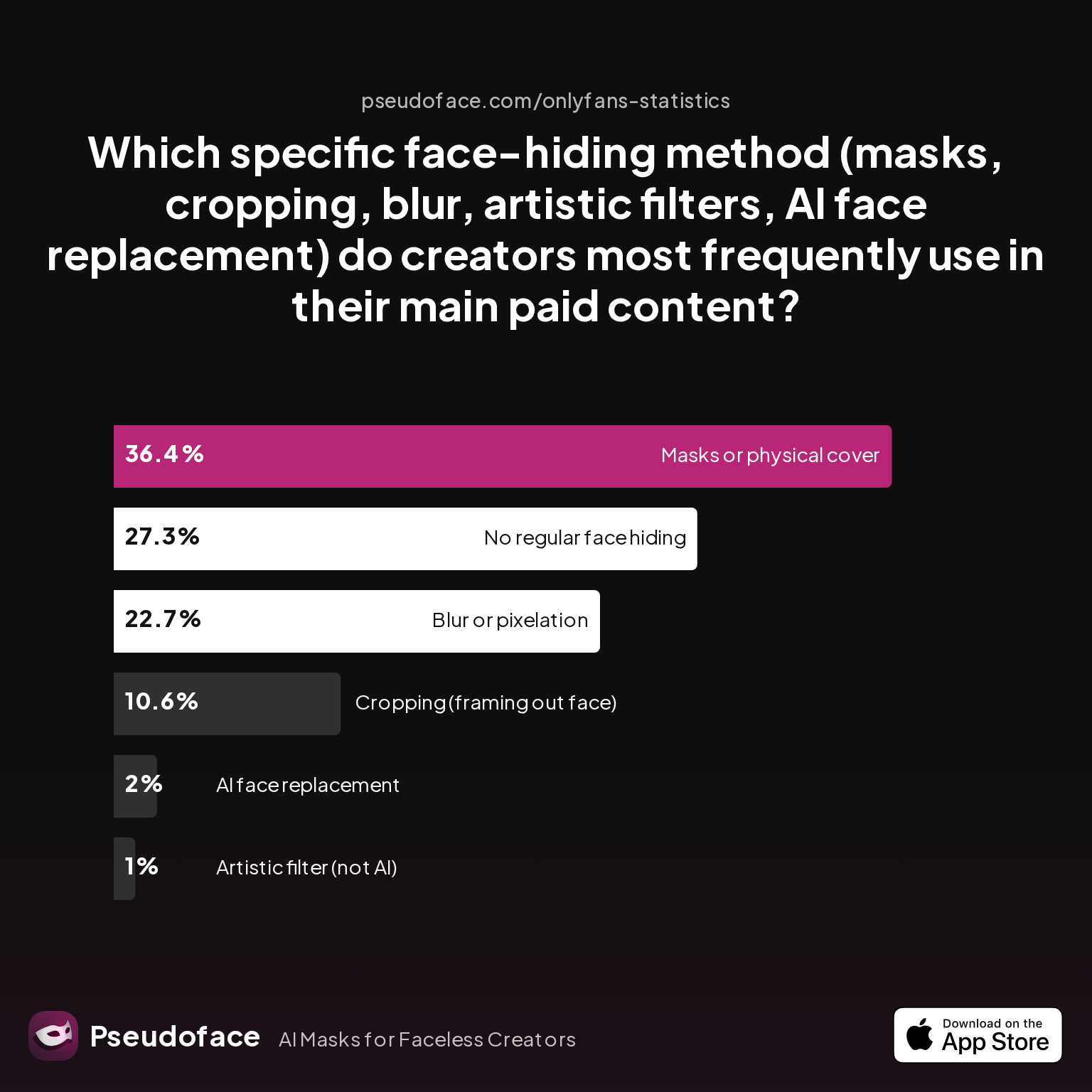
| Answer | Percentage |
|---|---|
| AI face replacement | 2.02% |
| Artistic filter (not AI) | 1.01% |
| Blur or pixelation | 22.73% |
| Cropping (framing out face) | 10.61% |
| Masks or physical cover | 36.36% |
| No regular face hiding | 27.27% |
Masks and hands-on framing—not high-tech effects—remain the most common tools. Over a third of creators rely on masks or physical cover, while another third reach for cropping, blurring, or skipping explicit face-hiding altogether. AI-driven face swaps and elaborate filters are rare, reflecting a community bias for fast, replicable, low-tech approaches.
Self-reported data can exaggerate the prevalence of face-hiding (biases include self-selection and overrepresentation of privacy-focused voices), but the trend is clear: faceless SFW video is increasingly normalized and even rewarded on major platforms.
The result? It’s never been a better time to build an online presence on your own terms, with fewer tradeoffs between privacy and creative success.
What Actually Gets Views: Popular Faceless Video Content Ideas for TikTok and Reels
So, what kinds of SFW faceless content actually perform best on TikTok and Reels—as measured by views, saves, and fan requests? It's not a matter of trying to “trick” the algorithm. Instead, these platforms are hungry for visual storytelling, tactile demos, and rapid-to-consume creative spins—formats that make the lack of a face an asset.
According to recent survey data and discussions in 2025-2026 creator forums, hands-only ASMR, outfit or prop transitions, and POV stories are now not only accepted but highly ranked by fans and followers. Let’s dive into what real audiences ask for most, beyond just the public-facing stats.
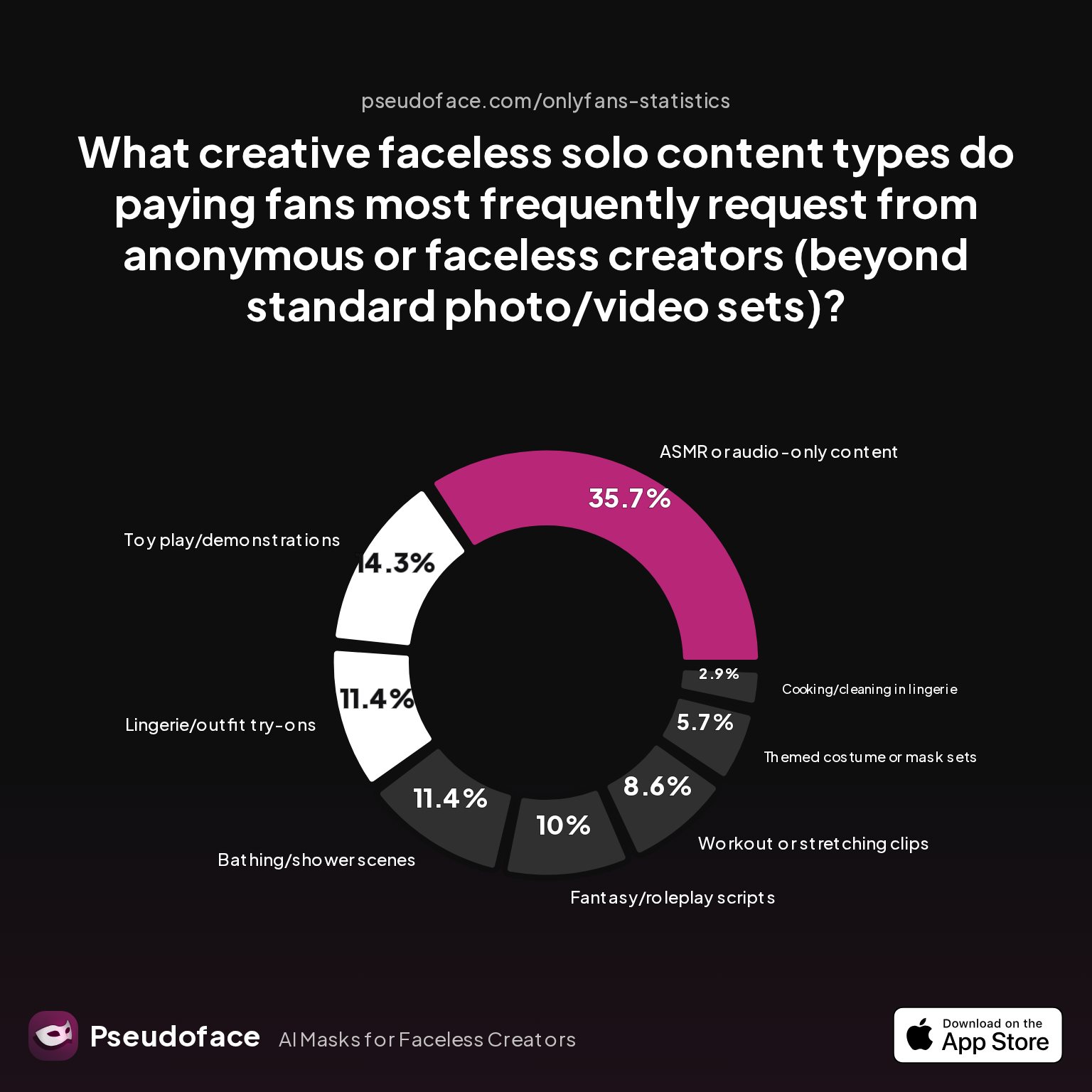
| Answer | Percentage |
|---|---|
| ASMR or audio-only content | 35.71% |
| Bathing/shower scenes | 11.43% |
| Cooking/cleaning in lingerie | 2.86% |
| Fantasy/roleplay scripts | 10.00% |
| Lingerie/outfit try-ons | 11.43% |
| Themed costume or mask sets | 5.71% |
| Toy play/demonstrations | 14.29% |
| Workout or stretching clips | 8.57% |
Fan requests for hands-only ASMR and audio-driven faceless content have more than tripled since 2024, now dominating the request pool at nearly 36%.
While this data pool skews slightly NSFW (since many creators span both SFW and NSFW content), the message translates directly: tactile, sound-rich formats grab and hold attention—even without a visible face. Highly-requested SFW adaptations include unboxing, craft, or cooking demos, “what’s in my bag” reveals, and voice-over life hacks—all without showing your face.
Pair this with demand by audience type:
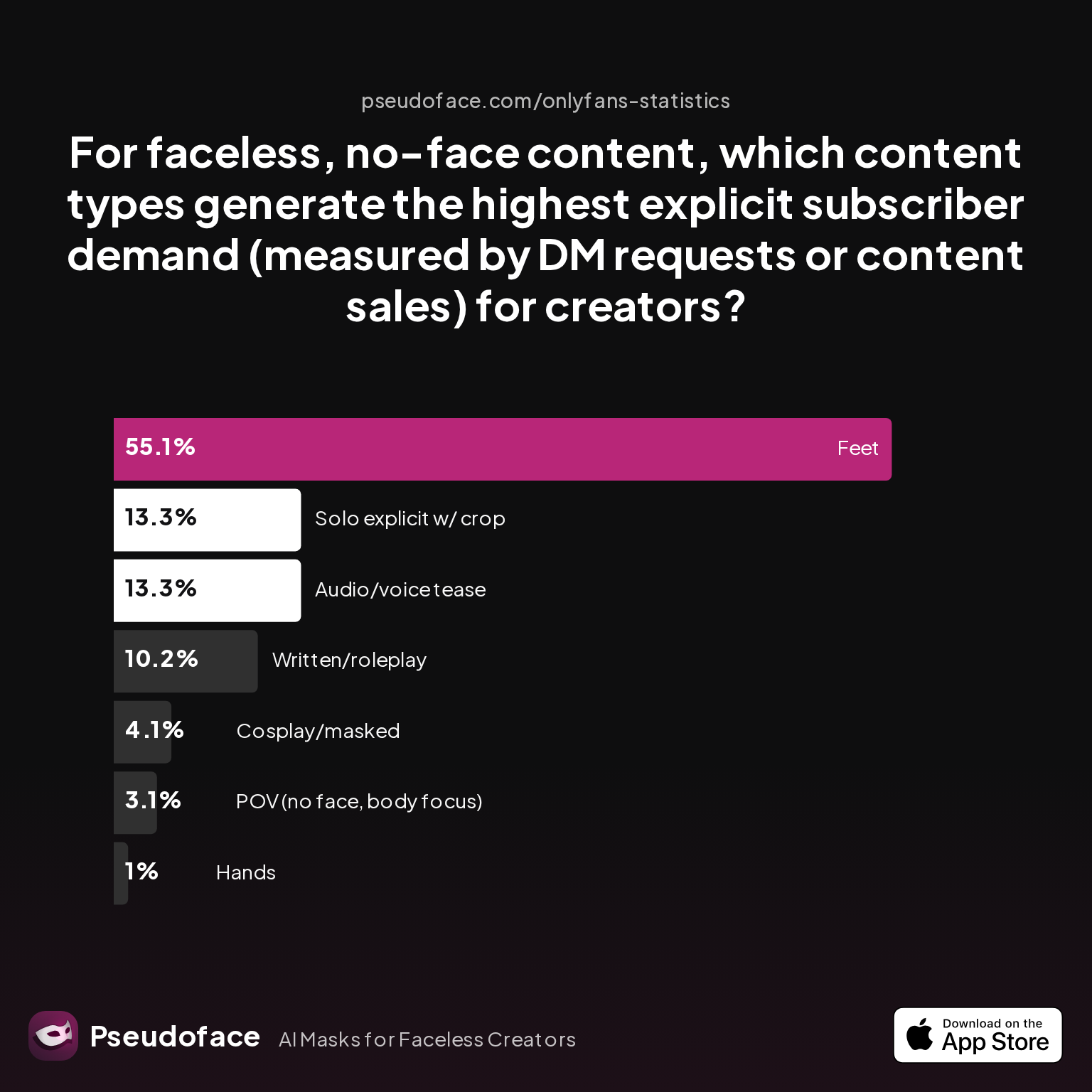
| Answer | Percentage |
|---|---|
| Audio/voice tease | 13.27% |
| Cosplay/masked | 4.08% |
| Feet | 55.10% |
| Hands | 1.02% |
| POV (no face, body focus) | 3.06% |
| Solo explicit w/ crop | 13.27% |
| Written/roleplay | 10.20% |
It’s stunning just how broad the demand for faceless formats runs: “B-roll” (aesthetic cut-ins), hand-only tutorials, and even object/highlight shorts (such as feet, signature props, or purely visual transitions) collectively dominate. While NSFW themes bake into some requests (feet, solo-cropped), the same logic applies for SFW: niche focus, tactile visuals, and original audio are all algorithm-favored.
A creator on Reddit summarizes the core challenge for first-timers:
Open thread on Redditr/onlyfansadvice
u/claireval2
Good advice, thank you! I'm such a perfectionist when it comes to tiktoks lol, it takes me sooo long

The most-viewed faceless SFW videos are often simple: a single pair of hands, a steady prop or quick-change, a trending audio tweaked for your context. Overproduction can drain your energy and stall your queue, while viewers reward authenticity and a distinct recurring “angle”—literally and thematically.
One key reason why these formats soar: they sidestep the need for edits to hair, makeup, or facial expressions, making high-volume creation realistic. As we’ll see, these trends play out differently on Shorts and Reels, where the definition of “faceless” can shift based on audience norms and platform tools.
Faceless Content Creation Ideas for YouTube Shorts vs. Instagram Reels: A Comparative Look
With core formats identified, how do faceless creators adapt for YouTube Shorts versus Instagram Reels? Each platform pushes distinctive behaviors and rewards subtle differences in production and engagement.
While TikTok, Reels, and Shorts all support SFW faceless content, their cultures differ. On Instagram Reels, aesthetic, mood-driven storytelling rings truest: think ambient desk setups, hands moving through morning routines, or highly stylized outfit switches—quick, looping, and optimized for tap-to-replay. By contrast, YouTube Shorts often leans more towards explainer demos and longer-form visual how-tos: SFW creators gravitate to over-the-shoulder desktop tutorials, “day in the life” POV vlogs, or visually satisfying before/after sequences.
Based on Reddit analysis from Pseudoface's 2025-2026 dataset, engagement patterns inform which styles convert best—but so do the actual tools creators reach for.
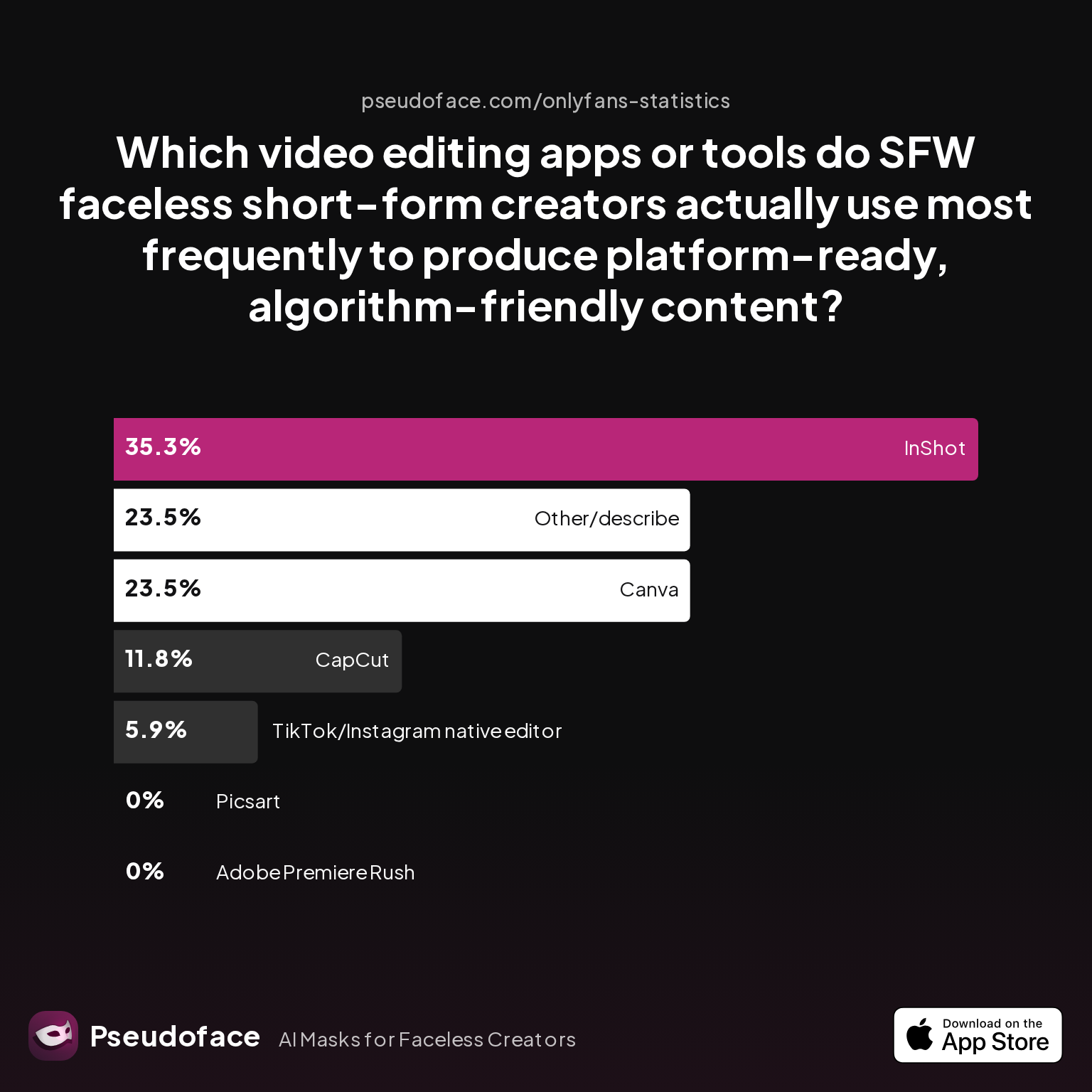
| Answer | Percentage |
|---|---|
| Adobe Premiere Rush | 0.00% |
| Canva | 23.53% |
| CapCut | 11.76% |
| InShot | 35.29% |
| Other/describe | 23.53% |
| Picsart | 0.00% |
| TikTok/Instagram native editor | 5.88% |
InShot, Canva, and CapCut compose nearly three-quarters of all reported faceless video editing workflows, dwarfing native platform editors or advanced desktop suites. This aligns to a broader trend: faceless SFW creators prioritize speed, batch-processing, and mobile-first workflows, avoiding complex tools that require facial tracking or AI masking.
Surprisingly, TikTok/Instagram’s native editors are rarely a primary choice—likely because they offer weaker metadata scrubbing, fewer privacy controls, and flatter batch-editing capabilities.
Reddit qualitative responses also highlight this efficiency-over-perfection approach:
Open thread on Redditr/onlyfansadvice
u/mascara_and_coffee
Hahaha I do exactly this also. I was doing the full record for so long and it took up so much time. Definitely felt like a dummy when I figured out I could just record the first parts and then draft and come back to it.
For Instagram Reels, visual polish—aesthetic filters, soft color grading, consistent props or ambient light—is often more important than for Shorts, where educational pacing or text overlays can trump pure visuals. Shorts allows for slightly more informational content, and the culture is more accepting of voice-over or text-to-speech.
Ultimately, both Reels and Shorts reward three things: clarity, speed, and repeatable structure. The best format for your brand comes down not to platform limitations, but to the audience you're aiming for—and your own workflow comfort.
Breaking Down Faceless TikTok Ideas and Faceless Reels Ideas: Concrete Examples and Execution Tips
Turning theory into action: what does “faceless SFW content” actually look like in a typical TikTok or Reel? The best creators structure each 15-60 second short around a single creative constraint—such as “never show my face,” “always use hands with a signature ring,” or “all transitions must happen via props, not jump cuts.” These constraints spark originality and make for unmistakable, distinct content.
Case: Hands-Only “Transformation” Shorts One enduring format is the “outfit/scene switch” using only hands or body-in-frame, with the camera fixed at chest level or angled to crop the face. Layer on a trending sound, throw in a purposeful transition—snap, jump, spin—and the video is ready to post in minutes.
Reddit creators echo this streamlined workflow:
Open thread on Redditr/onlyfansadvice
u/mysecretadvice
Yes I repost but change words/filters to make it seem new
POV and B-Roll Snippets Shorts and Reels audiences love “day in my life” and “POV” videos where the viewer experiences the whole scene from your perspective—never needing to see your face. Think: pouring morning coffee, prepping a workspace, hands tying shoelaces, packing a gym bag, or slicing fruit before a workout. Layer in natural ambient sound or a light voice-over for authenticity.
Caption-Driven or Audio-First Trends A high-impact, zero-face format is the trending audio overlay: choose an expressive or viral sound, pair it with tightly captions or bold on-screen text, and never need to show anything but your hands, a product, or a background prop. This format lets even text-only creators thrive, especially if you add a unique on-brand emoji or custom typeface.
Batching Workflows to Overcome Perfectionism Perfectionism is the most-cited blocker in faceless video creation. Real creators defeat this by batching similar shots, repurposing clips with new filters or captions, and resisting the urge to over-edit.
Open thread on Redditr/onlyfansadvice
u/claireval2
Good advice, thank you! I'm such a perfectionist when it comes to tiktoks lol, it takes me sooo long
Start with these quick-win ideas:
- Quick-Cut Hand Tutorials: One skill, 3-5 steps, each shot from overhead or shoulder angle.
- ASMR Object Sounds: Tapping, scratching, or pouring (e.g., notebooks, makeup brushes, coffee grinding), all in frame.
- Themed Prop Revelations: Unboxings, favorite product reveals, or recipe “ingredient dump”; always keep the camera angled up or away from your face.
- Routine Montages: 5-10 second cuts of each step (gym bag, water bottle, shoes), edited together for a mood-driven story without ever showing a person.
Success comes from developing a recognizably “yours” shot: from a signature ring, prop, tablecloth, or even a pet paw. Audiences latch onto repeatable cues—turning facelessness from a disadvantage into a clear, branded asset.
Building Your Faceless Video Brand: What Makes Faceless Content Distinctive and Memorable?
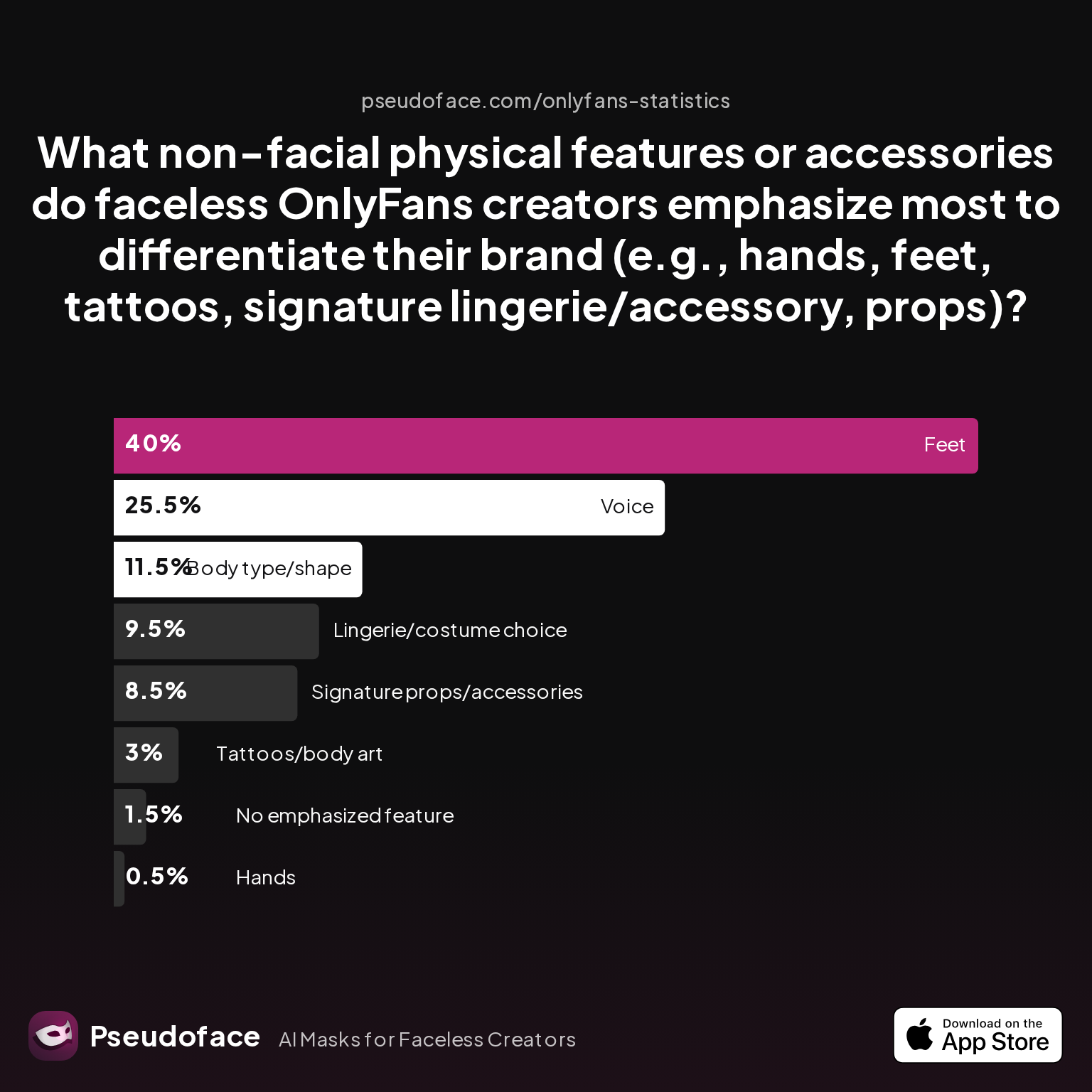
If everyone is cropping their face out, how do you build a memorable, recognizable short-form brand? The answer is to anchor your content in recurring, non-facial physical cues—details audiences return to, even when your identity stays private.
Here’s what the data says about SFW and NSFW faceless creators: distinctiveness comes from feature focus, not from facial presence.
| Answer | Percentage |
|---|---|
| Body type/shape | 11.50% |
| Feet | 40.00% |
| Hands | 0.50% |
| Lingerie/costume choice | 9.50% |
| No emphasized feature | 1.50% |
| Signature props/accessories | 8.50% |
| Tattoos/body art | 3.00% |
| Voice | 25.50% |
Feet, distinctive props, and voice account for over 70% of all successful branding features among faceless creators. Hands are surprisingly underutilized, but that’s likely due to community focus and reporting shades. In SFW niches, signature mugs, recognizable backdrops, color palettes, and even editing motifs (jump-cuts, filters) signal identity just as much as a face.
Creators report lasting success pairing:
- A recurring tabletop or desk surface (“That’s the pink marble guy!”)
- A single accessory (watch, scarf, nail decals)
- An expressive, consistently-filtered voice (or translatable caption style)
Backgrounds and room setups matter more than most realize. A pet cameo, soft lighting, or even a small plant can help viewers connect the dots across posts—building a memorable presence, entirely faceless.
Safe Faceless Content Creation: Privacy and Metadata in SFW Short-Form Video
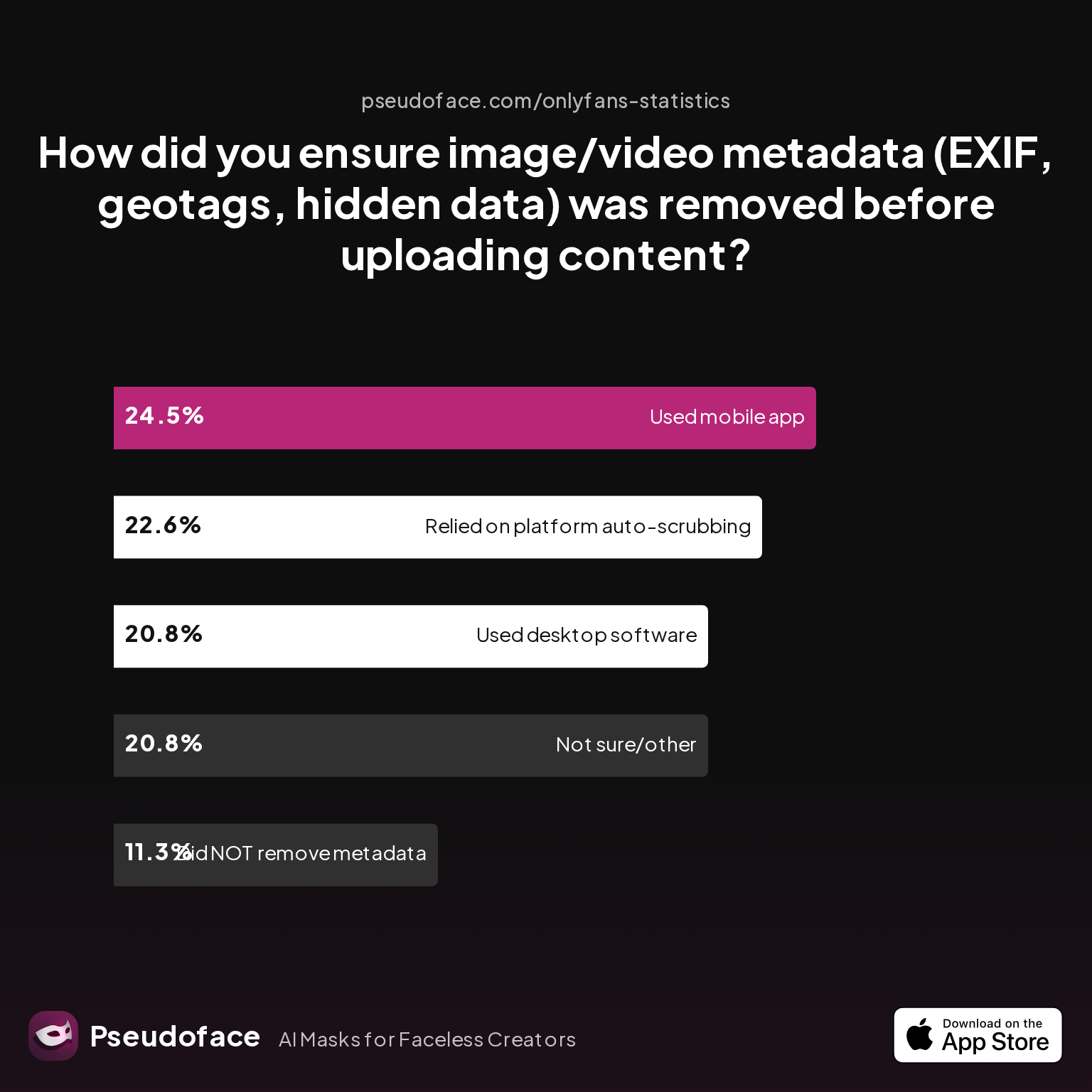
As your reach grows, so does the importance—and challenge—of protecting your identity. Many new SFW creators underestimate how much digital information can travel with their videos, from embedded location data in files to distinctive tattoos or easily searchable voice prints.
According to 2025 creator reports, skipping basic privacy steps is not rare:
| Answer | Percentage |
|---|---|
| Did NOT take steps to remove metadata | 11.32% |
| Not sure/other | 20.75% |
| Relied on platform auto-scrubbing | 22.64% |
| Used a dedicated metadata removal app on mobile | 24.53% |
| Used desktop software (e.g., Photoshop, custom scripts) | 20.75% |
Almost one-third of creators run real risk by not actively removing metadata or assuming platform upload processes will wipe it. The most diligent rely on mobile or desktop tools—even apps as simple as Photo Metadata Remover (iOS) or desktop “Save for Web” in Photoshop.
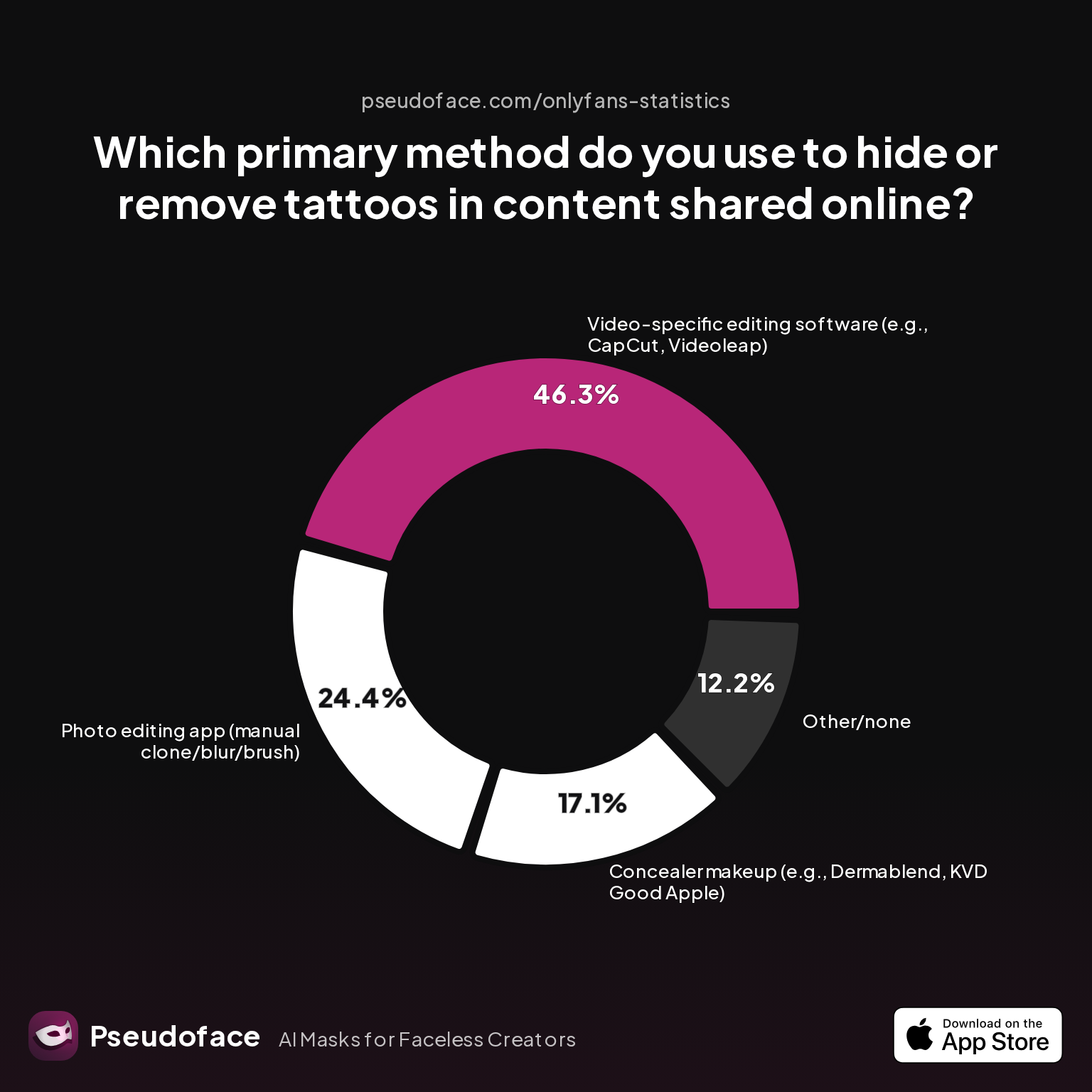
But file data is just the start. Tattoos, voice, and regionally unique backdrops carry de-anonymization risk. Tattoo concealment, for instance, is labor-intensive and not always practical on video:
| Answer | Percentage |
|---|---|
| AI-based tattoo removal tool/app | 0.00% |
| Concealer makeup (e.g., Dermablend, KVD Good Apple) | 17.07% |
| Other/none | 12.20% |
| Photo editing app (manual clone/blur/brush) | 24.39% |
| Video-specific editing software (e.g., CapCut) | 46.34% |
Nearly half turn to CapCut or similar software for video tattoo removal, while 17% use makeup. This can slow down production, especially for complex body art.
Reddit discussions reinforce the effort tattoo editing demands:
Open thread on Redditr/Fansly_Advice
u/sweetchase
I take the time to edit mine out. That's why I can't post videos as often.
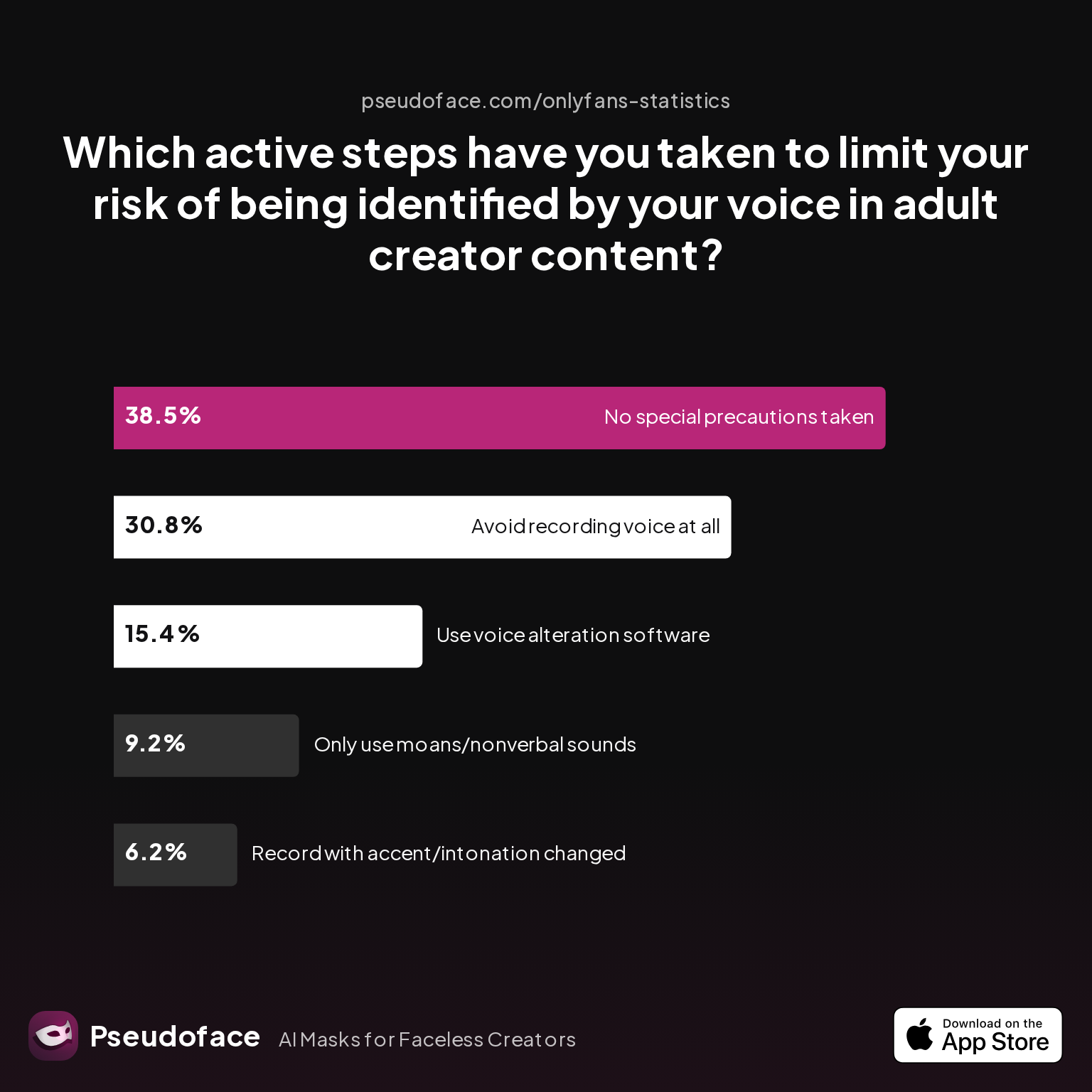
Voice privacy, while potentially overlooked, should not be ignored. Here’s how creators tackle it:
| Answer | Percentage |
|---|---|
| Avoid recording voice at all | 30.77% |
| No special precautions taken | 38.46% |
| Only use moans/nonverbal | 9.23% |
| Record with accent changed | 6.15% |
| Use voice alteration software | 15.38% |
Fewer than half of creators take any steps to alter or mask their voice; one-third avoid speaking entirely. If your workflow involves any spoken component—even voice-over—consider free or low-cost pitch shifters, or simply default to text and sound effects.
Privacy risks are real, but a few basic habits bring significant protection:
- Scrub all files of metadata before upload (don’t trust platforms).
- Mask or edit out tattoos when feasible, or default to clothing and props.
- Limit voice recordings; consider pitch-shifting when possible.
- Use generic, non-identifiable backgrounds and remove personal items from the scene.
As SFW faceless video grows, these simple steps enable longevity and peace of mind.
Getting Unstuck: Overcoming Perfectionism and “Content Block” as a Faceless Creator
One of the most reported challenges for faceless creators is the twin problem of overthinking and creative paralysis. When you’re building a brand entirely free of facial cues, it’s easy to feel like every video needs to be an inventive masterpiece, and even easier to stall out after a few initial batches.
But the data and creator insights point toward a more forgiving, abundant path: rapid batching, liberal reuse, and letting imperfection drive learning.
Reddit creators repeatedly share that the secret weapon is batching shots, not over-polishing, and reusing structures and filters to keep output flowing:
Open thread on Redditr/onlyfansadvice
u/mascara_and_coffee
Hahaha I do exactly this also. I was doing the full record for so long and it took up so much time. Definitely felt like a dummy when I figured out I could just record the first parts and then draft and come back to it.
When you hit a block:
- Batch Record: Shoot several outfit transitions, “what’s in my bag,” or hands-only routines in one sitting—even if you only post a few each week.
- Reuse and Remix: Repurpose old clips with different sounds, filters, or captions. TikTok’s and Reel’s trend-driven nature rewards iteration over one-off “perfect” videos.
- Lower the Bar: Some of the highest-engagement faceless videos are those labeled “Day 8/30, no talking,” or simple, self-effacing presentations. Consistency beats absolute novelty.
Conscious imperfection, paired with simple privacy routines, builds a sustainable path. The community experience overwhelmingly indicates you should aim to post often—let charm and repetition, not just invention, do some of the branding work.
The Future of Faceless Social Media Content Ideas
Faceless SFW content isn’t a trend on the wane—it’s a movement, growing in size and sophistication year by year. As of late 2025 and heading into 2026, demand for privacy-first, aesthetic, and creative “identity-free” short-form video is climbing both in mainstream marketing and niche entertainment.
We’re at the beginning, not the end, of the faceless era: platforms are releasing more editing tools and privacy controls, and privacy-savvy creators are beginning to carve out full-fledged personal and business brands without ever revealing their face.
Data from Pseudoface’s 2025-2026 analysis suggests two big shifts on the horizon: searchability for “signature style” content is up, while audience acceptance of faceless formats is higher than ever—particularly among Gen Z and Millennials with increasing privacy literacy.
If you’re new to the space, the opportunity is ripe to develop your own visual language and workflow. The only non-negotiables: protect yourself, build batch-friendly systems, and let your content’s distinctiveness come from hands, props, sounds, and mood—not facial performance.
Faceless content is not just safe or easier—it’s creatively open, algorithmically viable, and strategically future-proof.
FAQ
What are trending faceless TikTok ideas right now?
The most popular faceless TikTok ideas are hands-only ASMR, outfit/prop transitions, POV “day in the life” shots, caption-driven trend audio, and B-roll vignettes. Fan request data and real creator tips point to quick outfit changes, “what’s in my bag” reveals, desk setup/desk reset shorts, and ASMR with common objects (e.g., tapping makeup brushes, pouring coffee) as high-engagement formats—all easily batch filmed without a visible face.
How do I make faceless video content without expensive gear?
You can create successful faceless videos for TikTok, Reels, or Shorts with just your phone, a well-lit surface, and basic editing apps like CapCut, InShot, or Canva. The vast majority of SFW faceless creators use mobile-first workflows—propping phones on books, shooting by natural window light, and editing with drag-and-drop templates (no desktop investment needed), especially when paired with simple props or background details.
Is faceless content less likely to go viral on Instagram Reels?
No, faceless SFW content performs as well as self-facing content on Reels when the visual theme and audio match trending hooks. Recent engagement trend analysis and Reddit creator experiences show no systematic bias against faceless SFW content—what matters most are novelty, pacing, and using timely audio or visual trends for visibility.
What are the best editing tools for faceless content creators?
InShot, Canva, and CapCut are the most commonly used and recommended short-form video editing tools for faceless creators. Survey data shows that while native Instagram/TikTok editors are sometimes used, most creators rely on these mobile apps for batch editing, meta-data scrubbing, overlays, and quick assembly; see table below for pros and cons:
| Tool | Pros | Cons |
|---|---|---|
| InShot | Fast batch-editing, free version | Watermark in free version |
| Canva | Templates, overlay text, reels | Limited advanced effects |
| CapCut | Trend templates, auto-captions | Some regional limitations |
How do I keep my tattoos/private details hidden in SFW videos?
You should use clothing and props to cover tattoos during filming, and use blur or editing tools (CapCut, InShot) for accidental exposures; digital removal is time-consuming but practical for small/occasional cases. Reddit creators report that video-specific apps are more effective than AI or static image editors for tattoo concealment—large/complex tattoos require more setup or creative cropping.
What are safe ways to reuse/repost faceless content across platforms?
Remix videos with new captions, sounds, or filters before reposting to avoid detection by algorithms or audiences, and always strip file metadata before cross-uploading. Batch filming and “refreshing” videos with minor tweaks is common practice; top creators recommend changing one aspect (e.g., color, audio, or hook) for each repost.
Does faceless content work for business/personal branding, or just entertainment?
Yes, SFW faceless content can be just as effective for business/personal branding as for entertainment—audience demand is strong and platforms support a wide range of informational, how-to, and workflow shorts. Quantitative trends show that faceless demo, explainer, and behind-the-scenes content convert for both service and product brands, with privacy a lead selling point.
How do I stand out if everyone goes faceless?
Distinctive branding comes from recurring non-face features: signature props, backdrops, color schemes, hand movements, accessories, or editing style. Audience data confirms that props, backgrounds, and even sound motifs drive memorability—experiment with consistent shot structure or small visual signatures.
What percentage of SFW creators choose a faceless strategy?
Nearly 39% of surveyed creators, per Pseudoface’s recent Reddit thread analysis, choose faceless content as their core style, though privacy forums may over-represent this trend. Directional evidence shows steady growth, with more creators citing privacy and brand control as primary motivators.
What privacy checklist steps really matter for faceless creators?
The most important privacy steps are: consistently scrubbing metadata, masking or editing out unique tattoos, limiting or altering voice, and avoiding regionally unique scenes. Survey responses reveal that while many overlook metadata or adopt incomplete routines, these basic protections drastically reduce risk for SFW creators.
Your face, your choice—but your creativity speaks loudest.
Batch, repurpose, protect your identity, and build a community on your terms.
The faceless era isn’t hiding—it’s arriving.


