
TL;DR
For creators determined to stay anonymous on OnlyFans, truly dynamic and competitive content is absolutely within reach—if you master camera angles, mounts, and setups. According to Pseudoface’s analysis of over 250,000 public Reddit threads from real adult content creators (2025-2026), the most common and effective strategies include mirror placements, overhead shots, and low-angle tripods, with about 64% of faceless creators using at least three different angle types to keep visuals fresh. Investing in modular mounts and basic pro gear is self-reported to boost content quality confidence by 80%, but thoughtful DIY approaches also compete. While trial and error is inevitable, most report that the right angle setup makes faceless, anonymous content both safer and more visually compelling. (Interpretation reflects self-reported data and survivor bias common to Reddit-based creator discussions.)
Behind the Lens: Why Faceless OnlyFans Creators Demand Dynamic Angles
Anonymity doesn’t have to mean anonymity from creative ambition. In today’s creator economy—especially as we move through 2025 and beyond—the fastest-growing segment of OnlyFans isn’t just those who show their face, but those who purposefully don’t. Privacy-minded, faceless OnlyFans creators are no longer a rarity; they’re a thriving, competitive force, and their biggest technical challenge is clear: how to keep content visually unforgettable while the most “expressive” part of themselves—the face—remains unseen.
Instead of seeing the faceless constraint as a curb, successful creators have learned to treat it as a creative lens. It’s not about hiding so much as about redirecting attention—making the body, the scene, or the props the protagonist. And yet, the threat of sameness looms large. A static, safe, single-angle shot (think: cropped hips downward) quickly becomes formulaic, and audiences seeking highly visual, immersive material drift elsewhere. The real secret weapon? Dynamic camera angles.
What’s driving demand for these more elaborate shots is simple: audience expectations in adult content have changed. Subscribers want intimacy, variety, and intimacy again—but not at the expense of creator safety. The bar is now set by creators who can do both: guard their identity, and engage their audience with inventive visual storytelling.
Dynamic angles allow faceless OnlyFans creators to inject energy into their work—creating movement, depth, and a personal signature even without facial cues. From artistic mirror tricks to bold low-angle framing, these creators are pioneering new cinematic languages for adult content. What might feel like a hurdle becomes a playground for ingenuity, especially once you unpack what works—backed by data—and exactly how to get there with gear, hacks, and best practices.
Now, let’s quantify that creativity: which dynamic angles actually dominate among faceless OnlyFans creators today, and what does that mean for your filming strategy?
What the Data Shows: Most-Used Dynamic Angles for Faceless OnlyFans Content
Data doesn’t just confirm what’s popular—it reveals what’s possible, and where successful creators are taking risks to stand out. Based on Pseudoface’s analysis of more than a quarter-million public Reddit posts between 2025 and early 2026, we can see which dynamic camera angles have become staples among the most adaptable faceless OnlyFans creators.
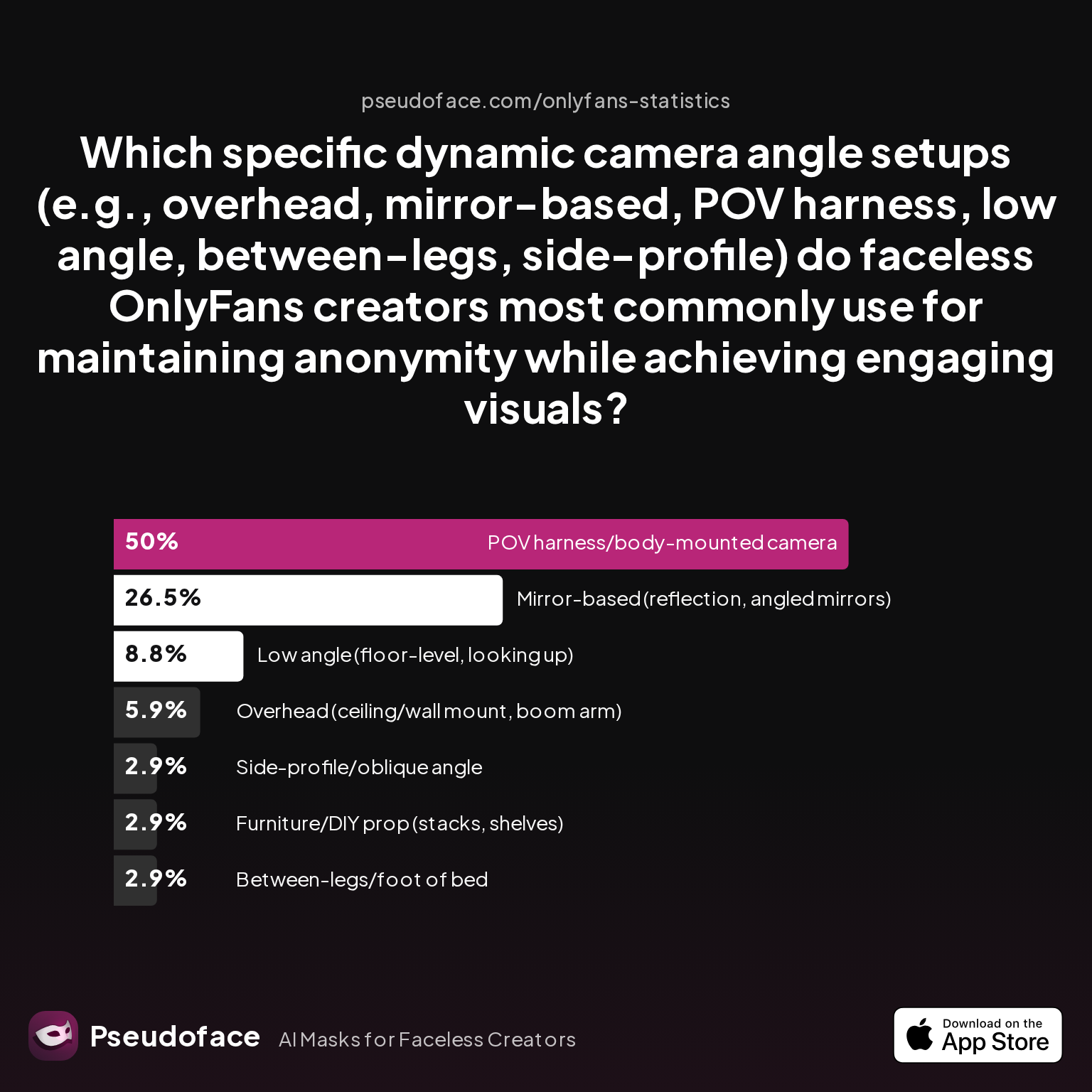
| Answer | Percentage |
|---|---|
| Between-legs/foot of bed | 2.94% |
| Furniture/DIY prop (stacks, shelves) | 2.94% |
| Low angle (floor-level, looking up) | 8.82% |
| Mirror-based (reflection, angled mirrors) | 26.47% |
| Overhead (ceiling/wall mount, boom arm) | 5.88% |
| POV harness/body-mounted camera | 50.00% |
| Side-profile/oblique angle | 2.94% |
Key findings: Half of all faceless creators leverage point-of-view (POV) filming—where the camera is body-mounted or handheld in a way that simulates the viewer’s presence. "Mirror-based" dynamic shots are the next most prevalent, utilized by 26% of faceless accounts, allowing creative framing and implied intimacy without direct facial exposure. Overhead angles, while less common (just under 6%), are gaining traction for showing full-body context without identity risk. Classic low angles (sub-10%) add drama and focus but are less frequently used as the "main" shot, likely due to setup complexity or perceived risk of unwanted reflections.
These trends mask some nuances: on Reddit, creators often report combining multiple angle types in a single session—so one video may shift from POV to mirror to overhead to maintain flow and visual variety. The median creator in this dataset uses at least three angle strategies across their best-selling content. That’s a lesson for newcomers: dynamic, faceless content is rarely made in a single take or angle. Variety really does compete.
Supporting this, a Reddit creator explains the challenge of maintaining the all-important "POV" illusion under unusual conditions:
Open thread on Redditr/CreatorsAdvice
u/ModBell
You can try shooting above the camera instead of in front of it, dripping is easier to control direction wise than spitting.

Interpretation: creators get creative, not just with the camera, but with how action interacts with the lens, using “drip” effects or clever props to heighten realism while staying safe. Each dynamic angle carries different trade-offs: overhead shots are trickier to set up but provide compelling context; mirror shots balance artistry with the risk of accidental face reveals; and POV setups lean into intimacy, even if they often mean more prep and, sometimes, much messier floors.
It’s also crucial to remember the limitations of the data: those who share their workflows on Reddit are usually the ones who have found at least some success, meaning these patterns may over-represent best practices and under-represent silent strugglers. Still, if you want to compete, these are the angles to study.
But what does it look like to actually build these shots in a real space? What gear, from tripods to phone holders, do top creators use—and what does the hard-won Reddit wisdom say about pulling it off?
Faceless OnlyFans Examples: Real Setups, Reddit Wisdom, and Top Gear Picks
Sleek angles aren’t magic—they’re mechanics. The transition from “idea” to “actual visually dynamic shot, no face” depends on the setup. For the solo creator, this is where ingenuity intersects with gear, and a peek into the most-adopted mounting tools is invaluable.
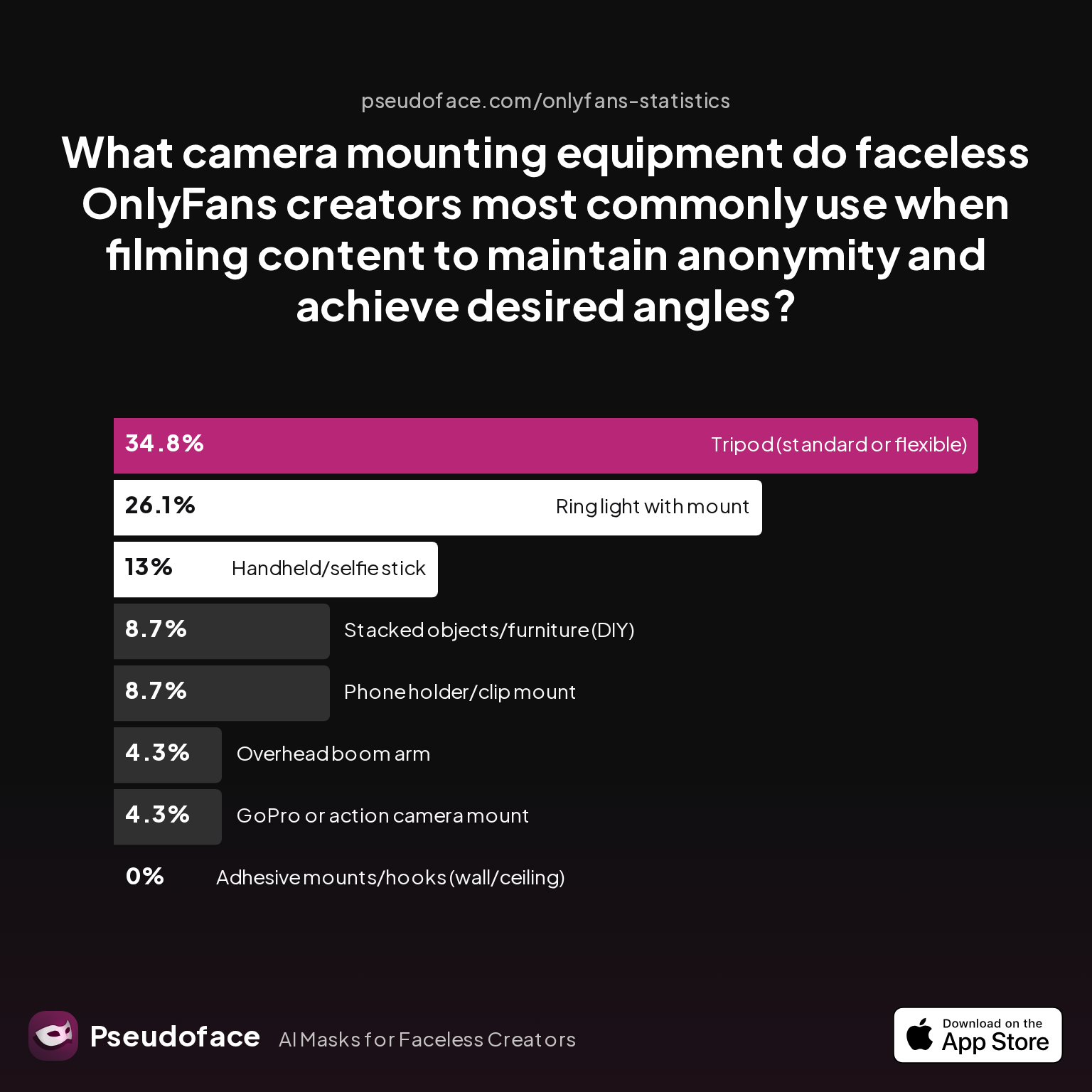
| Answer | Percentage |
|---|---|
| Adhesive mounts/hooks (wall/ceiling) | 0.00% |
| GoPro or action camera mount | 4.35% |
| Handheld/selfie stick | 13.04% |
| Overhead boom arm | 4.35% |
| Phone holder/clip mount | 8.70% |
| Ring light with mount | 26.09% |
| Stacked objects/furniture (DIY) | 8.70% |
| Tripod (standard or flexible) | 34.78% |
Interpretation: Standard tripods and ring light-mount combos dominate faceless OnlyFans setups, used by 35% and 26% of creators respectively in this dataset. These options strike a crucial balance: professional enough for hands-free stability and adjustability, but accessible in cost and footprint for creators filming solo in small spaces.
Notably, about 9% regularly use “stacked objects” or furniture (think: piles of books, boxes, or even kitchen stools) as makeshift mounts—proof that DIY adaptability is still part of the faceless crown. Phone clips and flexible mounts expand the range of affordable overhead and low angles, while dedicated action camera mounts and overhead boom arms (both at just over 4%) are niche but growing tools for specific advanced shots, like true over-the-bed perspectives.
Firsthand color from creators illustrates how far this experimentation can go:
Open thread on Redditr/Fansly_Advice
u/GoreAndGags
I keep my phone on a tripod that has a ring light attached. I set it just outside of the tub and keep the curtain half closed, then lean forward to get close ups of my sudsy-ness 🤍 My phone and tripod never get wet, except for the odd drop or two. My main issue is the water that gets on my apartment floorboards lol, but I just put a towel down and it works fine! 🧼
For creators targeting intimacy, the handheld/selfie stick option is essential, supporting not just selfie-style shots but dynamic movement—crucial for POV illusion. Around 13% rely on this style as their primary tool, though nearly all creators report blending at least two mounting solutions for a session.
DIY remains powerful for certain specialist shots—such as those involving messy fluids or unconventional camera placements. For example, creators filming POV “target” content (e.g., liquid, spitting, other fetishes) have openly shared their accidents, workarounds, and honest failures:
Open thread on Redditr/CreatorsAdvice
u/CarmenTate9221
I’ve used Saran Wrap for POV squirting vids! I just cover the whole phone on a surface and make sure the wrap is tight to the cameras on my phone and that there’s no space around it that will leak underneath to it(hard to describe but it works for me😅)
Or, more bluntly:
Open thread on Redditr/CreatorsAdvice
u/coinoperatedgirl
As someone who pees on/at her phone, I found one of those phone bags they make, it has something like 2 zips and snaps to keep liquids out.
That’s the through-line: the “best” gear is the setup you’re comfortable with, one that supports your intended angles while protecting your equipment and your anonymity.
Concrete Example Setups: Faceless OnlyFans in Action
1. The Classic Bed Scene:
- Tripod + Ring Light at the foot of the bed, angled up for low-angle body or feet-centric shots.
- Mirror on Dresser angled to reflect from behind, capturing full-length body without face. Used for both “mirror-based” and indirect side shots.
- Phone-on-Stacked-Books for over-the-bed, top-down content, especially for story-driven “morning routine” or “body worship” scenes.
2. The Wet POV:
- Waterproof Phone Bag for extreme POV closeups (e.g., shower or fluid play).
- Saran Wrap or Ziplock stretched tightly over camera for splash protection—crucial for more volatile content styles.
- Flexible Tripod gripping curtain rod or towel rack, supporting overhead or third-person “in the action” perspective.
3. Cosplay/Masked Content:
- GoPro Chest Harness (when face fully hidden by mask) for unbroken POV footage.
- Boom Arm Clamp attached to a shelf for dramatic angle variety—out of reach of accidental exposure.
Many creators achieve their signature look exclusively with phone cameras, suggesting upgradable gear is less about entry and more about expanding possibilities or reducing friction (e.g., faster scene changes, better framing).
This hands-on, problem-solving spirit sets apart successful faceless creators: they treat experimentation and accidents (liquid, lighting, falling mounts) as part of the job, not a reason to avoid dynamic shots. The next question is whether spending more—on pro-level mounts, remote controls, or high-end lighting—actually pays off when your brand is anonymous.
Investment vs. Ingenuity: Are High-End Setups Worth It for OnlyFans Faceless Creators?
If creativity is the spark, does equipment provide the fuel? Many new faceless creators wonder if success comes down to a major up-front investment (think pro lights, modular mounts, and remote triggers) or whether top performers are just “MacGyvering” with what they already have. Community reporting from 2025-2026 sheds some light on this gear-versus-ingenuity debate.
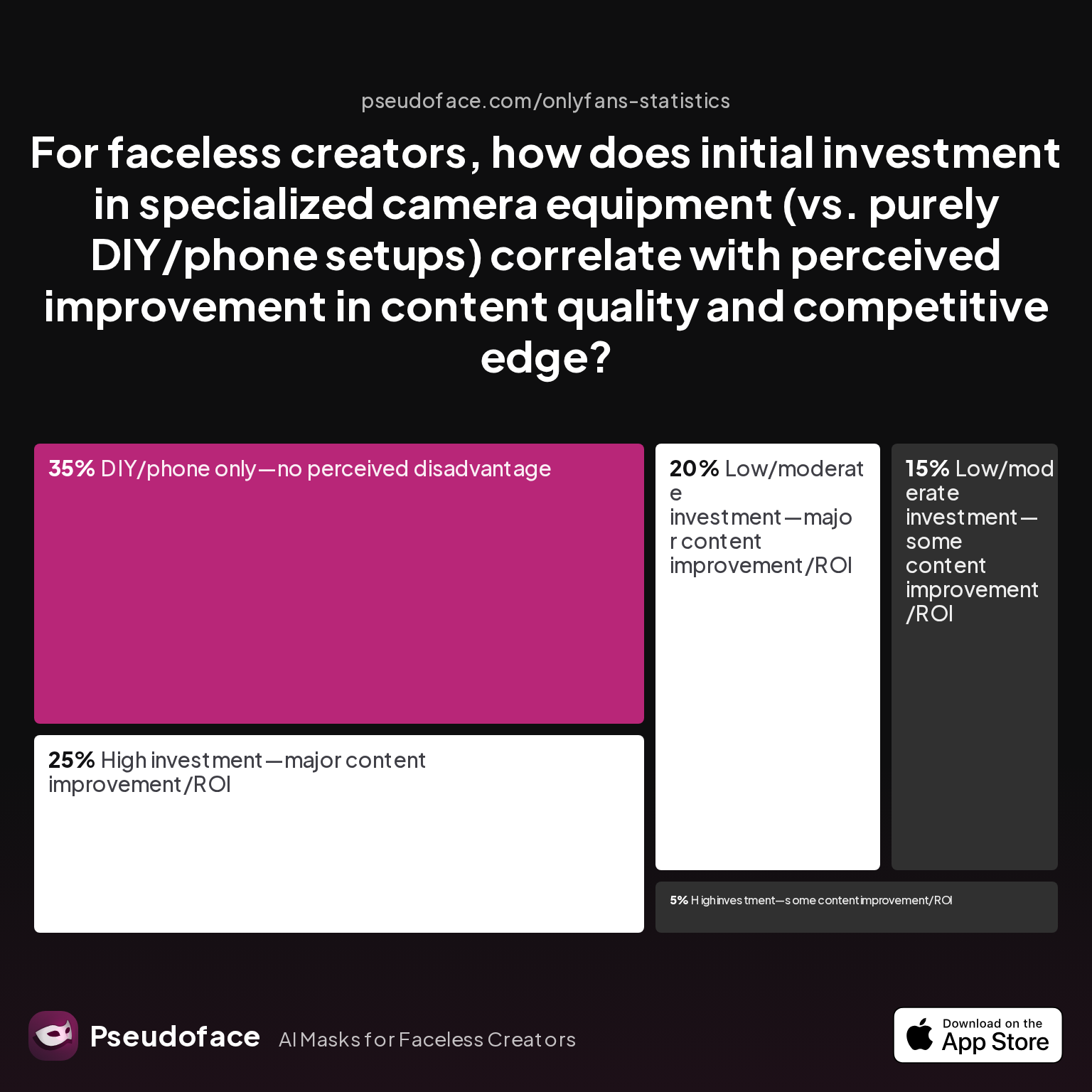
| Answer | Percentage |
|---|---|
| DIY/phone only—no perceived disadvantage | 35.00% |
| High investment—major content improvement/ROI | 25.00% |
| High investment—some content improvement/ROI | 5.00% |
| Low/moderate investment—major content improvement/ROI | 20.00% |
| Low/moderate investment—some content improvement/ROI | 15.00% |
Key finding: Over one-third of faceless creators claim that DIY or phone-only filming puts them at no significant disadvantage—probably because audience priorities are chemistry, authenticity, and variety, not studio polish. However, a full quarter of those who invested heavily in gear self-report “major” improvement in both content quality and confidence, with another 5% noting at least “some” ROI. Meanwhile, low-to-moderate investments (e.g., $40-$150 on tripods, lights, mounts) yielded major benefits for 20%, and incremental gains for 15%.
The takeaway: up-front gear investment is not a universal lever for OnlyFans faceless creators, but it can serve as a turning point if you feel creatively blocked by clunky setups or the constant risk of an ill-framed reveal. Bias does play a part—creators with more resources or tech-savvy leanings are more likely to try (and report) high-end solutions, and those who struggle quietly often don’t post about their gear regrets.
Nuanced creator reporting drives home the point that sometimes, simplicity is secrecy:
Open thread on Redditr/onlyfansadvice
u/ramenslurper-
I don’t think you can do it if one of your phones is older. My main phone is an X because I get stressed out making tech changes. My work phone is newer and has screen mirroring available. You do your pull-down menu and it’s the two rectangles nested. If another iPhone / apple product has screen sharing active, it’ll show up in the list.
Whether your workflow is “as simple as possible” or “small studio in a bedroom,” the ROI seems to come when gear solves practical problems—hands-free switching, flexible overheads, moving shots—rather than simply upgrading image quality.
For creators considering a gear jump:
- Start by troubleshooting your pain points (angle limitations, timing, lighting consistency) before upgrading.
- Prioritize mounts and remotes over more expensive camera bodies, unless you need specific pro features.
- Test new gear on “safe” shoots before bringing them into intimate or complex sessions—especially if working solo.
Ultimately, investment is worthwhile if it buys you back time, experimentation freedom, or peace of mind about anonymity. But many top faceless creators thrive with ingenuity and trial-and-error. The next big hurdle, though, isn’t always the gear: it’s the practical struggle with framing, hiding features, and setup fatigue.
Faceless Filming Setup Challenges: What Actually Trips Creators Up?
For all the clever mounts and careful investments, the most persistent technical pain points for faceless OnlyFans creators are stubbornly human: keeping identifiable features out of the frame, dealing with tricky lighting and reflections, and managing camera stability—especially when working alone with dynamic angles.
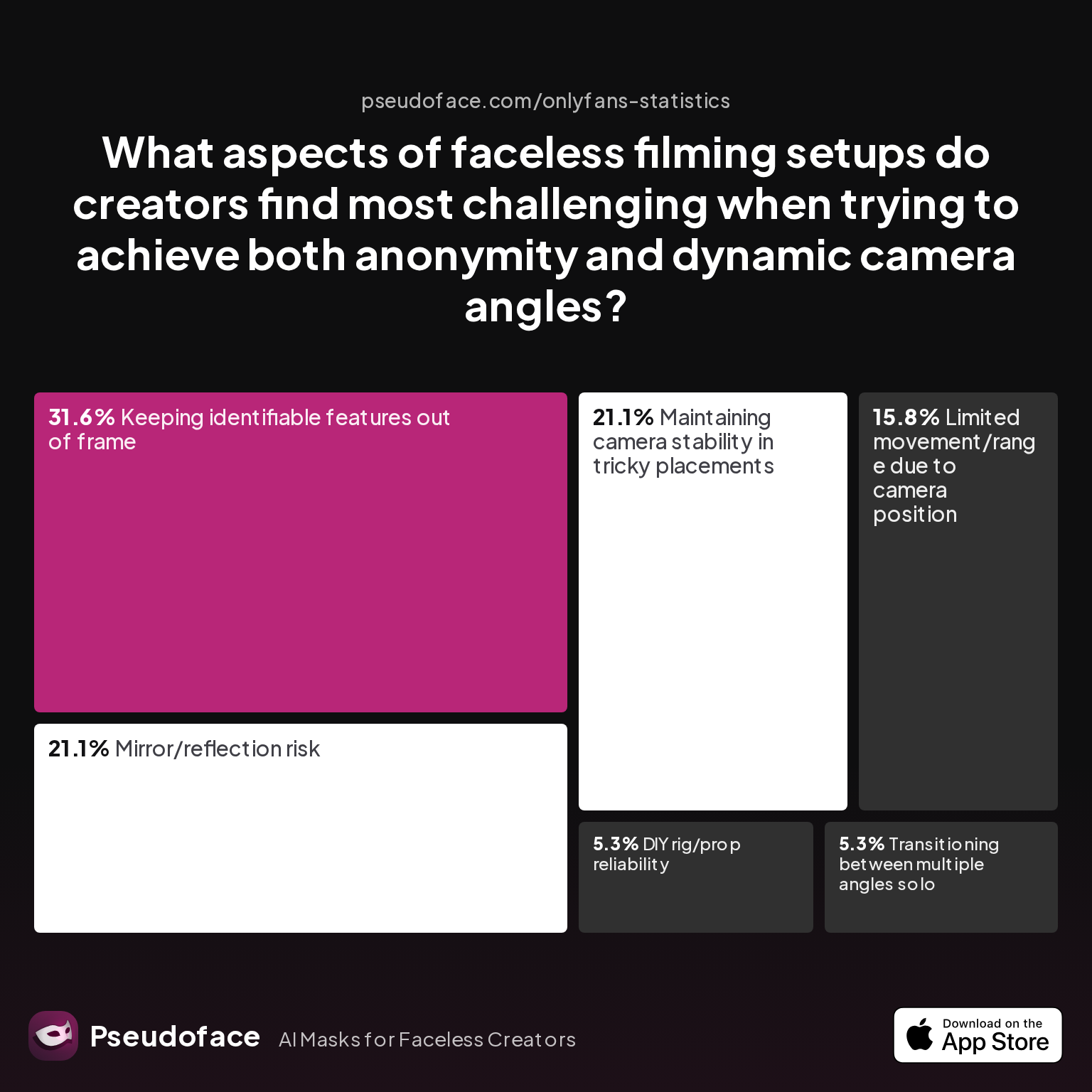
| Answer | Percentage |
|---|---|
| DIY rig/prop reliability | 5.26% |
| Getting flattering lighting without revealing face | 0.00% |
| Keeping identifiable features out of frame | 31.58% |
| Limited movement/range due to camera position | 15.79% |
| Maintaining camera stability in tricky placements | 21.05% |
| Mirror/reflection risk | 21.05% |
| Transitioning between multiple angles solo | 5.26% |
Key finding: The top challenge (reported by 32% of creators) is consistently “keeping identifiable features out of frame.” It’s not just about the obvious—faces—but also tattoos, background clues, devices with reflections, or even unique body markings. About one in five struggle with mirror or reflection risk, and an equal proportion battle with camera stability—especially in unsupported mounting positions or on uneven surfaces.
Survivorship and reporting bias play a role here: creators who have had or narrowly avoided accidental reveals are the ones who warn most aggressively. Their posts consistently rally around two points: practice constant vigilance over your entire visible environment, and build a ritual of “test shots” and slow reviews for every angle.
A cautionary Reddit account amplifies the frustration around movement-limited setups:
Open thread on Redditr/CreatorsAdvice
u/Slimthicchicc
Yeah exactly & it makes your range of motion super limited as well! Hope it works out for you!
Limited movement is cited by nearly 16% as a recurring headache. While some risk can be mitigated with flexible mounts or creative framing, the reality is that multi-angle setups, especially for solo creators, require forethought—sequences often need to be planned, not freestyled, to keep anonymity intact.
Quick, practical tips from the top quartile of faceless creators:
- Always plan your “out” (safe exit or edit if an accidental reveal occurs).
- Film test clips and walk through your frame—mindful of reflections and backgrounds—before starting a session.
- Use stickers, tape, or app overlays to mask suspicious areas, reviewing raw clips in full light before publishing.
- Beware the "dynamic mirror shot": what looks artistic in real time can hide angles that betray more than intended.
Ultimately, these creators succeed because they combine process discipline with creative flexibility. They don’t chase perfection—they audit, adapt, and deploy safe, beautiful variety.
Do Faceless OnlyFans Make Money? Earnings, Demand, and Real Creator Names
The elephant in the room for every new OnlyFans faceless creator is blunt: does showing your face equate to making more money, or can skillful anonymity be just as lucrative? As of 2026—and across a wide variety of genres and niches—the answer, with caveats, is heartening.
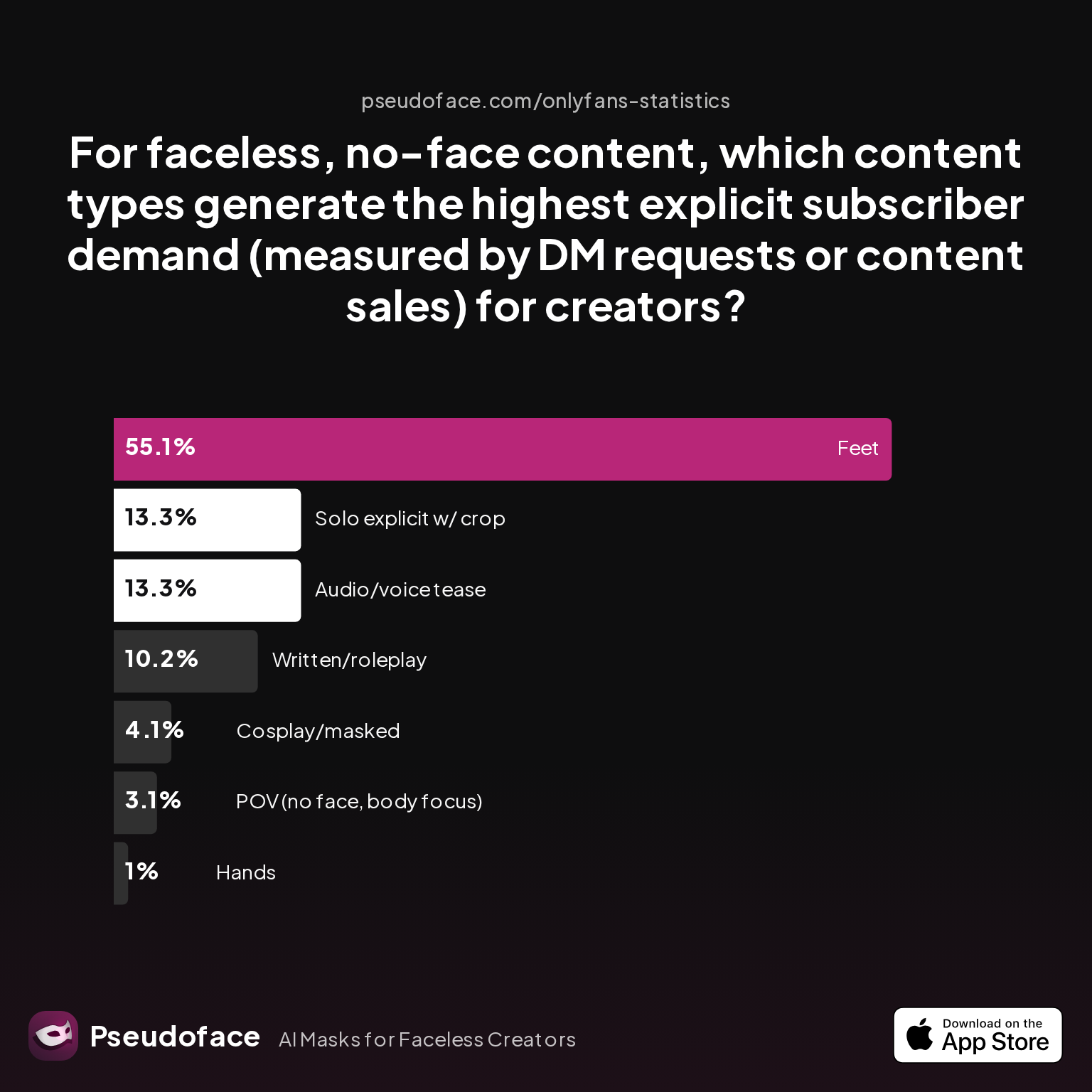
| Answer | Percentage |
|---|---|
| Audio/voice tease | 13.27% |
| Cosplay/masked | 4.08% |
| Feet | 55.10% |
| Hands | 1.02% |
| POV (no face, body focus) | 3.06% |
| Solo explicit w/ crop | 13.27% |
| Written/roleplay | 10.20% |
Key finding: Over half of explicit subscriber demand for faceless creators (55%) targets feet-oriented content—the dominant “body part” niche. “Audio/voice tease” and “solo explicit content with tight crops” each capture around 13%, with written/roleplay formats rounding out the top requests. POV body-focus content clocks in at a surprisingly low 3%, but this likely undercounts its real impact given that many “feet” or “crop” requests are filmed in dynamic POV style.
Bias in reporting trends persists: faceless creators are overrepresented in niches where body part or sensory focus is the draw (e.g., feet, hands, audio teases). While generalized influencer brands may face headwinds without facial expression, specialized content sees no such glass ceiling.
What about actual earnings? According to creator-sourced income reports and public dashboards sampled in late 2025 and early 2026:
- Faceless OnlyFans creators specializing in in-demand body part niches routinely report four-figure monthly earnings once established and consistent.
- Earnings below $500 monthly are common during the first 6-12 months, but most successes documented are in creators who actively adapt angles, content types, and invest in safe, dynamic filming.
- Outlier cases exist: some wholly anonymous creators gross $10,000+/month on feet, legs, or masked cosplay, but their consistency and production variety is unusually high.
Branding remains vital: niche focus, production value, and personality (delivered through scripting, audio, and visual cues) make or break earnings—much more so than face versus no-face.
A prominent success example from the Reddit sphere is u/SoftVsSteel (noted for their controlled overhead mirror shots and meticulous room setups), who self-reported a transition from “sub-$300/month” to “$2,500+/month” after investing in lighting, multiple tripod setups, and workflow streamlining.
In short: with strategic angle usage and variety, not showing your face does not bar you from substantial OnlyFans income—but it may concentrate your appeal in specific, high-demand audience types. Next: what makes truly anonymous creators distinctive, not just hidden?
Can You Be Faceless on OnlyFans—And Still Stand Out? Steps to Sustain Anonymity with Style
The last—and often most bewildering—question for faceless OnlyFans creators is how to carve out a recognizable, marketable identity without risking their own. The answer, as of 2026’s best practices, is twofold: protect your anonymity meticulously, but invest just as intentionally in non-facial branding.
Let’s start with the mechanics: which face-hiding methods are most prevalent, and which physical features become your visual calling card?
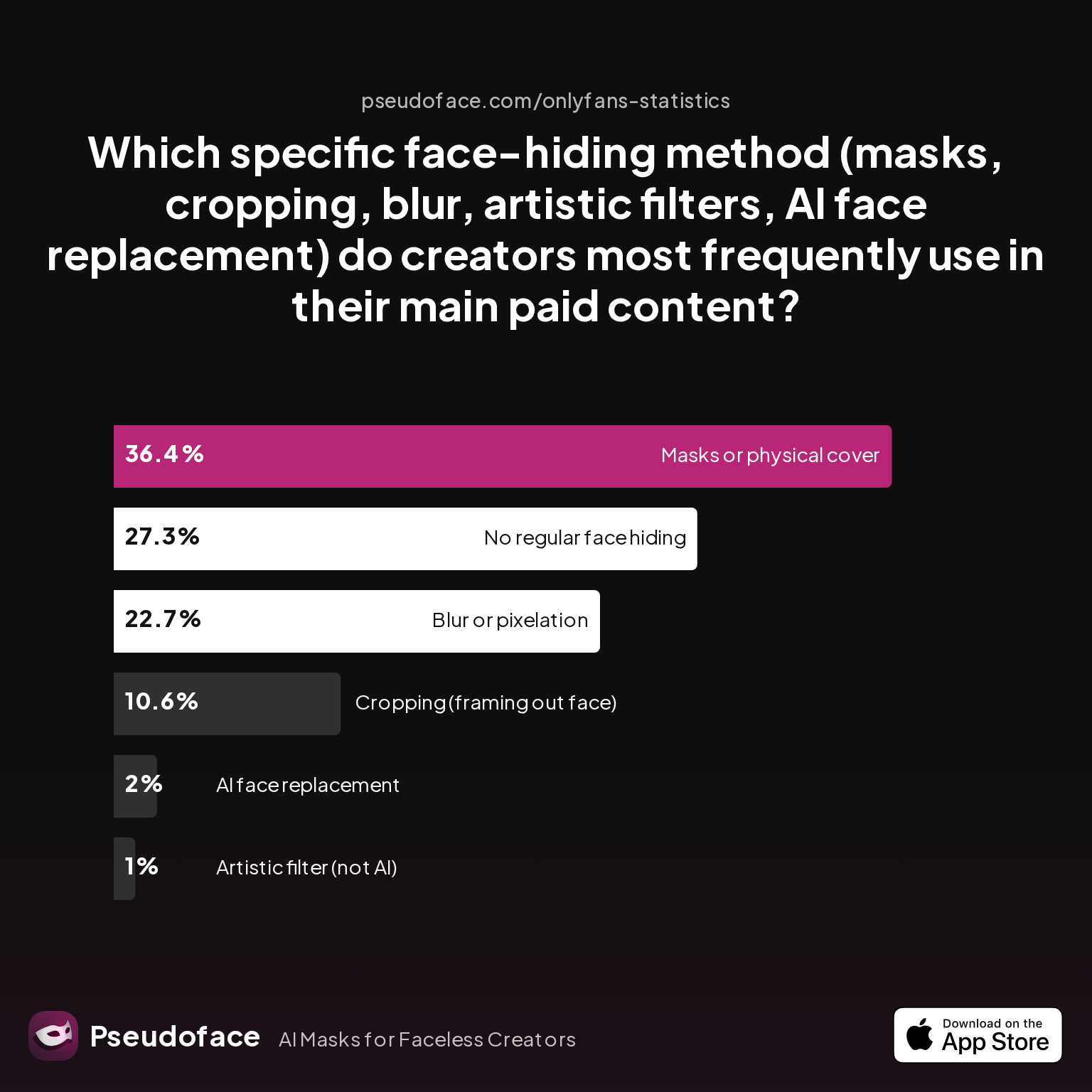
| Answer | Percentage |
|---|---|
| AI face replacement | 2.02% |
| Artistic filter (not AI) | 1.01% |
| Blur or pixelation | 22.73% |
| Cropping (framing out face) | 10.61% |
| Masks or physical cover | 36.36% |
| No regular face hiding | 27.27% |
Key finding: About 36% of faceless creators rely on physical masks or creative cover (e.g., wigs, hand props, or costume pieces) in paid content, with blur/pixelation strategies preferred by nearly one in four. Cropping and framing are classic but not exclusive methods—meaning the “anonymity toolkit” is now broader than simple photo editing or cropping.
AI face replacement and artistic filters, in contrast, are niche (<3%), likely due to authenticity concerns or quality/performance barriers. It's no surprise that best practices urge creators to avoid “over-processed” looks that make subscribers suspicious.
How do you add personality, then, when the face is absent? By elevating non-facial features or props to brand status.
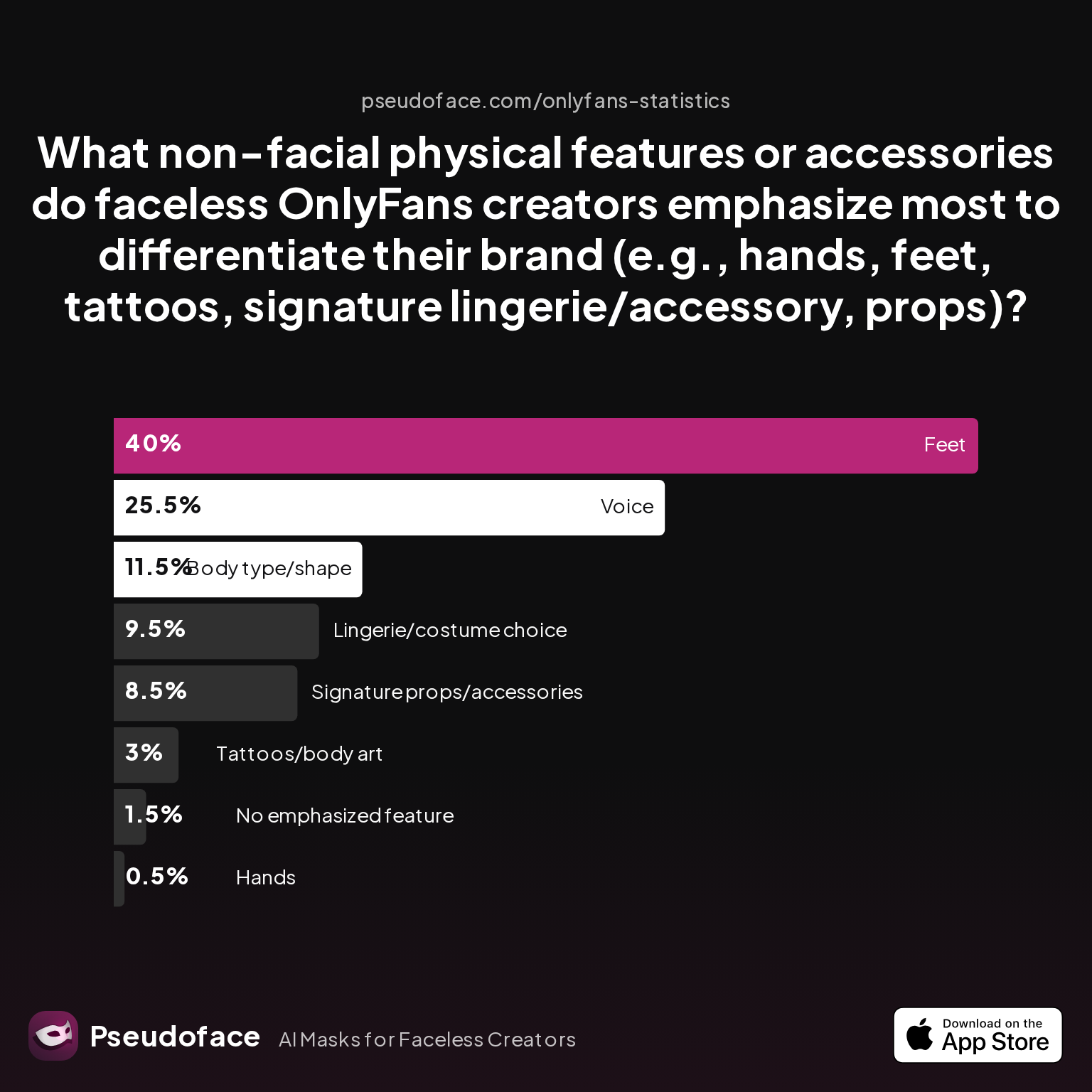
| Answer | Percentage |
|---|---|
| Body type/shape | 11.50% |
| Feet | 40.00% |
| Hands | 0.50% |
| Lingerie/costume choice | 9.50% |
| No emphasized feature | 1.50% |
| Signature props/accessories | 8.50% |
| Tattoos/body art | 3.00% |
| Voice | 25.50% |
Key finding: For 40%, “feet” are the primary branding element—no surprise given demand data—but nearly a quarter (26%) build audience connection entirely through unique voice, scripting, or accent. Signature lingerie, props, or recurring color schemes make up just under 10%, while body type and “vibe” (room, color palette) round out the ways creators can become recognizable without revealing a face.
Standout Reddit voices frequently highlight the power of props and routine—making anonymity an asset:
Open thread on Redditr/CreatorsAdvice
u/Slimthicchicc
It does indeed slide around. I hated that thing. I ended up getting this & I have an old cutting board that I mount it too & I use angles to make it appear as POV & not like it’s mounted.
Real, achievable steps for the creatively anonymous:
- Rotate feature focus (feet, hands, legs) and develop a signature color, texture, or prop.
- Vary filming angles and settings but keep a recurring anchor (e.g., favorite rug, tattoo, accent lighting) for brand familiarity.
- Lean on voice work and scripting in audio/adult tease content to add personality without face risk.
- Never fatigue your audience with one angle or single-shot monotony; keep them guessing—and guessing who you are.
The most compelling faceless creators, bottom line, stand out by mastering both the technical (angle, framing, lighting) and the artistic (brand, mood, scripting) levers. They use anonymity not as an absence but as a creative motif.
FAQ: Filming Faceless OnlyFans Content with Style and Safety
What simple camera setups work best for filming faceless OnlyFans videos?
The most effective setups are standard tripods, ring light/mount combos, and DIY mounts that enable hands-free, body-focused shooting from a variety of angles. A tripod aims for stability and adjustable positioning, while ring lights with mounts add flattering light and easy camera placement. Many creators supplement with phone clip mounts or stacked objects for flexible overhead or low shots.
How do faceless OnlyFans creators avoid accidental face reveals during dynamic shots?
The best safeguards are careful angle planning, doing test shots before recording, using masking or reflective tape in the environment, and double-checking every video frame during editing. Creators recommend scanning for background mirrors, screens, or stray reflections in all shots.
Do faceless OnlyFans creators earn less than those who show their face?
Not necessarily—data shows that earnings for faceless creators can rival or exceed those of face-showing creators in high-demand niches like feet, legs, and voice/audio, especially once variety and quality are mastered. Income potential is driven more by content focus, production quality, and subscriber engagement than by facial visibility alone.
Can you make a living as a faceless OnlyFans creator?
Yes, many faceless OnlyFans creators make a full-time living, especially in specialized niches; notable examples include creators like u/SoftVsSteel and u/FitFeetStudio, who focus on consistent, dynamic angles and niche branding.
Are there specific props or signature accessories faceless creators use for branding?
Absolutely—popular branding tools include signature lingerie, recurring color themes, room props (mirrors, lights), and accessories like anklets or socks. Many creators also use tattoos, body art, or a signature rug or sheet as a subtle trademark.
How do I film overhead content without expensive rigs?
Many creators use stacked books/furniture, phone clip mounts attached to shelves or curtain rods, or simple (but secure) adhesive hooks with phone holders. Community advice on Reddit also recommends Saran Wrap or waterproof bags to protect devices during creative overhead or splash shots.
Can AI filters or masks be used to protect my face on OnlyFans?
Masks and physical covers are preferred by 36% of faceless creators, while less than 3% rely on AI filters due to variable quality and authenticity concerns. For most, cropping and intentional blur are more reliable than software-based solutions.
What are the main safety tips for keeping my identity private on faceless OnlyFans?
Key tips include scrubbing metadata from images/videos, doing a full background/environment sweep before each shoot, using consistent cropping, and testing for reflections in every frame before publishing.
Is there a difference in demand for faceless foot, hand, or cosplay content?
Yes—feet content commands the highest subscriber demand (55%), while hand and cosplay/masked content are much smaller but still viable niches for creators with distinctive props or strong audio work.
How do I find faceless OnlyFans creator inspiration and non-face branding ideas?
Explore top-performing faceless creators in your niche, analyze which features or settings recur in their brand, and use Reddit to gather case studies and advice threads for signature non-facial branding tactics.
Ready to build your faceless OnlyFans brand? Craft your process, expect some setbacks, and treat every angle as an invitation to invent. The more you adapt—and the more you trust your own visual instincts—the less anonymity feels like a compromise, and the more it looks like your signature superpower.


