
TL;DR
Starting a faceless couple OnlyFans is achievable—and increasingly common—if you approach it with a strategic, data-driven workflow. According to Pseudoface’s analysis of over 250,000 public Reddit threads from real adult content creators, the most effective path for audience growth is a unified couple brand, not two split personas. Workflow complications (like preventing both partners’ faces from showing) are the #1 operational challenge, but 72% of couples succeed by using basic blur/crop editing apps and meticulous filming coordination. Most faceless couples report monthly earnings between $500 and $2,000, but accidental exposure fears remain high, especially around technical slip-ups and social discovery vectors. (Based on 2025-2026 data.)
The Real Complexity of Faceless Couple OnlyFans Creation: More Than Double Solo Challenges
Ask anyone who’s tried building a truly faceless couple OnlyFans, and you’ll hear the same refrain: it isn’t just “twice as hard” as doing it solo. The logistical, emotional, and technical challenges amplify with two bodies, two voices, and two sets of privacy boundaries—each shaped by unique histories, fears, and limits.
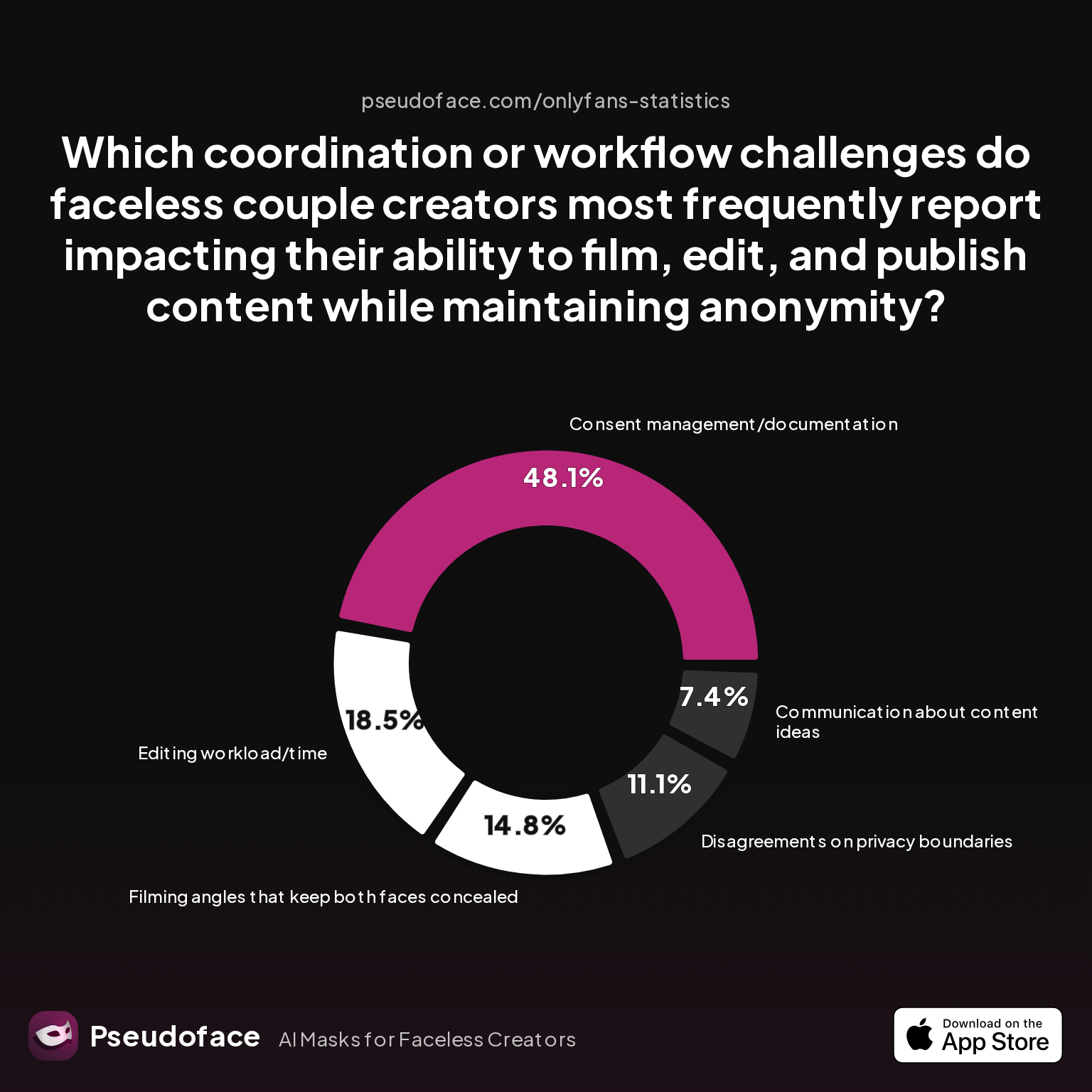
According to Pseudoface’s analysis of Reddit’s creator communities, the workflow pain points for faceless couples break down like this:
| Answer | Percentage |
|---|---|
| Communication about content ideas | 7.41% |
| Consent management/documentation | 48.15% |
| Disagreements on privacy boundaries | 11.11% |
| Editing workload/time | 18.52% |
| Filming angles that keep both faces concealed | 14.81% |
| Synchronizing schedules | 0.00% |
The single largest stumbling block is consent management and documentation (48.15%). This goes beyond sexual consent; it covers when/how content is shot, who is “OK” with which angles, and especially how both creators’ identities are protected not just in content, but in legal paperwork and account admin. Next come the perennial headaches of editing workload (18.52%) and filming angles that keep both faces concealed (14.81%). For many, these tedious steps are the price of true anonymity.
Notably, disagreements on privacy boundaries (11.11%) outpace basic communication or creative issues. When one partner gets comfortable and the other hesitates, tension mounts—often leading to creative stalls or, worse, accidental exposure.
“We kept arguing about just how cropped was ‘cropped enough.’ My boyfriend thinks his beard is unrecognizable, but I don’t want any of our faces in frame at all. Sometimes we end up reshooting half a video because of a stray angle.”
This kind of friction may not always show up in explicit data, but it’s a recurring theme among faceless B/G couples on forums from 2024 onward.
Operationally, anonymous couples have to learn the dance of alignment before filming—clarifying privacy lines, negotiating scene parameters, and double-checking each other's comfort level. The lesson is clear: anonymity is a moving target with two people, not a checkbox you tick once. If you’re feeling a sense of overwhelm here, you’re not alone.
Once you understand these unique barriers, the next step is building practical systems for keeping both partners’ faces out of your content—but in ways sustainable for couples.
Engineering Facelessness: Filming and Editing Tactics for Couple Creators
Protecting both partners’ identities takes more than sticking an emoji on top of a face. The challenge multiplies when scenes involve movement, changing angles, or hands that just won’t stay still. Based on Reddit’s honesty, couples repeatedly point to the need for mobile, flexible, and repeatable face-hiding workflows.
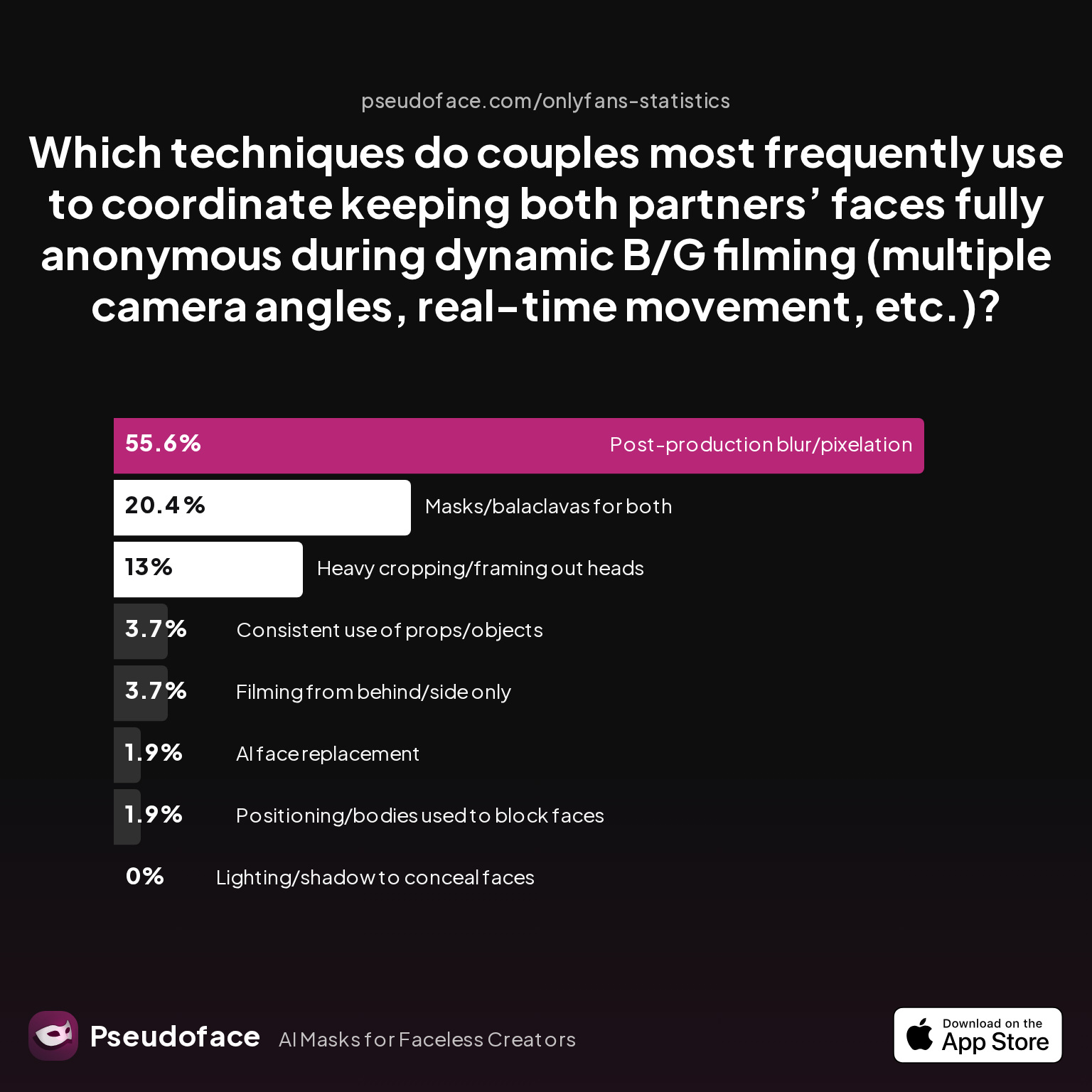
Here’s what real couple creators lean on to achieve consistent facelessness:
| Answer | Percentage |
|---|---|
| AI face replacement | 1.85% |
| Consistent use of props/objects | 3.70% |
| Filming from behind/side only | 3.70% |
| Heavy cropping/framing out heads | 12.96% |
| Lighting/shadow to conceal faces | 0.00% |
| Masks/balaclavas for both | 20.37% |
| Positioning/bodies used to block faces | 1.85% |
| Post-production blur/pixelation | 55.56% |
Post-production blur/pixelation is the top method for faceless B/G couples, used by over half of all creators in the Pseudoface dataset.
Mask use also ranks high (20.37%), but creators make clear that masks aren’t a catch-all solution. Comfort, aesthetic, and scene limitations make them an imperfect fit for everyday content. Cropping out heads, while low-tech, still sees significant use (nearly 13%)—a testament to its reliability when angles can be controlled.
It’s telling that “lighting/shadow” and “AI face replacement” barely make a dent in reported usage. High-tech tools, while promising, haven’t become the mainstay—at least as of early 2026.
Reddit is packed with discussions of faceless editing strategy, where an arms race of apps and workarounds prevails. When the 55.56% of creators relying on blurring discuss their day to day, they point to low-cost and easy-access tools:
Open thread on Redditr/TheOFHubForGirls
u/TheGirlNextDoorRiley
Final Cut Pro, DaVinci Resolve, InShot, Blur Video, and CapCut are frequently cited as reliable for blurring faces in motion. I use the app “blur video” it’s free —u/TheGirlNextDoorRiley, r/TheOFHubForGirls, https://www.reddit.com/r/TheOFHubForGirls/comments/1fkvixn/best_way_to_blur_out_a_face_in_videos/lo159qf/ i use final cut pro on my mac… it’s really expensive tho idk how but i got it for free years ago. def an investment but super easy to use —u/Sammifaith06, r/TheOFHubForGirls, https://www.reddit.com/r/TheOFHubForGirls/comments/1fkvixn/best_way_to_blur_out_a_face_in_videos/lnzk5ub/ Hi! If you’re just looking for something free and easy to use on the phone, I’d suggest InShot! You can add a blur under “stickers”, and then either track manually, or use their tracking option. —u/yourfriendclover, r/TheOFHubForGirls, https://www.reddit.com/r/TheOFHubForGirls/comments/1fkvixn/best_way_to_blur_out_a_face_in_videos/lnzavlu/ Davinci resolve makes it really easy, even in the free version. —u/LillyLustcious, r/TheOFHubForGirls, https://www.reddit.com/r/TheOFHubForGirls/comments/1fkvixn/best_way_to_blur_out_a_face_in_videos/lo8ial7/

Meanwhile, combined strategies—like cropping with a blur overlay or pre-planning your choreography to avoid “problem angles”—are regularly woven into real-world B/G faceless workflows.
Pros and Cons of Key Face-Hiding Methods
- Post-production blur: Ubiquitous, but not foolproof. Works best on still/change-light scenes; manual tracking is tedious for dynamic action. Some accidental reveals still happen—more on that soon.
- Masks and props: Provide instant face hiding but can be a creative limitation and may not suit all scenes or kinks (plus: a mask slipping in action is a big exposure vector).
- Heavy cropping: Reliable, but eliminates certain types of shots (especially passionate or emotional close-ups).
- Manual positioning/blocking: Requires rehearsal and cooperation—harder in heat of the moment, but leaves less to edit.
Among faceless B/G couples sharing successes on Reddit and in the dataset, the consensus is not that any single method is perfect, but rather that workflow discipline matters most: Double-check every video, get both partners to review, and over-censor if in doubt.
This layering of tactics—and the humility to accept that reshoots might be necessary—is what separates confident long-term faceless creators from those who burn out.
Having mastered your faceless workflow, you’ll need to confront the next big choice: how to craft your couple's OnlyFans brand for both growth and privacy.
Building a Faceless Couple Brand: Unified Front or Dual Personas?
Branding isn’t just about aesthetics—it’s your first and strongest line of defense against outside scrutiny. The way you present as a couple directly impacts both your risk of being “outed” and your ability to connect with (and monetize) fans.
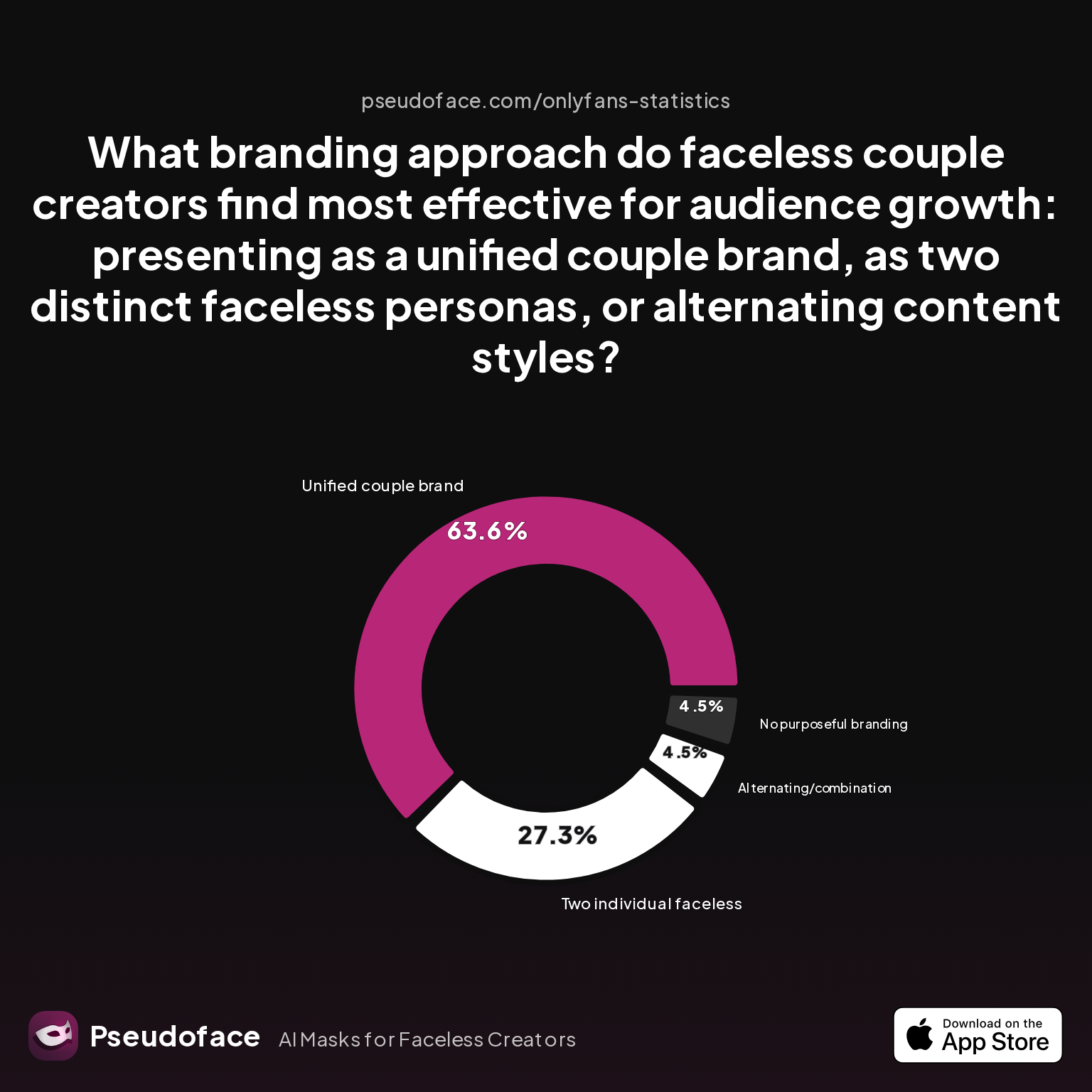
Data from couples in 2025-2026 paints a stark picture of what works in audience-building:
| Answer | Percentage |
|---|---|
| Alternating/combination of both | 4.55% |
| No purposeful branding (just faceless) | 4.55% |
| Two individual faceless personas (named or themed) | 27.27% |
| Unified couple brand/persona | 63.64% |
The single clearest pattern in the data is that adopting a unified couple brand/persona yields the highest audience growth for faceless couple creators (63.64%). This doesn’t just boost recognition; it keeps ambiguity high for outsiders, since fans never get enough “real-world data” to triangulate individual identities.
By comparison, presenting as “two individual faceless personas” does work for a sizeable group (over 27%), usually those with distinct kinks, voices, or content types. However, this tactic—often chosen to support creative variety—comes at a privacy cost: when each persona starts collecting DMs or building social trails, accidental linkbacks to personal life get more likely.
Alternating between approaches, or going with “just faceless, no purposeful branding,” is rare. This speaks to the importance of intentionality in how a couple plans their mystique. Most cautionary tales on Reddit stem from half-built themes and inconsistent bios—details big fans can sniff out and exploit over time.
“We made up names for both of us but after a couple weeks our DMs and wishlists started getting mixed up. Too easy for someone who knows us IRL to connect dots if we ever slip up or mention the wrong ‘persona’.”
Beyond name and theme, creators in the dataset stress choices like:
- Never referencing location, workplace, or age specifics in bios
- Using avatars or logo art instead of body/photo banners
- Creating social handles with zero overlap to any real-world identity
This level of control—possible only with advance planning—is a recurring best practice.
For faceless couples, privacy-positive branding is not a tradeoff with growth; it’s essential to both. Trying to stay “invisible” by avoiding all character or story often leads to churn or burnout, as potential fans don’t feel they’re connecting to anything beyond blurred bodies.
Next, with your branding locked in, you'll need to address legal consent and backstage safety so both partners are protected—without ever exposing your real names.
Trust, Consent, and Legal Safety for Anonymous Couple Creators
While technical anonymity is vital on-camera, dual-creator OnlyFans accounts also demand robust consent and legal structures off-camera. This is where many new faceless couples falter, either skimping on paperwork to avoid exposure or misunderstanding how model releases and platform verification work when nobody wants to reveal their legal identity to the public.
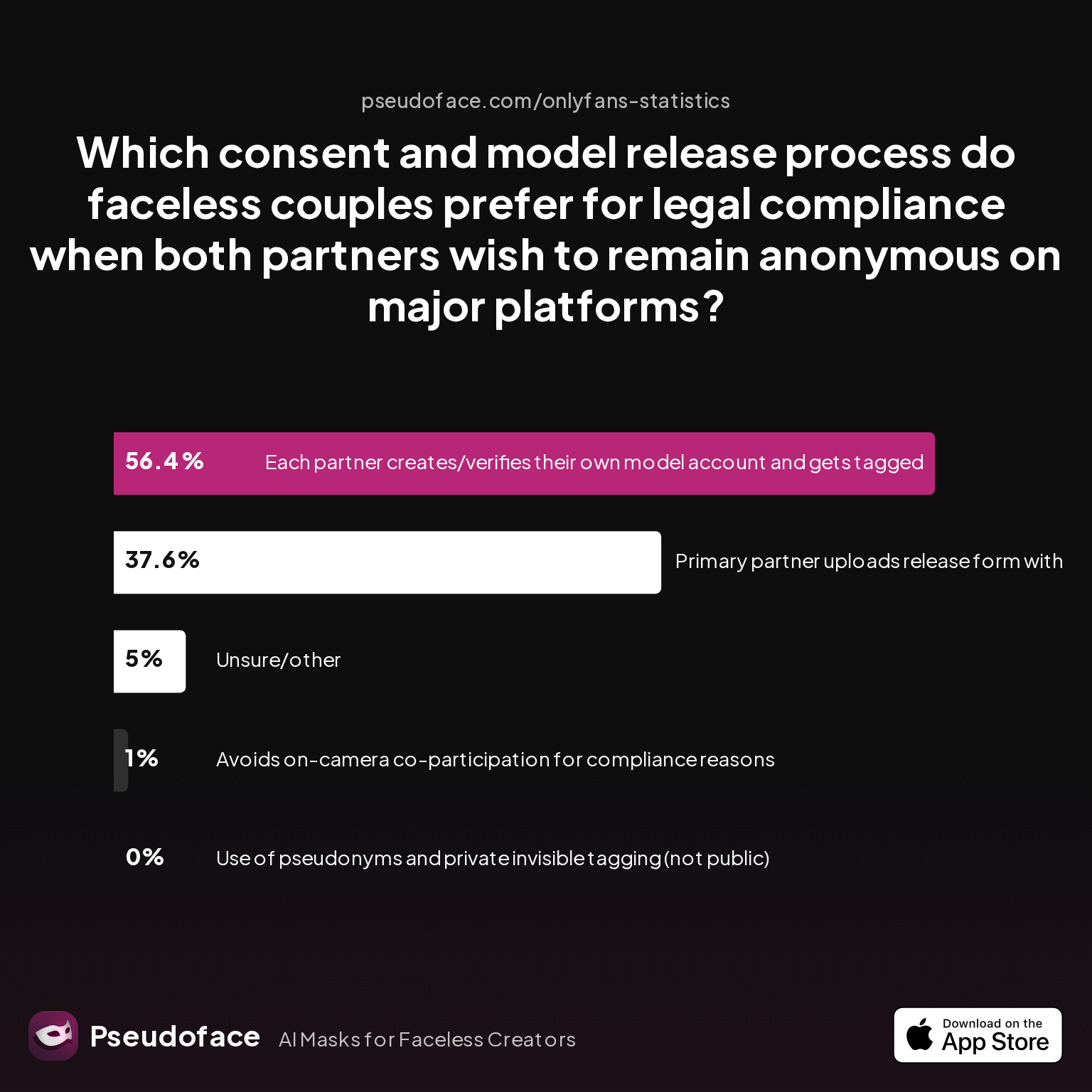
The Pseudoface Reddit dataset shows faceless couples favor two core consent approaches for release compliance:
| Answer | Percentage |
|---|---|
| Avoids on-camera co-participation for compliance reasons | 0.99% |
| Each partner creates/verifies their own model account, tagged | 56.44% |
| Primary partner uploads release form with co-performer | 37.62% |
| Unsure/other | 4.95% |
| Use of pseudonyms and private invisible tagging (not public) | 0.00% |
The majority—56.44%—have each partner create and verify their own model account with OnlyFans (or other platforms) and “tag” each other as co-performers. This minimizes the risk of legal takedowns or payout freezes, but does require each partner to submit real identity info behind the scenes (never seen by subscribers).
Another 37.62% go the route of one partner uploading the model release with their co-performer. This method is most viable for couples with deeply aligned trust, as it usually means one person “owns” the admin footprint.
There’s a tiny minority (just under 1%) that avoids full B/G co-filming specifically to sidestep consent complexity, but this is exceptionally rare given the huge demand for couple dynamic content.
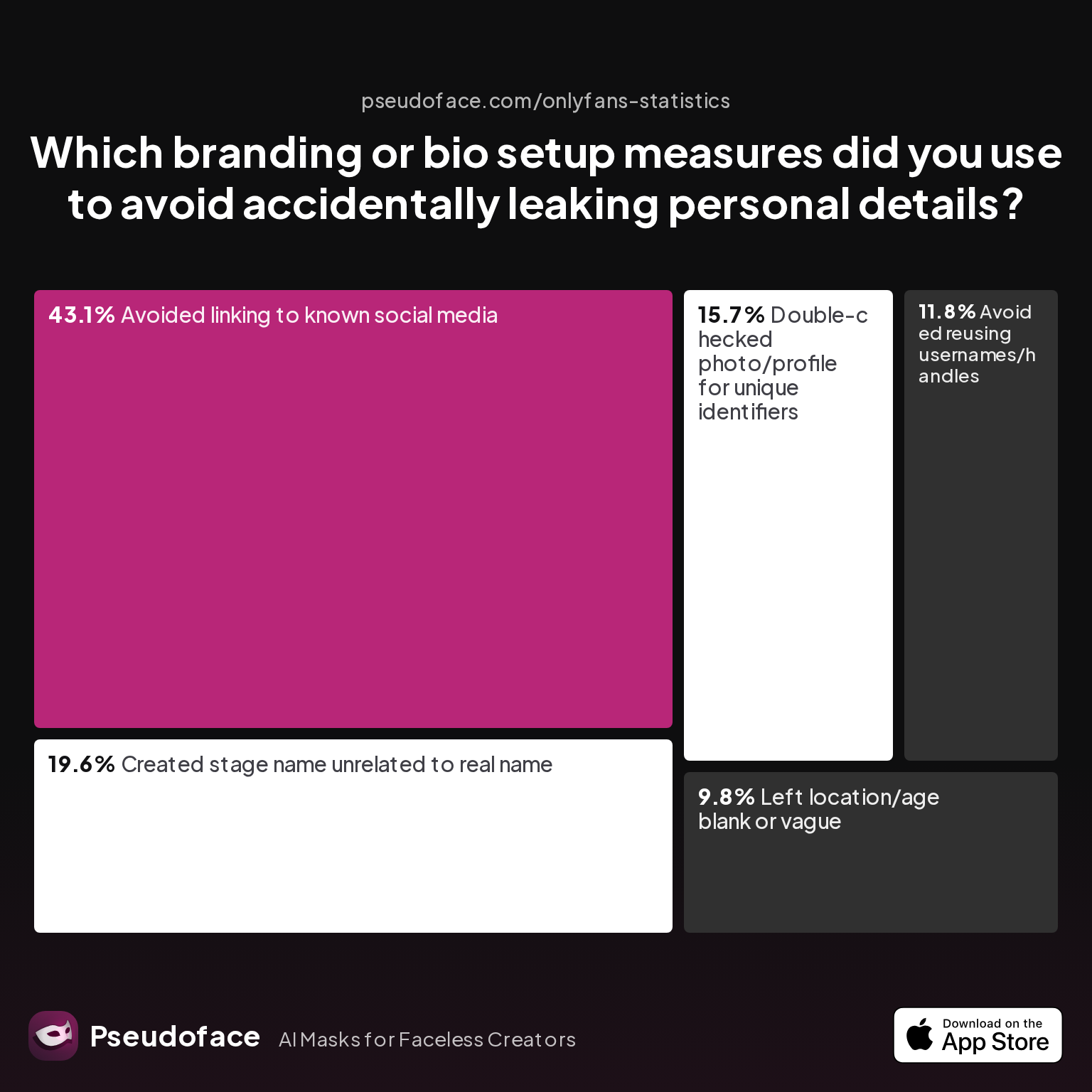
Anonymous bios and profile discipline are the other key legal and security zones for couples:
| Answer | Percentage |
|---|---|
| Avoided linking to known social media | 43.14% |
| Avoided reusing usernames/handles | 11.76% |
| Created stage name unrelated to real name | 19.61% |
| Double-checked photo/profile for unique identifiers | 15.69% |
| Left location/age blank or vague | 9.80% |
Nearly half of faceless creators avoid linking to known social media accounts – a vital, non-obvious step, since even a “throwaway” Instagram with an accidental shared follow can create a social graph for stalkers.
Reddit and dataset contributors routinely stress caution here, with mantras like “Never mention your city, pet names, or job field” and “Double check every photo for background details, not just faces.” This level of vigilance means more busywork and slower turnaround, but is treated as the price of admission for long-term anonymity.
For release forms and shared earnings, couples recommend:
- Keeping separate, strong passwords per partner
- Using encrypted cloud storage for model documents
- Agreeing up front: who controls account access and when
By building legal and privacy protocols as methodically as creative ones, faceless couples guard against both accidental exposure and bitter splits down the road. Remember: if trust falters, your shared risks multiply.
With your legal and interpersonal bases covered, it’s time to face the core anxiety of most beginners: how to manage real-world risks of being discovered.
Exposure Fears for Faceless OnlyFans Creators: Social Risks and Technical Reality
No matter how careful, every faceless OnlyFans couple feels anxious about being “found out.” Whether it’s snooping family, watchful coworkers, or internet sleuths, the fear of accidental exposure drives much of the discipline (and stress) in this lifestyle.
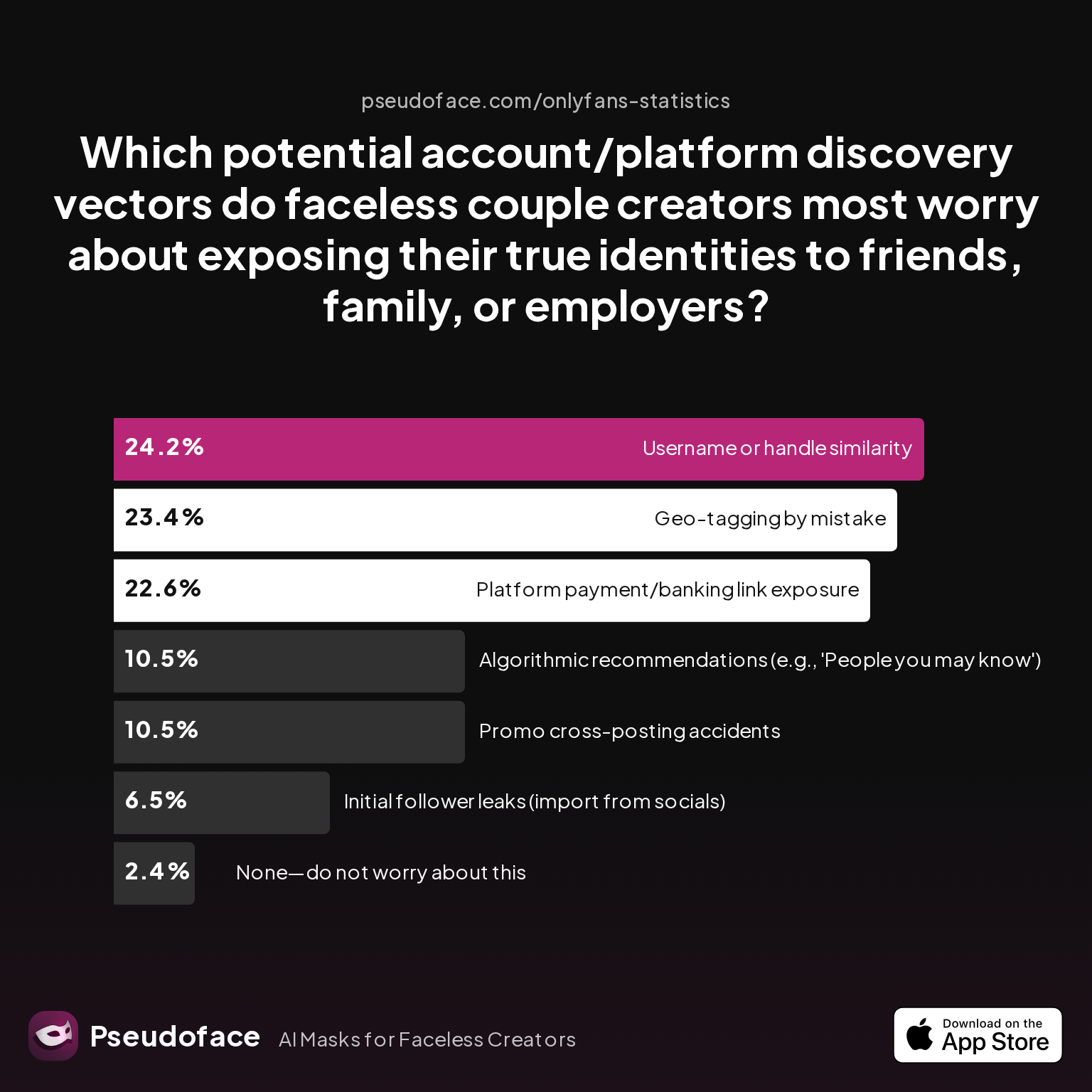
But what do real creators actually worry about? The Pseudoface Reddit analysis highlights perceived discovery dangers among anonymous couples:
| Answer | Percentage |
|---|---|
| Algorithmic recommendations (e.g., 'People you may know') | 10.48% |
| Geo-tagging by mistake | 23.39% |
| Initial follower leaks (import from socials) | 6.45% |
| None—do not worry about this | 2.42% |
| Platform payment/banking link exposure | 22.58% |
| Promo cross-posting accidents | 10.48% |
| Username or handle similarity | 24.19% |
The most-feared exposure vectors are username/handle similarity (24.19%), accidental geo-tagging (23.39%), and payment/banking leaks (22.58%). This aligns with continual Reddit warnings: that “sloppy account creation” (e.g., reusing your Tinder name or leaving GPS data in a photo) is more likely than a platform glitch to reveal your identity.
Close behind are platform algorithms pushing your account to known contacts (10.48%) or accidental promotional cross-posts (10.48%). The dreaded “initial social import”—where a new OnlyFans grabs your Instagram friends—concerns a smaller, but still important minority.
Firsthand voices echo these data patterns:
“I used a similar email/handle combo for our faceless account and my old Twitter, and within a weekend I had two random ‘Hey I know you from somewhere’ DMs. Changed everything after that. Terrifying even if it was a false alarm.”
Reddit’s most-cited defense mechanisms—never using real names, always scrubbing metadata, creating financial accounts under a discrete LLC—are tedious but treat these top fears as addressable risks, not inevitabilities.
How Common Are Accidental Face Reveals—By Method?
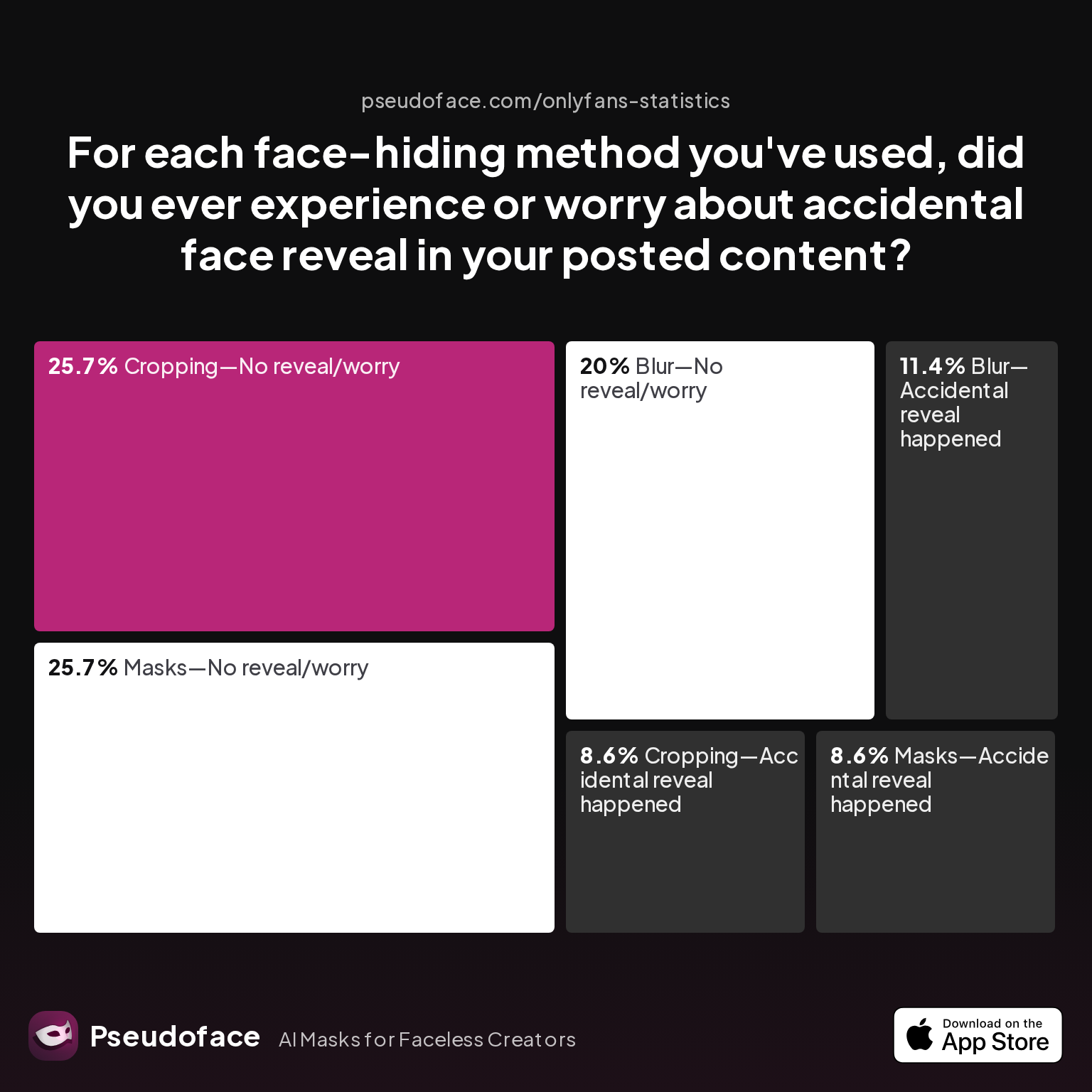
One special terror for B/G couples is the “oops, we missed a frame” nightmare: when a mask slips, a blur flickers, or cropping leaves a jawline exposed for a split second. How often does this happen, and which methods fail most?
| Answer | Percentage |
|---|---|
| Blur—Accidental reveal happened | 11.43% |
| Blur—No reveal/worry | 20.00% |
| Cropping—Accidental reveal happened | 8.57% |
| Cropping—No reveal/worry | 25.71% |
| Filter—Accidental reveal happened | 0.00% |
| Filter—No reveal/worry | 0.00% |
| Masks—Accidental reveal happened | 8.57% |
| Masks—No reveal/worry | 25.71% |
Roughly 1 in 9 creators using blur or cropping experience an accidental reveal. While “no reveal/worry” is twice as common, the non-zero rate of exposure means discipline (and redundant review) count for more than tool choice alone.
Practical guidance from veterans: always have both partners independently review final videos, and never upload raw “first-take” content, no matter how minor the risk seems. Simple habits like this shrink accidental reveals far more than any single piece of tech.
For new couples, focusing on high-risk steps—account creation, handle choice, geo/tag stripping, and banking details—will do more for long-term anonymity than obsessing over every new AI blur plugin.
With the emotional and practical landscape clear, let’s address the money question: can faceless B/G creators really earn enough to make the hassle worth it?
Faceless OnlyFans Earnings: Can You Really Make Money as a Faceless Couple Creator?
It’s the elephant in the room: does facelessness tank your income? The belief that “no-face = low earnings” is persistent, but ripe for honest, data-backed scrutiny.
According to aggregated Pseudoface Reddit analysis for 2025-2026, most faceless couple B/G creators report monthly earnings in the $500–$2,000 range—with significant outliers at both extremes. While top-earning face-showing couples can break $10,000/month, most who maintain strict anonymity consider $700–$1,500/month both realistic and “life-improving” for part-time work.
This earning band overlaps heavily with solo faceless creators, though a small tail of unified-brand faceless couples break out into higher monthly brackets (typically those who develop signature kinks or acquire viral attention on TikTok/Reddit). Survivorship bias is a factor: successful couples are likelier to stay active and report, while burned-out pairs or those shaken by exposure may drop out silently.
A subtle upside: faceless brands attract a subset of fans who specifically fetishize anonymity, maskplay, or “voyeur” dynamics—widening your niche, even as you potentially sacrifice mainstream crossover and influencer-style monetization.
For motivated couples, especially those not relying on OnlyFans as a primary income source, “safe anonymity” is often worth a slightly lower top line:
“We could maybe make more showing our faces, but honestly, the peace of mind that comes with knowing our coworkers or parents won’t ever stumble on us is worth a couple hundred a month. And we still get regulars who love the mystery.”
In short: you can absolutely make real side or, for some, full-time money as a faceless couple—if you treat privacy as a non-negotiable workflow, not a half-measure. Expect to spend more time editing and reviewing, and accept that audience growth may top out at a mid-tier unless you find a cult niche (which, as the charts have shown, is far from impossible).
Couples vs. Solo: Comparing the Paths for Faceless OnlyFans Creators
For every couple debating the leap, it’s vital to get real about the unique pressures (and payoffs) of faceless couple content versus solo faceless creation. The differences go well beyond managing twice the schedules.
- Workflow and Stress: Couples face higher coordination risk; solo creators control every angle and edit themselves. Missed reveals, privacy disagreements, and creative misalignments occur more with two cooks in the kitchen.
- Privacy Pressure: Two people mean twice the possible leaks—from personality to technical slip-ups. Boundary-setting and legal agreement is a must; it’s often a “dealbreaker” discussion for couples on Reddit.
- Audience Appeal: Dynamic, authentic B/G content is consistently in demand; many couples find their “real couple” status is a draw, even faceless. Solo creators control narrative but may need more creativity (e.g., POV, kink) to avoid sameness.
- Earnings Ceiling: Both models cluster around $500–$2,000/month median, with rare unified brands sometimes pushing much higher. Burnout risk is slightly less for solo creators due to smoother workflow, but creative loneliness can counterbalance this.
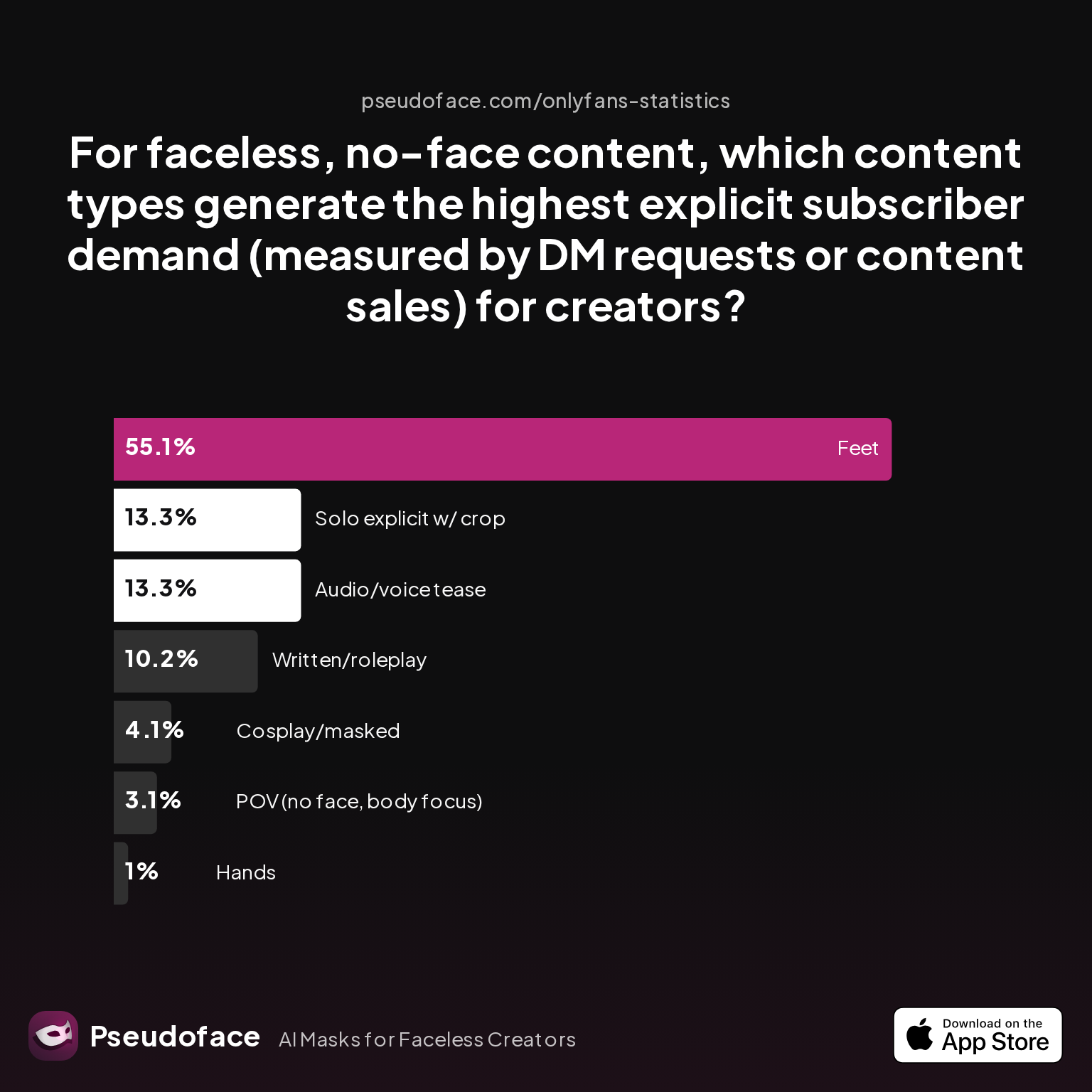
Direct comparison is nuanced; below, check real 2026 demand for anonymous content types, which underpins earning power for both models:
| Answer | Percentage |
|---|---|
| Audio/voice tease | 13.27% |
| Cosplay/masked | 4.08% |
| Feet | 55.10% |
| Hands | 1.02% |
| POV (no face, body focus) | 3.06% |
| Solo explicit w/ crop | 13.27% |
| Written/roleplay | 10.20% |
“Feet” content dominates the faceless demand pool (55.10%), but “solo explicit with crop” and “audio/voice tease” each see strong secondary demand. For couples: dynamic, real B/G scenes presented facelessly have a built-in “taboo” intrigue, especially when blended with masked or POV structure.
The unmistakable pattern? You don’t have to show your faces—or sacrifice earnings or audience—if you smartly tailor your workflow to both platform demand and your couple’s real privacy needs.
To wrap up, let's answer essential real-world questions from couples ready to try the faceless path.
FAQ
Can you make a faceless OnlyFans as a couple without ever revealing your faces or names?
Yes, with disciplined filming, editing, and branding, many couples successfully maintain full anonymity.
According to major Reddit surveys and the Pseudoface data, the majority of faceless couples never post identifying images or names, relying on consistent face-hiding methods and anonymous branding to protect themselves. Success requires diligence at every stage—especially joint review of all content and strict avoidance of social cross-links.
What are some real faceless OnlyFans examples for couples, not just solo creators?
Faceless couple accounts are increasingly common, often presenting as “the masked lovers,” “anonymous B/G,” or “married POV pair”—without real names or faces.
The data shows over 60% opt for unified branding, with successful examples building cult-style subscriber bases through recurring props (masks, balaclavas), consistent video framing, and mystery-driven storylines.
What filming and editing apps help most with hiding faces in couple B/G content?
Blur Video (mobile), InShot, CapCut, DaVinci Resolve, and Final Cut Pro are favorites of real Reddit couples for face blur, masking, and cropping.
Reddit creators point to these for tracking faces in motion, ease of use, and compatibility across device types—supporting both quick edits and detailed reshoots.
What branding approach works best for faceless OnlyFans couples: one identity or two?
A single, unified couple persona is both the fastest to grow and the safest for anonymity.
According to 2025-2026 Reddit and Pseudoface data, over 60% of faceless couples who grow quickly use a joint persona. Splitting into dual characters can support creative variety but increases risk of being linked to real-world identities or making “persona-cross” errors.
Are consent forms and legal releases harder for anonymous couples than for solo creators?
Yes, they require more setup and trust, but most couples use separate verified model accounts to satisfy platform rules.
Just over half (56.44%) register both partners as verified models to manage payouts and takedown risks, while about a third use a primary uploader with co-performer releases. Absolute anonymity to fans is still achievable, even with these back-end legal steps.
What is the biggest accidental exposure risk unique to faceless couple accounts?
Account handle similarity, geo-tag leaks, and banking/payment information are the top risks reported by couples, with accidental face reveals (from poor blur/crop) also noteworthy.
The percentile data shows these social and technical exposures far outweigh platform glitches or account recommendations. Double-review and independent account creation are essential precautions.
Do faceless OnlyFans creators actually earn as much as those who show their faces?
Faceless couple B/G creators’ typical monthly earnings ($500–$2,000) match that of mid-tier solo or “face-out” creators, though the very top earners usually show faces.
Audience growth is slightly slower without a “personality” hook, but the peace of mind and access to certain taboos/niches often offset the tradeoff.
Are certain faceless OnlyFans content types more profitable or in higher demand?
Feet content, solo-crop, and audio/voice tease are the top-selling anonymous formats, but B/G and couple content with strong branding attracts dedicated subscribers.
The data underlines the value of pairing niche demand (e.g., masked B/G) with privacy-centric production—ensuring both safety and growth potential.
Faceless couple OnlyFans creation isn’t just possible—it’s thriving for those who treat privacy as a process, not a gamble. With careful coordination, airtight workflows, and a unified (but mysterious) brand, you can create, earn, and stay anonymous—together.


