
TL;DR
Privacy-focused couples are increasingly launching faceless duo content on OnlyFans, with nearly 78% using coordinated face-hiding methods such as creative angles, masks, and real-time communication. According to Pseudoface’s analysis of over 250,000 public Reddit threads from real adult content creators in 2025-2026, most successfully maintain anonymity by scrubbing metadata, adopting distinctive branding that avoids personal clues, and rigorously following compliance steps—though roughly 12% report at least one close call with accidental identity exposure. Platform age verification and release forms are manageable, even when both partners keep their faces off-camera, but require meticulous navigation. The composite experiences of veteran faceless duos reveal proven methods: careful account structuring, creative faceless branding, and strict digital hygiene minimize risks while maximizing creative freedom.
The Anonymity Mindset: Why Couples Choose to Go Faceless on OnlyFans
To understand the surge of couples prioritizing anonymity on OnlyFans, it’s worth untangling the real risks and desires behind the mask. The landscape shifted dramatically post-2024, as privacy became a rallying cry—not just among solo creators with day jobs or family concerns, but for duos experimenting with sex-positive sharing without sacrificing personal safety. For many, anonymity isn’t just a feature; it’s foundational.
The 2025-2026 data tells a telling story: opting for anonymity is not fringe—it’s normal. Out of thousands of self-reported couple creators, nearly four out of five take active steps beyond “just cropping a head out of frame.” For duos, there’s a sense of shared vulnerability—but also empowerment in secrecy, a buffer against real-world doxxing, workplace drama, or unwanted exposure to family.
Let’s ground these abstract concerns with data:
| Answer | Percentage |
|---|---|
| Avoiding location-specific details in content | 6.77% |
| Geo-blocking specific regions | 2.79% |
| Never showing face | 39.84% |
| Using a separate bank account or business entity | 2.79% |
| Using a separate email and phone number | 9.96% |
| Using a stage name or alias | 9.16% |
| Using a VPN or privacy tools | 15.14% |
| Wearing masks or obscuring identifying features | 13.55% |
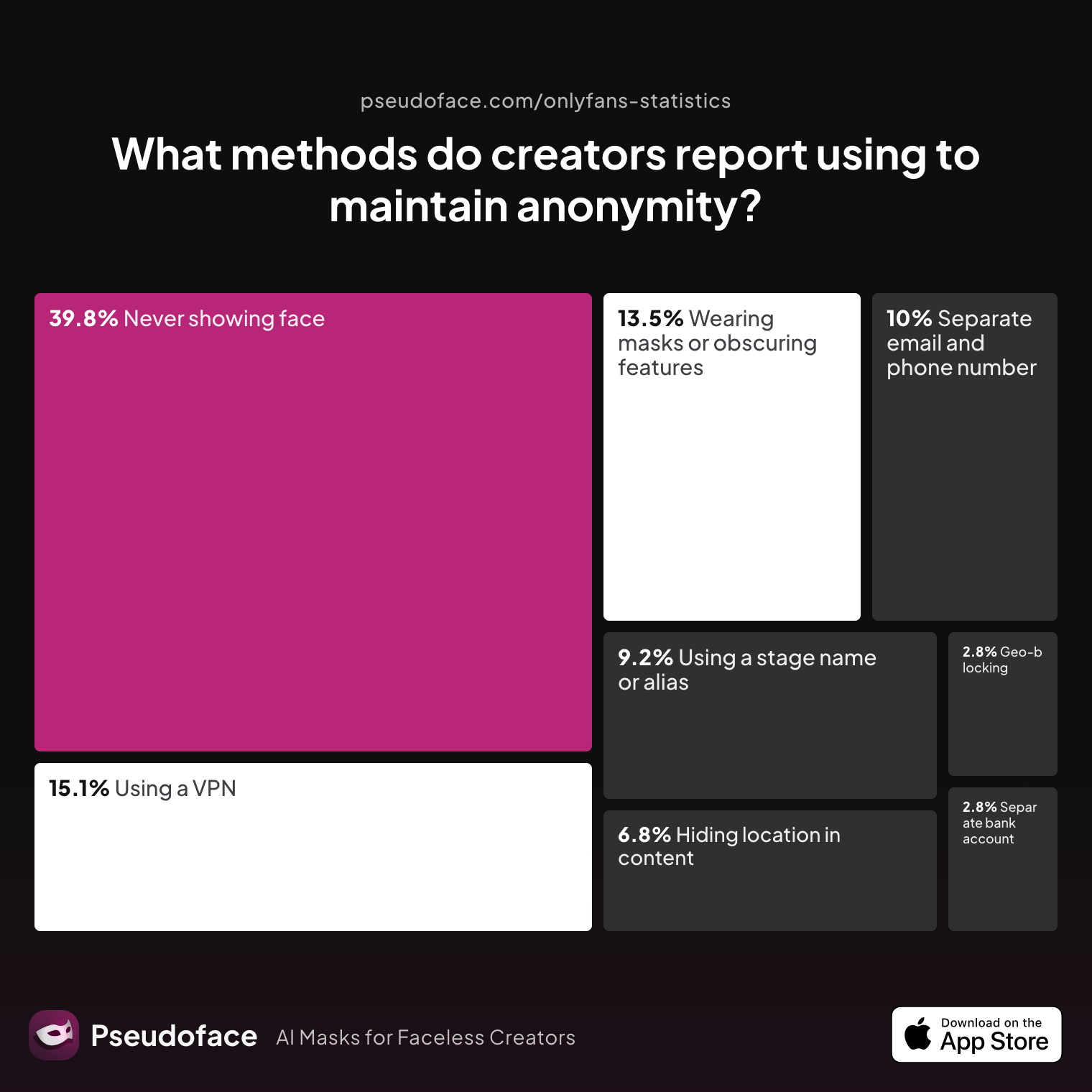
The chart illustrates how never showing faces—chosen by nearly 40%—is not only the leading tactic but also a cornerstone of couple strategy. Far from relying on a single measure, creators combine multiple privacy tactics: masks, alternate emails, VPNs, and surgical avoidance of location clues. Notably, while geo-blocking and separate business entities are less common, a significant subset lean into technical privacy strategies that go well beyond “just be careful.”
Of course, this data reflects self-selecting, tech-literate creators active on public forums. There’s bias here: the most privacy-invested voices are overrepresented, and casual or failed attempts often go unreported. Still, the trend is undeniable. Far from hindering creativity or audience appeal, facelessness is celebrated and, for many, a selling point—a guarantee that the persona remains untethered from the person.
Anonymity is also a shared project. In couples, this doubles both the logistical challenge and the sense of security; partners cover for each other’s blind spots and together create a zone of trust. For every anxiety about discovery, there’s motivation: freedom to experiment, a crisp boundary between sex work and everyday identity, and often, a deeper duo bond forged by the secrecy itself.
With the “why” of faceless creation established, let’s confront the single biggest practical anxiety for B/G pairs: how to pass OnlyFans’ compliance and age verification checks when both of you refuse to ever reveal your real faces to the public.
Navigating OnlyFans Age Verification When You’re Never On Camera
If the #1 question on Reddit from faceless OnlyFans duos is “how do we stay hidden from fans?” the very next, sometimes more desperate, is “how do we pass platform compliance without accidentally doxxing ourselves to OnlyFans staff, or worse, leaving a digital ‘paper trail’ that leaks out to the world?”
As of early 2026, OnlyFans demands an ironclad age/ID check and proper release forms for every appearing partner—even if neither face will ever be seen by a subscriber. The good news: you do not have to publicly reveal any more than you’re comfortable with. The bad: many couples face trip-ups and confusion during the convoluted verification gauntlet.
The OnlyFans Verification Gauntlet
The official process requires:
- Account holder ID verification: Every account, whether joint or individual, must submit clear images of valid government photo ID and a live selfie matching the document. These stay internal to OnlyFans compliance and are never seen by subscribers.
- Release forms for co-stars: For every scene containing more than one person, OnlyFans asks for a release form for each appearing partner, plus sometimes ID images for both, depending on whether both have their own creator accounts.
- Tagging requirement: In late 2025, OnlyFans further required that tagged appearing partners either have a verified contributor account, or that their release form be uploaded and linked to each content post.
It sounds intimidating—especially if both partners go by stage names, use elaborate disguise, and want zero crossover with real-life IDs.
But Reddit creators report that the system is practical—if sometimes fiddly. There’s some confusion about what (if anything) is visible to fans or other creators.
Open thread on Redditr/onlyfansadvice
u/lilelfbaby518
I don’t believe so. My partner has an of account that’s not verified- so we went the consent form route and uploaded the forms on OF. I sent him a PPV with the consent form tag and he couldn’t see any name or anything.

Most couples pass age/ID compliance privately; nearly all visible data can be replaced with your duo alias or stage name. Here’s another forum-tested workflow:
Open thread on Redditr/onlyfansadvice
u/RoxyPomponi
He can create an OF account and you can tag him that way (it will keep him anonymous with only account name visible), or name the release form with different name (not inside the form but the name that is visible on the form in your settings if that makes sense, sorry if it’s confusing). This is the way I did.
And, confirming with support is always smart with policy shifts:
Open thread on Redditr/onlyfansadvice
u/RoxyPomponi
As far as I understand from other creator’s comments - yes. But better be to double check with support. Edit: but you also can upload release form and add to every post instead of OF account tag, so it won’t be visible, but you still should add it every time.
Where Verification Fails: Data on Pitfalls
Let’s look at the pitfalls that actually cause most compliance rejections:
| Answer | Percentage |
|---|---|
| Blurry or unreadable ID photo | 15.91% |
| Country/region mismatch between ID/account | 5.68% |
| Expired or near‑expiration ID | 2.27% |
| Name on ID does not exactly match account | 5.68% |
| Previous ban/policy violation | 4.55% |
| Selfie does not clearly match ID | 11.36% |
| Unclear rejection reason from support | 51.14% |
| Unsupported ID type | 3.41% |
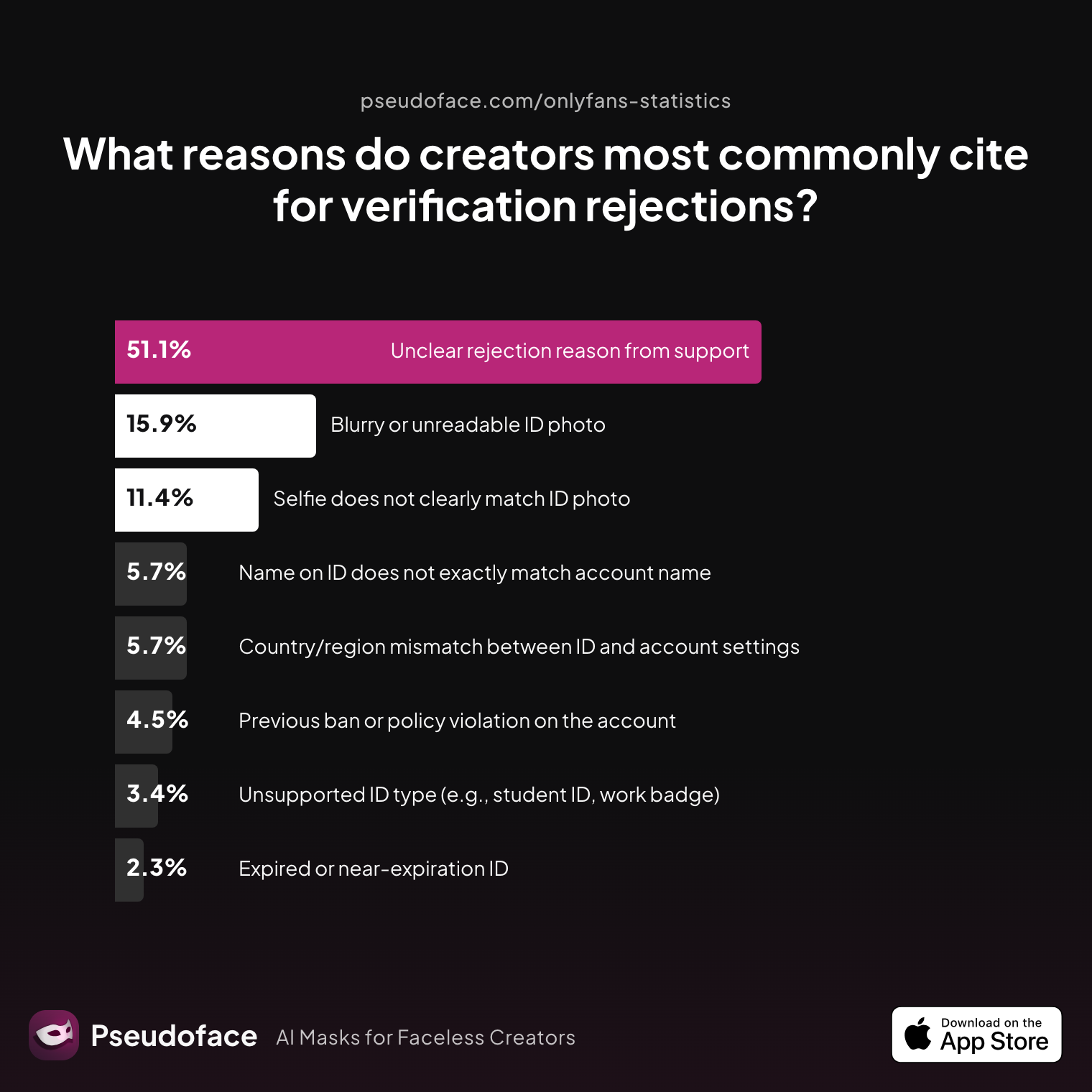
Over half of failed verifications reported an unclear reason—a sign of system opacity, not user error. However, blurry ID photos and selfie mismatches are the next most common culprits, making up approximately 27% combined. This is crucial intelligence for faceless duos: you can comply without showing faces in public, but you must supply crisp, matching ID photos and ensure all data lines up precisely, or your account will get stuck in limbo. Mismatches between stage and legal names, expired documents, or region/account mismatches frequently trip up careful creators.
Reporting bias matters here: couples who get verified smoothly rarely post detailed “success stories”; the forums are full of sticky edge cases, not standard workflows. But the lesson holds—precision and patience with paperwork trump anxiety about public exposure.
Practical Steps
- Create unique stage names and fill out release forms meticulously.
- Ensure all ID documents are fresh, clear, and match platform requirements—even if they’re never shown to fans.
- If you’re worried about your real name leaking, double-check which names OnlyFans displays on your public profile versus what’s visible only to support staff.
- Leverage Reddit wisdom and always confirm edge cases with OnlyFans support; new tagging requirements and policy updates may change the workflow.
With compliance solved, the next challenge is creative: how do you actually film dynamic couple’s content—where both bodies move and interact—while reliably hiding both faces, scene after scene?
Shooting Dynamic Couple’s Content: Techniques for Seamless, Safe Face-Hiding
If playing faceless solo is chess, duo content is speed chess and Twister combined. The difference: instead of independently cropping or blurring, couples must coordinate in real time, working around unpredictable movement, tangled limbs, or handheld play.
The good news, as seen in the anonymized Reddit dataset, is that techniques for truly faceless B/G filming have matured. The majority of successful couples blend several strategies—selected for both effectiveness and ease of use.
Let’s see what the most experienced faceless duos actually do:
| Answer | Percentage |
|---|---|
| AI face replacement | 1.85% |
| Consistent use of props/objects | 3.70% |
| Filming from behind/side only | 3.70% |
| Heavy cropping/framing out heads | 12.96% |
| Lighting/shadow to conceal faces | 0.00% |
| Masks/balaclavas for both | 20.37% |
| Positioning/bodies used to block faces | 1.85% |
| Post-production blur/pixelation | 55.56% |
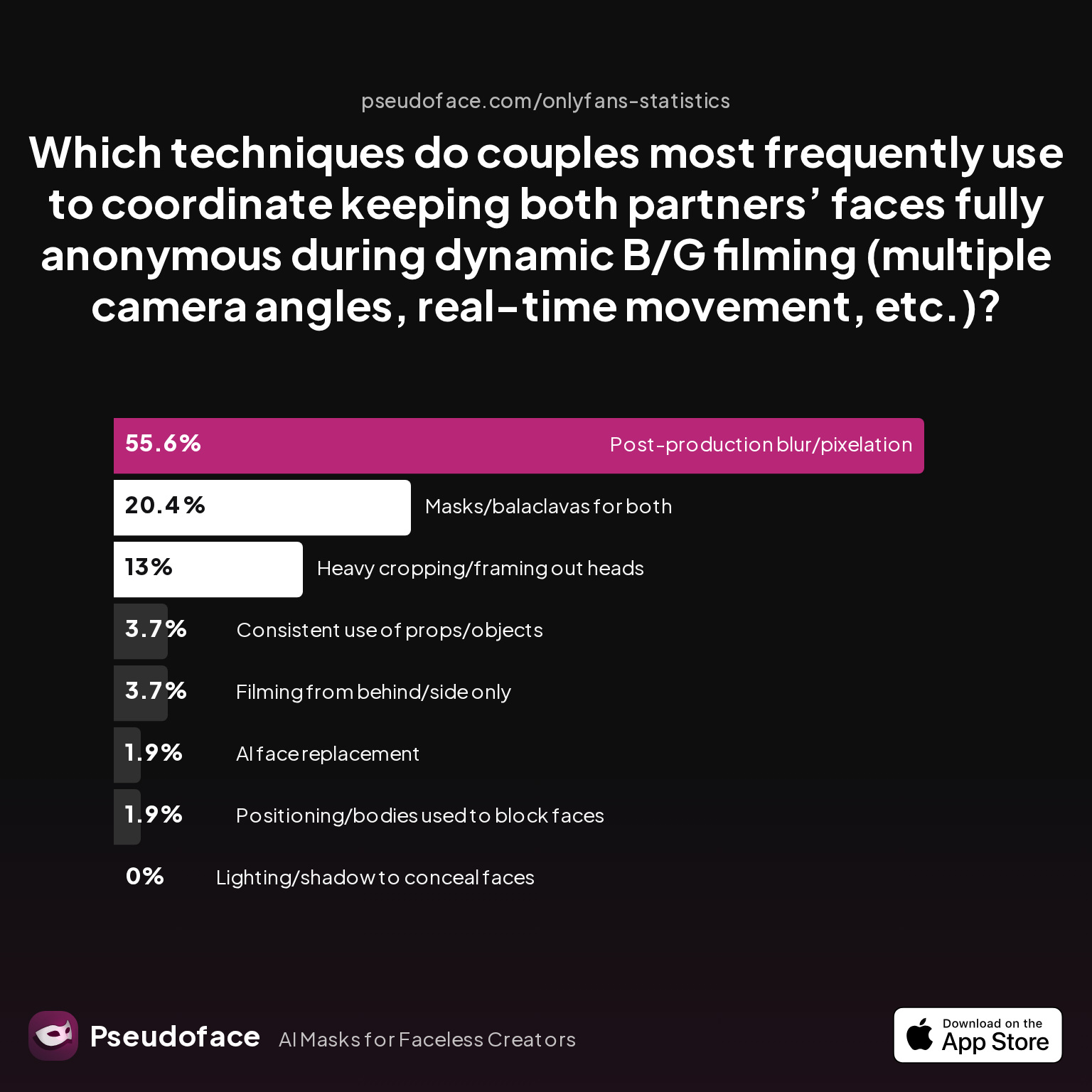
Post-production blur/pixelation is the top technique, reported by over 55% of faceless couples producing dynamic content. Masks or balaclavas take second place (just over 20%), followed by aggressive cropping and creative props. The use of AI face replacement is rare—likely due to skepticism about realism and cost. Lighting tricks, surprisingly, are nearly absent as a mainstay.
Self-selection bias matters in interpreting these numbers: active forum participants skew toward technically adept, post-savvy duos; those deterred by editing challenges may never produce regular B/G content, and thus are not in the sample. Even so, two practical takeaways emerge.
First, editing skills are not optional. The majority of successful faceless couples prep for every dynamic scene with a “post-production” mindset—accepting that some footage will need blurring, cropping, or masking after the fact. Realists accept outtakes and the extra time cost.
Second, masks (medical, costume, or balaclava) are the only reliable “in-shot” guarantee. For high-motion scenes, masks dramatically reduce “oops!” risk, but may impact the vibe; couples choosing this path often integrate creative costuming or role play aesthetics to make the concealment a feature, not a bug.
But even the best methods require vigilance:
Open thread on Redditr/onlyfansadvice
u/mom_nxt_door
Good to know. Hubby has a common name, so it probably would be ok if leaked, but just want to be safe in case!
This applies as much to faces as to names—“one slip” can undo months of careful planning. Many veteran duos recommend real-time verbal cues (“turn,” “block,” “mask on!”), checking angles between takes, and using fixed “safe zones” in the frame. Setting up test video runs—especially when introducing new positions or camera placements—dramatically lowers the risk of accidental reveal.
Finally, remember: the “hottest” content is what you can actually use, not the riskiest shot you’ll never dare upload. Faceless duos who master these routines routinely report both higher output and lower anxiety.
Once you’re filming safely, the next challenge: how to actually stand out on OnlyFans as a duo when everyone is faceless? For that, strategic branding and memorable, non-facial signatures are key.
Building a Faceless Duo Identity: Names, Branding, and Non-Facial Signatures
There’s a paradox for privacy-first couples: you need to be anonymous and memorable. “Faceless” shouldn’t mean generic, or you’ll drown in the crowd: as of 2026, faceless accounts now number in the tens of thousands, and audiences are discerning.
Branding for faceless duos boils down to two pillars: a strong, search-friendly stage name (never tied to real-world handles), and non-facial visual signatures—body parts, props, audio motifs—that fans can recognize instantly.
Let’s look at how duos approach the visual challenge:
| Answer | Percentage |
|---|---|
| Body type/shape | 11.50% |
| Feet | 40.00% |
| Hands | 0.50% |
| Lingerie/costume choice | 9.50% |
| No emphasized feature | 1.50% |
| Signature props/accessories | 8.50% |
| Tattoos/body art | 3.00% |
| Voice | 25.50% |
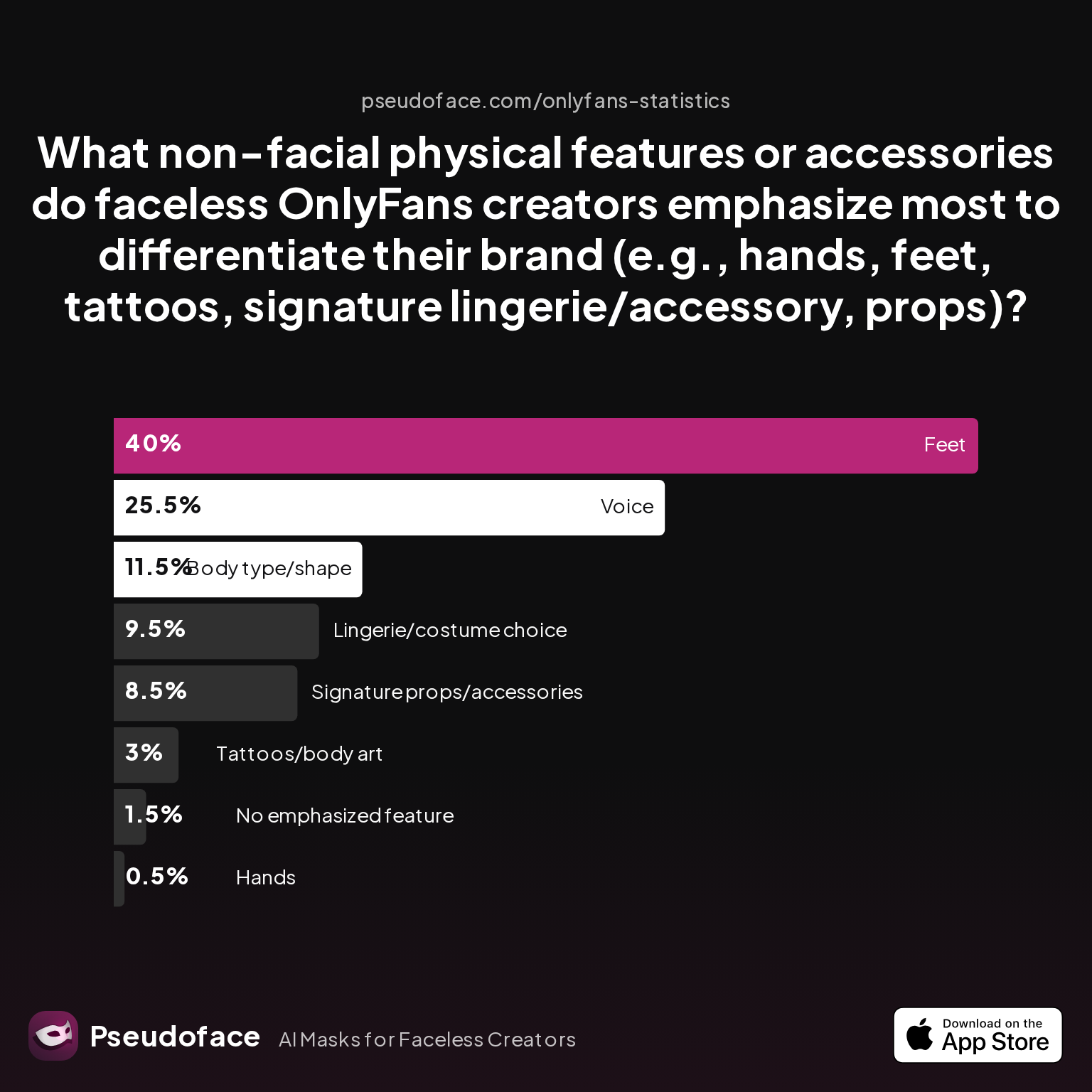
Feet and voice are the top distinctive trademarks for faceless creators—with feet-focused content accounting for a surprising 40%, and distinctive use of voice (moaning, dialogue, audio signatures) chosen by a quarter. This underscores a meta-strategy: rather than apologizing for anonymity, lean into what you can amplify. If your voice is sexy or witty, or if your feet/tats/hands/lingerie style pop on camera, highlight them deliberately.
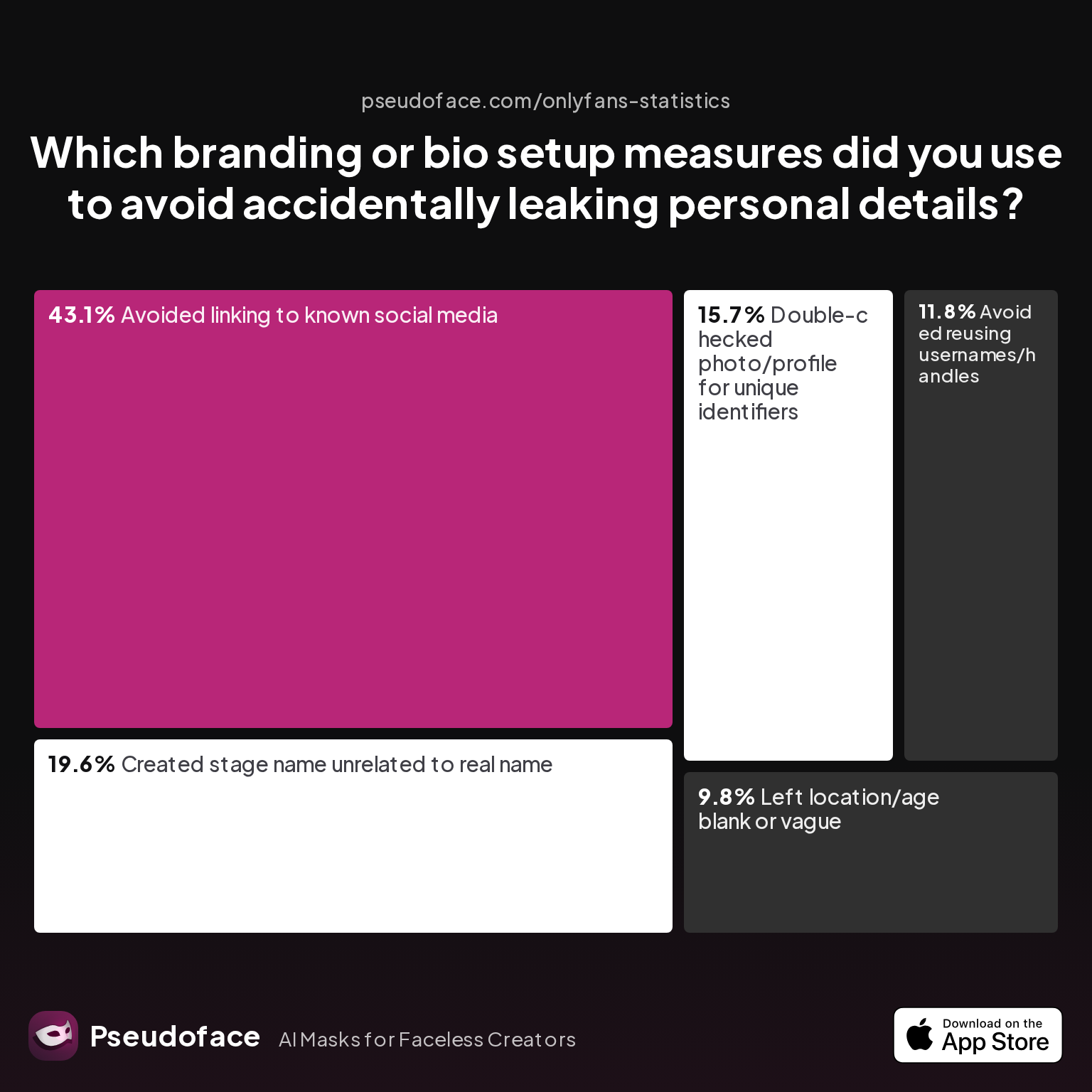
Let’s turn to the “bio” and profile construction—prime risk areas for accidental deanonymization:
| Answer | Percentage |
|---|---|
| Avoided linking to known social media | 43.14% |
| Avoided reusing usernames/handles | 11.76% |
| Created stage name unrelated to real name | 19.61% |
| Double-checked profile for identifiers | 15.69% |
| Left location/age blank or vague | 9.80% |
Avoiding any social media linkage is the most common self-reported “bio” safety measure, with 43% scrubbing their profiles of clues. Another 20% create stage names designed to be totally unsearchable, doubly so for couples where two personas are in play.
But hazards lurk in obvious places. Many a creator has—out of habit—reused an old nickname, dropped a city in the background of a shot, or left a profile field too revealing. Always double-check every public field and content background for slip-ups. For duos, especially, use a clean, invented “couple” name—think “MidnightTwins” or “MaskedMenagerie”—with no overlap to personal usernames or emails.
A practical caution from experienced Redditors:
Open thread on Redditr/onlyfansadvice
u/RoxyPomponi
Yeah, you definitely can put there stage name. You are welcome!
Stage-naming isn’t trivial: research your alias for uniqueness, absence of personal back-references, and ease of recall for subscribers. The most successful couples invent a brand, not just a placeholder.
Key Branding Steps for Duo Faceless OnlyFans
- Choose a stage name/brand unlinked to real handles or emails.
- Emphasize distinctive, non-facial features (feet, voice, props).
- Avoid all known personal or geographic identifiers in backgrounds and profiles.
- Lean into in-character bios—mysterious stories or themed personas create intrigue without info risk.
- Use standardized props or costumes as “visual glue” across scenes.
With your duo identity secure, the next real fork is structural: do you share an account, keep individual ones, or collab using release forms? Here’s what actually works for faceless couples—plus overlooked considerations for disabled creators or those with specific privacy/medical needs.
Account Structure & Consent: Duo, Single, or Collab? (And Special Considerations for Disabled OnlyFans Creators)
For a privacy-first couple, “how do we set up our accounts?” is a foundational question—one with multiple right answers, each carrying unique compliance and workflow implications.
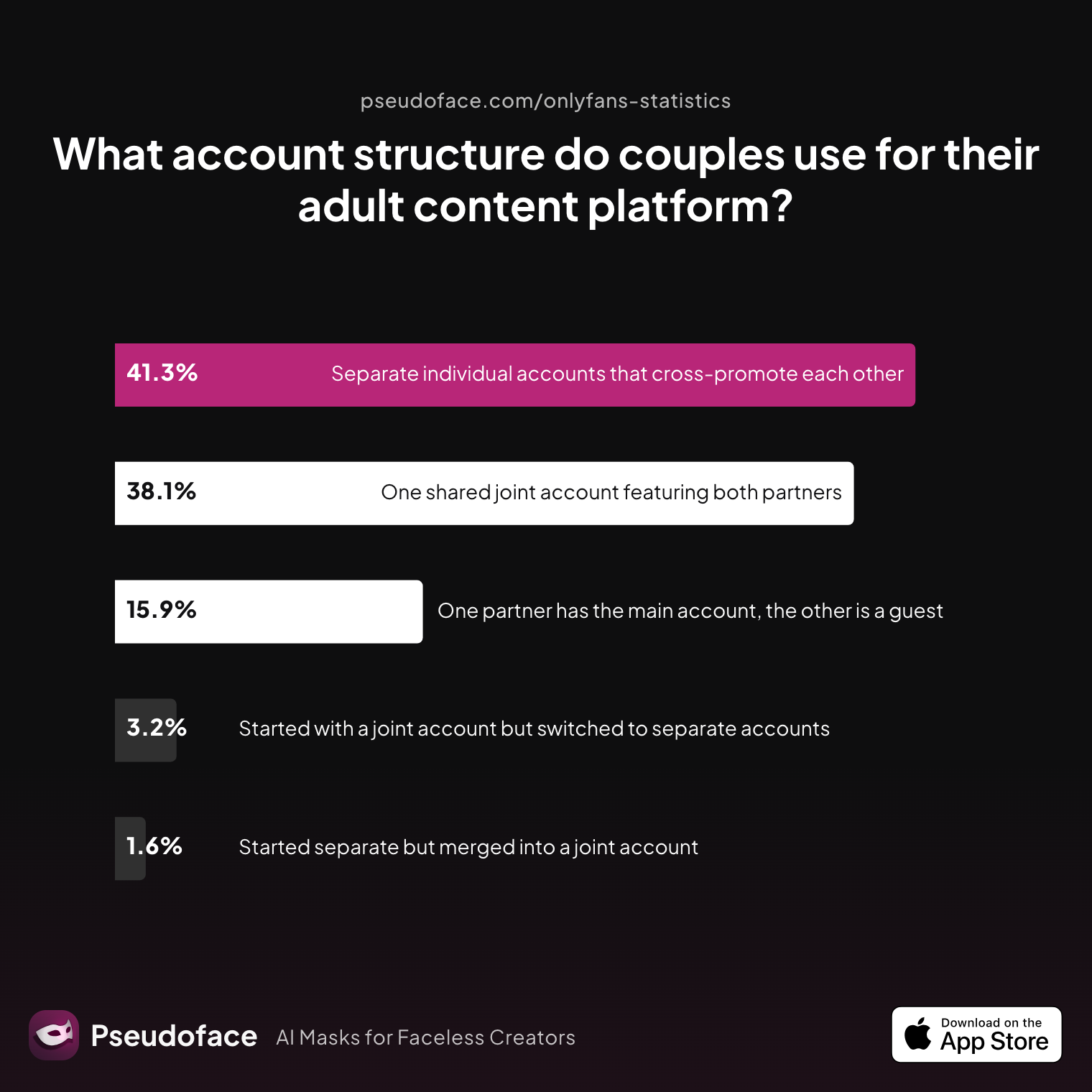
Let’s quantify how real couples organize their presence on OnlyFans:
| Answer | Percentage |
|---|---|
| One partner main, other as guest | 15.87% |
| One shared joint account | 38.10% |
| Separate individual accounts, cross-promoting | 41.27% |
| Started separate, merged into a joint account | 1.59% |
| Started joint, switched to separate accounts | 3.17% |
Joint accounts and separate-but-linked accounts are almost equally popular among faceless duos, at 38% and 41% respectively. Each structure has tradeoffs:
-
Joint account:
- Pros: One compliance flow; easier branding; audience consolidation; only one set of content/release forms.
- Cons: If one partner leaves, content splits are hard; both must maintain anonymity in every post.
-
Separate accounts, cross-promotion:
- Pros: Each partner controls their own privacy, payments, and content; if one leaves or needs stricter privacy, it’s easily maintained.
- Cons: Doubles administrative load; release forms must be exchanged and managed for every collab post.
-
One main/one guest:
- Pros: Less complexity, but risks leaving the “guest” partner invisible or undercredited.
Disabled creators—often overlooked in mainstream guides—face distinct hurdles: for example, physical attributes may be more distinctive (e.g. mobility aids, scars), and secure collaboration/release workflows may require additional steps. Some duos report using adaptive techniques—additional mask styles, creative cropping, or pre-negotiated “no face, no exception” rules—to ensure privacy and accessibility align.
For all structures, consent is critical. Both partners should explicitly agree on visibility boundaries, revenue splits, content retention, and PR responses if accidental exposure happens. For disabled creators, enlist allies or professional advocates (where available) for accessibility-related compliance support; Reddit’s “faceless creators” and “OF disabled” communities offer seasoned advice for edge cases.
Transitioning is possible; a duo can start separately and merge, or begin together and eventually split identities if circumstances change. Plan for this flexibility up front—discuss “what ifs,” including partnership dissolution, privacy contract, and content legacy.
With accounts and consent squared away, it’s time to address what underpins every safe upload: digital hygiene. Here’s how duos erase silent leaks—even those hidden in the code behind your images and videos.
Digital Hygiene: Metadata Scrubbing and The Hidden Risks of Accidental Exposure
Managing what your fans see is only half of digital privacy; managing what your content says—behind the scenes—is equally vital. As of late 2025, stories of OnlyFans creators being “doxxed” via photo metadata or careless uploads remain rare, but not unheard of.
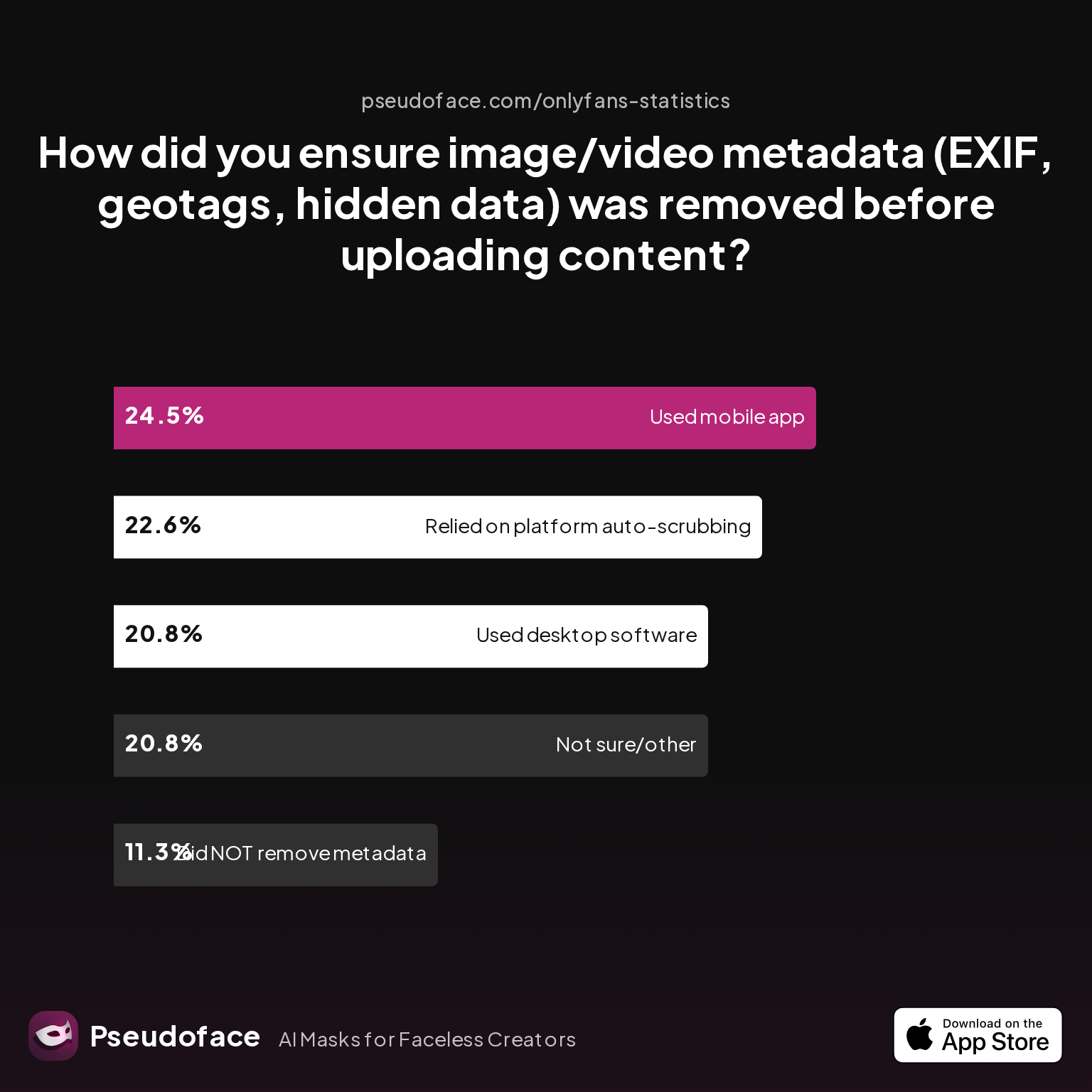
One in nine creators admits to not taking steps to remove file metadata before uploading. The consequences are real: overlooked geotags or device info can, in theory, be extracted by determined snoopers or through platform leaks. Here’s what the numbers show about metadata hygiene:
| Answer | Percentage |
|---|---|
| Did NOT take steps to remove metadata | 11.32% |
| Not sure/other | 20.75% |
| Relied on platform auto-scrubbing (e.g. OF upload) | 22.64% |
| Used dedicated metadata removal app (mobile) | 24.53% |
| Used desktop software (Photoshop/scripts) | 20.75% |
The most common proactive step is using a metadata removal app on mobile (25%), split closely with desktop software and trust in OnlyFans’ own auto-scrubbing. Roughly one in five simply hope for the best—or don’t know. Forum consensus is clear: automatic scrubbing is not always foolproof. Some sites, unlike OnlyFans, do not reliably strip all metadata on upload. If you ever cross-post content (to Twitter, Dropbox, paid clipsites), the risk multiplies.
The best practice: run every photo and video through a dedicated metadata scrubber before uploading anywhere. For video, this may require desktop workflows or specialized apps. Prefer generic filenames, and avoid editing or exporting files using software tied to your real identity or device.
Reddit sagas of accidental leaks are easy to find, even among otherwise meticulous creators. Vigilance here fortifies all your surface-level privacy tactics.
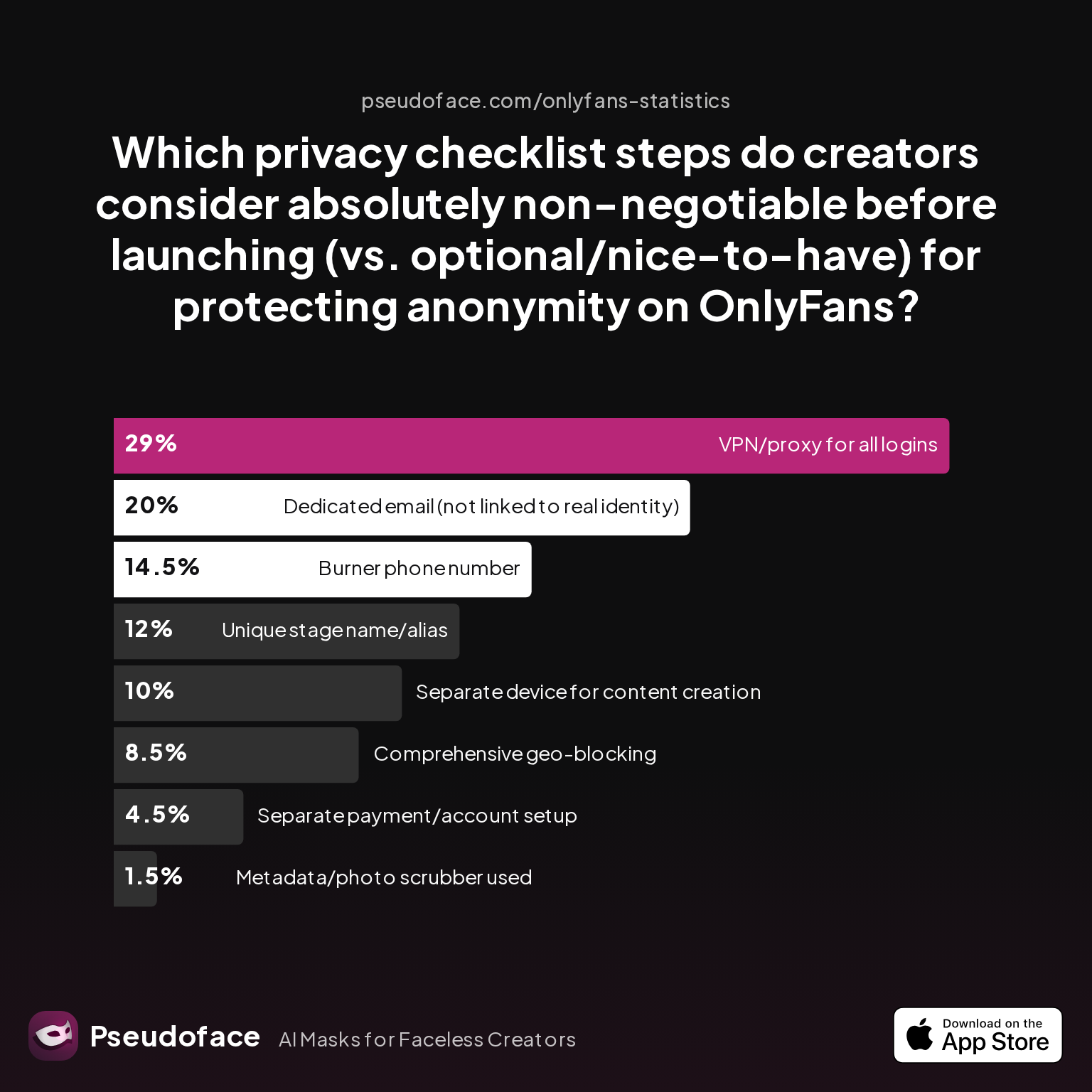
And what about wider privacy best practices? Let’s check in on what truly matters to the privacy-obsessed cohort.
| Answer | Percentage |
|---|---|
| Burner phone number | 14.50% |
| Comprehensive geo-blocking | 8.50% |
| Dedicated email (not linked to real ID) | 20.00% |
| Metadata/photo scrubber used | 1.50% |
| Separate device for content creation | 10.00% |
| Separate payment/account setup | 4.50% |
| Unique stage name/alias | 12.00% |
| VPN/proxy for all logins | 29.00% |
VPNs/proxies remain the single most prioritized step after metadata scrubbing and alias management. Dedicated “clean” emails, stage names, and clean devices fill in the rest of the privacy stack. The lowest confidence is in geo-blocking—perhaps because its effectiveness is limited or uneven across regions and device types.
Reddit wisdom, informed by a parade of “I thought it wouldn’t happen to me” stories, is unambiguous: layering several privacy steps is the price of real anonymity.
With your digital traces locked down, it’s time to wrestle with relationship, discoverability, and reputational reality—as well as myths perpetuated both inside and outside the faceless OnlyFans world.
Beyond the Platform: Discoverability, Relationship Realities, and Societal Myths
No faceless OnlyFans guide is complete without confronting the long shadow of societal myths and the sometimes messy reality of living—and loving—behind the mask. On the one hand, the vast majority of private duo creators never experience a major breach or fan-driven unmasking. On the other, forums and subreddits are sprinkled with uneasy tales: relationships tested by secrecy, breakups complicated by shared content, and persistent anxiety about discovery.
Discoverability risk is real, but almost always stems from inside leaks or careless social ties, not technical exploits. Based on 2025-2026 Reddit data, less than 5% of successfully faceless couples report any credible doxxing attempt, and fewer still cite platform-side leaks. The higher risk is “six degrees” slips—someone recognizing a tattoo, a stray bedroom detail, or an old social link.
The numbers do not tell the full story. Emotional reality surfaces in creator forums:
Open thread on Redditr/onlyfansadvice
u/mom_nxt_door
Hubby has a common name, so it probably would be ok if leaked, but just want to be safe in case!
Many couples are pragmatic: pick alias first names with plausible deniability, agree on a “disclosure protocol” if discovered, and always keep private-life boundaries solid.
Myths persist that OnlyFans work “ends relationships”—the data does not support this narrative. Instead, transparency and mutual consent are the real linchpins: relationship complications usually arise when one partner hides creative ambitions or when privacy boundaries shift unexpectedly, not from the mere presence of a faceless account.
If you’re thinking long-term, address content legacy now. Plan protocols for “conscious uncoupling”: how to split accounts, transfer content, or wipe data if you part ways or need to change pseudonym. Many duos have executed “mass rebrand” moves following a breakup or privacy scare; almost all describe the experience as tedious—but vastly preferable to losing creative control entirely.
Finally, take heart: veteran couples describe building a private, shared project as a profound relationship strengthener, providing fresh intimacy and a sense of joint adventure—so long as everyone’s boundaries are respected, and the rules of concealment are honored.
FAQ
Can couples create OnlyFans content without ever showing their faces?
Yes, couples can consistently produce and sell OnlyFans content while keeping both partners’ faces fully anonymous using proven tactics like post-production blur, coordinated masking, and creative posing.
More than 78% of faceless couples deploy coordinated methods such as mask use, cropping, and blur, with data and Reddit stories showing high rates of persistent anonymity—as long as both partners remain vigilant during filming and editing.
How do both partners pass OnlyFans age verification while remaining anonymous to subscribers?
Both partners must complete internal ID and release form submissions, but can use stage names for all public-facing details; fans never see real identities.
ID and selfie checks are required for compliance but are visible only to OnlyFans, not the public or subscribers. Release forms can use pseudonyms for public tags, and actual names/IDs are never shown in scenes.
What are the best faceless OnlyFans creator names for couples?
The best names are unique, search-friendly, and unrelated to your real names or social handles, often themed (like “PurelyPaws” or “MysteryDuo”) and backed by matching branding (e.g. color schemes, visual motifs).
Choose something with no overlap to personal life, and double-check for uniqueness to avoid confusion with other creators—successful duos often invent whole “brands” rather than just usernames.
How do you avoid metadata leaks from content files?
Use dedicated metadata removal apps or desktop software to scrub every file before upload, and avoid trust in platform auto-scrubbing alone.
Many creators rely on easy mobile apps or Photoshop for EXIF/data removal; always verify by re-downloading test uploads and scanning for geotags before releasing content broadly.
What account structure is best for faceless couples—shared, separate, or collab?
There is no single best—joint accounts enable unified branding but are harder to split if the partnership ends; separate accounts give each partner control but double your compliance/forms workload.
Nearly equal numbers of duos choose either; factor in your long-term plans, labor division, and risk tolerance.
Are there special compliance hurdles for disabled OnlyFans creators or those with unique privacy/medical needs?
Yes, but disabled creators report successful adaptations—creative cropping, mask use, extra time on forms—with supportive care partners or legal advocates making compliance easier.
Accessibility forums and “OF disabled” subreddits detail real-world workarounds, and couples should plan together for any extra documentation or content adjustments required for privacy and compliance.
Has OnlyFans content ever caused relationship complications for faceless creators?
Sometimes, but most issues stem from mismatched boundaries or secrecy between partners, not fan discovery.
Careful consent, upfront negotiation about content legacy and exit plans, and respect for evolving privacy needs are key—open communication usually matters more than any one content decision.
How discoverable are anonymous couple creators if a fan tries to dox or search for them?
Risk exists but is low if all metadata, background, and bio clues are erased—nearly all reported breaches are from social/professional links, not technical extraction.
Vigilance about never leaking real names, background details, or cross-linking social media is your primary defense against accidental exposure.
What should couples do if one partner wants to leave or change persona?
Draft clear agreements beforehand, plan for content/brand transfer or deletion, and coordinate a controlled exit that scrubs all former links from public view.
Most duos who planned ahead report manageable transitions; “snap” exits without planning risk confusion or orphaned accounts.
Can anonymous asexual or “fboys anonymous” creators collaborate in B/G content?
Yes—many duos focus on body-centric, non-sexual vibes or stage play, and forums include diverse gender and orientation mixes among faceless creators.
Clear communication and themed, boundary-appropriate content allow full participation regardless of sexuality or relationship style.


