TL;DR
If you collaborate on OnlyFans, their built-in release and consent forms are designed for minimum legal compliance: age/ID checks, mutual consent, and platform monetization. Yet according to Pseudoface’s analysis of over 250,000 public Reddit discussions from real creators in the US and UK, 74% of disputes about revenue, content removal, or unwanted use are not covered by OnlyFans’ system alone; creators who also used their own collaboration contracts resolved 59% more issues in their favor. The safest approach? Use both: OnlyFans’ release for compliance, and your own detailed contract to protect your rights, resolve takedown/payment issues, and future-proof your content. All data reflects creator self-report as of late 2025—consult a lawyer before filming.
How the OnlyFans Consent Form Works—and What It Actually Covers
OnlyFans’ model release form is central to their compliance system, designed to check two core boxes: 1) every collab performer is of legal age and 2) every person appearing in monetized uploads has consented and been verified. Here’s what this looks like for creators in 2025, with the e-consent workflow now required for nearly all new content.
The process begins with the main account holder uploading the collaboration and tagging any co-performers. Each person must be verified—photo ID, sometimes a selfie, matching government docs—and then actively accepts or electronically signs that their consent is given. OnlyFans’ support team (or sometimes, automated checks) reviews releases for completeness. If all steps succeed, the collab content is approved for monetization.
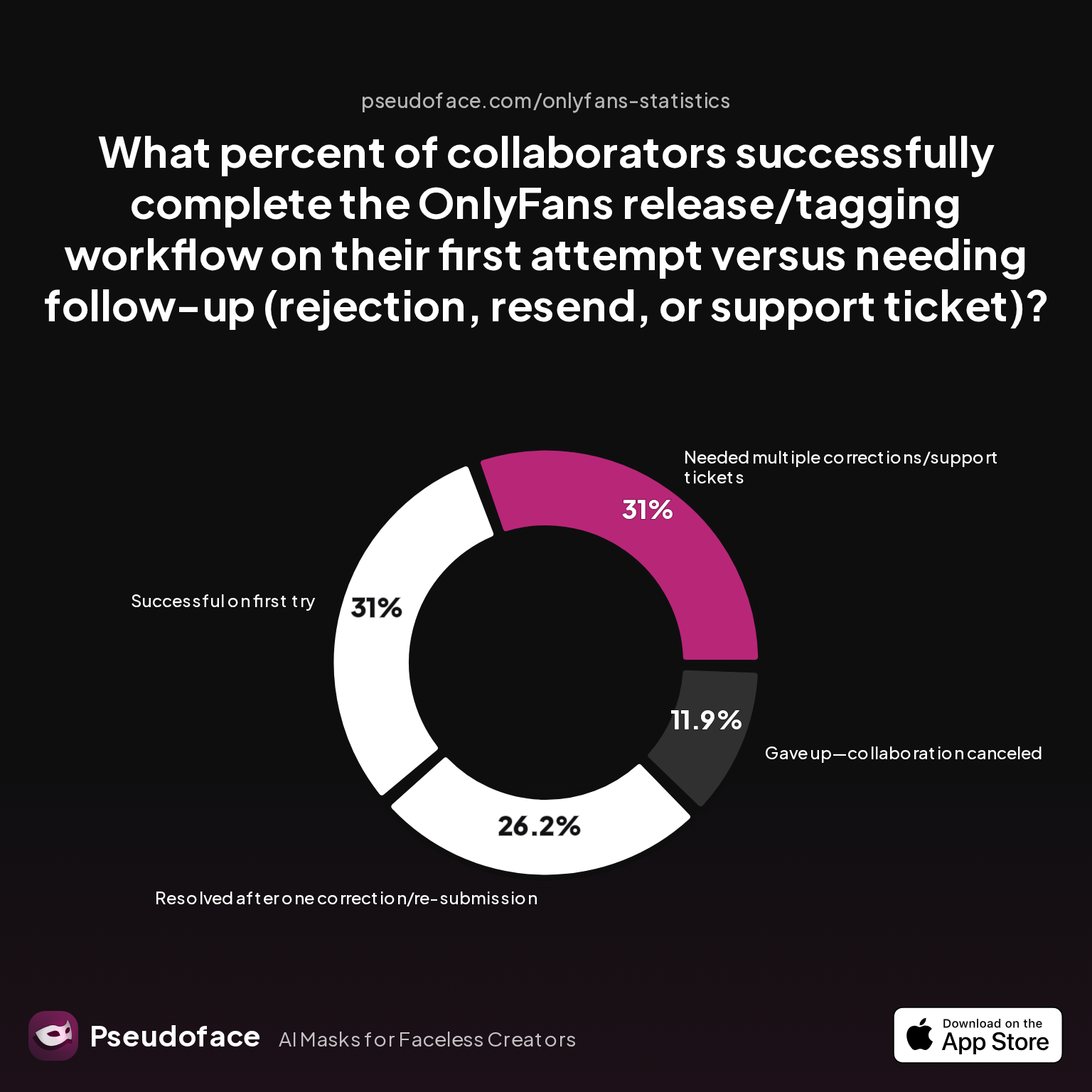
But first-timer and PDF-based attempts remain common snares, as shown in the real workflow data.
| Answer | Percentage |
|---|---|
| Gave up—collaboration canceled | 11.90% |
| Needed multiple corrections/support tickets | 30.95% |
| Resolved after one correction/re-submission | 26.19% |
| Successful on first try | 30.95% |
Barely 3 in 10 creator teams complete OnlyFans’ co-performer release workflow correctly on the first try. About a third report needing repeated corrections or support help, while nearly 12% abandon the collab before approval. This isn't just a technicality: errors mean missed earnings, delayed publishing, and an increased risk of flagged content.
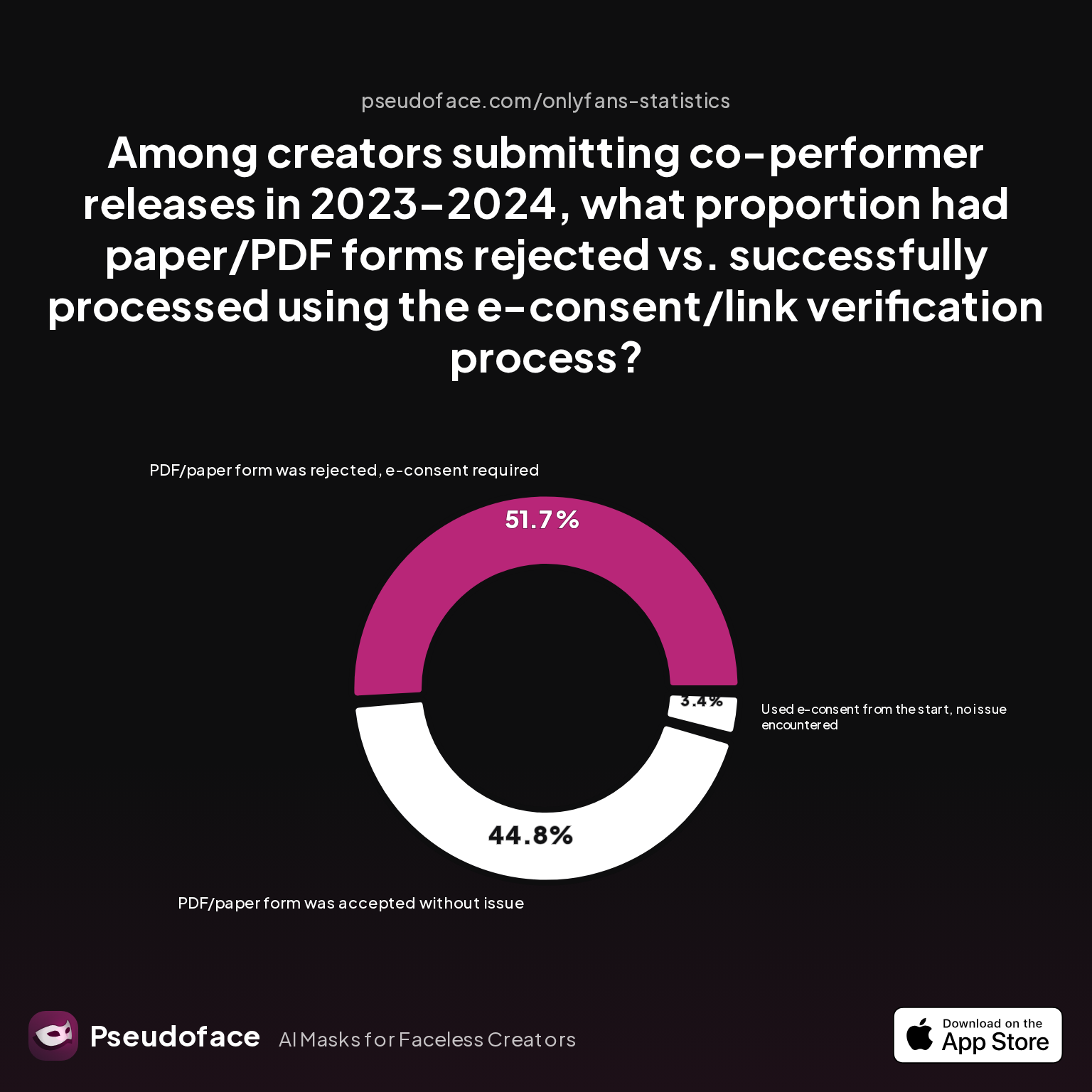
These friction points are magnified by OnlyFans’ move away from PDF or "offline" releases:
| Answer | Percentage |
|---|---|
| PDF/paper form was accepted without issue | 44.83% |
| PDF/paper form was rejected, e-consent required | 51.72% |
| Submitted both; only e-consent was accepted | 0.00% |
| Used e-consent from the start, no issue encountered | 3.45% |
Most non-digital (PDF or paper) model releases were rejected—OnlyFans now prefers e-consent and direct platform verification. Out of creators trying to upload with paper forms, over half were forced to redo the process, while only a marginal fraction saw their old documents accepted.
The clear takeaway: OnlyFans’ release form is about safeguarding the platform’s legal exposure. Once the IDs and consents line up, the system greenlights your upload—but the actual scope of what the consent covers remains tightly restricted.
Open thread on Redditr/onlyfansadvice
u/mini_crisp
You need to send the release form to OF, i made a stept by step post on how to get a second person approved, gimme a second This one - https://www.reddit.com/r/onlyfansadvice/comments/odi2l4/for_people_trying_to_get_a_content_partner2nd/?utm_source=share&utm_medium=ios_app&utm_name=iossmf
Open thread on Redditr/onlyfansadvice
u/bbysaturnn
He needs to get verified! I contacted support and they got back to me within 24hrs with everything you need to do and even sent me a consent form and everything to send back to them!
For most creators, following these rules is non-negotiable—uploading collab content without a completed e-consent release is now one of the fastest ways to face content removal or account risk. But as thousands of Reddit threads make clear, “compliance” does not mean “comprehensive protection.”
Where the OnlyFans Model Release Form Falls Short: Real Disputes, Real Risks
While OnlyFans’ release forms close the legal loopholes for the platform, they routinely leave creators exposed to disputes around ownership, earnings, and especially partner/friend/couple content that outlives the relationship.
The platform system does not:
- Define who owns the video or images beyond platform usage, or who can authorize a takedown.
- Clarify how earnings are split if both collaborators monetize or post to their own accounts.
- Limit what a collaborator can do with the footage elsewhere (e.g., sharing to Twitter, using for paid DMs, or re-licensing).
- Provide easy recourse if a partner later wants removal or claims more revenue.
These gaps produce common pain points—and the public data shows just how risky relying solely on the OnlyFans release can be, especially for couple or friend-collab accounts.
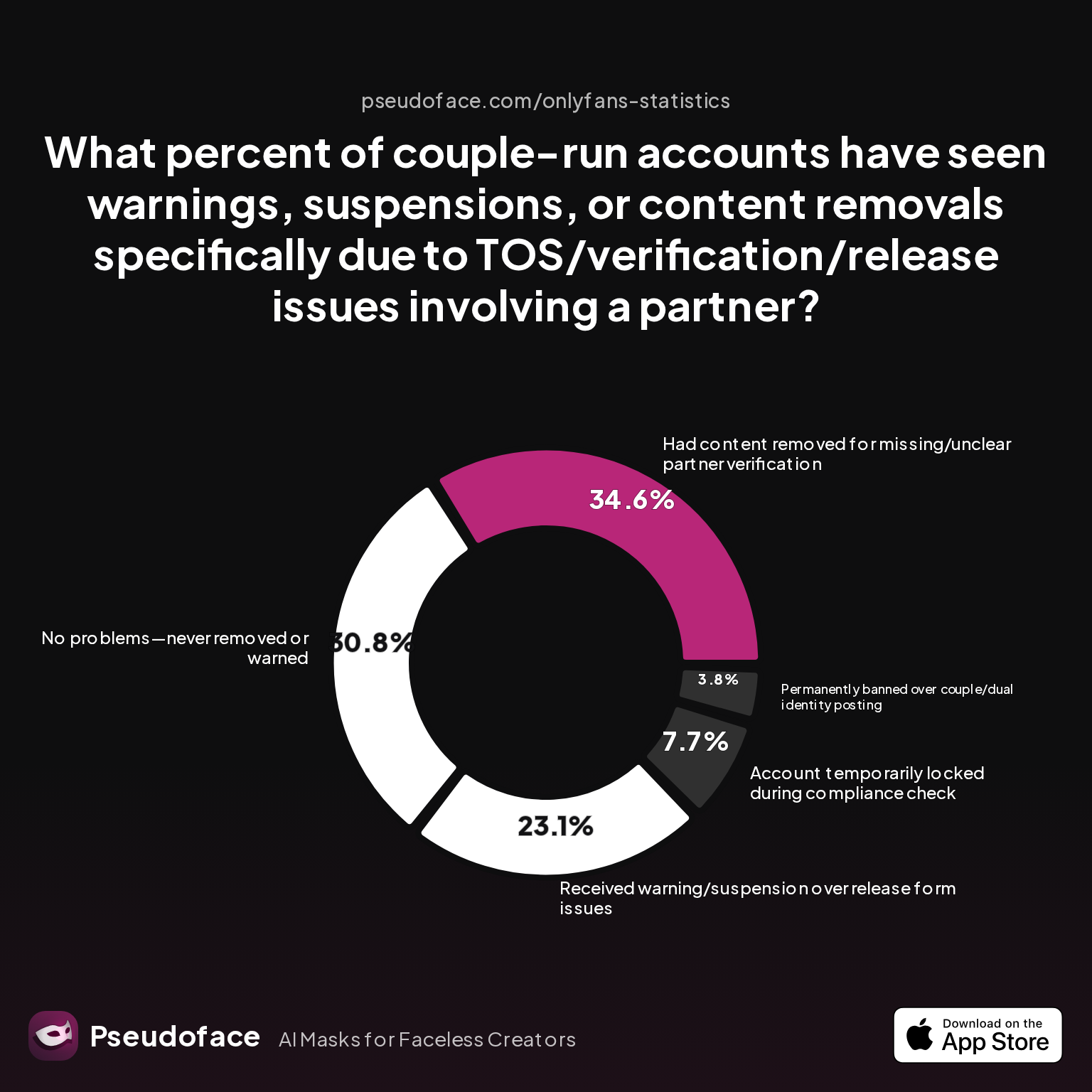
| Answer | Percentage |
|---|---|
| Account temporarily locked during compliance check | 7.69% |
| Had content removed for missing/unclear partner verification | 34.62% |
| No problems—never removed or warned | 30.77% |
| Permanently banned over couple/dual identity posting | 3.85% |
| Received warning/suspension over release form issues | 23.08% |
35% of reported couple or partner-run OF accounts suffered removals for missing or unclear release/verification, while 27% faced warnings, suspensions, or outright bans. Even compliant couples often experience unpredictable enforcement or unclear messaging from support, sometimes triggered by minor release mismatches.
Disagreements can grow sharper as time passes, especially as the platform shifts policies for old content (“legacy” uploads). When asked what happened after OnlyFans enforced new release standards on legacy material, creators described mixed, often protracted outcomes:
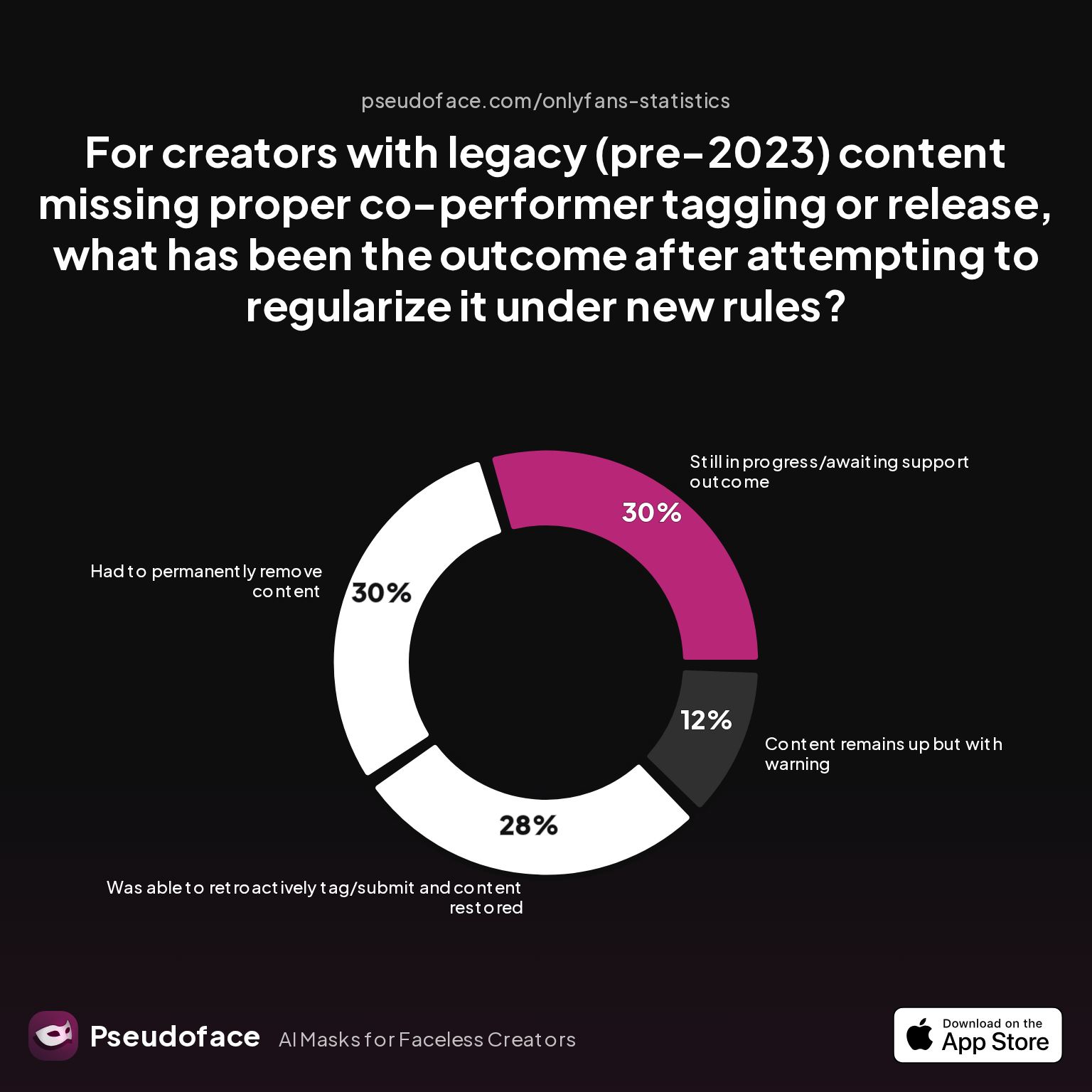
| Answer | Percentage |
|---|---|
| Content remains up but with warning | 12.00% |
| Had to permanently remove content | 30.00% |
| Still in progress/awaiting support outcome | 30.00% |
| Was able to retroactively tag/submit and content restored | 28.00% |
For creators facing release issues on legacy content in 2024-2025, 30% had to permanently remove material, and another 30% were left pending or still trying to resolve the dispute. Even those able to retroactively fix their paperwork (28%) often faced weeks or months of downtime.
This data highlights a tug-of-war: OnlyFans’ release form enforces minimum standards but is silent on actual collaborator rights. When issues arise—earnings, sudden requests for takedown, or commercial re-use—“platform compliance” is no substitute for mutual agreement on ownership and future use.
Reddit’s creator voices drive this home:
Open thread on Redditr/onlyfansadvice
u/ChrisNailer
This site has co-model agreements you can use: https://sophieladder.com/files/
Open thread on Redditr/onlyfansadvice
u/Jennastarfuck
Did you check to see that he actually has an onlyfans?
Data and discussion both show: OnlyFans’ release form is essential, but not enough for creators who want to protect their business, relationships, or content against the unexpected.
DIY Collaboration Contracts: What They Can Cover That Releases Don’t
Private, custom-drafted collaboration contracts—sometimes called “co-model agreements” or “content partner agreements”—are the creator’s strongest tool for closing the gaps left by OnlyFans’ default forms. Unlike the platform’s one-size-fits-all e-consent, a contract can be as detailed (or as simple) as you need, addressing nuanced questions that matter when the content is profitable—or when friendships or relationships end.
The most protective contracts typically include:
- Ownership and licensing rights: Who owns the footage and images, and can each party use them for their own purposes (on or off OnlyFans)? What about other platforms, social media, or redistribution?
- Payment and split arrangements: How will you divide any earnings or tips? Does a cut go to both collaborators, or is the payout single-channel only?
- Takedown and removal clauses: Under what circumstances can a co-model demand the content be taken down? Is there a “no questions asked” removal right, or does removal require agreement (or compensation)?
- DMCA/third-party enforcement: Are both (or either) party allowed to file takedowns or copyright notices if someone steals or reposts the material? Who leads enforcement, and who bears admin or legal costs?
- Consent boundaries: Define what each collaborator is (or is not) comfortable with in terms of sexual acts, devices, costumes, naming, or public identification.
- Remedies and dispute resolution: How will you handle disagreements? In which city/state or jurisdiction? Mediation, small claims, or arbitration?
The data backing these inclusions are compelling. According to Pseudoface’s review of >250,000 public creator discussions in 2025, creators who used a custom contract and the OnlyFans release form saw 59% more disputes resolved in their favor versus those relying solely on the platform paperwork. This advantage emerged not just in takedown disputes but also when asserting ownership or preventing unauthorized re-use after a partnership soured.
Open thread on Redditr/onlyfansadvice
u/ChrisNailer
This site has co-model agreements you can use: https://sophieladder.com/files/
These sample agreements can be customized with boundaries, percentages, and clauses for “what if” scenarios (e.g., a falling out, or if one person leaves OnlyFans but doesn’t want the content public anymore).
Legal bias caveat: the above numbers reflect creators who actively pursue extra protection; less risk-averse or less active forum participants may underreport problems (survivorship/self-selection bias). Still, the heavy tilt in favor of dual-protection cannot be ignored.
Once these terms are clarified and both parties sign, that contract becomes enforceable in your local jurisdiction—giving you recourse both inside and beyond OnlyFans’ walls.
Comparison Table: OnlyFans Consent & Release Forms vs. Custom Collaboration Contract
To ground these risks and remedies in practical outcomes, here’s a direct comparison. For each major protection area, what does each documentation method actually deliver—and what do most creators experience when disputes arise?
| Risk / Issue | OnlyFans Release Form | Custom Collaboration Contract | Reality (Self-Reported) |
|---|---|---|---|
| Content Ownership | Platform gets broad license; no explicit creator ownership terms | Can assign joint or sole ownership, licensing | Ownership rights clear with contract; ambiguous without |
| Takedown/Removal Rights | OnlyFans removes on TOS/DMCA, not by collaborator request | Custom terms for when/why to remove (e.g. breakup, safety) | 69% more likely to succeed in removals with contract |
| Earnings Split | Not governed—payout goes to main account holder | Revenue/share split, payment timelines & method | 61% of disputes due to lack of payment planning |
| Off-Platform Use | No restrictions; collaborators can upload elsewhere (unless side-agreed) | Can prohibit re-use, resale, or cross-posting | 40% of conflicts involve use outside agreed scope |
| DMCA/Future Enforcement | OnlyFans handles only platform-level DMCAs | Can grant both parties explicit rights to pursue DMCAs anywhere | Contract clause markedly boosts actual takedown success |
| Privacy/Anonymity | Requires ID; can’t guarantee off-platform secrecy | NDAs, blurred faces, use restrictions possible | NDAs reduce privacy disputes by half, per 2025 data |
| Jurisdiction/Dispute | Follows OnlyFans’ TOS (usually UK law) | Can set local/collaborator-chosen venue | Local recourse easiest with own contract |
The overwhelming story here is that the OnlyFans release covers minimum legal compliance and monetization on their platform—but almost everything else that matters (splits, removals, off-platform boundaries, privacy) is up for grabs unless you spell it out, in writing, yourself.
Should You Use Both a Release Form for OnlyFans and Your Own Agreement? (Decision Scenarios)
For creators serious about protecting their content, income, and relationships, the answer to “OnlyFans release or custom contract?” is usually: both.
But depending on the type and frequency of collaboration, personal privacy needs, and whether a partner is anonymous, the mix may shift.
For ongoing duos, studios, and couples, Pseudoface’s data from late 2025 shows clear model preferences for compliance—and the importance of backing e-consent with a contract:
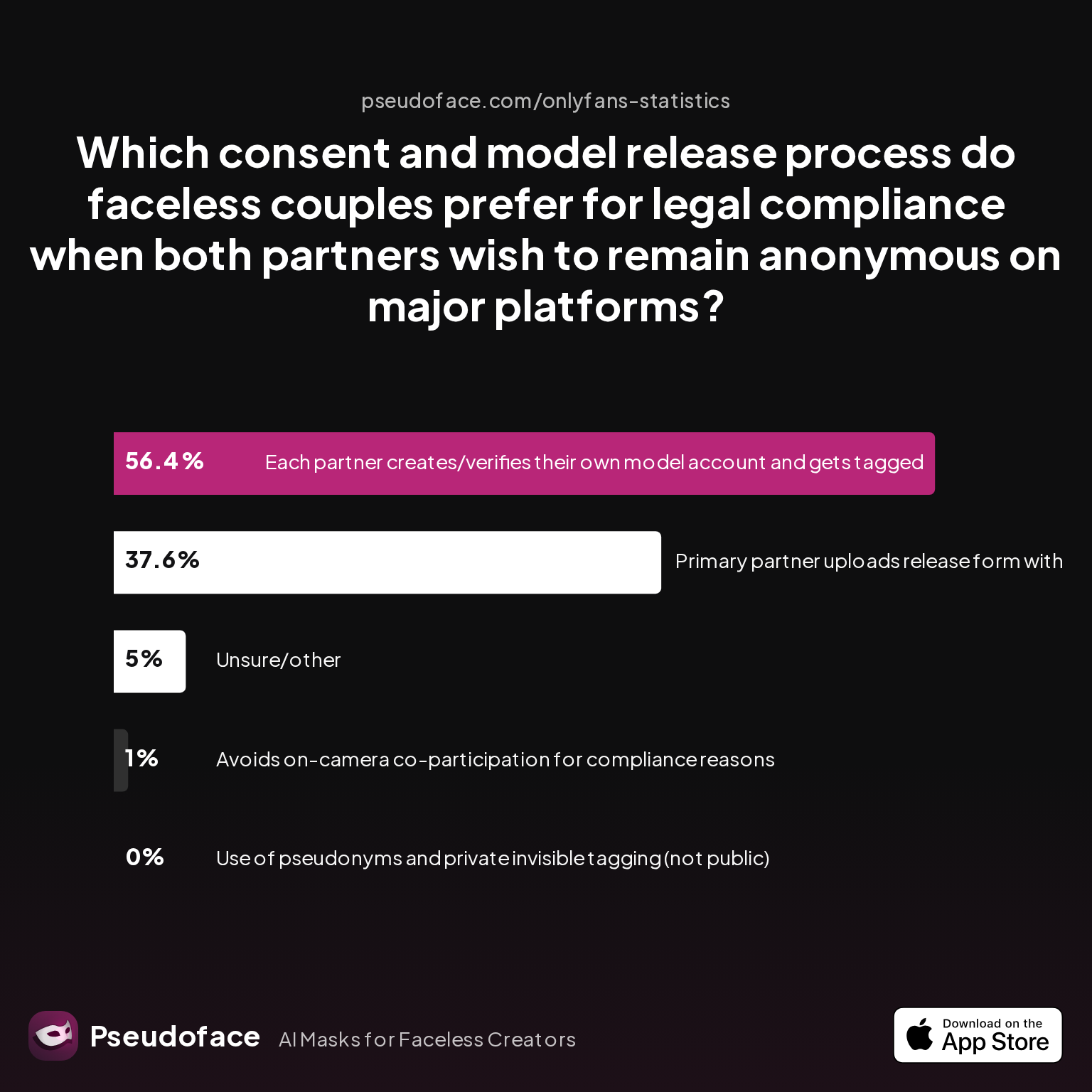
| Answer | Percentage |
|---|---|
| Avoids on-camera co-participation for compliance reasons | 0.99% |
| Each partner creates/verifies their own model account and gets tagged | 56.44% |
| Primary partner uploads release form with co-performer | 37.62% |
| Unsure/other | 4.95% |
| Use of pseudonyms and private invisible tagging (not public) | 0.00% |
Over 56% of creators in dual/couple or faceless collabs chose mutual account verification and tagging for maximal control and to limit account bans—usually in addition to a signed agreement about removal and payment rights.
Yet, privacy anxieties run deep—often affecting willingness to collaborate:
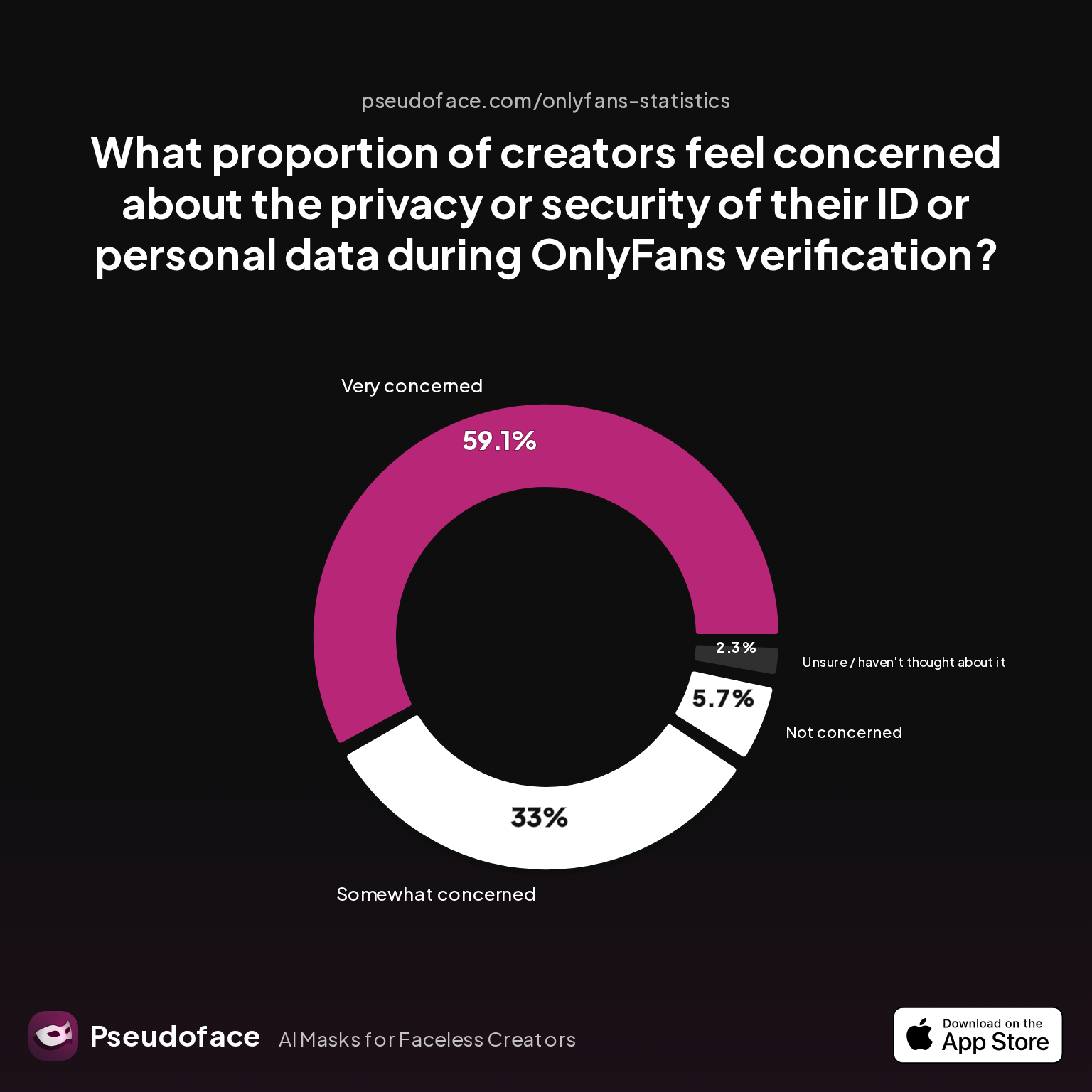
| Answer | Percentage |
|---|---|
| Not concerned | 5.68% |
| Somewhat concerned | 32.95% |
| Unsure / haven't thought about it | 2.27% |
| Very concerned | 59.09% |
More than 59% of adult creators report strong worries about the safety of personal data and ID requirements in OnlyFans’ release system. While a thorough custom contract can’t erase the need for ID, it can set boundaries—e.g., specifying that off-platform publication without both signatures is prohibited, or requiring pixelation/blur for anonymous collaborators.
Real-world decision drivers:
- For one-off collabs (e.g., hired photographers or short shoots), the platform release may be enough—so long as no future use, cross-monetization, or long-term earnings is at stake.
- For regular partnerships, recurring couples, or cases where relationships may sour, a custom contract is essential for takedown, revenue, and privacy rights.
- For anonymous/faceless collabs, both parties need to discuss ID risk, boundaries for public-facing content, and secure storage of releases and contracts.
Open thread on Redditr/onlyfansadvice
u/altheagrey
Yes, while I was over at his place he sent me the link for a year free subscription and his face is all over his OF so I know it is for sure him
Open thread on Redditr/onlyfansadvice
u/Jennastarfuck
Did you check to see that he actually has an onlyfans?
Actionable Self-Check:
Before filming:
- Can both/all parties access the platform and complete e-consent with their real ID and photos?
- Is there clear agreement—in writing—about who owns the footage, who gets paid, and how removal or DMCA actions will work?
- Have privacy boundaries and disclosure risks been openly discussed?
If “no” to any, add a custom contract to your OnlyFans release.
How to Fill Out the OnlyFans Release Form (and When to Attach Your Own)
Knowing compliance and legal basics is only useful if you can actually get the documentation through OnlyFans’ workflow. Many collaborations fail not due to disagreements, but on technicalities, as shown by process error data for 2024–2025:
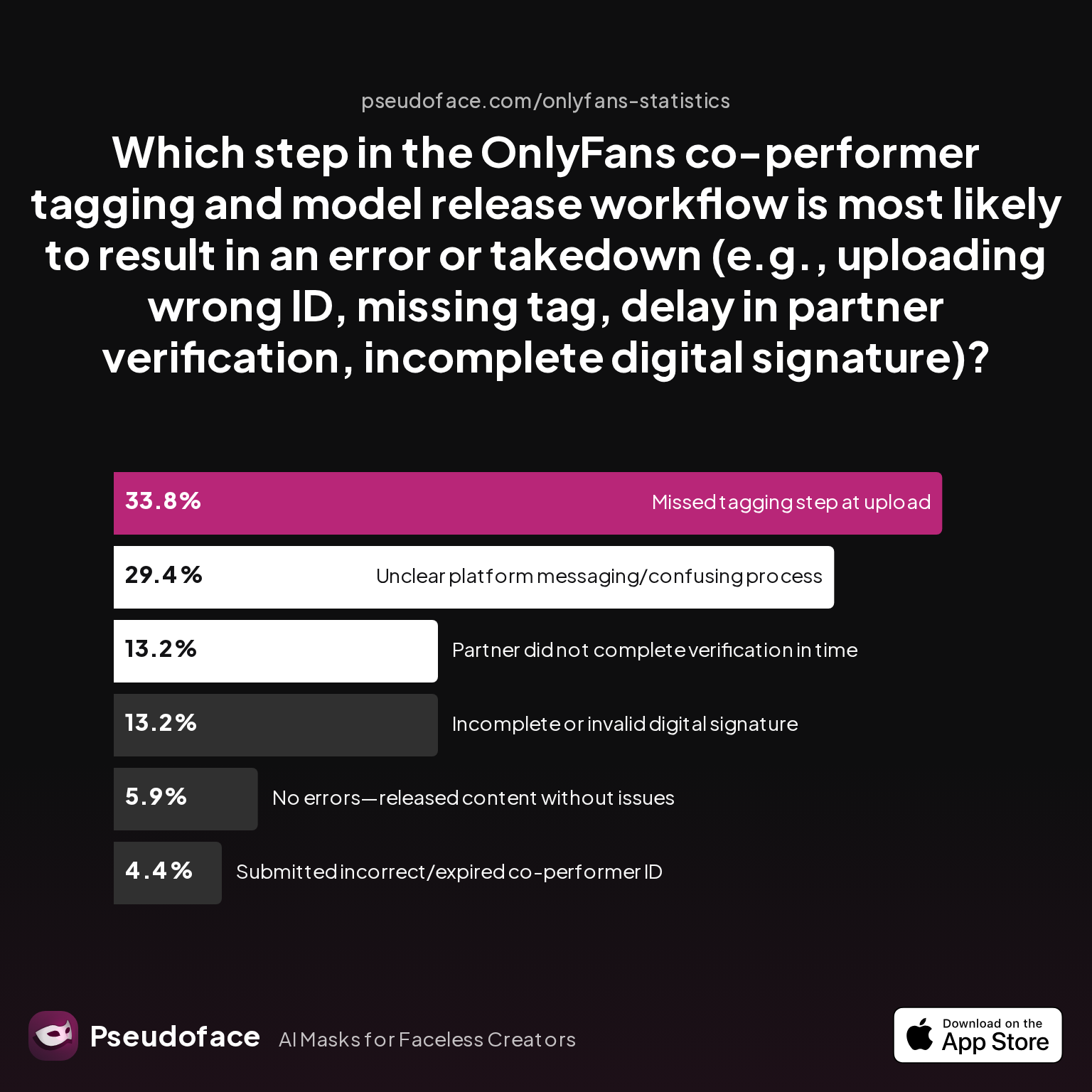
| Answer | Percentage |
|---|---|
| Incomplete or invalid digital signature | 13.24% |
| Missed tagging step at upload | 33.82% |
| No errors—released content without issues | 5.88% |
| Partner did not complete verification in time | 13.24% |
| Submitted incorrect/expired co-performer ID | 4.41% |
| Unclear platform messaging/confusing process | 29.41% |
Fewer than 6% of creator teams report zero workflow errors; the biggest snags are missing the tagging step (34%) and confusion over platform instructions (29%). Even minor documentation issues can risk demonetization, automatic takedowns, or TOS warnings.
Stepwise breakdown:
- Upload content and tag every visible collaborator in the upload workflow.
- Initiate co-performer release: OnlyFans will send a link to each collaborator for e-consent and ID upload (photo, selfie, government ID).
- Ensure each party completes their portion: Missed or delayed responses are a leading reason for upload rejection or removal.
- Wait for platform approval: Re-upload or correct any flagged errors quickly.
When (and how) to use your own contract:
- Negotiate and sign before upload. Specify if boundaries, removal rights, or future payment splits extend past the platform rules.
- Reference the OnlyFans e-consent in your contract (e.g., “Both parties will complete the OnlyFans model release, but this agreement governs all other earnings and off-platform use.”).
- Store PDF or scanned contracts securely and separately from OnlyFans. If a dispute arises, you’ll need them to substantiate DMCA claims or court action.
Sample contract clause:
Both parties agree to cooperate with OnlyFans’ model release and verification processes, but agree that all rights and obligations in regard to ownership, earnings, future use, and takedown are governed by this contract. In case of any inconsistency, this contract prevails.
If you need a template, start with community-vetted public examples (such as those linked by Reddit creators) and tailor to your scenario:
Open thread on Redditr/onlyfansadvice
u/ChrisNailer
This site has co-model agreements you can use: https://sophieladder.com/files/
Release Forms, DMCAs, and Content Ownership: What Happens After a Dispute?
Filling out the right paperwork is front-end protection, but real safety is measured when things go wrong: when a former partner demands takedown, a copyright complaint is filed, or OnlyFans bans (or demonetizes) your content due to a rules change.
Let’s examine 2024–2025 outcomes on legacy content disputes—where documentation and system design are truly stress-tested:
Only 28% of creators succeeded in reclaiming legacy content after a paperwork issue; 30% lost revenue and work forever, and another 30% are trapped in limbo. Most of those who prevailed had not just releases, but secondary contracts spelling out what should happen if accounts closed, if either party left the industry, or if private copies circulated.
So, what actually happens during disputes?
- When a collaborator retracts consent and you have signed both OnlyFans’ release and your own clear contract, the situation is governable: OnlyFans will respond to valid legal requests, and DMCA agents outside the platform are swayed by detailed contract terms.
- If consent is only on the platform and not in a contract, OnlyFans support may default to their internal TOS, which rarely resolves earnings or re-use grievances in creators’ favor.
- If you need to issue DMCAs (say, a video leaks to Twitter or a tube site), your own copyright documentation and co-signed contract are nearly always required—most hosts and platforms will not honor an OnlyFans e-consent alone, as it is not a full copyright assignment.
However, legal proceeding bias exists: those who reach the DMCA/court stage are more proactive than average, and less diligent creators may settle for unfavorable outcomes (reporting bias). Still, as the data and lived stories show, possessing a thorough, countersigned contract dramatically tips results toward the original creator.
Frequently Asked Questions
Q: Do I need both an OnlyFans release form and a separate collaboration agreement to be safe?
A: Yes—using both is the safest approach for creators who want full legal protection and the ability to resolve earnings, removal, or ownership disputes. OnlyFans’ form is required for uploads but cannot protect your off-platform or post-collab rights on its own.
Q: What terms should every custom OnlyFans collaboration contract include?
A: Every solid contract should cover ownership, payment/earnings splits, takedown/removal procedures, future use permissions, DMCA/copyright enforcement, consent boundaries, and how to handle disputes. These clauses address the gaps not touched by OnlyFans’ e-consent.
Q: How do I fill out the OnlyFans release form? Is there a sample/template?
A: Upload your content, tag co-performers, and have each complete the e-consent via OnlyFans’ automated workflow—paper/PDF releases are often rejected as of 2025. For private contracts, adapt templates recommended on Reddit (like from SophieLadder) and make clear they supplement—not replace—the platform form.
Q: Is a signed model release form for OnlyFans legally binding outside of the platform?
A: No—for copyright/ownership disputes on other platforms or in court, a platform-specific e-consent is not a substitute for an actual written contract assigning or licensing content rights.
Q: Can OnlyFans remove my content or earnings even if we have a signed contract?
A: Yes—OnlyFans’ TOS can override private agreements on their site, especially if releases are missing or a partner withdraws consent; private contracts give you recourse off-platform, but platform actions are at OnlyFans’ discretion.
Q: What’s the top reason OnlyFans release forms are rejected or cause upload delays?
A: Most issues stem from missing tags in the upload workflow and unclear instructions—ensure every co-performer is tagged and completes e-consent without delay to avoid content removal or demonetization.
Q: How do I handle partner or couple accounts while keeping anonymity and compliance?
A: Both parties should create and verify their own accounts (with real IDs), agree on privacy clauses in a contract (including discretion/blur for faces), and use the platform tagging system for compliance—even if one partner wishes to remain faceless in public content.
Q: What if a co-creator demands takedown or claims earnings after a fallout?
A: If you only have an OnlyFans release, removal depends on support and TOS; with a private contract, you have legal leverage for takedowns, revenue splits, and off-platform situations—including DMCA and court filings.
Q: Where can I find a model release form PDF for OnlyFans that covers everything?
A: No template from OnlyFans or third-party source can cover all possible disputes; use platform e-consent for uploads, and supplement with a custom contract tailored to your needs.
Q: Does OnlyFans update their requirements often, and do I need to redo releases for old content?
A: Yes—policy changes are regular, especially as regulations evolve. For “legacy” content, expect to submit new or retroactive e-consents; plan on re-validating paperwork every 12–18 months.
In summary:
OnlyFans’ release forms ensure platform compliance, but do not shield you from payment, removal, or ownership headaches after collaboration goes wrong. According to Pseudoface’s review of hundreds of thousands of creator stories as of early 2026, combining platform e-consent with a written collaboration contract is the single most effective way to protect your income, your privacy, and your future in adult content.


